Disclosure: airfryerkitchensupply.com is reader-supported. When you buy through links on our site, we may earn an affiliate commission at no extra cost to you.
Where to buy
The fastest way to buy the best quality faucets picks in this guide is through Amazon, where each verified model below is sold with its full finish and configuration options on one listing page. Start with the shortlist:
- KOHLER Simplice Response K-22036-VS Touchless Kitchen Faucet — Best Touchless Quality. Check the current price on Amazon before you decide, because finish choices change the total.
- Moen Brantford 7185SRS Pulldown Kitchen Faucet — Best Traditional Quality. Check the current price on Amazon before you decide, because finish choices change the total.
- Delta Lenta 19802Z-SP-DST Pull Down Kitchen Faucet — Best Valve Innovation. Check the current price on Amazon before you decide, because finish choices change the total.
- KRAUS Bolden KPF-1610SFS Pull Down Kitchen Faucet — Best Commercial Build. Check the current price on Amazon before you decide, because finish choices change the total.
An unlinked label in this guide signals that verification could not confirm an Amazon listing for that exact model; those products are analysed in the text and deliberately left unlinked.
People searching for the best quality faucets usually are not asking which faucet is prettiest or cheapest — they are asking which one will not embarrass them in three years. Quality, in faucet terms, is a short list of unglamorous things done right: a cartridge that seals perfectly after a hundred thousand cycles, a body cast or machined from real metal, a finish bonded as a system rather than sprayed as a colour, and a manufacturer who will still sell you the ten-dollar part that keeps a five-hundred-dollar faucet alive. This guide answers that question broadly — across styles, formats, and budgets — with six verified models chosen as quality evidence, not as a style countdown.
The six span the quality spectrum deliberately: a touchless Kohler for wear-free operation, a traditional Moen workhorse, a Delta with its seal-reinventing valve, a Kraus with commercial heft, and an American Standard from the professional line. Each model below is exactly the model its verified Amazon title names, because in a quality guide, precision about identity is the first quality signal of all.
Use the reviews to shortlist, then read the guide sections to learn the tests behind them: how to read a cartridge specification, why PVD-style finishes outlast plated ones, what separates a serviceable faucet from a disposable one. Those tests will serve you on any faucet you ever judge — including the ones your plumber, your builder, or your future self tries to sell you.
In this guide
Quick Picks
- Best Touchless Quality: KOHLER Simplice Response K-22036-VS Touchless Kitchen Faucet — Kohler’s Response touchless system on the Simplice platform in Vibrant Stainless — quality by removing the handle from most daily use.
- Best Traditional Quality: Moen Brantford 7185SRS Pulldown Kitchen Faucet — the Brantford’s traditional body with Reflex docking and Power Boost — Moen’s quality systems in a classic silhouette.
- Best Valve Innovation: Delta Lenta 19802Z-SP-DST Pull Down Kitchen Faucet — the Lenta’s soft-modern design with Diamond Seal valve engineering and a SpotShield finish — Delta quality in a gentle contemporary form.
- Best Commercial Build: KRAUS Bolden KPF-1610SFS Pull Down Kitchen Faucet — the Bolden’s open-coil spring spout and heavy-duty metal body with a ceramic cartridge — commercial construction as a quality statement.
- Best Trade-Brand Quality: American Standard Southport 7441300.075 Pull-Down Faucet — the Southport’s high-arc pull-down with a two-function, drip-free head — American Standard’s trade-grade reliability in a retail design.
- Best Accessible Quality: Moen Essie 87014SRS Pulldown Kitchen Faucet — the Essie’s clean pull-down design in Spot Resist Stainless — proof that the quality entry point still carries a real finish system and Moen support.
How These Picks Were Chosen
This guide’s filter was quality evidence. A model qualified only if it demonstrated at least three of: a named valve or cartridge system with long parts support, metal body construction, an engineered finish system (spot-resistant, PVD-style, or commercial chrome), a docking or spray system with a multi-year track record, and a maker whose replacement parts are stocked nationally. Every ASIN was verified against Amazon title for this site before linking, and models whose listings could not state their exact identity were excluded regardless of reputation.
The mix was then balanced for coverage rather than novelty: one touchless model, because eliminating handle cycles is a legitimate quality strategy; one professional-line model, because trade durability is quality in its purest form; one heavy-construction value model, to prove quality is not only a premium purchase; and three heritage-brand flagships across the modern and traditional divide. Tier language is qualitative throughout — check price on Amazon for the day’s totals, since finishes move models between tiers without changing their engineering.
The 6 Best Quality Faucets for the Kitchen
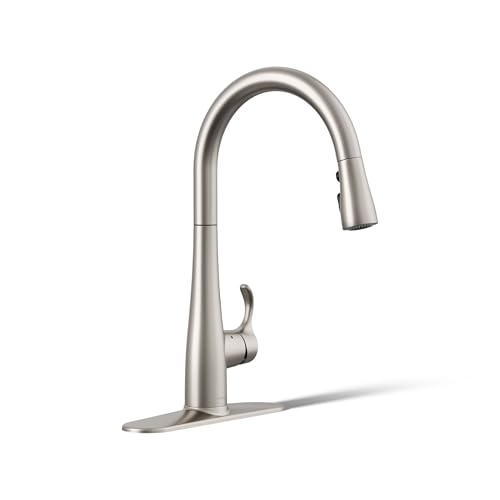
KOHLER Simplice Response K-22036-VS Touchless Kitchen Faucet — Best Touchless Quality
The Simplice Response applies Kohler’s sensor technology to its refined Simplice pull-down: wave a hand or a pot near the sensor and water flows, with the handle governing temperature. It is the quality pick for households that want to minimise mechanical wear and mess transfer in one move.
Strengths
- Touchless operation eliminates most handle cycles — the top wear point on any faucet
- Vibrant Stainless finish is Kohler’s hard-wearing stainless-look system
- Simplice platform brings a quality sprayhead and secure docking with it
Trade-offs
- Sensor ownership means batteries or power management and a learning curve
- Electronics narrow the DIY repair path compared with purely mechanical models
- Premium tier position within the Kohler range
| Model | K-22036-VS (Amazon title) |
| Finish | Vibrant Stainless (Amazon title) |
| Technology | Response touchless (product name / Amazon title) |
| Configuration | Pull down (Amazon title) |
The quality logic of touchless is subtraction: every activation that never touches the handle is wear that never happens and grime that never transfers. Kohler’s Response system is among the more disciplined implementations, with a sensor field tuned to deliberate gestures rather than passing traffic, and the Simplice underneath is a proven pull-down with an easy-clean spray philosophy that suits hard water. The Vibrant Stainless finish completes the longevity brief — it is the finish family Kohler warrants hardest. Accept the electronics honestly: keep the power source accessible, expect a household adjustment week, and this faucet’s moving-part count in daily service is the lowest in the guide, which is a genuine, measurable quality advantage.
Best for: hygiene-focused households wanting minimal handle wear / Not suited for: owners who want every repair to be purely mechanical
Check the current price on Amazon for the KOHLER Simplice Response K-22036-VS Touchless Kitchen Faucet.

Moen Brantford 7185SRS Pulldown Kitchen Faucet — Best Traditional Quality
The Brantford is the traditional-kitchen quality answer from Moen: period-friendly curves outside, and inside the same Reflex docking and Power Boost spray that headline Moen’s modern lines, finished in Spot Resist Stainless.
Strengths
- Reflex docking and Power Boost bring flagship systems to a traditional design
- Spot Resist finish preserves appearance in busy family kitchens
- Moen cartridge support is the industry’s most accessible
Trade-offs
- Traditional styling excludes modern kitchen schemes
- Single-handle mixing is faster but coarser than two-handle control
- Spot Resist reduces, not eliminates, the wiping routine
| Model | 7185SRS (Amazon title) |
| Finish | Spot Resist Stainless (Amazon title) |
| Features | Power Boost, Reflex docking (Amazon title) |
Traditional faucets are where quality goes to hide — many period-styled models are modern-costume pieces with generic internals. The Brantford is the opposite: a Moen platform faucet whose engineering is identical in spirit to the company’s modern flagships, wearing the clothes a traditional kitchen requires. Reflex keeps its wand seated, Power Boost handles the baked-on casserole, and the cartridge is the one every plumber stocks. If your kitchen’s design is traditional but your expectations are modern — a decade of drip-free, dock-tight service — the Brantford is the rare model that refuses to make you choose between the room’s look and the faucet’s engineering.
Best for: traditional kitchens refusing to compromise on engineering / Not suited for: modern minimalist schemes
Check the current price on Amazon for the Moen Brantford 7185SRS Pulldown Kitchen Faucet.

Delta Lenta 19802Z-SP-DST Pull Down Kitchen Faucet — Best Valve Innovation
The Lenta represents Delta’s quality systems in their most approachable modern form: Diamond Seal valve technology, magnetic docking, and a SpotShield Stainless finish, in a softened contemporary design that suits transitional kitchens — the largest real-world category of all.
Strengths
- Diamond Seal Technology targets the seal wear that causes ageing drips
- SpotShield finish resists spots and fingerprints between cleans
- Transitional styling fits kitchens that are neither starkly modern nor traditional
Trade-offs
- Soft-modern design will not anchor a strongly themed kitchen either way
- Single-hole format needs deck planning on older sinks
- Delta’s touch variants are separate models at higher tiers
| Model | 19802Z-SP-DST (Amazon title) |
| Finish | SpotShield Stainless (Amazon title) |
| Configuration | Single hole, pull-down sprayer (Amazon title) |
If the quality question is ‘which valve will still seal in year ten’, Delta’s Diamond Seal architecture is one of the industry’s most considered answers, and the Lenta packages it without the flagship price theatre. The design deserves its transitional label: gentle curves that sit comfortably between the Essa’s minimalism and the Leland’s tradition, which is precisely where most renovated kitchens land. SpotShield handles the appearance half of ageing. The Lenta is therefore the quality pick for the realistic majority — buyers who want proven internal engineering, a finish that forgives, and a silhouette that will not date their kitchen by 2030. It lacks touch activation and designer drama, and for its intended owner both absences are features.
Best for: transitional kitchens wanting proven valve engineering / Not suited for: theme kitchens needing a strong modern or traditional statement
Check the current price on Amazon for the Delta Lenta 19802Z-SP-DST Pull Down Kitchen Faucet.

KRAUS Bolden KPF-1610SFS Pull Down Kitchen Faucet — Best Commercial Build
The Bolden is Kraus’s commercial-format quality case: an 18-3/4-inch open-coil spring spout, a heavy-duty metal body, and a ceramic cartridge, in spot-free stainless — built for cooks who work a sink like a workstation and want hardware that feels industrial because it is.
Strengths
- Heavy-duty metal body and ceramic cartridge are stated, verifiable construction
- Spring spout manoeuvrability suits deep sinks and constant pot traffic
- Spot Free finish keeps a hard-working faucet presentable
Trade-offs
- Commercial silhouette and height dominate smaller kitchens
- Open coil collects grease and dust — budget cleaning time
- Kraus parts are ordered online rather than found locally same-day
| Model | KPF-1610SFS (Amazon title) |
| Height | 18 3/4 in, open-coil spring spout (Amazon title) |
| Construction | Heavy-duty metal body, ceramic cartridge (Amazon title) |
| Flow | 1.8 gpm (Amazon title) |
Most faucets ask you to trust their quality; the Bolden’s listing record states it — heavy-duty metal body, ceramic cartridge — and the faucet in hand confirms it with commercial mass and a spring spout that moves like equipment. That format is a quality choice for the right kitchen: the coil’s reach and the head’s freedom make a deep sink faster to work and to clean, and the construction tolerates the knocks of serious cooking. The honest costs are presence and upkeep — this is a tall, busy, grease-collecting silhouette that must be cleaned as equipment, not furniture. For a working chef’s kitchen, a utility-minded renovation, or a buyer whose quality instinct is ‘overbuilt’, the Bolden is the most literal answer in this guide.
Best for: serious cooks wanting commercial construction and reach / Not suited for: small, quiet, or ornament-led kitchens
Check the current price on Amazon for the KRAUS Bolden KPF-1610SFS Pull Down Kitchen Faucet.
American Standard Southport 7441300.075 Pull-Down Faucet — Best Trade-Brand Quality
The Southport brings American Standard’s trade reputation to a contemporary high-arc pull-down: a two-function spray head marketed on drip-free performance, stainless finish, and the backing of a brand whose name is printed on more North American plumbing than any other.
Strengths
- Drip-free ceramic-disc philosophy from a trade-grade manufacturer
- Two-function head covers daily stream and spray needs without complexity
- Brand parts depth is unmatched in ordinary plumbing channels
Trade-offs
- Design is restrained — quality here wears a plain suit
- Two functions only, where rivals offer three or four spray modes
- Stainless finish lacks a named spot-resist system in this listing
| Model | 7441300.075 (Amazon title) |
| Finish | Stainless Steel (Amazon title) |
| Spray | 2-function head, drip free (Amazon title) |
| Configuration | High-arc single handle pull-down (Amazon title) |
American Standard’s quality argument has never been glamour; it is installed-base survival. The Southport applies that to the pull-down format: a high arc for real cookware, a two-function head that does the two jobs kitchens actually repeat, and a drip-free valve brief backed by the deepest parts distribution in the business. In a decade, when a cartridge or a hose is needed, this brand’s part will be the one on the shelf — and that mundane fact is worth more to long-term owners than a third spray mode. Choose the Southport when your quality definition is ‘installed, forgotten, and serviceable forever’, and accept its restraint as the visible price of that philosophy.
Best for: long-term owners valuing serviceability over features / Not suited for: spray-mode collectors or design-first buyers
Check the current price on Amazon for the American Standard Southport 7441300.075 Pull-Down Faucet.
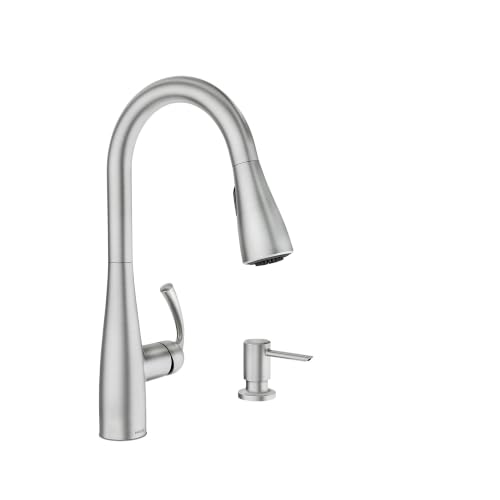
Moen Essie 87014SRS Pulldown Kitchen Faucet — Best Accessible Quality
The Essie is the quality floor done properly: Moen’s accessible pull-down with a Spot Resist Stainless finish and the company’s cartridge support, for buyers whose budget is real but who refuse disposable plumbing.
Strengths
- Spot Resist finish at an accessible tier — appearance longevity included
- Moen cartridge and parts support behind a value-positioned model
- Clean transitional design fits the widest range of kitchens
Trade-offs
- Fewer flagship systems than Arbor-class Moens — docking is simpler
- Accessible tier means plainer detailing on handles and wand
- Single-handle format only in this model
| Model | 87014SRS (Amazon title) |
| Finish | Spot Resist Stainless (Amazon title) |
| Configuration | Pulldown (Amazon title) |
Every quality guide needs its honesty anchor: the cheapest model that still deserves the word. The Essie earns that place because its compromises are in detailing and docking sophistication, not in the fundamentals — the finish is a real Moen system, the cartridge is a real Moen cartridge with national parts support, and the construction is a real metal-bodied faucet rather than a plated shell. Owners stepping up from builder-grade faucets feel the difference immediately in handle action and finish behaviour. If the budget stretches, the Arbor and Brantford above add engineered docking and spray power; if it does not, the Essie is the purchase that will not need apologising for in five years — check price on Amazon and buy it without the flagship guilt.
Best for: budget-realistic buyers who refuse disposable faucets / Not suited for: buyers wanting flagship docking and spray systems
Check the current price on Amazon for the Moen Essie 87014SRS Pulldown Kitchen Faucet.
Comparison Table
| Pick | Badge | Key spec | Best for |
|---|---|---|---|
| KOHLER Simplice Response K-22036-VS Touchless Kitchen Faucet | Best Touchless Quality | K-22036-VS, Response touchless | hygiene-focused households wanting minimal handle wear |
| Moen Brantford 7185SRS Pulldown Kitchen Faucet | Best Traditional Quality | 7185SRS, Reflex, Power Boost | traditional kitchens refusing to compromise on engineering |
| Delta Lenta 19802Z-SP-DST Pull Down Kitchen Faucet | Best Valve Innovation | 19802Z-SP-DST, Diamond Seal, SpotShield | transitional kitchens wanting proven valve engineering |
| KRAUS Bolden KPF-1610SFS Pull Down Kitchen Faucet | Best Commercial Build | KPF-1610SFS, spring spout, metal body | serious cooks wanting commercial construction and reach |
| American Standard Southport 7441300.075 Pull-Down Faucet | Best Trade-Brand Quality | 7441300.075, drip-free, high arc | long-term owners valuing serviceability over features |
| Moen Essie 87014SRS Pulldown Kitchen Faucet | Best Accessible Quality | 87014SRS, Spot Resist, accessible tier | budget-realistic buyers who refuse disposable faucets |
How to Judge Faucet Quality Like a Plumber
Plumbers judge faucets by what they replace. The cartridge is first: ceramic disc and advanced seal systems dominate the quality tier because they resist the grit and scale that destroy rubber-seal designs, and because the makers stock them for decades. Ask — or check — whether your candidate’s cartridge has a part number and a supply chain; that answer predicts the faucet’s tenth year better than any showroom test. Second is body construction: metal bodies survive deck flex and hose torque, and their threads and finish adhesion outlast plated plastic by years. Third is the finish system: named technologies — Spot Resist, SpotShield, Vibrant, PVD-style bonds — exist because raw plated colour fails in hard water, and a maker who names the system is a maker who tested it.
Fourth, test the moving systems as systems. A pull-down wand should dock with one certain motion and stay docked under its own hose’s pull; a handle should travel with even resistance and stop without bounce; a spray toggle should click, not mush. Fifth, weigh the maker’s service posture — warranty terms in plain language, parts diagrams published, cartridges in ordinary channels. A faucet is a fifteen-year appliance that drinks your water supply; the quality question is never ‘does it work today’ but ‘who stands behind its tenth year, and with what parts’.
Quality Across Budgets: What Each Tier Buys
At the accessible tier, quality money buys fundamentals — a real cartridge, a metal body, a named finish — and the Essie in this guide is the template. The mid tier adds engineered convenience that doubles as longevity: docking systems, spot-resist finishes, easy-clean spray faces, and boost sprays. The premium tier adds refinement — cartridge feel, designer finish systems, touchless activation, programme-level design — which long-term owners feel daily and short-term owners rarely recoup. The mistake is mixing the logics: paying premium money for a costume faucet with budget internals, or expecting accessible money to buy flagship systems. Decide which tier’s quality you are buying, verify its evidence with the tests above, and the purchase will age the way the tier promises.
How to Set Up a New Quality Faucet for a Long Life
Longevity is installed, not just manufactured. Start with clean water: flush the supply lines into a bucket before connecting the faucet, because construction grit is the first enemy of a new ceramic cartridge. Replace tired angle stops rather than asking them to serve another decade. Mount the faucet on a clean, sound deck, set any pull-down hose weight at the manual’s mark, and route the loop clear of disposals and stored chemicals — under-sink cleaning products are a finish and hose hazard in every home.
Then establish the care regime in week one, while it is still a choice rather than a rescue: soft cloth and mild soap for the finish, a weekly wipe of the spray face in hard-water homes before scale hardens, and a monthly under-sink glance for weeps at every joint you made. Register the warranty, photograph the model plate, and file the parts diagram. Set a calendar note for the first battery change if your faucet is touch or touchless. These small rituals are the entire difference between a quality faucet that proves it and one that merely promised it.
The Ten-Minute Quality Audit You Can Run on Any Faucet
Everything in this guide distils into an audit you can run in a showroom or from a listing. One: name the cartridge — if the maker will not say what seals the water, assume the cheapest answer. Two: confirm the replacement cartridge’s part number exists and is sold by ordinary plumbing channels. Three: heft or verify the body material; metal is stated proudly by makers who use it. Four: work the handle — even resistance, no play, a clean stop. Five: dock and redock the wand ten times; quality systems seat identically every time, tired ones wander by the fifth.
Six: read the finish’s name and its care instructions; a named system with instructions is engineering, a colour adjective is paint. Seven: check the spray toggle’s click and the hose’s suppleness. Eight: confirm the hole pattern and deck plate against your sink in writing, not in hope. Nine: read the warranty’s exclusions, which describe the owner’s duties the maker expects. Ten: ask who services it locally in year eight. A faucet passing eight of ten is a quality purchase at almost any tier; the picks in this guide were chosen by running exactly this audit against verified listings, and it will serve you on every faucet decision that follows this one.
Hard Water: The Quality Variable Nobody Lists
More faucets are killed by water than by use. Hard water scales spray faces into splayed patterns, crusts aerators, spots finishes into permanent maps, and works grit into cartridges. The quality response is layered. At the faucet: easy-clean spray faces you can wipe with a finger, spot-resist finish systems, and ceramic cartridges that tolerate the environment longest. At the house: a softener or conditioner transforms faucet life across every brand, and point-of-use filtration protects drinking taste while the main supply still serves the mechanics.
At the habit level, hard-water ownership is a wiping discipline: a weekly pass over the spray face and finish prevents the deposits that monthly desperation then attacks with acids the finish hates. Vinegar, the internet’s universal answer, is a genuine risk to several finish systems and should be used only as the maker directs — usually on a cloth, briefly, never as a soak on plated or matte surfaces. Judge your water before judging your faucet: several picks in this guide earned their places specifically because their spray and finish systems assume hard water is coming, which in much of the country is simply realism.
Renters, Landlords, and the Quality Middle Path
Quality advice usually assumes owners, but faucets serve tenants too, and the calculus differs in instructive ways. A landlord’s quality faucet is one whose cartridge any plumber can change between tenancies, whose finish survives unknown cleaning habits, and whose replacement cost will not sting if a tenant’s abuse ends it early — the professional-line and accessible-tier picks in this guide exist for exactly this brief. A tenant who may replace a faucet with permission should choose mainstream models whose parts and documentation travel with them, and keep the original faucet boxed for restoration at move-out.
The middle path both sides miss is maintenance as quality: most ‘bad faucets’ in rentals are good faucets with scaled aerators, perished supply lines, and stops that have not moved in a decade. A service visit that refreshes those consumables restores quality that a replacement budget would have wasted. Whether you own the building or the lease, the lesson of this guide holds — quality is a system of product, installation, water, and care — and the cheapest quality upgrade in most kitchens is servicing the faucet already there before shopping for its successor.
What to Keep When the Faucet Arrives: Documentation as a Quality Feature
Close the purchase like an engineer. Photograph the model plate and the box’s model string before the packaging leaves; file the parts diagram and warranty with your home documents; note the cartridge part number in your phone where future-you will actually find it. If the faucet is electronic, register it the same day and note the battery type beside the model. Keep the specialised hex keys and any finish-care instructions in a labelled bag in the under-sink cabinet, behind nothing.
This ritual sounds disproportionate for a faucet until the first service event, when it converts a weekend of guesswork into a twenty-minute cartridge swap with the correct part ordered first time. It is also the habit that separates households whose quality purchases compound from those whose purchases merely age. The six faucets in this guide will each serve a decade or more; the owners who get that decade are the ones who can still name their model in year nine. Quality, finally, is a relationship with an object — and like every relationship in a home, it rewards the people who pay attention early.
Faucets and Drinking Water: Materials and Peace of Mind
A quality faucet is also a drinking-water appliance, and its material standards deserve a buyer’s minute. Reputable makers certify their faucets to lead-free and material-safety standards for potable water, with wetted surfaces in compliant brass alloys, stainless, or engineered polymers — one more reason the established brands in this guide dominate a quality conversation, because certification is a system a maker maintains, not a label a listing invents. If a faucet’s listing cannot name its compliance, that silence is information.
Practical water quality at the tap is then mostly maintenance: flush a little water in the morning if the home’s plumbing is old, clean the aerator seasonally so flow stays even and splash-free, and let any filtration you install serve taste while the faucet’s certified materials serve safety. Buyers connecting a new faucet in an older home should ask the installer about the supply lines being replaced at the same visit — the faucet is rarely the oldest wetted component in the chain, and renewing the chain is the quality move this guide recommends everywhere it applies.
The Second Sink: Bar, Prep, and Laundry Faucets Held to the Same Standard
The quality tests in this guide travel well beyond the main sink. Bar and prep faucets live harder lives than their size suggests — constant short cycles, wet hands, and in laundry service, chemicals and grit that main kitchens never see. Apply the same audit: a nameable cartridge, a metal body, a finish system matched to the room’s chemistry, and parts that exist. The major makers’ bar lines share cartridges with their kitchen flagships, which is the efficient secret of whole-home standardisation: one parts kit services every faucet in the house.
Proportion is the second-sink discipline. A full-size pull-down on a small bar sink splashes and dominates; the makers in this guide offer scaled companions in the same programmes for exactly this reason. Match the programme, shrink the format, and keep the cartridge commonality — and the quality system you built at the main sink extends, without new learning curves or new spare-parts drawers, to every tap in the building. That is what buying quality, rather than buying a faucet, actually looks like over a decade of ownership.
A Final Word on Buying Once
There is an old workshop saying that the cheap tool is the expensive one, and faucets may be its purest domestic proof. A quality faucet asks for money once, attention occasionally, and a cartridge rarely; a disposable faucet asks for money repeatedly, attention constantly, and forgiveness eventually — for the cabinet floor, the ruined morning, the plumber’s emergency rate. The arithmetic is not subtle over a decade, and neither is the environmental ledger: one serviceable faucet in a kitchen for fifteen years is a fundamentally different object from four sealed units in a landfill across the same span.
Buying once is nevertheless a discipline, not a splurge. It means verifying identity, as this guide did with every listing. It means matching systems to water and workload rather than to photographs. It means installing carefully, documenting faithfully, and maintaining gently — the unglamorous liturgy repeated across every section above. Do those things with any of the six faucets in this guide and you will own the rarest appliance in the modern home: one you stop thinking about, because it simply, durably, works. That silence — the absence of drips, doubts, and replacement searches — is what quality sounds like, and it is worth every penny of the difference.
How This Guide’s Six Became Six: The Rejects and Why They Fell
A quality guide earns trust by showing its cutting floor. Models fell from this list for reasons worth naming, because the same reasons should cut your own shortlist. Several attractive faucets fell on identity: their listings could not state an exact model, and a quality purchase cannot begin with an unverifiable product. Several fell on ecosystems: handsome designs from makers whose cartridges could not be sourced through ordinary channels, which converts a fifteen-year fixture into a disposable with good posture. One category fell wholesale — faucets whose spray toggles and docking could not be confirmed as systems with any track record, however polished their photography.
Others fell on honesty of tier: models priced as flagships whose construction, where it could be examined, was accessible-tier in flagship clothing, and budget models making finish claims no system stood behind. What survived — Kohler’s touchless Simplice, Moen’s Brantford and Essie, Delta’s Lenta, Kraus’s Bolden, American Standard’s Southport — survived because each could prove its quality in the audit this guide teaches: named cartridge, metal construction, engineered finish, serviceable future. If a faucet you love failed to appear here, run it through that audit yourself before mourning it. Some omissions are this guide’s limits; the audit will tell you which ones are the faucet’s.
A Note on Gifts, Registries, and Housewarming Faucets
Faucets are given more often than the industry admits — parents equipping a first home, partners registering for a renovation, families pooling for a housewarming that actually matters. The quality rules make gifting safer: choose from makers with national parts support so the recipient is never stranded, prefer finishes with forgiving care regimes over fashion finishes with strict ones, and include the documentation ritual as part of the gift — model string recorded, warranty registered, cartridge number noted. A faucet given this way is not an appliance; it is a decade of unconsidered reliability, installed in the room where the household will gather most. Few gifts at any price can honestly promise that, which is why the humble, well-chosen faucet belongs on more registries than it currently graces.
Faucet Quality and Home Insurance: The Unromantic Connection
Water damage is among the most common and most expensive home insurance claims, and while no faucet prevents a burst pipe, the quality system this guide describes is quietly an insurance strategy. A serviceable faucet with a sound cartridge does not develop the slow, hidden drip that rots a cabinet floor over a season — the exact failure pattern that turns a minor leak into a major claim, because it is discovered by smell and sagging rather than by sight. Supply lines renewed at installation, stops that actually close, and joints checked with a dry towel are the difference between a leak that announces itself at the sink and one that announces itself through the ceiling below.
Insurers and inspectors notice these systems in their own language: documented renovations, branded fixtures with available parts, and evidence of maintenance all read as a cared-for water system. Keep the documentation this guide prescribes — model records, installation dates, cartridge changes — in the home file that an inspector or a future buyer will one day open. Quality, pursued for the daily reasons this article began with, turns out to also be the cheapest risk management in the house. The faucet was never just a faucet; it is the most-used valve in your home’s water system, and treating it with this level of seriousness is simply proportionate.
The Faucet in the Smart Home’s Blind Spot
Kitchens fill with connected devices while the faucet — the room’s most-used appliance — remains gloriously analogue in most homes, and this guide’s position is that the blind spot is mostly healthy. A faucet’s job is water, delivered instantly, at the temperature your hands requested, for decades; connectivity serves that job only at the margins of measured dispensing and leak detection. Leak detection is the one smart feature whose value is unambiguous, whether it lives in a faucet or in a separate sensor under the sink: water damage is the expensive failure, and early warning is cheap insurance that asks nothing of your daily routine.
For everything else, buy the mechanical quality first and let electronics be the garnish on an already sound platform, exactly as the major makers in this guide structure their ranges — the same Simplice, Arbor, and Cassidy platforms exist with and without activation technology, on identical cartridges. A household that standardises on those platforms can adopt or abandon the electronic layer at any renovation without disturbing the plumbing beneath it. That optionality is the mature way to buy into a changing category: the water path is permanent, the interface is replaceable, and quality — as this entire article has argued — lives in the water path.
Remember, too, that quality compounds across a household: the household that buys one serviceable faucet learns the audit, stocks the cartridge, and keeps the documentation, and every subsequent faucet decision in that home becomes faster, cheaper, and better. The first quality faucet is therefore the most valuable one — it is the purchase that teaches the system.
Keep one final habit from this guide, whatever you buy: the first-week check. Seven days after installation, run every mode, dry-towel every joint, confirm the docking, and tighten nothing that is not loose — simply look, while looking is still free. Most installation faults announce themselves in that first week, quietly, to owners who inspect; they announce themselves expensively, months later, to owners who did not. A quality faucet deserves a quality first week, and the five minutes it costs are the highest-value minutes in the faucet’s entire service life.
Common Buying Mistakes
Judging by showroom shine. Every faucet is beautiful on day one. Quality is cartridge architecture, body material, finish system, and parts support — none of which sparkle under display lighting.
Buying an unidentifiable listing. If a listing cannot state the exact model, you cannot verify its cartridge, finish, or warranty. In a quality purchase, an unstated model is a disqualification.
Overlooking water quality. Hard water destroys spray faces and spots finishes. In hard-water homes, easy-clean spray designs and spot-resist finishes are quality features, not cosmetics.
Neglecting the stops and lines. A quality faucet on failing angle stops and grit-filled lines starts its life injured. Refresh the supplies when you refresh the faucet.
Cleaning engineered finishes like bare metal. Abrasives and harsh descalers strip the systems you paid for. Soft cloth, mild soap, and patience are the manufacturer’s actual instructions.
Final Recommendation
For a single answer: the Kohler Simplice Response leads on wear-free quality, the Moen Brantford on traditional engineering, the Delta Lenta on valve innovation for real kitchens, the Kraus Bolden on commercial construction, the American Standard Southport on lifetime serviceability, and the Moen Essie on quality per realistic budget. Judge any other candidate by this guide’s tests — cartridge, body, finish system, docking, parts — and you will not buy a disposable faucet by accident again. Related reading: Best Quality Kitchen Faucets, Best Quality Delta Kitchen Faucets, Best Quality High End Kitchen Faucets, and Best Quality Kitchen Faucets Two Handle.
Frequently Asked Questions
What makes a faucet ‘quality’ rather than just expensive?
Verifiable systems: a ceramic or advanced-seal cartridge with long parts support, metal body construction, an engineered finish system, and moving parts — docking, handles, spray toggles — that operate with precision. Price sometimes buys those; sometimes it buys only design.
How long should a quality faucet last?
A decade or more of daily use, with a cartridge refresh as planned mid-life maintenance. Faucets from makers with deep parts networks routinely outlast the kitchens around them.
Is a ceramic cartridge really better?
Yes. Ceramic discs resist the grit, scale, and wear that degrade rubber-seal valves, which is why they dominate the quality tier and why plumbers recommend them for hard-water homes.
Do spot-resistant finishes matter?
In hard-water homes they are among the most felt quality features, keeping the faucet presentable between cleans. They reduce wiping rather than eliminating it, and they require non-abrasive care to survive.
Are touchless faucets reliable enough to count as quality?
From major makers, yes — and they reduce handle wear and mess transfer measurably. They add power management to ownership, so they suit households willing to keep batteries fresh and the power pack accessible.
What is the most common quality mistake buyers make?
Paying premium prices for design alone while ignoring internals and parts support — or the reverse error, buying the cheapest faucet and replacing it three times in the period one quality faucet would have covered.


