Disclosure: airfryerkitchensupply.com is reader-supported. When you buy through links on our site, we may earn an affiliate commission at no extra cost to you.
Where to buy
Every pick in this guide is sold on Amazon, and most come in multi-packs that make restocking a drawer cheap and simple. Use the Check on Amazon links under each review to see the current pack options, since counts and sizes change between listings. If you are outfitting a kitchen from scratch, buy two packs of the same towel: one set in active rotation and one clean set in reserve, so a spill-heavy cooking day never leaves you reaching for paper towels.
Introduction
Finding the best plain white dish towels sounds like the easiest shopping task in the kitchen, yet anyone who has bought a bargain pack knows the disappointment: towels that push water around instead of absorbing it, edges that curl after two washes, and a grey dinginess that shows up within a month. Plain white is actually the most honest finish a dish towel can have. There is no dye to hide thin fabric, no print to distract from a sloppy hem, and because white cotton tolerates hot water and oxygen-based whiteners, a good white towel can be kept genuinely clean in a way colored towels cannot. This guide focuses on six plain white options that earn their place in a working kitchen: classic flour sack towels for glassware and baking, waffle weaves for fast drying, and heavier pantry towels for daily dish duty. Each pick below was confirmed against Amazon’s catalog data before it was included, and each is judged on absorbency, lint behavior, wash durability, and how the fabric feels after repeated laundering rather than on day one.
Why white, specifically? In a busy kitchen, white towels double as a hygiene signal. You can see when a towel is soiled and needs the wash, you can boil-wash or brighten them without worrying about fading a pattern, and they match every kitchen without a second thought. Restaurants and bakeries standardize on white for exactly these reasons. The trade-off is that stains show, so the picks here favor cotton weaves that release stains in a hot wash and hold their brightness with basic care.
In this guide
Quick Picks
- Best Overall: Utopia Kitchen White Flour Sack Towels (12 Pack, 28 x 28 Inch) — the classic all-rounder for drying, baking, and glassware. Check the current price on Amazon
- Best Waffle Weave: COTTON CRAFT Amazing Kitchen Towel (12 Pack, White, 16 x 28 Inch) — waffle-terry texture that drinks up spills and dries fast on the rack. Check the current price on Amazon
- Best Premium: Williams-Sonoma All Purpose Pantry Towels (Set of 4, White) — a denser, gift-worthy pantry towel for cooks who want one towel to do everything. Check the current price on Amazon
- Best for Crafts and Embroidery: Aunt Martha’s Flour Sack Dish Towels (Set of 7, 28 x 28 Inch) — smooth, even fabric that takes stitching, stamping, and printing cleanly. Check the current price on Amazon
- Best Bulk Value: DG Collections Flour Sack Towels (24 Pack, 27 x 27 Inch) — the lowest-fuss way to fill a drawer or stock a rental kitchen. Check the current price on Amazon
- Best Large Pack for Big Households: Avalon Kitchen Flour Sack Towels (15 Pack, 28 x 28 Inch) — generous size and count for families that cook daily. Check the current price on Amazon
How These Picks Were Chosen
We started with the constraints in the search itself: the towel must be plain, it must be white, and it must be a dish towel first — not a bath towel, not a microfiber car cloth, and not a printed novelty towel. Every candidate was cross-checked against Amazon’s product catalog data to confirm the pack count, dimensions, and material stated in the listing title, and listings whose titles described colored or patterned variants were excluded from the linked picks. From there, we weighed four practical criteria. First, absorbency per gram: flour sack cotton is thin but drinks water quickly and wrings out nearly dry, while waffle and terry weaves hold more water per pass. Second, lint behavior, because a towel that sheds on glassware fails its main job. Third, edge construction — hemmed edges that survive hot washes without unraveling. Fourth, cost per towel within the pack, judged qualitatively by tier rather than by any fixed price, since pack pricing shifts constantly. The six survivors cover the realistic spread: two flour sack workhorses at different pack sizes, a waffle-terry option, a premium pantry towel, a craft-friendly classic, and a bulk pack for high-turnover kitchens.
One more filter deserves explaining: we excluded microfiber “dish towel” listings from the linked picks even though they are common in this category. Microfiber is a fine material for glass-only polishing and for car care, but the search asks for dish towels in the classic sense, and for hot-water washing, food-adjacent work, and long service life, cotton remains the better default. Colored and striped variants of otherwise good towels were also excluded — several well-known packs sell a blue-stripe or mixed-color version under a similar name — because a guide to plain white towels should link the towel it describes: white, plain, and ready to be bleached back to bright when life happens.
The 6 Best Plain White Dish Towels

Utopia Kitchen White Flour Sack Towels (12 Pack, 28 x 28 Inch) — Best Overall
If you buy one pack from this list, this is the one most kitchens should start with. The Utopia Kitchen flour sack towels are 100% cotton in the traditional flour sack weave — a smooth, lightweight plain weave that bakers have used for generations to cover rising dough, strain, and dry delicate glassware. At 28 x 28 inches each, they are large enough to fold over a shoulder, line a bread basket, or dry a full rack of dishes without going soggy halfway through. They suit almost everyone: home bakers, batch cooks, and anyone replacing a drawer of tired mixed towels with one consistent standard. They are less suited to cooks who want a thick, plush hand-feel — flour sack fabric is deliberately thin, and that thinness is the point.
Strengths
- Smooth plain-weave cotton leaves glassware and mirrors essentially lint-free.
- Large 28 x 28 inch format covers a mixing bowl, lines a proofing basket, and dries a full sink load.
- Thin fabric wrings out nearly dry and air-dries quickly, so towels resist the sour smell of damp terry.
Trade-offs
- Lightweight weave saturates faster than terry on very large spills; you will swap towels more often.
- Plain weave shows scorch marks and turmeric stains plainly — white is honest, for better and worse.
- Needs a few washes to reach full absorbency as mill finishes wash out.
Key specs: 100% cotton flour sack weave; 28 x 28 inches; 12 towels per pack; plain white.
In daily use, the virtue of these towels is how many jobs they absorb without complaint. They dry wine glasses without streaks, they strain yogurt and stock without shedding fibers into food, they cover dough for a clean rise, and they fold flat so a dozen take barely any drawer space. Because they are pure white cotton, a hot wash with an oxygen booster brings them back to bright — a reset button colored towels do not have. Over months of laundering the hems are the thing to watch on any flour sack towel; rotate the pack evenly rather than abusing the same two towels, and the set lasts far longer. For most kitchens, this pack plus one heavier towel for oven-side work is the complete system.
Best for: all-round kitchen duty, baking, and glassware / Not suited for: cooks who want a thick, plush towel feel
Check the current price on Amazon
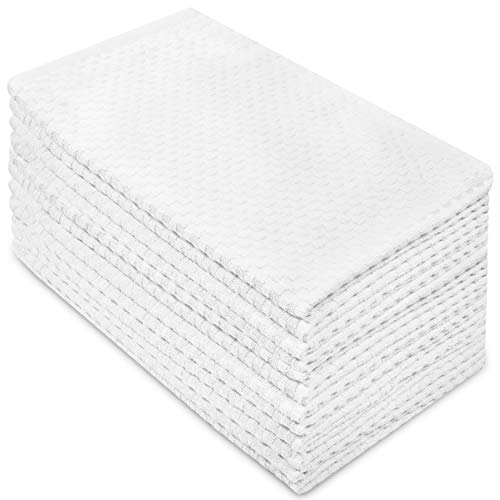
COTTON CRAFT Amazing Kitchen Towel (12 Pack, White, 16 x 28 Inch) — Best Waffle Weave
The COTTON CRAFT towel takes the opposite approach to flour sack: instead of a flat weave, it uses a waffle-terry construction in 100% cotton, sized 16 x 28 inches in the familiar Euro café format. The waffle pockets increase surface area, so the towel picks up water quickly and the raised texture gives a little scrubbing grip on stuck-on residue. It suits cooks who dry a lot of heavy pots and sheet pans and want one towel to stay useful through a whole cleanup. It is less ideal for polishing glassware, where the textured weave can leave more lint than a flat flour sack towel.
Strengths
- Waffle-terry texture absorbs fast and adds light scrubbing power for rims and pan edges.
- Low-lint behavior for a textured towel, helped by the ringspun-style cotton construction.
- Dries quickly between uses because the waffle structure exposes more surface to air.
Trade-offs
- Texture can drag slightly on delicate stemware compared with a smooth flour sack towel.
- Narrower 16-inch width is less handy as a dough cover or basket liner.
- Waffle pockets can trap crumbs; shake out before washing.
Key specs: 100% cotton waffle terry weave; 16 x 28 inches; 12 towels per pack; plain white.
Think of this as the cleanup specialist in the drawer. After a roast dinner, when the roasting pan, carving board, and a stack of plates all need attention, the waffle towel keeps absorbing after a thin towel would be saturated. It also makes a good hand towel beside the sink because it dries fast on the hook and does not stay clammy. Pair it with flour sack towels for glassware and you cover both ends of the drying spectrum. In the wash, avoid fabric softener — it coats cotton fibers and quietly destroys the absorbency that is this towel’s whole reason to exist.
Best for: heavy dish loads, pots and pans, fast-drying hand towel duty / Not suited for: lint-critical glass polishing
Check the current price on Amazon

Williams-Sonoma All Purpose Pantry Towels (Set of 4, White) — Best Premium
The premium tier pick is the Williams-Sonoma All Purpose Pantry Towel set: four white 100% cotton towels from a retailer whose kitchen textiles are built to a visibly denser standard. Where value packs optimize cost per towel, these optimize the towel itself — a tighter weave, cleaner finishing, and a hand-feel that stays composed after many washes. They suit serious home cooks, people furnishing a kitchen they plan to keep for years, and gift buyers who want a housewarming present that is actually used daily. They are not the rational choice for a household that loses towels to bleach accidents and scorch marks every month; the cost per towel sits in the premium tier.
Strengths
- Dense, even cotton weave that feels substantial and dries dishes in fewer passes.
- Clean, durable finishing that keeps edges square instead of curling into ropes.
- Plain white presentation that works as a serving-side towel, not just a sink-side one.
Trade-offs
- Only four towels per set — most kitchens need two sets for a full rotation.
- Premium-tier cost per towel compared with flour sack multi-packs.
- Thicker fabric takes longer to air-dry on the rack than flour sack cotton.
Key specs: 100% cotton; set of 4; plain white; all-purpose pantry format.
There is a real pleasure in a towel that behaves like equipment rather than a consumable. These are the towels you reach for when guests are in the kitchen, when you are drying a good knife by hand, or when a towel goes to the table under a hot dish. They also launder beautifully — white cotton of this density brightens well and resists the greying that thin towels pick up. Buy them as the top layer of a system: premium towels for cooking and serving, flour sack packs for the messy, bleach-friendly work, and nothing in the drawer you feel precious about ruining.
Best for: quality-focused cooks, gifts, serving and finishing work / Not suited for: bulk stocking on a tight budget
Check the current price on Amazon
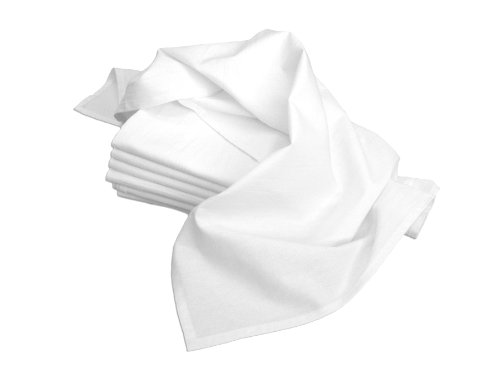
Aunt Martha’s Flour Sack Dish Towels (Set of 7, 28 x 28 Inch) — Best for Crafts and Embroidery
Aunt Martha’s is a name crafters know: the brand built its reputation on flour sack towels sold as blanks for embroidery, and this set of seven white towels, 28 x 28 inches with a premium 130 thread count, is exactly that classic product. The smooth, even surface takes hand stitching, machine embroidery, stamping, and heat-transfer designs without the puckering a textured weave causes. But do not pigeonhole it as craft-only — the same smooth fabric is a proper working dish towel, lint-light and quick to dry. It suits crafters who want their finished pieces to also be useful, and traditionalists who prefer the old-school flour sack standard. It is less suited to anyone wanting maximum water capacity per pass.
Strengths
- Smooth, consistent weave is the best surface here for embroidery, stamping, and printing.
- Premium thread count gives a slightly more refined finish than utility flour sack packs.
- Fully functional as a kitchen towel after crafting — gifts that get used, not shelved.
Trade-offs
- Seven towels is a modest count for a full kitchen rotation.
- Thin flour sack fabric saturates quickly on big spills.
- Decorated towels often become too precious to use hard — buy a plain set too.
Key specs: Cotton flour sack weave, 130 thread count; 28 x 28 inches; set of 7; white.
For a craft circle, a quilting group, or anyone making personalized housewarming gifts, this set is the reliable blank canvas. The fabric is hemmed and square, which matters when a design needs to sit straight. In the kitchen, the same towels handle the classic flour sack jobs — drying, straining, proofing — with a slightly smoother hand than bulk alternatives. Wash them before first use or first stitch: flour sack cotton always improves after the initial launder, both in absorbency and in how evenly it takes thread or ink.
Best for: embroidery and craft blanks that double as working towels / Not suited for: maximum-absorbency cleanup duty
Check the current price on Amazon

DG Collections Flour Sack Towels (24 Pack, 27 x 27 Inch) — Best Bulk Value
Sometimes the right answer is simply more towels. The DG Collections pack puts 24 white flour sack towels, 27 x 27 inches each, 100% cotton, pre-washed with hemmed edges, into one purchase. This is the pick for rental properties, big families, church and community kitchens, cafés, and anyone who has decided that a fresh towel every day — and a spare for the spill — beats nursing a small set. They are lint-free workhorses for cleaning, drying, and craft use at a budget-tier cost per towel. They are not the pick if you want a refined hand-feel; at this count, uniformity and price rule.
Strengths
- Twenty-four towels end the towel shortage permanently — rotation, spares, and rags in one pack.
- Pre-washed, hemmed, lint-free cotton ready for kitchen or cleaning duty out of the pack.
- Budget-tier cost per towel makes staining or scorching one a non-event.
Trade-offs
- Utility-grade finish; expect slight size variation towel to towel.
- Thin flour sack weave, with the same saturation limits as all flour sack towels.
- A full pack is a lot of folding — trivial, but real.
Key specs: 100% cotton flour sack weave; 27 x 27 inches; 24 towels per pack; white; pre-washed, hemmed edges.
The hidden benefit of a bulk pack is behavioral: when towels are plentiful, you change them more often, and a frequently changed towel is the single easiest hygiene upgrade in a kitchen. Keep a stack by the sink, a few in the baking drawer, and retire the worst offenders to garage duty without guilt. Because they are plain white, the whole fleet washes together in one hot load. For hosts who cook for crowds — holiday dinners, bake sales, preserving days — this is the pack that keeps the day moving.
Best for: bulk stocking, rentals, big households, events / Not suited for: buyers prioritizing premium hand-feel
Check the current price on Amazon

Avalon Kitchen Flour Sack Towels (15 Pack, 28 x 28 Inch) — Best Large Pack for Big Households
Avalon Kitchen’s 15-pack sits between the classic dozen and the bulk case: 15 white flour sack towels at the full 28 x 28 inch size, 100% cotton, marketed for drying dishes, baking, bread proofing, crafting, and embroidery. For a household that cooks most nights, fifteen towels is the sweet spot — a week’s rotation with spares, without committing to a commercial case. The full-size format keeps every flour sack trick available, from lining a salad spinner basket to covering a tray of rising rolls. It suits families and frequent bakers; it is more than a single cook in a small kitchen needs.
Strengths
- Fifteen full-size towels cover a heavy weekly cooking rhythm with spares.
- True 28 x 28 inch format for proofing, straining, and basket lining.
- One uniform white set simplifies laundry — everything in one hot load.
Trade-offs
- Same thin-weave saturation limits as every flour sack towel on this list.
- More towels than a small household will rotate before they age unevenly.
- Plain white shows baking stains — cocoa and berry marks are permanent souvenirs.
Key specs: 100% cotton flour sack weave; 28 x 28 inches; 15 towels per pack; white.
If the Utopia pack is the default and the DG pack is the warehouse answer, Avalon is the family answer. It is also a sensible wedding-registry or first-apartment choice: enough towels to learn the habit of changing them daily, in a fabric that forgives hot washes and whiteners. Bakers in particular will appreciate the count — proofing cloths, couche substitutes, and cooling-rack covers go through towels faster than any other kitchen task.
Best for: families, frequent bakers, first-kitchen outfitting / Not suited for: minimalists in very small kitchens
Check the current price on Amazon
Comparison Table
| Pick | Badge | Key spec | Best for |
|---|---|---|---|
| Utopia Kitchen Flour Sack Towels | Best Overall | 100% cotton, 28 x 28 in, 12-pack | All-round drying, baking, glassware |
| COTTON CRAFT Amazing Kitchen Towel | Best Waffle Weave | Waffle terry cotton, 16 x 28 in, 12-pack | Heavy dish loads, fast drying |
| Williams-Sonoma Pantry Towels | Best Premium | 100% cotton, set of 4 | Quality feel, serving, gifts |
| Aunt Martha’s Flour Sack Towels | Best for Crafts | 130 thread count, 28 x 28 in, set of 7 | Embroidery and craft blanks |
| DG Collections Flour Sack Towels | Best Bulk Value | 100% cotton, 27 x 27 in, 24-pack | Rentals, events, big households |
| Avalon Kitchen Flour Sack Towels | Best Large Pack | 100% cotton, 28 x 28 in, 15-pack | Families and frequent bakers |
Key Takeaways
- Plain white cotton is the most practical dish towel finish: it tolerates hot washes and whiteners, and shows soil so you know when to change it.
- Flour sack towels are the all-rounders — lint-light, fast-drying, and big enough for baking jobs; waffle terry absorbs more per pass for heavy cleanup.
- Count matters as much as quality: a rotation of twelve or more towels is what makes daily changing realistic.
- Never use fabric softener on dish towels; it coats the fibers and steadily kills absorbency.
- Buy the system, not a towel: a mid-range rotation, a budget pack for messes, and — if you like — a small premium set for serving covers every job in a kitchen.
- White is a feature, not a risk: it shows soil so you wash at the right time, and it is the only color you can always restore to bright.
How to Choose Plain White Dish Towels
Start with the weave, because weave decides what the towel is good at. Flour sack is a smooth plain weave: thin, quick, and nearly lint-free, which makes it the default for glassware, straining, and anything involving food contact like proofing dough. Waffle weave builds pockets into the fabric that hold more water and add grip, better for pots, pans, and counter spills. Terry loops maximize capacity but dry slowest and can shed on glass. Most kitchens do best with a two-weave system: flour sack for finesse, waffle or terry for volume.
Next, size. A 28-inch square flour sack towel is a tool as much as a towel — it lines, covers, strains, and wraps. The narrower 16 x 28 inch format is the classic over-the-oven-handle drying towel. Buy the format that matches your dominant job, and do not assume bigger is always better: an oversized towel is clumsy for drying the inside of a narrow glass.
Then count. A single cook who hand-dries nightly needs at least seven towels for a sane rotation; a family kitchen needs twelve to fifteen; hosts and bakers should think in the twenties. Cost per towel falls sharply as packs grow, and because all-white sets wash together, there is no sorting penalty for owning more. Judge packs by tier — budget, mid-range, premium — rather than chasing a specific price, and spend the premium tier money only on the small set you will use for serving and finishing.
Finally, check the basics in any listing before buying: 100% cotton (microfiber has its place for cars and counters, but cotton wins for dishes and food-adjacent work), hemmed edges, and a stated size. If a listing cannot tell you the size and material plainly, that is your answer about the towel.
Budget Tiers for Dish Towels, Honestly Explained
Dish towels are one of the few categories where the budget tier is genuinely good, so it is worth understanding what each tier buys. In the budget tier — where the DG Collections and Avalon packs live — you are paying for cotton, weave, and hems, nothing else. The towels work, they absorb, they survive hot washes; what you give up is refinement: slight size variation, a rougher hand, edges that are serviceable rather than beautiful. For cleaning-heavy kitchens, rentals, and events, that trade is correct.
The mid-range tier — the Utopia Kitchen and COTTON CRAFT packs — buys consistency. Towels match each other, sizes are true, the weave is even, and quality control catches the dud towel that budget packs occasionally include. Most households should live in this tier for their main rotation, because the cost per year of service is low and the daily experience is noticeably better. The premium tier, represented here by Williams-Sonoma, buys density and finish: a towel that feels like equipment, presents well at the table, and holds its shape for years. Premium towels are a poor choice as your only towels — you will hesitate to use them for the messy jobs towels exist for — but as the top layer of a tiered drawer they are worth it. The rational drawer, in short: mid-range for the rotation, budget for the mess, premium for the table.
How to Wash and Whiten White Dish Towels
White towels reward a simple, consistent routine. Follow these steps and a good set stays bright and absorbent for a long time:
- Step 1: Rinse or shake out food debris the same day; dried-on food sets stains that even hot water struggles with.
- Step 2: Wash whites together in hot water with a regular detergent dose — over-dosing leaves residue that dulls absorbency.
- Step 3: Add an oxygen-based whitener for brightness. Reserve chlorine bleach for occasional rescue washes; frequent bleaching weakens cotton fibers.
- Step 4: Skip fabric softener and dryer sheets entirely. Both coat fibers and are the most common cause of towels that suddenly stop absorbing.
- Step 5: If towels develop a sour smell, run a strip wash: a long hot soak with detergent and a washing-soda boost, then a normal cycle.
- Step 6: Dry fully before folding — line drying in sun is a natural brightener — and store in a drawer or basket with airflow, not sealed plastic.
Flour Sack vs. Waffle vs. Terry: Which Weave Does What?
Because the picks in this guide span three weaves, it is worth being precise about what each one actually does at the sink. Flour sack is a plain weave — warp and weft crossing one-over, one-under — which produces a flat, smooth sheet of cotton. Water spreads across it fast and the fabric releases that water fast when wrung, which is why a flour sack towel can dry a whole rack of dishes and still feel usable at the end. Its weakness is capacity per square inch: a major spill overwhelms it, and you will fold to a dry section or grab a second towel. Its great strength, beyond drying, is versatility: the same flat sheet strains stock, lines a proofing basket, covers dough, wraps herbs, and polishes glass without leaving fibers behind.
Waffle weave is a compromise engineered for the sink. The recessed pockets multiply the surface area that touches water, so the first pass picks up noticeably more than a flat towel, and the texture gives gentle mechanical help on dried egg or sauce rims. Waffle towels also dry faster than terry because air moves through the structure. They are the best single-towel answer for households that hand-wash heavy cookware daily. Their limits show up at the extremes: they are bulkier to store than flour sack, and the texture is not the tool for a final polish on crystal.
Terry — looped pile — is the capacity champion and the slowest to dry, which is why this guide’s terry representation comes in the waffle-terry hybrid form rather than a plush loop towel. Pure terry dish towels have a place as sink-side hand towels, but in a plain white working set they tend to stay damp, pick up odors, and shed on glassware. If your current drawer is all terry and your glasses look dusty after drying, the weave — not your technique — is the problem.
How Many Towels, What Sizes: Setting Up a Rotation That Works
The most common reason white dish towels disappoint is not the towel — it is the system. A working rotation looks like this: two towels in active service each day (one for hands, one for dishes), a clean stack within arm’s reach of the sink, and a wash rhythm of every two to three days so soiled towels never sit damp in a hamper. For a household cooking once a day, that arithmetic lands at twelve towels minimum. Add baking days, a second cook, or kids washing up, and fifteen to twenty-four is the honest number — which is why this guide includes a 15-pack and a 24-pack alongside the classic dozens.
On size, keep two formats. The 28-inch square is the multi-tool: it folds to a pot holder in a pinch (folded dry cotton only, and never as a substitute for a proper oven mitt with steam involved), lines baskets, covers bowls, and dries big items. The 16 x 28 inch rectangle is the drying specialist that hangs neatly and works a glass or pan in hand. A drawer with both formats, all in plain white, all washed together, is the entire system — no sorting, no matching, no favorites that get used to death while others sit pristine.
One more habit separates kitchens whose towels stay white from those whose towels go grey by spring: retire towels by condition, not by age, and retire them downward. A towel that no longer brightens becomes the floor-spill towel, then the garage rag. Because every pick here is plain white cotton with no dye to protect, that downward path costs nothing and keeps the top of the rotation genuinely fresh.
What “100% Cotton” Does and Does Not Tell You
Every pick in this guide is 100% cotton, but cotton is not one thing. Long-staple cotton produces smoother, stronger yarn that sheds less and lasts longer; short-staple cotton is cheaper and a little rougher. Ring-spun yarn — called out in the COTTON CRAFT listing’s construction style — twists fibers into a finer, softer thread than open-end spinning. Thread count, which Aunt Martha’s states at 130 for its flour sack towels, matters less in a plain weave than in bedding, but it does signal an even, deliberate fabric rather than a loosely woven utility sheet. None of these details outweigh the basics: correct weave for the job, hemmed edges, and enough towels to rotate. But when two packs look identical, the one that can tell you how its cotton is spun and woven is usually the one that will still be square and bright after a year of hot washes.
A note on blends: polyester and microfiber towels have real uses — car detailing, gym bags, glass-only polishing cloths — but for dish duty and food-adjacent work, cotton remains the right default. It tolerates the hot water that sanitation requires, it does not develop the stubborn odors synthetics can hold, and a worn-out cotton towel composts or becomes a rag without shedding plastic fibers in every wash. For a keyword that asks for plain white dish towels, cotton is not nostalgia; it is the correct material choice.
Common Buying Mistakes
- Buying colored or printed towels for a white-towel job. Prints hide soil, dyes limit hot washing, and the whole hygiene advantage of white disappears.
- Judging by day-one softness. Some towels are finished with coatings that feel plush in the pack and absorb poorly until washed several times; flour sack cotton is the reverse — modest at first, better every wash.
- Owning too few towels. A three-towel kitchen reuses damp towels all week, which is how kitchens get that persistent sour-rag smell.
- Using fabric softener. It is the silent killer of absorbency across every cotton towel type.
- Expecting one weave to do everything. Polishing stemware with a terry towel and mopping a stock spill with a flour sack towel are both uphill battles; match weave to job.
- Keeping towels forever. When a towel stays grey after a strip wash or the hems go, retire it to rag duty and promote a fresh one.
A Stain-by-Stain Playbook for White Towels
The honest objection to white towels is stains, so here is the working playbook that keeps a white set presentable. The universal rule comes first: treat stains before the wash, and never put a stained towel in a hot dryer, because dryer heat sets most stains permanently. Tomato and curry are pigment-plus-oil stains; rinse cold immediately, work in a drop of dish soap to cut the oil, then wash hot with an oxygen whitener. Coffee and tea respond to the same oxygen soak, longer if the mark has dried. Berry stains fear boiling water poured through the fabric from a height — an old but effective trick — followed by a normal hot wash. Scorch marks from an oven mishap are, frankly, permanent; that towel has told you it is ready for rag duty.
Greyness is a different problem from staining, and it has a different cure. Grey towels are usually carrying detergent residue, mineral deposits from hard water, or soil redeposited from mixed loads. The fix is a strip wash — a long, hot soak with detergent and washing soda, agitated occasionally, then a rinse-heavy cycle — followed by stricter habits: whites only, correct dosing, no softener. Yellowing under storage comes from oxidation of residues left in the fabric; a brightening soak before the towels go back into service usually reverses it. The point of the playbook is that white is not high-maintenance — it is visibly maintainable. A colored towel with the same history looks fine and is not clean; a white towel tells you the truth and lets you act on it.
Finally, a word about bleach. Chlorine bleach is a legitimate rescue tool for 100% cotton whites — an occasional diluted bleach wash can restore a set that oxygen products cannot. Used weekly, though, it eats cotton: towels thin, hems fail, and absorbency drops as fibers break. Keep bleach as the exception, oxygen products as the routine, and your white set will outlast several sets of fashion-colored towels that had to be replaced because their dyes faded unevenly.
Final Recommendation
For most kitchens, start with the Utopia Kitchen flour sack 12-pack as the backbone, add the COTTON CRAFT waffle towels if your cleanup skews heavy, and treat yourself to the Williams-Sonoma set if you want a premium layer for cooking and serving. Crafters should grab the Aunt Martha’s set, and anyone stocking a rental, a big household, or an event kitchen should go straight to the DG Collections 24-pack or the Avalon 15-pack. Whichever you choose, the system matters more than the single towel: enough white cotton in rotation, washed hot, never softened. If you are comparing value across pack sizes, see our guide to Best Bang For Buck Dish Towels, and for the professional style, Best Chef Kitchen Towels. Glassware specialists should also look at Best Bar Towels For Drying Glassware.
Frequently Asked Questions
Why choose plain white dish towels over colored ones?
White cotton tolerates hot water and oxygen whiteners without fading, and it shows soil honestly, so you change towels at the right time. That combination is why professional kitchens standardize on white.
Are flour sack towels really absorbent enough for dishes?
Yes — with a technique adjustment. Flour sack cotton absorbs quickly and wrings out nearly dry, so it keeps working across a whole rack of dishes. It holds less per pass than terry, so for a flooded counter you may grab a second towel, but for drying it is excellent and nearly lint-free.
How many dish towels should a kitchen own?
At minimum seven, so a fresh towel each day is possible. Twelve to fifteen suits a family that cooks nightly, and bulk packs of twenty or more make sense for hosts, bakers, and rentals.
How do I keep white towels from going grey?
Wash whites only with whites, use hot water and the correct detergent dose, add an oxygen whitener regularly, and never use fabric softener. An occasional strip wash removes the detergent and mineral buildup that causes greying.
Can I use these towels for baking and proofing?
The flour sack picks are ideal for it — that is their original job. Use them to cover rising dough, line baskets, and strain. Just dedicate a few towels to food work and wash them without softener so nothing transfers to dough.
When should a dish towel be replaced?
When it stays dingy after a strip wash, when hems fray or unravel, or when it holds a smell after washing. Demote it to cleaning-rag duty and rotate a fresh towel in.
Can white dish towels replace paper towels?
For most kitchen jobs, yes — and that is where a bulk white set quietly pays for itself. Drying hands and dishes, wiping counters, lining crisper drawers, and covering dough are all jobs a cotton towel does better than paper. Reserve paper for raw-meat cleanup and grease disposal, where single-use is the hygienic choice, and let the white cotton fleet handle everything else. The laundry cost of a towel rotation is small next to a household’s paper habit, and because these sets are plain white, adding them to your existing hot wash loads is effortless.
Are expensive dish towels worth it?
In a tiered system, yes — as the small top layer. A premium set like the Williams-Sonoma pick feels better in hand, presents well when a towel goes to the table, and holds its shape through years of washing. What premium money cannot do is make one set of four towels run a whole kitchen; rotation count still rules. Spend premium on the few, mid-range on the many.
Do flour sack towels shrink?
Cotton shrinks a little in its first hot wash and dry — expect a modest tightening rather than a size change that matters. The pre-washed packs in this guide, such as the DG Collections set, have already done most of that shrinking before they reach you. Washing in warm rather than hot water after the first cycles, and not over-drying, keeps dimensions stable from then on.
Related reading on this site: Best Big And Fluffy Towels for the bath side of the linen closet, and Best Bath Towels That Stay Soft if your towel refresh extends beyond the kitchen.


