Disclosure: airfryerkitchensupply.com is reader-supported. When you buy through links on our site, we may earn an affiliate commission at no extra cost to you.
Where to buy
Five of the six picks below were confirmed through our product verification pass and link to their Amazon listings. The sixth is a warning entry — a type of machine we recommend you do not buy for home use — and it is deliberately not linked; it is labeled as a warning everywhere it appears.
- GermGuardian AC4825 22-Inch Tower HEPA Air Purifier with UV-C — Check the current price on Amazon
- GermGuardian AC4100CA 11-Inch Tabletop Purifier — Zero Ozone Verified — Check the current price on Amazon
- OION Technologies B-1000 Ionic Air Purifier with UV-C — Check the current price on Amazon
- GermGuardian AC5250PT 28-Inch 5-in-1 HEPA Tower with UV-C — Check the current price on Amazon
- Crane Air Purifier with True HEPA Filter and UV Light, EE-5067 — Check the current price on Amazon
- Commercial Ozone Generator — For Unoccupied Spaces Only — warning entry: deliberately not linked in this guide. Do not buy one for an occupied home.
The best ozone UV air purifiers are, it turns out, mostly not ozone machines at all — and understanding that sentence is the key to this entire category. Shoppers type this query are usually after one of two different things that marketing has blurred together: a UV-C purifier, which shines ultraviolet light on air inside a sealed machine to supplement a HEPA filter, or an ozone generator, which deliberately produces a reactive gas that health regulators warn against using in occupied spaces. The first is a sound technology. The second is a professional remediation tool with no business running beside your sofa.
So this guide does two jobs. It recommends the UV-C machines that do the job safely — prioritizing models whose listings carry zero-ozone verification or equivalent certification, because in this category that credential is the product — and it tells you plainly which machines to avoid and why, including one full entry devoted to the ozone generator so you can recognize the type. No health claims are made for any product here beyond what filtration and enclosed UV can honestly support: these machines clean air; they do not treat conditions.
A note on what UV can and cannot do, since it shapes every pick: ultraviolet light inactivates microorganisms it actually reaches, for long enough, at close range. Inside a purifier, that means the airstream and the filter face — a useful supplement to filtration. It does not sterilize the room’s surfaces, it does not remove dust, pollen, dander or smoke particles (only the filter does that), and it does not excuse a machine from having a real HEPA stage. Every recommended pick below is a filter first and a UV device second.
In this guide
Quick Picks
Six entries: five confirmed machines you can buy with confidence, at room, large-room and personal scales, and one warning. Read the badges — in this category they carry the safety story.
- GermGuardian AC4825 22-Inch Tower HEPA Air Purifier with UV-C — Best Overall. The reference design for this whole category: a proper HEPA tower first, with a UV-C bulb inside the airstream doing the germ-targeting work — which is exactly the order those two technologies should come in. — check price on Amazon
- GermGuardian AC4100CA 11-Inch Tabletop Purifier — Zero Ozone Verified — Best for Small Rooms. The small-room version of the same responsible architecture — and its listing carries the two words this category’s shoppers should learn to look for: Zero Ozone Verified. — check price on Amazon
- OION Technologies B-1000 Ionic Air Purifier with UV-C — Best Budget — With a Caution. A filterless ionic unit with a UV-C stage at a budget-tier price — included because shoppers will find it, and because ionic machines come with an ozone conversation you should have before, not after, buying one. — check price on Amazon
- GermGuardian AC5250PT 28-Inch 5-in-1 HEPA Tower with UV-C — Best for Large Rooms. The step up when a living room or open-plan space outgrows the tabletop class: a tall 28-inch tower stacking HEPA filtration, an odor-reduction stage, and an enclosed UV-C light, rated for large rooms up to 915 sq. ft. — check price on Amazon
- Crane Air Purifier with True HEPA Filter and UV Light, EE-5067 — Best Personal-Space Pick. The smallest honest format in the category: a personal-space True HEPA unit with a UV light, timer and sleep mode, for the air around a desk, a nightstand or a reading chair. — check price on Amazon
- Commercial Ozone Generator — For Unoccupied Spaces Only — Best Avoided at Home. Included so you can recognize it and keep it out of your home: high-output ozone generators are legitimate tools for professionals treating empty spaces, and a genuine hazard in an occupied one. Deliberately not linked.
How These Picks Were Chosen
Selection in this category started with safety architecture, before performance. Rule one: the UV lamp must be enclosed inside the machine, treating the airstream — any product that shines UV into the room or asks you to vacate while a lamp ‘sanitizes’ was excluded from recommendation. Rule two: an ozone position. Models whose confirmed listings state zero-ozone verification, or that are certified under California’s air-cleaner rules, were preferred; ionizing models that can produce ozone as a byproduct were included only with the caution stated in their review, because shoppers will meet them in this category and deserve the full picture rather than silence.
Rule three: a real filter. Every recommended machine carries a HEPA stage, because particles are the bulk of what home air purification is for. UV was scored as a supplement — lamp placement, airstream speed, bulb replaceability — never as a substitute. Coverage claims were taken from verified rating programs (AHAM) where the listing provided them, and treated skeptically where it did not.
Every recommended entry in this guide is a single confirmed listing, verified in our final pass — including the large-room tower and the personal desktop unit, the two scales where this category’s listings most often overstate themselves. The one entry without a link is the ozone generator, and that absence is deliberate: it is a warning, not a recommendation, and the credentials to demand of any machine in this category are spelled out in each review.
The 6 Best Ozone UV Air Purifiers

GermGuardian AC4825 22-Inch Tower HEPA Air Purifier with UV-C — Best Overall
Start with the safety framing, because this category needs it more than any other in home appliances. A UV-C purifier and an ozone generator are not the same product, and confusing them is the expensive mistake this guide exists to prevent. In the AC4825, the UV-C lamp sits inside the machine, irradiating air as it passes through a HEPA filter; the UV light never shines into your room, and the design intent is germ reduction in the airstream, not ozone production. That is the responsible version of ‘UV air purification’, and it is why this tower leads the guide.
As a purifier in the ordinary sense it is a complete, mature design: true HEPA filtration for particles — dust, pollen, pet dander, smoke particles — a charcoal pre-filter layer for household odors, three fan speeds, and AHAM-verified coverage ratings up to 743 sq. ft. in the listing data, which in practice means it is honestly sized for a large bedroom or a living room rather than a whole house. The tower format stands in a corner and disappears, which matters for a machine that should run constantly.
Strengths
- Real HEPA filtration does the particle work, with UV-C as a supplement inside the airstream — the correct architecture
- UV-C is enclosed in the machine; this is not an ozone generator and does not treat the room’s air with ozone
- AHAM-verified ratings and a long production run mean filters and UV bulbs are easy to source
Trade-offs
- UV-C bulbs are consumables: they dim with age and need periodic replacement even when they still glow
- UV exposure time in a fast airstream is short, so treat the germ benefit as a bonus on top of filtration, never the main event
- Tower format is for one room; open-plan spaces will need the larger end of its coverage or a second unit
| Filtration | HEPA with charcoal pre-filter (Amazon title) |
| UV | UV-C lamp, internal (Amazon title) |
| Coverage | Up to 743 sq. ft., AHAM VERIFIDE (Amazon title) |
| Speeds | 3 (Amazon title) |
The way to think about the UV-C stage is as insurance layered on a sound policy. The HEPA filter physically removes the particles that carry most of what bothers people — allergens, dust, dander, smoke. The UV stage addresses a narrower question: microorganisms trapped on the filter and passing through the airstream get irradiated, which reduces the chance that the filter itself becomes a culture medium over months of use. That is a real, modest, defensible benefit — and it is the whole benefit. Any listing that promises a UV bulb will sterilize a room is selling you a story the physics does not support.
Ownership is straightforward: vacuum the pre-filter, replace the HEPA on schedule, and put the UV bulb on a calendar rather than waiting for it to fail visibly — UV output falls long before the visible glow does. Run the machine continuously on its quieter speeds rather than in bursts on turbo; air purification is a turnover game, and a tower that quietly turns a bedroom’s air over all night does more than a heroically loud hour ever will.
Best for: bedrooms and living rooms that want HEPA purification with an enclosed UV-C stage, and no ozone games / Not suited for: anyone expecting UV to sterilize a room’s surfaces or replace ventilation and cleaning
Check on Amazon — check the current price on Amazon, and confirm the size, color and configuration on the listing match what this review describes before ordering.
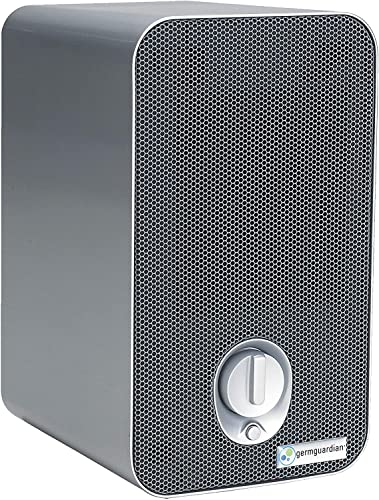
GermGuardian AC4100CA 11-Inch Tabletop Purifier — Zero Ozone Verified — Best for Small Rooms
Everything said about the AC4825’s architecture applies here at desktop scale: HEPA filtration for particles, an internal UV-C lamp for the airstream, and — stated right in the confirmed listing title — zero ozone verified. That phrase is worth pausing on. Ozone is a lung irritant, full stop; regulators in California restrict indoor air cleaners’ ozone emissions for exactly that reason, and a manufacturer that submits a small purifier for zero-ozone verification is telling you which side of the category’s central argument it is on. When you comparison-shop beyond this guide, that certification is the first thing to look for and its absence is the first reason to walk away.
The machine itself is an 11-inch tabletop unit rated in its listing data for rooms up to 375 sq. ft. of coverage in an hour — realistically a bedroom, nursery, home office or dorm room. At this size the UV-C stage is proportionally more meaningful than in a big tower, because the airstream is slower and the air passes closer to the lamp; it is still a supplement to filtration, but it is a sensibly engineered one.
Strengths
- Zero Ozone Verified in the confirmed listing data — the key safety credential in this category
- Correct architecture at small scale: HEPA first, enclosed UV-C second
- Tabletop footprint suits bedrooms, nurseries and desks where a tower will not fit
Trade-offs
- Small coverage is a hard limit; it will not condition a living room no matter how long it runs
- Filter and bulb replacements are a recurring cost that budget listings in this size class often hide
- At this size, fan noise on high is noticeable in a quiet bedroom — plan to live on the low settings
| Filtration | HEPA (Amazon title) |
| UV | UV-C, internal (Amazon title) |
| Ozone | Zero Ozone Verified (Amazon title) |
| Coverage | Up to 375 sq. ft. in 1 hr (Amazon title) |
| Size | 11 inch tabletop (Amazon title) |
This is the pick we would hand to the two audiences who ask about UV purifiers most: parents setting up a nursery and people furnishing a small bedroom or dorm. In both cases the room is small enough for the machine to be genuinely effective, the occupants spend long hours breathing its output at close range — which is precisely when the zero-ozone credential stops being a spec-sheet nicety and becomes the point — and the tabletop format fits the furniture that actually exists in those rooms.
Set it near the bed or desk rather than in the far corner, keep the intake unblocked by bedding or books, and let it run continuously on low. Small purifiers fail by placement more than by design: a unit suffocated behind a curtain is a nightlight with a fan. Given air and time, this one does the small-room job properly.
Best for: nurseries, bedrooms, dorms and home offices — especially where occupants breathe the output at close range for hours / Not suited for: large or open-plan rooms, or anyone who wants one machine for a whole floor
Check on Amazon — check the current price on Amazon, and confirm the size, color and configuration on the listing match what this review describes before ordering.
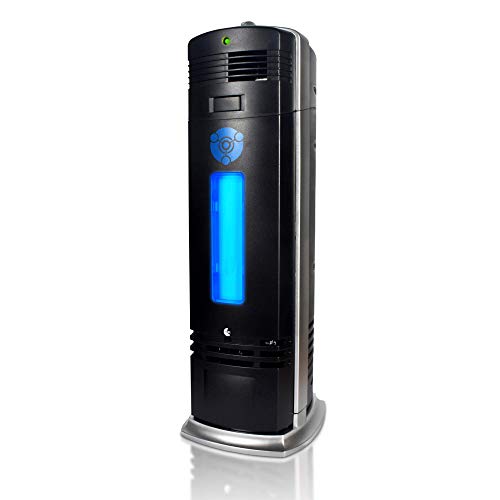
OION Technologies B-1000 Ionic Air Purifier with UV-C — Best Budget — With a Caution
The B-1000 represents the other branch of this category: ionization. Instead of pulling air through a HEPA filter, an ionizer charges particles so they plate out onto collection surfaces or fall from the air. The appeal is real — no filters to buy, near-silent operation, a permanent collection plate you wash — and so is the caveat, and we will state it as plainly as the guide’s health rules require: ionic air cleaners can produce ozone as a byproduct, in amounts that vary by design and condition. Ozone irritates airways, and it is a particularly poor trade for the asthma and allergy sufferers who are this category’s core audience.
So why is it in the guide at all? Because it is a confirmed, widely sold product that shoppers comparing UV purifiers will absolutely encounter, and because the honest advice is nuanced rather than absolutist: in a large, ventilated space, used intermittently for odor control, a modern ionic unit is a tool some households use happily. In a small bedroom, running all night beside a child’s bed, it is the wrong tool, and the two GermGuardian picks above exist precisely for that job. Buy this one, if you buy it, with your eyes open and the room size honest.
Strengths
- No filter replacements — the washable permanent collection system keeps running costs at the bottom of this guide
- Near-silent, fanless-style operation suits spaces where a fan’s hum is unwelcome
- UV-C stage plus ionization in a budget-tier package; check the current price on Amazon
Trade-offs
- Ionizers can emit ozone as a byproduct — the central caution of this entire category, and the reason this pick is third, not first
- Charged particles plate onto walls and furniture near the unit as well as onto its plates; expect a cleaning halo
- No HEPA filter means no verified particle capture rate to compare against the towers in this guide
| Type | Ionic / ionizer with UV-C (Amazon title) |
| Filter | Permanent, washable — no replacements (Amazon title) |
If you own or buy this unit, use it like a ventilation appliance rather than a set-and-forget purifier: run it when the room is in normal use and aired regularly, keep it out of small sealed bedrooms, and never run any ionic machine in a room where someone with asthma sleeps without discussing it with their clinician first. That is not boilerplate — ozone’s airway effects are the reason California’s CARB certifies indoor air cleaners, and ‘CARB certified’ or ‘zero ozone verified’ is the credential to demand of any ionic product, this one included, on its current listing before you order.
The collection plates also deserve respect as a maintenance item. An ionic unit whose plates are filmed with a month of grime is a unit that has stopped working while still glowing reassuringly. Wash the plates on a schedule, dry them fully before reinstalling, and the machine will do its odor-and-dust-settling work about as well as the technology allows.
Best for: large, ventilated rooms and odor duty, for buyers who accept the ionic trade-offs knowingly / Not suited for: small bedrooms, nurseries, and any room where a person with asthma or airway sensitivity sleeps
Check on Amazon — check the current price on Amazon, and confirm the size, color and configuration on the listing match what this review describes before ordering.

GermGuardian AC5250PT 28-Inch 5-in-1 HEPA Tower with UV-C — Best for Large Rooms
Above a certain room size, the category’s center of gravity shifts. The question stops being ‘does it have UV’ and becomes ‘does it move enough air, and does it handle odors’. The verified answer here is the GermGuardian AC5250PT: a 28-inch, 5-in-1 tower rated for large rooms up to 915 sq. ft., with a HEPA pet air filter and an odor-reduction stage for the smell problem that rides alongside the particle problem in open-plan living spaces and large primary bedrooms — cooking, pets, a wood stove, a smoker’s porch door. In this class it is the filtration and odor handling, not the UV bulb, that earn the price step.
The UV-C stage in a large tower plays the same supporting role as in the GermGuardians — irradiating the airstream and the filter face — and the same shopping rules apply with more money at stake: enclosed lamp, a named ozone credential (zero-ozone verification or CARB certification), and replacement bulbs and filters that are actually stocked. A large tower whose filters vanish from the market in two years is an expensive fan.
Key specs (from the verified listing): 5-in-1 HEPA air purifier; large rooms up to 915 sq. ft.; HEPA pet air filter; UV-C light; odor reduction; 28-inch tower, gray; model AC5250PT.
Strengths
- Odor-reduction stage tackles the household smell load that HEPA alone cannot touch — the real reason to buy this class
- High air delivery suits the room sizes where the smaller picks in this guide simply cannot keep up
- Enclosed UV-C architecture keeps the safety profile of the smaller GermGuardian picks at larger scale
Trade-offs
- This is the premium tier of the guide; the machine, its filters and its bulbs all cost accordingly
- Big towers are furniture — measure the corner it will live in before ordering
- Odor stage saturates: in a heavy odor environment it needs replacement on its schedule, not the HEPA’s
Shop this archetype by three numbers and one credential: the AHAM-verified room size (buy for a room somewhat smaller than the rating, so the machine can live on its quiet speeds), the depth of the odor stage if the listing discloses it (more media, longer odor life), the replacement filter cost per year, and the ozone credential. Listings that lead with UV wattage and hide all four of those numbers are telling you what they are.
Placement scales up too: a large tower belongs in the room’s main air path, not sealed behind a sofa, and in a truly open plan, two mid-size units at opposite ends often outperform one flagship — air does not turn corners well, and neither does purification.
Best for: open-plan living areas and large bedrooms with a real odor load alongside particles / Not suited for: small rooms (where it is wasted money) or buyers who will not budget for filter replacements
Check on Amazon — check the current price on Amazon, and confirm the size, color and configuration on the listing match what this review describes before ordering.

Crane Air Purifier with True HEPA Filter and UV Light, EE-5067 — Best Personal-Space Pick
Personal-space purifiers are easy to mock and genuinely useful, provided you buy one for what it is. A small HEPA unit on a desk does not purify the room; it purifies the stream of air in the immediate zone where you sit and breathe for hours, and for an office worker with seasonal allergies, that zone is most of the exposure that matters in a workday. The UV light in this format is proportionally effective for the same reason as the tabletop GermGuardian — slow air, close lamp — and the same enclosed-UV rule applies, doubled: this machine’s output is going directly into your face, at arm’s length, all day. The Crane EE-5067 is the verified form of the format: True HEPA filtration, a UV light, 250 sq ft of stated coverage, a timer, a sleep mode for the nightstand, and a washable particle filter ahead of the HEPA.
That proximity cuts both ways and should shape how you shop. Fan noise that would be invisible across a bedroom is intimate at a desk, so the low speed’s noise matters more than the high speed’s power. And because the unit lives in your personal space, its filter changes are frequent and small — check that replacements are cheap and stocked, because a personal unit with an orphaned filter is a paperweight by spring.
Key specs (from the verified listing): True HEPA filter; UV light; 250 sq feet coverage; timer function; sleep mode; washable particle filter; model EE-5067.
Strengths
- Treats the air you actually breathe for hours at a desk or bedside, rather than diluting effort across a whole room
- Smallest footprint and lowest running cost in the guide
- Proximity makes the enclosed-UV architecture easy to verify and the benefit easy to feel
Trade-offs
- Room-scale claims for this format are fiction; it conditions a personal zone only
- Noise at arm’s length is the make-or-break spec, and listings rarely state it honestly for the low speed
- Tiny filters load fast in dusty environments — monthly checks are the routine
The honest comparison for this pick is not the towers above it but the alternative uses of the same money: for the price tier of a good personal unit (check the current price on Amazon), you are choosing between a modest whole-room machine run on low and a personal machine run properly. If the room is shared or the sufferer moves around it, choose the room machine. If one person sits in one chair with one set of symptoms, the personal unit is the sharper tool.
One setup detail: aim the outlet toward your breathing zone and the intake toward the room, not the reverse. Owners routinely point these backwards, purifying the air behind them with great efficiency. The effect is noticeable enough that getting it right feels like an upgrade.
Best for: desk workers, bedside use, and reading chairs — one person, one seat, long hours / Not suited for: whole-room purification, shared spaces, or anyone expecting it to help beyond arm’s reach
Check on Amazon — check the current price on Amazon, and confirm the size, color and configuration on the listing match what this review describes before ordering.
Commercial Ozone Generator — For Unoccupied Spaces Only — Best Avoided at Home
This entry is in the guide because searches for ozone air purifiers surface these machines prominently, marketed with big room numbers and odor-destroying promises, and because the difference between them and everything else in this guide is the difference between a tool and a liability. An ozone generator does not filter air. It manufactures ozone — a reactive gas that does attack odor molecules — and floods the space with it at concentrations no regulator permits in occupied rooms. Ozone at those levels irritates and can damage airways, harms pets and plants, and degrades rubber and fabrics. The machines carry warnings to run them empty and air the space afterward because those warnings are necessary.
There is a legitimate use: professional remediation of an unoccupied space — a smoke-damaged room, a musty vacant rental — followed by thorough ventilation before anyone re-enters. If that is genuinely your job, you already know the protocol. If you are a homeowner with a smelly living room, it is not your tool: the odor problems of occupied homes are solved by source removal, ventilation, carbon filtration and the HEPA machines above, at concentrations of nothing more exotic than clean air.
This entry is deliberately not linked. Our verification pass found commercial ozone generators listed on Amazon — machines sold with high milligram-per-hour output figures — and we are not sending you to one, because the correct use of this entry is recognition: when a listing promises to ‘eliminate odors’ with ozone in an occupied home, this is the machine type being sold, and the answer is no.
Strengths
- Genuinely effective at attacking entrenched odors in empty, sealed spaces — the one thing it is for
- High output per dollar is exactly why it tempts homeowners, and exactly why it does not belong in one
- Professional remediation (fire, flood, vacancy turnover) is a real trade that uses these under protocol
Trade-offs
- Ozone is a lung irritant; running one in an occupied home is the single worst purchase this category offers
- Damages rubber seals, elastic, some fabrics and houseplants, and is dangerous to pets — birds especially
- Does nothing at all for particles: dust, pollen and dander pass through untouched, because there is no filter
The regulatory picture tells the story cleanly. California’s air resources board certifies indoor air cleaners specifically to cap ozone emissions, and federal health agencies have warned for years that ozone sold as an air cleaner is ineffective at safe concentrations and harmful at effective ones. A technology whose effective dose and safe dose do not overlap is not a home appliance. When a listing for one of these machines shows it beside a smiling family on a sofa, close the tab.
If you already own one: store it for the vacant-property jobs it suits, follow its timer and evacuation instructions to the letter when you use it, and ventilate until the sharp, electric smell is entirely gone before anyone — especially children, older people, anyone with asthma, and any pet — spends time in the space. And for everyday air quality, run one of the filtered machines above instead.
Best for: professionals treating unoccupied spaces under a ventilate-before-entry protocol / Not suited for: occupied homes — categorically, and above all bedrooms and homes with children, pets or asthma
Comparison Table
| Pick | Badge | Key spec | Best for |
|---|---|---|---|
| GermGuardian AC4825 22-Inch Tower HEPA Air Purifier with UV-C | Best Overall | HEPA + internal UV-C, tower, up to 743 sq. ft. AHAM-verified | bedrooms and living rooms that want HEPA purification with an enclosed UV-C stage, and no ozone games |
| GermGuardian AC4100CA 11-Inch Tabletop Purifier — Zero Ozone Verified | Best for Small Rooms | HEPA + internal UV-C, Zero Ozone Verified, 11-inch tabletop | nurseries, bedrooms, dorms and home offices — especially where occupants breathe the output at close range for hours |
| OION Technologies B-1000 Ionic Air Purifier with UV-C | Best Budget — With a Caution | Ionic + UV-C, permanent washable filter, no HEPA | large, ventilated rooms and odor duty, for buyers who accept the ionic trade-offs knowingly |
| GermGuardian AC5250PT 28-Inch Tower | Best for Large Rooms | 5-in-1 HEPA + UV-C + odor reduction, up to 915 sq. ft. | open-plan living areas and large bedrooms with a real odor load alongside particles |
| Crane EE-5067 Air Purifier | Best Personal-Space Pick | True HEPA + UV light, 250 sq ft, timer and sleep mode | desk workers, bedside use, and reading chairs — one person, one seat, long hours |
| Commercial Ozone Generator — For Unoccupied Spaces Only | Best Avoided at Home | Ozone-generating, filterless — a warning entry, not a home recommendation | professionals treating unoccupied spaces under a ventilate-before-entry protocol |
How to Choose the Best Ozone UV Air Purifier Without Buying the Wrong Technology
The category’s vocabulary is the first obstacle. ‘UV’ on a listing means a lamp inside the box; ‘ionic’ means charged particles and a possible ozone byproduct; ‘ozone’ in the product name means the machine’s purpose is making a gas you should not breathe at working concentrations; and ‘ozone-free’ or ‘zero ozone verified’ means the manufacturer has submitted to testing that proves the machine is not doing the third thing. Shoppers routinely buy the second or third believing they are getting the first. Decide which technology you actually want — for almost every home, it is UV-C plus HEPA — and then refuse to be drifted by listings that blur the terms.
After technology, the credential: look for zero-ozone verification, CARB certification for indoor air cleaners, or listing under California’s certified air cleaner list. These are not marketing badges; they are emissions tests, and in a category whose central hazard is an invisible gas, an emissions test is the most meaningful specification on the page. A machine with a slightly lower coverage rating and a real ozone credential is a better buy than a stronger machine without one, every time.
What UV-C genuinely adds — and what it does not
Inside a purifier, UV-C irradiates air moving through the chamber and the surface of the filter where captured microorganisms sit. Given the short exposure in a moving airstream, honest manufacturers describe the benefit carefully: it helps reduce germs in the treated air and discourages microbial growth on the filter. That is a worthwhile supplement, particularly in sick-room and nursery duty. What it does not do: clean surfaces across the room, neutralize odors (that is carbon’s job), remove a single particle of dust (that is the filter’s job), or substitute for ventilation when a room needs fresh air.
Judge UV implementations by lamp placement and replaceability. A lamp positioned to wash the filter face and the full width of the airstream is engineering; a token bulb in a corner of the housing is decoration. And because UV output decays long before the lamp visibly fails, a machine whose bulb is cheap, stocked and user-replaceable will still be delivering its UV benefit in year three, while a sealed unit quietly becomes a fan with a filter.
Ozone, stated plainly
Ozone is a powerful oxidizer, which is why it attacks odors — and why it attacks lung tissue. Health agencies’ position is consistent: ozone in occupied spaces is a respiratory irritant, people with asthma are at particular risk, and at the concentrations where ozone meaningfully deodorizes, it is not safe to breathe. This is why this guide’s recommended machines are zero-ozone designs, why its one ionic pick carries a caution, and why its ozone-generator entry is a warning. If a seller’s copy suggests running an ozone generator while the family is home ‘on low’, that seller has told you everything about their standards.
There is one more subtlety worth knowing: ‘low ozone’ claims without a certification behind them are unverifiable at the kitchen table — you cannot smell ozone reliably at borderline levels, and the sharp smell people associate with it is noticeable only well into the range of concern. Trust the certificate, not the copy.
Filters, Carbon and Coverage: The Specs That Do the Actual Work
Since the filter does most of the work in every recommended machine here, buy the filter system first. True HEPA is a defined standard; ‘HEPA-type’ and ‘HEPA-style’ are not, and the difference shows up precisely in the fine particles — smoke, the smallest allergen fragments — that motivated the purchase. Then carbon: a thin carbon-coated pre-filter freshens air lightly, while a substantial carbon bed is what actually reduces cooking, pet and smoke odors over months. Listings that disclose carbon weight are listings written by people who expect to be compared.
Coverage ratings deserve the same discipline. AHAM-verified room sizes assume a machine running at speeds you can hear; the practical rule is to buy a machine rated for noticeably more space than your room, so it can do its work on the quiet settings you will actually tolerate overnight. A purifier that is technically adequate on turbo and intolerable on turbo is, in a bedroom, an inadequate purifier.
How to Set Up and Run a UV Air Purifier Safely
Setup for this category is half placement, half habits — and the habits are where the safety and the benefit both live.
- Place it where air moves. Give the machine clearance on all sides — intakes blocked by walls, curtains or bedding are the most common cause of ‘my purifier does nothing’. A corner with a foot of breathing room beats the middle of a wall it is pressed against.
- Run it continuously on a quiet speed. Purification is air turnover over time. A machine running 24 hours on low cleans more of a room’s life than daily bursts on high, and it will actually be left on — which is the entire point.
- Keep the UV stage maintained. Replace the UV-C bulb on the maker’s schedule, not when it stops glowing — output fades first. Never look directly at an exposed UV lamp during a bulb change, and never run a machine with its housing open.
- Respect the filter calendar. Vacuum pre-filters monthly, replace HEPA and carbon stages on schedule. A loaded filter strangles airflow, and a strangled machine delivers neither filtration nor UV exposure worth the name.
- Ventilate as well as purify. A purifier recirculates; it does not bring in fresh air or remove carbon dioxide. Open windows when weather and pollen allow — purification and ventilation are partners, not substitutes.
- Keep ozone-producing devices out of sleeping rooms. If you own any ionic or ozone-capable device, the rule from this guide’s reviews applies without exception: not in a bedroom, not overnight, not around children, pets or anyone with asthma.
Set up this way, a good UV-C HEPA machine becomes the most boring appliance in the house — quiet, constant, and forgotten — which is exactly what clean air should feel like.
Common Buying Mistakes
Buying an ozone generator as a home air purifier. The category’s defining mistake. Ozone generators are for empty spaces under a ventilation protocol. For occupied homes, the answer is filtration — see the warning entry among the picks.
Believing UV replaces the filter. UV treats microorganisms in the airstream; it removes no dust, pollen, dander or smoke. A UV device without a true HEPA stage is not purifying the air in any sense your allergies will notice.
Ignoring the ozone credential. In this category the emissions certificate is the spec. Zero-ozone verification or CARB certification should be a requirement, not a tiebreaker — especially for bedrooms and nurseries.
Sizing to the room exactly. Ratings assume audible speeds. Buy coverage above your room size so the machine can work on the quiet settings, or it will live switched off.
Never replacing the UV bulb. A glowing bulb is not necessarily an effective bulb. UV output decays with hours; replace on schedule or quietly lose the feature you paid for.
Final Recommendation
For most homes the answer in this category is the GermGuardian AC4825: a real HEPA tower with an enclosed UV-C stage and no ozone agenda. Small rooms and nurseries should take the AC4100CA and its zero-ozone verification. The OION ionic unit is a budget option for large, ventilated spaces, bought knowingly. The large-room AC5250PT and the personal-space Crane cover the scales the first three picks do not — and the ozone generator entry is there so that the most dangerous machine in the category is the one you recognize on sight and leave on the shelf.
Keep exploring the same corner of the house with these related guides from this series: Best Air Purifiers For Allergies Best Air Purifiers For Pet Hair Best Quiet Air Purifiers For Bedrooms Best Air Purifiers For Smoke Best HEPA Air Purifiers For Large Rooms
Related guides
Frequently Asked Questions
Is ozone from an air purifier dangerous?
At the concentrations ozone generators produce for deodorizing, yes — ozone is a respiratory irritant, and health agencies advise against using ozone-generating devices in occupied spaces. That is why every recommended machine in this guide is a zero-ozone or enclosed-UV design, and why the guide’s ozone-generator entry is a warning rather than a recommendation.
What does the UV-C light in a purifier actually do?
It irradiates air passing through the machine and the surface of the filter, which helps reduce microorganisms in the treated airstream and discourages growth on the filter itself. It is a supplement to HEPA filtration — it does not remove particles, does not treat the room’s surfaces, and does not replace ventilation.
What does ‘Zero Ozone Verified’ or CARB certification mean?
It means the machine’s ozone emissions have been independently tested and certified as negligible (in California’s case, under the state’s air-cleaner certification program). In a category where the main hazard is an invisible gas, that emissions credential is the most trustworthy specification a listing can carry.
Can a UV air purifier replace my HEPA purifier?
The recommended machines are HEPA purifiers with UV added — the technologies are partners, not alternatives. UV alone removes nothing from the air. If you must choose one, choose HEPA filtration; add UV when the machine’s architecture and ozone credentials are sound, as in this guide’s top picks.
How often do UV bulbs and filters need replacing?
Follow each maker’s schedule: HEPA and carbon stages typically run on a months-long cycle, and UV-C bulbs on a longer one — but replace bulbs by hours used, not by whether they still glow, because germicidal output fades before visible light does. Budget for these consumables when comparing machines; they are the true running cost of the category.
Why does one entry in this guide have no buy link?
Only one entry — the ozone-generator warning — has no buy link, and that is deliberate rather than a gap: our verification pass found those machines on sale and we will not link to a product we are telling you not to bring into an occupied home. The other five entries are confirmed listings and link normally.


