Disclosure: airfryerkitchensupply.com is reader-supported. When you buy through links on our site, we may earn an affiliate commission at no extra cost to you.
Where to buy
For readers comparing the best office chairs for leaning forwards, every chair below was cross-checked against the Amazon catalog data available to us, and each pick links straight to its Amazon listing so you can check the current price on Amazon and read the full specification sheet before you commit. If a chair is listed here, it is a complete chair sold as a complete chair — no parts, no add-ons dressed up as picks. Start with these links:
- Varier Move Tilting Saddle Stool — Check the current price on Amazon
- Ergooffile Adjustable Standing Desk Chair (Leaning Perch) — Check the current price on Amazon
- 2xhome Ergonomic Saddle Stool with Adjustable Tilt — Check the current price on Amazon
- Office Star Saddle Drafting Stool with Footring — Check the current price on Amazon
- DRAGONN by VIVO Ergonomic Kneeling Chair — Check the current price on Amazon
- Herman Miller Classic Aeron Task Chair (Seat Angle Adj.) — Check the current price on Amazon
The best office chairs for leaning forwards solve a posture problem that standard chairs quietly create. Most desk chairs are designed around a reclined ideal: backrest behind you, weight settled into a bucket seat, screen at a distance. But a large share of real desk work — sketching, drafting, writing by hand, examining documents, working over a drawing tablet, playing an instrument at a desk, soldering, model-making — pulls you forward. In a conventional chair you end up perched on the front edge of the seat, backrest abandoned, feet hooked around the base, lower back rounding a little more every hour. The chair is not broken; it is simply designed for the opposite lean.
Forward-lean seating attacks the problem from the seat pan rather than the backrest. A seat that tilts forward — or a saddle or perch shape that is forward by design — opens the angle between your thighs and torso, lets your pelvis roll into a neutral position, and moves your center of mass over your feet instead of behind them. Your back then stacks itself with far less muscular effort, and leaning into the work stops being a posture you collapse into and becomes a posture the chair supports. Kneeling chairs reach a similar place from another direction, shifting part of your weight onto your shins so the forward lean is the structure, not the exception.
Honesty about claims matters in this category, so here is our rule for this guide: a pick only appears if its listing title states the forward-lean mechanism — a tilting saddle, an adjustable seat angle, an angled kneeling seat, a leaning perch. We do not claim forward tilt for chairs whose titles merely say ‘ergonomic’ or ’tilt,’ because ordinary backrest tilt usually reclines you, the opposite of what this search wants. Six products passed that test, from a premium Norwegian tilting saddle to a classic task chair with a stated seat-angle adjustment. None of them will suit a full day of reclined reading, and we say so in each review — forward seating is a tool for forward work.
Key Takeaways
- Forward lean is a seat mechanism, not a backrest feature: look for tilting saddles, adjustable seat angles, angled kneeling seats or leaning perches — all stated in these titles.
- Match the format to your desk height first: kneeling and seat-angle chairs for standard desks; saddles and perches for drafting and sit-stand heights.
- Ramp up over two weeks in short sessions, and keep a conventional chair for reclined tasks.
- Kneeling chairs load the knees — choose a saddle or perch if yours are troublesome.
In this guide
Quick Picks
Varier Move Tilting Saddle Stool — Best Overall: A height-adjustable tilting saddle stool designed by Per Øye — the saddle pivots with you as you lean into the desk, keeping the forward posture supported rather than perched. Check on Amazon
Ergooffile Adjustable Standing Desk Chair (Leaning Perch) — Best for Sit-Stand Desks: A wobble perch whose title says ‘leaning perch seat’ outright — built for the half-standing, forward-leaning position at a raised desk. Check on Amazon
2xhome Ergonomic Saddle Stool with Adjustable Tilt — Best Adjustable Saddle: A backless rolling saddle stool with adjustable height and tilt stated in the title, in PU leather with a foam padded seat — the drafting and studio format at an accessible tier. Check on Amazon
Office Star Saddle Drafting Stool with Footring — Best with Footring: A saddle drafting stool whose title states an adjustable seat angle and an adjustable footring — forward tilt plus somewhere proper for your feet at drafting height. Check on Amazon
DRAGONN by VIVO Ergonomic Kneeling Chair — Best Kneeling Chair: A kneeling chair with an angled seat and thick moulded foam cushions stated in the title — the forward lean becomes the structure of the chair itself. Check on Amazon
Herman Miller Classic Aeron Task Chair (Seat Angle Adj.) — Best Full Chair Option: A classic Aeron listing whose title states a tilt limiter with seat angle adjustment and fully adjustable arms — forward seat angle inside a full ergonomic chair. Check on Amazon
How These Picks Were Chosen
We cross-checked candidates through the site’s Amazon listing data access and read titles literally. Qualifying mechanisms were: a tilting or pivoting saddle seat, an adjustable seat angle, an angled kneeling seat, or a perch seat described as leaning. Chairs with only backrest recline, however good, were excluded — recline is not forward tilt. Replacement tilt mechanisms and parts were also excluded; this guide recommends complete seats, not components.
The six survivors split into three families, and we kept all three because forward-leaners disagree about which suits them. Saddle and perch stools (Varier Move, Ergooffile, 2xhome, Office Star) keep you semi-elevated with feet planted, ideal at drafting tables and sit-stand desks. Kneeling chairs (the DRAGONN) commit fully to the forward posture with shin support. And one full task chair (the Herman Miller Aeron Classic listing) offers a stated seat-angle adjustment inside a conventional chair, for readers who lean forward for part of the day and sit back for the rest. Prices are not printed anywhere in this guide — check the current price on Amazon from each pick’s link — and every feature quoted comes from the verified listing title, with gaps flagged as ‘not stated’ rather than filled in.
The 6 Best Office Chairs for Leaning Forwards

Varier Move Tilting Saddle Stool — Best Overall
The Varier Move is the product that defined this category, and its title states the essential mechanism without decoration: a tilting saddle stool. The saddle shape straddles like a bicycle seat writ large, which drops your thighs downward at an angle a flat seat cannot achieve, and the base pivots so the seat follows your lean instead of fighting it. Lean toward a drawing and the saddle tips with you; sit back upright and it returns. That following motion is the whole point — your weight stays supported through the lean rather than sliding you toward the seat’s front edge.
The height-adjustable gaslift makes it a natural partner for sit-stand desks and drafting tables, where the working surface sits higher than a standard desk and a normal chair leaves you hunched. Perched on the Move at counter height, your feet stay planted, your hips stay open, and the forward lean toward the work surface becomes short and supported. The listing notes it is designed by Per Øye and intended for height-adjustable desks, which matches exactly the use case this search describes.
The trade-offs are inherent to the format. There is no backrest and no armrest — by design, since both would anchor you backward — so this is a working seat for active tasks, not a chair for a three-hour video call marathon. Saddle seats also have a learning curve: the first days can feel unfamiliar through the inner thighs, and most people build up time gradually. The title does not state a weight capacity, so heavier users should confirm the rating on the full listing before ordering. For the right user, though, this is the purest answer to the keyword that exists.
Strengths
- Tilting saddle mechanism stated in the title — the seat follows your forward lean
- Height-adjustable gaslift suits drafting tables and sit-stand desks
- A long-established specialist design rather than a generic stool
Trade-offs
- No backrest or armrests — not a chair for reclined tasks
- Saddle format has an adjustment period for new users
- Weight capacity is not stated in the title
| Spec (as stated in the listing title) | Detail |
|---|---|
| Seat (title-stated) | Tilting saddle stool |
| Adjustment (title-stated) | Height adjustable gaslift |
| Designer (title-stated) | Designed by Per Øye |
Best for: Forward-lean workers at adjustable desks who want the reference design / Not suited for: Anyone who wants a backrest or armrests
Check the current price on Amazon

Ergooffile Adjustable Standing Desk Chair (Leaning Perch) — Best for Sit-Stand Desks
Some forward leaners are not really sitting at all. At a standing desk raised to working height, the natural rest position is a perch: hips on a raised seat, legs angled down, torso tipped slightly forward over the work. The Ergooffile is built for exactly that position, and its title uses the words ‘leaning perch seat’ — the most literal match to this search in the entire catalog. The wobble base lets the seat tip and swivel 360 degrees, so leaning left toward a reference monitor or forward over a keyboard is met by the seat rather than resisted by it.
As an adjustable standing-desk chair, it fills the gap between standing all day (fatiguing) and sitting all day (the problem you bought a standing desk to escape). Perching unloads the legs while keeping the hip angle open and the torso tall, and because your feet carry real weight, shifting position is constant and unconscious — you will move more without deciding to. For forward-lean work like editing timelines, reviewing prints or working over a bench, that supported lean is the position your body keeps asking a normal chair for and not getting.
Set expectations correctly. A perch is a partial seat: it supports a fraction of your weight, and sessions are measured in stretches between standing and walking, not in eight-hour sits. The wobble base that makes leaning pleasant also demands a basic level of balance, and the title does not state a weight capacity — check the full listing. The title’s marketing language also mentions core and posture benefits; we make no such claims here beyond the mechanical description above. As a perch for a sit-stand setup, it is the most direct tool in this guide.
Strengths
- ‘Leaning perch seat’ stated in the title — a literal match for forward-lean work
- Wobble base and 360° swivel let the seat follow your lean
- Purpose-built for standing desks, where standard chairs are too low
Trade-offs
- A perch supports only part of your weight — not an all-day full seat
- Wobble base requires balance; not for everyone
- Weight capacity is not stated in the title
| Spec (as stated in the listing title) | Detail |
|---|---|
| Seat (title-stated) | Leaning perch seat |
| Motion (title-stated) | 360° swivel wobble stool |
| Use (title-stated) | Standing desk chair |
Best for: Sit-stand desk users who perch more than they sit / Not suited for: Traditional seated work at a standard-height desk
Check the current price on Amazon

2xhome Ergonomic Saddle Stool with Adjustable Tilt — Best Adjustable Saddle
The 2xhome takes the saddle concept and adds the one adjustment that matters most for this search: tilt. Its title states adjustable height and tilt on a backless rolling task chair, which means you can dial the saddle’s forward angle to match your desk and your task — a few degrees for keyboard work, more for leaning over a bench or drawing board. That adjustability separates it from fixed-angle stools, because forward lean is personal: the right angle depends on your desk height, your thigh length and how far over the work you need to reach.
The format — PU leather over a foam padded saddle, on a rolling base — is the standard studio and drafting stool, and the title name-checks drafting, medical and dental use. Those professions lean forward for a living, over patients, benches and boards, and the stool format persists there because it works: feet on the floor or the base ring, hips high, torso free to tip forward without a backrest pushing back or armrests fencing you in. For home users — artists, makers, musicians, anyone whose desk work is hands-first — the same logic applies.
A backless stool is a commitment. Without a backrest, your own muscles hold your torso, which is precisely the point for active tasks and precisely the problem for passive ones; nobody should buy this as their only chair for long stretches of reading or calls. PU leather wipes clean — good for studios — but will not breathe like mesh in a hot room. And as with the other stools here, the title states no weight capacity, so verify it on the full listing if that is a concern. Within its intended job, it is the most adjustable saddle in this guide at an accessible tier.
Strengths
- Adjustable tilt stated in the title — set your own forward angle
- Saddle format proven in drafting, medical and dental work
- PU leather wipes clean in studio and workshop settings
Trade-offs
- Backless — your muscles do the work a backrest would
- PU leather runs warm in un-air-conditioned rooms
- Weight capacity is not stated in the title
| Spec (as stated in the listing title) | Detail |
|---|---|
| Seat (title-stated) | Saddle stool, backless |
| Adjustment (title-stated) | Adjustable height and tilt |
| Upholstery (title-stated) | PU leather, foam padded seat |
Best for: Drafting, studio and bench work on a budget / Not suited for: Long reclined sitting — there is no backrest
Check the current price on Amazon

Office Star Saddle Drafting Stool with Footring — Best with Footring
Drafting height changes the forward-lean equation. When the work surface is at standing-ish height, the seat rises too, and your feet dangle — and dangling feet drag your pelvis backward, undoing the open hip angle the saddle created. The Office Star answers with the detail its title states plainly: an adjustable footring alongside the adjustable seat angle. Set the saddle’s forward tilt for your task, then set the ring where your feet actually rest, and the whole chain — feet, knees, hips, spine — lines up in the forward posture instead of fighting itself.
The rest of the stated specification is workmanlike in the best way: black vinyl upholstery that wipes down, a backless saddle format for unobstructed leaning, and a design the title describes as suitable for commercial and home use. This is the stool format found beside drafting tables, lab benches and workshop counters, where people lean over work for hours and need to slide sideways along a bench — something a wheeled stool does and a fixed chair does badly. If your home office doubles as a making space, that sideways mobility is worth as much as the tilt.
Note the casters: the title states carpet casters, so on hard floors this stool belongs on the list of chairs to check carefully — roll it on a mat or expect harder rolling and possible floor marking, and see our laminate-floor guide if that is your surface. The drafting height also makes it the wrong tool for a standard 29-inch desk; your knees would jam the underside. And the backless format carries the same caveat as every stool here — it is for active, forward work, in sessions, not for settling in with a novel.
Strengths
- Adjustable seat angle stated in the title — true forward-tilt control
- Adjustable footring supports feet properly at drafting height
- Vinyl upholstery wipes clean; built for commercial and home use
Trade-offs
- Carpet casters stated in the title — use care or a mat on hard floors
- Drafting height is too tall for standard desks
- Backless format suits active sessions, not long passive sitting
| Spec (as stated in the listing title) | Detail |
|---|---|
| Seat angle (title-stated) | Adjustable height and seat angle |
| Footring (title-stated) | Adjustable footring |
| Upholstery (title-stated) | Black vinyl |
Best for: Drafting-height work where feet need support / Not suited for: Standard desk heights, where a drafting stool sits too tall
Check the current price on Amazon
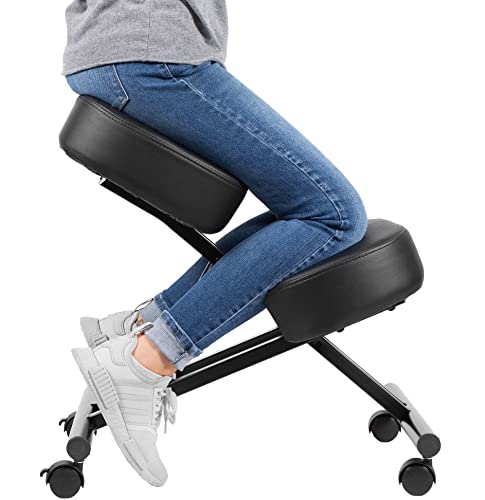
DRAGONN by VIVO Ergonomic Kneeling Chair — Best Kneeling Chair
The kneeling chair is the most committed answer to leaning forward: instead of a seat that permits the posture, it is a frame that consists of it. The DRAGONN’s title states the essentials — an angled seat, thick moulded foam cushions, brake casters. Your weight splits between the angled seat and the shin pads, your thighs slope steeply downward, and your pelvis settles into the open, forward-tilted position that saddle stools approximate. There is no slumping option; the geometry holds you in the lean, which is why devotees describe kneeling chairs as the one seat where their back stays straight without effort or reminders.
The moulded foam cushions matter because kneeling chairs live or die on padding. Your shins carry a real share of your weight for hours, and thin pads announce themselves by the second hour. Thick moulded foam, shaped rather than flat, spreads that load. The brake casters are a thoughtful touch in the same practical spirit: a kneeling chair you mount by kneeling onto it should not roll away mid-mount, and the brakes hold it while you settle, then release for normal repositioning.
The cautions are real and we will not soften them. Kneeling chairs load the knees and shins, so anyone with knee problems should look at the saddles instead — and ideally take proper advice before buying any posture furniture. Getting in and out is a small athletic event compared with a normal chair, which wears thin if your work has you up every five minutes. And the posture is all-or-nothing: there is no recline mode for a phone call. For the reader whose work is hours of forward focus at a standard desk, though, this is the strongest structural answer in the guide.
Strengths
- Angled seat stated in the title — the forward posture is built into the geometry
- Thick moulded foam cushions for the shin load kneeling creates
- Brake casters hold the chair steady while you mount it
Trade-offs
- Loads the knees and shins — not suitable for everyone
- Getting in and out takes more effort than a normal chair
- No recline or backrest mode for passive tasks
| Spec (as stated in the listing title) | Detail |
|---|---|
| Seat (title-stated) | Angled seat |
| Cushions (title-stated) | Thick moulded foam cushions |
| Casters (title-stated) | Brake casters |
Best for: Committed forward-posture sitters at standard desks / Not suited for: Anyone with knee problems, or who gets up and down constantly
Check the current price on Amazon

Herman Miller Classic Aeron Task Chair (Seat Angle Adj.) — Best Full Chair Option
Not everyone can dedicate their only chair to leaning forward. If your day mixes heads-down forward work with reclined calls and reading, a stool leaves you stranded for half of it. This Herman Miller Classic Aeron listing is the compromise candidate, and it qualifies for this guide on a specific stated feature: a tilt limiter with seat angle adjustment. Seat angle adjustment lets you set the seat pan level or tipped forward rather than accepting the backward-sloping bucket most chairs impose, and the tilt limiter controls how far the chair reclines when you do sit back. Between the two, the chair can be configured for a forward working posture in the morning and a supported recline after lunch.
The rest of the title describes the classic Aeron formula: a lumbar pad, fully adjustable vinyl arms, and the chair’s well-known mesh suspension format (the listing is for the Classic model, and it states carpet casters — a point for hard-floor owners to note). For forward work, the adjustable arms earn their keep: set them low or swing your elbows inside them and they stop dictating your distance from the desk, the usual reason people abandon the backrest and perch.
Be clear about what this is not. It is not a perch, a saddle or a kneeling chair; the forward angle available from a seat-pan adjustment is a few useful degrees, not a new posture, and a worker who leans over a bench all day will get more from the Varier Move above. The Classic is also an older model line, and this listing’s stated carpet casters are the wrong tread for hard floors without a mat. But as the one full chair in this guide whose title actually states seat angle adjustment, it is the honest pick for mixed-use days.
Strengths
- Seat angle adjustment stated in the title — rare on a full task chair
- Tilt limiter lets you bound the recline for the rest of the day
- Fully adjustable arms stop dictating your distance from the desk
Trade-offs
- Forward angle is modest compared with a saddle or perch
- Classic model listing states carpet casters — use a mat on hard floors
- Premium-brand pricing tier; check the current price on Amazon
| Spec (as stated in the listing title) | Detail |
|---|---|
| Seat (title-stated) | Seat angle adjustment |
| Tilt (title-stated) | Tilt limiter |
| Support (title-stated) | Lumbar pad |
| Arms (title-stated) | Fully adjustable vinyl arms |
Best for: Mixed days — forward work and reclined calls in one chair / Not suited for: Purists who want a dedicated perch or saddle
Check the current price on Amazon
Comparison Table
| Pick | Badge | Key spec | Best for |
|---|---|---|---|
| Varier Move Tilting Saddle Stool | Best Overall | Tilting saddle seat; height-adjustable gaslift | Forward-lean workers at adjustable desks who want the reference design |
| Ergooffile Adjustable Standing Desk Chair (Leaning Perch) | Best for Sit-Stand Desks | Leaning perch seat; 360° swivel; adjustable height | Sit-stand desk users who perch more than they sit |
| 2xhome Ergonomic Saddle Stool with Adjustable Tilt | Best Adjustable Saddle | Adjustable height and tilt; PU leather saddle; foam padded | Drafting, studio and bench work on a budget |
| Office Star Saddle Drafting Stool with Footring | Best with Footring | Adjustable seat angle; adjustable footring; vinyl upholstery | Drafting-height work where feet need support |
| DRAGONN by VIVO Ergonomic Kneeling Chair | Best Kneeling Chair | Angled seat; moulded foam cushions; brake casters | Committed forward-posture sitters at standard desks |
| Herman Miller Classic Aeron Task Chair (Seat Angle Adj.) | Best Full Chair Option | Seat angle adjustment; tilt limiter; lumbar pad | Mixed days — forward work and reclined calls in one chair |
Why Forward-Leaning Hurts in a Normal Chair — and What Changes It
Sit in a standard office chair and lean toward your screen or your work. Three things happen. Your weight slides toward the front edge of a seat designed to hold you at the back. The backrest — the expensive ergonomic part you paid for — leaves your back entirely, because you have leaned away from it. And your hip angle closes: thighs roughly level, torso tipped forward, the pelvis rolling under until your lower spine rounds into a C. Hold that for an hour of detailed work and the ache that follows is not weakness; it is geometry. The chair offered support for exactly one posture, and your task required another.
Forward-lean seating changes the geometry at the seat. Tip the seat pan forward — or replace it with a saddle, perch or kneeling frame — and the thighs slope downward, the hip angle opens past ninety degrees, and the pelvis can rest in its neutral tilt instead of rolling under. From a neutral pelvis, the spine’s natural curves stack with far less muscular holding, and leaning toward the work becomes a position you rest in rather than a position you endure. This is why drafting, dentistry and bench crafts settled on stools generations before ‘ergonomics’ was a marketing word: the work is forward, so the seat is too.
Two honest limits. First, forward seats trade support for freedom: without a backrest, long passive tasks — reading, calls, watching — fatigue faster, which is why many owners pair a forward seat with a conventional chair and switch by task. Second, no chair fixes a badly set desk. If your work surface is too low, you will hunch over any seat; the forward lean should come from the hips over a surface at the right height, not from the neck and shoulders reaching down. Set the desk and the seat as one system.
How to Choose Among Saddles, Perches, Kneeling Chairs and Seat-Angle Chairs
Match the seat to the desk first. At a standard-height desk, the realistic options are a kneeling chair or a conventional chair with seat angle adjustment — saddles and perches sit too high and will jam your thighs under the desktop. At a drafting table, counter or sit-stand desk, the field opens: saddles and perches come into their own, using the height that a normal chair wastes. Measure your surface height before you fall in love with any format in this guide; more forward-lean purchases fail on desk height than on the seat itself.
Next, match the seat to the task’s rhythm. If you sit for long, unbroken, forward-focused stretches — drawing, bench work, detailed editing — the kneeling chair’s structural support pays off, because it holds the posture when your attention is entirely on the work. If you are up and down constantly, choose a saddle or perch you can mount in one motion; a kneeling chair’s entry and exit will annoy you by day three. If your day is genuinely mixed, forward and back, the seat-angle task chair is the adult compromise: less forward than the specialists, but never the wrong chair for the next meeting.
Finally, plan the adaptation honestly. Every format in this guide asks muscles and joints to work differently, and the first week should be built in short sessions — an hour on the new seat, back to the old chair, repeat — rather than a heroic full day that leaves you sore and the stool in a corner. Kneeling chairs deserve a specific caution: they load the knees and shins, so if yours are already troublesome, start with a saddle instead. And whatever you choose, keep your old chair for the first month. Forward seating is a tool added to a workspace, not a religion, and the best setups we know keep both options within rolling distance.
Forward-Lean Seating at a Standard Desk: The Realistic Options
Most readers of this guide do not own a drafting table. They own a standard desk, roughly 29 inches high, and a growing suspicion that their chair is why detailed work leaves them folded in half. So it is worth stating plainly which of this guide’s formats actually work at that desk. The kneeling chair works: it was designed for standard heights, holding the forward posture with your shins while your hands stay at desktop level. The seat-angle task chair works: a few degrees of forward pan inside a normal chair, under a normal desk, with a backrest waiting when the task changes. Those are the two standard-desk answers, and both are in this guide with their mechanisms stated in their titles.
The saddles and the perch, by contrast, need height the standard desk does not offer. A saddle holds your hips well above chair height; slide it under a 29-inch desktop and your thighs meet the underside before your hands meet the work. This is the mismatch behind most returned stools, and it is nobody’s fault but the measuring tape’s. If your desk is height-adjustable, the calculus flips: raise the desk, and the saddle and perch become available, with the perch in particular coming into its own in the sit-stand rhythm — stand for a stretch, perch for a stretch, and the forward lean is supported through both.
There is also a hybrid worth knowing: many forward-leaners at standard desks end up running two seats — the kneeling chair or angled task chair as the main seat, and their old conventional chair rolled to the side for calls and reading. That sounds indulgent until you price it against a single premium chair that does both jobs badly. Two honest tools beat one compromise, and the second tool is usually already in your house. Whichever route you take, measure your desk height before ordering anything in this guide; it is the one number that decides which half of the guide is yours.
Forward Lean and Your Eyes: Placing Screens and Documents
Forward-lean seating changes your eye geometry, and setups that ignore this undo the chair’s work at the neck. In a conventional reclined posture, your eyes sit back and slightly down; on a saddle, perch or kneeling chair, you sit higher and more upright, and your gaze naturally levels. A screen positioned for your old chair — low on its factory stand, tilted up at a slumped face — now sits below your eye line, and you will crane down to meet it, trading the back posture you bought for a neck posture you did not. Raise the screen so its center sits at or just below your new eye level, and bring it a little closer: the upright posture shortens your comfortable viewing distance, and a screen left at reclined distance invites exactly the forward head poke the seat was meant to retire.
Paper and tablets need the same respect. Flat documents on a desk force the steepest lean in office life — your whole trunk tips to bring your eyes over the page — and no seat geometry fully rescues it. A sloped reading stand or drafting slope shortens that lean dramatically by bringing the work up to meet your gaze, and it pairs with forward seats the way a footrest pairs with a tall chair: the seat opens your hips, the slope closes the remaining distance. Artists and annotators discovered this pairing generations ago; it is why drafting tables tilt. If your forward work is mostly paper, budget for the slope before you budget for a second stool.
Lighting completes the triangle. Forward postures put your head and shoulders between ceiling lights and the work more often, shadowing the page with your own body. A desk lamp placed to the side opposite your writing hand — the classic drafting arrangement — exists precisely because forward workers lean over their light. Set the chair, raise the screen, slope the paper, light from the side: four small decisions that together decide whether your forward-lean setup feels like a revelation or like an expensive way to acquire a stiff neck.
How to Set Up a Forward-Lean Seat at Your Desk
Start with height, because height decides everything else. For a saddle or perch at a sit-stand or drafting surface, raise the seat until your hips sit clearly above your knees with your feet flat and bearing weight — you should feel perched, not seated, with your thighs sloping down at a comfortable angle. For a kneeling chair at a standard desk, set the seat so your shins rest fully on the pads without your knees taking your whole weight; your sitting bones should still carry the majority. For a seat-angle task chair, begin with the pan level, then tip it forward one notch at a time over several days until you find the angle where leaning in feels supported rather than slidey — too much angle and you will brace your feet all day against sliding forward.
Then set the desk to the seat, not the other way round. Your work surface should meet your hands where they naturally fall in the forward posture: elbows loosely bent, shoulders down, work directly in front of your sternum rather than off to one side, which twists the lean. If you work on paper, a tablet or a bench piece, bring it closer and, if you can, raise it — a sloped drawing board or a stand under a tablet shortens the lean your back has to make, and the seat only has to supply the rest. Screen users should raise the monitor so its center sits near eye level in the forward posture; a perch above a laptop on a low desk is a neck ache with extra steps.
Finish with a two-week ramp. Use the new seat for your most forward tasks first, in sessions of an hour or so, and keep your old chair for calls and reading. Note what you feel at the end of each session — fresh legs and an easy back mean the setup is close; numb shins, sore knees or a stiff neck mean adjust height or angle before adding time. By the end of the second week most people know their format’s honest place in the day, and that — a forward seat used for forward work, in the hours it suits — is the outcome this guide is aiming for.
Common Buying Mistakes
Buying a reclining chair and calling it forward-tilt. Ordinary tilt reclines the backrest. Forward lean needs the seat itself to tip, angle or be shaped for it. If the listing does not state a seat mechanism, it does not have one.
Matching a drafting stool to a standard desk. Saddles and perches sit high by design. Under a standard desktop they jam your thighs and force a worse hunch than the chair you replaced.
Starting with a full day on a kneeling chair. New postures need ramping. Build up in hour-long sessions over two weeks, or soreness will convince you the format failed when the schedule did.
Ignoring knee load. Kneeling chairs rest real weight on the shins and knees. If your knees are already a problem, choose a saddle or perch instead of pushing through.
Leaning from the neck instead of the hips. A forward seat opens the hips; the work still has to be raised and brought close. A perch plus a low laptop equals an expensive neck ache.
Final Recommendation
For most readers, the Varier Move is the reference pick: a tilting saddle from the designer who defined the category, equally at home at a drafting table or a sit-stand desk. Sit-stand users who perch more than they sit should look at the Ergooffile leaning perch, while the 2xhome and Office Star saddles bring adjustable tilt and a footring respectively to more accessible tiers. If you want the posture held for you through long focused sessions, the DRAGONN kneeling chair is the structural answer — and if your day is honestly mixed, the Aeron Classic listing’s stated seat angle adjustment makes it the one full chair that belongs in this guide.
Whichever format you choose, set it up patiently, ramp your hours, and keep your old chair nearby for the tasks that lean back. Forward work deserves a forward seat; it does not require a forward life.
Best Office Chairs For Sit And Stand Best Office Chairs For Back And Posture Best Office Chairs For Your Core Best Office Chairs Home Office Chairs
Frequently Asked Questions
What is the difference between forward tilt and regular tilt?
Regular tilt reclines the backrest — it leans you back. Forward tilt tips the seat pan itself forward, opening the hip angle so you can lean toward your work with your pelvis in a neutral position. They solve opposite problems, and a listing that only says ’tilt’ almost always means the reclining kind.
Are kneeling chairs bad for your knees?
Kneeling chairs rest part of your weight on your shins, so they are not the right choice for everyone — particularly anyone with existing knee problems. The DRAGONN in this guide uses thick moulded foam cushions to spread that load, and short, ramped-up sessions are the sensible way to start. If in doubt, a saddle stool gives much of the same hip angle without loading the knees.
Can I use a saddle stool at a normal desk?
Usually not comfortably. Saddles and perches hold you higher than a chair, and under a standard-height desktop your thighs will collide with the underside. They belong at drafting tables, counters and sit-stand desks. For a standard desk, look at the kneeling chair or the seat-angle task chair in this guide.
How long does it take to get used to a forward-lean seat?
Plan on about two weeks of graduated use — hour-long sessions for your most forward tasks, building up as it feels easier. Some initial unfamiliarity, especially with saddle seats, is normal. Persistent knee, shin or neck pain is not; it usually means the height or angle needs adjusting, or the format is not right for you.
Do forward-lean chairs help your back?
We make no medical claims. Mechanically, these seats open the hip angle and let the pelvis rest neutrally instead of rolling under, which many users find more comfortable for forward work than perching on a standard chair’s edge. Anyone with ongoing back problems should take professional advice about their specific situation rather than relying on furniture marketing — including ours.
Can I switch between a perch and a regular chair?
Yes, and many people do exactly that: forward seat for focused desk work, conventional chair for calls and reading. The formats complement rather than replace each other, and keeping both within reach is the setup we recommend while you learn which tasks suit which seat.
Can I add forward tilt to my existing chair?
Not safely or simply. Tilt mechanisms are model-specific replacement parts — our research surfaced several, and this guide excludes parts as picks because fitting the wrong mechanism to a chair is a safety problem, not an upgrade. If your current chair lacks a seat-angle feature, the honest routes are a kneeling chair, a saddle at a suitable desk, or a chair that states the feature, like the Aeron listing in this guide.


