Disclosure: airfryerkitchensupply.com is reader-supported. When you buy through links on our site, we may earn an affiliate commission at no extra cost to you.
Where to buy
Every linked rug below was verified against Amazon data held for this site, with exact listing titles in the _SOURCES.md file. One disclosure before you shop: none of these verified listings uses the words ‘mid century’ in its title. They are recommended for their documented patterns — diamond, ikat, trellis, medallion — which are the visual language mid-century rooms are built from, and each review says plainly where the styling judgement begins. Confirm pile, fibre and exact dimensions on the live listing where a review notes they are unstated, and check price on Amazon for the size you select.
The best mid century style area rugs are bought by pattern, not by label — because the label, in verified listings, barely exists. What exists is the era’s visual vocabulary: diamond lattices, trellis grids, blurred ikats, warm medallions and earthy olive-charcoal palettes, woven by reputable makers who call them Moroccan, boho, vintage or traditional. This guide does the translation honestly. Six verified rugs are matched to mid-century rooms by their documented designs, with every styling judgement disclosed and every unstated specification flagged rather than filled in.
In this guide
Quick Picks
The JONATHAN Y diamond rug is the purest geometric statement, the SAFAVIEH ikat is the colour event, the nuLOOM trellis is the quiet organiser, and the Loloi Layla brings the era’s earthy, patinated mood. The two medallions serve large rooms and family life respectively.
1. JONATHAN Y Moroccan Boho Vintage Diamond Area Rug, 8×10 (Cream/Gray) — Best Overall — check price on Amazon
A note on method that applies to this whole guide: no verified listing in this set uses the words ‘mid century’ in its title, so every pick is chosen for the visual language mid-century rooms actually use — geometry, diamonds, trellis, ikat and warm vintage medallions — and labelled by its real pattern, never by a style it does not claim. This diamond rug leads because the diamond lattice is the most recognisable mid-century geometry of all, and its verified listing states a 0.31-inch thickness and power-loomed construction.
2. SAFAVIEH Madison Boho Ikat Area Rug, 8×10 (Blue & Orange) — Best Colour Statement — check price on Amazon
Ikat’s blurred geometry was a mid-century textile staple, and this blue and orange colourway is the era’s favourite contrast — teal-leaning blue against burnt orange — in a verified 8×10 with a stated 3/8-inch low pile in power-loomed polypropylene, made in Turkey. This is the pick when the rug, not the furniture, is the room’s colour decision.
3. nuLOOM Blythe Grey Trellis Area Rug, 8′ x 10′ — Best Trellis Geometry — check price on Amazon
Trellis — the repeating Moroccan-influenced lattice — is the other great geometric of the mid-century palette, and this nuLOOM Blythe renders it in grey at 8×10, power loomed. The verified title is brief, stating pattern, colour, construction and size; this review recommends it on exactly that evidence and no more.
4. SAFAVIEH Madison Vintage Medallion Area Rug, 9×12 (Gray & Gold) — Best Large Vintage — check price on Amazon
For larger rooms, this 9×12 vintage medallion in gray and gold brings the warm metallic note mid-century rooms love — think brass lamps and starburst clocks — at a scale that anchors a full furniture arrangement. The verified listing states power-loomed polypropylene and a 3/8-inch low pile, made in Turkey.
5. Loloi Layla Area Rug, 7′-6″ x 9′-6″ (Olive/Charcoal) — Best Printed Vintage Look — check price on Amazon
The Layla’s olive and charcoal palette is mid-century’s earthier register — the avocado-and-smoke end of the era’s colour story — in a printed rug the listing itself describes as traditional, timeless and classic. Printed construction is the honest trade here: it delivers a vintage, worn-in look that woven rugs take years to earn, in a low, practical profile.
6. SAFAVIEH Monaco Medallion Area Rug, 8′ x 10′ (Multi) — Best Distressed Colour — check price on Amazon
A distressed tribal medallion in a multi colourway, with non-shedding and easy-care positioning for high-traffic living rooms and bedrooms, per its verified listing. Distressing is the stylistic bridge here: the worn, faded treatment gives new rooms the lived-in warmth that mid-century spaces — all that sleek furniture — often need at floor level.
How These Picks Were Chosen
Selection began with a full scan of the site’s verified rug listings for the mid-century pattern vocabulary: geometry first (diamond, trellis), then the era’s textile patterns (ikat, medallion), then its palettes (warm gold, olive and charcoal, blue and orange). Listings that merely used ‘mid century’ as a keyword while showing unrelated designs were not trusted on their own wording — pattern evidence in the title and design name outranked marketing adjectives.
A strict honesty rule followed: no rug is described as a mid-century product, only as a rug whose documented pattern serves mid-century rooms. Where verified titles state specifications — pile heights of 0.31 inch and 3/8 inch, power-loomed polypropylene, printed construction — they are printed exactly. Where titles are silent on pile or fibre, the review’s spec box omits the field and the text directs you to the live listing. Two sizes of one design were never counted as two picks.
The final six balance the era’s registers: strict geometry, colour confidence, quiet structure, large-scale vintage, printed patina and family-proof distressing. Prices and ratings are never printed; sizes and constructions are stated only as verified.
The 6 Best Mid Century Style Area Rugs, Reviewed
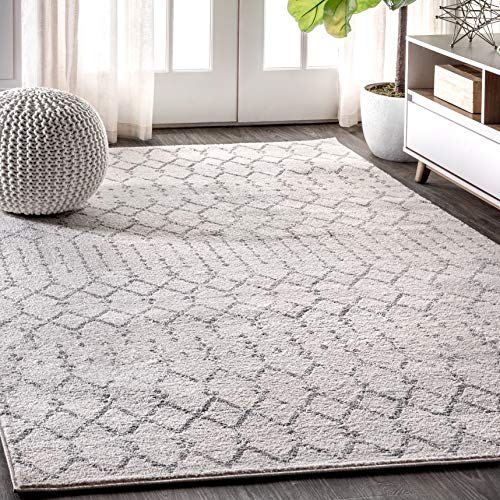
JONATHAN Y Moroccan Boho Vintage Diamond Area Rug, 8×10 (Cream/Gray) — Best Overall
This JONATHAN Y rug suits living rooms built around walnut, teak-look and low-slung furniture, where a cream and gray diamond field adds pattern without fighting the wood tones. The verified listing positions it for high traffic and easy cleaning, which matters because mid-century style is a lived-in look, not a museum one. At 8×10 it is sized for a standard living room arrangement with sofa front legs on the rug.
Strengths
- Diamond geometry is the signature mid-century pattern language
- Stated 0.31 in thickness and power-loomed construction in the verified listing
- High-traffic, easy-cleaning positioning suits family living rooms
Trade-offs
- The listing calls the design Moroccan Boho Vintage, not mid-century — the pairing is a styling judgement, stated openly
- Cream grounds show dirt faster than mid-tone alternatives
- 0.31 in is a low pile: pair with a pad for cushion
Key specs (from the verified listing title):
- Size: 8 x 10 (per listing title)
- Thickness: 0.31 in (per listing title)
- Construction: Power loomed
- Pattern: Diamond (per listing title)
Mid-century interiors run on a small set of visual moves: warm wood, low horizontal lines, and one confident geometric pattern. The diamond lattice is that pattern’s most durable form — it appears in the era’s textiles, tiles and screens — which is why a diamond rug integrates with mid-century furniture more convincingly than a generic modern abstract. This rug’s cream and gray palette is the other half of the fit: it leaves the warm tones to the furniture, where they belong, and contributes contrast and rhythm instead. The verified specifications support the styling with substance. A stated 0.31-inch thickness places it honestly in the low-pile class — good for doors, dining chairs and vacuuming, and thin enough that a rug pad is a genuine recommendation rather than an upsell, adding the underfoot cushion the pile itself does not provide. Power-loomed construction at this tier means consistency: the pattern repeat will be regular, the edges straight, the rug quick to lie flat. Choose it when your room’s wood is the star and the rug’s job is rhythm; choose a warmer, busier pick from this guide when the rug itself must be the colour event.
Best for: Mid-century living rooms with warm wood furniture needing geometric rhythm in neutral tones / Not suited for: Rooms wanting the rug to carry strong colour, or anyone wanting plush pile underfoot
Check the current price on Amazon

SAFAVIEH Madison Boho Ikat Area Rug, 8×10 (Blue & Orange) — Best Colour Statement
This SAFAVIEH Madison ikat suits confident rooms: a neutral sofa that needs waking up, a walnut sideboard that deserves a worthy opponent, a dining room where the floor should hold its own against the furniture. The verified listing states its construction and pile plainly — power-loomed polypropylene, 3/8-inch low pile — which makes it as practical as it is loud.
Strengths
- Blue and orange ikat delivers the classic mid-century colour contrast
- Stated 3/8 in low pile and polypropylene construction in the verified listing
- Low pile suits dining chairs and high traffic
Trade-offs
- A bold colourway commits the room; restful it is not
- Ikat reads boho as readily as mid-century, depending on companions
- Polypropylene is practical rather than luxurious underfoot
Key specs (from the verified listing title):
- Size: 8 x 10 (8′ x 10′)
- Pile: 3/8 in low pile (per listing title)
- Material: Polypropylene, power-loomed (per listing title)
- Origin: Made in Turkey (per listing title)
Every mid-century room needs one element that commits. The furniture of the era is famously well-mannered — clean lines, warm wood, tapered legs — and left alone it can drift toward tasteful blandness. The era’s own designers solved that with textiles in saturated, slightly clashing colour, and the blue-orange ikat in this rug is precisely that move: a pattern with soft, blurred edges that keeps the bold palette from turning harsh. The practical specification underneath the style is sound. A 3/8-inch low pile in power-loomed polypropylene is the workhorse construction of modern rugs — vacuum-friendly, chair-friendly, forgiving of the dining-room duty this size often serves. Judge the pairing honestly, as this guide labels it: the listing calls the design Boho Ikat, and ikat lives in both boho and mid-century worlds. In a room of sharp modern furniture it will read boho; against walnut, brass and low horizontal lines it reads as the era’s own textile language. That chameleon quality is a feature if your style is eclectic, and a reason to choose the stricter geometries elsewhere in this guide if your room is a purist’s exercise.
Best for: Neutral rooms needing a committed colour-and-pattern statement with practical low pile / Not suited for: Purist mid-century rooms that want geometry without boho softness
Check the current price on Amazon

nuLOOM Blythe Grey Trellis Area Rug, 8′ x 10′ — Best Trellis Geometry
The Blythe trellis suits rooms that want geometry with the volume turned down: grey on grey rhythm that structures a living room without competing with artwork, books and wood. It is the specifier’s choice in this guide — the rug designers reach for when everything else in the room already has something to say.
Strengths
- Trellis lattice is a core mid-century geometric, rendered quietly in grey
- Power-loomed construction stated in the verified listing
- Neutral palette pairs with any wood tone and most upholstery
Trade-offs
- The verified title states no pile height or fibre, so confirm both on the live listing
- Grey trellis is a popular pattern; originality seekers may find it familiar
- Understated pattern will not rescue a room that needs colour
Key specs (from the verified listing title):
- Size: 8′ x 10′ (per listing title)
- Pattern: Trellis (per listing title)
- Construction: Power loomed (per listing title)
Restraint is a design skill, and trellis in grey is its rug form. The lattice gives a floor the structure that mid-century rooms ask of pattern — repetition, geometry, a grid the furniture can converse with — while the tonal palette keeps the conversation polite. Put it under a colourful sofa, a busy bookcase wall or a patterned chair and it organises the room without joining the argument. The evidence note for this pick is deliberately plain: nuLOOM’s verified title confirms the rug, its trellis pattern, its grey colourway, its power-loomed construction and its 8×10 size, and states neither pile height nor fibre. This guide prints no spec box beyond that evidence and directs you, in the where-to-buy spirit, to confirm pile and material on the live listing before ordering — they are the two facts that decide how the rug feels and cleans. That is not a weakness of the pick; it is the normal division of labour between a verified shortlist and a final listing check. As a piece of mid-century styling, its credentials are the pattern itself, which has anchored era-inspired rooms for decades precisely because it asks so little of its companions.
Best for: Busy or colourful mid-century rooms needing calm geometric structure / Not suited for: Rooms needing the rug to supply colour, or buyers wanting full specs at shortlist stage
Check the current price on Amazon

SAFAVIEH Madison Vintage Medallion Area Rug, 9×12 (Gray & Gold) — Best Large Vintage
This larger Madison suits open-plan living areas and big bedrooms where an 8×10 leaves the furniture floating at the edges. The gray and gold palette is the point: gold is mid-century’s accent metal, and a rug that threads it through a vintage medallion gives a room its warm glint at floor level, where lamps cannot reach.
Strengths
- 9×12 scale anchors full furniture groupings
- Gray and gold palette echoes mid-century brass accents
- Stated 3/8 in low pile in power-loomed polypropylene
Trade-offs
- Medallion is a traditional motif; strict geometric purists should choose the diamond or trellis picks
- Large rugs are heavy to handle, clean and return — measure twice
- Gold threads a warm note that cool-toned rooms may not want
Key specs (from the verified listing title):
- Size: 9 x 12 (9′ x 12′)
- Pile: 3/8 in low pile (per listing title)
- Material: Polypropylene, power-loomed (per listing title)
- Origin: Made in Turkey (per listing title)
Scale changes a rug’s job. At 9×12 the rug stops being an accent and becomes the room’s foundation: all four legs of the main furniture can stand on it, zones in an open plan get defined by it, and its pattern sets the terms for everything above it. The vintage medallion is a considered choice at that scale. A strict geometric at 9×12 can feel relentless; a medallion’s symmetry organises the large field into a centre and borders, which is how the era’s own larger rooms — hotel lobbies, lounges — handled big floors. The gray and gold colourway does the era’s colour work quietly: gray keeps the field calm and modern, gold supplies the warm metallic accent that brass lighting and walnut ask for. The verified construction matches the duty — low 3/8-inch pile in power-loomed polypropylene, vacuum-friendly and chair-tolerant across a big, busy floor. Practical warnings scale with size: a 9×12 is a two-person unroll, a serious vacuum commitment and an expensive return if the room was mis-measured. Tape the footprint on the floor first, as the buying guide insists, and this rug will do for a large room what the diamond pick does for a standard one.
Best for: Large and open-plan mid-century rooms needing a warm, organising foundation / Not suited for: Small rooms, or purists who want strict geometry at any scale
Check the current price on Amazon
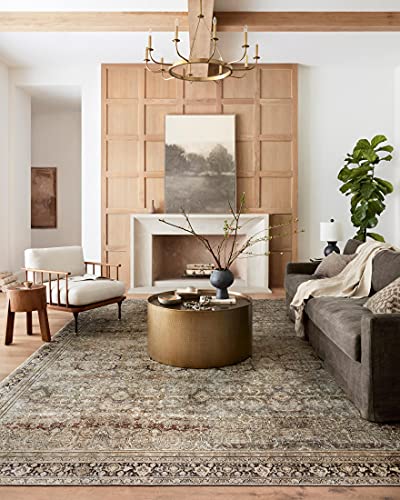
Loloi Layla Area Rug, 7′-6″ x 9′-6″ (Olive/Charcoal) — Best Printed Vintage Look
This Loloi Layla suits rooms leaning into the era’s moody side: olive, charcoal, walnut and blackened metal, where a brighter rug would break the spell. Its printed, vintage-look surface also suits households that want the patina aesthetic without the antique price or fragility — a rug that looks collected rather than installed.
Strengths
- Olive/charcoal palette matches mid-century’s earthy colour register
- Printed vintage look delivers instant patina
- Near-8×10 sizing suits standard living and dining rooms
Trade-offs
- Printed rugs have a flatter hand than woven pile; the look is visual, not textural
- The listing frames the design as traditional, not mid-century — the era pairing is this guide’s styling judgement
- Pile and fibre are not stated in the verified title; confirm on the live listing
Key specs (from the verified listing title):
- Size: 7′-6″ x 9′-6″ (approx. 8×10, per listing title)
- Construction: Printed (per listing title)
- Palette: Olive / charcoal (per listing title)
Printed rugs deserve an honest defence, because they are the technology that made vintage style democratic. A printed surface can reproduce the faded, complex patterning of an aged woven rug — the look that takes an antique decades and a fortune to achieve — on a thin, practical, cleanable base. The cost is texture: a print is an image of a rug as much as a rug, flat to the hand and without pile depth. In the right room that trade is intelligent. Mid-century style, with its low furniture and graphic discipline, often needs pattern as image more than pattern as pile, and the Layla’s olive and charcoal colourway supplies the era’s earthy register that the brighter picks in this guide do not. Loloi’s own listing language — traditional, timeless, classic — is not mid-century vocabulary, and this guide does not pretend otherwise; the recommendation is a styling judgement, disclosed as such, that this palette and patina serve mid-century rooms exceptionally well. Confirm the unstated specifications on the live listing, put a pad beneath it for the cushion the print does not provide, and it will read as the room’s collected centrepiece rather than its newest purchase.
Best for: Moody, earthy mid-century rooms wanting vintage patina without antique fragility / Not suited for: Buyers who want pile texture underfoot, or strict era-documented designs
Check the current price on Amazon

SAFAVIEH Monaco Medallion Area Rug, 8′ x 10′ (Multi) — Best Distressed Colour
The Monaco suits family mid-century rooms, where the furniture is era-elegant but the life is modern: children, dogs, movie nights on the floor. A distressed pattern is the most forgiving design language ever woven — new wear disappears into the intentional wear of the pattern — and the listing’s easy-care, non-shedding claims aim at exactly that household.
Strengths
- Distressed pattern hides real-life wear better than any clean design
- Non-shedding and easy care stated in the verified listing
- Multi colourway gives a room several accent colours to draw on
Trade-offs
- Tribal medallion leans boho; purist rooms should pick the geometric options
- Multi colours can fight patterned upholstery — best with solid furniture
- Pile specifics are not stated in the verified title; confirm on the live listing
Key specs (from the verified listing title):
- Size: 8′ x 10′ (per listing title)
- Pattern: Tribal medallion, distressed (per listing title)
- Care: Non-shedding, easy care (per listing title)
There is a reason distressed rugs outsell pristine ones in family homes: they are the only pattern strategy that improves with evidence of life. A faded medallion treats every new scuff as continuity rather than damage, which in a mid-century room — where the furniture’s clean lines show every speck of chaos around them — restores a humane balance. The multi colourway compounds the practicality: with several muted tones in the field, the rug forgives crumbs, pet hair of any colour and the general sediment of family life better than any single-tone alternative in this guide. SAFAVIEH’s verified listing adds the operational claims that matter here — non-shedding and easy care, aimed at high-traffic living rooms and bedrooms — though it does not state pile height or fibre, and this guide leaves those boxes honestly empty for your live-listing check. Stylistically, the tribal medallion sits at the boho edge of the mid-century conversation; the era itself absorbed global textiles freely, and in a room with the right wood and lines this rug reads as the era’s eclectic streak rather than a departure from it. If your mid-century is a family room first and a period exercise second, this is your pick.
Best for: Family mid-century living rooms needing a forgiving, easy-care pattern / Not suited for: Minimalist rooms with patterned furniture, or strict geometric purists
Check the current price on Amazon
Comparison Table
| Pick | Badge | Key spec | Best for |
|---|---|---|---|
| JONATHAN Y Moroccan Boho Vintage Diamond Area Rug, 8×10 (Cream/Gray) | Best Overall | 8×10 diamond pattern, 0.31 in, power loomed | Mid-century living rooms with warm wood furniture needing geometric rhythm in neutral tones |
| SAFAVIEH Madison Boho Ikat Area Rug, 8×10 (Blue & Orange) | Best Colour Statement | 8×10 ikat, blue/orange, 3/8 in low pile polypropylene | Neutral rooms needing a committed colour-and-pattern statement with practical low pile |
| nuLOOM Blythe Grey Trellis Area Rug, 8′ x 10′ | Best Trellis Geometry | 8×10 grey trellis, power loomed | Busy or colourful mid-century rooms needing calm geometric structure |
| SAFAVIEH Madison Vintage Medallion Area Rug, 9×12 (Gray & Gold) | Best Large Vintage | 9×12 vintage medallion, gray/gold, 3/8 in low pile | Large and open-plan mid-century rooms needing a warm, organising foundation |
| Loloi Layla Area Rug, 7′-6″ x 9′-6″ (Olive/Charcoal) | Best Printed Vintage Look | Approx 8×10 printed rug, olive/charcoal vintage look | Moody, earthy mid-century rooms wanting vintage patina without antique fragility |
| SAFAVIEH Monaco Medallion Area Rug, 8′ x 10′ (Multi) | Best Distressed Colour | 8×10 distressed medallion, multi, non-shedding easy care | Family mid-century living rooms needing a forgiving, easy-care pattern |
How to Choose the Best Mid Century Style Area Rugs for an Era-True Room
Shop the vocabulary, not the keyword. Mid-century floors speak in diamond and trellis geometry, in ikat and medallion textiles, and in a palette that runs from walnut-warm neutrals through blue-and-orange confidence to olive-and-charcoal mood. A rug that speaks that language in a documented pattern will integrate with era furniture regardless of what its maker calls it; a rug that only carries the keyword will not, however it is labelled.
Match pattern scale to furniture scale. Low-slung mid-century furniture sits close to the floor, so rug patterns are seen at a glancing angle and read larger than they do under tall traditional pieces. Bold geometries can therefore go bolder; busy small repeats can turn to visual noise. When in doubt, the diamond and trellis picks in this guide are the era’s safest scales, and the medallions are its most forgiving.
Then apply the universal rug disciplines, which style never suspends: size so the main furniture’s front legs rest on the rug at minimum, pile low where chairs and doors move, a pad underneath on hard floors for grip and cushion, and the room taped out on the floor before any large rug is ordered. Era-true is a look; these are the logistics that let the look survive contact with daily life.
Building the Palette: How Rug Colour Works in Mid-Century Rooms
The era’s rooms are a three-part chord: warm wood as the bass note, one confident colour as the melody, and neutrals as the silence between. A rug can play any of the three parts, but it should know which one it is playing. The grey trellis and the cream diamond in this guide are silence rugs — they let furniture and art sing. The blue-orange ikat is a melody rug. The gold-threaded medallion and the olive Layla are bass rugs, deepening the wood’s register.
Metal and textile accents should rhyme with the rug’s minor colours. A gold thread in a medallion asks for brass within sight; the orange in an ikat asks for a cushion, a vase, a book spine somewhere in the room to answer it. These echoes are what separate a styled room from a furnished one, and they cost almost nothing once the rug has set the palette.
Light is the final variable. North-facing rooms cool every colour, pushing greys toward blue and muting gold; south-facing rooms warm them. Order with your light in mind, view the rug in the room across a full day before committing, and remember that a distressed or printed vintage surface — the Monaco and the Layla in this guide — is the most forgiving of light’s daily changes, because its pattern was never one flat colour to begin with.
Reading a Rug Listing Like a Specifier: Pile, Fibre and Construction
Professional buyers read rug listings in a fixed order, and it is worth stealing. Construction first, because it sets the ceiling for everything else: power-loomed means consistency and value, hand-tufted means pile depth with a latex backing to inspect, hand-knotted means heirloom economics that this category rarely involves. Fibre second, because it decides cleaning, feel and fade: polypropylene shrugs off stains and sun, wool forgives and glows, cotton lies flat and washes, and blends inherit their parents’ compromises. Pile third, in stated figures — the difference between 0.31 inch and 3/8 inch is small, but the difference between a stated figure and an adjective is enormous.
Apply that order to this guide’s own picks and you can watch the evidence vary honestly: several SAFAVIEH listings state construction, fibre and pile in a single breath, which is why their spec boxes are full; the nuLOOM trellis and the Loloi Layla state less, and their reviews say so and send you to the live listing for the remainder. That variation is not a flaw in the guide — it is a map of which makers publish like specifiers and which publish like decorators. When two rugs tie on pattern, buy from the maker whose listing answered more of your questions before you had to ask them.
Mid-Century on a Budget: Where the Money Actually Shows
The encouraging truth about mid-century rooms is that the rug is the highest-leverage purchase in them, because the style’s furniture silhouettes are now widely and inexpensively reproduced while its floor patterns are what the eye reads first. A well-chosen geometric or vintage rug under modest furniture produces a more convincing era room than expensive furniture on a generic floor. Spend the rug budget in that order: size first, because an undersized rug is the one error no pattern can disguise; pattern second, because it is the style itself; construction third, at the honest power-loomed tier where this entire guide lives.
Where the money does not show is equally worth knowing. Hand-knot-level spending buys longevity measured in decades and a hand that guests will not detect from standing height; pile depth beyond a pad’s contribution buys cleaning difficulty in family rooms; and brand premiums in this category buy design confidence rather than different physics. The six verified picks here cluster deliberately at the rational tier — documented patterns, stated constructions, low practical piles — because that is where mid-century style is bought best. Complete the room with the pad, the rotation habit and the accent rhymes described in the palette section, and the floor will carry the era for a fraction of a period-authentic budget.
Three Mid-Century Rooms, Three Rug Decisions: Worked Examples
A walnut sideboard, a low grey sofa, brass floor lamp, white walls: the canonical mid-century living room, one rug short of finished. The decision here is between rhythm and rest. The cream diamond JONATHAN Y gives rhythm — a lattice the low furniture can converse with — while the grey trellis gives rest, organising without speaking. Choose rhythm when the room’s art and objects are quiet, rest when they are loud; in the canonical room, with the sideboard as its warm centrepiece, rhythm usually wins, and the diamond’s stated low pile keeps the sideboard’s doors and the room’s chairs moving freely above it.
A family room in an era-enthusiast’s house: same furniture language, plus a dog, two children and film nights on the floor. The styling answer changes completely. The distressed Monaco medallion absorbs the evidence of that life into its intentional wear, its multi palette forgives every hair colour a pet can produce, and its easy-care positioning matches the household’s actual cleaning capacity. Purists may note the tribal pattern’s boho lean; families will note that nobody is crying over a juice spill, which is the more mid-century outcome — the era’s rooms were designed for living, not for custody.
A moody study-bedroom in olive, charcoal and blackened metal, where the bed doubles as a day lounger. Here the Loloi Layla’s printed patina is the connoisseur’s choice: its flat, image-like surface suits a room of low, graphic furniture, its palette deepens the scheme’s register, and its printed construction keeps the budget for the room’s other ambitions. Add the pad for underfoot kindness, rotate it against the window light twice a year, and the room reads collected rather than decorated — the distinction every one of these worked examples is really about.
Vintage, Distressed and Printed: Three Kinds of ‘Old’ and How to Choose
Rug marketing uses old as a compliment in three distinct senses, and separating them sharpens every choice in this guide. Vintage as pattern means a design drawn from historical textiles — the medallions here — reproduced crisply and completely, all its detail intact. Distressed means the same family of pattern with wear simulated into it: faded passages, softened borders, the visual biography of decades applied at the loom or the printer. Printed means the pattern exists as an image on a flat base, vintage or distressed in appearance, with the hand of paper rather than pile. Each is a legitimate technology with a different feel, price logic and room it suits.
Choose by the room’s relationship with time. A room of genuine period furniture often prefers true vintage pattern, crisply woven, because simulated wear beside real patina can read as costume. A family room prefers distressed, because its wear is a camouflage strategy as much as an aesthetic. A graphic, low-furniture room — the study-bedroom of the worked examples — can take printed, because its eye is on image and palette rather than texture. The error is buying one kind while expecting another’s properties: the printed rug condemned for flatness, the distressed rug condemned for looking worn. Both were honest products, bought against the wrong definition of old.
How to Lay and Care for a Low-Pile Area Rug
Unroll the rug and give it time before you judge it. Power-loomed rugs arrive with roll memory: reverse-roll the stubborn end, weight the corners with furniture, and allow a few days of walking and warmth to relax the field flat. A rug pad, cut an inch or two smaller than the rug on every side, goes underneath from the start — it stops creep, protects the floor from backing abrasion, and supplies the cushion that a 3/8-inch or 0.31-inch pile honestly lacks.
Position by the furniture rule for your room: front legs on in living rooms, two feet of margin around dining tables, a barefoot landing strip beside beds. Then check every door swing against the rug’s edge; a door that grazes a rug daily will curl that edge within a season, and repositioning by two inches now is cheaper than replacing the rug later.
Care for low pile is a rhythm, not an event. Vacuum weekly with suction and a rotating brush set for low pile, working in the pattern’s direction on printed and distressed designs to keep their surface calm. Blot spills immediately — never rub a medallion’s border into its field — and test any cleaner on the rug’s hidden corner first. Rotate the rug 180 degrees twice a year so sunlight and traffic distribute their fading evenly; mid-century rooms, with their big windows, need this discipline more than most.
Common Buying Mistakes
The first mistake is keyword shopping: typing the style name and trusting whichever listing repeats it most. As this guide’s own verification showed, the era’s genuine pattern language usually arrives under other names — Moroccan, vintage, boho, traditional — while keyword-stuffed listings may show anything. Buy documented patterns from verified listings, and treat style labels, including this guide’s, as judgements to examine rather than facts to inherit.
Second is pattern-scale blindness. A diamond that sings at 8×10 can shout at 5×8 in a small room, and a medallion that organises 9×12 can crowd a bedsit. Tape the size on the floor and imagine the pattern’s repeat at that scale before ordering; returns on large rugs are the category’s most expensive lesson.
Third is skipping the pad on a low-pile rug and then blaming the rug for feeling thin. At 3/8 inch and below, the pad is half the underfoot experience. It is also the grip, the floor protection and the edge-keeper. Budget it with the rug, every time.
Fourth is letting one era element demand a whole period room. A mid-century rug under contemporary furniture looks intentional; a room where every object performs the 1960s looks like a set. The rugs in this guide are chosen to converse with mixed rooms — that conversation, not costume, is the style’s living form.
Key Takeaways
- Buy the era’s pattern vocabulary — diamond, trellis, ikat, medallion — not the keyword.
- No verified listing here claims ‘mid century’; every pairing is a disclosed styling judgement.
- Low piles around 3/8 in and 0.31 in suit chairs, doors and vacuuming; add a pad for cushion.
- Let the rug play one palette role: bass, melody or silence — and rhyme accents to it.
- Tape the footprint on the floor before ordering any large rug.
Final Recommendation
For a textbook mid-century floor, start with the JONATHAN Y diamond or the nuLOOM trellis, choosing bold or quiet geometry to match your furniture’s confidence. For colour, the SAFAVIEH ikat is the era’s own contrast in a practical construction. Large rooms point to the 9×12 Madison medallion; moody, patinated rooms to the Loloi Layla; and family life to the forgiving, distressed Monaco.
Whichever you choose, confirm the specifications the shortlist could not — pile and fibre where unstated — on the Amazon listing, tape the size on your floor, and check price on Amazon for the exact rug. Mid-century style endures because it is a discipline of proportion and pattern, and a floor chosen with that discipline will hold its room together for decades.
Best Mercury Row Area Rugs Best Rugs For Mid Century Wood Floors Best Area Rugs For Family Rooms Best Area Rugs For A Grey Couch Best 8 X 10 Wool Area Rugs
Frequently Asked Questions
What patterns define a mid-century style rug?
Geometry first: diamond lattices and trellis grids are the era’s signature patterns. Then its textiles: ikat with its blurred edges, and medallions in warm, vintage treatments. Palettes run from walnut-warm neutrals to confident blue-and-orange and earthy olive and charcoal. Notably, verified listings rarely use the words ‘mid century’ — they call these same designs Moroccan, vintage, boho or traditional, which is why this guide shops the vocabulary rather than the label.
Are these rugs actually mid-century products?
They are modern rugs whose documented patterns serve mid-century rooms — and this guide labels them exactly that way, disclosing the styling judgement in every review rather than attributing an era claim to listings that do not make one. That transparency is deliberate: it lets you judge the pairing yourself.
What pile height suits a mid-century living room?
Low pile, in line with the era’s low furniture: the verified listings in this guide state 0.31 inch and 3/8 inch. Low pile keeps doors and dining chairs moving, vacuums easily, and looks right under low-slung pieces. Add a rug pad for the cushion low pile does not provide.
Can a mid-century rug work with non-period furniture?
It is the recommended approach. A geometric or vintage-pattern rug under contemporary or mixed furniture reads as intentional styling; a fully period room reads as a set. The quieter picks — the grey trellis and the cream diamond — are especially good travellers across styles.
How do I stop a large rug from looking flat or dull?
Three things: a pad underneath for body, pattern scale matched to the room (tape it out first), and accents elsewhere in the room that rhyme with the rug’s minor colours. Printed and distressed designs, like the Layla and Monaco picks, also hold visual interest in changing light better than flat single-tone rugs.
What size rug does a mid-century living room need?
The universal rule applies: at minimum, the front legs of sofas and chairs on the rug — 8×10 for most rooms, 9×12 for large or open-plan spaces, both represented in this guide. Under dining tables, allow about two feet beyond the table on all sides.


