Disclosure: airfryerkitchensupply.com is reader-supported. When you buy through links on our site, we may earn an affiliate commission at no extra cost to you.
Where to buy
Shopping for the best lightweight stand mixers is a comfort decision as much as a baking one, and each machine below is sold on Amazon, and the links go to the exact colour and configuration verified for this guide — with lightweight mixers, colour variants live on separate listing pages, so if you change colour, double-check the bowl size and attachments on the new page. As always on this site, check price on Amazon at the moment of purchase; we do not print prices because they change too often to print honestly.
- KitchenAid Artisan Mini 3.5-Quart Tilt-Head Stand Mixer (KSM3316X, Candy Apple Red) — Check the current price on Amazon
- CKEMU Compact Stand Mixer (SM-2549A) — Check the current price on Amazon
- Dash Everyday Stand Mixer (3-Quart, White) — Check the current price on Amazon
- Kitchen in the Box 3.2-Quart Stand Mixer (Alternate Finish) — Check the current price on Amazon
- Cuisinart Precision Master 5.5-Quart Stand Mixer (SM-50) — Check the current price on Amazon
- Hamilton Beach 4-Quart Electric Stand Mixer — Check the current price on Amazon
The best lightweight stand mixers solve a human problem before they solve a baking one. A traditional stand mixer can be a genuinely heavy object, and for an older baker, a cook with arthritis or a weak grip, or anyone whose kitchen stores appliances in a cupboard rather than on display, that weight quietly decides whether baking happens at all. When lifting the mixer feels like a chore to be avoided, the mixer stays in the cupboard, and so do the cakes.
This guide is written from the hands outward. We judged these machines on how they feel to lift, carry, tilt, clean and put away — the grip points, the bowl weight when it is full of batter, whether the head tilts without a fight, and whether the controls can be worked by hands that do not have the strength they once did. Mixing performance matters, of course, but in this category comfort is performance: the mixer you can use without thinking about your wrists is the mixer that gets used.
A note on honesty: lightweight stand mixers trade away dough capacity and some stability — that physics is covered plainly in the guide sections. What they give back is independence. Every pick below can be moved by one person without strain, set up in under a minute, and cleaned without wrestling a heavy bowl at the sink. If that is the baking life you want, read on.
In this guide
Quick Picks
Six machines chosen for backs, wrists and hands as much as for batters. The order below reflects overall comfort for older and mobility-conscious bakers first, mixing ability second.
- Best Overall for Easy Lifting: KitchenAid Artisan Mini 3.5-Quart Tilt-Head Stand Mixer (KSM3316X, Candy Apple Red) — the lightest way to own a true KitchenAid — smaller batches, ten speeds and a tilt head that opens with a light touch. — check price on Amazon
- Best Compact Design: CKEMU Compact Stand Mixer (SM-2549A) — a space-saving compact with a stainless bowl, a 300-watt motor per the listing and dishwasher-safe attachments — cleanup designed for tired hands. — check price on Amazon
- Best Budget for Gentle Use: Dash Everyday Stand Mixer (3-Quart, White) — among the lightest stand mixers you can buy — a 3-quart tilt-head that many users can lift one-handed, at a budget tier. — check price on Amazon
- Best One-Hand Carry: Kitchen in the Box 3.2-Quart Stand Mixer (Alternate Finish) — marketed by its maker as a portable lightweight mixer — 3.2 quarts, six speeds and the full whisk, hook and beater set. — check price on Amazon
- Best Step-Up for Stronger Hands: Cuisinart Precision Master 5.5-Quart Stand Mixer (SM-50) — the honest step-up — 5.5 quarts and twelve speeds for readers who can manage a mid-weight machine and need the capacity back. — check price on Amazon
- Best with Easy-Carry Handle: Hamilton Beach 4-Quart Electric Stand Mixer — the listing names the feature our readers need — an easy-carry handle — plus planetary mixing, seven speeds and a full attachment set. — check price on Amazon
How These Picks Were Chosen
Verification followed the site rule: brand-and-model searches, returned titles matched to each machine, ASINs recorded only on a confident match. All six picks verified, including the fresh listings for the Artisan Mini in this colour, the CKEMU compact and the alternate Kitchen in the Box finish.
Selection weighted human factors first: lift weight and carry design, bowl weight in use, control stiffness, cleanup burden and storage height practicality. Mixing competence was the second filter, honest capacity the third. Two picks — the Cuisinart SM-50 and, to a lesser degree, the Hamilton Beach — are deliberate step-up options and are labelled with their heavier lifts in plain language, because a comfort guide that hides weight would betray its readers.
The 6 Best Lightweight Stand Mixers for Easy Lifting and Everyday Comfort

KitchenAid Artisan Mini 3.5-Quart Tilt-Head Stand Mixer (KSM3316X, Candy Apple Red) — Best Overall for Easy Lifting
For a baker who loves the KitchenAid way of doing things but can no longer comfortably haul a full-size Artisan out of a cupboard, the Mini is the dignified answer. KitchenAid designed it for smaller batches — a 3.5-quart bowl, ten speeds and three accessories per the Amazon listing — in a body that is meaningfully lighter and smaller than the classic machine, while keeping the smooth tilt-head action and the front attachment hub.
Strengths
- Lightest route to genuine KitchenAid build quality and mixing action
- Tilt head opens easily and locks positively — no wrestling
- Ten graduated speeds are gentle on delicate mixtures and on the user
Trade-offs
- Still the most substantial lift in this guide — waist-height storage advised
- Premium tier: you pay for the badge and the build, fairly but noticeably
- 3.5-quart bowl means the big family batches of the past stay in the past
| Type | Tilt-head stand mixer |
| Bowl | 3.5-quart |
| Speeds | 10 |
| Accessories (per listing) | 3 included |
Comfort here is about quality of movement as much as quantity of weight. The Mini’s controls are positive without being stiff, the head tilts with a controlled motion rather than a clunk, and the bowl — smaller and therefore lighter even when full — is manageable at the sink. For the experienced baker downsizing without downgrading, this is the machine that respects both the baker and the baking. It is the pick we would give a parent who has baked for forty years and intends to bake for twenty more.
A detail older bakers notice immediately: the Mini’s speed lever moves with a light, positive action that does not demand pinch strength, and the head-release is a lever rather than a button to be thumbed hard. These are the ergonomics of a company that has watched its customers age with its machines. The Candy Apple Red finish of this verified listing is also a practical choice beyond cheerfulness — a visible machine on the counter is a machine that gets used, and a bright finish makes the mixer easy to locate at a glance in a busy kitchen.
Best for: experienced bakers downsizing from a full-size KitchenAid / Not suited for: strict budgets or anyone who needs large-batch capacity
Check on Amazon — check the current price on Amazon before you decide, as listings and included accessories change over time.
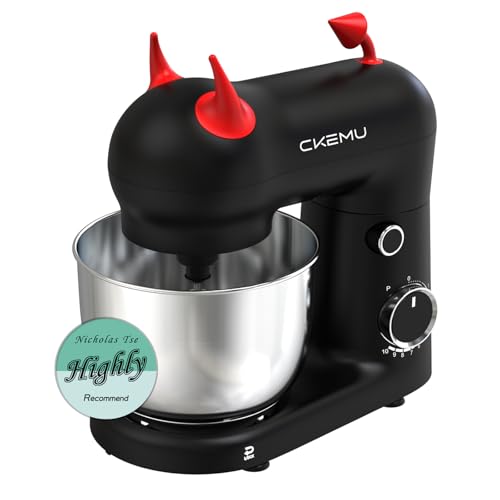
CKEMU Compact Stand Mixer (SM-2549A) — Best Compact Design
The CKEMU SM-2549A approaches the lightweight brief from the cleanup side: compact and space-saving by design, with a stainless steel bowl and — the detail that matters for our readers — dishwasher-safe attachments, per the Amazon listing. Every attachment that can go in the dishwasher is a minute of hand-washing with a slippery beater that arthritic hands do not have to spend.
Strengths
- Dishwasher-safe attachments minimise hand-washing and gripping
- Compact, space-saving body is easy to house at waist height
- Stainless bowl is light, unbreakable and easy to handle when wet
Trade-offs
- Newer brand: long-term support and spares are less established
- Compact capacity — single, modest batches only
- Playful styling will not suit every kitchen’s taste
| Type | Compact stand mixer |
| Bowl | Stainless steel (per listing) |
| Motor (per listing) | 300 watts |
| Attachments | Dishwasher-safe (per listing) |
Judge this mixer by a Tuesday evening, not a bake-off. It comes out of the cupboard without a grunt, mixes a small cake, and its working parts go straight into the dishwasher while the light bowl rinses in seconds. That frictionless loop — out, mix, wash, away — is exactly what keeps baking in a person’s life when strength is not what it was. Keep batches modest and speeds sensible, and it is a kind, capable little machine.
The dishwasher-safe attachments deserve a fuller explanation than a bullet allows. Hand-washing a beater means gripping a smooth, soapy, awkward shape and working a brush around its wires — precisely the task arthritic hands find miserable. Attachments that go straight into the dishwasher remove that task from baking entirely. Combined with a stainless bowl that can be rinsed rather than scrubbed when it has only held batter, the CKEMU’s cleanup loop is the gentlest in this guide, and for many readers that loop — not the mixing — is what decides whether baking stays in their week.
Best for: bakers who prioritise easy cleanup and compact storage / Not suited for: brand-loyal buyers or anyone baking for a crowd
Check on Amazon — check the current price on Amazon before you decide, as listings and included accessories change over time.
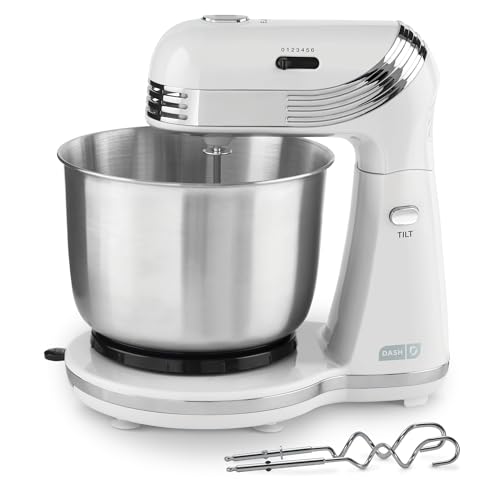
Dash Everyday Stand Mixer (3-Quart, White) — Best Budget for Gentle Use
If the requirement is simply ‘the lightest stand mixer that still works properly’, the Dash Everyday is the usual answer. Its 3-quart stainless bowl and six-speed tilt-head body (per the Amazon listing) add up to a machine that most adults can lift with one hand and carry without planning the journey first. In white, it also disappears visually on a light counter, which matters in small kitchens where the mixer may live out permanently.
Strengths
- Exceptionally light — realistic one-handed lift for many users
- Simple six-speed control: nothing fiddly for stiff fingers
- Small enough to live on the counter, removing lifting from the routine entirely
Trade-offs
- Smallest capacity class here — think cakes for two to four people
- Light body needs a non-slip mat for energetic mixing
- Budget motor: short sessions, soft mixtures, no heroics
| Type | Tilt-head stand mixer |
| Bowl | 3-quart stainless steel |
| Speeds | 6 |
| Positioning | Budget tier |
The Dash’s greatest comfort feature is that it can simply stay out. A mixer that lives on the counter asks nothing of your back at all — you walk up, tilt the head, and bake. For a grandparent baking with grandchildren, or a cook managing a bad shoulder, that zero-lift routine is worth more than any specification. Its baking brief is small and cheerful; respect it, and this little machine delivers a surprising amount of joy per square inch of counter.
Because the Dash can live permanently on the counter, it changes who bakes. Grandchildren can be lifted to watch cream whip; a spouse who would never fetch a heavy mixer from a cupboard will happily tilt this one’s head and start a cake. Cooks recovering from shoulder or wrist injuries also report it as a bridge appliance — light enough to use during recovery, capable enough for the small celebratory bakes that mark getting better. No specification table captures that role, but it is real, and it is why this little machine appears in both of this site’s lightweight guides from different angles.
Best for: anyone who wants zero-lift, counter-resident, small-batch mixing / Not suited for: large households or bakers who regularly double recipes
Check on Amazon — check the current price on Amazon before you decide, as listings and included accessories change over time.
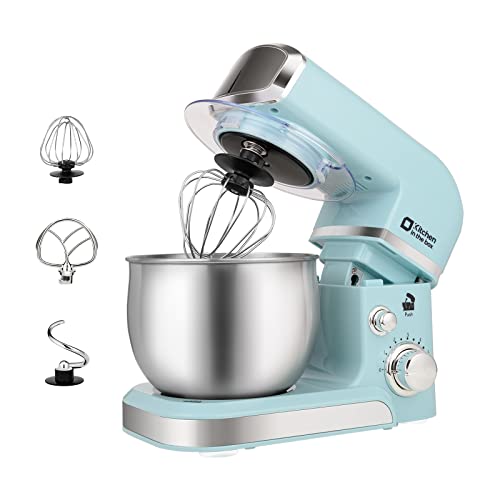
Kitchen in the Box 3.2-Quart Stand Mixer (Alternate Finish) — Best One-Hand Carry
This Kitchen in the Box variant — a separate listing from its sibling in our companion guide — repeats the formula that makes the line so suitable here: the manufacturer itself describes the machine as a portable lightweight mixer for daily use, with a 3.2-quart bowl, six speeds and the egg whisk, dough hook and flat beater all included, per the Amazon listing. It is a complete baking kit that one hand can carry from cupboard to counter.
Strengths
- Purpose-designed to be carried — balanced, compact and light
- Complete attachment set included, no extra purchases to start baking
- Six speeds are easy to learn and gentle to operate
Trade-offs
- 3.2-quart ceiling: single batches, always
- Light frame can shift with thick mixtures — use a mat and moderate speeds
- Brand support is thinner than the heritage names
| Type | Compact stand mixer |
| Bowl | 3.2-quart |
| Speeds | 6 |
| Attachments (per listing) | Egg whisk, dough hook, flat beater |
What recommends this machine to our audience is the carry itself. The body is compact enough to get fingers around securely, the weight sits low, and there are no dangling parts — attachments nest with the machine rather than travelling separately. For a baker who stores the mixer in a cupboard and brings it out for a Saturday cake, that tidy, one-trip carry is the difference between baking and deciding not to. Inside the bowl, it handles the standard repertoire — sponges, buttercream, whipped cream — with uncomplaining competence.
The carry deserves a second look, because it is this pick’s whole argument. The machine’s weight sits low and central, the body offers a secure grip, and there are no protruding parts to catch on a cupboard edge mid-lift. Practised owners develop a one-motion routine — shelf, counter, plug — that takes seconds and asks nothing of the lower back. For a baker whose alternative is asking for help to fetch the mixer, that independence is not a convenience feature. It is the difference between baking on your own schedule and baking on someone else’s availability.
Best for: cupboard-stored baking with a one-trip, one-hand carry / Not suited for: stiff doughs, double batches or bakers wanting heritage-brand support
Check on Amazon — check the current price on Amazon before you decide, as listings and included accessories change over time.

Cuisinart Precision Master 5.5-Quart Stand Mixer (SM-50) — Best Step-Up for Stronger Hands
Not every reader of a lightweight guide needs the lightest machine — some need the lightest machine that still bakes for a family. The Cuisinart SM-50 is that boundary, clearly labelled: a 5.5-quart stainless bowl, twelve speeds, and a chef’s whisk, mixing paddle, dough hook and splash guard with pour spout, all confirmed in the Amazon listing. It is heavier than the compacts above, and we will not pretend otherwise.
Strengths
- Family-size 5.5-quart bowl restores double-batch freedom
- Twelve speeds with a proper slow start for controlled mixing
- Splash guard with pour spout reduces mess and mid-mix lifting
Trade-offs
- A two-handed, deliberate lift — the heaviest machine in this guide
- Needs real counter or low-shelf space; measure before buying
- If lifting is your primary constraint, the compacts above serve you better
| Type | Stand mixer |
| Bowl | 5.5-quart stainless steel |
| Speeds | 12 |
| Includes (per listing) | Chef’s whisk, paddle, dough hook, splash guard |
Include this machine in your thinking if your situation is ‘I can still lift a mid-weight mixer from a low shelf, but I cannot bake in a 3-quart bowl any more’. The splash guard deserves a special mention for our audience: adding flour through the pour spout while the machine runs slowly means no stopping, no lifting the bowl, and no flour cloud — small kindnesses that add up across a baking session. Buy it with open eyes about the lift, and it returns family-scale baking to the menu.
The splash guard with pour spout is this machine’s quiet accessibility feature. Adding flour to a running mixer normally means stopping, lifting the head or the bowl shield, spooning flour, and restarting — four operations, two of them with a flour-dusted hand. The pour spout collapses that to one: flour goes in gradually, while the machine runs slowly, with the guard catching the cloud. For bakers with limited stamina, removing three operations from every recipe is a genuine gift, and it is a large part of why this heavier machine still belongs in a comfort-focused guide.
Best for: bakers who need capacity and can manage a planned two-handed lift / Not suited for: anyone for whom lifting is the main problem being solved
Check on Amazon — check the current price on Amazon before you decide, as listings and included accessories change over time.

Hamilton Beach 4-Quart Electric Stand Mixer — Best with Easy-Carry Handle
Most mixers are carried by hugging them; this Hamilton Beach is carried by a handle, and for hands with reduced grip strength that difference is everything. The Amazon listing confirms the easy-carry handle alongside a 4-quart bowl, seven speeds, planetary mixing for full bowl coverage, a splash guard, and the whisk, flat beater and dough hook in the box. It is the mid-weight machine designed by someone who thought about how mixers actually get moved.
Strengths
- Easy-carry handle gives a secure, one-point grip for moving the machine
- Planetary action reaches the whole bowl — less stopping to scrape
- 4-quart bowl splits the difference between compact and family sizes
Trade-offs
- Mid-weight: the handle helps, but plan the lift and store it low
- Dough hook tempts overuse — keep doughs soft and modest
- Black finish shows flour dust; a quick wipe becomes routine
| Type | Stand mixer, planetary action |
| Bowl | 4-quart |
| Speeds | 7 |
| Carrying | Easy-carry handle (per listing) |
The handle changes the emotional maths of baking day. Instead of a two-armed hug around a floury machine, you get a single secure grip, a free hand for the cupboard door, and a controlled set-down. Combined with planetary mixing — which spares you the repeated stop-scrape-restart cycle that tires arms — this is the most thoughtfully accessible mid-size mixer in this guide. For the baker who is not ready to downsize to 3 quarts, it is the smartest compromise here.
Planetary mixing has a comfort dividend that rarely gets mentioned: because the beater sweeps the whole bowl, the cook scrapes once instead of repeatedly. Each scrape cycle on a lesser machine is a stop, a lift of the head, a reach into the bowl and a restart — small efforts that accumulate across a long recipe into tired arms. The Hamilton Beach’s combination of that action with a proper carry handle makes it the mid-weight machine that asks the least total effort per bake, which is the correct metric for this guide — not the least weight on a shelf, but the least strain across the whole job.
Best for: bakers with reduced grip strength who still bake family quantities / Not suited for: the very lightest-lift shoppers — the compacts above weigh less
Check on Amazon — check the current price on Amazon before you decide, as listings and included accessories change over time.
Comparison Table
| Pick | Badge | Key spec | Best for |
|---|---|---|---|
| KitchenAid Artisan Mini 3.5-Quart Tilt-Head Stand Mixer (KSM3316X, Candy Apple Red) | Best Overall for Easy Lifting | Type: Tilt-head stand mixer; Bowl: 3.5-quart | experienced bakers downsizing from a full-size KitchenAid |
| CKEMU Compact Stand Mixer (SM-2549A) | Best Compact Design | Type: Compact stand mixer; Bowl: Stainless steel (per listing) | bakers who prioritise easy cleanup and compact storage |
| Dash Everyday Stand Mixer (3-Quart, White) | Best Budget for Gentle Use | Type: Tilt-head stand mixer; Bowl: 3-quart stainless steel | anyone who wants zero-lift, counter-resident, small-batch mixing |
| Kitchen in the Box 3.2-Quart Stand Mixer (Alternate Finish) | Best One-Hand Carry | Type: Compact stand mixer; Bowl: 3.2-quart | cupboard-stored baking with a one-trip, one-hand carry |
| Cuisinart Precision Master 5.5-Quart Stand Mixer (SM-50) | Best Step-Up for Stronger Hands | Type: Stand mixer; Bowl: 5.5-quart stainless steel | bakers who need capacity and can manage a planned two-handed lift |
| Hamilton Beach 4-Quart Electric Stand Mixer | Best with Easy-Carry Handle | Type: Stand mixer, planetary action; Bowl: 4-quart | bakers with reduced grip strength who still bake family quantities |
Notice the deliberate spread: three true featherweights for zero-strain baking, one premium mini for the experienced downsizer, and two handled mid-weights for readers whose constraint is grip or batch size rather than pure weight. Your position on that spread is a fact about your hands and your household, not about your worth as a baker — choose where you actually stand.
How to Choose the Best Lightweight Stand Mixers for Comfort and Independence
Start with the lift, because the lift is the gatekeeper. Where will the mixer live, and what journey must it make to reach the counter? A machine stored at waist height, carried two steps and set down gently is a different proposition from one stored overhead or carried across a kitchen. If any part of the journey worries you, either choose a lighter machine or — often the better answer — rearrange the kitchen so the mixer lives on the counter or on a low, pull-out shelf.
Then judge the details that hands notice. Controls should turn or slide without a fight. The head should tilt with a controlled, damped motion rather than dropping. The bowl should be stainless and modest in size, because a full bowl is the heaviest thing you will actually lift — batter is dense, and a 3.5-quart bowl of it is a far kinder load than a 5.5-quart one. Attachments that go in the dishwasher are not a luxury in this category; they are an accessibility feature.
- Arthritis or weak grip: prioritise carry handles, light bowls and dishwasher-safe attachments.
- Bad back or shoulders: prioritise counter-resident machines — the lightest lift is no lift.
- Small kitchen, able hands: any compact here works; choose on capacity and budget tier.
- Baking for grandchildren or gatherings: consider the handled mid-weight picks, stored low.
The bowl is the real weight you lift
Specifications quote the machine’s weight, but in daily life you lift the bowl far more often — to the oven, to the fridge, to the sink. Stainless bowls in the 3 to 3.5-quart class stay manageable even full of batter; glass bowls look lovely and weigh a surprising amount empty. If your wrists are the concern, bowl material and size deserve as much attention as the mixer’s headline weight.
Stability without mass: mats, feet and technique
Lightweight mixers stay put through technique rather than tonnage. Keep suction feet clean, set the machine on a non-slip mat, start thick mixtures slowly and let the beater find its rhythm before raising speed. A compact mixer treated this way is perfectly well-behaved for batters and creams. The walking and wobbling stories belong to overfilled bowls and maximum speeds — both avoidable, both covered in the mistakes section below.
Setting Up a Kitchen That Makes Lightweight Baking Easy
The mixer is only half the system. The other half is a kitchen arranged so that baking asks little of your body: ingredients stored at waist height near the mixing spot, a stool at the counter for longer sessions, good lighting over the bowl so you are not leaning in to see, and a clear landing space beside the mixer for the bowl. None of this costs much, and all of it multiplies the benefit of choosing a lightweight machine.
Consider, too, the social geometry of baking. A lightweight mixer that lives out on the counter invites grandchildren, neighbours and spouses into the process — baking becomes an activity at the counter rather than a feat of strength performed alone. Readers consistently tell stories in which the small, always-ready mixer is the one present for the memories. That is not a specification, but it might be the best reason in this entire guide.
Grip, Posture and the Ergonomics of a Comfortable Bake
Comfort in baking is a chain, and the mixer is only one link. Posture comes first: work at a counter height where your forearms rest roughly level, because mixing at a too-high counter lifts the shoulders and tires them within minutes. If your counter is tall, a sturdy low step or a lowered pull-out shelf for the mixer changes the geometry entirely. Lighting matters more than cooks admit — seeing into the bowl without leaning prevents the stooped posture that turns a pleasant bake into a backache.
Grip is the second link. Beyond the mixer’s own controls and handles, audit the supporting cast: a mixing bowl with a handle, a spatula with a thick, soft grip, ingredient jars that open without a fight. Many bakers find that two or three small ergonomic swaps around the mixer do as much for their comfort as the choice of mixer itself. Silicone grips, lever-style jar openers and a kitchen scale (which eliminates lifting heavy flour bags for measuring cups) all belong in the comfort toolkit.
Pacing is the third link, and the one experienced older bakers teach best. Sit for the tasks that allow it — a stool at the counter during a long creaming is not surrender, it is strategy. Stage ingredients before starting so nothing is fetched mid-recipe with floury hands. Let the machine do the waiting: a stand mixer’s great gift is that it works while you rest, which is the deepest reason this category exists at all.
- Counter height and a stool: fix the posture before blaming the appliance.
- Thick-grip utensils and a scale: small swaps, large comfort returns.
- Stage everything first; bake in stages; sit whenever the machine is working.
When Lightweight Is Not Enough: Honest Alternatives
A comfort guide owes its readers the exits as well as the entrances. If even a compact stand mixer is too much to lift and the counter cannot host one permanently, the next honest step is a good hand mixer used with the bowl resting in the sink or on a low surface — the sink trick, beloved of occupational therapists, brings the work down to a height where weak shoulders can manage it, and contains the splashes for free. Several hand mixers in this site’s light duty guide weigh very little and store in a drawer at waist height.
If the constraint is not strength but stamina — standing itself is the problem — then the answer is a kitchen reorganised around sitting: a lower work table, a compact mixer on it, a stool with back support, and recipes staged in advance. And if baking has become a two-generation pleasure, let it be one openly: the lightweight mixer that a grandchild can safely fetch and set up turns ‘helping’ into a designed feature of the kitchen rather than an admission of defeat.
What should not happen is the quiet ending where the heavy mixer stays in the cupboard, the baking stops, and a pleasure of decades disappears without a decision ever being made. Every pick and every alternative in this guide exists to prevent that ending. Choose the arrangement that keeps you baking — that is the only criterion that, in the end, matters.
A Word to the Baker Who Feels Guilty About Downsizing
Some readers arrive at this guide with an emotion they did not expect: guilt, or something close to it, at the thought of replacing a beloved heavy mixer with a smaller one — as if the machine were a measure of the baker. It is worth answering directly. The big mixer was the right tool for the baking life of its years: the christening cakes, the school fairs, the Christmas marathons. Choosing a lighter tool now is not a verdict on that life or on the baker who lived it. It is the same practical wisdom that chose the big machine then, applied to the kitchen as it is today.
Many bakers keep both for a season — the heavy machine in its cupboard for the two feasts a year that still need it, the lightweight on the counter for the fifty weeks that do not — and find the arrangement settles the question emotionally as well as practically. Others pass the big mixer to a child or grandchild and report an unexpected pleasure in watching it work in a new kitchen. Either way, the baking continues, and the baking — not the appliance — was always the point.
Buying a Lightweight Stand Mixer as a Gift: A Checklist for Families
Many lightweight stand mixers are bought not by their users but by their children and grandchildren, and a gift purchase has its own pitfalls worth naming. The first is pride: frame the gift around baking, not around frailty. ‘For your kitchen, because your old one is enormous’ lands better than any sentence containing the words ‘easier for you now’. The second is reconnaissance — bake with the recipient, watch where the current mixer lives and what actually gets mixed, and let the observed kitchen, not your assumptions, choose the size.
The third pitfall is the surprise installation. A mixer that arrives as a surprise often stays in its box, because reorganising a kitchen is a personal project. The better gift includes the setup: an afternoon together, the old machine retired to wherever the recipient chooses, the new one homed at waist height or on the counter, and a first bake shared on the spot — a cake that christens the machine and proves, in the eating, that nothing has been lost in the downsizing. That afternoon is remembered long after the specification sheet is forgotten.
Choose the model by the recipient’s hands, not your own: if you visit and notice jar lids being run under the tap or passed to you, weight and grip are the live issues, and the handled or counter-resident picks in this guide should lead. If the kitchen is simply small and the baker is strong, the measurement-led choices in our companion guide apply. Either way, include the non-slip mat in the box. It is the smallest part of the gift and, week after week, possibly the most used.
How to Use a Lightweight Stand Mixer Safely and Comfortably
These habits protect both the baker and the machine. They are written for the lightweight category specifically, where sensible technique substitutes for the brute stability of a heavy frame.
- Set the mixer on a non-slip mat on a dry counter, at a height where you can see into the bowl without stooping.
- Lock the bowl in place and add ingredients before starting; never reach into a moving bowl.
- Begin every mixture on the lowest speed and increase gradually — gentle starts protect your mixture, your counter and the motor.
- For creaming, use room-temperature butter; cold butter is the heaviest load a light mixer meets.
- Use the splash guard when adding flour, and add it a spoonful at a time through the pour spout where fitted.
- Stop the machine fully before scraping, and use a light silicone spatula rather than a heavy utensil near the beater.
- Lift the bowl with two hands when it is full, or slide it along the counter to the sink rather than carrying it across the room.
- After baking, wash or load attachments straight away — dried batter doubles the scrubbing effort later.
Finally, store the machine the way you found it: attachments nested in the bowl, cord loosely coiled, at waist height or on the counter. The goal is that next time’s setup takes under a minute and asks nothing of you — because a routine that easy is a routine that survives for years.
Common Buying Mistakes
Mistake 1: Storing a ‘light’ mixer overhead. Even a lightweight mixer is a dense motor in a housing, and overhead lifting is where shoulders get hurt. Waist-height shelves or counter residence are the safe homes for every machine in this guide.
Mistake 2: Choosing by machine weight and forgetting the bowl. You lift the bowl constantly and the machine occasionally. A light machine with a huge, heavy bowl defeats the purpose. Stainless, modest-capacity bowls are the comfort choice.
Mistake 3: Skipping the non-slip mat. It is the cheapest comfort and safety upgrade in the category. Lightweight mixers on polished counters can creep during vigorous mixing; a mat ends the problem for very little money.
Mistake 4: Overfilling to avoid a second batch. Two small batches are kinder to the machine, the mixture and you. An overfilled lightweight mixer mixes badly, walks, and strains its motor — the trifecta of regret in this category.
Mistake 5: Assuming lightweight means low quality. The premium mini in this guide is a KitchenAid in every engineering respect that matters. Lightweight is a design brief, not a quality tier; there are excellent and poor machines at every weight.
Final Recommendation
If we could give one machine to every reader of this guide, it would be the KitchenAid Artisan Mini: light enough to manage, good enough to respect a lifetime of baking skill. For the easiest possible routine, the Dash Everyday lives on the counter and asks nothing of your back; for the easiest cleanup, the CKEMU’s dishwasher-safe attachments win; for the easiest carry, the Kitchen in the Box was designed for exactly that trip. The Hamilton Beach, with its carry handle, and the Cuisinart SM-50 serve readers who need capacity back and can manage a planned lift from a low shelf.
Baking should be a pleasure at every age. Choose the machine your hands will thank you for, arrange its home kindly, and keep baking. The companion guides below look at lightweight mixers from the measurement angle and at light duty mixing more broadly:
- Best Overall for Easy Lifting: KitchenAid Artisan Mini 3.5-Quart Tilt-Head Stand Mixer (KSM3316X, Candy Apple Red) — check price on Amazon
- Best Compact Design: CKEMU Compact Stand Mixer (SM-2549A) — check price on Amazon
- Best Budget for Gentle Use: Dash Everyday Stand Mixer (3-Quart, White) — check price on Amazon
- Best One-Hand Carry: Kitchen in the Box 3.2-Quart Stand Mixer (Alternate Finish) — check price on Amazon
- Best Step-Up for Stronger Hands: Cuisinart Precision Master 5.5-Quart Stand Mixer (SM-50) — check price on Amazon
- Best with Easy-Carry Handle: Hamilton Beach 4-Quart Electric Stand Mixer — check price on Amazon
Best Light Weight Kitchen Stand Mixers Best Light Duty Mixers Best 6 Qt Standing Mixers Best Stand Mixers Best Small Stand Mixers
Frequently Asked Questions
What is the lightest stand mixer worth buying?
The compact 3-quart class — represented here by the Dash Everyday — is about as light as a functional stand mixer gets, and it remains a real mixer for small batches of batter, frosting and cream. Below that size you leave stand mixers behind entirely and enter hand-mixer territory, which is also a perfectly good answer for many bakers.
Are lightweight stand mixers suitable for older bakers?
They are designed for exactly that reader, provided the kitchen setup cooperates: waist-height storage or counter residence, a non-slip mat, and batches kept modest. The combination of a light machine and a kind setup preserves baking independence far better than a heavy machine that stays in its box.
Can I still make bread in a lightweight stand mixer?
Small, soft doughs occasionally — a single pizza base or an enriched bun dough at low speed. Regular or stiff bread baking is beyond the category’s honest brief and will shorten the machine’s life. Many readers keep bread as a hand-kneaded pleasure and let the mixer handle everything else.
Is a carry handle really important?
For grip strength issues, yes — it converts an awkward two-handed hug into a single secure grip, leaving a hand free for cupboard doors and balance. It is one of the most practical accessibility features in this category, which is why the handled Hamilton Beach earns its place here.
Hand mixer or lightweight stand mixer — which is kinder to arthritic hands?
A stand mixer, for most people: a hand mixer must be gripped and held against the mixture’s resistance for the whole job, while a stand mixer only asks to be lifted into place. If even that lift is too much, a counter-resident compact stand mixer removes lifting from the routine almost entirely.
How do I stop a lightweight mixer from moving during use?
Clean suction feet, a non-slip mat, a dry counter, gradual speed increases and batches within the bowl’s capacity. With those five habits in place, the compacts in this guide stay where you put them through any batter or cream.


