Disclosure: airfryerkitchensupply.com is reader-supported. When you buy through links on our site, we may earn an affiliate commission at no extra cost to you.
Where to buy
If you are shopping for the best large mixers, start with this verified shortlist. Every machine below was verified as a current Amazon listing before a link was attached. ‘Large’ in this guide means the whole machine — capacity, frame, motor and footprint — not just the bowl, so check the current price on Amazon for your pick and check your kitchen’s measurements with equal care: these are the biggest appliances most homes will ever host.
- Kitchen in the box Stand Mixer 8.5 QT — Best Overall Large Mixer for Homes: check price on Amazon.
- KitchenAid 7 Quart Bowl-Lift Stand Mixer KSM70 — Best Premium Large Mixer: check price on Amazon.
- Kenwood Chef Titanium Kitchen Machine 7 qt — Best Large Mixer for Control: check price on Amazon.
- Ankarsrum AKM6230 Assistent Original — Best Large Mixer for Dough Production: check price on Amazon.
- KitchenAid Commercial KSM8990 — Best Bridge to Commercial: check price on Amazon.
- Happybuy 10Qt Commercial Food Mixer — Best True Commercial Size: check price on Amazon.
Large mixers are sold into both home and small-business use, sometimes under near-identical listings. Confirm on the listing whether the model is the home or commercial configuration, which tools are included, and what warranty terms apply — at this scale, those details matter as much as the machine.
The best large mixers are bought at the moment a kitchen’s ambitions outgrow domestic scale: the home baker taking market orders, the household that cooks like a small restaurant, the caterer working from a domestic base. Where our large-bowl guide judged machines by the bowl alone, this guide judges the whole instrument — frame mass, motor endurance, capacity in realistic working loads, and the physical reality of housing a machine that may weigh as much as a small child and stand taller than anything else on the counter. Large mixers are not bigger versions of home mixers; past a certain point they are a different category of equipment, and they should be bought with a different mindset.
That mindset starts with honesty about duty. A large home flagship like the 7-quart KitchenAid serves enthusiastic production inside a domestic pattern — big days, with rest days between. A true commercial planetary mixer, like the 10-quart machines in this guide, assumes the opposite pattern: production as routine, measured in hours daily. Both are ‘large’, and choosing between them is really choosing how your kitchen works, not how big your batches are. The six picks span that spectrum deliberately, from the largest budget tilt-head to genuine commercial equipment.
We have also kept the two great alternative platforms in view — the rotating-bowl Ankarsrum and the European Kenwood — because at large scale, design philosophy stops being a preference and becomes a production decision. Read the badges as workload descriptions, measure your space before you fall for any of them, and let your actual weekly volume, not your biggest imagined day, make the final call.
In this guide
Quick Picks
Six large machines across three worlds: home flagships, alternative platforms and true commercial equipment. The badge names the workload each is built for — match it to yours.
- Best Overall Large Mixer for Homes — Kitchen in the box Stand Mixer 8.5 QT: the largest home-format machine here: an 8.5-quart handled bowl, 900-watt motor and ten speeds in a tilt-head any home baker already knows how to use.
- Best Premium Large Mixer — KitchenAid 7 Quart Bowl-Lift Stand Mixer KSM70: the refined end of large: a 7-quart bowl-lift with eleven speeds, a folding half speed and five accessories, backed by the deepest support ecosystem in the category.
- Best Large Mixer for Control — Kenwood Chef Titanium Kitchen Machine 7 qt: seven quarts under electronic variable speed control with an 800W motor — the large machine for bakers who prize precise, load-independent speed.
- Best Large Mixer for Dough Production — Ankarsrum AKM6230 Assistent Original: the rotating-bowl platform whose large-scale dough development has no planetary equal — the production baker’s alternative tradition.
- Best Bridge to Commercial — KitchenAid Commercial KSM8990: KitchenAid’s commercial bowl-lift: the step from home flagship to business equipment, for kitchens whose production has become a livelihood.
- Best True Commercial Size — Happybuy 10Qt Commercial Food Mixer: a genuine 10-quart commercial planetary mixer with a timer and three speeds — bakery and pizzeria equipment, listed for the small business buyer.
How These Picks Were Chosen
Verification followed the series rule without exception: every model was matched against Amazon’s catalogue, title to model, before a link was attached, and capacities and motor figures in the specification boxes come from those verified titles. At this end of the market, where commercial and domestic listings intermingle, unverified roundups routinely confuse the two; this one does not.
Judgement weighed the large-machine virtues in order. Endurance: can the frame and drive sustain the load pattern the badge promises, day after day? Working capacity: not brim volume, but the dough and batter loads the machine runs comfortably. Stability: a large, unbalanced load is a physical event, and the machine’s mass and clamping decide whether it stays an event inside the bowl. And livability: height, weight, cleaning and the bowl’s handling when full, because a large mixer that its owner dreads moving will be worked around rather than with.
We spread the picks across price philosophies on purpose. The commercial machines are not ‘better’ than the home flagships for a home; they are better at a different job. Each review states its machine’s job in the first paragraph, so a reader can self-select out of the wrong category quickly — the most valuable service a large-mixer guide can perform.
The 6 Best Large Mixers
Ordered by how completely each machine serves the large-mixer brief for its intended owner — which means the commercial giants are judged as commercial equipment and the home flagships as home equipment, not against each other.

Kitchen in the box Stand Mixer 8.5 QT — Best Overall Large Mixer for Homes
For home users, this is the large-mixer sweet spot: capacity beyond every branded home flagship, in the familiar tilt-head format, at a price that leaves budget for the ingredients such capacity consumes. It suits large families, event bakers and batch households whose scale is domestic but whose batches are not.
Strengths
- 8.5-quart bowl is the largest in home format here
- Handled bowl and splash guard manage big loads practically
- Ten speeds and full tool set included
Trade-offs
- Tilt-head architecture at the edge of its comfortable scale
- Budget-brand build and support expectations
- Far too much bowl for everyday small baking
| Specification | Detail |
|---|---|
| Bowl capacity | 8.5 quart, with handle (from Amazon listing title) |
| Motor | 900 watt, per Amazon listing title |
| Speeds | 10, adjustable |
| Design | Tilt-head |
| Included tools | Whisk, flat beater, splash guard |
| Colour verified | Silver |
What makes this the home large-mixer pick is the combination, not any single figure: the biggest bowl in a home format, a motor rated for the heavy dough the listing itself advertises, and the ergonomics — handled bowl, splash guard, tilt-head access — that make large batches manageable by one person in a domestic kitchen. A full bowl at this scale is a serious lift; the handle is not a detail, it is the feature that makes the capacity usable.
Discipline applies as with all budget giants: run the heaviest doughs at low speed, respect working fractions of the bowl rather than its brim, and set longevity expectations by the price. Within those terms, no branded home machine offers this much mixer — and for the household whose problem is purely scale, that settles the question.
Best for: large households and event bakers needing maximum home-format capacity / Not suited for: commercial duty or small-batch everyday baking
Check the current price on Amazon for the Kitchen in the box Stand Mixer 8.5 QT — our Best Overall Large Mixer for Homes pick in this guide.

KitchenAid 7 Quart Bowl-Lift Stand Mixer KSM70 — Best Premium Large Mixer
The KSM70 is the large mixer for buyers who want scale without leaving the supported, warrantied, accessory-rich home world. It serves production-minded home bakers — multi-loaf days, batch sessions, holiday scale — with a composure and finish the commercial machines do not attempt and the budget giants cannot match.
Strengths
- Rigid bowl-lift frame keeps large loads composed
- Half speed extends its range down to delicate work
- Five accessories included; vast ecosystem beyond them
Trade-offs
- Premium price for the home category
- Tall, heavy and permanently stationed
- Home duty cycle — not a commercial schedule machine
| Specification | Detail |
|---|---|
| Bowl capacity | 7 quart (from Amazon listing title) |
| Design | Bowl-lift |
| Speeds | 11, including 1/2 speed for folding |
| Included tools | Double Flex Edge Beater and 4 other accessories, per Amazon listing title |
Large machines usually force a trade between capacity and finesse; the KSM70 is the exception that organises this guide’s premium end. The bowl-lift frame and 7-quart bowl handle production loads, the double flex-edge beater keeps the big bowl scraped, and the half speed folds delicate mixtures that other large machines would bully. Add the attachment hub — which no commercial rival here offers — and it is the only large mixer that also remains a whole-kitchen platform.
Its boundary is duty, stated plainly: it is a home machine, engineered for enthusiastic patterns with rest between, and a buyer running market production daily should read on to the commercial picks. Inside the domestic world, though, this is the ceiling — the large mixer against which the others are value judgements in one direction or compromises in the other.
Best for: production-minded home bakers wanting premium scale with full support / Not suited for: commercial schedules or small kitchens
Check the current price on Amazon for the KitchenAid 7 Quart Bowl-Lift Stand Mixer KSM70 — our Best Premium Large Mixer pick in this guide.

Kenwood Chef Titanium Kitchen Machine 7 qt — Best Large Mixer for Control
The Kenwood suits the technically minded large-scale baker: someone who notices when a mixer surges or labours as load changes, and who values the Chef platform’s electronic control keeping the set speed honest. Its 7-quart stainless format matches the flagship class while feeling distinctly European in the hand.
Strengths
- Electronic variable speed holds pace under changing loads
- 800W motor in the flagship power class
- 7-quart stainless bowl with three tools included
Trade-offs
- Thinner US service and retail presence than KitchenAid
- Separate attachment ecosystem
- Control style takes adjustment for planetary-mainstream users
| Specification | Detail |
|---|---|
| Bowl capacity | 7 quart stainless steel (from Amazon listing title) |
| Motor | 800W, per Amazon listing title |
| Speed control | Electronic variable speed |
| Included tools | Three mixing tools, dishwasher-safe work bowl |
Electronic speed control is the feature large-mixer shoppers underrate until they have lived without it. Big loads change resistance constantly — a dough coming together, a batter thinning — and a controlled drive holds the chosen pace through those changes instead of hunting around it. The result is more even development and a calmer machine, which at 7-quart scale is a production virtue, not a luxury.
As with its appearance in our large-bowl guide, the cautions are platform ones: Kenwood’s world is its own, and in the US it is the connoisseur’s choice rather than the convenient one. For the baker who prioritises the mixing itself — the control, the bowl, the tools — it stands level with the premium pick here, and preference between them is legitimately a matter of hand and habit.
Best for: technically minded bakers wanting flagship scale with electronic speed control / Not suited for: buyers prioritising US service convenience or KitchenAid attachments
Check the current price on Amazon for the Kenwood Chef Titanium Kitchen Machine 7 qt — our Best Large Mixer for Control pick in this guide.
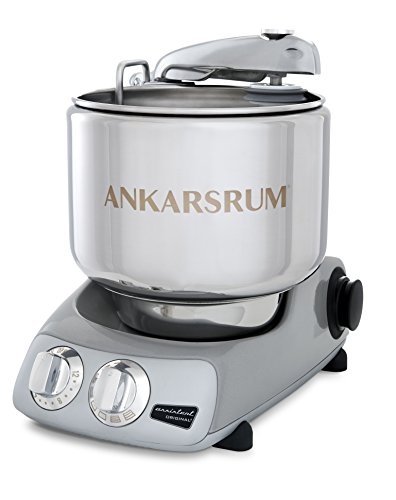
Ankarsrum AKM6230 Assistent Original — Best Large Mixer for Dough Production
For dough-led production — the home bakery selling at markets, the household built around bread — the Ankarsrum’s large-scale credentials come from its method rather than its measurements. Its rotating bowl works big dough masses continuously and gently, the way production hand-kneading does, at volumes that strain planetary designs.
Strengths
- Unmatched large-dough development among home-format machines
- Open bowl suits staged flour addition at production rhythm
- Proven decades-long design with dedicated following
Trade-offs
- Learning curve before production speed is possible
- Aeration tasks need its second bowl system
- Specialist pricing and ecosystem
| Specification | Detail |
|---|---|
| Model | AKM6230, per Amazon listing title |
| Design | Rotating bowl (manufacturer’s Assistent platform) |
| Colour verified | Jubilee Silver |
At production scale, dough quality is a temperature and development story: overworked dough warms, tears and ferments unevenly. The Ankarsrum’s roller-and-scraper action develops large masses the way a baker’s hands would — folding and pressing rather than tearing — which is why market bakers who switch to it describe the change in the bread, not just in the effort. Its open, rotating bowl also matches production rhythm: flour in stages, additions by eye, nothing hidden under a head.
The platform asks for commitment — technique relearned, a second bowl system for creams and whipping, accessories from its own world. For a mixed baker that is a real cost. For a dough producer it is tuition paid once for a capability nothing else in this guide replicates at scale, and that is the correct frame for its price.
Best for: dough-led producers and market bakers working at volume / Not suited for: mixed baking, beginners or one-machine-for-everything households
Check the current price on Amazon for the Ankarsrum AKM6230 Assistent Original — our Best Large Mixer for Dough Production pick in this guide.

KitchenAid Commercial KSM8990 — Best Bridge to Commercial
The KSM8990 suits the transition kitchen: the home-based business that has outgrown domestic machines’ duty cycles but still works in a domestic or small-studio space. It brings commercial build and terms to a footprint a serious home setup can house.
Strengths
- Commercial-duty build for sustained daily running
- Bowl-lift stability at production volumes
- A familiar platform for KitchenAid-experienced producers
Trade-offs
- Commercial warranty and service terms — verify on the listing
- Beyond any purely domestic requirement
- Work-first specification without home-market trims
| Specification | Detail |
|---|---|
| Model | KSM8990, per Amazon listing title |
| Platform | KitchenAid Commercial bowl-lift line |
Every growing food business meets the machine boundary: the point where domestic equipment, however premium, begins failing on schedule rather than on capability — because it was engineered for enthusiasm, not for Tuesdays. The KSM8990 exists for that boundary. Its commercial platform assumes daily sustained running, and its ownership terms are written for businesses that can plan around service rather than warranties designed for households.
Buyers should cross this boundary deliberately, with the listing’s commercial terms read in full. For the kitchen that has genuinely become a small business, it is the correct large mixer — the one whose promises match the rota. For the kitchen that merely bakes a lot, the KSM70 remains the wiser ceiling, and this guide says so in both reviews.
Best for: home-based food businesses outgrowing domestic duty cycles / Not suited for: domestic baking at any scale below business routine
Check the current price on Amazon for the KitchenAid Commercial KSM8990 — our Best Bridge to Commercial pick in this guide.

Happybuy 10Qt Commercial Food Mixer — Best True Commercial Size
This is not a home appliance and this review does not pretend otherwise: the Happybuy 10Qt is for bakeries, pizzerias, restaurants and serious production kitchens that need commercial bowl capacity at an accessible commercial price. Home bakers should read it as the guide’s far shore — useful to know where the category ends.
Strengths
- True 10-quart commercial capacity
- Timing function suits production routines
- Three-speed commercial planetary format with full tool set
Trade-offs
- Commercial scale, weight and footprint — not domestic equipment
- Three speeds only; no domestic finesse expected or offered
- Commercial ownership terms and support model
| Specification | Detail |
|---|---|
| Bowl capacity | 10 quart stainless steel (from Amazon listing title) |
| Motor | 500W commercial, per Amazon listing title |
| Speeds | 3 |
| Features | Timing function, per Amazon listing title |
| Intended use | Bakery, pizzeria, restaurant kitchen, per Amazon listing title |
Commercial planetary mixers are a mature, standardised technology — a heavy frame, a big bowl, a small set of speeds and tools built to be serviced — and this machine is that technology at its most accessible. The timer is the tell of its world: production runs are timed, repeated and delegated, and the machine is specified for a rota rather than a recipe. In a small bakery or pizzeria, those are the virtues that matter, and capacity per dollar here undercuts every domestic flagship in this guide.
The same facts disqualify it at home: the footprint, the weight, the three-speed bluntness and the commercial terms are all wrong for a kitchen that also makes birthday cakes. We include it because ‘large mixers’ searches bring commercial buyers too, and because its presence calibrates the rest of the guide — this is what large means when large is a job description.
Best for: small bakeries, pizzerias and restaurants needing commercial capacity accessibly / Not suited for: any domestic kitchen, however ambitious
Check the current price on Amazon for the Happybuy 10Qt Commercial Food Mixer — our Best True Commercial Size pick in this guide.
Comparison Table
Read this table by world, not by ranking: home flagships, alternative platforms and commercial equipment solve different problems that happen to share the word ‘large’.
| Pick | Badge | Key spec | Best for |
|---|---|---|---|
| Kitchen in the box Stand Mixer 8.5 QT | Best Overall Large Mixer for Homes | 8.5-qt tilt-head, 900W, 10 speeds | large households and event bakers needing maximum home-format capacity |
| KitchenAid 7 Quart Bowl-Lift Stand Mixer KSM70 | Best Premium Large Mixer | 7-qt bowl-lift, 11 speeds plus half speed | production-minded home bakers wanting premium scale with full support |
| Kenwood Chef Titanium Kitchen Machine 7 qt | Best Large Mixer for Control | 7-qt, 800W, electronic variable speed | technically minded bakers wanting flagship scale with electronic speed control |
| Ankarsrum AKM6230 Assistent Original | Best Large Mixer for Dough Production | Rotating-bowl dough production platform | dough-led producers and market bakers working at volume |
| KitchenAid Commercial KSM8990 | Best Bridge to Commercial | Commercial bowl-lift platform | home-based food businesses outgrowing domestic duty cycles |
| Happybuy 10Qt Commercial Food Mixer | Best True Commercial Size | 10-qt commercial planetary, 3 speeds, timer | small bakeries, pizzerias and restaurants needing commercial capacity accessibly |
The single most useful question the table raises is duty: how many hours a week will this machine actually run? Under ten, buy the home flagship that fits your batches. Over that, start reading the commercial rows seriously — the category boundary is drawn in hours, not quarts.
How to Choose the Best Large Mixers: Start With Duty, Not Size
Large-mixer regret almost never comes from choosing too little capacity; it comes from choosing the wrong duty class. So begin with a rota, not a recipe: estimate the hours per week the machine will run, and the pattern — big domestic days with rest between, or production that repeats daily. Domestic flagships are engineered for the first pattern and warrantied for households; commercial machines assume the second. A buyer who matches class to rota gets a machine that lasts; a buyer who matches only bowl size gets a countdown.
Then size the working load honestly. Use your largest regular batch — not the annual extreme — and apply working fractions: dough at about half the bowl’s volume, batter at two-thirds. That arithmetic converts the brochure numbers in this guide into loaves and dozens, which are the units your kitchen actually thinks in. Buy one step above the result to leave headroom, and resist the second step: oversizing taxes every ordinary batch with worse mixing and every cleaning with a bigger bowl.
Finally, audit the room. Large mixers need a station: counter depth for the footprint, vertical clearance for heads, lifts and bowl removal, a route for a full bowl that you can walk safely, and a floor or counter that takes the weight without complaint. More large mixers are returned for fit than for performance, and every one of those returns was preventable with a tape measure.
Home Flagship, Alternative Platform or Commercial: The Three Large-Mixer Worlds
The home flagship world — KSM70, Kenwood — offers capacity with civilisation: wide speed ranges, delicate low ends, attachments, finishes and household warranties. Its ceiling is duty, and for kitchens inside that ceiling it is not a compromise at all; it is the best tool. The alternative platforms — Ankarsrum’s rotating bowl above all — trade that breadth for depth in one discipline, dough, and reward producers whose work is concentrated there.
The commercial world strips civilisation back to capability: fewer speeds, heavier frames, timed runs, serviceable parts and terms written for businesses. Nothing about it is worse; everything about it is specialised. The mistake is crossing worlds unknowingly — a home buyer seduced by a 10-quart bargain, a business buyer burning out a flagship. This guide labels the worlds on every pick so the crossing, if you make it, is a decision rather than an accident.
The Ownership Costs of Going Large: Bowls, Parts and Power
Large machines carry large running costs that sticker prices hide. A second bowl at this scale is a significant purchase, yet batch producers need one; price it before committing to a platform. Replacement beaters, hooks and whisks are bigger, fewer and pricier than standard sizes, and on the alternative and commercial platforms they come from smaller supply chains — check availability and lead time while you can still choose a different machine.
Power and placement have costs too. Large motors on long production runs want a circuit that is not already sharing the oven and the kettle, and commercial models may have requirements a domestic kitchen must adapt to. None of these costs are reasons to stay small; they are reasons to buy large with a budget that includes the machine’s life, not just its arrival. The producers who thrive at this scale are the ones who priced the whole system on day one.
Footprint, Weight and the Architecture of a Mixer Station
A large mixer reorganises a kitchen around itself, and treating that as a design problem rather than a surprise is the difference between a station and an obstacle. Start with the vertical: bowl-lift and tilt-head machines need their operating height, not their resting height, measured against cabinets — and at this scale the difference between the two numbers decides kitchens. Continue with depth and swing: bowls come forward and out, heads go back, and the cook needs standing room in front of all of it, ideally with the main prep surface adjacent rather than across a walkway a full bowl must cross.
Weight writes the final rules. Machines in this class range from heavy to genuinely immovable in daily practice, which means the station is permanent and should be planned like one: power within reach without trailing cables, tools and the second bowl stored at the station rather than across the room, and lighting good enough to read a dough’s surface — because at production scale, you judge by looking. Kitchens that give a large mixer this modest architecture find it disappears into the workflow. Kitchens that squeeze it into a leftover corner find it resented weekly, at exactly the size that makes resentment expensive.
Noise, Vibration and Neighbours: Living With Production Equipment at Home
Large mixers make their presence known acoustically and physically, and home buyers — especially those stepping up from domestic machines — should know what changes. A big planetary under load transmits vibration through counter and floor; on hollow or lightweight surfaces that becomes audible rooms away, and the machine’s own mass, which feels like quality in the showroom, is partly there to absorb exactly this. Commercial machines add the honest industrial note: they were voiced for workplaces, not for flats with sleeping children, and their three-speed directness includes no concession to dawn baking.
The mitigations are practical. A solid, level surface is the first and best silencer; a dense mat under the machine absorbs much of the rest. Scheduling matters at production scale in shared buildings — the 6 a.m. market bake is a neighbour-relations decision as much as a production one. And the alternative platforms earn a mention here: the rotating-bowl Ankarsrum works large doughs with a markedly different, generally calmer acoustic signature than planetary machines at full load. None of this should veto a purchase. All of it belongs in the decision, because a large mixer is heard and felt by everyone in the building, not only by the person who chose it.
Resale, Service and the Long Economics of Large Machines
Large mixers are among the few kitchen purchases with a genuine second life, and that changes their economics in ways worth pricing at the start. Established platforms — the flagships and commercial machines in this guide — hold value because their buyers are producers who shop used deliberately, their parts pipelines run long, and their failure modes are serviceable rather than terminal. A well-kept flagship sold at year five can return a meaningful share of its price toward its successor; a budget giant, bought new at a fraction of the price, returns a fraction of a fraction. The honest comparison is therefore not price against price, but cost of ownership across the years you will actually run the machine.
Service access is the other long-economics variable. Before committing to any platform at this scale, learn who services it within your reach, whether wear parts — belts, gears, beaters, bowls — are stocked or ordered, and what a typical service costs relative to the machine’s price. Commercial equipment wins this audit almost by definition, which is part of what its price buys; flagship home platforms follow through their brands’ networks; budget and alternative platforms ask more of the owner’s resourcefulness. None of these answers disqualifies a machine. Together, they decide whether year six looks like a service visit, a parts order or a replacement purchase — and at this scale, that is a financial decision measured in hundreds, made once, at the moment of buying.
A Note on Moving Day: Transporting and Re-Siting a Large Mixer
Large mixers move house, get sold, and change kitchens, and their size makes each of those events a small logistics exercise worth planning rather than improvising. Keep the original packaging if storage allows — it is engineered for exactly this machine’s weight distribution — and if it is gone, pack the bowl separately from the body, immobilise the head or lift in its resting position, and treat the machine as the two-person lift its weight declares it to be. On arrival anywhere new, the installation protocol in this guide applies in full again: level surface, clearances re-measured rather than assumed, an empty run through the speeds, and a half-scale first batch. Machines that survive decades usually survive several kitchens; the ones that arrive damaged in a new home were almost always packed by optimism. At this scale, a little pessimism in bubble wrap is a professional virtue.
Large Machines, Long Lives: A Closing Note on Buying Once
There is a philosophy of equipment that large mixers reward more than almost any other kitchen purchase: buy once, at the level your work genuinely requires, and let time do the rest. The machines in this guide are heavy, capacious and built — in their different classes — to be the last mixer a given kitchen needs for a long while. That longevity is not an accident of price; it is the product of matching, because machines die early from mismatch far more often than from defects: the flagship burned out on a commercial rota, the commercial unit abandoned because its bluntness taxed a home, the budget giant shaken apart by loads its frame never promised to carry. Every one of those early deaths was a correct machine in an incorrect kitchen.
So the closing advice of this guide is the advice it has given in every section, now stated once, plainly: know your rota, know your batches, know your room, and buy the machine those three facts describe — verified, measured and honestly classed. Do that, and a large mixer stops being the riskiest purchase in the kitchen and becomes the most settled one: a fixed point of capability around which years of baking organise themselves. That is what large is actually for, and it is available at every price philosophy represented above, provided the match is made with open eyes.
Installation Day: Electrical, Levelling and the First-Run Protocol
Large mixers deserve an installation, not an unboxing, and the protocol is short enough to have no excuse. Begin with the electrical check the guide’s ownership section promised: confirm the circuit that will carry the machine, especially where production runs coincide with ovens and kettles, and give long sessions a sensibly clear supply. Level the machine where it stands — a large planetary under an unbalanced load will find any slope and amplify it — and confirm the surface takes the static weight and the dynamic one, which are different numbers on a machine whose whole job is controlled violence in a bowl.
Then run the first-run protocol before any ingredient is committed: every speed empty, listening; the lift or tilt through its full travel; the bowl seated, removed and reseated until the motion is familiar; and a first batch chosen deliberately at half scale, so the machine’s voice, pace and handling are learned on a load that forgives. Record the model and serial, register what is registrable, and file the manual where the station’s notebook will live. An hour spent this way is the cheapest insurance in the entire purchase — it converts day-one surprises into day-one knowledge, while every remedy is still free.
Crew, Family and Customers: Who Else Your Large Mixer Has to Work For
Large mixers are rarely solo instruments. The market baker’s machine is run by a partner at dawn and a helper at weekends; the family machine is borrowed by teenagers and grandparents; the small business’s workhorse may be operated by staff whose training is a laminated card. That social reality belongs in the buying decision: controls that a second operator can learn in one demonstration, a bowl and tool routine that cannot be assembled dangerously wrong, and a machine whose limits are obvious rather than discovered. The home flagships score well here almost incidentally — their domestic design language is legible to everyone — while commercial machines assume a trained operator and reward one.
It also argues for the notebook and the recipe file living at the station, written for other hands than your own: batch sizes that worked, speeds and times, the quirks this particular machine has taught you. A large mixer outlasts routines, helpers and sometimes businesses; the knowledge around it should be as durable as the frame. Buyers who plan for the crew — present and future — buy machines that remain assets as their kitchens change, which at this scale and price is the only definition of value that survives contact with real life.
How to Set Up a Large Mixer Station and Run Big Batches Safely
A large mixer is a workstation, not an appliance, and ten minutes of station setup pays back on every batch. Work through this sequence when the machine arrives and at the start of production days.
- Position the machine on a level, load-rated surface with clearance for the head, lift and bowl path, and confirm it cannot walk toward an edge under load
- Seat and clamp the bowl, fit the correct tool, and run the machine empty through its speeds once — any grinding or surging is a day-one exchange, not a quirk
- Stage ingredients in batch order beside the machine; large batches punish mid-mix fetching, because the bowl does not wait politely
- Build doughs in stages — liquids and most of the flour first, a rest, then the remainder — and keep working loads inside the fractions this guide recommends
- Use timers for repeated production runs so texture, not memory, sets the endpoint, and note the times on the recipe itself
- Move full bowls with two hands and a planned route, and never carry a full large bowl at head height or over a floor someone is about to cross
Close the session by washing tools while residue is fresh — dried dough in a 10-quart whisk is a genuine labour event — wiping the frame and clamping surfaces, and leaving the bowl seated but unclamped. A large mixer maintained as a station stays accurate, stable and ready; maintained as an afterthought, it becomes the kitchen’s biggest chore in every sense.
Common Buying Mistakes
- Buying commercial capacity for domestic duty, then living with three speeds, commercial terms and a machine that dominates the kitchen
- Running a home flagship on a commercial rota and discovering duty cycle in the repair bill
- Sizing by brim volume instead of working fractions, and crowning bowls that should have been split
- Skipping the station audit — height, depth, circuit and bowl route — until the machine is already in the room
- Forgetting the second bowl and the replacement tools in the budget, then stalling production days on a washing relay
- Treating a full large bowl as a one-handed lift; most large-mixer injuries are handling injuries
Every mistake here is a planning failure rather than a product failure. Large mixers reward the buyers who plan like producers — which, at this scale, is exactly what they have become.
Final Recommendation
For homes, the 8.5-quart Kitchen in the box is the capacity answer and the KSM70 is the premium one; choose between them by how much finish, support and finesse your baking will use. The Kenwood serves control-minded bakers at the same flagship scale, the Ankarsrum serves dough producers like nothing else, and the two commercial machines — KitchenAid’s KSM8990 and the 10-quart Happybuy — are there for the kitchens whose mixing has become a business, with the terms to match.
Check the current price on Amazon for your pick, confirm the configuration and warranty terms on the listing, and measure your station one final time before ordering. Then put the machine to work at the scale you bought it for. The related guides below go deeper on large bowls specifically and on the professional KitchenAid range.
Short on time? Start with the Kitchen in the box Stand Mixer 8.5 QT, KitchenAid 7 Quart Bowl-Lift Stand Mixer KSM70, Kenwood Chef Titanium Kitchen Machine 7 qt — check price on Amazon for each and compare the current bundles before you decide.
Best Large Bowl Mixers Best Kitchenaid Professional Mixers Best Kitchen Stand Mixers Best Kitchen Mixers Under $300 Best Kitchenaid Mixers For Cooks
Frequently Asked Questions
What makes a mixer ‘large’ — the bowl or the machine?
Both, and this guide weighs the whole machine: capacity, frame, motor endurance and footprint. A big bowl on a light frame is a large-bowl mixer; a large mixer is built, as a system, for sustained big work. The distinction decides stability, duty and lifespan.
Should a home baker buy a commercial mixer?
Almost never. Commercial machines trade speed range, finesse, household warranty and kitchen-friendly size for duty cycle a home cannot use. The honest exception is the home-based food business, where the rota is commercial even if the address is domestic.
How many loaves can a 7 to 10-quart mixer handle?
Working by the fractions in this guide — dough at roughly half the bowl’s volume — a 7-quart machine comfortably runs multi-loaf batches of two to four standard loaves depending on dough type, and a 10-quart commercial extends that further. Stiff, low-hydration doughs sit at the lower end of any estimate.
Are large mixers hard to clean and store?
They are furniture-scale: most live permanently on a counter or station, bowls occupy a full sink, and tools are oversized. Plan the station, wash tools promptly after big sessions, and the upkeep is routine; improvise the storage and it never will be.
Which large mixer is best for a market baker?
Dough-led market bakers should look first at the Ankarsrum for development quality or the commercial machines for rota duty; mixed producers are usually best served by the KSM8990 bridge or the 10-quart commercial format. Match the machine to your product mix and weekly hours, in that order.
Do large mixers use more power than my kitchen can supply?
They draw more than standard appliances and run longer, so a shared, loaded circuit can complain during production. Check the listing’s electrical requirements for your chosen model and give production runs a sensibly clear circuit — a small planning step that prevents mid-batch trips.


