Disclosure: airfryerkitchensupply.com is reader-supported. When you buy through links on our site, we may earn an affiliate commission at no extra cost to you.
Where to buy
Shopping for the best kitchen sinks for durability? Every linked pick below was cross-checked against Amazon’s own catalogue data before it earned a link, and only listings that matched the product described here carry one. Start with the SANYCASA 30 Inch Undermount Workstation Sink if you want the short answer, or work through the full list — each pick is linked again in its review, the comparison table and the final recommendation, and every link lands on the same verified listing so you can check price on Amazon before you order.
The best kitchen sinks for durability are not the ones that look toughest in a showroom — they are the ones whose failure modes you understand and accept. Every sink material fails somehow: steel dents and scratches, enamel chips, composite can chip at an edge, and thin bowls of any material drum, flex and age fast. A durable choice is a sink whose weaknesses live where your household never strikes.
So this guide ranks by honest construction evidence: gauges and materials are claimed only where the verified Amazon listing states them — including one sink built from 11 gauge steel, several 16 gauge benchmarks, a cast composite and a cast iron traditionalist. Every linked model was checked against the Amazon catalogue, and each review names its pick’s real failure mode alongside its strengths, because that is the information a durability buyer actually needs.
In this guide
Quick Picks
- Best Overall — SANYCASA 30 Inch Undermount Workstation Sink: 30 inch undermount single bowl workstation with integrated ledge, 11 gauge (3mm) stainless steel per the verified listing. households and keen cooks who dent, drop and abuse sinks daily.
- Best Mainstream Durability — Kraus KHU100-30 Standart Pro 30 Inch Sink: 30 inch undermount single bowl, 16 gauge stainless steel, KHU100-30, channel grooves and NoiseDefend pads per the verified listing. buyers who want proven durability from a major brand.
- Best Non-Steel Durability — Karran Granite Composite Single Bowl Sink, Black: Quartz composite single-bowl undermount sink, 9 inch deep bowl, reversible offset drain, 36 inch minimum cabinet per the verified listing. households whose sinks die by denting and noise rather than by staining.
- Best Cast Iron Durability — American Standard Quince 33 Inch Cast Iron Double Bowl: 33 x 22 top mount double bowl cast iron kitchen sink, 3 holes, Brilliant White, Quince series. traditional kitchens wanting a sink measured in generations.
- Best Scratch-Disguising Steel — Kraus KA1US33B 33 Inch Undermount Sink: 33 inch undermount single bowl, 16-gauge TRU16 steel, radiant pearl finish, rounded corners, NoiseDefend foil-layer soundproofing per the verified listing. owners whose durability worry is a sink that looks tired in three years.
- Best Big-and-Tough — Lordear 36 Inch Undermount Kitchen Sink: 36 x 19 x 10 inch undermount single bowl, 16 gauge stainless steel, handmade, deep basin per the verified listing. large households that need maximum bowl and heavy steel in one pick.
One-line summary: thickness defeats dents, mass defeats drumming, finishes defeat cosmetic ageing, and brand longevity defeats the year-nine spare-parts problem. No sink wins all four — pick your two.
How These Picks Were Chosen
We defined durability operationally before looking at a single product: resistance to denting, resistance to cosmetic ageing, structural calm (no flexing or drumming), and the manufacturer’s likelihood of supporting the model in a decade. Marketing words like ‘heavy duty’ counted for nothing unless a listing stated a gauge, a material or a construction detail we could repeat.
Verification ran through the Amazon catalogue for airfryerkitchensupply.com. The SANYCASA’s 11 gauge claim, the Kraus and Lordear 16 gauge claims, the Karran’s quartz composite construction and the Quince’s cast iron build all come from their verified listing titles — and where a listing stayed silent, this guide stays silent too.
The six slots deliberately span the four durability strategies — extreme steel thickness, proven 16 gauge steel, cast composite, and enamelled cast iron — plus one pick engineered against cosmetic ageing and one that uses sheer size as protection. A durability guide that only lists one strategy would be a catalogue, not advice.
Two picks illustrate the standard best: the Kraus KHU100-30 Standart Pro 30 Inch Sink and the Karran Granite Composite Single Bowl Sink, Black both matched their catalogue listings exactly, model number for model number, which is the level of certainty every linked pick in this guide had to reach.
The 6 Best Kitchen Sinks for Durability
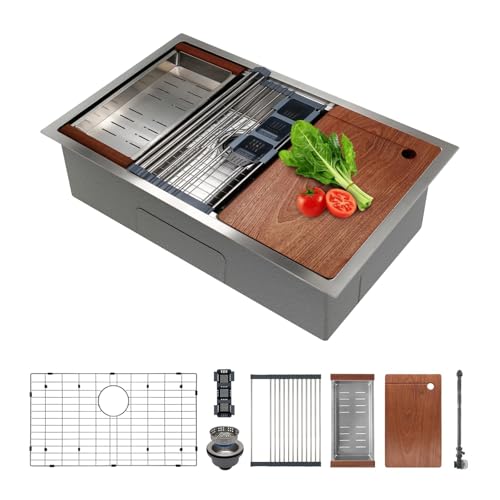
SANYCASA 30 Inch Undermount Workstation Sink — Best Overall
Durability guides usually argue about 16 versus 18 gauge. The SANYCASA ends that argument by leaving the scale: its verified listing states 11 gauge — 3 millimetre — stainless steel, several times the metal of a standard bowl, formed into a 30 inch undermount workstation. A dropped cast-iron skillet meets a bowl that behaves like a workbench, not a drum.
Strengths
- 11 gauge steel — dramatically thicker than the 16-18 gauge norm — stated plainly in the listing title
- Integrated ledge workstation format survives in a bowl built like equipment, not décor
- Single bowl with no divider to bend, crack or trap damage
Trade-offs
- Very heavy for an undermount — cabinet and counter support must be specified for it
- Premium tier positioning follows the material bill
- Overkill for gentle households; the weight is the point and the cost
| Key spec (from verified listing) |
|---|
| 30 inch undermount single bowl workstation with integrated ledge, 11 gauge (3mm) stainless steel per the verified listing |
That thickness buys the two things durability actually means in a sink: dent resistance under impact, and a structure that does not flex and drum as it ages. The trade is honest — this is a heavy object that needs a cabinet and counter specified to carry it, installed once and installed properly. For a buy-it-for-decades brief, that is the right shape of compromise.
Best for: households and keen cooks who dent, drop and abuse sinks daily / Not suited for: light-use kitchens paying for armour they will never test
Check the current price on Amazon for the SANYCASA 30 Inch Undermount Workstation Sink.

Kraus KHU100-30 Standart Pro 30 Inch Sink — Best Mainstream Durability
If the SANYCASA is the extreme answer, the KHU100-30 is the proven one: Kraus’s Standart Pro in 16 gauge steel, a model line that has been absorbing family punishment for years. Its durability claim is stated in the verified listing — 16-gauge TRU16 construction — and backed by the less glamorous kind of longevity: a maker that still sells the matching grids and strainers.
Strengths
- 16-gauge TRU16 steel construction stated in the verified listing
- Standart Pro is a long-running line — parts and replacements stay available
- Channel grooves keep the bowl floor draining instead of holding standing water
Trade-offs
- Steel still scratches — durability here is structural, not cosmetic perfection
- Undermount install quality decides rim longevity
- No workstation ledge for prep-heavy cooks
| Key spec (from verified listing) |
|---|
| 30 inch undermount single bowl, 16 gauge stainless steel, KHU100-30, channel grooves and NoiseDefend pads per the verified listing |
Judge steel durability correctly and this sink scores exactly where it should. It will scratch — every steel sink does — but it will not dent under normal abuse, its corners will not crack, and its floor is grooved to drain rather than to hold the standing water that ages finishes. Structural honesty over cosmetic promises is what durability means.
Best for: buyers who want proven durability from a major brand / Not suited for: anyone expecting a scratch-proof bowl — no steel sink offers that
Check the current price on Amazon for the Kraus KHU100-30 Standart Pro 30 Inch Sink.

Karran Granite Composite Single Bowl Sink, Black — Best Non-Steel Durability
Granite composite attacks durability from the opposite direction to steel: instead of a tougher skin, it offers a solid cast body with nothing to dent. The Karran’s quartz composite bowl is the same material class as premium composite counters — hard, dense, coloured through — so the wear of a decade reads as gentle dulling rather than damage.
Strengths
- Cast composite cannot dent — impact energy goes into a material with no thin skin to deform
- Colour runs through the material, so wear does not expose a different layer
- No metallic ringing or rust pathway, ever
Trade-offs
- Composite can chip if a heavy pan edge strikes the rim hard — tough is not invincible
- Heavy bowl; support requirements are real
- Black shows light mineral deposits in hard-water homes
| Key spec (from verified listing) |
|---|
| Quartz composite single-bowl undermount sink, 9 inch deep bowl, reversible offset drain, 36 inch minimum cabinet per the verified listing |
Its failure mode is different and worth knowing: a sharp, heavy impact on an edge can chip composite where steel would dent. In the middle of a bowl floor, though — where family sinks actually take their punishment — composite is close to untroubled. Choose it when your history says your sinks die by dents, drumming and rust anxiety rather than by dropped skillet rims.
Best for: households whose sinks die by denting and noise rather than by staining / Not suited for: anyone needing a light sink for a weak cabinet or a drop-in install
Check the current price on Amazon for the Karran Granite Composite Single Bowl Sink, Black.

American Standard Quince 33 Inch Cast Iron Double Bowl — Best Cast Iron Durability
Before stainless took over, the durable kitchen sink was enamelled cast iron, and the Quince shows why the material still has believers: a massive iron casting that absorbs impact silently, wearing an enamel skin that can be cleaned, polished and even touched up across decades of service. Sinks like this are routinely the oldest working fixture in old houses.
Strengths
- Cast iron core is the heaviest, most impact-absorbent sink construction in the guide
- Enamelled surface is repairable in a way modern coatings are not
- Top-mount deck design from a heritage plumbing brand
Trade-offs
- Enamel can chip if struck hard, exposing iron that must be touched up
- Extremely heavy — cabinet reinforcement and two installers are assumed
- White enamel shows stains and demands prompt wiping from heavy users
| Key spec (from verified listing) |
|---|
| 33 x 22 top mount double bowl cast iron kitchen sink, 3 holes, Brilliant White, Quince series |
The durability bargain is different from steel’s: iron does not dent, but enamel can chip under a hard edge strike, and a chip must be sealed before the iron beneath rusts. Owners who understand that single rule get a sink that can outlast the kitchen around it — twice. The weight is the other truth: plan the cabinet and the install crew for it.
Best for: traditional kitchens wanting a sink measured in generations / Not suited for: anyone installing alone or into lightweight cabinetry
Check the current price on Amazon for the American Standard Quince 33 Inch Cast Iron Double Bowl.

Kraus KA1US33B 33 Inch Undermount Sink — Best Scratch-Disguising Steel
Most steel sinks do not fail structurally — they fail cosmetically, ageing into a map of scratches that makes a sound sink look finished. The KA1US33B is engineered at exactly that failure point: its radiant pearl finish, named in the verified listing, is a scratch-masking surface over 16-gauge TRU16 steel, so the bowl’s working wear blends into the finish instead of announcing itself.
Strengths
- Radiant pearl finish is specified to mask scratches — the top cosmetic killer of steel sinks
- 16 gauge steel with foil-layer soundproofing for structural calm
- Rounded corners resist the grime build-up that ages corners first
Trade-offs
- Masking scratches is not preventing them — heavy abuse still marks any steel
- 33 inch single bowl needs the cabinet to match
- Pearl sheen is softer than some buyers expect from ‘stainless’
| Key spec (from verified listing) |
|---|
| 33 inch undermount single bowl, 16-gauge TRU16 steel, radiant pearl finish, rounded corners, NoiseDefend foil-layer soundproofing per the verified listing |
Underneath the finish the fundamentals are right — heavy steel, rounded cleanable corners, and foil-layer soundproofing that keeps the bowl from drumming itself loose-feeling over years of thermal and mechanical cycling. If your definition of durability is ‘still looks intentional in year eight’, this is the steel pick that answers it.
Best for: owners whose durability worry is a sink that looks tired in three years / Not suited for: commercial-style users who need the 11 gauge extreme instead
Check the current price on Amazon for the Kraus KA1US33B 33 Inch Undermount Sink.

Lordear 36 Inch Undermount Kitchen Sink — Best Big-and-Tough
Size is a durability feature nobody lists: a bowl big enough for the pan means the pan is washed inside the sink instead of balanced on its rim, which is where chips, dents and counter damage actually happen. The Lordear 36 pairs that logic with 16 gauge steel and a 10 inch depth across a 36 x 19 handmade single bowl, per the verified listing.
Strengths
- 36 inch handmade bowl in 16 gauge steel — size and substance together
- 10 inch depth contains the impacts of big-pot washing inside the bowl
- Single uninterrupted floor has no divider joint to fail
Trade-offs
- Big bowl, big cabinet requirement — measure before dreaming
- Handmade sinks vary slightly unit to unit; template from the actual sink
- No workstation ledge on this plainer sibling of the workstation model
| Key spec (from verified listing) |
|---|
| 36 x 19 x 10 inch undermount single bowl, 16 gauge stainless steel, handmade, deep basin per the verified listing |
Handmade construction brings slightly softened, welded-and-finished geometry that shrugs off the daily clatter of a big household, and the uninterrupted floor removes the divider — statistically a sink’s most-battered component — from the design entirely. It is the durability pick for households whose loads are simply large, all the time.
Best for: large households that need maximum bowl and heavy steel in one pick / Not suited for: small kitchens or weak counters that cannot carry a 36 inch undermount
Check the current price on Amazon for the Lordear 36 Inch Undermount Kitchen Sink.
Comparison Table
Compare the construction column, not the shine. The verified listings state these gauges and materials; anything a seller would not put in its own listing title should not be in your decision either.
| Pick | Badge | Key spec | Best for |
|---|---|---|---|
| SANYCASA 30 Inch Undermount Workstation Sink | Best Overall | 30 inch undermount single bowl workstation with integrated ledge, 11 gauge (3mm) stainless steel per the verified listing | households and keen cooks who dent, drop and abuse sinks daily |
| Kraus KHU100-30 Standart Pro 30 Inch Sink | Best Mainstream Durability | 30 inch undermount single bowl, 16 gauge stainless steel, KHU100-30, channel grooves and NoiseDefend pads per the verified listing | buyers who want proven durability from a major brand |
| Karran Granite Composite Single Bowl Sink, Black | Best Non-Steel Durability | Quartz composite single-bowl undermount sink, 9 inch deep bowl, reversible offset drain, 36 inch minimum cabinet per the verified listing | households whose sinks die by denting and noise rather than by staining |
| American Standard Quince 33 Inch Cast Iron Double Bowl | Best Cast Iron Durability | 33 x 22 top mount double bowl cast iron kitchen sink, 3 holes, Brilliant White, Quince series | traditional kitchens wanting a sink measured in generations |
| Kraus KA1US33B 33 Inch Undermount Sink | Best Scratch-Disguising Steel | 33 inch undermount single bowl, 16-gauge TRU16 steel, radiant pearl finish, rounded corners, NoiseDefend foil-layer soundproofing per the verified listing | owners whose durability worry is a sink that looks tired in three years |
| Lordear 36 Inch Undermount Kitchen Sink | Best Big-and-Tough | 36 x 19 x 10 inch undermount single bowl, 16 gauge stainless steel, handmade, deep basin per the verified listing | large households that need maximum bowl and heavy steel in one pick |
How to Choose a Kitchen Sink for Durability
Gauge: the one number that predicts dent resistance
In steel, gauge runs backwards — lower is thicker. The working ladder in this guide is 18 gauge (budget, adequate), 16 gauge (the durability benchmark for homes), and the SANYCASA’s 11 gauge, which is less a sink specification than a workbench one. Each step up buys dent resistance and acoustic calm, and costs money and weight.
Two cautions keep gauge honest. First, claim it only where stated — this guide repeats a gauge solely when the verified listing prints it. Second, gauge is not the whole sink: corner construction, floor slope and mounting all decide whether thick steel translates into a bowl that feels carved rather than folded.
Steel, composite, cast iron: three ageing stories
Steel ages cosmetically first: scratches accumulate into a patina that brushed and pearl finishes disguise well, while the structure underneath stays sound for decades. Composite ages slowest in the middle of the bowl — nothing to dent, colour through the body — but carries a chip risk at exposed edges. Cast iron under enamel is the generational option: silent, massive, and repairable, with chips as its one managed weakness.
Choose by your household’s damage history. Dent-prone homes (cast iron cookware, teenagers, catering pans) should buy thickness or composite. Appearance-driven homes should buy finish strategy. Homes that keep things for thirty years should buy iron or the heaviest steel and accept the install weight.
The parts of a sink that actually wear out
Drains, strainers, seals and mounting clips fail years before bowls do. A durable purchase therefore includes the ecosystem: standard drain openings, a manufacturer that sells replacement strainers and grids, and mounting hardware that can be re-tightened. The mainstream lines in this guide earn their places partly on this unglamorous criterion.
Soundproofing pads deserve a mention as a durability feature: a bowl that drums is flexing microscopically with every impact, and padded bowls — several Kraus listings here specify their NoiseDefend systems — feel and stay more solid over years of thermal cycling between cold fill and boiling kettle.
Install quality is half of durability
An undermount hung on too few clips, or a heavy bowl on an unreinforced cabinet, will work loose, crack its seal and take the counter’s edge with it — failures blamed on the sink that belong to the install. Heavy picks like the 11 gauge SANYCASA, the composite Karran and the cast iron Quince demand the support conversation before delivery day.
Seal the rim properly, support the bowl independently of the counter where the maker allows it, and re-check clips and seals yearly. The most durable sink in this guide will still fail early in a careless install; a mid-tier sink installed beautifully will outlive it.
Budget tiers in durability terms
Durability has a price curve with a knee in it. The first step up — from the thinnest budget bowls to honest 16 gauge steel or entry composite — buys the largest lifespan gain per pound spent, because it eliminates the failure modes (denting, drumming, flexing seals) that kill cheap sinks young. Steps beyond that, to 11 gauge extremes or flagship cast iron, buy refinement of the same promise rather than a new one.
The rational durability budget therefore depends on the counter the sink serves. Under a granite or quality timber counter that will live for decades, overspending slightly on the sink is correct arithmetic — the sink should be built to the counter’s lifespan, not the appliance cycle. In a rental or a five-year kitchen, the mid-tier picks here deliver nearly all the real-world durability at a fairer total.
When to repair, when to replace
Most sink ‘failures’ are accessory failures wearing a disguise: a perished seal, a worn strainer, a loose clip, a grid with dead feet. All are cheap, all are fixable, and none justify a new bowl. Learn to diagnose by layer — water where it should not be means seals and connections first; noise means clips and pads; appearance means finish care — and you will replace sinks a third as often as your neighbours.
True replacement triggers are structural: a cracked bowl, a corroded-through floor, a warped rim that will no longer seal, or a size and layout the household has genuinely outgrown. If none of those is true, your durable sink is probably already installed, waiting for an afternoon of maintenance to be itself again.
The Sound of a Sink Giving Up
Sinks announce their decline acoustically before they show it. A bowl that has begun to drum more than it used to may have lost a sound pad or loosened a clip; a new creak at the rim suggests movement that will eat the seal; a disposal that suddenly sounds rougher through the bowl may be telegraphing a mounting problem. None of these sounds is the sink dying — all of them are the sink asking for the five-minute inspection this guide keeps recommending.
Make a habit of listening during the evening fill, the way drivers listen to a familiar car. You know your sink’s ordinary voice; a changed voice is data. The durable sink is rarely the one that never asks for attention — it is the one whose owner hears the ask while it is still a whisper, and answers it with a spanner instead of a skip.
Why Sinks Look Old Before They Are Old
Walk into a ten-year-old kitchen and the sink usually looks older than the cabinets. The causes are specific: a scratch bloom on the bowl floor from pans, water-spot etching around the faucet deck, grime welded into tight corners, and a rim seal gone dark. Notice that none of these is structural — the sink works perfectly and looks finished.
That is why this guide treats finish strategy and corner geometry as durability features, not styling. A radiant pearl or brushed finish, rounded corners that a cloth can sweep, and a floor that drains fully instead of holding a permanent puddle are the difference between a sink that ages into patina and one that ages into neglect. Buy for the ten-year photograph, not the delivery-day one.
The Decade Test: Parts, Standards and Makers
Apply the decade test to any sink: in ten years, can you buy its strainer, its grid, its mounting clips? Is its drain a standard size that any plumber’s merchant stocks? Does its maker still exist as a sink company? The picks here pass because they come from lines — Standart Pro, Dayton-class mainstream ranges, Karran’s composite programme, American Standard’s cast iron — with installed bases too large to orphan.
No-name sinks fail this test silently: the bowl survives and the accessories vanish, and a sink without its fitted grid or strainer is a sink half-retired. Durability is a supply chain as much as a material, and it is the cheapest part of the whole purchase to get right at ordering time.
Thermal Shock, Boiling Kettles and Other Daily Violence
Sinks endure a thermal life nobody designs for: near-freezing fills, then a kettle of boiling pasta water; a frozen turkey defrosting, then hot tap at full blast. Materials answer differently. Thick steel takes thermal cycling in stride, expanding and contracting as one honest piece of metal. Enamel over iron handles heat superbly but asks you not to follow a freezing fill instantly with boiling water against a chipped spot. Composite shrugs off ordinary kitchen temperatures entirely.
The practical rule is boring and effective: run a little cold water into any sink before the boiling deluge, whatever it is made of. It costs three seconds, softens every thermal transition the bowl will ever meet, and is the sort of unglamorous habit that separates thirty-year sinks from ten-year ones more reliably than any specification.
Durability for the Planet: The Sink You Never Replace
A kitchen sink is a large, heavy, manufactured object whose replacement involves skips, plumbers and countertop risk. The most sustainable sink is therefore not made of any particular material — it is the one still in service in twenty-five years, which is a durability argument wearing an environmental hat. Every pick in this guide was chosen to be capable of that service life in its material class.
Support that choice by keeping the paperwork: model number, purchase date, and the maker’s parts channel, filed where the next owner of your house will find them. Sinks outlive memories and sometimes ownership. The household that inherits your kitchen — possibly your own children — will bless the folder that tells them exactly which strainer fits the bowl you wisely never replaced.
Warranties: Reading the Promise Behind the Product
Sink warranties reward close reading. Many cover the bowl’s structure generously while treating finish, accessories and labour narrowly — which mirrors this guide’s own analysis that bowls rarely die first. A long structural warranty from an established maker is a useful signal of confidence; a lifetime promise from a brand with no visible parts channel is a poem, not a policy.
Register the purchase, keep the receipt with the model number, and photograph the underside label before install. When a strainer or clip is needed in year nine, that small archive converts a research project into a single order. Durability, once again, turns out to be partly paperwork — the least glamorous and most reliable kind.
Abuse Profiles: Matching the Sink to the Actual Enemy
Durability advice fails when it imagines the wrong enemy, so profile yours honestly before choosing from this guide. The dropped-skillet household needs impact mass — thick steel, composite, iron. The scouring household, where cleaning is enthusiastic and abrasive, needs a finish that forgives being cleaned hard — brushed steel or composite, never a delicate coating. The soaking household, where acidic tomato and wine sit overnight, needs non-porous composure. The rental household needs parts availability above all, because tenants test ecosystems, not bowls.
Most households are a blend, with one dominant enemy. Name it, and the ranking in this guide rearranges itself into your personal order — which is exactly what a durability guide should do. The worst purchase in this category is a sink armoured against a threat you do not have, naked against the one you meet every week.
The Laboratory of Real Life: Rental Properties and Holiday Homes
Landlords and holiday-home owners are durability’s unwilling scientists: their sinks endure strangers, parties and cleaners of varying mercy, and their replacement patterns reveal what actually lasts. Their collective wisdom, gathered across countless changeovers, is unfashionable and consistent — mainstream bowls in honest materials, accessories that can be reordered in one phone call, and nothing whose care instructions require a manual or a meeting.
Homeowners can steal the whole playbook without giving up beauty, because the landlords’ favourites and this guide’s picks substantially overlap: 16 gauge steel from lines with deep parts catalogues, composite that cannot dent, iron that predates us all. The rental market simply strips away the sentimental options and leaves the evidence. If a sink survives a decade of holiday lets, it will survive your family — and it will probably survive the family after yours as well.
How to Install a Heavy-Duty Sink So It Stays That Way
Durability is installed, not just bought. These steps apply to every heavy pick in this guide and are where long service life is actually decided.
- Check the cabinet and counter against the sink’s weight — bowl plus a full load of water — and add reinforcement or an independent support frame for composite, cast iron or extra-thick steel models.
- Dry-fit everything: sink, faucet, disposal flange and drain alignment, before any sealant is opened.
- Use the maker’s full clip set for undermounts, spaced as specified — clips are structural, not decorative, and spares in the box are not permission to skip positions.
- Bed rims and undermount joints on a continuous, correct bead of kitchen-and-bath silicone, then leave the joint untouched for the full cure time before filling the bowl.
- Fill the bowl to the brim, load it as you would on the worst family night, and inspect underneath with a torch after an hour — weeps found now are adjustments; weeps found in a year are damage.
- Calendar a yearly five-minute check: clips tight, seal sound, drain connections dry, grid feet intact. Durability maintained is durability doubled.
If the support step reveals a cabinet that cannot carry your chosen sink, believe it and step down the list to a lighter pick. A slightly thinner sink on a solid install outlasts a heavyweight on a struggling one, every time.
After install, keep one quiet record: a phone photograph of the underside — clips, connections, disposal flange — taken while everything is new and dry. In year six, when something drips at 9 p.m., that photograph is the difference between diagnosing by comparison and diagnosing by guesswork. Durability is partly documentation. Keep the maker’s care sheet, however dull, in the same folder as the warranty. The cleaning products a manufacturer blesses for its own finish are the ones least likely to shorten the sink’s cosmetic life, and in year five nobody in the household will remember which those were — unless the sheet is where the folder lives. One more durability habit, and it is free: rotate the insults. The spot under the drying rack, the corner where the kettle always lands, the stretch of rim that catches every pan — sinks age where life concentrates. Moving the drying zone a few inches each season, and varying where heavy items rest, spreads a decade of wear across the whole bowl instead of engraving it into one square. It sounds trivial until you compare two ten-year-old sinks and see the map of a household written on only one of them.
Common Buying Mistakes
Believing any sink is scratch-proof. No household sink material is. Steel scratches, enamel and composite chip at edges. Buy the failure mode you can live with, and be suspicious of any listing that promises none.
Chasing gauge and ignoring the install. Thick steel on too few clips with a broken rim seal fails faster than thin steel installed beautifully. Half of durability is under the counter, not in it.
Dropping cast iron cookware into any bowl carelessly. Even 11 gauge steel prefers not to catch a falling skillet, and enamel or composite edges can chip. Durability is a partnership between the sink and the household’s habits.
Letting standing water live in the bowl. A floor that holds puddles — or a household that leaves soaking water for days — ages finishes and seals faster than impact does. Drain, rinse, and let the bowl dry when you can.
Orphaning the sink with no-name accessories. When the fitted grid or strainer for an unknown brand vanishes from sale, the sink is half-retired while its bowl is still perfect. Buy the ecosystem, not just the bowl.
Skipping the yearly clip and seal check. Five minutes annually catches the loose clip and the lifting seal while they are still adjustments. Skipped for years, they become the leak that ruins the cabinet.
Final Recommendation
The short version, with every pick in one place: the SANYCASA 30 Inch Undermount Workstation Sink (best overall); the Kraus KHU100-30 Standart Pro 30 Inch Sink (best mainstream durability); the Karran Granite Composite Single Bowl Sink, Black (best non-steel durability); the American Standard Quince 33 Inch Cast Iron Double Bowl (best cast iron durability); the Kraus KA1US33B 33 Inch Undermount Sink (best scratch-disguising steel); the Lordear 36 Inch Undermount Kitchen Sink (best big-and-tough). Match that list against the way your household actually cooks and cleans, and the right choice usually names itself.
Buy the SANYCASA 11 gauge if your household is genuinely hard on sinks and the cabinet can carry it — nothing else here is built like it. Buy the Kraus KHU100-30 if you want the proven mainstream version of the same idea, and the Karran composite if your damage history is dents and drumming rather than edge impacts.
Choose the Quince cast iron for a generational traditional kitchen, the KA1US33B when cosmetic ageing is your real enemy, and the Lordear 36 when the loads themselves are the hazard. Then install whichever you choose like you mean it — that is the step where durability is finally decided.
Keep researching the cluster: Best Kitchen Sinks For A Big Family Best Kitchen Sinks For Hard Water Best Kitchen Sinks For A Granite Countertop Best Kitchen Sinks For Butcher Block Countertops Best Kitchen Sinks Double
Frequently Asked Questions
What sink material lasts the longest?
Enamelled cast iron and heavy-gauge steel both measure service in decades, and granite composite is in the same conversation. The practical answer is that install quality and accessory availability decide real lifespan more than the bowl material — a well-installed 16 gauge steel sink from a supported line will outlast a neglected anything.
Is 16 gauge steel worth it over 18 gauge?
For a hard-working kitchen, yes: 16 gauge resists dents noticeably better and sounds far more solid, and the price step is usually modest. In this guide gauges are only claimed where the verified listing states them — including one 11 gauge model for genuinely heavy use.
Can a durable sink still look good after years of use?
Yes, if you buy finish strategy as well as structure: brushed and radiant pearl finishes mask the scratch pattern steel inevitably collects, composite’s colour runs through the material, and enamel can be polished and touched up. Sinks look old mainly when their finish shows every mark.
Do granite composite sinks chip?
They can chip at an exposed edge under a hard, sharp impact — that is their honest failure mode. In the bowl floor, where most punishment lands, composite is extremely resistant because there is no thin surface to dent or peel.
How do I stop my sink’s accessories becoming unavailable?
Buy from established model lines and order the fitted grid and any spare strainer early. Standard drain sizes and big installed bases are what keep parts available in year ten.
Does a bottom grid really extend a sink’s life?
It protects the bowl floor — the most scratched surface in any sink — from direct pan contact, and lifts dishes out of standing water. It is one of the cheapest genuine durability upgrades available.
How long should a good kitchen sink last?
A well-chosen, well-installed sink from the classes in this guide should serve 20 years and often far longer — enamelled cast iron and heavy steel routinely outlast the kitchens around them. In practice, seals, strainers and accessories need renewal along the way; the bowl itself is rarely the part that ends a sink’s life.
Is a heavier sink always more durable?
Weight correlates with durability within a material — thicker steel, solid composite, cast iron — but it is not the whole story. Corner construction, finish strategy, parts availability and install quality all share the credit. A heavy sink installed badly will lose to a lighter sink installed beautifully, which is why this guide treats install as half the subject.
Do thicker sinks resist stains better?
Thickness itself does not govern staining — surface and finish do. What thickness buys is impact and structural life. For stain behaviour, look to material: composite and glazed fireclay release stains from non-porous surfaces, while steel’s resistance depends on its finish and on not letting acidic foods sit. Choose the thickness for dents and the material for stains, as separate decisions.
Can a scratched stainless sink be restored?
To a degree, yes: brushed steel can be re-grained with the correct pads, working always in the direction of the existing grain, and pearl and brushed finishes forgive the process gracefully. Deep dents and creases are beyond cosmetics, which is why this guide weights dent resistance — the gauge decision — so heavily at purchase time.
Are pricier sinks from the same brand always more durable?
Not automatically — price often buys size, accessories and finish options rather than thicker metal or stronger construction. Compare the stated gauge, material and construction between tiers, using verified listing details as this guide does, and pay for the specifications that predict lifespan rather than for the tier’s name.
Does a durable sink need a special cleaner?
No — it needs the right restraint rather than a special product: non-abrasive cleaners matched to the material, prompt rinsing of acidic foods, and no scouring pads on finishes you want to keep. The makers’ own care guidance, kept with the warranty paperwork this guide recommends filing, is the authority for your specific bowl, and following it is itself a durability decision that costs nothing and compounds for decades.


