Disclosure: airfryerkitchensupply.com is reader-supported. When you buy through links on our site, we may earn an affiliate commission at no extra cost to you.
Where to buy
Shopping for the best kitchen sinks for a granite countertop? Every linked pick below was cross-checked against Amazon’s own catalogue data before it earned a link, and only listings that matched the product described here carry one. Start with the Karran Granite Composite Single Bowl Undermount Sink, Black if you want the short answer, or work through the full list — each pick is linked again in its review, the comparison table and the final recommendation, and every link lands on the same verified listing so you can check price on Amazon before you order.
Choosing the best kitchen sinks for a granite countertop starts with a constraint most sink guides ignore: granite decides the mount for you. Granite is cut and polished for undermount bowls — the stone’s finished edge becomes part of the sink’s rim — so nearly every serious option here is an undermount, and the real questions become material, finish and how the bowl behaves against a hard, expensive, effectively permanent counter.
That permanence raises the stakes. A sink under granite is not a casual swap; replacing it later means disturbing the stone. So this guide favours sinks built to age gracefully beside granite: granite composite that shares the counter’s material logic, and 16 gauge steels with finishes chosen to mask the wear that polished stone would otherwise spotlight. Every linked model was verified against Amazon’s catalogue data, with gauges and materials quoted only where the listing itself states them.
In this guide
Quick Picks
- Best Overall — Karran Granite Composite Single Bowl Undermount Sink, Black: Quartz composite (granite composite) single-bowl undermount sink, 9 inch deep bowl, reversible offset drain, 36 inch minimum cabinet per the verified listing. granite-counter owners who want a sink that behaves like the counter itself.
- Best Granite Workstation — Kraus Bellucci KGUW2-33MGR Granite Workstation Sink, Metallic Gray: 32 inch undermount workstation in granite composite, metallic gray, integrated ledge with accessories per the verified listing. granite kitchens that need prep space without a steel workstation look.
- Best Stainless Under Granite — Kraus KA1US33B 33 Inch Undermount Sink: 33 inch undermount single bowl, 16-gauge TRU16 steel, radiant pearl finish, rounded corners, NoiseDefend foil-layer soundproofing per the verified listing. owners who want steel’s familiarity with a finish that forgives daily use.
- Best Easy-Clean Design — Kraus Dex KD1US33B 33 Inch Undermount Sink: 33 inch undermount single bowl, 16 gauge stainless steel, Dex series design. granite owners who prioritise a clean, minimal bowl over accessories.
- Best Steel Workstation Under Granite — Ruvati RVH8300 32 Inch Workstation Sink: 32 inch undermount workstation, 16-gauge stainless steel, single bowl, soundproofed, includes cutting board and accessories per the verified listing. granite kitchens short on prep counter that still want steel.
- Best Value Kit Under Granite — Elkay Crosstown Workstation 31.5 Inch Sink Kit: 31-1/2 x 18-1/2 x 9 inch undermount workstation sink kit, 18 gauge stainless steel, Crosstown series. granite remodels on a controlled budget that still want a workstation.
The one-line version: granite composite disappears into the counter’s look and never rings; steel is lighter, cheaper to change, and needs a forgiving finish. Pick your material story first, then your size.
How These Picks Were Chosen
Granite narrows the field in useful ways. Drop-in sinks waste the polished cutout granite is famous for, so we considered undermount models only, in the 31.5 to 33 inch band that suits typical granite runs and standard cabinets, plus composite models whose listings state their cabinet minimums.
Verification ran through the Amazon catalogue for airfryerkitchensupply.com: model numbers, materials, gauges and kit contents were taken from listing titles and matched to the products described. Where a sink is described as 16 gauge or as granite composite in this article, that claim appears in the verified listing — we do not repeat gauge or material claims that circulate only in secondary roundups.
The six slots were then balanced deliberately: two granite composite sinks for owners who want the stone story continued, three 16 gauge steel sinks at different design temperatures, and one 18 gauge kit as the honest budget route — labelled as 18 gauge, because under a premium counter the gauge is exactly the sort of detail a buyer deserves to have stated plainly.
Two picks illustrate the standard best: the Kraus Bellucci KGUW2-33MGR Granite Workstation Sink, Metallic Gray and the Kraus KA1US33B 33 Inch Undermount Sink both matched their catalogue listings exactly, model number for model number, which is the level of certainty every linked pick in this guide had to reach.
The 6 Best Kitchen Sinks for a Granite Countertop

Karran Granite Composite Single Bowl Undermount Sink, Black — Best Overall
Granite countertops almost always take undermount sinks, and the Karran granite composite is the pick that treats the sink as a continuation of the stone rather than an insert in it. The quartz composite body is cast as a single bowl with a 9 inch depth and a reversible offset drain, and because it is not metal it never rings, clangs or shows the scratch bloom that steel develops under granite’s hard visual contrast.
Strengths
- Granite composite pairs naturally with granite counters — similar hardness story, no metallic ring
- Offset drain frees cabinet space below for storage or a disposal offset
- 9 inch deep bowl handles family-size pots without splash drama
Trade-offs
- Composite is heavy — the granite counter and cabinet must be properly supported
- Black composite shows light-coloured water deposits more than steel does
- Undermount cut and polish must match the counter fabricator’s template exactly
| Key spec (from verified listing) |
|---|
| Quartz composite (granite composite) single-bowl undermount sink, 9 inch deep bowl, reversible offset drain, 36 inch minimum cabinet per the verified listing |
The offset drain is a quiet practical win: shifting the drain to one side moves the trap and disposal in the cabinet, freeing a usable wedge of storage in what is usually the most wasted cabinet in the kitchen. With granite, the install conversation matters as much as the sink — this bowl undermounts with the rim sealed to the polished cutout, and that cutout must be templated from the actual sink, not from a catalogue drawing.
Best for: granite-counter owners who want a sink that behaves like the counter itself / Not suited for: anyone planning a drop-in install — this is undermount only
Check the current price on Amazon for the Karran Granite Composite Single Bowl Undermount Sink, Black.
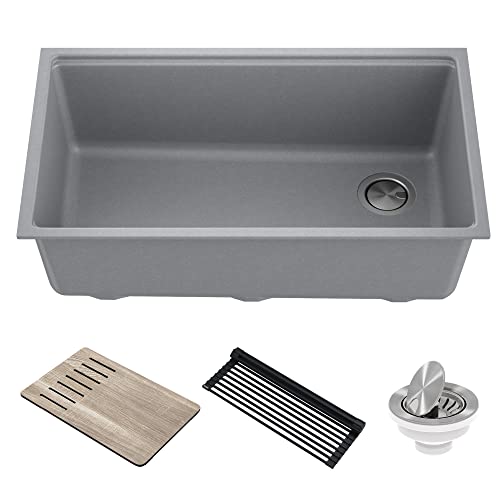
Kraus Bellucci KGUW2-33MGR Granite Workstation Sink, Metallic Gray — Best Granite Workstation
Most workstation sinks are steel, which can look like a appliance dropped into a stone kitchen. The Bellucci KGUW2-33MGR builds the same integrated-ledge idea in granite composite, finished in a metallic gray that bridges the gap between dark granite and stainless appliances. The verified listing confirms the workstation format and included accessories for the 32 inch undermount bowl.
Strengths
- Workstation ledge in a granite-look composite — prep over the bowl, stone aesthetic kept
- Metallic gray sits between black and steel for counters with mixed veining
- Accessories included per the listing, so the workstation works out of the box
Trade-offs
- Granite composite workstation is a premium-tier purchase
- The ledge accessories need storage when the full bowl is in use
- Composite colour must be chosen against your actual slab, not a screen image
| Key spec (from verified listing) |
|---|
| 32 inch undermount workstation in granite composite, metallic gray, integrated ledge with accessories per the verified listing |
Under a granite counter the Bellucci reads as carved stone with a working ledge, which is precisely the effect to aim for: the sink disappears into the counter’s material story while quietly adding the board-and-rack workflow that makes small prep zones feel twice the size. Order a colour sample mindset — composite grays vary with light, and granite veining can pull a gray warm or cool.
Best for: granite kitchens that need prep space without a steel workstation look / Not suited for: buyers whose slab colour clashes with gray — see the black and steel alternatives here
Check the current price on Amazon for the Kraus Bellucci KGUW2-33MGR Granite Workstation Sink, Metallic Gray.

Kraus KA1US33B 33 Inch Undermount Sink — Best Stainless Under Granite
Plenty of granite owners still prefer steel — it is lighter than composite, cheaper to replace, and familiar to every fabricator. The KA1US33B is the steel pick tuned for life under granite: its radiant pearl finish, called out in the verified listing, is designed to mask the fine scratches that would otherwise glare against a flawless stone surround.
Strengths
- Radiant pearl finish is specified to mask scratches — ideal against pristine granite
- 16 gauge steel with foil-layer soundproofing for a solid, quiet bowl
- Rounded corners release food and wipe clean faster than tight radii
Trade-offs
- Steel under granite needs its cutout sealed and supported correctly
- A 33 inch bowl in a wide granite run can look modest — check proportions
- Pearl finish has a softer sheen than polished steel if you want high shine
| Key spec (from verified listing) |
|---|
| 33 inch undermount single bowl, 16-gauge TRU16 steel, radiant pearl finish, rounded corners, NoiseDefend foil-layer soundproofing per the verified listing |
The construction details support the premium setting: 16-gauge TRU16 steel and NoiseDefend foil-layer soundproofing, both from the listing, keep the bowl feeling as substantial as the counter above it. If your granite is light-coloured, steel also avoids the colour-matching gamble entirely — it is a deliberate contrast rather than an attempted match.
Best for: owners who want steel’s familiarity with a finish that forgives daily use / Not suited for: anyone wanting a composite sink’s stone-matched look instead
Check the current price on Amazon for the Kraus KA1US33B 33 Inch Undermount Sink.

Kraus Dex KD1US33B 33 Inch Undermount Sink — Best Easy-Clean Design
The Dex KD1US33B is the minimalist’s granite sink: a 33 inch, 16 gauge undermount bowl with the series’ squared, architectural lines and an interior shaped to drain and wipe without fuss. Against granite — a material that reads as permanent and precise — that restraint looks right, and the bowl’s clean geometry is genuinely easier to keep looking sharp.
Strengths
- Dex design language emphasises clean lines and an easy-wipe interior
- 16 gauge steel at a 33 inch family-friendly size
- Undermount profile suits granite’s polished cutout edge
Trade-offs
- Fewer bundled accessories than the workstation picks
- Single bowl only — no divider option in this model
- Steel will show water spots against dark granite without a wipe-down habit
| Key spec (from verified listing) |
|---|
| 33 inch undermount single bowl, 16 gauge stainless steel, Dex series design |
Choose the Dex when the kitchen design is doing the talking and the sink’s job is to be a flawless utility. It skips ledges and bundles, which keeps the price of entry to Kraus 16 gauge steel lower than the workstation models, and it leaves the counter visually uninterrupted — often the entire point of choosing granite in the first place.
Best for: granite owners who prioritise a clean, minimal bowl over accessories / Not suited for: households that need a double bowl for simultaneous soaking and rinsing
Check the current price on Amazon for the Kraus Dex KD1US33B 33 Inch Undermount Sink.

Ruvati RVH8300 32 Inch Workstation Sink — Best Steel Workstation Under Granite
The RVH8300 is the long-running steel workstation answer for granite counters: a 32 inch undermount bowl in 16-gauge steel with the ledge, cutting board and accessories that turn the sink into a prep station. Under granite, that matters because granite counters are usually specified for looks and durability, not because the kitchen has spare counter to burn.
Strengths
- Full workstation system with board and accessories included
- 16-gauge steel with soundproofing suits quiet, high-end granite kitchens
- Brushed finish hides scratches against the counter’s polished surface
Trade-offs
- Workstation ledge needs an exact, level undermount install to sit accessories flat
- 32 inches is the compact end of workstation sizes
- Steel-plus-accessories bundle is priced as a system, not a bare bowl
| Key spec (from verified listing) |
|---|
| 32 inch undermount workstation, 16-gauge stainless steel, single bowl, soundproofed, includes cutting board and accessories per the verified listing |
Ruvati’s brushed finish is the right steel texture next to polished stone — it diffuses reflections and disguises the working scratches every sink collects. The install note that matters: a workstation ledge must sit dead level under the counter so boards rest flat, so this is a sink to template carefully with your fabricator rather than a casual weekend swap.
Best for: granite kitchens short on prep counter that still want steel / Not suited for: design-led kitchens that would rather keep the sink visually silent
Check the current price on Amazon for the Ruvati RVH8300 32 Inch Workstation Sink.

Elkay Crosstown Workstation 31.5 Inch Sink Kit — Best Value Kit Under Granite
Elkay’s Crosstown workstation kit is the value route into a granite undermount: a 31.5 inch workstation bowl sold as a kit, so the essentials arrive together and the total is easier to predict mid-remodel. The honest specification to note is in the verified title itself — 18 gauge steel, thinner than the 16 gauge Kraus and Ruvati picks here.
Strengths
- Complete kit format from a major American plumbing brand
- Workstation layout at a mid-tier positioning
- 9 inch deep bowl suits granite installations in standard cabinets
Trade-offs
- 18 gauge steel is thinner than the 16 gauge picks — stated plainly in the listing
- Slightly smaller footprint than the 32-33 inch alternatives
- Kit contents should be confirmed against the listing before ordering extras
| Key spec (from verified listing) |
|---|
| 31-1/2 x 18-1/2 x 9 inch undermount workstation sink kit, 18 gauge stainless steel, Crosstown series |
That gauge difference is a trade-off, not a disqualification. For a household that cooks normally rather than catering from its sink, 18 gauge Elkay steel with proper sound treatment performs well, and the money saved can go toward the fabricator’s polishing and sealing work that a granite install demands anyway. Buy it with eyes open and it is a sensible kit.
Best for: granite remodels on a controlled budget that still want a workstation / Not suited for: heavy commercial-style users who should step up to 16 gauge
Check the current price on Amazon for the Elkay Crosstown Workstation 31.5 Inch Sink Kit.
Comparison Table
Materials and gauges in this table are quoted from the verified listings. Note the one 18 gauge entry — it is the value kit, and the table does not dress it up as anything else.
| Pick | Badge | Key spec | Best for |
|---|---|---|---|
| Karran Granite Composite Single Bowl Undermount Sink, Black | Best Overall | Quartz composite (granite composite) single-bowl undermount sink, 9 inch deep bowl, reversible offset drain, 36 inch minimum cabinet per the verified listing | granite-counter owners who want a sink that behaves like the counter itself |
| Kraus Bellucci KGUW2-33MGR Granite Workstation Sink, Metallic Gray | Best Granite Workstation | 32 inch undermount workstation in granite composite, metallic gray, integrated ledge with accessories per the verified listing | granite kitchens that need prep space without a steel workstation look |
| Kraus KA1US33B 33 Inch Undermount Sink | Best Stainless Under Granite | 33 inch undermount single bowl, 16-gauge TRU16 steel, radiant pearl finish, rounded corners, NoiseDefend foil-layer soundproofing per the verified listing | owners who want steel’s familiarity with a finish that forgives daily use |
| Kraus Dex KD1US33B 33 Inch Undermount Sink | Best Easy-Clean Design | 33 inch undermount single bowl, 16 gauge stainless steel, Dex series design | granite owners who prioritise a clean, minimal bowl over accessories |
| Ruvati RVH8300 32 Inch Workstation Sink | Best Steel Workstation Under Granite | 32 inch undermount workstation, 16-gauge stainless steel, single bowl, soundproofed, includes cutting board and accessories per the verified listing | granite kitchens short on prep counter that still want steel |
| Elkay Crosstown Workstation 31.5 Inch Sink Kit | Best Value Kit Under Granite | 31-1/2 x 18-1/2 x 9 inch undermount workstation sink kit, 18 gauge stainless steel, Crosstown series | granite remodels on a controlled budget that still want a workstation |
How to Choose a Kitchen Sink for a Granite Countertop
Undermount is the granite standard — plan it properly
An undermount sink hangs from the underside of the granite, sealed at the rim, so the counter’s polished inner edge is exposed and wipeable straight into the bowl. That edge is finished by your fabricator, which means the sink and the stone are a package: the sink must be on site, or at least templated, before the granite is cut.
Support matters more with heavy bowls. Granite composite sinks are substantially heavier than steel, and the cabinet and mounting system must carry the bowl plus a full load of water and dishes. Raise the weight question with your fabricator before choosing composite — it is a five-minute conversation that prevents the only genuinely bad outcome in this category.
Granite composite vs stainless steel
Granite composite — quartz particles in a resin matrix — is cast, coloured through, and effectively non-porous. It does not ring like steel, it tolerates heat well, and dark colours hide a multitude of daily sins. Its weaknesses are weight, a higher price tier, and light-coloured mineral deposits showing on black bowls in hard-water homes.
Stainless steel is lighter, cheaper, and universally understood by installers. Against granite its risks are cosmetic: scratches and water spots show against the stone’s perfection, which is why the steel picks here lean on brushed and pearl finishes that diffuse wear. Neither material is ‘better’ — they are different ageing strategies.
Colour and finish against your slab
With composite, you are colour-matching a permanent fixture to a natural material full of movement. Black composite under black granite reads as one carved object; gray bridges to stainless appliances; white composite under light granite is the classic bright scheme. Order with your actual slab in mind — screen images lie about composite colours more than about almost anything else in a kitchen.
With steel, finish is the decision. Brushed finishes scatter light and hide scratches; the radiant pearl finish on the Kraus KA1US33B is explicitly a scratch-masking finish per its listing. Mirror-polished steel under granite is the one combination we steer family kitchens away from: it shows everything, immediately, forever.
Size, depth and the fabricator conversation
Most granite runs suit a 32-33 inch undermount in a 36 inch cabinet, with composite models sometimes stating a 36 inch minimum cabinet outright, as the Karran listing does. Bowl depths around 9 inches balance splash control against reach. Deeper bowls under a thick granite slab plus undermount drop can put the bowl floor a long way down.
Bring three things to the fabricator conversation: the exact sink (or its template), the faucet choice, and the disposal plan. Drain position — centre or offset — changes the cabinet plumbing, and an offset drain like the Karran’s can be chosen deliberately to win storage space under a granite kitchen’s most contested cabinet.
Reveal options: positive, negative and flush
Undermount sinks under granite are fitted with a reveal — the amount of sink rim visible inside the cutout — and it is a real decision your fabricator will ask about. A positive reveal shows a ledge of the sink’s rim: it protects the granite edge and gives fingers purchase, but creates a shelf where grime collects. A negative reveal overhangs the stone slightly past the rim, hiding the joint; it looks sleek and makes the exposed stone edge more vulnerable to pan strikes.
A flush or zero reveal aligns stone and steel exactly and demands the most precise templating. For family kitchens we lean positive or flush: the granite’s cut edge is the most fragile part of the whole installation, and a small rim ledge is cheap armour for it. Whatever you choose, choose it before templating — the reveal is cut into the stone, not adjusted afterwards.
What to ask the fabricator, in writing
Get four things confirmed before cutting day: the exact sink model and template being used, the reveal you have chosen, the edge profile and polish of the cutout, and who supplies and fits the mounting hardware. Granite projects involve enough parties that verbal understandings evaporate; a one-paragraph email trail protects the stone, the sink and the schedule.
Ask also how the fabricator wants the sink delivered — on site for templating, or template-only — and what support they expect the cabinet to provide for your chosen bowl’s weight. These are ordinary questions in the trade, and a fabricator who answers them crisply is telling you something good about the install your expensive counter is about to receive.
Sound in a Stone Kitchen
Granite kitchens are acoustically bright: stone counters, hard floors and a steel bowl can turn dish duty into percussion. It is a genuine quality-of-life factor in open-plan homes, and it is why the soundproofing details quoted in several verified listings here — pads, coatings, foil layers — deserve more weight under granite than they might in a softer kitchen. A composite bowl sidesteps the issue entirely by never ringing in the first place.
Test the idea cheaply before committing: at a showroom, set a saucepan into a display bowl and listen. Then imagine that sound at ten in the evening, nightly, beneath a bedroom. Households differ in sensitivity, but nobody who has run the thought experiment regrets weighting it. The sink is the loudest instrument in the kitchen orchestra; under granite, choose one that plays quietly.
Why the Sink Decision Is Bigger With Granite
With laminate or solid-surface counters, a disappointing sink is an afternoon’s regret. With granite, the cutout is forever: the hole in the stone fixes the sink’s maximum size and shape for the life of the counter, which is measured in decades. That is why this guide weights durability of appearance — finishes that mask wear, materials that do not date — as heavily as day-one specifications.
It also explains the conservative streak in the picks: established model lines from Kraus, Elkay, Ruvati and Karran, verified by model number, rather than novelty designs. When a fixture is effectively married to a stone slab, a manufacturer with a long-running model and available parts is worth more than a fashionable silhouette.
Sealing, Edges and Living With the Undermount Joint
The rim joint between sink and granite is sealed with silicone, and that seal is maintenance, not a lifetime fitting: expect to inspect it yearly and renew it when it darkens or lifts. Water standing at the joint is the enemy, so the family habit of wiping the counter into the bowl — the whole joy of undermount — should end with a quick pass along the rim line.
The exposed granite edge inside the cutout also deserves its sealer kept up; granite is sealed on its faces, and the cut edge is a face too. None of this is burdensome — it is ten minutes a few times a year — but buyers who want a zero-maintenance joint should know the truth before the stone is cut, not after.
Granite Thickness, Sink Weight and the Long View
Granite slabs come in different thicknesses, and the thicker stone that looks so permanent also raises the bowl: a thick slab plus an undermount drop plus a 9 or 10 inch bowl can put the sink floor surprisingly low. Households with shorter members should rehearse the reach at a showroom with the actual slab thickness in mind, because the number that matters is countertop-to-bowl-floor, not bowl depth alone.
Weight compounds across the system too — thick stone, a composite bowl full of water, a disposal — all carried by one cabinet. None of the picks here is unreasonable, but the granite conversation is precisely where ‘the cabinet will handle it’ should be verified rather than assumed. A five-minute check with the fabricator protects a four-decade counter.
Matching the Sink to Granite’s Veining and Movement
Quiet, fine-grained granites forgive almost any sink: the stone whispers and the bowl can speak. Bold, high-movement slabs reverse the relationship — a busy workstation with ledges, boards and racks can fight the stone’s drama, and the minimal bowls in this guide, the Dex and the KA1US33B, exist for exactly those counters. Stand back from a photograph of your slab and ask whether the sink should be a soloist or part of the choir.
Composite colour choice follows the same logic. Pull a colour from the slab’s secondary tone — the gray in the veining, the warm fleck — rather than matching its dominant field, and the sink reads as carved from the same geology. Match the dominant field exactly and any slight mismatch shouts. Fabricators do this instinctively; now you know the trick they are using.
Lighting: The Variable Nobody Templates For
Granite changes character with light, and the sink set into it inherits the drama. Under warm evening lighting a metallic gray composite deepens toward charcoal; under cold morning light the same bowl reads almost silver. Steel’s brushed finishes shift less, which is one more argument for steel when a kitchen’s lighting is theatrical and the household is particular.
If you can, view your shortlisted finishes beside a sample of your slab under your own kitchen’s lighting before the template is cut — a showroom’s spots flatter everything and represent nothing. The five minutes of scepticism this requires is the cheapest design insurance in the whole granite project, and it is the moment when colour mistakes are still free to make.
What Happens at the Corners: Radius, Templates and Chips
The cutout’s corners are where granite is weakest and templates matter most. A sink’s corner radius must be matched by the stone’s internal corners; force a tighter stone corner than the bowl expects and you create a stress point in the slab and a rim that cannot seal evenly. This is fabricator territory, but the buyer’s contribution is simple: never substitute a ‘similar’ sink after templating, because similar sinks have different corners, and the stone has already been told about the first one.
Chips, when they happen at sink cutouts, happen at those same corners and at the exposed front edge, usually from a pan swung carelessly. The reveal discussion earlier in this guide is partly chip strategy: a small positive reveal puts the sink’s rim where the pan arrives first. Granite is hard, not invulnerable, and the sinks in this guide were chosen partly for rims and profiles that respect that distinction.
A Decade With the Same Sink: What Owners Report
Ask owners ten years into a granite-and-sink marriage what they would change and the answers cluster with unusual consistency. Almost nobody wishes they had bought a different bowl size. Many wish they had thought harder about finish — the polished steel that showed every mark, the composite colour chosen from a screen that arrived a shade cooler than the slab. And nearly everyone mentions the seal: the year they noticed it, the afternoon they renewed it, the relief of finding dry wood and clean silicone beneath.
That testimony is why this guide spends so many of its words on finish strategy, colour method and the rim joint rather than on bowl fashion. The granite will look magnificent in year ten regardless; whether the sink still looks like it belongs there is decided by exactly the unglamorous variables covered above. Buy the finish your future self will thank you for, template carefully, and the decade reports suggest you will join the quiet majority who would change almost nothing.
How to Plan a Sink Install With a Granite Countertop
A granite sink install is a coordination exercise between you, the sink supplier and the fabricator. This sequence keeps the stone, the sink and the plumbing arriving in the right order.
- Choose the sink before the granite is templated. The fabricator needs the actual sink or its manufacturer template to cut and polish the opening.
- Confirm the minimum cabinet size and the bowl weight with the listing and your cabinet plan — especially for granite composite models, which are heavy.
- Decide drain position (centre or offset) and tell the plumber early; offset drains change trap and disposal layout under the cabinet.
- Agree the edge profile of the cutout with the fabricator and confirm the exposed edge will be polished and sealed.
- Have the sink on site for templating day. Photograph the template against the slab before cutting if your fabricator offers the chance.
- After install, run a full bowl of water, check the rim seal and the drain for weeps, and note the sealant renewal in your home maintenance calendar.
If you are replacing a sink under existing granite, your size is fixed by the existing cutout — measure the opening itself, not the old bowl, and shop only models whose rims cover that opening with the correct reveal.
While the fabricator is on site, ask for the cutout offcut if it is large enough to keep. A polished piece of your own granite is a trivet, a cheese board and — years later — the perfect colour reference if the sink or anything near it ever needs replacing. It costs nothing to ask before the slab leaves the workshop. Keep the fabricator’s paperwork with the sink’s: slab name, sink model, template date. Granite outlives memories, and if the sink is ever serviced or the counter repaired, that small file turns a guessing game into a phone call. Permanence deserves documentation. One more granite habit pays quietly: keep a soft cloth in the sink cabinet and give the rim joint a weekly wipe-and-look while the kettle boils. It takes the length of a kettle’s boil, it keeps the seal’s condition permanently current in your mind, and it converts the only real maintenance an undermount under granite asks for into a ritual so small it cannot be postponed. The owners who describe their granite sinks as ‘no trouble at all’ are, without exception, the owners doing some version of this tiny, regular thing.
Common Buying Mistakes
Choosing the sink after the granite is cut. The cutout is made for a specific sink or template. Falling in love with a different bowl afterwards means a sink that does not fit the hole in a very expensive stone.
Colour-matching composite from a phone screen. Composite colours shift with light and with the slab beside them. Decide against the real granite, in your kitchen’s light, or choose steel and sidestep the match entirely.
Ignoring bowl weight on composite models. Granite composite sinks are heavy before you fill them with water. The mounting system and cabinet must be specified for the load, not assumed.
Polished steel in a hard-working kitchen. A mirror finish under granite shows every scratch and spot against the stone’s perfection. Brushed and pearl finishes exist precisely for this setting.
Forgetting the rim seal is maintenance. Undermount silicone joints need periodic renewal. Treating the joint as fit-and-forget is how water finds the cabinet.
Skipping the disposal and faucet plan. Faucet reach, disposal flange and drain position all interact with the bowl you choose. Decide them together, before templating day.
Final Recommendation
The short version, with every pick in one place: the Karran Granite Composite Single Bowl Undermount Sink, Black (best overall); the Kraus Bellucci KGUW2-33MGR Granite Workstation Sink, Metallic Gray (best granite workstation); the Kraus KA1US33B 33 Inch Undermount Sink (best stainless under granite); the Kraus Dex KD1US33B 33 Inch Undermount Sink (best easy-clean design); the Ruvati RVH8300 32 Inch Workstation Sink (best steel workstation under granite); the Elkay Crosstown Workstation 31.5 Inch Sink Kit (best value kit under granite). Match that list against the way your household actually cooks and cleans, and the right choice usually names itself.
If your granite is dark and your taste runs to the seamless look, the Karran granite composite is the anchor pick — it behaves like the counter and its offset drain buys cabinet space. For a workstation in the same material language, step to the Kraus Bellucci in metallic gray.
If you prefer steel, choose your finish before your model: the KA1US33B’s radiant pearl for maximum forgiveness, the Dex for minimal lines, the Ruvati RVH8300 for a full workstation system. The Elkay Crosstown kit remains the honest value route — 18 gauge, clearly labelled, and entirely adequate for normal family cooking.
Keep researching the cluster: Best Kitchen Sinks Double Undermount Best Kitchen Sinks For A Big Family Best Kitchen Sinks For Butcher Block Countertops Best Kitchen Sinks For Durability Best Kitchen Sinks For Hard Water
Frequently Asked Questions
Can you put a drop-in sink in a granite countertop?
Technically a granite slab can be cut for a drop-in, but it wastes the polished-edge advantage that makes granite special, and the rim sits on top of the stone collecting grime. Undermount is the standard for granite for good reasons; every pick in this guide is an undermount.
Is granite composite or stainless steel better under granite?
Composite matches the stone’s look and feel, never rings, and hides wear in dark colours, but it is heavy and costs more. Steel is lighter, cheaper and easier to replace, but shows scratches and spots unless you choose a brushed or pearl finish. It is an ageing-strategy choice, not a quality verdict.
What size sink suits most granite countertops?
A 32-33 inch undermount in a 36 inch cabinet is the common sweet spot, with bowl depth around 9 inches. Some composite models state a 36 inch minimum cabinet in their listings — always check the specific model’s requirement.
Will a black granite composite sink show hard-water deposits?
Light mineral deposits do show more on black composite than on steel. They wipe away with routine cleaning, but if your water is very hard and your cleaning is very occasional, a mid-gray composite or a brushed steel will be more forgiving.
Does the sink need to be present when granite is templated?
Yes — the fabricator templates the cutout from the actual sink or its official template. Choosing or changing the sink after the stone is cut is the most expensive mistake in this category.
How do I maintain the seal between sink and granite?
Inspect the silicone rim joint a few times a year, keep it clean and dry, and renew the sealant when it darkens, cracks or lifts. It is a short job that protects the cabinet below from slow water damage.
Can I change my sink later without replacing the granite?
Only within the limits of the existing cutout: a replacement must cover the same opening with a compatible rim and reveal. This is why granite buyers should choose a sink from an established line with a standard footprint — it maximises the chance that a future replacement exists in the same dimensions.
Does granite need sealing around the sink more often?
The cut edge inside the sink opening is exposed to constant water, so it deserves attention whenever you reseal the counter — and a check more often than the rest of the slab. Keeping that edge sealed protects both the stone’s appearance and the cabinet below.
Will a granite composite sink match my granite countertop exactly?
Almost never exactly — and it should not try to. Composite is a manufactured colour; granite is a natural material with movement no factory reproduces. The professional approach is coordination, not matching: choose a composite tone drawn from the slab’s secondary colours, or a deliberate contrast, and the pairing reads as designed rather than nearly-matched.
How thick is the granite edge around an undermount sink?
It is the slab’s own thickness, exposed and polished at the cutout — which is why the edge’s finish and sealing deserve the attention this guide gives them. Thicker slabs make a more substantial visual rim and raise the bowl slightly; your fabricator can show you the effect on a sample before the real stone is cut.
Does a workstation ledge work under granite?
Yes — the ledge is part of the sink, hanging below the counter, so granite suits workstation models exactly as it suits plain undermounts. The one extra demand is levelling: the install must sit dead level so boards rest flat on the ledge, which is a templating and fitting conversation to have before the stone is cut, not after.


