Disclosure: airfryerkitchensupply.com is reader-supported. When you buy through links on our site, we may earn an affiliate commission at no extra cost to you.
Where to buy
The fastest way to compare finishes, hole configurations and current availability for the best kitchen faucets 2 holes shortlist is Amazon, where each verified pick below links straight to its listing. Prices move with finish and retailer, so this guide never prints a fixed price — use the links to check price on Amazon on the day you order. If a pick is marked as unlinked, it is discussed for fit and context but carries no purchase link, because its exact configuration could not be confirmed against a verified listing.
- Moen Essie 87014SRS Pull-Down Kitchen Faucet — Best Overall for 2-Hole Sinks: Check on Amazon
- Kingston Brass Heritage Bridge KS1278ALBS Kitchen Faucet — Best True Two-Post Bridge: Check on Amazon
- Kingston Brass Heritage Bridge KS1275AXBS Kitchen Faucet — Best Bridge in Oil Rubbed Bronze: Check on Amazon
- FORIOUS Pull-Down Kitchen Faucet with 10-Inch Deck Plate — Best Deck-Plate Cover Strategy: Check on Amazon
- OWOFAN Spring Pull-Down Kitchen Faucet with Deck Plate — Best Spring Style on a Plate: Check on Amazon
- LUFG Pull-Down Kitchen Faucet with Deck Plate — Best Budget Plate Option: Check on Amazon
Searching for the best kitchen faucets 2 holes quickly teaches you an awkward truth about the kitchen faucet market: almost nobody builds a faucet natively for exactly two holes anymore. Modern kitchen sinks are drilled for one, three or four holes, and mainstream faucets follow those patterns. A genuine two-hole sink — common on older stainless sinks, some bar and laundry sinks, and a handful of farmhouse installs where a separate sprayer or soap dispenser was removed — sits in a gap the catalogues mostly skip. That does not mean you are stuck. It means the honest shortlist looks different from a normal faucet roundup: one verified pull-down that explicitly covers one, two, three or four holes, classic two-post bridge faucets that genuinely mount through two holes, and long-deck-plate single-hole faucets that can cover a two-hole pattern when the spacing lines up — each labelled for exactly what it does, and each checked against a verified listing before it earned a link.
This guide is built around hole-count honesty. Every pick below states its verified mounting story in plain language: native two-hole, two-post bridge, or deck-plate cover. Where a listing only confirms one or three holes, the pick says so and explains the measuring step that decides whether it works on your sink — it never quietly re-labels a three-hole faucet as a two-hole faucet. Read the measuring section before you order anything, because with two-hole sinks the tape measure, not the marketing badge, decides the fit.
The six picks split into three families. The Moen Essie is the only mainstream pull-down in this guide whose verified listing explicitly includes two-hole installation, which makes it the default answer for most people. The two Kingston Brass bridge faucets are the traditional answer: two separate posts, two holes, no deck plate games. The remaining three are deck-plate strategies — single-hole faucets whose included plates can span and cover a two-hole deck when the hole spacing falls inside the plate length — useful when you want a modern pull-down and your second hole sits close to the first. Each family solves the same problem a different way, and the right one depends on your hole spacing, your style, and whether a soap dispenser or sprayer will ever reclaim that second hole.
In this guide
Quick Picks: The Shortlist for Best kitchen faucets 2 holes
Short on time? Start with the Moen Essie if you want a modern pull-down with an explicitly verified two-hole option. Choose a Kingston Brass bridge if your two holes are spaced eight inches apart and you want a true two-post mount. Use the deck-plate picks only after measuring your hole spacing against the plate length.
Moen Essie 87014SRS Pull-Down Kitchen Faucet — Best Overall for 2-Hole Sinks. The rare mainstream pull-down whose verified listing explicitly covers 1, 2, 3 or 4-hole installation, with a deck plate and included soap dispenser, Power Clean spray and Reflex docking. Check on Amazon.
Kingston Brass Heritage Bridge KS1278ALBS Kitchen Faucet — Best True Two-Post Bridge. A classic bridge faucet in brushed nickel that mounts through two posts on 8-inch centres — a genuine two-hole architecture with a separate side sprayer using an additional hole where available. Check on Amazon.
Kingston Brass Heritage Bridge KS1275AXBS Kitchen Faucet — Best Bridge in Oil Rubbed Bronze. The same honest two-post bridge architecture in oil rubbed bronze, for two-hole decks in kitchens built around dark, warm metal tones. Check on Amazon.
FORIOUS Pull-Down Kitchen Faucet with 10-Inch Deck Plate — Best Deck-Plate Cover Strategy. A brushed nickel pull-down whose verified listing includes a 10-inch deck plate for 1 or 3-hole decks — on closely spaced two-hole decks, that long plate can cover both holes; measure the spacing first. Check on Amazon.
OWOFAN Spring Pull-Down Kitchen Faucet with Deck Plate — Best Spring Style on a Plate. A commercial-style spring pull-down, NSF certified in its verified listing, with a deck plate for 1 or 3-hole decks — another plate-cover candidate for two-hole sinks after measuring. Check on Amazon.
LUFG Pull-Down Kitchen Faucet with Deck Plate — Best Budget Plate Option. A SUS 304 single-handle pull-down sold with a deck plate in brushed nickel — the budget entry in the plate-cover family for two-hole decks that measure up. Check on Amazon.
How These Picks Were Chosen
Every faucet in this guide was matched against a verified Amazon listing retrieved through the site’s own product data channel, and its mounting story was taken only from what that listing states: documented hole configurations, deck plate inclusion, or bridge architecture visible in the product title. No faucet was promoted to a two-hole pick on inference. A faucet whose listing says one or three holes is described as exactly that, with the two-hole route explained as a plate-cover strategy that depends on the reader’s own measurement.
Beyond mounting, picks were screened for the fundamentals that decide whether a faucet stays satisfying: cartridge quality signals, spray functionality, hose behaviour on pull-downs, finish options, and the maker’s parts ecosystem. The final six deliberately span the three honest solutions to the two-hole problem — documented multi-hole fit, native two-post bridges, and plate covers — so the guide answers the keyword as it actually exists in the market instead of pretending a native two-hole category is crowded.
One category was excluded on principle: faucets marketed with vague ‘fits most holes’ language but no documented configuration and no included plate. On a two-hole deck, vagueness becomes a return shipment. If your deck matches none of the three strategies here — very wide spacing, offset holes, a damaged deck — the honest answer is a new sink or a professional re-drill, and the guide says so rather than stretching a pick to fit.
The 6 Best Kitchen Faucets for 2-Hole Sinks, Reviewed
Each review below follows the same order: who the pick suits, its verified strengths and trade-offs, the specifications that could be verified, and a plain verdict. Badges match the Quick Picks exactly, so you can move between the shortlist and the deep reviews without losing your place.
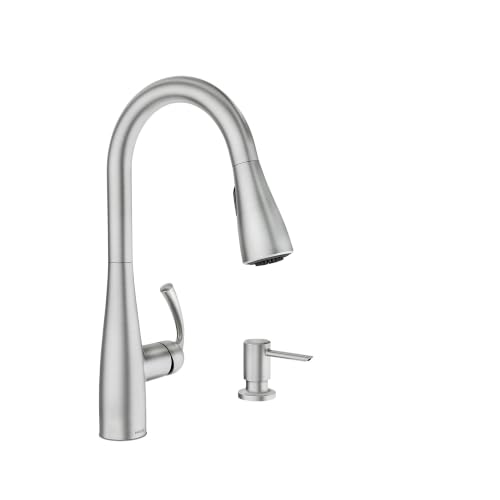
Moen Essie 87014SRS Pull-Down Kitchen Faucet — Best Overall for 2-Hole Sinks
The Essie is the pick that makes this guide possible. Its verified listing describes installation across one, two, three or four holes with the deck plate included, which means a two-hole sink is a documented configuration rather than a hopeful improvisation. You get a modern high-arc pull-down with Moen’s Power Clean spray, a Reflex hose that retracts and docks smoothly, Duralock quick-connect fittings, and a matching soap or lotion dispenser that can occupy an extra hole on wider decks — or stay in the box on a true two-hole deck.
Strengths
- Verified 1, 2, 3 or 4-hole installation — the only pull-down here with an explicit two-hole listing
- Power Clean spray delivers a stronger rinse stream for stuck-on food
- Reflex docking and Duralock fittings make both daily use and installation smoother
Trade-offs
- Spot Resist Stainless is the headline finish; matching every kitchen palette takes a finish check
- Deck plate look is modern-transitional, which may clash with a period kitchen
- On a two-hole deck the included dispenser has nowhere to go unless a hole frees up
| Specification | Detail (verified) |
|---|---|
| Verified dimensions | 8.78 x 2.31 x 15.75 inches |
| Overall height | 15.75 in (verified) |
| Hole configurations | 1, 2, 3, or 4-hole, deck plate included (verified in listing features) |
| Spray technology | Power Clean, Reflex docking, Duralock (verified) |
Why does explicit two-hole support matter so much? Because a faucet’s escutcheon and mounting hardware are engineered around the configurations the maker documents. When two-hole installation is in the listing, the plate length, the mounting nut clearance and the hose routing have all been validated for that deck pattern. With an undocumented configuration you are guessing at all three. The Essie’s spray performance is the other half of the story: Power Clean concentrates the rinse stream so flatware and baked-on pans clear faster, and the Reflex system keeps the wand seated instead of drooping after a year of use — the two failure modes that send pull-down owners shopping again. For a two-hole owner who wants one purchase that simply works, this is the lowest-risk route in the guide.
Best for: Two-hole sink owners who want a modern pull-down with documented fit / Not suited for: Shoppers who want a traditional two-handle bridge silhouette
Check the current price on Amazon to confirm the exact finish and configuration before ordering.
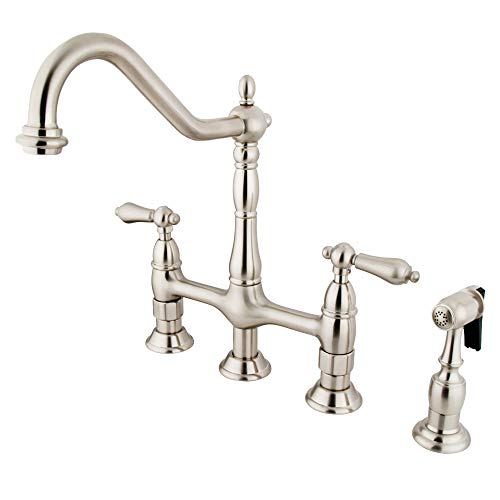
Kingston Brass Heritage Bridge KS1278ALBS Kitchen Faucet — Best True Two-Post Bridge
Bridge faucets predate the single-hole era, and their architecture is exactly what a two-hole deck was built for: two separate valve posts rise through two holes, joined above the deck by the bridge that carries the spout. The Heritage KS1278ALBS in brushed nickel delivers that layout with traditional cross-or-lever styling and a brass side sprayer. If your two holes sit on standard eight-inch centres, this is not a workaround — it is the native design.
Strengths
- True two-post mounting: the two holes are the design, not a compromise
- Traditional styling suits farmhouse and period kitchens that pull-downs fight with
- Brass side sprayer adds a dedicated rinse tool at the sink
Trade-offs
- The side sprayer needs its own hole — on a strict two-hole deck it cannot be installed
- Two-handle operation is slower than a single lever when hands are messy
- Bridge styling is a strong look that dominates a small sink run
| Specification | Detail (verified) |
|---|---|
| Style | Heritage bridge, brushed nickel (verified title) |
| Spout dimension in title | 8-3/4 in (verified title) |
Measure before falling for the bridge look: the posts must land on your two holes, which on bridge faucets means eight-inch centres. Decks drilled at other spacings cannot take a bridge without re-drilling, which is why the measuring section of this guide matters more for this pick than any other. Where it fits, the bridge repays you with serviceability — each valve is an independent, widely supported cartridge assembly — and with a silhouette no deck plate can imitate. The separate sprayer caveat is real: plan to leave it uninstalled, or pair this faucet with a sink that offers a third hole for it. Owners who cook in a traditional kitchen and value repairable, mechanical simplicity over spray modes will feel immediately at home.
Best for: Eight-inch-centre two-hole decks and traditional kitchens / Not suited for: Anyone whose second hole must host the sprayer on a two-hole-only deck
Check the current price on Amazon to confirm the exact finish and configuration before ordering.

Kingston Brass Heritage Bridge KS1275AXBS Kitchen Faucet — Best Bridge in Oil Rubbed Bronze
Finish is the whole reason this second bridge earns its own slot. Oil rubbed bronze anchors kitchens with dark cabinetry, copper accents and warm stone, and it is a finish the modern pull-down catalogues increasingly skip. The KS1275AXBS brings the Heritage bridge layout — two posts, two holes, spout carried on the bridge — to that palette, so a two-hole owner does not have to choose between the architecture that fits and the finish the room demands.
Strengths
- Genuine two-hole bridge mounting in a hard-to-find dark finish
- Lets a period or rustic kitchen keep one consistent metal story
- Independent hot and cold valves are simple, serviceable hardware
Trade-offs
- Oil rubbed bronze shows water spots differently and needs gentler cleaning than chrome
- As with any bridge, eight-inch centres are mandatory — measure first
- No pull-down wand; rinsing big trays relies on spout swing and any sprayer setup
| Specification | Detail (verified) |
|---|---|
| Style | Heritage bridge, oil rubbed bronze (verified title) |
Dark finishes punish lazy specification: two bronze faucets from different makers rarely match, so if your kitchen already carries oil rubbed bronze handles, hinges or lighting, a verified bridge in the same finish family protects the room’s coherence. Functionally this pick mirrors its brushed-nickel sibling — the same measuring discipline, the same sprayer-hole caveat, the same repairable two-valve logic. Choose between the two bridges purely on finish and on which metal your kitchen already speaks; the mounting story, and the honesty about it, is identical.
Best for: Two-hole decks in oil-rubbed-bronze kitchens / Not suited for: Shoppers who need a pull-down spray wand
Check the current price on Amazon to confirm the exact finish and configuration before ordering.

FORIOUS Pull-Down Kitchen Faucet with 10-Inch Deck Plate — Best Deck-Plate Cover Strategy
This pick is labelled a strategy, not a native fit, and the distinction is deliberate. The FORIOUS listing verifies a single-handle pull-down in SUS304 stainless with a ceramic cartridge, three spray modes and a ten-inch deck plate documented for one or three-hole installation. On a two-hole sink whose holes sit close together, a ten-inch plate can span and conceal both holes with the faucet mounted through one of them. Whether yours qualifies is a measurement, not a promise — the guide’s how-to section walks through it.
Strengths
- Long 10-inch deck plate gives the widest coverage window of the plate picks
- Three spray modes (stream, spray, pause) and an 18-inch hose cover daily tasks well
- cUPC and NSF/ANSI/CAN 61 credentials appear in the verified listing features
Trade-offs
- Two-hole coverage is conditional on your hole spacing — not a documented configuration
- The unused hole sits hidden under the plate; it cannot host a dispenser later without swapping faucets
- Value-brand long-term parts support is thinner than the legacy brands
| Specification | Detail (verified) |
|---|---|
| Verified flow | 1.8 GPM |
| Overall height | 14.76 in (verified) |
| Hole configurations | 1 or 3-hole with 10 in deck plate (verified) |
| Spout height | 6.69 in (verified) |
The plate strategy lives or dies on one number: the distance from the centre of your first hole to the far edge of your second. If that span fits inside the plate with margin at both ends, the plate seals over the unused hole and the install looks intentional. If it does not, stop — forcing a short plate over a wide pattern leaves an exposed hole edge that traps water and grime. FORIOUS earns the strategy slot because its plate is the longest verified here and its listing carries real plumbing credentials, which matters on a part that will sit under constant water pressure for years. Treat the measurement as the purchase decision and this becomes a legitimate, economical route to a modern pull-down on an older two-hole sink.
Best for: Closely spaced two-hole decks that pass the plate measurement / Not suited for: Wide-spaced two-hole decks or anyone unwilling to measure first
Check the current price on Amazon to confirm the exact finish and configuration before ordering.

OWOFAN Spring Pull-Down Kitchen Faucet with Deck Plate — Best Spring Style on a Plate
Some two-hole owners want the exposed-spring, pro-kitchen silhouette, and the OWOFAN is the verified route to it in this guide. Its listing confirms a spring pull-down design with dual stream and high-pressure spray modes, SUS304 construction, a ceramic cartridge tested through extensive cycling, and a deck plate for one or three-hole decks. As with the FORIOUS, two-hole use means the plate-cover strategy: one mounting hole, one covered hole, decided by your tape measure.
Strengths
- Spring spout gives flexible, pro-style reach around large pots
- Lead-free, NSF certified positioning in the verified listing
- Dual-mode spray head covers both filling and blasting tasks
Trade-offs
- The tall spring profile needs cabinet clearance — check the 16-inch height
- Plate coverage of a two-hole deck is conditional, never documented
- Spring faucets splash more in shallow sinks than high-arc wands do
| Specification | Detail (verified) |
|---|---|
| Verified dimensions | 1.85 x 1.85 x 16 inches |
| Overall height | 16 in (verified) |
| Hole configurations | 1 or 3-hole, deck plate included (verified) |
The spring design changes how a sink feels to work at: the wand travels on a flexible coil, so rinsing a sheet pan corner-to-corner stops being a wrestling match. That freedom is why this pick exists alongside the calmer FORIOUS — same plate strategy, different working style. Respect the height: sixteen inches plus the arc of the coil can crowd low cabinets or shelves above the sink, and the measuring routine in this guide includes a clearance check for exactly that reason. If your spacing passes and your cabinets clear, this is the most characterful way to modernise a two-hole sink without re-drilling it.
Best for: Two-hole owners who want spring-faucet reach and pass both measurements / Not suited for: Low-clearance sinks or wide two-hole spacings
Check the current price on Amazon to confirm the exact finish and configuration before ordering.
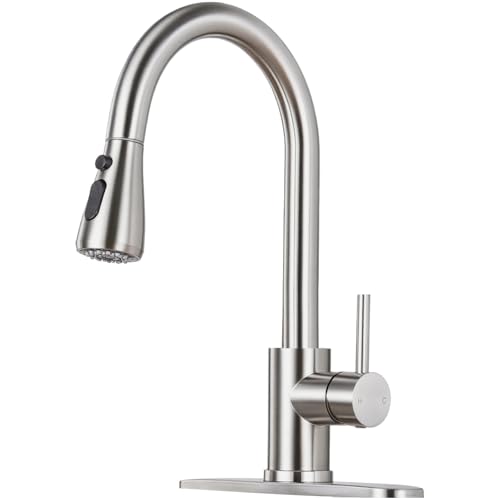
LUFG Pull-Down Kitchen Faucet with Deck Plate — Best Budget Plate Option
Every strategy needs an accessible rung, and the LUFG fills it: a brushed nickel, single-handle pull-down in SUS 304 stainless, listed with a deck plate. The verified title confirms the plate and the material; the listing does not document two-hole installation, so this pick is presented exactly like its plate siblings — a cover strategy gated by measurement, at the most approachable tier of the three. For a rental refresh or a laundry-adjacent kitchen sink, that honesty-plus-economy combination is the point.
Strengths
- Most accessible tier in the deck-plate family
- SUS 304 stainless construction stated in the verified title
- Single-handle pull-down format keeps daily use simple
Trade-offs
- Fewest verified details of any pick here — confirm plate length on the listing before ordering
- Two-hole coverage remains a measurement-dependent strategy
- Budget tier means modest expectations for finish longevity
| Specification | Detail (verified) |
|---|---|
| Construction | SUS 304 stainless steel (verified title) |
| Configuration | Single handle, deck plate included (verified title) |
Budget plate picks reward a careful buyer and punish a hurried one. Before ordering, confirm the plate length on the listing and run the spacing measurement in this guide; after installing, check the plate seal after the first week of use, because a plate covering an unused hole must stay sealed against sink splash. Do those two things and the LUFG delivers the essential upgrade — a pull-down wand, a single lever, a covered second hole — without paying for brand heritage you may not need in a secondary sink. Skip it for a forever-home main sink, where the Essie’s documented fit is worth the step up.
Best for: Budget refreshes and secondary two-hole sinks that pass the measurement / Not suited for: Primary forever-home sinks where documented fit matters most
Check the current price on Amazon to confirm the exact finish and configuration before ordering.
Comparison Table
Use this table to separate native fits from strategies at a glance. Only the Essie documents two-hole installation outright; the bridges are native two-post designs; the plate picks depend on your spacing measurement.
| Pick | Badge | Key spec | Best for |
|---|---|---|---|
| Moen Essie 87014SRS Pull-Down Kitchen Faucet | Best Overall for 2-Hole Sinks | 1/2/3/4-hole verified, 15.75 in high | Two-hole sink owners who want a modern pull-down with documented fit |
| Kingston Brass Heritage Bridge KS1278ALBS Kitchen Faucet | Best True Two-Post Bridge | Two-post bridge, 8-in centres | Eight-inch-centre two-hole decks and traditional kitchens |
| Kingston Brass Heritage Bridge KS1275AXBS Kitchen Faucet | Best Bridge in Oil Rubbed Bronze | Two-post bridge, bronze finish | Two-hole decks in oil-rubbed-bronze kitchens |
| FORIOUS Pull-Down Kitchen Faucet with 10-Inch Deck Plate | Best Deck-Plate Cover Strategy | 10-in deck plate, 1.8 GPM | Closely spaced two-hole decks that pass the plate measurement |
| OWOFAN Spring Pull-Down Kitchen Faucet with Deck Plate | Best Spring Style on a Plate | Spring pull-down, 16 in high | Two-hole owners who want spring-faucet reach and pass both measurements |
| LUFG Pull-Down Kitchen Faucet with Deck Plate | Best Budget Plate Option | Deck plate included, SUS 304 | Budget refreshes and secondary two-hole sinks that pass the measurement |
How to Choose a Faucet for a 2-Hole Sink
Start by identifying which two-hole deck you actually have
Two-hole decks come from different eras and intents, and the right faucet depends on which one is in your counter. The most common is the eight-inch-spaced pair, drilled for a traditional two-post or widespread faucet — the bridge family in this guide was born for it. The second is the close pair: a faucet hole with a near neighbour that once held a sprayer or dispenser, often only a few inches away — the natural territory of the long deck plate. The third is the orphan pair left when a three or four-hole setup lost an accessory, where spacing can be irregular. Centre-to-centre distance between the holes is the single measurement that sorts you into the right family, so take it before browsing finishes.
Also note what the holes pass through. A stainless sink deck flexes differently from a cast-iron or stone deck, and a heavy bridge faucet on a thin stainless deck may benefit from reinforcement. Check under the sink for the mounting space too: two-hole sinks in older homes often sit in cabinets crowded with disposals and water filters, and a pull-down’s hose and weight need a clear drop zone to retract properly. Five minutes with a flashlight now prevents the classic mid-install surprise.
Deck plates: how the cover strategy really works
A deck plate (escutcheon) is a flat cover that sits between the faucet body and the sink, hiding unused holes. The strategy works when three conditions hold: the plate is longer than the span from the far edge of the first hole to the far edge of the second, the plate’s seal or gasket is intact, and the faucet mounts through one hole with enough thread engagement to clamp the plate firmly. When those hold, the covered hole is protected from splash and the install reads as intentional. When the plate is even slightly short, the exposed crescent of the second hole collects water and becomes a leak path into the cabinet — which is why this guide treats plate length as a go/no-go measurement rather than a detail.
Plates also decide your future options. A covered hole is a retired hole: you cannot add a soap dispenser or filtered-water tap there later without changing faucets. If there is any chance you will want an accessory at the sink within the faucet’s life, the Essie’s documented multi-hole route — which keeps configurations flexible — is the safer architecture than burying a hole under a plate.
Bridge faucets: the native answer and its demands
A bridge faucet’s two posts carry the hot and cold valves, and the spout bridges between them above the deck. The design demands eight-inch centres and rewards you with independent, easily serviced valves and a silhouette that suits traditional kitchens. Two practical notes: first, the separate side sprayer found on many bridges requires its own hole, so on a strict two-hole deck the sprayer stays in the box — factor that into value comparisons. Second, two-handle control is a genuine workflow difference: adjusting temperature mid-task takes two hands or a practised nudge, which some cooks love for its precision and others find slow with messy hands.
Bridge bodies are also heavier than single-post faucets, and they spread that weight across two mounting points — generally a stability advantage on solid decks. On thin stainless decks, check for flex after install; a support brace underneath is a cheap cure. Finally, match the bridge’s finish to the room deliberately: a bridge is a visual centrepiece, and its finish will set the tone for handles and hardware around it.
Pull-down performance still matters after the fit is solved
Once mounting is settled, judge pull-downs the way you would on any sink: spray pressure and pattern, hose retraction, docking security, and swivel range. A wand that droops or a hose that snags on under-sink plumbing will annoy you daily, long after the hole problem is forgotten. Moen’s Reflex and Power Clean systems on the Essie represent the engineered end of that spectrum; the value picks trade some refinement for price, which is a fair trade only when the mounting strategy already works. Whatever you choose, route the hose in a clean loop at install and keep the under-sink cabinet from swallowing it with stored bottles — most retraction complaints are cabinet clutter, not faucet faults.
Flow rate deserves one honest sentence: all verified picks here sit in the standard residential range, and perceived rinsing power comes more from spray design than from small flow differences. Prioritise the spray pattern you will use — a concentrated rinse for pans, a wide spray for produce — over spec-sheet decimals.
What to Do When No Faucet Fits Your Two Holes
Some two-hole decks defeat all three strategies: spacing too wide for any plate and off the eight-inch bridge standard, holes damaged or enlarged by corrosion, or a deck so thin that no mounting feels solid. In those cases the honest options are replacing the sink, having a professional drill or modify the deck, or choosing a wall-mounted faucet if the plumbing and backsplash allow it. None of those is a failure of shopping; sinks outlive faucet fashion cycles, and a two-hole deck from another era sometimes needs a deck-level decision rather than another box from a warehouse.
If you replace the sink, drill for the future: a single-hole deck with separate accessory holes spaced for a dispenser gives you the widest faucet choice and keeps accessories optional. If you keep the sink, photograph the deck and record both measurements — centre-to-centre spacing and hole diameters — before ordering anything. Those two numbers, shared with a manufacturer’s support line, will confirm fit more reliably than any product-page badge, and they turn a frustrating niche search into a single confident purchase.
Two-Hole Decks in Older Homes: What the Plumbing Tells You
Two-hole sinks cluster in predictable housing stock: post-war stainless decks, nineties builder kitchens where a sprayer was deleted mid-plan, and utility sinks that were always specced lean. Each origin leaves clues under the sink that should shape your faucet choice. Post-war decks often pair with older supply stops and narrower mounting clearance, which favours faucets with flexible supply lines and compact mounting hardware — the Essie and the plate picks qualify; a heavy bridge needs its posts’ footprint checked against the deck’s reinforced zones. Builder-era decks are usually standard in every dimension, which is why the plate strategy succeeds there so often. Utility sinks reward the budget LUFG logic: function first, finish second.
Look also at what the second hole used to do. A hole that hosted a sprayer may still have its hose guide or a widened bore; a hole from a removed dispenser is usually clean and standard. Enlarged bores change plate coverage maths — the far edge you must cover is further than the nominal pattern suggests — which is another reason this guide insists on measuring diameters as well as spacing. Ten minutes of archaeology under your own sink is worth more than any compatibility chart, because your deck, not the average deck, is what the faucet must fit.
Finally, consider the home’s next decade. If a kitchen remodel is plausible within the faucet’s life, a documented multi-hole faucet like the Essie travels to the new sink gracefully, while a plate-strategy purchase is married to this deck’s pattern. Buying for the home you have is the rule; buying with one eye on the home you are planning is the refinement — and on a two-hole deck, that refinement points squarely at the pick with the widest verified configuration range.
Care and Maintenance for Two-Hole Installations
A two-hole installation has one maintenance duty other decks do not: the covered or second hole is a moisture frontier. On plate installs, inspect the plate’s perimeter monthly for the first season — a fingertip run around the edge after washing up tells you whether the gasket is holding or whether splash is migrating underneath. Early reseating is a five-minute job; a season of ignored migration is a cabinet-floor repair. On bridge installs, the equivalent duty is the posts’ base seals, where two separate penetrations double the points that deserve the same fingertip test.
The faucets themselves ask for the standard liturgy, with two-hole-relevant emphases. Keep aerators clear — older homes feeding two-hole sinks often carry older pipework whose sediment load is higher, and a clogged aerator masquerades as failing water pressure. Exercise pull-down hoses through their full travel weekly so the loop never takes a set against under-sink stored items. Wipe finishes with soft cloths only; the bridge finishes in particular — brushed nickel and oil rubbed bronze — carry their character in a surface layer that abrasives strip. Do these small things and a two-hole installation, however improvised its origin, settles into the same decade of unremarkable service as any standard deck — which is the entire goal.
A Worked Example: Three Two-Hole Kitchens, Three Right Answers
Kitchen one: a 1960s ranch with a stainless two-hole deck on eight-inch centres, copper-toned cabinets and a cook who cans every autumn. The bridge is the answer — Kingston’s Heritage in whichever finish the room speaks — because the spacing is native, the style is native, and the canning pot fills under a bridge spout without a wand ever entering the conversation. The sprayer stays boxed; the deck never learns it is unusual. Kitchen two: a nineties builder home, close-spaced holes where a sprayer died years ago, a young family that wants a pull-down yesterday. The plate maths passes with the FORIOUS’s ten inches, and the modern wand arrives without a sink replacement. Kitchen three: the same builder pattern, but the owners plan a dispenser next year and a remodel in five. The Essie, documented across one to four holes, serves today’s deck, hosts tomorrow’s dispenser and survives the remodel’s new sink. Three identical-looking searches; three different correct faucets. The variable was never the holes — it was the household around them.
Carry that example into your own decision by writing your kitchen’s three facts down: the spacing, the style the room speaks, and the changes already planned. Match them against the families in this guide in that order. If the facts conflict — native spacing but modern taste, close holes but a dispenser dream — the conflict itself is the answer: it points at the Essie, the one pick engineered to hold multiple futures open. Flexibility is a feature you can buy, and on a two-hole deck it is sometimes the only feature that matters.
How to Measure a 2-Hole Sink and Install Your Faucet
This routine takes ten minutes before ordering and about an hour at install. It is written for the three strategies in this guide and prevents nearly every two-hole return.
- Measure centre-to-centre spacing. From above, measure from the centre of one hole to the centre of the other. Eight inches points to a bridge; a short span points to a plate; anything else needs the Essie’s documented flexibility or a professional opinion.
- Measure hole diameters. Most kitchen faucet holes are standard, but enlarged or corroded holes change plate coverage. Note both diameters alongside the spacing.
- Test plate coverage on paper. For a plate pick, add the spacing to one hole diameter: that total span must be shorter than the plate length with margin at both ends. If it is not, do not order the plate pick.
- Check vertical clearance. Measure from deck to any cabinet or shelf above the sink, and compare with the faucet height — spring models like the OWOFAN need the full 16 inches plus working room.
- Clear the under-sink drop zone. Pull-down hoses hang in a loop below the deck. Move stored items so the loop and weight travel freely before the faucet arrives.
- Dry-fit before connecting water. Set the faucet or plate in place, confirm coverage and alignment, then connect supplies. For plate installs, seat the gasket evenly and check the covered hole is fully concealed.
- Leak-check like a plumber. Run both temperatures, exercise the wand through its full travel, then inspect every new joint and the plate edges with a dry paper towel after ten minutes of use.
If a bridge faucet is your pick, have the sprayer decision made before install day: on a two-hole deck the sprayer is omitted, so cap or store its parts per the manual rather than improvising. And keep your two measurements in a kitchen drawer — the next faucet conversation, however many years away, starts with them.
Common Buying Mistakes
Two-hole purchases fail in predictable ways. These are the ones that generate returns — and the thinking that avoids each.
- Assuming ‘1 or 3-hole’ means 2-hole works. It does not. Only a documented configuration or a measured plate strategy makes a two-hole install sound. Read listings literally.
- Skipping the spacing measurement. Centre-to-centre distance decides bridge versus plate versus neither. Ordering before measuring is gambling with return postage.
- Forgetting the sprayer’s hole. Bridge and multi-piece faucets often include a side sprayer that needs its own hole. On two holes, that part may be unusable — price the faucet accordingly.
- Burying a hole you will want later. A deck plate retires the hole under it. If a dispenser or filter tap is in your future, choose documented multi-hole hardware instead.
- Ignoring under-sink hose space. Pull-downs need a clear loop below the deck. A packed cabinet causes snagging that owners misdiagnose as a faulty faucet.
- Choosing finish before architecture. On a two-hole deck, fit narrows the field first. Settle the mounting family, then choose the finish inside it.
Final Recommendation
For most two-hole owners, the Moen Essie is the recommendation: it is the one mainstream pull-down whose verified listing documents two-hole installation outright, and its spray and docking systems are the strongest daily-use package in this guide. If your holes sit on eight-inch centres and your kitchen leans traditional, a Kingston Brass bridge — brushed nickel or oil rubbed bronze — is the native, serviceable, characterful answer. If your holes are closely spaced and you have measured a plate span that works, the FORIOUS, OWOFAN and LUFG give you modern pull-down function at three commitment levels.
Whichever route you take, let the measurement choose the family and the listing confirm the configuration. That discipline — not any single product — is what turns the awkward two-hole search into a one-time purchase.
The verified shortlist, linked for convenience: Moen Essie 87014SRS Pull-Down Kitchen Faucet; Kingston Brass Heritage Bridge KS1278ALBS Kitchen Faucet; Kingston Brass Heritage Bridge KS1275AXBS Kitchen Faucet; FORIOUS Pull-Down Kitchen Faucet with 10-Inch Deck Plate; OWOFAN Spring Pull-Down Kitchen Faucet with Deck Plate; LUFG Pull-Down Kitchen Faucet with Deck Plate.
Keep exploring the cluster: Best Kitchen Faucets Best Kitchen Faucets 3 Hole Best Kitchen Faucets And Touch Best Pull Down Kitchen Faucets Best Moen Kitchen Faucets
Frequently Asked Questions
Does a true 2-hole kitchen faucet exist?
Rarely as a dedicated category. The honest options are a faucet that documents 2-hole installation (the Moen Essie here), a two-post bridge faucet on 8-inch centres, or a single-hole faucet whose deck plate measurably covers both holes. Anything else is marketing vagueness.
Can I install a 3-hole faucet on a 2-hole sink?
Only through the deck-plate strategy: mount through one hole and let a long enough plate cover the second. The plate span must exceed your hole span with margin — measure first, because a short plate leaves an exposed hole edge that leaks.
What spacing do bridge faucets need?
Standard bridge faucets mount on 8-inch centres. Measure centre-to-centre between your two holes; if the deck is not at 8 inches, a bridge will not fit without modifying the sink.
Will the side sprayer work on my 2-hole sink?
A separate side sprayer needs its own hole. On a strict two-hole deck with a bridge faucet using both holes for its posts, the sprayer cannot be installed — plan to omit it or choose a pull-down instead.
Should I just replace a 2-hole sink?
If spacing defeats bridges and plates, or the deck is damaged, replacement can be the economical answer over years of compromises. A new sink drilled for one hole plus accessory holes gives you the widest future faucet choice.
How do I keep a covered hole from leaking?
The plate’s gasket must sit flat and fully cover the hole, clamped evenly by the faucet mounting. Check the plate edges with a dry towel after the first uses, and re-seat the plate if any moisture appears.


