Disclosure: airfryerkitchensupply.com is reader-supported. When you buy through links on our site, we may earn an affiliate commission at no extra cost to you.
Where to buy
The best inexpensive egg cookers are small, light and cheap to ship, so Amazon is the natural place to buy one — every pick in this guide has a confirmed listing. Buy the model, not the colour premium: the same cooker in a seasonal colour sometimes lists higher, and the eggs cannot tell the difference.
- Dash Rapid Egg Cooker — check the current price on Amazon.
- Cuisinart 10-Egg Cooker CEC-10 — check the current price on Amazon.
- Dash Deluxe Egg Cooker — check the current price on Amazon.
- Hamilton Beach 3-in-1 Electric Egg Cooker 25507 — check the current price on Amazon.
- Elite Gourmet 7-Egg Easy Electric Egg Cooker — check the current price on Amazon.
- Amazon Basics Electric Egg Cooker — check the current price on Amazon.
The best inexpensive egg cookers all do one simple thing — steam eggs to a set doneness using a measured cup of water — and the good ones do it for the price of a couple of café breakfasts. An electric egg cooker removes the two annoying parts of stovetop eggs: watching the pot, and guessing the timing. You pierce the shells, add water to the marked line for soft, medium or hard, press one button, and walk away until the buzzer or the auto shut-off tells you breakfast is done.
Inexpensive is the operative word in this guide. Every pick sits in the budget tier of the category, where the differences are about capacity, trays and shut-off behaviour rather than cooking quality — steam is steam. All six picks below have confirmed Amazon listings, and because prices in this category wobble with colours and seasons, each one simply says check the current price on Amazon rather than printing a number that will be wrong next month.
In this guide
Quick Picks
Six budget egg cookers, six different reasons to pick one. Here is the short version.
- Best Overall: Dash Rapid Egg Cooker — the default recommendation — boils, poaches and makes omelettes, then shuts itself off.
- Best Capacity: Cuisinart 10-Egg Cooker CEC-10 — ten eggs across two tiers, in brushed stainless — the big-batch budget pick.
- Best for a Dozen: Dash Deluxe Egg Cooker — the double-decker Dash — a full dozen hard-boiled eggs per run.
- Best 3-in-1: Hamilton Beach 3-in-1 Electric Egg Cooker 25507 — boils seven, poaches, makes omelettes and steams vegetables — the versatile one.
- Best Budget: Elite Gourmet 7-Egg Easy Electric Egg Cooker — seven eggs, auto shut-off and dishwasher-safe parts at the bottom of the budget tier.
- Best No-Frills: Amazon Basics Electric Egg Cooker — the store-brand straightforward option — seven eggs, auto shutoff, nothing you do not need.
How These Picks Were Chosen
We limited this guide to the budget end of the egg cooker market on purpose: once a simple steamer costs as much as a small multi-cooker, it has lost its reason to exist. Every model below was checked by brand and model against our product database, and the listing title was confirmed before a link was added. We then ranked by the things that actually differ at this price: how many eggs fit, whether poaching and omelette trays are included, whether the cooker shuts itself off or just buzzes, and how much of it goes in the dishwasher.
One honest note about the whole category: an egg cooker does not make eggs taste different from a careful stovetop steamer. What it makes is consistency — the same medium egg on a distracted Tuesday as on a careful Sunday — and at this price, consistency is exactly what you are paying for. If you already steam eggs happily in a pan, you do not need anything on this page.
The 6 Best Inexpensive Egg Cookers

Dash Rapid Egg Cooker — Best Overall
The Dash Rapid is the egg cooker most people picture when they picture the category, and it earns Best Overall here by doing the whole job without fuss. It boils eggs soft, medium or hard using the marked measuring cup, poaches with the included tray, handles omelettes and steaming, and — the detail that matters on a weekday morning — shuts itself off when the water runs out, so a forgotten cooker is an inconvenience, not a hazard.
Strengths
- Automatic shut-off means no burnt base if you get distracted
- Poaching and omelette trays included, not sold as extras
- Compact footprint suits small counters and dorm rooms
Trade-offs
- Single-layer capacity means big families cook in two batches
- The alert tone is brief; light sleepers in the next room will not hear it, cooks might miss it
- Plastic trays need a rinse straight after egg whites or they grip
| Functions | Boil (soft/medium/hard), poach, steam, omelette |
| Safety | Automatic shut-off |
| Materials | BPA-free trays |
The Rapid’s real talent is repeatability. The measuring cup’s lines for soft, medium and hard are honest — fill to the line, pierce each shell with the pin in the cup’s base, and the results land where the marks promise, batch after batch. Pierce the shells, always: it is the difference between a clean peel and the occasional egg that splits in the shell. Poached eggs come out in tidy rounds that suit eggs Benedict better than the swirling-pan method most of us actually manage before coffee.
Downsides are scale and materials. This is a small-batch machine; a household boiling a dozen eggs for meal prep should look at the Dash Deluxe or the Cuisinart below. And like every cooker in this guide, the trays are plastic — BPA-free, dishwasher-friendly, but happier with a quick rinse than a baked-on soak. Treat it as a ten-minute appliance, not a heirloom, and it will earn its counter space.
Best for: one to three people who want set-and-forget eggs most mornings / Not suited for: large families or meal-preppers boiling a dozen eggs at once
Check on Amazon — check the current price on Amazon before you decide, because trim, finish and bundle options change between listings.

Cuisinart 10-Egg Cooker CEC-10 — Best Capacity
When the job is eggs for a crowd — brunch, devilled eggs for a party, a week of meal prep — the Cuisinart CEC-10 is the inexpensive cooker with the capacity to do it in one run. Its two-tier tray stacks ten eggs, the brushed stainless housing looks like a kitchen appliance rather than a gadget, and the water-measure control with an audible alert keeps doneness consistent across that big batch.
Strengths
- Ten eggs in one cycle — the most in this guide
- Stainless housing wipes clean and suits visible counter space
- Audible alert you can hear from the next room
Trade-offs
- Tallest footprint here when both tiers are stacked
- Poaching capacity is smaller than the boiling capacity — check tray counts for your use
- Costs the most in this budget guide, though still firmly in the inexpensive tier
| Capacity | 10 eggs, two-tier |
| Housing | Brushed stainless steel |
| Controls | Water-measure control, audible alert |
| Trays | Poach and omelet trays included |
Two-tier cooking is the whole story: the lower tier takes the first layer of eggs and the upper tray stacks a second, so ten eggs steam in roughly the time a single layer takes. In practice the top tier runs a touch softer than the bottom for the same water, which experienced owners turn into a feature — hard eggs below, medium eggs above, one cycle. The poach tray handles the brunch test well, producing set whites and runny yolks with none of the vinegar-water swirling of the stovetop method.
The CEC-10 is also the cooker here most likely to live on the counter rather than in a cupboard, and the stainless finish earns that. It is not the pick for a single person boiling two eggs — the Dash Rapid does that job smaller and cheaper — but for households that entertain or prep, capacity per cycle is the metric that matters, and this wins it.
Best for: brunch hosts, big families and meal-preppers / Not suited for: solo cooks with tiny counters who boil two eggs at a time
Check on Amazon — check the current price on Amazon before you decide, because trim, finish and bundle options change between listings.

Dash Deluxe Egg Cooker — Best for a Dozen
The Dash Deluxe takes the Rapid’s formula and doubles down on it: a double-decker tray that hard-boils twelve eggs in one cycle, with the same poaching, steaming and omelette functions and the same automatic shut-off. If your household’s egg habit is measured in dozens — packed lunches, gym meal prep, a family that treats boiled eggs as a staple snack — this is the inexpensive cooker sized for the job.
Strengths
- Twelve eggs per cycle, the joint-largest batch in this guide
- Auto shut-off protects the base when the water runs dry
- Same simple marked-cup system as the Rapid — nothing new to learn
Trade-offs
- Two tiers means the top layer cooks marginally gentler — rotate for uniformity
- Bigger footprint than the Rapid when counter space is tight
- Poaching and omelette trays serve fewer people than the boiling tray
| Capacity | 12 hard-boiled eggs, double-decker |
| Functions | Boil, poach, steam, omelette |
| Safety | Auto shut-off |
Think of the Deluxe as a small production line. Twelve eggs, pierced and loaded, come out at a consistent doneness with one cup of measured water, and the cooker looks after itself if you leave the kitchen. For meal prep that reliability is the product: Sunday’s batch behaves exactly like last Sunday’s batch, which is more than most of us can say for a pot of boiling water and a phone timer. The double-decker design does ask one small favour — if you are picky about uniformity, swap the tiers’ contents mentally: put the eggs destined for devilled eggs (where a firm yolk matters) on the bottom tier.
Against the Cuisinart, the Deluxe trades stainless looks for two extra eggs and a typically lower price within the budget tier. Against its little sibling, it trades counter space for capacity. Both trades are fair; pick by the size of your Sunday batch.
Best for: meal-preppers and families who buy eggs by the dozen / Not suited for: small kitchens where the cooker must hide in a drawer
Check on Amazon — check the current price on Amazon before you decide, because trim, finish and bundle options change between listings.
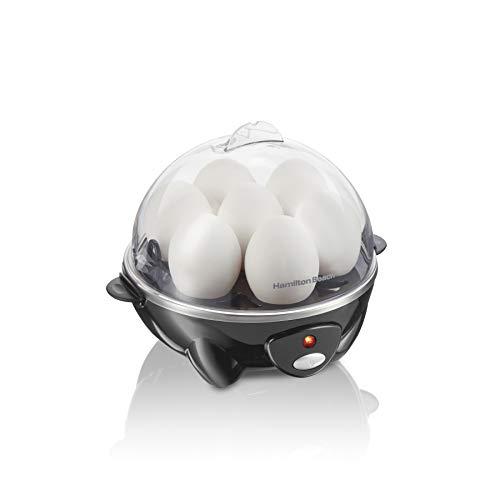
Hamilton Beach 3-in-1 Electric Egg Cooker 25507 — Best 3-in-1
Hamilton Beach leans into versatility with the 25507: a seven-egg boiler that also poaches, makes omelettes and — the differentiator — steams vegetables with the same base. For a small kitchen counting every appliance, a cooker that reheats leftover veg or steams a portion of broccoli earns its place in a way a single-task gadget cannot. The seven-egg capacity lands in the sweet spot for couples and small families.
Strengths
- Vegetable steaming stretches it beyond breakfast duty
- Seven-egg capacity suits most households without two tiers
- Hamilton Beach parts and support are easy to reach in the US
Trade-offs
- Jack of all trades — the poacher serves small portions only
- No double-tier option for dozen-egg batches
- Steaming veg leaves the base needing a wipe before the next egg run
| Capacity | 7 eggs |
| Functions | Hard-boiled, poacher, omelette maker, vegetable steamer |
| Model | 25507 |
The 3-in-1 framing is honest: this is an egg cooker first, and the steamer function is a useful second job rather than a replacement for a dedicated steamer. A portion of green beans or a small bowl of leftover rice steams while eggs cook on a weekend morning, and suddenly the little appliance is working two meals a day. The boiling performance itself is unremarkable in the best way — pierce, fill to the line, walk away, consistent eggs.
Choose it if your kitchen rewards multi-taskers. Skip it if your egg volume is the priority (the two double-deckers above move more eggs) or if you already own a steamer and want the smallest, cheapest boiler only — the Elite Gourmet and Amazon Basics below undercut it by doing less.
Best for: small kitchens that value one appliance doing several small jobs / Not suited for: high-volume egg households or dedicated-steamer owners
Check on Amazon — check the current price on Amazon before you decide, because trim, finish and bundle options change between listings.
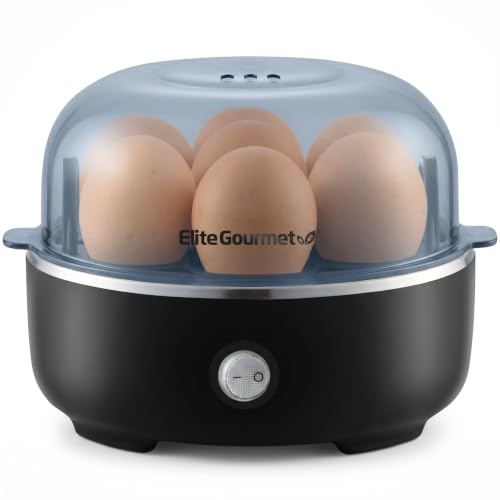
Elite Gourmet 7-Egg Easy Electric Egg Cooker — Best Budget
The Elite Gourmet is the cooker for the buyer who has read this far, is convinced, and wants to spend as little as possible finding out if the category suits them. It covers the fundamentals properly: seven eggs, soft/medium/hard from the marked measuring cup with its piercing pin, auto shut-off when the water is gone, and parts that go in the dishwasher. It even moonlights as a small food steamer. Nothing here is fancy, and nothing important is missing.
Strengths
- The lowest-commitment way into the category in this guide
- Auto shut-off included — not stripped out to hit the price
- Dishwasher-safe parts make the morning cleanup trivial
Trade-offs
- Lightweight build feels more gadget than appliance
- Seven-egg single layer only — no expansion path for bigger batches
- Basic alert; plan to be within earshot
| Capacity | 7 eggs |
| Power | 360W |
| Safety | Auto shut-off |
| Care | Dishwasher-safe parts, BPA-free |
At 360 watts the Elite Gourmet is gentle and economical to run, and its cycle times are in line with the rest of the class — the water volume, not the wattage, sets the doneness. The measuring cup’s piercing pin is built in, a small thing that matters because the loose pins on rival cookers are the first part to vanish into a drawer. Results are consistent in the way the whole category is consistent: the same water line gives the same egg.
The honest framing is that this is a trial purchase as much as a final one. If egg cookers turn out to be your thing, you may upgrade to capacity later; if they do not, you have spent the least possible amount learning that. Either way the auto shut-off and dishwasher-safe parts mean it asks almost nothing of you while you decide.
Best for: first-time egg cooker buyers and students on a tight budget / Not suited for: households already sure they need a dozen-egg capacity
Check on Amazon — check the current price on Amazon before you decide, because trim, finish and bundle options change between listings.

Amazon Basics Electric Egg Cooker — Best No-Frills
Amazon’s own Basics cooker is the category stripped to its essentials: a seven-egg tray, auto shut-off, dishwasher-safe BPA-free parts, and a black housing that disappears into any kitchen. Store-brand appliances live or die on whether the basics are right, and here they are — this is a competent execution of the standard design, aimed at buyers who comparison-shop on price within the budget tier and want a familiar seller behind the purchase.
Strengths
- Dead-simple operation — one job, done the standard way
- Auto shut-off and dishwasher-safe parts match pricier rivals
- Amazon’s returns process is the safety net if it disappoints
Trade-offs
- Hard-boiled focus — poaching/omelette extras are not its pitch
- No brand heritage if you prefer a kitchen-name manufacturer
- Seven eggs, single layer — same ceiling as the other budget singles
| Capacity | 7 eggs |
| Safety | Auto shutoff |
| Care | Dishwasher-safe parts, BPA free |
| Finish | Black |
There is a specific buyer this cooker serves perfectly: the one who wants hard-boiled eggs handled, has no interest in poaching trays, and would rather click a familiar listing than research a gadget category. The cooking itself follows the category script — measured water, pierced shells, steam, shut-off — and the results are the same predictable eggs every other pick here makes. Where it quietly wins is friction: ordering, delivery and returns are as painless as this category gets.
Where it loses is ambition. If there is any chance you will poach eggs for guests or steam vegetables in the same base, the Hamilton Beach or Dash models above serve that future better for a small step up within the same budget tier. Buy the Basics knowing it is a single-promise appliance, and it will keep that promise.
Best for: hard-boiled-only households who want the simplest possible purchase / Not suited for: cooks who want poaching and steaming in the same unit
Check on Amazon — check the current price on Amazon before you decide, because trim, finish and bundle options change between listings.
Comparison Table
All six cookers steam eggs the same way; they differ in batch size, extra trays and shut-off behaviour. Pick by the size of your typical batch first, then by the extras you will genuinely use.
| Pick | Badge | Key spec | Best for |
|---|---|---|---|
| Dash Rapid Egg Cooker | Best Overall | Boils, poaches, steams, omelettes; automatic shut-off | one to three people who want set-and-forget eggs most mornings |
| Cuisinart 10-Egg Cooker CEC-10 | Best Capacity | 10-egg two-tier capacity, brushed stainless, audible alert | brunch hosts, big families and meal-preppers |
| Dash Deluxe Egg Cooker | Best for a Dozen | 12-egg double-decker capacity, auto shut-off | meal-preppers and families who buy eggs by the dozen |
| Hamilton Beach 3-in-1 Electric Egg Cooker 25507 | Best 3-in-1 | Holds 7 eggs; poacher, omelette maker and vegetable steamer | small kitchens that value one appliance doing several small jobs |
| Elite Gourmet 7-Egg Easy Electric Egg Cooker | Best Budget | 7 eggs, 360W, auto shut-off, dishwasher-safe parts | first-time egg cooker buyers and students on a tight budget |
| Amazon Basics Electric Egg Cooker | Best No-Frills | 7-egg capacity, auto shutoff, dishwasher-safe parts | hard-boiled-only households who want the simplest possible purchase |
How to Choose an Inexpensive Egg Cooker
Capacity is the first and nearly the only decision. Count the eggs your household actually eats in a sitting or a prep session: one to seven points to the single-layer cookers, eight to twelve points to the two double-deckers. Buying capacity you never use costs counter space every day; buying too little costs a second cycle every Sunday. Be honest about which inconvenience you would rather have.
The second decision is the shut-off. Cookers that switch themselves off when the water evaporates are the right default for busy mornings; the water always evaporates eventually, and a cooker that only buzzes will sit there heating an empty base until someone notices. Every pick in this guide has auto shut-off — treat it as a requirement, not a feature, and be wary of any ultra-cheap model that omits it.
- Piercing pin included and stored on the cooker itself — loose pins get lost
- Dishwasher-safe trays and lid: hand-washing egg trays daily gets old fast
- A measuring cup with soft/medium/hard lines you can actually read in morning light
- Poaching tray only if you will use it — otherwise it is cupboard clutter
- A compact footprint you have measured against your counter or cupboard
What “Inexpensive” Should and Should Not Mean Here
Egg cookers are one of the few categories where the budget tier is genuinely the right tier for most people, because the cooking method — steam from a measured cup of water — does not improve with money. What extra money buys in this category is capacity, stainless housings and brand support, not better eggs. So the inexpensive brief is not a compromise; it is the category working as intended.
Where cheap becomes too cheap is safety and honesty: no auto shut-off, unmarked water cups that make doneness a guessing game, or trays that warp after a month. The six picks here avoid those traps while staying in the budget tier. If a listing you find elsewhere costs dramatically less than all six, check those three things first — one of them is usually missing.
Getting Peel-Easy Eggs: the Variables That Actually Matter
The cooker controls time and steam; the egg controls the peel. Very fresh eggs peel worst no matter the appliance, because the white bonds tightly to the membrane. Eggs that have been in the fridge a week or so release far more cleanly — which is why meal-preppers who buy eggs ahead have an easier life than farmers-market shoppers cooking same-day eggs. Piercing the shell before cooking helps, an ice bath (or a thorough cold rinse) after cooking helps more, and peeling under a thin stream of water finishes the job.
Doneness drift is the other common complaint, and it is almost always water measurement. The marked lines assume room-temperature eggs of a standard large size. Jumbo eggs or eggs straight from a very cold fridge shift the result slightly firmer or softer; adjust by a teaspoon of water either way and note your correction on the cup with a marker. Two batches in, the cooker will be dialled to your eggs, your fridge and your taste — which is the entire point of owning one.
Egg Cooker vs Stovetop vs Multi-Cooker: Which Method Wins When
The stovetop method costs nothing and, done carefully — eggs in cold water or steamed over boiling water, timed, then chilled — produces eggs as good as any appliance. Its weakness is attention: it needs you present and counting, and its results drift with pan, hob and distraction. For one or two eggs cooked by someone who enjoys the ritual, it remains entirely respectable, and no gadget purchase is justified.
A multi-cooker with a pressure setting makes excellent boiled eggs — the shells often slip off beautifully after pressure cooking — and if you already own one and cook eggs in small batches, it covers the job. Its weaknesses are size and cycle time: hauling out a six-quart cooker, waiting for pressure, and washing the pot is a lot of ceremony for four eggs, and the counter space it occupies dwarfs a dedicated cooker.
The dedicated egg cooker wins on the specific axis of repeatable, unattended, small-batch eggs. It is the fastest of the three from cupboard to breakfast, the only one that effectively supervises itself, and the only one whose footprint disappears into a drawer. Its weakness is that it does exactly one category of task. Households that boil eggs three or more times a week feel the win daily; households that boil eggs twice a month should keep their saucepan and their money.
Meal Prep With an Egg Cooker: a Week of Breakfasts in One Session
The strongest case for the bigger cookers in this guide is a single weekly session. A dozen eggs through the Dash Deluxe or ten through the Cuisinart, cooked hard, chilled thoroughly and stored unpeeled in the fridge, become the week’s grab-and-go breakfasts, salad toppings, sandwich fillings and snack protein. Unpeeled hard-boiled eggs keep best; peel them as you use them and the texture stays noticeably fresher than a batch peeled on day one.
Work backwards from your week. Eggs destined for devilled eggs or egg salad want the firmest cook — use the hard line or a touch more water, and put them on the bottom tier where the steam is strongest. Eggs for breakfast sandwiches and ramen want jammy yolks, so run a small second batch at the medium line rather than compromising the main batch. Label the containers with the day they were cooked; a week is the sensible outer limit for cooked eggs in the fridge, and a label removes the guesswork.
One prep-day refinement worth adopting: cook eggs that are at least several days old. Put a reminder on the shopping list to buy eggs a few days before prep day, or keep a rotating dozen — the older dozen cooks this week, the fresh dozen is next week’s. It is the single change that most improves peeling, and it costs nothing but a little fridge organisation.
Care, Descaling and Making a Budget Cooker Last
Budget egg cookers die from neglect more than from defects, and the neglect is almost always mineral scale. The heating plate evaporates a small cup of water every cycle, and whatever minerals were in that water stay behind as a chalky or brownish film. Left alone, the film insulates the plate, cycles run longer, and doneness drifts — the cooker gets blamed for what the water did. The fix takes a minute: every few uses, wipe the plate with a cloth dampened with plain vinegar, let it sit briefly, wipe again, and run one water-only cycle if your manual suggests it.
The plastic parts want the opposite treatment — gentleness. Egg proteins bake onto trays if they sit; a rinse while they are still warm is worth more than any scrubbing later. Dishwasher-safe parts genuinely can go in the dishwasher, but top rack only, and keep the base unit itself away from water entirely: it is an electrical appliance with a cord, and it gets wiped, never submerged. Store the cooker with the measuring cup and piercing pin inside the unit, because the pin is the one part every owner loses and the one part the cooker cannot work properly without.
Do those two small things — descale the plate, rinse the trays — and an inexpensive cooker should give years of identical eggs. That reliability, more than any feature, is what separates the six picks in this guide from the anonymous ultra-cheap listings that skip the auto shut-off and the readable measuring cup.
Soft, Medium, Hard: What the Water Lines Actually Do
New owners often assume the cooker has a thermostat or a timer inside. It has neither — and understanding that makes every result predictable. The heating plate boils the measured water into steam; the eggs cook in that steam for exactly as long as the water lasts; when the plate runs dry, its temperature rises sharply, which is what triggers the alert or the auto shut-off. Less water means a shorter steam bath and a softer egg. The measuring cup is not an accessory — it is the entire control system, which is why filling it by eye defeats the appliance.
That mechanism also explains the category’s quirks. Two eggs cook slightly firmer than seven for the same water, because less cold mass absorbs the steam — drop a touch below the line for small batches. Eggs at altitude cook softer, because steam is cooler where water boils at a lower temperature — add a little water to compensate. And a cooker that has drifted firmer over the months is usually scaled, its plate running less efficiently; descale before you blame the eggs. Once you see the machine as a water-measuring device, every troubleshooting question answers itself.
Egg Cookers Beyond the Family Kitchen: Dorms, Desks and Small Spaces
Some of the happiest egg cooker owners do not have full kitchens at all. In a dorm room or studio where the cooking equipment is a kettle and good intentions, a compact cooker like the Dash Rapid or the Elite Gourmet turns eggs — cheap, filling, fridge-friendly — into a reliable meal that no shared-kitchen queue can delay. The auto shut-off matters even more in these settings, where the person cooking is also the person rushing to a lecture.
Office kitchens are the other natural habitat: a seven-egg cooker, a fridge shelf of eggs, and breakfast stops depending on the café downstairs. If you are buying for a shared space, choose the model with dishwasher-safe parts and the simplest cup markings — the cooker that five different colleagues can operate without instructions is the one that survives. The Amazon Basics and Elite Gourmet, the two most stripped-back picks here, are oddly the strongest shared-space choices precisely because there is nothing on them to misunderstand.
Poached Eggs and Omelettes: Managing Expectations at This Price
The boiling function is why these cookers exist; the poaching and omelette trays are why people keep them. Set expectations correctly and both extras delight. Poached eggs from a tray are moulded eggs — neat, round, uniformly set, closer in spirit to a café’s egg mould than to the free-form swirl of the stovetop method. For eggs Benedict and breakfast sandwiches that tidiness is a virtue: the egg sits where you put it, the white is fully set, and four portions arrive together instead of one anxious egg at a time. If your heart is set on wispy, free-poached eggs, keep the saucepan for Sundays and let the cooker handle weekdays.
Omelettes from a steamer tray are really steamed egg cups — fluffy, pale and gentle, closer to a Japanese steamed egg than to a French omelette. Children and anyone who dislikes browned eggs tend to love them; purists should look away. The practical tip for both trays is a whisper of oil or butter before the egg goes in: budget plastic trays release cleanly when greased and grip stubbornly when not. Treat the extras as a second small talent rather than the headline act, and an inexpensive cooker will keep surprising you pleasantly instead of disappointing you unfairly.
Buying Two: When a Second Cooker Makes Sense
It sounds like gadget excess, but there is a rational case for owning two inexpensive cookers, and regular hosts make it often. Two mid-size cookers running side by side beat one large one in three situations: when half the table wants soft eggs and half wants hard (two water lines, no compromise batch), when eggs for a crowd must all finish at the same moment (parallel cycles instead of sequential ones), and when one cooker lives at home and the other at a holiday place, office or dorm. The combined cost of two budget models is still modest within this category, and each unit stays small enough to store easily. The case collapses if your batches are small — one cooker, honestly sized, remains the right answer for most kitchens — but if you have ever run a third consecutive cycle while guests waited, you already know whether you are the two-cooker household.
If you do run two, buy the same model twice rather than two different ones. Identical cups, identical lines and identical trays mean one learned routine, interchangeable parts when a tray cracks, and no morning confusion about which cup belongs to which base. It is the same logic restaurants use when they standardise small equipment, scaled down to a countertop and a dozen eggs.
How to Use an Electric Egg Cooker (and Steam More Than Eggs)
Every cooker in this guide works the same way. Master the sequence once and it transfers to any model you own later.
- Step 1 — Measure the water. Fill the measuring cup to the line for the doneness you want: less water, softer egg. The cup, not the clock, is the timer.
- Step 2 — Pierce every shell. Use the pin on the cup or cooker base to pierce the wider end of each egg. This releases the air cell pressure and prevents cracked shells.
- Step 3 — Load and lid. Eggs go pierced-end up in the tray. Add the poaching or omelette tray only if you are using it; extra trays change the steam path.
- Step 4 — Switch on and walk away. The cooker steams until the water is gone, then alerts or shuts off depending on the model. Eggs keep cooking in their shells, so do not dawdle.
- Step 5 — Chill immediately. Move eggs to cold water or an ice bath for a few minutes. This stops the cooking, prevents the grey-green ring on yolks, and loosens the shell.
- Step 6 — Peel under water. Crack all over, start at the wide end where the air cell sits, and let water get under the membrane.
- Step 7 — Wipe the base. Mineral scale builds on the heating plate. A splash of vinegar on a cloth after every few uses keeps it clean and the steam honest.
Beyond eggs: the steaming trays on the Hamilton Beach and Elite Gourmet handle a portion of vegetables, dumplings or leftover rice gracefully. Keep portions small, add a little extra water for longer steaming, and remember these are steamers of opportunity — for family-size steaming, a dedicated steamer or a bamboo basket over a pan still wins.
Common Buying Mistakes
Skipping the piercing pin. Unpierced eggs crack in the shell as the air cell expands, leaking white that cooks onto the tray. Ten seconds with the pin prevents the entire mess.
Filling water by eye. The whole value of the appliance is the measured cup. Eyeballing the water turns a precision tool back into guesswork, and doneness wanders batch to batch.
Leaving cooked eggs sitting in the hot cooker. Residual heat keeps cooking them. Ten forgotten minutes is the difference between jammy and chalky yolks — chill them as soon as the cycle ends.
Buying the dozen-egg model for a two-egg household. Capacity you never use is just a bigger thing to store. Match the cooker to your real batch size, not your most ambitious brunch fantasy.
Blaming the cooker for hard-to-peel eggs. Peeling is about egg freshness, not the appliance. Week-old eggs peel cleanly from any cooker here; same-day farm eggs fight back in all of them.
Final Recommendation
The Dash Rapid is the inexpensive egg cooker most households should buy: full feature set, auto shut-off, modest footprint. Go bigger deliberately — the Cuisinart CEC-10 for ten-egg batches in a stainless housing, or the Dash Deluxe for a full dozen — if your Sundays involve meal prep. The Hamilton Beach is the pick for small kitchens that reward multi-taskers, and the Elite Gourmet and Amazon Basics close the list as the lowest-friction ways to spend the least and still get the fundamentals right.
Whichever you choose, the routine is the same: pierce, measure, steam, chill. Two weekends in, your eggs will be more consistent than they have ever been from a saucepan — and that, at this price, is the whole promise kept.
The shortlist one more time: Dash Rapid Egg Cooker (best overall); Cuisinart 10-Egg Cooker CEC-10 (best capacity); Dash Deluxe Egg Cooker (best for a dozen) — check the current price on Amazon for each before you order.
Related reading on this site: Best Inexpensive Rice Cookers; Best Insta Pot Cookers; Best Instant Pot Type Cookers; Best Immersion Cookers.
Frequently Asked Questions
Are inexpensive egg cookers worth it if I can boil eggs in a pan?
If your stovetop eggs already come out exactly how you like them, no. The cooker earns its money for everyone else: it removes the watching, the timing and the batch-to-batch variation, and it shuts itself off. At budget-tier prices, that convenience pays for itself quickly in saved attention alone.
Why did my eggs crack in the cooker?
Almost always an unpierced shell or a hairline crack that was already there. Pierce the wide end of every egg before cooking, and roll each egg under your palm first — a cracked shell reveals itself before it leaks into the tray.
How do I get softer or firmer eggs than the cup lines give?
Adjust the water, not the time — the cooker runs until the water is gone. A teaspoon less water softens the result; a teaspoon more firms it. Jumbo eggs and fridge-cold eggs also shift doneness slightly, so dial in with your usual eggs.
Can I cook eggs and steam vegetables at the same time?
On models with a steaming tray, yes for small portions — the Hamilton Beach and Elite Gourmet here are built for it. Keep the vegetable portion modest so steam circulates, and expect to add a little extra water for longer steaming.
Do egg cookers use much electricity?
Very little. These are small appliances — the Elite Gourmet in this guide runs at 360 watts — heating a few tablespoons of water for a few minutes. A cycle costs a fraction of bringing a saucepan of water to the boil on a hob.
How do I stop the grey-green ring on hard-boiled yolks?
Chill the eggs the moment the cycle ends. The ring is a harmless reaction that appears when eggs sit hot after cooking; a cold-water bath stops the cooking and keeps yolks yellow.


