Disclosure: airfryerkitchensupply.com is reader-supported. When you buy through links on our site, we may earn an affiliate commission at no extra cost to you.
Where to buy
The best instant pot type cookers from rival brands are sold through the same mainstream channels as Instant Pot itself, and every pick below has a confirmed Amazon listing. Because these brands compete on function counts, read past the headline number — a ’16-in-1′ badge usually counts warming and reheating as functions. The listings linked here are the exact models reviewed.
- COSORI 6QT Pressure Cooker 9-in-1 — check the current price on Amazon.
- COMFEE’ 12-in-1 Electric Pressure Cooker 6 Qt — check the current price on Amazon.
- CHEF iQ Smart Pressure Cooker — check the current price on Amazon.
- Midea 12-in-1 Electric Pressure Cooker 6 Qt — check the current price on Amazon.
- Presto 02141 6-Quart Electric Pressure Cooker — check the current price on Amazon.
- Nuwave Duet Air Fryer Pressure Cooker Grill Combo — check the current price on Amazon.
The best instant pot type cookers are the multi-cookers that do what an Instant Pot does — pressure cook, slow cook, steam, sauté, make rice and yogurt — without being an Instant Pot. Rival brands compete on the axes the original leaves open: lower prices, ceramic-coated pots instead of stainless, built-in scales and app-guided recipes, quieter steam releases, and lids that air fry. For many households one of these is not the consolation prize but the better buy, because the right axis matters more than the famous name.
This guide compares the six strongest alternatives, all verified by brand and model against our product database with confirmed listings. It is the companion to our guide to the genuine Instant Pot range: read this one if you are brand-agnostic and shopping on features and value, and check the current price on Amazon for each pick — multi-cooker pricing is promotional by nature, and the pecking order genuinely changes with the week’s discounts.
In this guide
Quick Picks
Six Instant Pot alternatives — from a smart cooker with a built-in scale to a budget 12-in-1. Short version first.
- Best Overall Alternative: COSORI 6QT Pressure Cooker 9-in-1 — the polished all-rounder — ceramic pot, sous vide and a safety-first design.
- Best Budget: COMFEE’ 12-in-1 Electric Pressure Cooker 6 Qt — the value champion — twelve menus and a 24-hour timer at the bottom of the price ladder.
- Best Smart: CHEF iQ Smart Pressure Cooker — the guided-cooking flagship — a built-in scale and app recipes that set time and pressure for you.
- Best Stainless Pot: Midea 12-in-1 Electric Pressure Cooker 6 Qt — the stainless-pot alternative from the world’s biggest appliance maker.
- Best Simple: Presto 02141 6-Quart Electric Pressure Cooker — from America’s pressure-cooking heritage brand — straightforward electric pressure cooking.
- Best Combo: Nuwave Duet Air Fryer Pressure Cooker Grill Combo — three appliances in one — pressure cook, air fry and grill with interchangeable lids.
How These Picks Were Chosen
We defined the category strictly: electric multi-cookers with pressure cooking at their core, from brands other than Instant Pot, each verified against our product database before linking. Ranking weighted cooking performance and pot quality first — a multi-cooker lives or dies by its inner pot and its pressure control — then the honesty of the function list, the steam release design, and whether the headline extras (apps, scales, air fry lids) solve real problems or decorate the box.
One structural note: rival brands iterate model names quickly, so treat the model numbers in this guide as the unit of truth. A COSORI or COMFEE’ cooker from two seasons ago may share a name and little else with the current listing; the links below point at the versions we verified.
The 6 Best Instant Pot Type Cookers
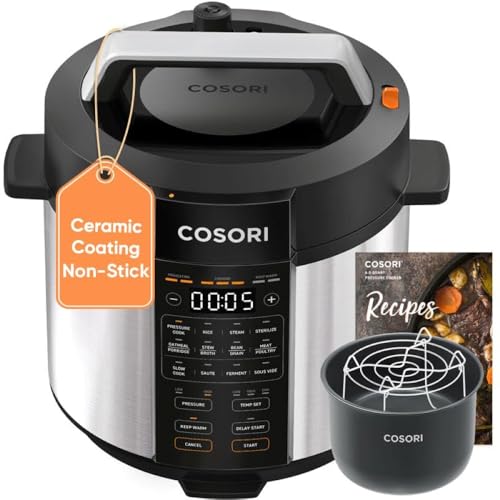
COSORI 6QT Pressure Cooker 9-in-1 — Best Overall Alternative
COSORI built its name on air fryers and brought the same polish to this 6-quart pressure cooker: nine functions including sous vide, a ceramic-coated inner pot for buyers who prefer it to stainless, a fingerprint-resistant stainless housing, and a design that advertises its twelve safety features rather than hiding them. It is the alternative most likely to convert a household that walked in planning to buy the famous brand.
Strengths
- Ceramic-coated pot releases food and washes easily
- Sous vide included — a function Instant Pot reserves for its Pro tier
- Strong safety story and a clean, modern control layout
Trade-offs
- Coated pot will not outlast a stainless pot across a decade
- Accessory and spare-part ecosystem is thinner than Instant Pot’s
- 1100W is brisk, but searing purists still prefer stainless for fond
| Capacity | 6 Qt |
| Functions | 9-in-1 including sous vide |
| Inner pot | Ceramic coating |
| Power | 1100W |
| Safety | 12 safety features |
The ceramic pot is the fork in the road versus Instant Pot’s Duo. Food releases more easily, rice lifts out cleanly, and the pot is lighter to handle at the sink — everyday pleasures that compound. The counterweight is lifespan and searing: coatings are wear items in a way stainless is not, and while the COSORI sautés perfectly well, the deep fond that stainless builds for a stew’s base is a shade less forthcoming. Neither is a defect; they are the two honest philosophies of the category, and this is the leading example of the coated school.
Around the pot, COSORI’s appliance polish shows: controls that read clearly, a steam release designed to keep fingers away from the jet, and sous vide that holds temperature steadily enough for steaks and egg bites. If your shortlist is ‘Instant Pot, but easier-cleaning and with sous vide at a mid price’, this is the cooker the market built for you.
Best for: buyers who prefer a ceramic pot and want sous vide without flagship pricing / Not suited for: decade-horizon buyers who want a stainless pot and the biggest accessory pool
Check on Amazon — check the current price on Amazon before you decide, because trim, finish and bundle options change between listings.

COMFEE’ 12-in-1 Electric Pressure Cooker 6 Qt — Best Budget
COMFEE’ — Midea’s value brand — plays the multi-cooker game on price and specification count, and plays it well: a six-quart cooker with twelve menus, a 24-hour delay timer, a nonstick inner pot and the full safety set, at the tier where own-brand supermarket cookers are its real competition. For a first multi-cooker, a student kitchen or a second pot for side dishes, it delivers the core experience — tender stews, fast beans, unattended rice — without the brand tax.
Strengths
- The strongest specification list at the budget tier
- 24-hour delay timer — set it in the morning, eat at night
- Backed by Midea’s manufacturing scale and parts pipeline
Trade-offs
- Nonstick pot is the wear item, as with all coated rivals
- Controls and display feel budget-grade next to COSORI or CHEF iQ
- Function count flatters — several “menus” are time presets of the same mode
| Capacity | 6 Qt |
| Functions | 12-in-1 menus |
| Timer | 24-hour delay start |
| Inner pot | Nonstick |
Judge the COMFEE’ by the standard of its tier and it impresses: pressure control is steady, the sauté is hot enough to brown onions honestly, and the delay timer — rare at this price — changes how a working household uses a cooker, because dinner can be loaded at breakfast. The twelve menus deserve the usual translation: they are preset time-and-pressure combinations for common foods, useful as starting points, not twelve different machines. Used that way, they are a convenience rather than a fiction.
The compromises are tactile. The panel, the lid feel and the pot’s coating all announce the price tier, and heavy daily users will feel the difference from the COSORI within a month. Occasional and value-first users will not care, because the food — the actual output — is barely distinguishable. That is precisely what a budget champion is supposed to prove.
Best for: first-time multi-cooker buyers and value-first households / Not suited for: heavy daily users who will feel budget controls and coatings wear
Check on Amazon — check the current price on Amazon before you decide, because trim, finish and bundle options change between listings.

CHEF iQ Smart Pressure Cooker — Best Smart
CHEF iQ is the multi-cooker for people who like the idea of pressure cooking but not the guesswork. Its party trick is a scale built into the cooker itself: add ingredients, the cooker weighs them, and the paired app’s guided recipes set the time, pressure and release method automatically — with the library running to hundreds of dishes. Add WiFi monitoring from the sofa and a 10-in-1 function set, and it is the most technologically ambitious cooker in this guide.
Strengths
- Built-in scale plus guided recipes remove pressure-cooking guesswork
- App monitoring and control suit open-plan, multi-tasking cooks
- Excellent for learners — the cooker teaches as it cooks
Trade-offs
- The smart features need the app, an account and WiFi to shine
- Premium pricing — you are buying software as much as hardware
- If the app ecosystem fades, you own a good but ordinary cooker
| Functions | 10-in-1 multi-cooker |
| Smart | WiFi, app-guided recipes (500+ per brand) |
| Scale | Built-in ingredient scale |
The scale sounds like a gimmick until you cook grains with it: rice and water weighed in the pot, ratios exact, results repeatable — the two variables that ruin rice removed in one motion. Guided cooking generalises that idea across the repertoire, and for nervous first-timers the confidence transfer is real: follow the app’s prompts and the machine handles the parts (release method, rest times) that cookbooks assume you know. Experienced cooks use it differently — as a remote monitor and a precise scale that happens to cook.
The honest risks are platform risks. Smart appliances are only as smart as their apps’ maintenance, and the premium only makes sense if you will actually cook guided recipes rather than admire them for a fortnight. Buy it as a keen learner or a genuine app cook and it is the most interesting cooker here; buy it as a technophobe’s gift and you have purchased an expensive way to make stew.
Best for: learners, app-happy cooks and anyone who wants guided, weighed cooking / Not suited for: app-averse buyers or anyone who wants the lowest price per stew
Check on Amazon — check the current price on Amazon before you decide, because trim, finish and bundle options change between listings.

Midea 12-in-1 Electric Pressure Cooker 6 Qt — Best Stainless Pot
Midea is the manufacturing giant behind half the world’s small appliances, and its own-brand 12-in-1 cooker is the connoisseur’s value pick: twelve presets, the full multi-cooker repertoire, and — the detail that separates it from most rivals — a stainless steel inner pot. If you like Instant Pot’s stainless philosophy but want to pay the value brand’s price for it, this is the cooker built precisely on that thought.
Strengths
- Stainless inner pot at a value-tier price — the longevity play
- Twelve presets cover the everyday repertoire without fuss
- Midea’s scale means parts and support are not a cottage industry
Trade-offs
- Design and display are functional rather than beautiful
- Brand carries less kitchen-counter prestige — if that matters to you
- Accessory ecosystem is generic rather than model-specific
| Capacity | 6 Qt |
| Functions | 12 presets: pressure, slow cook, rice, steam, sauté, yogurt and more |
| Inner pot | Stainless steel |
The stainless pot changes daily life in the ways Duo owners describe: proper searing before the lid goes on, no coating anxiety with metal utensils or the dishwasher, and a pot that will outlive the electronics around it. Around that pot, the Midea is a competent, unshowy machine — presets that map to real foods, pressure control that holds steady, a sauté with enough heat to matter. Nothing about it performs for the camera, and everything about it performs at dinner.
Against its sibling, the COMFEE’, the choice is philosophical: the Midea costs a step more and returns it as the pot. Against the Instant Pot Duo, it trades ecosystem and resale recognition for price. Households that keep appliances until they die — the natural audience for stainless — will find this the most rational cooker in the guide.
Best for: longevity-first buyers who want stainless without the famous brand’s price / Not suited for: buyers who want a deep model-specific accessory and recipe ecosystem
Check on Amazon — check the current price on Amazon before you decide, because trim, finish and bundle options change between listings.

Presto 02141 6-Quart Electric Pressure Cooker — Best Simple
Presto has made pressure cookers since before most of its rivals existed, and its 6-quart electric model is the traditionalist’s entry in this guide: a straightforward electric pressure cooker from the company that taught America stovetop pressure cooking. It lacks the multi-cooker sprawl of the 12-in-1 crowd, and that focus is its pitch — pressure cooking, done properly, by the people who wrote the original manuals.
Strengths
- Presto’s pressure-cooking heritage and US support network
- Focused function set — less to learn, less to fail
- A natural step for cooks moving from stovetop Presto pots
Trade-offs
- Not a true multi-cooker — the repertoire is narrower than rivals here
- Fewer presets and conveniences than the COMFEE’ or Midea at similar tiers
- Stovetop converts may find electric pressure gentler than they expect
| Capacity | 6 Qt |
| Type | Electric pressure cooker |
| Brand | Presto (model 02141) |
There is a real audience for this cooker: the household that owns a stovetop Presto, trusts the name, and wants the electric version’s set-and-forget supervision without a touchscreen or a dozen menus. The cooking itself is everything pressure cooking promises — beans, stews, tough cuts transformed — with the electric format’s usual dividends of no hob-watching and automatic keep-warm. Presto’s manuals and support remain the industry’s plain-spoken benchmark, which matters more in year three than any preset.
The limits are the mirror of its virtues. If your ambitions include yogurt, sous vide or app-guided anything, the rivals above serve you better; if your ambitions are pressure cooking itself, the Presto’s narrowness is a kind of quality. It is also the pick we’d give a nervous first-timer who finds the multi-cooker category’s sprawl off-putting — one job, clearly explained, from the brand that invented the job’s home version.
Best for: traditionalists and stovetop Presto owners going electric / Not suited for: buyers who want the full multi-cooker repertoire in one appliance
Check on Amazon — check the current price on Amazon before you decide, because trim, finish and bundle options change between listings.
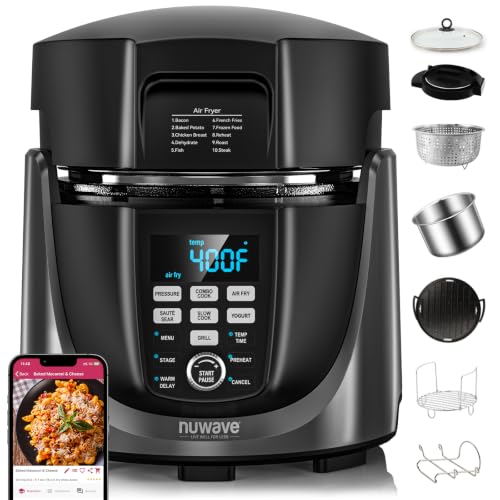
Nuwave Duet Air Fryer Pressure Cooker Grill Combo — Best Combo
The Nuwave Duet is the maximalist answer to the multi-cooker question: one base, three removable lids, and a repertoire spanning pressure cooking, air frying and grilling, with a stainless 18/10 inner pot and a safety locking system across all three modes. The brand’s function count is marketing exuberance, but the underlying idea is sound — the pressure-then-crisp workflow that makes the Duo Crisp popular, extended to grilling, for households whose counters cannot hold three appliances.
Strengths
- Pressure cook, air fry and grill from one base — maximum consolidation
- Stainless 18/10 inner pot, the premium pot material
- Pressure-then-crisp in one vessel, no transfer losses
Trade-offs
- Three lids are three things to store — the consolidation has a cupboard cost
- Each mode is good rather than best-in-class versus dedicated appliances
- The most complex cooker here, with the longest learning curve
| Modes | Pressure cooker, air fryer, grill — 3 removable lids |
| Inner pot | 18/10 stainless steel |
| Also | Slow cook, sauté, dehydrator functions |
| Safety | Sure-Lock safety system |
The Duet’s best trick is the same one that sells the Duo Crisp Ultimate: a chicken pressure-cooked to tenderness, then crisped under the air fry lid without leaving the pot. The grill lid adds a third act — seared finishes and grill-marked vegetables — that no other cooker in this guide attempts. For a small kitchen or a caravan, replacing three appliances with one base is a genuine spatial argument, provided the three lids have a home; measure the cupboard before the counter argument wins you over.
The compromises are the usual consolidation taxes. The air fry mode works in pot-shaped batches, not drawer-shaped ones; the grill is a contact-free radiant grill, not a barbecue; and the interface must serve three appliances’ worth of programs, which shows. Buy it as a space solution with real cooking chops and it delivers; buy it expecting three best-in-class appliances and the arithmetic of compromise will find you.
Best for: tiny kitchens, caravans and consolidators who will use all three modes / Not suited for: buyers with room for dedicated appliances, or simplicity seekers
Check on Amazon — check the current price on Amazon before you decide, because trim, finish and bundle options change between listings.
Comparison Table
The alternatives compared. The axes that matter: pot material, smart features, and whether the lid does more than pressure cook.
| Pick | Badge | Key spec | Best for |
|---|---|---|---|
| COSORI 6QT Pressure Cooker 9-in-1 | Best Overall Alternative | 6 Qt, 9-in-1, ceramic-coated pot, sous vide, 1100W | buyers who prefer a ceramic pot and want sous vide without flagship pricing |
| COMFEE’ 12-in-1 Electric Pressure Cooker 6 Qt | Best Budget | 6 Qt, 12-in-1 menus, 24-hour delay timer | first-time multi-cooker buyers and value-first households |
| CHEF iQ Smart Pressure Cooker | Best Smart | WiFi, built-in scale, 500+ guided recipes, 10-in-1 | learners, app-happy cooks and anyone who wants guided, weighed cooking |
| Midea 12-in-1 Electric Pressure Cooker 6 Qt | Best Stainless Pot | 6 Qt, 12 presets, stainless steel inner pot | longevity-first buyers who want stainless without the famous brand’s price |
| Presto 02141 6-Quart Electric Pressure Cooker | Best Simple | 6 Qt electric pressure cooker from Presto | traditionalists and stovetop Presto owners going electric |
| Nuwave Duet Air Fryer Pressure Cooker Grill Combo | Best Combo | Pressure cooker + air fryer + grill, 3 lids, 18/10 stainless pot | tiny kitchens, caravans and consolidators who will use all three modes |
How to Choose an Instant Pot Type Cooker
Start with the pot, because you will touch it daily and replace it never-or-once. Stainless pots (Midea, Nuwave, and Instant Pot itself) sear best and last indefinitely; ceramic and nonstick pots (COSORI, COMFEE’) release food beautifully and wash in seconds but are wear items with a finite slick life. Neither is wrong; your cooking style — sear-heavy stews versus rice-and-release convenience — should decide.
Then audit the extras with suspicion. Sous vide is a real technique worth having if you cook steaks and eggs seriously. A built-in scale and guided app (CHEF iQ) genuinely help learners and precision cooks. Air fry lids genuinely enable the pressure-then-crisp workflow. Beyond those three, most function counts are preset arithmetic. Finally, weigh the ecosystem: Instant Pot’s accessories and spare rings are everywhere; rivals are catching up unevenly, so check that a spare sealing ring and pot for your chosen model are actually orderable before you need them at 6pm on a Sunday.
- Pot first: stainless for longevity and searing, coated for release and easy washing
- Extras that matter: sous vide, guided cooking, crisping lids — in that order for most cooks
- Check spare ring and pot availability for the exact model before buying
- A diffused steam release is worth real money in an open-plan home
- Sale prices reshuffle this category weekly — compare on the day, not the month
Instant Pot vs the Alternatives: Where the Original Still Wins, and Where It Does Not
The original still wins on ecosystem and information: every recipe, accessory, spare part and troubleshooting thread assumes it, and that gravity is a real ownership benefit money cannot easily buy elsewhere. It also wins on the stainless pot at the mainstream tier — the Duo’s pot remains the benchmark the rivals are measured against.
The alternatives win specific, identifiable fights. COSORI wins on pot convenience and sous vide at a mid price. COMFEE’ wins on price outright. CHEF iQ wins on guidance — no Instant Pot teaches you to cook. Nuwave wins on consolidation. And Midea wins the quietest fight of all: stainless-pot longevity at a value price, from the factory that builds appliances for half the industry. Brand-agnostic shoppers who name their fight first will end up with the right cooker; shoppers who buy the logo or the discount blind will end up with a fine cooker that solves someone else’s problem.
Pressure Cooker Safety in Modern Electric Models
Every cooker in this guide is an electric pressure cooker with multiple independent safety systems — lid locks that physically prevent opening under pressure, pressure release valves, temperature cut-offs and, on the COSORI, a dozen advertised safety features. This generation of appliance is categorically safer than the stovetop pots that built pressure cooking’s scary reputation, provided three user habits hold: respect the maximum fill line (two-thirds, or half for foaming foods), keep the steam valve and float valve clean and moving freely, and replace the sealing ring when it slackens or cracks.
The one incident pattern that remains is user-generated: forcing a lid, venting with a face over the jet, or cooking with a blocked valve after a starchy boil-over was left uncleaned. Ten seconds of valve-checking before each cook and a proper wash after foamy dishes reduce the risk to the level of any other hot appliance in the kitchen — which is to say, respected and routine.
The Pressure-Then-Crisp Workflow, Explained Once
One workflow justifies half the premium features in this category, so it deserves a plain explanation. Many great dishes want two contradictory treatments: moist pressure heat to become tender, then dry fierce heat to become crisp. A chicken, ribs, a pork shoulder — pressure alone leaves them pale and flabby-skinned; crisping alone dries them before they tenderise. The workflow is simply sequential: pressure cook in the pot until tender, then crisp in the same vessel under an air fry or grill lid (the Nuwave here, the Duo Crisp in the Instant Pot range), or tipped briefly under a hot oven grill if your cooker has no crisping lid. The juices stay in the pot, the skin shatters, and the washing-up stays singular. If that sentence made you hungry, a crisping model belongs on your shortlist; if it did not, save the money with a clear conscience — pressure cooking alone covers most of the map.
Reading a Multi-Cooker Listing Like a Skeptic
Listings in this category reward a particular reading order. First, find the quart size and whether it is the pot’s volume or a marketing rounding. Second, find the inner pot’s material — it decides searing, cleaning and lifespan, and it hides lower in the listing than the function count. Third, translate the functions into core modes and ignore the total. Fourth, check the wattage: higher wattage pressurises faster and sears harder, and budget models quietly save money here. Fifth, search the listing and the brand’s store for the spare sealing ring and replacement pot; their existence and price tell you how the brand expects the cooker to age. Read in that order and two listings that looked identical separate into a keeper and a compromise within a minute — which is all the skepticism this category actually requires.
Why These Brands Exist: the Short Economics of the Multi-Cooker Market
Understanding why the alternatives are cheaper — or smarter, or more specialised — helps you judge which advantage is real. Instant Pot created the category’s modern form and charges partly for the ecosystem and the name; rivals attack from their own strengths. Midea and its COMFEE’ brand manufacture at a scale that lets them price stainless pots like other brands price coated ones. COSORI came from air fryers with a design-led, direct-to-consumer playbook and spends on product polish instead of shelf space. CHEF iQ is a software company wearing an appliance: its margin lives in the app and the guided content. Nuwave built its name on countertop ovens and infomercial-era versatility, so consolidation is its native language. Presto simply never left — its pressure heritage predates the category’s reinvention by generations.
None of those origins guarantees a good cooker, but each predicts where the money went: manufacturing scale, design, software, versatility or heritage support. Match the prediction to your priorities and the marketing becomes legible — you stop comparing badges and start comparing where each brand actually spent its budget on your behalf.
Two-Cooker Households: When the Alternative Is a Second Pot, Not a Replacement
A surprising number of multi-cooker owners end up with two, and the second is very often an alternative brand bought for a specific job. The pattern makes sense: the big stainless-pot cooker handles stews and batch cooking, while a smaller or coated-pot second cooker makes the rice, the eggs, the oatmeal and the side vegetables in parallel — the two-pot dinner problem (main under pressure, accompaniment waiting) disappears. A budget COMFEE’ or a compact COSORI as the second pot costs less than most households expect and changes weeknight logistics more than any single premium model does.
If you go this route, standardise what you can: same quart size means lids, rings thinking and recipe timings transfer, even if pressure parts themselves must never be swapped between brands. And stagger the purchases — live with one cooker for a month, notice which second jobs actually recur in your kitchen, and let that diary, not a sale banner, choose the second machine. Two-cooker households built that way use both; two-cooker households built on a bundle deal usually store one.
Multi-Cooker Ownership Costs Nobody Puts on the Box
The purchase price is the beginning of a multi-cooker’s cost, not the total, and the alternatives differ here in ways worth pricing before you choose. Sealing rings are consumables on every brand — cheap, but only if the brand actually sells them in your market; a cooker with no ring supply has a built-in expiry date. Coated pots are the second consumable: a replacement coated pot every few years is the honest running cost of the COSORI and COMFEE’ philosophy, while the stainless Midea and Nuwave pots should never need replacing at all. Electricity, by contrast, is a non-issue — these are small, insulated, short-cycle appliances whose running costs vanish next to an oven’s.
Counter space is the third cost and the one households feel most: every cooker here occupies roughly a square foot forever, plus headroom to open the lid and vent steam away from cupboards. The cheapest cooker that lives in a cupboard it is annoying to reach becomes the most expensive, because it stops being used. Price the whole ownership — rings, pots, space, and your own likelihood of reaching for it — and the value ranking in this guide mostly prices itself.
From Stovetop to Electric: What Changes for Experienced Pressure Cooks
Cooks arriving from stovetop pressure cookers — often Presto veterans — find electric multi-cookers simultaneously easier and stranger. Easier, because the machine holds pressure without hob adjustment, times itself, releases on schedule and keeps dinner warm; the entire supervisory burden that defined stovetop pressure cooking simply evaporates. Stranger, because electric cookers run at slightly lower pressure than a 15-psi stovetop pot, so beloved recipes need a small time increase — roughly a tenth more as a starting rule — and because the sealed, no-evaporation environment keeps liquids liquid: stovetop recipes that relied on reduction need their liquid trimmed or their sauce finished uncovered.
The flavour difference, such as it is, follows from that liquid retention: electric pressure dishes can taste a touch less concentrated until you learn to season after cooking and reduce on sauté. Most converts call the trade even within a month — a little concentration surrendered, a great deal of attention reclaimed. The Presto electric in this guide exists precisely for this audience, and it is no accident that it is the least multi of the multi-cookers here: for a stovetop traditionalist, the shortest bridge is the best one.
The Ten-Minute Test: Evaluating Any Multi-Cooker in a Shop or a Listing
Whether you are standing in a store or reading a listing, ten minutes of structured scepticism beats an hour of review-reading. Minute one: find the pot material and say its trade-off out loud. Minutes two and three: find the spare ring and replacement pot for this exact model and note their prices — absence is data. Minute four: translate the function count into core modes. Minute five: check the wattage against rivals of the same size. Minutes six and seven: read the steam release description and picture your hand doing it, tired, at 7pm. Minute eight: measure it — footprint and lid-open height — against your counter and cupboards, honestly. Minute nine: ask which of its headline extras you used in the last month on any appliance; if the answer is none, demote them to zero in your comparison. Minute ten: name the dish you will cook first. A cooker that survives all ten minutes with a dish named is a cooker that will be used; the rest is showroom weather.
The test works in reverse, too, on a cooker you already own and have stopped using. Run the same ten minutes over it and the failure point usually identifies itself — the ring you never replaced, the size that never matched your dinners, the app you never opened. Fix the identified point if it is fixable, or sell the cooker honestly and buy the one the test points to. Kitchens fill with appliances that failed one minute of this test and were never re-examined; ten honest minutes, applied yearly, keeps the counter a working surface instead of a museum of good intentions.
Apply the same discipline to the guides you read, this one included: a review earns your trust by naming trade-offs you can verify — pot materials, spare-part prices, release behaviour, real capacities — not by the confidence of its badges. The badges in this guide are our judgement; the verifiable facts underneath them are yours to check, and a cooker bought on checked facts stays bought, happily, for years of weeknight dinners, weekend projects and everything in between, without a single moment of buyer’s remorse attached to it in any way at all.
How to Use an Instant Pot Type Cooker: the Universal First Week
Every brand’s controls differ; the underlying method does not. This sequence works on all six cookers in this guide.
- Step 1 — Water test. One cup of water, five minutes at high pressure. Learn your model’s sounds, its float valve, and how its release behaves — before food is involved.
- Step 2 — Sauté, then deglaze. Brown aromatics or meat in the pot, then add liquid and scrape every browned bit loose. This is both the flavour step and the burn-warning prevention step.
- Step 3 — Layer, do not stir. Thin liquid at the base, ingredients above, thick sauces and tomato on top unstirred. Stir after cooking, when it is safe and sensible.
- Step 4 — Seal and set. Lid locked, valve to sealing, program or manual time set. Remember the clock starts at pressure — budget the come-up time.
- Step 5 — Choose the release deliberately. Natural for meats, beans and full pots; quick for vegetables, eggs and seafood; ten-minutes-natural-then-vent for most real dinners.
- Step 6 — Finish like a cook. Pressure cooking concentrates little and browns nothing at the end — reduce sauces on sauté, crisp under a grill or air fry lid if you have one, and season after, not before.
Keep a one-line log for the first dozen cooks — dish, liquid, time, release, verdict. Multi-cookers are consistent machines, and a dozen logged cooks convert their manual from a booklet you fear into notes you wrote yourself.
Common Buying Mistakes
Counting functions instead of reading them. A “16-in-1” badge counts keep-warm and reheating as functions. Compare the pressure, slow cook, rice, yogurt and sous vide lines — the ones that describe actual cooking — and ignore the arithmetic.
Assuming all 6 Qt pots cook alike. Coated and stainless pots sear and release differently, and heating power varies by brand. Your first cooks in any new model are calibration, whatever the recipe says.
Ignoring spare-part availability. A cooker whose sealing ring cannot be reordered is a cooker with an expiry date. Check spares for the exact model before purchase, not after the ring gives up.
Buying smart features for a cook who hates apps. A CHEF iQ in an app-averse kitchen is an expensive manual cooker. Match the interface to the human, not to the specification sheet.
Filling to the brim because it fits. Two-thirds is the pressure limit, half for beans and grains. The pot that “just fits” a double batch of lentils will redecorate your ceiling via the release valve.
Final Recommendation
The COSORI is the instant pot type cooker we would buy with our own money for most kitchens: the ceramic pot, the sous vide, the safety-first design and the polish add up to the most complete alternative. The Midea is the rationalist’s pick — stainless longevity at a value price — and the COMFEE’ the budget champion whose food embarrasses its price tag. CHEF iQ stands alone for guided cooking, the Presto serves traditionalists who want one job done properly, and the Nuwave Duet consolidates three appliances for the kitchens that need exactly that.
Read alongside our guide to the genuine Instant Pot range, the honest summary is this: the original wins on ecosystem, the alternatives win on specific features, and the cooker that wins your kitchen is the one whose specific fight matches your cooking. Name the fight first — pot, price, guidance or consolidation — and the badge chooses itself.
The shortlist one more time: COSORI 6QT Pressure Cooker 9-in-1 (best overall alternative); Midea 12-in-1 Electric Pressure Cooker 6 Qt (best stainless pot); COMFEE’ 12-in-1 Electric Pressure Cooker 6 Qt (best budget) — check the current price on Amazon for each before you order.
Related reading on this site: Best Insta Pot Cookers; Best Japanese Pressure Cookers; Best Inexpensive Rice Cookers; Best Immersion Cookers.
Frequently Asked Questions
Are Instant Pot alternatives as good as the real thing?
At cooking the food — yes, the leading alternatives match the original stew for stew. The differences live around the cooking: pot material, steam release design, app guidance, spare-part availability and the recipe ecosystem that assumes the original. Choose on those axes and an alternative can be the better buy for your kitchen.
Which is better, a stainless or a coated inner pot?
Stainless sears better, tolerates metal utensils and the dishwasher, and lasts indefinitely; coated pots release food more easily, are lighter, and wash faster, but the coating is a wear item. Sear-heavy cooks should choose stainless; convenience-first cooks will be happier coated.
Do these cookers use the same accessories as Instant Pot?
Sometimes — trivets, steamer baskets and glass lids in the same quart size often interchange, but sealing rings and lids are model-specific and must match exactly. Never use another brand’s pressure lid or ring on your cooker; pressure parts are not a place for improvisation.
Is a smart pressure cooker worth the premium?
If you will cook from its guided recipes — genuinely, weekly — the CHEF iQ’s scale and automation remove real friction and teach real skills. If you cook from your own repertoire and habits, the premium buys features you will bypass, and a COSORI or Midea serves you better for less.
Why do brands advertise so many functions?
Because counting presets is free marketing. Most “functions” are stored combinations of the same pressure, temperature and time controls. Judge a cooker by its core modes — pressure, slow cook, sauté, rice, steam, yogurt, sous vide — and treat any count above a dozen as arithmetic, not capability.
Can these cookers also slow cook properly?
Yes, with one adjustment of expectation: multi-cookers heat from the bottom only, where a classic slow cooker wraps heat around the sides, so liquids and stirring behave slightly differently. Use the glass-lid accessory if offered, keep the pot reasonably full, and results are thoroughly comparable.


