Disclosure: airfryerkitchensupply.com is reader-supported. When you buy through links on our site, we may earn an affiliate commission at no extra cost to you.
Where to buy
The fastest way to check current availability, sizes and options for the verified picks in this guide is Amazon. Use the links below to go straight to the listings we verified; for any slot marked as a pick slot, no listing had been verified at the time of writing, so search Amazon using the criteria described in that section instead of following a link from us.
- Dearfoams Unisex Child Lil Bear Slipper (9-10 Toddler) — check price on Amazon
- JOINFREE Toddler Slippers — Adjustable Hook and Loop House Shoes — check price on Amazon
- SITAILE Toddler Slippers — Warm House Shoes with Grips — check price on Amazon
- L-RUN Toddler Slipper (Beige, 5.5-6 Infant = EU 22-23) — check price on Amazon
- Fadezar Toddler Slipper — Bunny (Pink, 8-9 Toddler) — check price on Amazon
- OWIF Toddler Slippers — Dinosaur (Green) — check price on Amazon
The best indoor slippers for toddlers have one job that adult slippers do not: staying on feet that run, climb, kick and remove their own footwear as a hobby. Every pick in this guide is a genuine house slipper for toddlers — verified listings for indoor slipper styles with grips, straps or closed construction — and we have deliberately excluded baby booties, bath slippers, dance and sport shoes, and anything pitched with medical claims, because none of those is an indoor toddler slipper whatever the search results imply.
Toddlers also fall for reasons that have nothing to do with clumsiness: socks on hard floors, oversized hand-me-downs, and smooth soles on kitchen tiles. So the criteria below are practical — grip, fit security, a sole suited to indoor floors, and sizing stated in the listing so you can match it to a measured foot rather than an age guess. Where a listing states a size (9-10 Toddler, 12-18 months, EU 22-23), we print exactly that.
A note on supervision and safety, because this category involves the youngest walkers: slippers are for supervised indoor floor time. They are not sleepwear for a cot, they should come off for naps and overnight, and new walkers still need plenty of barefoot time on safe surfaces to develop balance. The right slipper supports a toddler’s day; it does not replace watching them.
Key Takeaways
- Only genuine indoor house slippers are listed — no booties, bath slippers, dance shoes or medical-claim products.
- Grip is the headline feature: non-slip soles or grips appear in every verified pick’s listing.
- Fit security (straps, closed backs, snug designs) matters as much as size for toddlers.
- Sizes are printed exactly as listings state them — toddler sizes, month ranges and EU sizes are not interchangeable.
- Slippers are for supervised floor time, never for sleeping in a cot.
In this guide
Quick Picks
Dearfoams Unisex Child Lil Bear Slipper (9-10 Toddler) — Best Overall
A unisex toddler house slipper in buffalo plaid, verified in 9-10 Toddler US, from a dedicated slipper brand. Check price on Amazon.
JOINFREE Toddler Slippers — Adjustable Hook and Loop House Shoes — Best Adjustable Fit
Adjustable hook-and-loop toddler house shoes with a stated non-slip indoor sock-slipper design, machine washable. Check price on Amazon.
SITAILE Toddler Slippers — Warm House Shoes with Grips — Best for Cold Floors
Warm plush-lined toddler house slippers with a stated non-slip sole, grips and memory foam, for bedroom and home wear. Check price on Amazon.
L-RUN Toddler Slipper (Beige, 5.5-6 Infant = EU 22-23) — Best Minimal Indoor Slipper
A minimal beige indoor house slipper for girls and boys, verified in 5.5-6 (EU 22-23) sizing. Check price on Amazon.
Fadezar Toddler Slipper — Bunny (Pink, 8-9 Toddler) — Best Character Pick with Real Grip
A warm bunny character slipper with a stated non-slip rubber sole and half-cover heel, verified in 8-9 Toddler. Check price on Amazon.
OWIF Toddler Slippers — Dinosaur (Green) — Best Warm Character Alternative
A green dinosaur house slipper stated as non-slip, warm, soft and fuzzy, for winter indoor bedroom wear. Check price on Amazon.
How These Picks Were Chosen
We verified toddler slipper listings and then applied the exclusions this category demands. Out went baby booties and crib shoes (a toddler who walks needs a slipper, not a bootie), bath slippers, novelty costume paws sold for dress-up rather than daily wear, and any listing whose pitch was primarily medical. What remained were house slippers whose listings state indoor use, grip and toddler sizing.
Ranking favoured grip and staying-on design first, then warmth, then washability. Sizes quoted are the specific sizes of the verified listings; most of these product lines offer further sizes on their listing pages, but we describe only the configurations we verified and say so. Colour and character variants of one model are treated as one pick.
The 6 Best Indoor Slippers for Toddlers

Dearfoams Unisex Child Lil Bear Slipper (9-10 Toddler) — Best Overall
Dearfoams makes slippers and little else, and its Lil Bear toddler slipper is the steady centre of this guide: a unisex child house slipper in a buffalo plaid finish, verified in the 9-10 Toddler US size. It is a proper indoor slipper — made to be walked in across living rooms and kitchens all day — rather than a novelty item, and the brand’s toddler line is built around the reality that small slippers must cushion, grip and survive the wash cycle of family life.
Strengths
- A genuine house slipper from a specialist slipper brand
- Unisex design in buffalo plaid — easy hand-me-down between siblings
- Verified in a stated toddler size (9-10 Toddler US)
Trade-offs
- Character styling will not suit every family’s taste
- The verified listing is one size; check the listing page for the size run before ordering
- Like all toddler slippers, fit must be checked weekly during growth spurts
| Specification | Detail (from verified listing title) |
|---|---|
| Size verified | 9-10 Toddler US |
| Style | Unisex child house slipper, buffalo plaid |
Choose this as the default if you want the least experimental option in the guide: a mainstream toddler house slipper from a brand whose entire business is slippers. Measure your toddler’s foot, match it to the size stated on the listing page, and expect the usual toddler truth — the right slipper is the one that is still on their feet at lunchtime.
Best for: everyday indoor wear for toddlers in the stated size range / Not suited for: brand-new walkers still in the bootie stage, or families wanting a strap-fastened fit
Check on Amazon — check the current price on Amazon before you decide.

JOINFREE Toddler Slippers — Adjustable Hook and Loop House Shoes — Best Adjustable Fit
The JOINFREE design answers the toddler slipper problem directly: a hook-and-loop strap that adjusts the fit, on a non-slip indoor sock-slipper style house shoe that the listing describes as warm, a walking shoe for indoors and out, and machine washable. Adjustability is worth more at this age than any character print — feet differ, socks vary in thickness, and a strap lets the same pair fit snugly across both, which is what keeps a slipper on and a toddler upright.
Strengths
- Hook-and-loop adjustment stated — fit can be tuned as feet grow and socks change
- Non-slip indoor positioning stated in the listing
- Machine washable per the listing — a real virtue in toddler footwear
Trade-offs
- Sock-slipper style gives less structure than a moulded-sole slipper
- Strap fastenings are also toddler-operable: expect self-removal games
- The listing spans baby-to-toddler language, so size carefully against the stated size chart
| Specification | Detail (from verified listing title) |
|---|---|
| Fastening | Adjustable hook and loop (as stated) |
| Care | Machine washable (as stated) |
| Positioning | Non-slip indoor sock slipper (as stated) |
For a toddler between sizes, or one whose slippers rotate off narrow heels, this adjustable design is the pragmatic pick. The washable claim also matters more than it sounds: toddler slippers meet every floor in the house and most of the garden path too, whatever the ‘indoor’ label intends.
Best for: toddlers between sizes or with narrow heels that slip out of standard slippers / Not suited for: families wanting a firm, structured sole for outdoor-heavy use
Check on Amazon — check the current price on Amazon before you decide.

SITAILE Toddler Slippers — Warm House Shoes with Grips — Best for Cold Floors
SITAILE’s toddler slipper is the winter specification: the listing states a soft plush lining, a non-slip sole with grips, and memory foam, positioned for bedroom, home and indoor winter wear for boys and girls. On cold hard floors — stone, tile, uncarpeted boards — that combination of insulation and grip is exactly the point of a toddler slipper, and the listing states each element rather than leaving us to infer warmth from a photograph.
Strengths
- Warmth features stated: plush lining and winter indoor positioning
- Grip features stated: non-slip sole with grips
- Memory foam stated for underfoot cushioning
Trade-offs
- Warm lining is too much for heated floors in summer
- Plush styles pick up crumbs and need regular shaking and washing checks
- Character-cute styling may date before the slippers wear out
| Specification | Detail (from verified listing title) |
|---|---|
| Lining | Soft plush lined (as stated) |
| Sole | Non-slip sole, with grips (as stated) |
| Cushioning | Memory foam (as stated) |
Buy this specification for the house you actually have in January: if your toddler’s play space is a cold kitchen floor, warmth plus grip is the whole brief, and this listing states both. In a carpeted, well-heated flat it is more slipper than you need, and the lighter picks above and below will suit better.
Best for: cold hard floors and winter indoor wear / Not suited for: warm carpeted homes in summer, where plush lining overheats small feet
Check on Amazon — check the current price on Amazon before you decide.

L-RUN Toddler Slipper (Beige, 5.5-6 Infant = EU 22-23) — Best Minimal Indoor Slipper
The L-RUN entry is the plain option: an indoor house slipper for toddler girls and boys in beige, verified in the 5.5-6 size which its listing equates to EU 22-23. Its listing is refreshingly short — an indoor house slipper, in a stated size — and for families who want a simple, neutral slipper without characters, straps or plush, that restraint is the appeal. It is also the pick that most requires the fit discipline in our how-to: a minimal slipper only works at exactly the right size.
Strengths
- Neutral beige styling suits any outfit and any sibling
- Stated dual sizing (5.5-6 / EU 22-23) helps cross-check the fit
- Simple indoor house slipper design with nothing to break or detach
Trade-offs
- Minimal design means fit is everything — too big and it rotates off
- The verified listing states no grip or lining features, so we claim none
- One verified size configuration; check the listing for the wider size run
| Specification | Detail (from verified listing title) |
|---|---|
| Size verified | 5.5-6, stated as EU 22-23 |
| Colour | Beige (as stated) |
We flag the information gap honestly: unlike the SITAILE listing, this one does not state its grip or lining in the title we verified, so this guide claims neither. What it offers is a clean, minimal indoor slipper at a stated size — measure the foot, order the stated size, and use the listing page’s own details for anything beyond what we verified.
Best for: families wanting a plain, neutral toddler house slipper / Not suited for: buyers who need stated grip features or an adjustable fastening
Check on Amazon — check the current price on Amazon before you decide.

Fadezar Toddler Slipper — Bunny (Pink, 8-9 Toddler) — Best Character Pick with Real Grip
Character slippers earn their keep when the character is why the toddler agrees to wear them — and the Fadezar bunny pairs that appeal with the features that matter: its listing states a non-slip rubber sole, cozy plush construction, a half-cover heel that helps the slipper stay on, and a verified size of 8-9 Toddler, for autumn and winter indoor wear. The half-cover heel is the detail to notice: full open-back slippers are the ones found abandoned under sofas.
Strengths
- Character appeal with stated substance: non-slip rubber sole
- Half-cover heel stated — helps the slipper stay on active feet
- Warm plush construction stated for autumn and winter wear
Trade-offs
- Bunny styling in pink will not hand down to every sibling
- Plush warmth is seasonal, not year-round
- Half-cover heel helps, but determined toddlers still remove any slipper
| Specification | Detail (from verified listing title) |
|---|---|
| Size verified | 8-9 Toddler |
| Sole | Non-slip rubber sole (as stated) |
| Heel | Half cover heel (as stated) |
This is the pick for the toddler who refuses plain slippers: it meets them on character while keeping the grip and heel design that make a house slipper functional. Buy it in the stated size, and treat the character as what it is — a wearing incentive, not a safety feature; the sole and heel do that work.
Best for: toddlers who need character appeal to keep slippers on, in cooler months / Not suited for: summer wear, or families avoiding character styling
Check on Amazon — check the current price on Amazon before you decide.
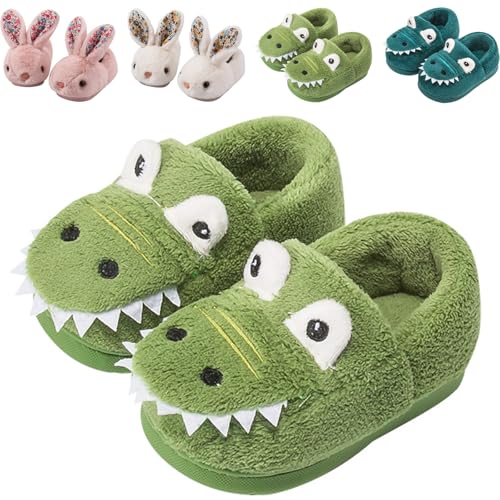
OWIF Toddler Slippers — Dinosaur (Green) — Best Warm Character Alternative
The OWIF dinosaur slipper is the second character option, in green, and its listing states the functional words alongside the fun: non-slip, warm, soft, winter, fuzzy, indoor bedroom house slipper. A sibling listing from the same line covers the non-character version of the same idea; we count the line once, as one pick, and feature the dinosaur configuration because character is usually the deciding factor at this age. Warm and fuzzy is a winter specification — in a heated home in July, choose a lighter pick.
Strengths
- Non-slip stated in the listing, alongside warm and soft
- Dinosaur character in green — strong wearing incentive for dino-phase toddlers
- Winter fuzzy specification for cold bedroom floors
Trade-offs
- Fuzzy warmth is a winter weight, not a year-round slipper
- Character phase may pass before the slippers wear out
- The verified title states no numeric size, so use the listing page’s size chart carefully
| Specification | Detail (from verified listing title) |
|---|---|
| Colour | Green (as stated) |
| Positioning | Non slip, warm, winter fuzzy indoor (as stated) |
We note the missing numeric size in the verified title openly: this pick requires the most careful size-chart work on the listing page. What it states — grip, warmth, indoor purpose — is the right set of claims for a winter character slipper, and for a dinosaur-obsessed toddler it will be worn, which is the first safety feature of any slipper.
Best for: dinosaur-phase toddlers needing a warm, grippy winter house slipper / Not suited for: summer use, or buyers who want the size stated without consulting a chart
Check on Amazon — check the current price on Amazon before you decide.
Comparison Table
| Pick | Badge | Key spec | Best for |
|---|---|---|---|
| Dearfoams Unisex Child Lil Bear Slipper (9-10 Toddler) | Best Overall | 9-10 Toddler US, house slipper | everyday indoor wear for toddlers in the stated size range |
| JOINFREE Toddler Slippers — Adjustable Hook and Loop House Shoes | Best Adjustable Fit | Hook-and-loop adjustable, non-slip, washable | toddlers between sizes or with narrow heels that slip out of standard slippers |
| SITAILE Toddler Slippers — Warm House Shoes with Grips | Best for Cold Floors | Plush lined, grips, memory foam stated | cold hard floors and winter indoor wear |
| L-RUN Toddler Slipper (Beige, 5.5-6 Infant = EU 22-23) | Best Minimal Indoor Slipper | Beige, 5.5-6 / EU 22-23 stated | families wanting a plain, neutral toddler house slipper |
| Fadezar Toddler Slipper — Bunny (Pink, 8-9 Toddler) | Best Character Pick with Real Grip | 8-9 Toddler, rubber grip sole, half heel | toddlers who need character appeal to keep slippers on, in cooler months |
| OWIF Toddler Slippers — Dinosaur (Green) | Best Warm Character Alternative | Green dinosaur, non-slip stated | dinosaur-phase toddlers needing a warm, grippy winter house slipper |
How to Choose the Best Indoor Slippers for Toddlers
Start with grip, because it is the feature that prevents the most common toddler fall: a sock-smooth sole on a hard floor. Every pick in this guide has grip stated in its listing — non-slip soles, grips, or a rubber sole — and that is not a coincidence; it was our first filter. If you shop beyond this guide, treat any toddler slipper that will not state its grip as a sock with ambitions.
Then fit security. Toddlers’ feet are wider at the toes and narrower at the heel than adult feet in miniature, and they are in constant motion. Straps (JOINFREE), half-cover heels (Fadezar) and snug closed designs stay on; loose backless styles are found under furniture. Finally warmth: match the lining to your floors, not the season outside — a plush winter slipper on a heated floor makes sweaty, slippery feet, which defeats the purpose.
Sizing Toddler Slippers Without Guessing
Measure the foot, in the afternoon, standing: heel to longest toe, in centimetres, then match to the listing’s own size chart. Age-based sizing is a last resort — the picks here show why, with sizes stated three different ways across listings (toddler US sizes, a month range on related products, and an EU equivalence of 22-23 on the L-RUN). The same toddler can be a different ‘size’ in each system.
Leave a small thumb of growing room, not a size of it: a slipper a full size too big rotates, trips and teaches the toddler to grip with their toes. Re-measure every couple of months at this age; the slipper that fit at the start of winter may be the reason for February’s stumbles.
What We Excluded, and Why It Matters
Search results for toddler slippers are crowded with products that are not indoor slippers. Baby booties and crib shoes are for pre-walkers and offer no grip for a walking toddler. Bath slippers are designed for wet grip in tubs, not all-day floor wear. Ballet, dance and sport shoes answer different activities entirely. Costume paw slippers are dress-up items. And any slipper pitched primarily with medical language — posture correction, therapy, treatment — is making claims a house slipper should not make and this guide will not repeat.
The exclusion list is the guide’s quality filter made visible. What remains — house slippers with stated grip, indoor purpose and toddler sizing — is a short list by design. A short honest list protects a two-year-old better than a long padded one.
Indoor Slippers and Safe Toddler Movement
Slippers are for supervised time on indoor floors. They should come off for naps and overnight sleep, and never be worn in a cot. New and unsteady walkers also benefit from regular barefoot time on safe, clean surfaces, which builds the balance and foot strength that no footwear can provide. Think of the slipper as equipment for cold or slippery floors, not as all-day clothing.
Keep the environment part of the system: wipe up spills promptly (no grip defeats a wet patch), use stair gates as you normally would regardless of footwear, and check slipper soles weekly — a worn-smooth grip sole should be retired, not handed down. When a slipper’s sole is smooth, its lining is compressed and its fit is outgrown, it has done its service.
Warm, Light or Adjustable: Matching the Slipper to Your Home
Cold hard floors call for the warm specification: plush lining, closed construction, stated grip — the SITAILE and the two character picks. Heated or carpeted homes call for lighter, simpler slippers — the L-RUN minimal design or the Dearfoams — where grip still matters on kitchen and bathroom thresholds. Fit problems call for adjustability: the JOINFREE strap design exists for the toddler whose feet defeat standard sizing.
Most families end with two pairs in rotation: a warm pair for mornings and cold rooms, a lighter pair for the rest of the day, which also solves the laundry problem — toddler slippers need washing, and a rotation means a clean pair is always dry.
How to Fit and Check Toddler Slippers at Home
Five minutes of fitting saves weeks of lost slippers and avoidable tumbles. Do this check with any new pair, and repeat the size check every couple of months.
- Measure both feet standing in the afternoon: heel to longest toe in centimetres. Use the larger foot and the listing’s own size chart — not the age on the box.
- Put the slippers on over the socks your toddler usually wears indoors, and check the toes: a small thumb of room, no more.
- Watch a walking circuit of your real floors — boards, tiles, rug edges — looking for heel slip, rotation, or toe-gripping to keep the slipper on. Any of the three means refit or resize.
- Test the grip yourself: press the sole and twist gently on your kitchen floor. It should resist, not skate. Repeat this test monthly; a smooth-worn sole is a retired slipper.
- Check fastenings and heels: straps should hold without leaving marks, and half-cover or closed heels should cup the foot rather than perch behind it.
- Set the routine: slippers on for floor time, off for naps, sleep and cot time, and into the wash or airing rotation weekly.
If a toddler consistently removes a well-fitted slipper, the answer is usually a different design — a strap or a character they love — rather than a tighter fit. Comfort and willingness are fit features too: the safest slipper is the one still being worn at lunchtime.
The Developmental Case for Bare Feet — and Where Slippers Fit
Toddlers’ feet are not small adult feet: they are wide, padded, still forming, and busy learning balance through direct contact with the ground. That is why this guide insists that slippers are equipment for specific conditions — cold floors, slippery floors, other people’s floors — rather than all-day dress. Barefoot time on safe indoor surfaces lets the foot spread, grip and strengthen; a slipper worn constantly on forgiving carpet adds nothing except laundry.
Where slippers earn their place is exactly where bare feet fail: the stone-flagged kitchen where a toddler’s feet chill in minutes, the polished boards where socks skate, the grandparent’s house with its unfamiliar thresholds. In those settings a grippy house slipper is a safety device in the plainest sense, and the picks in this guide were chosen for stated grip first for precisely that reason. The slipper extends the toddler’s territory; it does not replace the territory’s natural surface.
Fit interacts with development too. A slipper that is too large teaches toe-gripping and shuffling; one that is too small cramps a foot that is growing visibly month to month. The measurement routine in our how-to — centimetres, standing, afternoon, both feet — sounds fussy until you have watched a toddler’s gait change between a well-fitted pair and a hand-me-down. At this age, footwear fit is not a comfort detail; it is part of how walking gets learned.
Materials, Linings and the Warmth Spectrum for Small Feet
Toddler slipper linings span a spectrum the listings in this guide state with unusual clarity. At the warm end sit plush-lined winter designs like the SITAILE, with memory foam underfoot — a specification for cold hard floors, where the slipper is insulation first and footwear second. In the middle sit the general house slippers — the Dearfoams Lil Bear class — warm enough for ordinary homes, light enough for all-day wear. At the minimal end sits the L-RUN’s plain design, for heated floors where grip and a barrier are the whole requirement.
Soles divide the category just as sharply. A stated rubber sole with grip, like the Fadezar’s, behaves like light footwear and tolerates the doorstep dash. A grip-dotted fabric sole suits carpeted homes and quieter toddlers. A sock-slipper hybrid like the JOINFREE trades sole structure for a barefoot-adjacent feel and an adjustable strap. None is universally best; each answers a floor and a child. What is universal is that the sole’s grip must be stated or demonstrable — an unstated sole on a toddler product is a question the manufacturer should have answered.
Washability closes the triangle. Toddler slippers meet floors that adult shoes never touch — every spill’s landing zone, the bathroom’s splash radius, the garden path despite all intentions. The JOINFREE’s stated machine washability is a genuine specification, not a footnote, and for the non-washable picks the practical answer is rotation: two pairs, alternating, so a washed or aired pair is always ready. A single pair of toddler slippers is a plan that fails by Wednesday.
Slippers at Nursery, Grandparents’ Houses and Out of the Home
Many toddlers need slippers in more than one building. Nurseries and daycare settings commonly require indoor footwear, and their floors — hard, high-traffic, cleaned often — are exactly the cold, slippery case where a grippy house slipper earns its keep. Choose for nursery the pair that stays on and can be labelled, fastened by small hands with staff help, and washed without ceremony; the character picks in this guide succeed there partly because a toddler can identify their own dinosaur or bunny from across a cloakroom.
Grandparents’ houses present the other classic case: unfamiliar floors, often colder and harder than home, plus steps and thresholds a toddler has not mapped. A dedicated pair that lives at the grandparents’ — fitted, grippy, checked each visit against fast-growing feet — removes a whole category of holiday tumbles. The Dearfoams-class general slipper is the natural choice for that drawer: uncontroversial, effective, and sized to be checked in seconds.
Travel generalises the lesson: hotel floors, holiday cottages and relatives’ spare rooms are all unknown surfaces at toddler height. A pair of house slippers in the changing bag is a small packing decision with an outsized safety return — provided the supervision rule travels too. Slippers are for floor time with an adult present, in every building, without exception, and never for sleep.
When Slippers Are the Wrong Answer
Honesty about a category includes its limits. Slippers are the wrong answer for a child who is not yet walking — that is bootie territory, excluded from this guide on purpose. They are the wrong answer on wet floors, where no toddler grip defeats a spill, and the right answer is a wiped floor. They are the wrong answer as a response to a child who falls unusually often, in unusual ways, or whose walking pattern worries you — that is a question for a health professional, and this guide’s comfort-and-grip framing is not a substitute for it.
They are also the wrong answer when they become a battle that ruins the morning. A toddler who screams at a strap design may accept a character pair; a toddler who removes everything may be telling you the floors are warm enough for socks with grip dots or bare feet. The goal is a safe, warm, mobile toddler — the slipper is one tool toward it, and a tool that fights its user has failed regardless of its specifications.
Finally, slippers are the wrong answer when they are outgrown, worn smooth or damaged — however beloved. The checks in our how-to exist because a toddler cannot report a failing sole. Retire pairs promptly, hand down only pairs that pass the grip and fit tests for the next child, and let the category do its quiet work: fewer avoidable falls, warmer feet, and one less thing for a parent to worry about on a cold morning.
A Parent’s Pre-Purchase Checklist for Toddler Slippers
Before any pair in this guide — or anywhere — goes into a basket, run the checklist this article has built, in order. One: is it a genuine indoor house slipper, not a bootie, bath shoe, dance shoe or costume piece? Two: does its listing state its grip — non-slip sole, grips, rubber sole — in words you can point to? Three: do you know your toddler’s foot length in centimetres, measured standing, this month? Four: does the listing’s own size chart convert that measurement into the size you are ordering, without an age label doing the translating? Five: does the design stay on — a strap, a half or closed heel, a snug construction — against a determined toddler’s removal campaign?
Six: does the warmth match your floors rather than the season’s photograph — plush and memory foam for cold stone and tile, lighter construction for heated boards and carpet? Seven: can it be cleaned the way your household actually cleans — machine washable as stated, or rotated and aired if not? Eight: do you understand the supervision rule that travels with every pair — floor time only, off for naps and sleep, never in a cot? A pair that passes all eight is a good purchase at almost any point in the category; a pair that fails two is a bad purchase at any discount.
Keep the checklist for the next pair too, because there will be a next pair sooner than you expect: toddler feet outgrow slippers on a schedule measured in months, soles wear smooth under daily mileage, and the dinosaur phase yields to the dinosaur-extinction phase without warning. The parents who navigate this category calmly are not the ones who found a perfect slipper; they are the ones with a short, repeatable method — which is what this guide, its exclusions and its stated sizes were built to give you.
Rotation, Spares and the Two-Pair Rule for Toddlers
Adult warm-slipper advice in this series recommends two pairs in rotation; for toddlers the case is stronger and the reason is simpler — toddlers’ slippers get wet, dirty and lost at a rate no single pair survives gracefully. A working pair and a spare pair, both fitted, both grippy, means a washed pair can dry properly instead of being worn damp, a pair left at nursery does not strand the home floors, and the morning a dinosaur cannot be found is an inconvenience rather than a crisis. Buy the spare in the same size while the size is current; a spare bought a size up is not a spare, it is a future tripping hazard wearing a familiar face.
Rotation also extends each pair’s honest life. Grip soles rest and recover between wears, plush linings dry fully instead of accumulating the day’s moisture, and the fit checks in our how-to can alternate pairs through the wash-and-inspect cycle without leaving small feet bare on a cold floor in the meantime. When one pair of the rotation fails the grip or fit test, it retires alone, and its replacement joins a rotation that never fully stops — a small logistics system, running quietly, that most families assemble by accident after the first lost-slipper emergency. Assemble it on purpose instead.
Label everything. Toddlers’ slippers are small, similar and magnetically drawn to other children’s cubbies, cars and grandparents’ hallways. A name inside each slipper, a photograph of the current pairs on a parent’s phone for identification, and a rule that slippers travel in the changing bag’s same pocket every time — these trivial systems are the difference between a category that feels effortless and one that feels like a weekly search operation. The slippers themselves, chosen by this guide’s method, will do their part: grip, fit, warmth. The rest is household choreography, and it is learnable in a week.
What Grandparents and Gift-Buyers Should Know
Toddler slippers are a favourite grandparent gift and a frequent sizing casualty, so this guide closes its advice where the purchases often begin. Gift-buyers: never size from the child’s age or from a shoe bought last season — ask a parent for the current foot measurement in centimetres, or buy from a listing whose size chart the parent can check, with returns kept simple. The stated sizes in this guide — 9-10 Toddler, 8-9 Toddler, 5.5-6 equated to EU 22-23 — show how differently brands express the same small feet; a gift that lands in the wrong system is a gift that lives in a drawer.
Choose the gift by the house it will live in, which you may know better than the parents’ shopping list does: your own cold kitchen floor argues for the warm, grippy specification; the parents’ heated flat argues for the lighter general pair. And include the supervision note with the gift, kindly and once — slippers for floor time, off for sleep — because a gift that arrives with its one safety rule attached is more helpful than one that arrives with a bow alone. The toddlers will supply the enthusiasm; the adults, between them, can supply the fit, the grip and the rule.
One Last Check Before the First Wear
Before the first wear, do the two-minute ceremony this guide recommends for every pair: tags and packaging fully removed and checked for rough edges, soles pressed and twisted once on the kitchen floor, straps or heels tested through one walking circuit, and the pair photographed on your toddler’s feet — the photograph dates the fit, so next month’s growth check has a baseline. Then let the slippers do their ordinary, unglamorous work: warm feet on cold stone, grip on polished boards, and one less reason for a small person to meet the floor before breakfast.
Common Buying Mistakes
Buying booties for a walking toddler. Booties and crib shoes are for pre-walkers. A walking toddler needs a house slipper with stated grip and a fit that stays on.
Sizing by age. Ages do not have feet. Measure in centimetres and use each listing’s chart — the picks here state sizes in three different systems.
Buying a size up ‘to grow into’. Oversized slippers rotate and trip. A thumb of room is growing room; a full size is a hazard.
Letting toddlers sleep in slippers. Slippers are for supervised floor time. Off for naps, off overnight, never in a cot.
Ignoring sole wear. Grip wears smooth. Check monthly and retire worn soles rather than handing them down.
Choosing medical-sounding claims. A house slipper supports comfort and grip. Listings pitched mainly as therapy or treatment were excluded from this guide on purpose.
Final Recommendation
Start with the Dearfoams Lil Bear for a mainstream, specialist-brand default; choose the JOINFREE if fit is your battle, the SITAILE if your floors are cold, and the Fadezar or OWIF character picks if cooperation is the battle — a worn slipper beats a perfect abandoned one. The L-RUN is the plain, neutral option for families who want none of the above theatre.
Whichever pair you choose, measure first, test the grip on your own kitchen floor, and keep slippers for supervised floor time only. Toddlers fall enough on their own schedule; the right indoor slipper simply removes the avoidable ones. Related guides include Best Baby Walking Slippers and Best Baby Slippers With Velcro.
Best Baby Walking Slippers Best Baby Slippers With Velcro Best Bear Claw Slippers Best Bedroom Slippers For Grandma
Frequently Asked Questions
At what age should a toddler wear indoor slippers?
Once a child is walking confidently indoors, a grippy house slipper helps on cold or slippery floors. Pre-walkers need booties or bare feet, not slippers, and all toddlers still benefit from barefoot time on safe surfaces.
How should toddler slippers fit?
Snug at the heel, a small thumb of room at the toes, no rotation when walking. Measure feet in centimetres and follow each listing’s size chart rather than age labels.
Are character slippers safe?
Character is decoration; safety is in the sole and the fit. The character picks here state non-slip soles, and the Fadezar adds a half-cover heel. Judge any character slipper by those stated features, not the face on the toe.
Can toddlers wear slippers to sleep?
No. Slippers are for supervised floor time — remove them for naps and overnight, and never in a cot.
How often should toddler slippers be replaced?
When the fit is outgrown (check every couple of months), the sole’s grip is worn smooth, or the lining is fully compressed. At toddler growth rates, fit usually decides first.
What is the difference between toddler slippers and baby booties?
Booties are soft coverings for pre-walkers. Toddler house slippers are footwear: structured enough to stay on, with stated grip for walking on indoor floors. This guide lists only the latter.


