Disclosure: airfryerkitchensupply.com is reader-supported. When you buy through links on our site, we may earn an affiliate commission at no extra cost to you.
Where to buy
Every pick below was cross-checked against this site’s the Amazon catalogue before it earned a link. Use the links to check the current price on Amazon and — critically for this category — to confirm your size, because quiet slippers use soft soles that fit differently from hard-soled house shoes, and a sloppy fit creates its own noise: the slap of a loose slipper is half the stomping problem in many homes.
- Japanese Style Quiet House Slippers (Beige) — Best Overall: Check on Amazon
- Fadezar Japanese Quiet House Slippers — Best Washable: Check on Amazon
- COCOMUSE Ultralight Cotton-Linen Cloth-Bottom Slippers — Best for Downstairs Neighbors: Check on Amazon
- EitCaton Unisex Linen House Slippers — Best Cushioned Soft Bottom: Check on Amazon
- Japanese Bamboo House Slippers with Soft Sole — Best for Warm Feet and Summer: Check on Amazon
- Japanese Style Cotton Linen Slippers, Woven — Best Breathable Everyday Pair: Check on Amazon
Introduction: stomping is a sole problem, not a walking problem
The best house slippers to eliminate stomping all share one design decision: no hard sole. Stomping noise — the thud that travels through a floor to the apartment below, the clatter that wakes a baby in the next room, the heel-strike that echoes down a hallway at 6 a.m. — is produced when a rigid outsole (hard rubber, plastic, or a wooden clog base) strikes a hard floor. Your walking style barely matters. A considerate person in hard-soled slippers on tile or laminate will still announce every step, and a heavy-footed person in soft cloth soles will move through the same home almost silently.
That is why this guide is deliberately narrow. The wider slipper market is full of excellent products that are wrong for this job: thick rubber outdoor soles, arch-support clogs with rigid shanks, bootie slippers on lugged outsoles. They are comfortable, durable and loud. Every pick here instead comes from the quiet end of the catalog — Japanese-style house slippers and cloth-bottom designs with soft, flexible soles, fabric or cushioned bottoms, and no hard heel counter to strike the floor. Each was verified in this site’the Amazon catalogue, and where a listing says “quiet” or “soft sole” or “cloth bottom,” we quote that positioning; where it does not, we judge the design by its construction type and say so.
The honest trade-off, stated up front: soft soles wear faster than rubber soles, grip less on wet tile, and are indoor-only footwear. You are trading durability and outdoor versatility for silence. For the reader this guide is written for — the apartment dweller with a downstairs neighbor, the parent of a light-sleeping baby, the night-shift worker coming home to a sleeping household — that trade is not a compromise. It is the entire point.
In this guide
Quick Picks
- Best Overall — Japanese Style Quiet House Slippers (Beige). A closed-toe, open-back design sold explicitly as quiet house slippers — the straightforward answer to the question this guide asks. Check on Amazon
- Best Washable — Fadezar Japanese Quiet House Slippers. Quiet, machine washable, breathable and lightweight, in a unisex sizing run — the practical household workhorse. Check on Amazon
- Best for Downstairs Neighbors — COCOMUSE Ultralight Cotton-Linen Slippers. A true cloth bottom: the quietest sole construction there is, in an ultralight open-toe design. Check on Amazon
- Best Cushioned Soft Bottom — EitCaton Unisex Linen House Slippers. Cotton fabric, memory foam and an explicitly soft bottom, machine washable — for walkers who want padding and quiet together. Check on Amazon
- Best for Warm Feet and Summer — Japanese Bamboo House Slippers. A non-slip soft sole in a breathable, easy-clean bamboo design positioned to keep feet dry and cool. Check on Amazon
- Best Breathable Everyday Pair — Japanese Style Cotton Linen Slippers, Woven. A woven cotton-linen upper on a soft indoor sole — the airy, everyday version of the quiet design. Check on Amazon
How These Picks Were Chosen
The first filter was sole construction, and it eliminated most of the slipper market. To qualify, a pick needed a soft sole: cloth, fabric, cushioned foam without a hard shell, or a thin flexible soft sole of the Japanese house-slipper type. Hard rubber outsoles marketed as “indoor/outdoor,” rigid arch-support shanks, and any clog or platform construction were excluded no matter how comfortable — they transmit heel strike straight into the floor. This is also why you will not find famous-name memory foam slippers with rubber soles here: the foam is quiet, but the rubber sole under it is not.
The second filter was honest positioning. We favored listings whose own titles name the trait — “Quiet House Slippers,” “Soft Sole,” “Cloth Bottom,” “Soft Bottom” — because a maker who designs and labels for quiet has usually also kept the heel soft and the profile low. The third filter was household practicality: washability (soft soles pick up floor dust and need laundering to stay grippy and fresh), breathable natural-fiber uppers for all-day wear, and sizing that covers both women and men where the design allows.
The 6 Best House Slippers to Eliminate Stomping

Japanese Style Quiet House Slippers (Beige) — Best Overall
This is the archetype: a Japanese-style house slipper, closed toe with an open back, easy to slip on, in beige — and sold, in its verified listing title, as “Quiet House Slippers.” Japanese home footwear evolved in exactly the environment that produces this guide’s problem: thin floors, close neighbors, shoes removed at the door, and a cultural premium on moving softly through shared space. The design answers with a soft, low sole that flexes with the foot instead of striking the floor as a unit, and an upper that holds the slipper close so it does not flap or slap.
Strengths
- Quiet is the stated design purpose in the listing, not our inference — soft sole, low profile, no hard heel.
- Closed toe protects against furniture corners while the open back keeps the slip-on convenience and airflow.
- A close, simple fit minimizes the loose-slipper slap that ruins many “soft” slippers in practice.
Trade-offs
- Soft soles are indoor-only and wear faster than rubber — plan on them as a consumable, not a decade purchase.
- Minimal arch structure: this is a comfort-and-quiet design, not an orthopedic one.
- Open back means it can slip on stairs if you rush; it rewards a calm gait, which is rather the point.
Spec box: Style: Japanese house slipper · Closed toe, open back · Beige · Positioned as quiet house slippers (per Amazon listing title).
For most readers this is the pair to buy first: it is the design the whole category is measured against, sized and styled neutrally enough to live by any front door. If your floors are wood or laminate over a neighbor’s ceiling, the difference between this and a rubber-soled slipper is not subtle — it is the difference between footsteps and silence.
Best for: apartments, thin floors, anyone whose goal is simply “stop the stomping noise.” / Not suited for: outdoor trips to the mailbox, wet bathroom floors, or buyers needing firm arch support. Check on Amazon
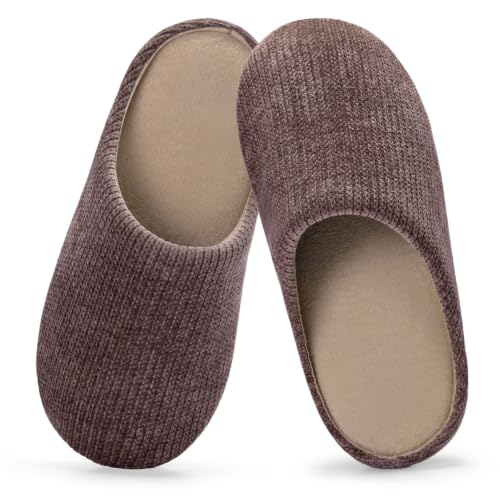
Fadezar Japanese Quiet House Slippers — Best Washable
The Fadezar entry pairs the same quiet Japanese design language with the practical feature soft slippers need most: it is machine washable, per its verified listing, which also describes a breathable lining, a non-slip lightweight build, and sizing for both women and men (the listed size run includes Brown 10-11 Women / 8-9 Men). Soft soles live on the floor; they pick up dust, kitchen drips and hallway grit, and a quiet slipper you cannot wash becomes a grubby slipper you stop wearing. Washability is what turns this from a novelty into the household’s everyday pair.
Strengths
- Machine washable per the listing — the maintenance feature that keeps soft soles grippy, fresh and in service.
- “Quiet House Slippers” in the maker’s own title, with a lightweight build that adds no heel-strike mass.
- Unisex sizing and a breathable lining suit shared-household, his-and-hers buying.
Trade-offs
- Non-slip soft soles still grip less than rubber on wet tile — treat bathroom floors with respect.
- Frequent washing is part of the deal; if you will not launder slippers, a soft sole ages badly.
- Lightweight construction means light insulation — cold-floor winters may want a second, warmer pair for evenings.
Spec box: Style: Japanese house slipper · Machine washable · Breathable lining · Non-slip, lightweight · Unisex sizing (per Amazon listing title).
Buy two pairs if the budget allows: one in the wash, one on your feet, and the quiet habit never breaks. That rotation is how Japanese households actually use these slippers, and it is the difference between a product that solves the noise problem permanently and one that solves it until laundry day.
Best for: everyday household wear, shared homes, anyone who values washable practicality. / Not suited for: wet-floor grip, deep-winter warmth, or outdoor use. Check on Amazon

COCOMUSE Ultralight Cotton-Linen Slippers, Cloth Bottom — Best for Downstairs Neighbors
If the complaint has already arrived — the knock on the ceiling, the note from the neighbor, the building manager’s email — this is the maximal answer. The COCOMUSE’s verified listing describes an ultralight, open-toe, cotton-linen women’s slipper with a cloth bottom. A cloth bottom is the quietest sole construction in existence: there is no rigid layer at all between foot and floor, so there is nothing to strike, clack or thud. It is the footwear equivalent of walking in socks, with an upper that keeps it a slipper rather than a sock.
Strengths
- True cloth bottom — the absolute floor for footstep noise; heel strike simply has no hard surface to report.
- Ultralight cotton-linen build is breathable and sweat-absorbing per the listing — comfortable for all-evening wear.
- Open toe keeps it cool and easy, a genuine summer-evening slipper as well as a quiet one.
Trade-offs
- Cloth bottoms wear fastest of all and offer the least protection against stubbing or stepping on something hard.
- Least grip of any pick here on smooth floors, especially as the cloth polishes with wear — wash to restore texture.
- Women’s sizing and open-toe styling only; not the unisex or cold-weather answer.
Spec box: Style: open-toe house slipper · Cloth bottom · Cotton-linen, ultralight · Sweat-absorbing (per Amazon listing title).
Think of this pair as the diplomatic solution: the one you wear in the evening hours when the neighbor below is home and the building is quiet. Many apartment dwellers keep a cloth-bottom pair for exactly those hours and a soft-foam pair for the daytime. As a single-purpose purchase — silence, above all — nothing in this guide goes further.
Best for: serious downstairs-neighbor situations, evening quiet hours, warm-weather wear. / Not suited for: durability-first buyers, cold floors, or anyone unsteady who needs maximum grip. Check on Amazon

EitCaton Unisex Linen House Slippers — Best Cushioned Soft Bottom
Some walkers stomp because they are heavy heel-strikers, and for them pure cloth is too thin — they want the impact absorbed, not just un-amplified. The EitCaton’s verified listing describes a cotton-fabric unisex slipper with memory foam and an explicitly soft bottom, non-slip and machine washable. Memory foam under the heel does for impact what the soft bottom does for sound: the strike lands in foam, spreads over time, and never becomes a thud. This is the pick that feels most like the plush slippers people are reluctant to give up, translated into a quiet construction.
Strengths
- Memory foam cushioning plus a soft bottom — absorbs heel strike instead of transmitting it.
- Cotton fabric upper, breathable and open-toe, in unisex sizing (listed runs include women’s and men’s equivalents).
- Machine washable per the listing, so the foam-and-fabric build can be kept fresh.
Trade-offs
- Foam compresses over months of use; the quiet survives, but the plushness gradually thins.
- More sole than the cloth-bottom picks means marginally more sound than the COCOMUSE — the price of cushion.
- Open-toe design leaves toes unprotected against furniture corners.
Spec box: Style: open-toe house slipper · Cotton fabric · Memory foam · Soft bottom · Non-slip · Machine washable · Unisex (per Amazon listing title).
Choose this when the person doing the stomping is also the person who complains that quiet slippers feel like walking on cardboard. It is the comfort-first end of the quiet spectrum, and for heavy heel-strikers it can actually beat thinner designs on real-world noise, because a strike absorbed by foam never reaches the floor as force.
Best for: heavy heel-strikers, comfort-first buyers, couples buying a unisex design. / Not suited for: maximum-silence purists, or buyers wanting a closed toe. Check on Amazon

Japanese Bamboo House Slippers with Soft Sole — Best for Warm Feet and Summer
Heat is the enemy of slipper compliance: the quietest slipper in the world does nothing in the closet, and plush slippers get abandoned in summer. This pick’s verified listing describes Japanese bamboo house slippers with a non-slip soft sole, positioned to keep feet dry and cool, odor-resistant and easy to clean, in a tatami-friendly design. Bamboo-faced footbeds feel cool on contact and handle perspiration better than foam-and-fleece builds, which makes this the pair most likely to still be on your feet in August.
Strengths
- Soft sole keeps the step quiet while the bamboo design keeps the foot cool and dry, per the listing.
- Odor-resistant positioning and easy cleaning suit a slipper worn barefoot daily.
- Non-slip soft sole is the safer soft option around kitchen and entryway floors.
Trade-offs
- A firmer, cooler feel than foam slippers — buyers wanting plush should look at the EitCaton instead.
- Summer-weight design; not a winter slipper for cold floors.
- Soft soles remain indoor footwear — no garden, no garage.
Spec box: Style: Japanese house slipper · Bamboo design · Non-slip soft sole · Odor-resistant positioning · Easy to clean (per Amazon listing title).
There is a seasonal strategy worth copying here: a warm quiet pair for winter, this bamboo pair for summer, and the stomping problem stays solved all year instead of returning every June when the plush slippers go back in the wardrobe.
Best for: warm feet, summer wear, tatami and wood floors, barefoot wearers. / Not suited for: cold-floor winters or plush-cushion seekers. Check on Amazon

Japanese Style Cotton Linen Slippers, Woven — Best Breathable Everyday Pair
The last pick is the quiet design in its most breathable everyday form: a Japanese-style slipper with a woven cotton-linen upper, per its verified listing. Woven natural fiber breathes in both directions — it does not trap the day’s warmth against the foot — and cotton-linen uppers soften and conform with wear, which improves the close fit that keeps a slipper from slapping. It is the least specialized pick in the guide and, for a mild-climate household that wants one quiet pair by the door for everything, possibly the most useful.
Strengths
- Woven cotton-linen upper: genuinely breathable, natural-fiber comfort for all-day indoor wear.
- The soft Japanese-style sole keeps steps quiet as a matter of construction.
- A conforming fit that improves with wear — less slip, less slap, less noise.
Trade-offs
- The listing is spare on extras — no washability or foam claims — so judge it as a simple, honest design.
- Natural-fiber uppers show wear and water spots more readily than synthetics.
- Like all picks here: indoor-only, soft-sole lifespan.
Spec box: Style: Japanese house slipper · Woven cotton-linen upper · Breathable indoor design (per Amazon listing title).
If the household’s problem is general — footsteps audible room to room, a partner who works nights, a baby who naps lightly — and nobody wants a wardrobe of specialized slippers, this is the one-pair answer: quiet by construction, breathable by material, unremarkable in the best way.
Best for: everyday all-purpose quiet wear, natural-fiber fans, mild climates. / Not suited for: buyers wanting maximum cushion, maximum warmth, or stated washability. Check on Amazon
Comparison Table
| Pick | Badge | Key spec | Best for |
|---|---|---|---|
| Japanese Style Quiet House Slippers | Best Overall | Closed toe, open back, quiet-positioned soft sole | General stomping problems |
| Fadezar Japanese Quiet House Slippers | Best Washable | Machine washable, breathable, lightweight, unisex | Everyday household wear |
| COCOMUSE Cotton-Linen Slippers | Best for Downstairs Neighbors | True cloth bottom, ultralight, open toe | Maximum silence |
| EitCaton Unisex Linen Slippers | Best Cushioned Soft Bottom | Memory foam, soft bottom, machine washable | Heavy heel-strikers |
| Japanese Bamboo House Slippers | Best for Warm Feet and Summer | Non-slip soft sole, cool bamboo design | Summer and barefoot wear |
| Japanese Cotton Linen Slippers, Woven | Best Breathable Everyday Pair | Woven cotton-linen upper, soft sole | One-pair households |
How to Choose House Slippers That Actually Stay Quiet
Judge a slipper by what is between your heel and the floor at the moment of impact. Three constructions, in descending order of quiet: a cloth bottom (nothing rigid at all), a soft foam or fabric sole (impact absorbed and spread), and a thin flexible soft sole of the Japanese type (impact muted, slight structure retained). Everything beyond that — rubber cupsoles, lugged outsoles, rigid shanks, wooden or cork platforms — is a noise transmitter wearing a slipper costume. When a listing does not show or describe the sole, assume it is the loud kind; quiet soles are a selling point and makers who build them say so, as the listings in this guide do.
Fit is the second half of quiet. A soft slipper that is a size too large slaps at the heel on every step — a noise as carrying as a stomp, and the reason some people conclude soft slippers “don’t work.” Buy your true size, prefer designs that hold the midfoot (closed uppers, woven cotton-linen that conforms, snug Japanese cuts), and be suspicious of any slipper you can kick off without using your other foot. The third factor is your floor: the harder and more resonant the floor — tile, laminate, bare wood over joists — the more sole softness matters, and the further down the quiet scale you should shop. On carpet, honestly, almost anything works, and this guide’s problem mostly solves itself.
Finally, plan for the sole’s lifespan. Soft soles compress, polish smooth and thin out; that is physics, not a defect. A pair worn daily will give its best quiet service for a season or two, and the category’s modest prices reflect that rhythm. Washing restores some grip and freshness (two of our picks are explicitly machine washable), rotating two pairs doubles the life of both, and demoting a worn pair to garden-door duty beats throwing it away. Budget for quiet slippers the way you budget for socks, not the way you budget for boots.
The Physics of Footstep Noise: Why Soft Soles Work
Footstep noise in a building travels by two paths. The first is airborne: the clack or thud you hear in the same room. The second, and the one downstairs neighbors actually complain about, is structure-borne: impact energy enters the floor, travels through joists and slab, and re-radiates as sound in the room below. Hard soles are efficient at both — a rigid heel concentrates your weight’s impact into a few milliseconds and a small contact patch, producing a sharp, high-energy strike. Soft soles attack the problem at its source: they spread the same impact over a longer time and a wider area, so the peak force entering the floor drops dramatically. Foam adds absorption, converting impact energy into harmless compression; cloth removes the rigid interface entirely.
This is also why “walk more quietly” advice fails and footwear advice works. Gait changes reduce impact modestly and nobody sustains them at 6 a.m.; a soft sole reduces impact on every step, including the tired, distracted, carrying-a-toddler steps that are loudest of all. Rugs and runners multiply the effect — a soft slipper on a hallway runner is close to silent — and the combination of quiet slippers plus one runner in the main traffic path solves most apartment noise complaints outright. If you can change only one thing, change the slippers; they go everywhere the rugs do not.
How to Keep Soft-Soled Slippers Quiet, Grippy and Fresh
- Wash them on a rhythm. Floor dust works into soft soles and cloth bottoms, polishing them smooth and reducing both grip and quiet. Machine wash the washable picks (Fadezar and EitCaton, per their listings) or hand-wash the rest, then air-dry fully before wearing.
- Rotate two pairs. Foam needs rest to recover its loft, and a damp pair worn daily never dries. Alternating pairs keeps both quieter, fresher and longer-lived.
- Keep them indoors. One trip across a gritty patio embeds particles in a soft sole that then scratch floors and click. Keep a separate pair of hard shoes at the door for outside errands.
- Check the fit monthly. Soft uppers stretch. If the heel starts slapping, the pair has effectively grown a size — replace it or reserve it for seated-evening wear.
- Retire them by sound, not by looks. When the sole has compressed to a hard, thin layer, the quiet is gone even if the upper looks fine. That is the replacement signal.
Quiet Slippers for Specific Households
The night-shift worker. Your problem is inverted: the household sleeps while you live. Your loudest moments are the kitchen at 4 p.m. (their 4 a.m.) and the bathroom run before your shift. The cloth-bottom COCOMUSE or the archetype Japanese pair by the bed, plus the discipline of never crossing the house in work boots, solves nearly all of it. Keep the pair where you change out of your uniform, so the quiet habit starts at the door of your day, not halfway through it.
The new parents. You are not worried about neighbors; you are worried about the forty-minute nap you just spent twenty minutes earning. Your enemy is the one loud step — the heel strike outside the nursery door. Any pick in this guide removes it, but the EitCaton deserves special mention for parents specifically: its memory foam absorbs the heavy, tired, carrying-someone gait that exhausted adults actually walk with, rather than the careful gait they intend to walk with.
The thin-walled building. In older conversions and budget apartment blocks, the floor is a drum and everyone knows everyone’s schedule. Here the answer is layered: quiet slippers for every member of the household (a guest in hard shoes resets the problem, so keep a spare soft pair by the door — the Fadezar’s unisex washable design is made for this), plus a runner on the main lane. Buildings like this are where cloth bottoms stop being a preference and become a courtesy with a waiting list of grateful neighbors.
The multi-generational home. Grandparents in the room below, adult children above — the stomping complaint in these homes is affectionate but real, and the fix must respect the elder’s need for secure footing. Choose the non-slip soft soles (the bamboo pair, the EitCaton), the correct size, and closed or well-held uppers; never put an unsteady walker in a loose backless cloth slipper for the sake of quiet. Safety outranks silence in this guide’s judgment, every time, and the non-slip soft-sole picks exist so the household rarely has to choose.
The work-from-home household. Your stomping problem has an audience of colleagues: the pacing during calls, the kitchen trips between meetings, audible through the floor to a partner also on calls below. Soft slippers plus a rug under the pacing lane is the whole solution, and it is cheaper than the acoustic panels you were considering. The woven cotton-linen pair is the natural office-hours choice — presentable enough for the doorbell, quiet enough for the floor.
Stairs, Guests and Other Hard Cases
Stairs deserve honesty: soft slippers and stairs require attention. Cloth and soft soles grip stair treads less decisively than rubber, and backless designs can shift on the descent. The household rules that work: hold the rail (always, not as a concession), take stairs at walking pace, and if your stairs are polished wood, consider the non-slip soft-sole picks as the household’s stair pair. No guide about quiet footwear should pretend this trade does not exist; managed openly, it is a small price, and the alternative — hard soles on wooden stairs — is both the loudest surface in most homes and not obviously safer in a hurry.
Guests are the other hard case, because a household can convert itself to soft soles and still be undone by one visitor’s boots. The Japanese solution is the guest pair: a washable, unisex soft slipper kept at the entrance — which is another reason the Fadezar earns its badge — offered with the same matter-of-fact hospitality as a coat hook. Most guests, told the downstairs neighbor works nights, are delighted to comply. The spare pair also covers the plumber, the babysitter and the teenager’s friend, which is to say it covers reality.
Finally, the hard case of the determined stomper: some people walk heel-first with genuine force, and for them even good slippers only halve the problem. The full answer for that walker is the EitCaton’s foam under the heel, a runner on their main route, and — gently — the information that their footsteps are audible, which most heavy walkers genuinely do not know. Footwear first, flooring second, conversation third; in that order, the problem almost always closes.
Common Buying Mistakes
- Buying rubber-soled “comfort” slippers to solve a noise problem. The foam insole is quiet; the rubber outsole under it is what hits the floor. Read the sole, not the insole.
- Choosing arch-support clogs for quiet. Rigid shanks and structured soles are excellent engineering for support and excellent engineering for transmitting heel strike. Support and silence are different briefs; this guide serves silence, and says so.
- Sizing up for comfort. A loose soft slipper slaps. Your true size, snugly held, is the quiet size.
- Wearing soft soles outdoors. Grit embeds, soles shred, floors get scratched. Indoor-only is a rule, not a suggestion.
- Expecting one pair to last for years. Soft soles are a consumable. Judge value by quiet months per pair and easy replacement, not by boot-style longevity.
- Ignoring the floor half of the equation. Slippers plus a hallway runner beats either alone. If complaints persist after soft slippers, the answer is a rug, not a fourth pair of slippers.
A Short History of the Quiet Slipper, and Why the Design Works
It is not an accident that five of this guide’s six picks are Japanese in design or inspiration. Japan’s housing tradition — timber construction, rooms divided by light partitions, floors of wood and tatami that register every impact, and a strict custom of removing outdoor shoes at the genkan entrance — created centuries of selective pressure toward exactly one kind of indoor footwear: light, soft, close-fitting and quiet. The uwabaki and home slipper tradition that followed refined the type into what you see in these listings: fabric uppers, soft or cloth soles, minimal structure, nothing hard anywhere in the design. Tatami adds a second pressure — hard soles damage woven rush mats — so the culture engineered the damage and the noise out together.
Western slipper design evolved under opposite pressures: carpeted floors that muffle everything, and a marketing race toward outdoor versatility, which is how the modern slipper acquired its rubber outsole, its lugs, its shank — and its stomp. Neither tradition is wrong; they are answers to different floors. The reader of this guide lives, acoustically, in the Japanese problem: hard floors, shared structures, sound that travels. Borrowing the Japanese answer is not exoticism, it is engineering transfer — the same reason this guide’s picks cluster where they do, and why the cloth-bottom COCOMUSE, the closest thing here to the traditional form, is also the quietest object in the list.
There is a practical corollary worth keeping: because these designs come from a wash-and-rotate culture, they are priced and built as renewable household goods rather than heirloom footwear. The two-pair rotation, the machine washing, the seasonal replacement — the habits recommended throughout this guide are not apologies for the products. They are the products’ native operating system, and households that adopt the system get the silence permanently, while households that buy one pair and expect boot longevity get a season of quiet and a puzzling decline. Buy into the system and the stomping problem does not come back.
A Buying Plan for the Whole Household
Stomping is rarely a one-person problem, so here is the conversion plan that works in practice. Start with the loudest walker — usually the heaviest heel-striker — and fit them first with the EitCaton or the archetype Japanese pair; their conversion delivers the largest immediate quiet and makes them an ally rather than a defendant. Next, the entrance: a guest pair (the washable Fadezar) and a small mat that says, without words, that this is a soft-shoe house. Then the rest of the household on the two-pair rotation — one on the feet, one in the wash — sized correctly for each person, because the teenager in a borrowed, flapping pair is tomorrow’s noise complaint wearing good intentions.
Budget the conversion as a system, not a splurge: the pairs in this guide sit in the consumable price class, and a full household conversion — two pairs per person plus the guest pair — typically costs less than one pair of premium hard-soled slippers that would have solved nothing. Set a calendar note for the season’s end to inspect soles, demote the thinned pairs to garden duty, and replace them before the quiet degrades gradually enough to become the new normal. Noise creeps back by millimeters of compressed foam; the inspection is what keeps the victory.
Testing Your Current Slippers: A Two-Minute Floor Audit
Before you buy anything, audit what you own — the results occasionally surprise. Test one: the hallway walk. Walk your main route at your natural, unthinking pace in your current slippers while a household member listens from the room below or the far end of the hall. If they can count your steps, the soles are hard, whatever the insole promises. Test two: the drop test. Hold a slipper a foot above the hard floor and let it fall heel-first; a soft sole lands with a whisper, a hard sole lands with the exact clack your neighbors hear, multiplied by your body weight. Test three: the slap check. Walk away from a mirror — or ask — and listen for the heel slap of a loose fit; if it is there, your problem is sizing as much as sole, and a snug soft pair fixes both at once. Households that run this audit stop debating whether the problem is real and start choosing between this guide’s picks, which is where the problem actually gets solved.
The Courtesy Layer: Rugs, Doors and the Rest of the Quiet House
Slippers are the largest lever, not the only one. A runner on the main hallway lane multiplies their effect, as noted earlier; felt pads under chair and table legs remove the scrape that often shares the blame with footsteps; a door sweep or a soft-close habit ends the slam that dwarfs any stomp. None of this diminishes the slippers’ role — they are the only measure that travels with the walker into every room — but a household that layers all three usually stops hearing the building entirely, and stops being heard. Consider this guide the first layer, and the encouragement to finish the job the house started.
What Success Sounds Like
It is worth naming the goal precisely, because it is modest and total at once: success sounds like nothing. It is the baby who sleeps through the morning routine, the neighbor who stops knowing your schedule, the night-shift partner whose day-sleep is no longer edited by footsteps. None of the picks in this guide will be admired the way a beautiful shoe is admired — they are quiet in every sense, including the visual one. But a household that has lived with the noise and then without it does not find the change modest at all. It finds it, nightly, in the quality of its sleep and the peace of its building — which is a great deal of life to improve with a pair of soft soles.
Final Recommendation
Start with the Japanese Style Quiet House Slippers if you want the archetype — quiet by design, closed toe, easy on and off. Choose the Fadezar if washability will decide whether the pair actually gets worn daily, and the COCOMUSE cloth bottoms if a downstairs neighbor is already unhappy and you want the maximum silence physics allows. Heavy heel-strikers should take the EitCaton’s foam-cushioned soft bottom; hot feet and summer households should take the bamboo pair; and the woven cotton-linen Japanese slippers are the one-pair answer for everyone else. Whichever you choose, buy your true size, keep them indoors, wash them on a rhythm — and enjoy walking through your own home without announcing it.
Exploring the rest of the slipper shelf? See our guides to Best House Slippers Home, Best House Slippers Wide Width, Best Indoor Slippers For Summer, Best House Slippers For Supination and Best Lightweight Women House Slippers for the related picks in this program.
Frequently Asked Questions
Do soft-soled slippers really stop stomping noise?
They address its cause. Stomping sound is a hard sole striking a hard floor; a cloth, foam or soft flexible sole spreads and absorbs that impact so far less energy enters the floor. On wood, laminate and tile the difference is dramatic. On carpet the problem is already muted and any slipper works.
Are quiet slippers safe? Soft soles sound slippery.
Soft does not have to mean slick: several picks here carry non-slip soft soles (the bamboo pair and the EitCaton state it in their listings). The real cautions are wet tile, where any soft sole grips less than rubber, and worn, polished soles — wash them to restore texture and replace them when the sole goes thin and hard. Anyone unsteady on their feet should prioritize grip and consult their own judgment over any guide’s.
Why not just walk in socks?
Socks are indeed quiet — and they are also slippery on hard floors, cold, and hard on their own heels. A cloth-bottom slipper gives you the sock’s silence with an upper that stays on, a layer of warmth, and a sole designed to be walked on. Think of these slippers as socks that took the job seriously.
How long do soft-soled slippers last?
Worn daily, expect a season or two of best service before the sole compresses and polishes. Washing and rotating two pairs extends that considerably. They are priced as consumables, and the honest comparison is not against boots but against the cost — in neighbor relations and household sleep — of the noise they prevent.
Can I wear these slippers outside to take out the trash?
We advise against it. Soft and cloth soles pick up grit that then scratches your floors and clicks, and they wear rapidly on concrete. Keep a pair of outdoor shoes at the door; it takes five seconds and preserves both the slippers and the floors.
Do quiet slippers work on stairs and in kitchens?
With the cautions this guide states openly: soft soles grip less than rubber on wet kitchen floors and polished stair treads, so choose the non-slip soft-sole picks (the bamboo pair, the EitCaton), keep kitchen floors dry underfoot, and use the handrail as a rule rather than a rescue. Managed that way, quiet slippers serve the whole home — unmanaged, the stairs are where any footwear philosophy meets its limits.
Which pick is best for a baby who naps during the day?
Any of the six will transform nap-time noise compared with hard soles. For the lightest sleepers, the COCOMUSE cloth bottoms are the quietest construction in the guide; for the parent who also wants cushion for long days on their feet, the EitCaton’s memory foam soft bottom is the balanced choice.

