Disclosure: airfryerkitchensupply.com is reader-supported. When you buy through links on our site, we may earn an affiliate commission at no extra cost to you.
Where to buy
Every pick below was verified against Amazon listing data — the six range from an ultralight open-toe linen slipper that weighs almost nothing in a suitcase to a closed-back chenille style whose name literally promises lightweight comfort. Use the links to check the current price on Amazon in your size, and read the fit notes in each review first: lightweight slippers live or die on sizing, because there is less material to forgive a wrong size.
COCOMUSE Ultralight Open Toe Cotton Linen Women’s Slippers — check price on Amazon
Dearfoams Women’s Rebecca Lightweight Closed Back Slipper — check price on Amazon
RockDove Women’s Original Two-Tone Memory Foam Slipper — check price on Amazon
EverFoams Women’s Fuzzy Slip-On Memory Foam Slippers — check price on Amazon
Japanese Style Linen House Slippers, Open Toe — check price on Amazon
Dearfoams Women’s Leslie Washable Terry Clog — check price on Amazon
Best Lightweight Women House Slippers: Featherweight Comfort, Honestly Weighed
The best lightweight women house slippers solve a specific problem: ordinary house slippers are heavier than they need to be. Thick shearling, heavy rubber soles and dense foam add up across thousands of steps a day, and by evening a heavy slipper feels like footwear you are carrying rather than wearing. The lightweight end of the market strips that weight three ways — open-toe breathable uppers, thin flexible soles, and foam cushioning that stays airy instead of dense — and the six verified picks in this guide cover each approach, so you can choose light for summer, light for travel, or light with warmth kept.
A quick honesty note before the picks. ‘Lightweight’ is not a regulated claim, so listings use it loosely. We judged it the way you will feel it: by construction. A slipper built from linen or cotton cloth with a thin sole is genuinely light. A memory foam slipper is light relative to a boot slipper but still has substance. A closed-back chenille slipper that names itself lightweight earns the word through a foam build rather than a heavy lug sole. Each review below tells you plainly which kind of light you are getting, because the right answer for a July apartment is the wrong answer for a draughty January house.
All six picks are women’s house slippers in the true sense — indoor-first designs, several with soles rated by their makers for brief indoor-outdoor use. None of them are sandals, slides or massage shoes, and none makes any medical claim; where a style offers a fuller, more supportive-feeling footbed we describe it as comfort, nothing more. Sizing notes matter throughout: several of these come in range sizes rather than exact sizes, and the reviews flag where sizing up is the safer call.
In this guide
Quick Picks
COCOMUSE Ultralight Open Toe Cotton Linen Women’s Slippers — Best Overall. The lightest construction in this guide: an open-toe cotton-linen upper on a soft cloth bottom, built for warm rooms, warm climates and anyone who finds foam slippers sweaty. Check the current price on Amazon.
Dearfoams Women’s Rebecca Lightweight Closed Back Slipper — Best Lightweight with Warmth. A closed-back chenille slipper with memory foam that puts ‘lightweight’ in its own name — the warm pick for women who want light without giving up a proper back and cosy upper. Check the current price on Amazon.
RockDove Women’s Original Two-Tone Memory Foam Slipper — Best Cushioned All-Rounder. The crowd-pleasing middle ground: memory foam cushioning, a non-slip sole rated for indoor-outdoor use, machine washable, and a listing that confirms lightweight among its headline features. Check the current price on Amazon.
EverFoams Women’s Fuzzy Slip-On Memory Foam Slippers — Best Breathable Cosy Pick. A curly fleece slip-on whose listing manages a rare pairing — warm and breathable in the same breath — with lightweight, washable and anti-slip confirmed alongside. Check the current price on Amazon.
Japanese Style Linen House Slippers, Open Toe — Best for Guest and Travel Use. A minimalist linen open-toe design with an anti-skid sole — the listing itself names guest bedrooms, which is exactly where this flat, quiet, easy pair belongs. Check the current price on Amazon.
Dearfoams Women’s Leslie Washable Terry Clog — Best Washable Clog. A terry clog with memory foam and wide widths — the step-in, step-out workhorse for kitchens and laundry days, in a light washable build. Check the current price on Amazon.
How These Picks Were Chosen
We verified every candidate, matching each ASIN to its returned title before a pick earned a link. From the verified shortlist we selected for genuine lightness of construction first: cloth and linen uppers, open toes, thin or flexible soles, and foam builds without heavy outdoor lugs. We then spread the six across real use cases — warm-weather breathability, washable everyday wear, travel packing, a warmer closed-back option, a clog for quick on-and-off, and a cushioned all-rounder — because ‘lightweight’ means different things in different houses.
We excluded anything that was not a women’s house slipper: ballet and dance slippers, sandals and flip-flops, massage footwear, and heavy boot styles that contradict the keyword. Size-variant listings of the same slipper were counted once. Where a listing’s own title confirms a feature — washable, wide widths, indoor-outdoor sole — we say so; where the title is silent, for example on exact weight in grams, we do not invent a number, and the review notes it as not stated.
The 6 Best Lightweight Women House Slippers

COCOMUSE Ultralight Open Toe Cotton Linen Women’s Slippers — Best Overall
If your definition of lightweight is ‘barely there’, start here. The COCOMUSE pairs a cotton-linen open-toe upper with a soft cloth bottom, so the whole slipper flexes, breathes and packs flat. The listing describes the upper as sweat-absorbing, which matches the design logic: in a warm house, moisture management matters more than insulation, and an open toe plus natural-feel cloth is the coolest combination in this roundup. This is the slipper for hardwood and tile homes in summer, for humid climates, and for anyone whose feet run hot year-round.
Strengths
- Genuinely minimal weight — cloth construction, nothing heavy anywhere
- Open toe and cotton-linen upper breathe in warm rooms
- Packs completely flat for travel or a guest drawer
Trade-offs
- Cloth bottom offers little grip or protection on slick floors
- No meaningful cushion for long standing on hard floors
- Indoor-only design; not built for outdoor steps
| Detail | What the listing confirms |
|---|---|
| Upper | Cotton linen, open toe (per Amazon title) |
| Sole | Soft cloth bottom (per Amazon title) |
| Use | Indoor |
Wear it where it shines: morning routines on warm floors, evening wear in heated apartments, and as the pair that lives in your suitcase. The trade is deliberate — you give up cushion and sole structure to get a slipper that never feels like footwear. On cold stone or tile in winter it will feel like not enough slipper, and that is not a flaw so much as the other end of the lightweight spectrum doing its job.
Care follows the cloth logic: these are the easiest style here to freshen, and the flat build means they dry fast after washing — check the listing’s care guidance for your exact pair. Size by your usual slipper size and expect a close, sock-like fit rather than a roomy clog feel.
Best for: hot sleepers, warm climates and travel packing / Not suited for: cold floors or anyone wanting cushioned support for long standing

Dearfoams Women’s Rebecca Lightweight Closed Back Slipper — Best Lightweight with Warmth
Most lightweight slippers achieve lightness by opening up. The Rebecca goes the other way: a closed back, a chenille upper and memory foam cushioning, engineered to stay light through its foam build rather than a heavy sole. The closed back matters more than it sounds — it keeps the slipper on when you climb stairs, carry laundry or move quickly, where backless styles flap and slip. The listing also confirms wide widths, which makes this the most accommodating fit in the guide for women who find standard slippers pinchy.
Strengths
- Closed back stays on securely on stairs and quick movement
- Memory foam cushion with a genuinely light build
- Wide widths available, per the listing title
Trade-offs
- Chenille warmth is too much for hot climates
- Closed back means slower on-and-off than a clog or mule
- Range sizing may need a size-up for between sizes
| Detail | What the listing confirms |
|---|---|
| Upper | Chenille, closed back (per Amazon title) |
| Cushion | Memory foam (per Amazon title) |
| Fit | Wide widths offered (per Amazon title) |
This is the January answer in a lightweight guide: full coverage and foam comfort at a weight that still feels easy at the end of the day. The Sleet colourway in the verified listing is a soft grey that hides household dust well between washes. If your house is cold and your floors are hard, the foam earns its place; if your house is warm, look at the open-toe picks instead and keep this style for winter rotation.
Fit note: Dearfoams range sizes reward measuring. If you sit at the top of a size range or plan to wear socks, the next range up is usually the calmer choice, and the wide option solves width without forcing length. Check the current price on Amazon in your size and width before deciding.
Best for: cold houses wanting light weight plus real warmth and a secure back / Not suited for: hot climates or anyone who kicks slippers off and on constantly

RockDove Women’s Original Two-Tone Memory Foam Slipper — Best Cushioned All-Rounder
RockDove’s two-tone slipper is the one to buy when the household brief is simply ‘good slippers, not heavy’. The verified title reads like a checklist of what most women actually ask for: memory foam for cushion, a non-slip sole, machine washability for real life, and lightweight construction so the pair never feels like boots. The slip-on shape with a low back is quick at the door and stable enough around the house, and the indoor-outdoor sole rating means the trip to the mailbox does not require a shoe change.
Strengths
- Listing confirms lightweight, washable and non-slip in one package
- Memory foam cushion suits hard floors and long wear
- Indoor-outdoor sole handles quick trips outside
Trade-offs
- Low back is less secure on stairs than a closed back
- Memory foam warms up in summer wear
- Two-tone casual styling is home-first, not dressy
| Detail | What the listing confirms |
|---|---|
| Cushion | Memory foam (per Amazon title) |
| Sole | Non-slip, indoor/outdoor (per Amazon title) |
| Care | Machine washable (per Amazon title) |
In daily use this is the pair that disappears into routine: on in the morning, fine on the kitchen tile, fine for the bins, into the wash when they need it. The Eggplant two-tone of the verified listing is forgiving of household marks. Weight-wise it sits in the middle of this guide — lighter than any boot slipper, more substantial than the cloth picks — which is exactly where an all-rounder should sit.
Sizing runs in ranges; the verified listing is the 7-8. If you wear thick socks at home, consider the upper end of your range. As with all foam slippers, expect the cushion to feel firmest in the first days and to mould to your foot over the first week.
Best for: one-pair households wanting cushion, washability and easy outdoor trips / Not suited for: anyone wanting the absolute lightest cloth-style slipper
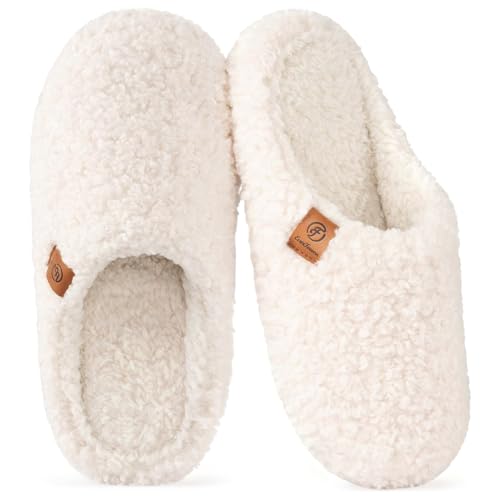
EverFoams Women’s Fuzzy Slip-On Memory Foam Slippers — Best Breathable Cosy Pick
Fleece slippers usually force a choice between cosy and stuffy. This EverFoams listing is interesting because its own title claims both warmth and breathability, built around a curly fleece finish over memory foam. Curly fleece traps less stale heat against the skin than dense plush, which is how a fall-weight slipper can stay comfortable into the evening without the swampy feeling. The listing also confirms the practical trio: lightweight, machine washable and an anti-slip sole.
Strengths
- Curly fleece aims for warmth without the stuffiness of dense plush
- Listing confirms lightweight, breathable and washable together
- Memory foam cushion with an anti-slip sole
Trade-offs
- Fall-weight warmth still too warm for summer rooms
- Fleece shows pet hair readily between washes
- Beige colourway shows soil faster than darker options
| Detail | What the listing confirms |
|---|---|
| Upper | Curly fleece (per Amazon title) |
| Cushion | Memory foam (per Amazon title) |
| Care | Machine washable (per Amazon title) |
Think of this as the shoulder-season specialist: the pair for October evenings and cool spring mornings when the cloth slippers feel thin and the winter boots feel absurd. The slip-on cut keeps it quick, the foam keeps hard floors friendly, and washability keeps fleece honest — fleece that cannot be washed ages badly, and this one can.
The verified listing is Beige in 7-8 US. Fleece slippers fit snug at first and relax with wear, so a first-day fit that feels merely close is usually right. If you are between ranges and dislike any toe contact, size up.
Best for: shoulder seasons and cool evenings wanting cosy but not heavy / Not suited for: hot sleepers in summer

Japanese Style Linen House Slippers, Open Toe — Best for Guest and Travel Use
Some slippers are personal; this one is social. The Japanese-style linen design is unisex, minimal and quiet on hard floors, and the listing explicitly pitches it for guest bedrooms — a role lightweight slippers fill perfectly, because a guest pair must fit many feet, feel clean, and store flat in a drawer. The open toe and linen keep it breathable, the anti-skid sole keeps it safe on bathroom tile and polished wood, and the whole thing weighs next to nothing in a linen cupboard or a carry-on.
Strengths
- Anti-skid sole suits tile and polished floors
- Unisex minimalist design fits the guest-pair role perfectly
- Flat, light and quiet — stores and packs anywhere
Trade-offs
- Minimal cushion — a guest pair, not an all-day standing pair
- Open toe offers no warmth for cold houses
- Linen shows water spots; keep a second pair for bathroom duty
| Detail | What the listing confirms |
|---|---|
| Upper | Linen, open toe (per Amazon title) |
| Sole | Anti-skid (per Amazon title) |
| Fit | Unisex sizing (per Amazon title) |
Hosts should buy these the way hotels think: in a couple of sizes, washed between guests, stored where guests can find them without asking. For personal use, they double as the travel pair — flat in the bag, fine on hotel floors, and breathable in warm destinations. The soft, easy-wear build the listing describes is about unobtrusiveness, and that is the point: nobody remembers these slippers, which for a guest pair is the highest praise available.
Because sizing is unisex, check the listing’s size guidance against your usual women’s size rather than assuming a straight conversion.
Best for: guest bedrooms, travel kits and minimalist homes / Not suited for: anyone wanting plush cushion for all-day wear

Dearfoams Women’s Leslie Washable Terry Clog — Best Washable Clog
The clog is the pragmatic shape: no heel to fold down, no back to negotiate, just step in and go. Dearfoams’ Leslie wraps that shape in terry with memory foam underneath, and the listing leads with the word that matters for a kitchen slipper — washable. Terry earns its place here because it behaves like the towels it resembles: absorbent of small splashes, quick to freshen, and cool against the skin compared with fleece or chenille. For warm kitchens and summer houses, a terry clog is often the lightest-feeling cushioned option of all.
Strengths
- Terry upper feels cool and handles kitchen splashes gracefully
- Washable build with memory foam cushion
- Wide widths available, per the listing title
Trade-offs
- Open back can slip during fast stair descents
- Terry flattens visually with age faster than chenille
- Less cosy than closed styles for winter evenings
| Detail | What the listing confirms |
|---|---|
| Upper | Terry clog (per Amazon title) |
| Cushion | Memory foam (per Amazon title) |
| Fit | Wide widths offered (per Amazon title) |
Keep this pair where the work is: kitchen, laundry, back door. The clog shape shines in stop-start movement — cooking, tidying, carrying — where a closed back is friction and a cloth slipper is too little. The Iceberg colourway in the verified listing is a pale blue-grey that suits the fresh, washable character of the design.
Fit in a clog should be easy but not sloppy: your heel should sit inside the footbed’s edge with room to spare. The wide-width option makes that achievable for more feet than most slippers in this guide. Check the current price on Amazon in your size before ordering.
Best for: kitchens, laundry days and warm houses wanting a step-in clog / Not suited for: stair-heavy homes wanting a locked-in heel
Comparison Table
| Pick | Badge | Key spec | Best for |
|---|---|---|---|
| COCOMUSE Ultralight Open Toe Cotton Linen Women’s Slippers | Best Overall | Cotton-linen open toe, cloth bottom | hot sleepers, warm climates and travel packing |
| Dearfoams Women’s Rebecca Lightweight Closed Back Slipper | Best Lightweight with Warmth | Chenille closed back, memory foam | cold houses wanting light weight plus real warmth and a secure back |
| RockDove Women’s Original Two-Tone Memory Foam Slipper | Best Cushioned All-Rounder | Memory foam, washable, indoor-outdoor sole | one-pair households wanting cushion, washability and easy outdoor trips |
| EverFoams Women’s Fuzzy Slip-On Memory Foam Slippers | Best Breathable Cosy Pick | Curly fleece, memory foam, washable | shoulder seasons and cool evenings wanting cosy but not heavy |
| Japanese Style Linen House Slippers, Open Toe | Best for Guest and Travel Use | Linen open toe, anti-skid sole | guest bedrooms, travel kits and minimalist homes |
| Dearfoams Women’s Leslie Washable Terry Clog | Best Washable Clog | Terry clog, memory foam, wide widths | kitchens, laundry days and warm houses wanting a step-in clog |
How to Choose Lightweight House Slippers That Still Feel Like Slippers
Lightness comes from three decisions: the upper, the cushion and the sole. Cloth and linen uppers are the lightest and coolest; fleece and chenille add warmth at a small weight cost; terry sits between, cool and absorbent. Cushion is where weight hides — a thin foam layer keeps a slipper easy, while deep stacked foam feels plush but carries more. Soles decide the rest: a cloth bottom is lightest and quietest, a thin anti-slip sole adds safety on tile, and a true indoor-outdoor sole adds the most weight while buying you mailbox trips. Decide which of the three you are optimising, because no slipper wins all three at once.
Then match the shape to your movement. Open-toe designs breathe and suit warm rooms and warm feet. Clogs and mules are fastest for stop-start days. Closed backs are the safest on stairs and the warmest in winter. A useful household pattern is two pairs in rotation — one genuinely minimal pair for summer and travel, one cushioned pair for winter and long standing — which together still weigh less than a single pair of heavy boot slippers and cover the whole year honestly.
Finally, treat ‘lightweight’ claims with friendly suspicion. Prefer listings whose construction explains the lightness — cloth, linen, open toe, thin sole — over listings that merely assert it. And remember that a slipper’s weight is per pair at your size; a style that is light in a size six is less light in a size eleven, which is another reason construction matters more than adjectives.
- Choose your optimisation: coolest upper, softest cushion or safest sole
- Closed backs for stairs, clogs for stop-start days, open toes for heat
- Trust construction (cloth, linen, thin soles) over the word ‘lightweight’
Fit, Sizing and the Range-Size Problem
Most slippers in this guide are sold in size ranges rather than exact sizes, and that is where most returns are born. Measure your foot in the evening, when it is at its largest, and compare against the listing’s own guidance rather than your shoe size alone. If you land at the top of a range, or if you wear socks at home, the next range up is usually the better home — a slipper that is slightly roomy stays comfortable, while one that is slightly short punishes your toes at every step and wears out at the heel faster.
Width deserves its own decision. Two picks in this guide — the Dearfoams Rebecca and the Dearfoams Leslie — confirm wide widths in their listings, which matters because squeezing a wide foot into a standard slipper defeats the cushion: the foam compresses at the edges instead of underfoot. If standard slippers habitually feel tight across the ball of the foot, choose the wide option in your normal length rather than sizing up in length, which trades a width problem for a tripping problem.
Keeping Light Slippers Fresh: Washing and Rotation
Lightweight slippers live closer to the skin and the floor than any other footwear, and most of this guide’s picks are washable — use that. Wash foam slippers gently and let them air-dry fully; heat warps foam and shortens its life. Cloth and linen pairs dry fastest and tolerate the most frequent washing, which is part of their appeal for guest use. A simple rotation — two pairs alternating days — extends cushion life noticeably, because foam recovers between wears instead of staying compressed.
Soles need attention too. Anti-slip patterns clog with household dust and pet hair, and a clogged sole on tile is worse than a smooth one. A quick brush or rinse restores grip. When the cushion stops recovering overnight, or the sole’s pattern has worn smooth, the pair has done its service — lightweight slippers are consumables with a lifespan, and replacing them on time is cheaper than the fall a worn sole invites.
Lightweight Slippers and Hard Floors: The Cushion Question
The most common disappointment with lightweight slippers is not weight but hardness: a thin cloth pair on a tiled kitchen floor transmits every step, and by the end of a cooking session the wearer is barefoot on a mat wondering why she bought slippers at all. The physics are simple — cushion is compressed air and foam, and light designs carry less of both. The answer is not to abandon light slippers but to zone them. Cloth and linen pairs belong to bedrooms, carpets and warm wooden floors; foam pairs — the RockDove, the Dearfoams duo and the EverFoams in this guide — belong to kitchens, bathrooms and any room where you stand still for long stretches.
Standing and walking ask different things, which is why the zoning works. Walking favours lightness and flexibility; standing favours thickness under the heel and ball of the foot. A household that cooks seriously should treat its kitchen pair the way it treats its kitchen knife — a specific tool, kept at its station — while the light pair roams. Two mid-priced pairs zoned honestly will out-serve one expensive pair asked to be both, and the total weight on your feet across a day drops either way.
If one pair must do everything, choose from the foam middle of this guide and accept the small weight premium as the price of the cushion. That is the RockDove’s entire design brief, and it is why it anchors so many households: not the lightest, not the warmest, but the pair that never feels wrong in any room of the house.
Slipper Materials Decoded: Terry, Chenille, Linen and Fleece
The four uppers in this guide behave like the fabrics they are, and choosing between them is choosing a climate. Terry is towelling: absorbent, cool, quick to wash and dry, and the natural kitchen and summer material — the Dearfoams Leslie’s whole argument. Chenille is the opposite pole: a soft, fuzzy yarn that traps warmth, chosen for cold houses and evening wear, as in the Dearfoams Rebecca. Linen is the warm-climate specialist — breathable, crisp, moisture-shedding — in the Japanese-style and COCOMUSE open-toe designs. Curly fleece, the EverFoams’ finish, splits the difference: warmer than terry, airier than chenille, and the shoulder-season answer.
Soles divide just as cleanly. A cloth bottom is silent and weightless but offers the least grip and no outdoor life. A moulded anti-skid sole adds safety on tile at a few grams’ cost. A true indoor-outdoor sole — the RockDove’s listing claims it — adds the most weight and the most freedom. Neither axis has a wrong answer; there is only the mismatch, the January chenille in a tropical flat or the linen slipper on a stone floor in February, and both mismatches are avoidable by buying for your house’s actual climate rather than its occasional weather.
A last material note: foam itself ages. Memory foam softens with heat and use, which is why rotation extends its life and why a slipper that feels perfect in the shop feels merely good at month three. That is not a defect to chase with returns; it is the material settling into the shape of your foot, and it is priced into every honest foam slipper in this guide.
A Year of Slippers: Building the Two-Pair Rotation
The rotation this guide keeps recommending deserves a concrete shape. Pair one is the house’s climate pair: in a warm home, the COCOMUSE linen or the Japanese-style open toe; in a cold one, the Dearfoams Rebecca’s closed chenille back. It is bought for the majority of your evenings and worn without thinking. Pair two is the specialist: a kitchen-and-standing pair with real foam — the RockDove or the Leslie clog — or, in a warm house that bought cloth first, the EverFoams fleece for the cold snap weeks. Between them, every room, season and task in a normal house is covered, and neither pair is ever asked to be what it is not.
The economics surprise people: two honest mid-tier pairs, rotated, outlast two sequential premium pairs worn to death one at a time, because foam recovers on its rest days and uppers dry fully between wears. Rotation also solves the washing problem that kills single pairs — there is always a clean pair while the other dries, so washing actually happens instead of being postponed until the slippers can be smelled from the doorway. Mark the pairs’ roles loosely — a hook by the kitchen for the standing pair, the bedroom for the roamer — and the system maintains itself.
Replace by evidence, not by calendar: when a foam pair stops recovering overnight, when a sole’s grip pattern smooths, when an upper tears at the flex point. Slippers are the hardest-working footwear in a house — thousands of steps a day on unforgiving floors — and a pair that gives a year of daily service has not failed; it has finished. The rotation simply makes sure it finishes gracefully, with its successor already broken in beside it.
Slippers as Gifts and Guest Pairs: The Host’s Angle
Lightweight slippers are the rare gift that is both personal and safe, and the reasons are in this guide’s picks: they pack flat, they need no precise size — range sizing forgives — and every recipient’s house has a floor. The RockDove’s own listing calls itself gift-ready, and the EverFoams listing mentions gifting too; the market knows. For gifting, choose the middle of the climate range — a foam slip-on travels between houses and seasons better than a specialist — and choose the colour you would want photographed on your own stairs, because it will be.
The guest-pair version of the same logic is the Japanese-style linen pick’s home ground, but it generalises: a washed, dedicated guest pair, stored where guests sleep, in a mid-range size, with a sole that will not betray them on your bathroom tile. Hosts who keep one report the same small moment — the guest who emerges in the morning already comfortable, already at home — which is the entire point of a guest pair and worth more than its price several times a year.
One etiquette note from the receiving end: slippers ask a household question — are we a shoes-off house? — and answer it kindly. Offering a clean pair at the door is warmer than announcing a policy, and a lightweight pair is the easiest offer to accept, carry and forget you are wearing. That is the deepest sense in which these are social objects, and why the lightest picks in this guide may be the most worn of all.
What Lightweight Slippers Teach About Footwear Generally
Spend a month in genuinely light slippers and a quiet recalibration happens: you start noticing how much of ordinary footwear’s weight is habit rather than necessity. Shoes carry structure for streets, weather and work; a house slipper carries none of those briefs, and its ideal weight approaches the weight of the sock it replaces. The picks in this guide map that approach from three directions — cloth that weighs almost nothing, foam engineered to feel like less than it is, and uppers chosen so the air does part of the work — and the lesson transfers: the right weight for a thing is the weight its job requires, and no more.
There is a comfort corollary worth stating carefully, in comfort language only. Feet that spend home hours unburdened feel fresher at day’s end than feet that spend them in outdoor-weight footwear worn indoors, which is one reason shoes-off households so often become slipper households once a good light pair arrives. This guide makes no medical claims for any pick; the observation is the ordinary one that lighter, softer and cleaner indoor footwear is pleasanter to live in, and pleasant is a perfectly respectable design goal for the object you wear more hours than any shoe you own.
So buy the pair your house’s climate and floors describe, keep the second pair for the other season or the other job, wash them like you mean it, and let the heavy boot slippers go to the cabin, the winter cottage or the relative whose house is genuinely cold. At home, for most women, most of the year, light wins — and this guide’s six verified ways of winning it are all, in their different materials, the same idea: exactly enough slipper, and not one gram more.
Slipper Troubleshooting: Fixes for the Common Complaints
Too slippery on tile: the sole’s grip pattern is usually clogged, not worn — scrub it with a stiff brush and warm water, let it dry fully, and test again before replacing the pair; if the pattern itself has worn smooth, no cleaning restores it and the pair retires to carpet-only duty. Too warm by evening: the upper is winning against your climate, and the honest fix is the rotation — a cloth or linen pair for the warm hours rather than a thinner sock inside a warm slipper, which solves nothing and feels like a compromise at every step. Too loose after a month: foam and knit uppers relax with wear, and a pair bought snug becomes a pair that fits; a pair bought loose becomes a pair that slaps — which is why this guide keeps advising the close side of a size range at purchase.
Heel slipping in clogs and mules is a sizing signal, not a character flaw: the footbed is longer than your foot’s working length, and the next range down, tested standing, usually cures it. Odour that survives washing lives in foam that never fully dries — give the pair two full days of air after its next wash, near moving air rather than in a cupboard, before concluding it is finished. And the squeak that some soles develop on polished floors is moisture and dust in the tread; a dry brush-out ends most squeaks, and the rest are a reason to keep that pair for the carpeted rooms. None of these fixes costs money, which is rather the point: lightweight slippers are simple objects, and simple objects repay simple maintenance with years of unconsidered service.
How to Break In and Wear Lightweight Slippers Comfortably
A good lightweight slipper needs almost no breaking in — and that ‘almost’ is worth an hour of attention. Foam pairs feel firmest on day one and mould over the first week; cloth pairs may feel snug across the toes until the weave relaxes. Wear new pairs around the house in short sessions first, and check the three pressure points: toes, heel edge and the ball of the foot.
- Wear new slippers indoors for an hour before committing to a full day
- Check toe room standing, not sitting — feet lengthen under weight
- If between size ranges, test with the socks you actually wear at home
- For foam pairs, allow a week of wear before judging the cushion
- Keep anti-slip soles clean — brush dust from the pattern weekly
- Rotate two pairs on alternate days so foam recovers between wears
- Wash washable pairs before odour sets in, and air-dry completely
- Replace pairs whose soles have worn smooth, especially for tile and stairs
One habit separates happy slipper owners from the rest: a home for the pair. Lightweight slippers migrate — under sofas, into bathrooms, out to the porch — and a pair that lives by the bed or the door gets worn, washed and replaced on schedule, while a wandering pair gets worn to death in one spot of the house. Give them a place, and the rotation and washing habits above almost run themselves.
Common Buying Mistakes
Buying heavy ‘cosy’ slippers for a warm house. Warmth and weight travel together. In heated or warm-climate homes, cloth, linen and terry picks feel better by evening than any fleece boot.
Sizing down in range sizes. A short slipper punishes toes and wears at the heel. At the top of a range, or with socks, take the next range up.
Ignoring the sole on tile and wood. Cloth bottoms are quiet and light but slippery on polished floors. Choose an anti-skid or non-slip sole where floors are slick.
Never washing washable slippers. The washability is the feature. Unwashed foam slippers hold odour and lose freshness long before they wear out.
Expecting one pair to do summer and winter. The honest solution is a minimal pair and a cushioned pair in rotation — still lighter together than one heavy pair.
Final Recommendation
For most women, the COCOMUSE ultralight linen pair and the RockDove two-tone split the year between them: cloth-light for warmth and travel, cushioned and washable for everyday hard floors. Choose the Dearfoams Rebecca if your house is cold and you want a secure closed back without boot weight, the EverFoams curly fleece for shoulder seasons, the Japanese linen pair for guests and suitcases, and the Dearfoams Leslie terry clog if your slippers live in the kitchen. Check the current price on Amazon in your size — and width, where offered — before you decide.
More slipper guides in this programme cover neighbouring needs: Best House Slippers For Women High Arches, Best House Summer Slippers For Women, Best Ladies Slippers, Best House Slippers Home and Best House Slippers Wide Width.
Best House Slippers For Women High Arches Best House Summer Slippers For Women Best Ladies Slippers Best House Slippers Home Best House Slippers Wide Width
Frequently Asked Questions
What makes a house slipper genuinely lightweight?
Construction, not marketing: a cloth, linen or terry upper, a thin foam cushion and a light sole. Boot slippers with thick shearling and lug soles are the heavy end; open-toe cloth designs are the light end. The reviews above tell you where each pick sits on that spectrum.
Are lightweight slippers warm enough for winter?
The closed-back and fleece picks here — the Dearfoams Rebecca and the EverFoams curly fleece — are built for cold houses and stay light through foam construction. The open-toe linen and cloth picks are warm-weather designs; in a cold house they are a summer rotation pair, not a January answer.
Can I wear these slippers outside?
Only where the listing says so. The RockDove pick confirms an indoor-outdoor sole for quick trips. Cloth-bottom and linen picks are indoor-only — outdoor grit destroys a cloth sole quickly and voids the point of the design.
How should lightweight slippers fit?
Easy but not sloppy: toes clear of the front edge when standing, heel seated inside the footbed, no squeezing across the ball of the foot. In range sizes, go up a range if you are at the top of one or wear socks. Choose wide widths where offered rather than extra length.
How often should I wash house slippers?
Washable pairs benefit from a wash every few weeks of daily wear, sooner if odour appears. Air-dry foam pairs completely — heat damages foam. Rotating two pairs lets each dry and recover fully between wears, which extends both pairs’ lives.
When should lightweight slippers be replaced?
When the cushion no longer recovers overnight, the upper tears at the toe, or the sole’s grip pattern has worn smooth. On tile and stairs, a worn sole is a safety issue, not a cosmetic one — replace on time.


