Disclosure: airfryerkitchensupply.com is reader-supported. When you buy through links on our site, we may earn an affiliate commission at no extra cost to you.
Where to buy
All six of the best home cleaning towels below are sold on Amazon and were confirmed in Amazon’s catalog data before being included. If you want one pack that handles most of a home, start with the USANOOKS Microfiber Cleaning Cloths, 12-pack. If your cleaning is mostly drying, dishes, and big kitchen surfaces, start with the Utopia Kitchen Flour Sack Towels, 12-pack. Every pick below names its size and pack count exactly as its verified listing states them, because with towels, size and count are the product.
What makes a cleaning towel good (and why most homes own the wrong mix)
The search for the best home cleaning towels usually ends with a giant pack of identical cloths, and that is the first mistake this guide exists to prevent. Homes do not have one cleaning job; they have at least four. Glass and mirrors need a tight, lint-free weave that leaves nothing behind. Kitchens need absorbency for spills and a cloth that survives bleach-adjacent abuse. Bathrooms need a towel that can be color-coded so it never migrates to the kitchen. And floors, baseboards, and big drying jobs need size, the one specification budget packs quietly shrink. Microfiber dominates three of those jobs because its split fibers grip dust and hold liquid far beyond cotton’s capacity, but cotton keeps one crown: for drying glassware, covering dough, and lint-free drying of big surfaces, a flour sack towel’s smooth, thin weave still beats a plush microfiber. The six picks below are a system, not a ranking of identical products: two microfiber all-rounders, a streak-free specialist, the cotton champion, an extra-large floor and mop cloth, and a bulk pack for households that clean like it is a team sport.
Every specification quoted here, sizes, counts, and claims like a stated wash lifespan, comes from the verified listing itself. Where a listing makes a durability claim, we attribute it to the listing rather than endorsing it as tested fact. No prices are printed; towel pricing shifts with pack promotions constantly, so check the current price through the links.
In this guide
Quick Picks
- Best Overall — USANOOKS Microfiber Cleaning Cloth, Grey, 12 Pcs (12.5″ x 12.5″): a high-performance microfiber with a stated lifespan of 1200 washes, sized for all-purpose home cleaning. Check the current price on Amazon
- Best Value Staple — Amazon Basics Microfiber Cleaning Cloths, Pack of 24 (16″ x 12″): larger-format ultra-absorbent cloths in three colors for simple color-coding. Check the current price on Amazon
- Best for Glass and Kitchen — MR.SIGA Microfiber Cleaning Cloths, 12 Pack: streak-free, high-density, color-coded cloths for kitchen, glass, car, and household surfaces. Check the current price on Amazon
- Best Cotton — Utopia Kitchen White Flour Sack Towels, 12 Pack (28″ x 28″): 100% cotton, highly absorbent, the drying and tea-towel champion. Check the current price on Amazon
- Best Extra-Large — CODOHI Microfiber Cleaning Cloth, 6 Pcs (20″ x 30″): oversized washable cloths for floors, mopping, bathrooms, and housekeeping at scale. Check the current price on Amazon
- Best Bulk — HOMERHYME Microfiber Cleaning Cloth, 100 Pack (11.5″ x 11.5″): a hundred all-purpose cloths for big households, rentals, and garage-plus-home systems. Check the current price on Amazon
How These Picks Were Chosen
The first filter was verification: each pick is a cleaning towel or cloth confirmed in Amazon’s catalog data, sold for home cleaning; bath towels, beach towels, gym towels, and travel towels that surface in towel searches were excluded, because a cleaning towel is judged on absorbency, lint behavior, durability through harsh washing, and size for the job, not on softness against skin. The second filter was job coverage, as described above: the six slots map to the six real roles in a home cleaning system. The third filter was specification clarity: we favored listings that state exact dimensions and counts, since towel listings that hide their size are hiding the thing that decides whether the towel works.
Claims discipline: durability and performance language from listings is reported as the listing’s own claim. The USANOOKS listing, for example, states a lifespan of up to 1200 washes; we report that as its stated figure, impressive if your laundry habits are gentle, and we still advise the care routine in this guide, because microfiber lifespan in the real world is decided more by how you wash it than by what the pack promises.
The 6 Best Home Cleaning Towels
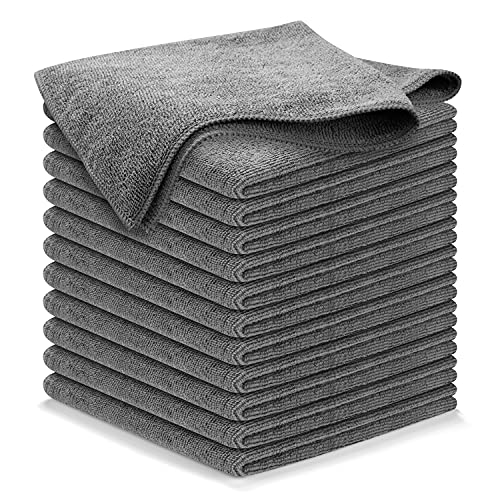
USANOOKS Microfiber Cleaning Cloth, Grey, 12 Pcs — Best Overall
The USANOOKS pack is the best single answer to “just tell me which cleaning cloths to buy.” The cloths are 12.5″ x 12.5″, a true all-purpose square that folds into quarters for a padded hand feel, in a single practical grey that does not show the stains a cleaning cloth honorably earns. The listing describes a high-performance microfiber weave for grime and liquid, aimed at streak-free results on mirrors and glass as well as general surfaces, and states a lifespan of up to 1200 washes, the strongest durability claim in this roundup, reported here as the maker’s figure.
Strengths
- True all-purpose size and a single stain-hiding color for a unified kit
- Stated lifespan of up to 1200 washes, the roundup’s strongest durability claim
- Positioned for both grime pickup and streak-free glass work, reducing the need for separate cloth types
Trade-offs
- One color only, so room color-coding requires a second pack from another line
- 12.5″ square is a hand cloth; floor and big drying jobs want the larger picks below
- The 1200-wash figure is the listing’s claim under its conditions; hot water and fabric softener will shorten any microfiber’s life
Key specs (from the verified listing): brand USANOOKS; microfiber; 12 pcs; 12.5″ x 12.5″; Grey; stated up to 1200 washes.
Buy this pack as the core of a cleaning caddy: six cloths in rotation for the kitchen and living areas, four for bathrooms, two kept pristine for glass. Grey is an underrated virtue in a cleaning cloth; a white cloth that greys with use looks dirty after every wash, while a grey cloth simply looks like what it is, a tool.
Best for: most homes wanting one quality all-purpose microfiber pack. / Not suited for: households needing color-coding from a single pack or oversized cloths.
Check the current price on Amazon

Amazon Basics Microfiber Cleaning Cloths, Pack of 24 — Best Value Staple
The Amazon Basics cloths are the dependable staple: 24 cloths at 16″ x 12″, a noticeably larger hand format than the standard 12-inch square, described as ultra absorbent, lint free, streak free, non-abrasive, reusable, and washable, in a blue, white, and yellow mix that quietly enables the color-coding a single-color pack cannot. Twenty-four cloths is the right household number for a weekly laundry rhythm: enough that you never reach for a paper towel out of desperation, few enough that the drawer still closes.
Strengths
- Larger 16″ x 12″ format covers more surface per wipe and folds into a thick pad
- Three colors included, enabling kitchen/bathroom/glass separation from one pack
- 24 count matches a realistic weekly wash cycle
Trade-offs
- A value line; edge stitching and ultimate lifespan trail the premium picks
- Too large for fiddly jobs like faucet detailing, where the smaller squares excel
- Colors are fixed by the pack; you cannot choose your own coding scheme
Key specs (from the verified listing): brand Amazon Basics; microfiber; pack of 24; 16″ x 12″; Blue/White/Yellow.
This is the pack to buy when setting up a home from scratch, a rental, a dorm, a first apartment, because it establishes the whole system, including color discipline, in one inexpensive decision. Households that already own cloths but lack a coding system can also use it as the reset: retire the mystery rags, start clean.
Best for: new households and anyone wanting size plus color-coding at a value tier. / Not suited for: buyers wanting premium durability claims or extra-large floor cloths.
Check the current price on Amazon

MR.SIGA Microfiber Cleaning Cloths, 12 Pack — Best for Glass and Kitchen
MR.SIGA has built its name on cleaning tools rather than general merchandise, and its cloths show it: the listing describes streak-free, ultra absorbent, high-density microfiber towels, color coded, positioned for kitchen, car, glass, and household surfaces. High density is the operative phrase for glass work; a denser weave leaves fewer stray fibers and less haze on mirrors and windows, which is why this pack, rather than a plusher one, gets the glass-and-kitchen slot.
Strengths
- High-density, streak-free positioning aimed squarely at glass and glossy surfaces
- Color-coded cloths support room-by-room hygiene discipline
- From a cleaning-tools specialist brand
Trade-offs
- 12 pack is a specialist set; whole-home volume needs a second pack
- Density that excels on glass is less plush for heavy spill absorption than looser weaves
- Listing title does not state dimensions; confirm the size on the product page before ordering
Key specs (from the verified listing): brand MR.SIGA; microfiber; 12 pack; streak-free, high-density; color coded; size not stated in title (check product page).
Keep the MR.SIGA cloths as your finishing team: the final wipe on the bathroom mirror, the stovetop polish, the window pass after the all-purpose cloth has done the heavy lifting. Two-cloth glass method, one damp to clean, one dry to buff, is where this pack earns its keep every single week.
Best for: glass, mirrors, stainless, and kitchen finishing work. / Not suited for: bulk buyers or floor-scale jobs.
Check the current price on Amazon

Utopia Kitchen White Flour Sack Towels, 12 Pack — Best Cotton
Every microfiber-heavy kit still needs its cotton champion, and the flour sack towel is it. These are 100% cotton, 28″ x 28″, highly absorbent, and sold as a 12-pack for cleaning and drying. The flour sack weave is thin, smooth, and nearly lint-free, which is why it remains the professional choice for drying glassware without spots, wiping down counters after the microfiber has cleaned them, and the hundred kitchen tasks where a plush cloth is clumsy: handling hot lids with a folded pad, straining, covering rising dough, and drying a cast-iron pan you do not want to leave damp.
Strengths
- Large 28″ x 28″ format drapes over a shoulder, a rack, or a whole sink of dishes
- 100% cotton, smooth weave, minimal lint for glassware and drying
- Tolerates hot washing and bleach in a way microfiber never will
Trade-offs
- Thin weave saturates faster than microfiber on big spills; it is a dryer, not a mop
- White shows stains; these will look like working towels quickly, because they are
- Not the dusting choice; cotton does not grip dust the way split microfiber does
Key specs (from the verified listing): brand Utopia Kitchen; 100% cotton flour sack; 12 pack; 28″ x 28″; White.
A note for households that bake, embroider, or host: the same qualities that make flour sacks the best drying towel make them the craft and kitchen-linen staple, and the 12-pack size means you can dedicate a few to non-cleaning duty without raiding the cleaning stock. When a flour sack finally wears thin after years of hot washes, it retires gracefully to garage duty, the fullest life cycle of any towel in this guide.
Best for: drying, glassware, and all cotton-only kitchen tasks. / Not suited for: dusting or maximum-absorbency spill duty.
Check the current price on Amazon

CODOHI Extra Large Microfiber Cleaning Cloth, 6 Pcs — Best Extra-Large
At 20″ x 30″, the CODOHI cloths are a different tool from everything above: floor-scale microfiber, sold as a 6-pack of washable, reusable cloths positioned for mopping, office and bathroom cleaning, and housekeeping. An extra-large cloth wraps a flat mop head, covers a bathroom floor by hand in a few passes, dries a shower surround in one sweep, and turns the dreaded baseboard job into a single walk down the hallway. This listing was verified in an earlier pass of this program’s catalog work and is included from that confirmed record.
Strengths
- 20″ x 30″ size does floor and large-surface work the hand cloths cannot
- Doubles as a mop wrap and a drying cloth for showers and tubs
- Washable and reusable, sized for housekeeping-scale routines
Trade-offs
- Too large for mirrors, faucets, and detail work; it is a specialist
- Six cloths is a working set, not a stockpile; heavy floor routines may want two packs
- Large cloths take more laundry space and drying time
Key specs (from the verified listing): brand CODOHI; microfiber; 6 pcs; 20″ x 30″; washable and reusable; Orange and Green colors on this listing.
If your home has hard floors throughout, this pack plus a spray bottle replaces most disposable mop pads and paper-towel floor habits. It is also the pick for move-in and move-out cleans, spring cleaning, and any household with a member who cleans bathrooms on hands and knees and wants one cloth to do the whole floor.
Best for: hard floors, bathrooms, and housekeeping-scale cleaning. / Not suited for: glass, mirrors, or detail work.
Check the current price on Amazon

HOMERHYME Microfiber Cleaning Cloth, 100 Pack — Best Bulk
Sometimes the correct number of cleaning cloths is one hundred. The HOMERHYME bulk pack offers 100 microfiber cloths at 11.5″ x 11.5″, described as absorbent and lint-free, positioned for cars, automotive and garage work, and home and kitchen use. Bulk changes the psychology of cleaning: when cloths are effectively unlimited, you use a fresh one per job, retire the truly foul ones without regret, keep dedicated sets in the garage, the car kit, and every bathroom, and stop rationing the good cloths for guests.
Strengths
- 100 count ends cloth scarcity across home, garage, and car
- Smaller 11.5″ size suits quick wipe-downs and disposable-adjacent duty
- One purchase stocks rentals, workshops, and multi-bathroom homes
Trade-offs
- Bulk cloths are thinner than premium packs; they are a volume tool, not a luxury one
- Storage: a hundred cloths need a bin, a shelf, or a plan
- Single smaller size; pair with a large-format pack for floors and drying
Key specs (from the verified listing): brand HOMERHYME; microfiber; 100 pack; 11.5″ x 11.5″; all-purpose positioning.
Buy the bulk pack if you manage a rental property, run a home with many bathrooms and many people, detail cars, or simply know that your household’s cleaning improves when the right tool is always within reach. Pair it with the USANOOKS or MR.SIGA as the quality core and the CODOHI for floors, and you own the complete system this guide describes.
Best for: big households, rentals, garages, and fresh-cloth-per-job cleaners. / Not suited for: minimalists or anyone wanting one premium dozen only.
Check the current price on Amazon
Comparison Table
| Pick | Badge | Key spec | Best for |
|---|---|---|---|
| USANOOKS Microfiber, 12 Pcs | Best Overall | 12.5″ x 12.5″, stated up to 1200 washes | All-purpose home cleaning core |
| Amazon Basics Microfiber, 24 Pack | Best Value Staple | 16″ x 12″, three colors | New households, color-coding |
| MR.SIGA Microfiber, 12 Pack | Best for Glass and Kitchen | High-density, streak-free, color coded | Mirrors, glass, stainless |
| Utopia Kitchen Flour Sack, 12 Pack | Best Cotton | 100% cotton, 28″ x 28″ | Drying and glassware |
| CODOHI Microfiber, 6 Pcs | Best Extra-Large | 20″ x 30″ | Floors and bathrooms |
| HOMERHYME Microfiber, 100 Pack | Best Bulk | 11.5″ x 11.5″, 100 count | Rentals, garages, big homes |
How to Build a Home Cleaning Towel System That Actually Works
Build by job, not by pack. Assign each room a color or a pack, and never let cloths migrate: bathroom cloths stay in bathrooms, kitchen cloths stay in kitchens, and glass cloths are kept clean enough to deserve the name. The Amazon Basics three-color pack and the color-coded MR.SIGA set exist to make this effortless. Keep three quality tiers in the house: the good microfiber for glass and finishing, the workhorse microfiber for daily surfaces, and the cotton flour sacks for drying; demote tired cloths downward through the tiers (glass to surfaces, surfaces to floors, floors to the garage) instead of throwing them out at the first sign of age, and a pack’s real lifespan doubles.
Size your stock to your laundry rhythm. A cloth system fails when the clean drawer empties mid-week and paper towels creep back in. Count your weekly cloth usage honestly for one week, then own twice that number, so one load is always in reserve. Store by station, not centrally: a small stack in each bathroom, the core set in the kitchen, the big CODOHI cloths with the mop. Finally, protect the investment in the wash, because microfiber is ruined in the laundry more often than in service: wash microfiber separately from cotton (cotton lint coats the split fibers and kills absorbency), skip fabric softener entirely (it waterproofs the fibers), use warm rather than very hot water, and tumble dry low or air dry. Cotton flour sacks, by contrast, want the opposite life: hot water, bleach when needed, no special handling, which is one more reason the two materials complement each other in a complete system.
How to Wash and Rotate Cleaning Towels: A Simple Weekly Routine
Daily, hang used cloths to dry over a rack or rod rather than balling them in a hamper; a damp microfiber left in a ball mildews and holds odor that survives washing. Collect the week’s cloths into one dedicated load. Sort loosely: microfiber together, cotton flour sacks with the regular hot wash. Wash microfiber warm with a plain detergent, no softener, no bleach; add a rinse cycle if your machine offers one, because detergent residue is the hidden cause of streaking on glass. Dry low or hang. While that load runs, the reserve set covers the house, which is why the stock math in the previous section matters. Inspect as you fold: cloths that have gone stiff, thin, or permanently stained move down a tier, and glass cloths that have started leaving lint retire to surface duty. Once a month, give the hardest-working kitchen cloths a deep clean soak before washing, and replace the flour sacks that have worn to transparency. The whole routine takes minutes, and it is the difference between a towel system that performs for years and a drawer of grey disappointments.
Common Buying Mistakes
The first mistake is buying one giant pack of identical small cloths and calling it a system; you end up with no drying towel, no floor cloth, and no color discipline. The second is washing microfiber with cotton towels and fabric softener, then concluding microfiber does not work. The third is using the same cloth for the toilet and, later, the kitchen counter because the pack had no colors to stop you. The fourth is judging towels by softness in the hand; a cleaning towel is a tool, and the plushest cloth is often the worst on glass. The fifth is ignoring dimensions: a listing that will not state its size is telling you something. The sixth is keeping cloths until they are rags and then wondering why cleaning feels ineffective; rotate tiers and retire on schedule.
Final Recommendation
Start with the core: the USANOOKS 12-pack for all-purpose work, the Utopia flour sacks for drying, and add the MR.SIGA set when glass and stainless start streaking, the CODOHI when floors enter the routine, and the HOMERHYME hundred when the household outgrows dozens. Budget-constrained households can begin with the Amazon Basics 24-pack alone and build from there. For the larger end of this category, see our guide to the Best Large Cleaning Towels, and for the rest of the towel closet, Best Bang For Buck Dish Towels and Best Bar Towels For Drying Glassware cover the kitchen-specific branches.
Microfiber, Decoded: Weave, Density, and Why Price Varies
Microfiber is not one material but a family, and the differences explain why one pack costs what three of another cost. The fiber itself is a split blend of polyester and polyamide; splitting creates the star-shaped cross-section that traps dust and absorbs liquid into the fiber’s structure rather than pushing it around. Density, often expressed as GSM (grams per square meter), decides plushness and absorbency per cloth: denser cloths hold more liquid and feel more substantial, while lighter cloths dry faster and leave less lint, which is why the glass specialists in this guide, like the high-density MR.SIGA, are woven tight rather than fluffy. Weave decides the job: a terry weave is the all-purpose worker, a waffle weave sheds water and suits drying, and a tight flat weave is the glass finisher. Edges decide lifespan: stitched, serged edges survive hundreds of washes, while the cheapest laser-cut bulk cloths, the HOMERHYME’s tier, trade edge longevity for count, a fair trade when the whole point is volume. None of these numbers appears reliably in listing titles, which is why this guide’s spec boxes report what the listings state and the product page deserves your two minutes for the rest. The buying rule that emerges is simple: pay for density and edges in the cloths you will wash five hundred times, and pay for count in the cloths you will use hard and retire without grief.
The Right Towel for Each Job: A Room-by-Room Playbook
In the kitchen, run a three-towel rotation: a workhorse microfiber for counters and spills, a flour sack for drying and hands, and a dedicated glass-grade cloth for the final pass on the stovetop and appliance fronts; replace the counter cloth daily, because a kitchen cloth used past its day becomes a distribution system for everything it wiped. In the bathroom, color discipline is the whole game: one color touches only sanitary fixtures, another only mirrors and counters, and neither ever travels, which the color-coded packs in this guide make automatic. Mirrors get the two-cloth method, damp to clean, dry to buff, with the MR.SIGA or the USANOOKS kept pristine for the role. For dusting living areas, microfiber used dry outperforms any spray-and-paper routine, because the split fibers hold dust instead of relocating it; shake cloths outside and wash when they stop grabbing. For cars, dedicate a set that never returns to the house: the HOMERHYME bulk cloths for interiors and wheels, a quality microfiber for paint-adjacent work. For pet households, keep a large cloth, the CODOHI’s size, by the door for paws and a sacrificial set for accidents that you will not mourn retiring. The playbook is not fussiness; it is how a modest stock of towels outperforms a mountain of paper towels at every job in the house. Shoppers building out the rest of the laundry shelf can compare our Best Bargain Towels coverage for the value end of adjacent categories.
Paper Towels vs Reusable Cloths: The Honest Comparison
Reusable cloths win most comparisons, but not all, and a trustworthy guide says where. Cloths win on cost per use by an enormous margin over any realistic timeframe, on absorbency per wipe, on dusting, on glass, and on waste. They win on cleaning quality too, because a cloth can be folded into a padded pad, rinsed, and reused within the same job, while a paper towel disintegrates at the exact moment the job gets serious. Paper towels keep three legitimate crowns: truly hazardous messes you want out of the house immediately, grease disposal where a cloth would carry the problem into your laundry, and situations with no laundry access at all. The mature household system is therefore not cloth-purist; it is cloth-first with a roll of paper towels kept for its three honest jobs, and it is striking how long that roll lasts once cloths handle everything else. The picks in this guide were chosen to make the cloth-first system easy enough that it sustains itself: enough cloths that a clean one is always at hand, the right sizes for the jobs that used to default to paper, and cotton flour sacks for the hot, bleachy work that microfiber should not do. Sustainability here is not a slogan; it is a drawer that is properly stocked.
Troubleshooting: When Good Towels Go Bad
Most towel complaints trace to a handful of fixable causes, and this guide’s care sections exist because of them. Problem: microfiber that pushes water around instead of absorbing it. Cause: almost always fabric softener or dryer-sheet residue waterproofing the split fibers, or a load washed with cotton that coated the fibers in lint. Fix: rewash the microfiber alone, warm, with a plain detergent and an extra rinse, and dry without softener products; one corrective wash recovers most cloths, two recover nearly all. Problem: streaks on glass from a cloth that used to be flawless. Cause: detergent buildup or the cloth’s quiet demotion-worthy wear. Fix: the corrective wash first; if streaks persist, the cloth has graduated to surface duty and a fresh cloth takes the glass role, which is a rotation, not a failure. Problem: sour-smelling cloths straight from the drawer. Cause: cloths stored damp or a hamper that kept them wet for days. Fix: hang cloths to dry before they enter any hamper, wash the smelly set hot (cotton) or warm with a thorough rinse (microfiber), and dry completely before folding. Problem: cotton flour sacks that stopped absorbing. Cause: usually softener again, or a hard-water film; a hot wash without softener restores them, and their tolerance for exactly that treatment is why they anchor the cotton side of this system. Problem: cloths shedding lint on everything. Cause: new budget cloths in their first washes, or a cloth disintegrating at end of life. Fix: wash new cloths separately twice before service, and retire shedders to the garage tier. Every one of these problems masquerades as “bad towels” in reviews; nearly all of them are laundry, not product.
Stocking Specific Households: Rentals, Big Families, and Minimalists
The right stock depends on the household’s shape, and the six picks recombine cleanly for each. A rental or Airbnb host should think like a hotelier: the HOMERHYME hundred for turnover volume, flour sacks for the kitchen because they bleach back to white between guests, and the CODOHI set for bathroom floors, with color discipline protecting the property’s hygiene story in reviews. A big family should build around the Amazon Basics 24 as the daily core, the USANOOKS as the glass-and-good set that children learn to respect, and a bulk pack in reserve, because family laundry is a river and the system fails only when the clean drawer runs dry mid-week. A minimalist should buy the fewest, best cloths: one USANOOKS dozen, one flour sack dozen, and nothing else, washed often and rotated through the tier system until each cloth has genuinely earned retirement; minimalism in towels is not owning three cloths, it is owning exactly the system and no clutter beyond it. A household with a member who cleans professionally, or simply cleans like it, will appreciate the MR.SIGA’s specialist density and should be given the dignity of dedicated tools rather than the family’s leftovers. In every case the pattern is the same: a quality core, a cotton drying set, sizes matched to the home’s surfaces, and numbers matched to the laundry rhythm. Get those four decisions right and the specific brands almost choose themselves, which is the quiet thesis of this entire guide.
Setting Up a Cleaning Caddy: The Towels in Their Working Home
Towels perform in a system, and the caddy is where the system lives. Build one caddy per floor, or one for the whole home in a small apartment, and stock it by job rather than by product: two workhorse microfiber cloths folded in quarters, one glass cloth kept in a separate pocket or on top where it stays cleanest, one flour sack for drying and for the jobs that need a cloth you can boil later, and, for bathrooms, the color-coded pair that never leaves that room’s caddy. Add the sprays your household actually uses, a small brush for grout and faucets, and gloves, and the caddy becomes a complete argument against the under-sink sprawl that makes cleaning feel like a scavenger hunt. The large CODOHI cloths live with the mop rather than the caddy, and the bulk HOMERHYME stock lives in a labeled bin that refills every caddy, which is the entire logistics of a well-run towel household: stations stocked, reserve centralized, dirty cloths collected to one laundry point. Refill and audit monthly: count what each station actually consumed, notice which cloths are being avoided (usually the ones that have quietly failed and should be demoted), and replace from the reserve before a station runs dry and paper towels sneak back into jobs they had lost. Households that run this small system consistently report the same surprise: cleaning gets faster not because anyone tries harder, but because the right towel is always in the hand that reaches for it.
The caddy also protects your best cloths from your worst habits. Glass cloths stored loose in a general drawer pick up lint, grease, and mystery residue, and then streak, and then get blamed. A pocket of their own, a labeled shelf, or even a simple zip bag in the caddy keeps the finishing tools at finishing standard. It takes one minute to organize and saves the recurring purchase of replacement glass cloths that were never actually worn out, only contaminated, which is the most common towel expense in otherwise careful homes.
The Environmental Ledger, Kept Honestly
Reusable cleaning towels are usually sold with a green halo, and the honest ledger is more interesting than the halo. On the credit side: a single quality microfiber cloth replaces hundreds of paper towels across its life, the cloth system’s waste is a trickle compared with a paper habit’s weekly bag, and cotton flour sacks at end of life are biodegradable and endlessly demotable to garage and garden duty before that. On the debit side, and a trustworthy guide keeps debits visible: microfiber is a synthetic, it sheds microfibers in washing like all synthetics, and its production is petrochemical; laundering any reusable system costs water and energy that paper towels spend at the factory instead of your home. The balanced conclusion most households land on is the system this guide already recommends for performance reasons: cloth-first, with microfiber reserved for the jobs where it is decisively better and washed carefully to extend its life, cotton carrying the hot and heavy work, and paper kept for its three honest jobs. Longevity is the environmental variable you control most: a cloth washed correctly and rotated through the tiers serves years, and every additional year divides its footprint further. Buy the system once, maintain it with the routines in this guide, and the ledger, environmental and financial alike, comes out clearly ahead without needing a single slogan.
How Many Towels, Revisited: A Counting Exercise for Your Own Home
Abstract stock advice becomes useful when it is counted against a real week, so run this exercise before ordering. For seven days, every time you reach for a cleaning cloth or towel, note the job and the room in your phone or on paper; most households are surprised twice, first by how many reaches happen (thirty to sixty in a family home is normal), and second by how concentrated they are, with the kitchen taking half and one bathroom taking most of the rest. Now sort the notes by the jobs in this guide: surface wiping, glass finishing, drying, floor work, and the sacrificial jobs. The counts in each row are your minimum weekly stock for that role, and doubling them, one set in use, one in reserve or laundry, gives the purchase quantities that will actually sustain the system. Compare the result with the packs here: a typical family count lands almost exactly on one all-purpose dozen, one specialist dozen, one cotton dozen, and a large-format set, which is why the picks are sized as they are. A single-person household’s count will land at half that, and a rental portfolio’s at ten times it, and both are correct answers to the same exercise. The households that fail at cloth systems are never the ones with the wrong brands; they are the ones that bought a guess instead of a count and ran dry every Wednesday. Count first, buy once, and let the laundry rhythm, not hope, size your shelves.
A Note on Variants, Colors, and Pack Sizes
Several picks in this guide are sold in multiple colors and pack configurations beyond the exact listing verified here, and choosing among them is safe when you keep two checks in mind. First, confirm the dimensions and count of the variant in your cart, because towel listings commonly group several sizes under one page and the headline photograph may show a different size from the one selected; the spec boxes in this guide record the verified configuration for each pick, and that is the configuration the review describes. Second, when a color choice changes the product’s role in your system, a grey all-purpose cloth becoming a white one, say, reconsider the assignment rather than assuming equivalence, because color in a cleaning system is information, not decoration. Bought with those two checks, variants are a feature: they let the same verified product fit different rooms, color schemes, and stock levels without leaving the ground this guide has already verified for you.
Start this week rather than someday: the counting exercise takes no equipment, the first core pack replaces a month of paper towels on its own, and every routine in this guide, the caddy, the tiers, the laundry rules, can be adopted one habit at a time as the cloths arrive. A towel system is built by accumulation, not by overhaul, and the households that succeed at it are simply the ones that begin.
Keep the system boring and it will keep the house clean: same stations, same colors, same laundry rhythm, week after week, with the towels quietly doing the work that paper never could.
The drawer, stocked and sorted, is the whole secret: everything else in this guide is commentary on that one quiet fact of household life.
Clean cloths, within reach, every day: that is the entire promise, and it is enough.
Frequently Asked Questions
Is microfiber or cotton better for home cleaning?
They win different jobs. Microfiber grips dust, absorbs more liquid for its weight, and leaves glass cleaner, so it owns most surface cleaning. Cotton flour sacks dry better, tolerate bleach and hot water, and are nearly lint-free on glassware. A complete home system, like the one in this guide, owns both.
Why do my microfiber cloths leave streaks?
Usually detergent residue, fabric softener buildup, or lint contamination from being washed with cotton. Wash microfiber separately, skip softener, add an extra rinse, and keep two or three cloths dedicated to glass only. Streaking that survives that routine means the cloth has reached the end of its glass career; demote it to general surfaces.
How many cleaning towels does a home need?
Enough for two weeks of your real routine: one week in use, one in reserve or in the wash. For most homes that means a core dozen all-purpose cloths, a set of drying towels, and specialists as needed; large households and rental managers should think in the bulk pack’s terms.
Can I bleach microfiber cleaning cloths?
No. Bleach and very hot water degrade microfiber’s split fibers and shorten its life sharply. That is one reason the cotton flour sacks earn their place: they take the bleach-and-boil jobs, like kitchen sanitation, that microfiber should never be asked to do.
What size cleaning towel is best?
Match size to job: 11.5″ to 12.5″ squares for hand cleaning and detail work, 16″ x 12″ for larger hand coverage, 28″ cotton squares for drying, and 20″ x 30″ for floors and big surfaces. This guide includes one pick at each of those sizes deliberately.
How long do microfiber cleaning cloths last?
It depends on care more than brand. The USANOOKS listing states up to 1200 washes under its conditions; real-world life is set by your laundry habits. Washed separately, without softener, and rotated through the tier system in this guide, quality microfiber serves for years rather than months.


