Disclosure: airfryerkitchensupply.com is reader-supported. When you buy through links on our site, we may earn an affiliate commission at no extra cost to you.
Where to buy
The fastest way to buy any pick in this guide to the best hepa filter room air purifiers is Amazon, where stock, filter bundles and delivery options are shown on the product page itself. Use the links below to check the current price on Amazon for each model:
- LEVOIT Core 300S-P Smart Air Purifier (Best Overall): Check on Amazon
- WINIX 5510 Air Purifier (Best for Large Rooms): Check on Amazon
- COWAY Mighty AP-1512HH Air Purifier (Best Proven, Set-and-Forget Design): Check on Amazon
- Levoit Core 200S-P Air Purifier (Best Budget for Small Rooms): Check on Amazon
- BLUEAIR Blue 311i Max Air Purifier (Best Quiet Performer): Check on Amazon
- Medify MA-40 Air Purifier (Best for Smoke and Odour Days): Check on Amazon
If you are shopping for the best hepa filter room air purifiers, the first thing to understand is that “HEPA” on a box can mean two very different things. A true HEPA filter is a dense pleated filter rated to trap very fine particles such as dust, pollen and pet dander as air passes through it. A “HEPA-type” or “HEPA-style” filter looks similar but is not built or tested to the same standard. Every pick in this guide uses a genuine HEPA-grade filter stage (or, in one clearly flagged case, a proprietary electrostatic-HEPA hybrid), is sized honestly for a real room, and has replacement filters that are easy to buy.
This guide is about everyday air quality and comfort: less visible dust settling on furniture, a fresher-smelling bedroom, and air that feels cleaner during pollen season or wildfire smoke days. An air purifier is not a medical device and this guide makes no medical claims. What a good purifier does do, measurably, is move a room’s air through a fine filter several times an hour — and the six models below are the ones that do that job with the least noise, cost and fuss for different room sizes and priorities.
In this guide
Quick Picks
LEVOIT Core 300S-P Smart Air Purifier — Best Overall. A compact smart purifier with a genuine HEPA filter, a very quiet sleep mode and app control — the easiest recommendation for a bedroom or home office. Check on Amazon
WINIX 5510 Air Purifier — Best for Large Rooms. The current generation of a long-running large-room design, with true HEPA filtration, a serious carbon filter for odours and app support. Check on Amazon
COWAY Mighty AP-1512HH Air Purifier — Best Proven, Set-and-Forget Design. A long-established mid-size purifier with an air quality monitor, auto and eco modes, and a four-stage filter system that just gets on with the job. Check on Amazon
Levoit Core 200S-P Air Purifier — Best Budget for Small Rooms. A smaller, cheaper smart purifier for dorms, nurseries and small bedrooms, with the same app ecosystem as its bigger sibling. Check on Amazon
BLUEAIR Blue 311i Max Air Purifier — Best Quiet Performer. A fast, very quiet purifier using Blueair’s HEPASilent hybrid filtration — extremely effective on particles, with one honest caveat about the technology explained in the review. Check on Amazon
Medify MA-40 Air Purifier — Best for Smoke and Odour Days. A workhorse purifier with a HEPA filter and strong coverage, aimed squarely at smoke, wildfire and heavy-odour situations. Check on Amazon
How These Picks Were Chosen
Each candidate was checked against the airfry site’s own Amazon record so that the model name and listing title match a real, currently sold product. We then filtered the list on five practical criteria. First, filtration: a true HEPA stage (H13 or equivalent) or a clearly described hybrid system, plus a pre-filter for large particles and, on most picks, activated carbon for odours. Second, honest sizing: we used the manufacturer’s one-hour room coverage as an upper bound and recommend the model for rooms comfortably below that figure, because purifiers clean fastest on their loudest setting and you will live with them on medium or low. Third, noise: a usable sleep or quiet mode matters more than a headline turbo number. Fourth, running cost: replacement filter price and lifespan, and whether the unit nags you with a filter-life indicator. Fifth, controls you will actually use — auto mode with a particle sensor, a timer, and app control where it genuinely helps. Models that failed on filter availability or honest sizing were cut, however good their marketing looked.
The 6 Best HEPA Filter Room Air Purifiers
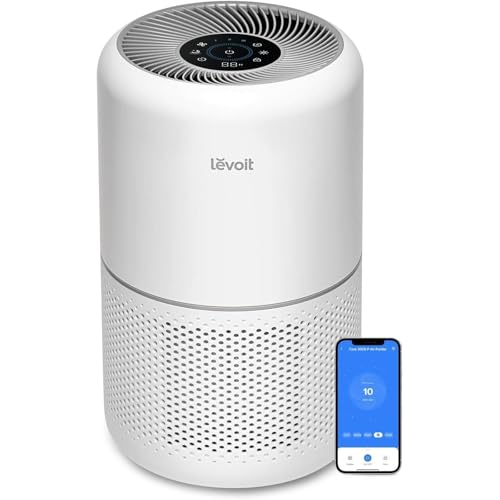
LEVOIT Core 300S-P Smart Air Purifier — Best Overall
The Core 300S-P is the purifier we would hand to most people without a long conversation. It is a compact cylinder that disappears into a bedroom corner, yet its 3-in-1 filter — pre-filter, HEPA stage and activated carbon — handles the everyday mix of dust, pollen and pet hair that makes rooms feel stale. The smart features are the ones you will actually use: it connects to WiFi for app and voice control, and its sleep mode dims the display and drops the fan to a level most people can sleep through.
In daily use the pattern is simple. Run it on auto or medium during the day, let the sleep mode take over at night, and vacuum the pre-filter every few weeks so the HEPA stage is not wasting its life on lint. Pet owners in particular notice the difference on soft furnishings, because the pre-filter catches a surprising amount of hair before it reaches the main filter. It is a single-room machine, though: in a big open-plan living area it will still help, but it will not cycle the whole volume quickly, and that is what the larger picks below are for.
A month into ownership, the pattern that emerges is how little you interact with it. The app fades into the background, the sleep mode becomes automatic at bedtime, and the only recurring task is vacuuming the pre-filter when you do the bedroom anyway. That invisibility is the product working as intended — the Core 300S-P is best understood as the purifier for people who want cleaner air without a new hobby, and its compact footprint means it survives room rearrangements that exile bulkier machines to the garage.
Strengths
- Genuine HEPA filter in a compact, quiet body
- Sleep mode is properly quiet with the display off
- App control and AHAM-verified performance claims
Trade-offs
- Single-room coverage; not a whole-flat solution
- Replacement filters are proprietary to Levoit
- Carbon layer is light, so strong odours need the bigger picks
| Filter | 3-in-1 filter with HEPA stage |
| Control | App and voice control, auto/sleep modes |
| Positioning | Bedroom and pet-hair duty |
Best for: Bedrooms and offices up to a medium size / Not suited for: Very large open-plan spaces on its own
Check on Amazon — check the current price on Amazon before you decide, because filter bundle offers change often.

WINIX 5510 Air Purifier — Best for Large Rooms
The WINIX 5510 succeeds one of the most widely owned large-room purifiers ever sold, and it keeps the formula that made the earlier model popular: a true HEPA filter paired with an unusually substantial activated carbon stage. That carbon matters if your air-quality problem is smells as much as particles — cooking odours, a wood stove, a litter tray in the corner. Most slim purifiers carry a token carbon sheet; this one carries enough to make a real dent in household odours between filter changes.
It is a floor-standing tower-sized unit and it looks like one, so measure your corner before ordering. In return you get the air changes per hour that a large living room actually needs, an air quality monitor that reacts visibly when you fry food or open a door on a high-pollen day, and app support for schedules. On turbo it is loud, as all big purifiers are; on the middle speeds it settles into background. For a main living space, this is the pick that avoids the classic mistake of buying a bedroom unit for a lounge.
Long-term owners of this WINIX lineage will recognise the ownership rhythm: filters on a predictable cycle, a machine that simply continues. The 5510’s monitor earns its place during real events — frying, sanding in the next room, a high-pollen evening with the windows open — when you can watch it respond and then settle. It is the pick in this guide most likely to still be running, unremarked, in five years, in the corner of the room where the air problem actually lives.
Strengths
- True HEPA plus a genuinely useful carbon stage for odours
- Sized honestly for large rooms and open-plan areas
- Air quality monitor and app support for set-and-forget running
Trade-offs
- Big footprint compared with bedroom purifiers
- Turbo speed is too loud for conversation
- Replacement filter sets are a real annual cost
| Filter | True HEPA plus high-deodorisation carbon |
| Coverage | Large room, up to 1,881 sq ft in 1 hour (manufacturer figure) |
| Control | App support, air quality monitor |
Best for: Large living rooms and open-plan spaces / Not suited for: Small bedrooms where its size is overkill
Check on Amazon — check the current price on Amazon before you decide, because filter bundle offers change often.

COWAY Mighty AP-1512HH Air Purifier — Best Proven, Set-and-Forget Design
The Coway Mighty has been on sale, largely unchanged, for years — and in purifiers that is a compliment, because it means filters stay available and the design’s quirks are well understood. Its four-stage system combines a washable pre-filter, an odour carbon filter, a true HEPA filter and an optional ioniser stage you can switch off if you prefer filtration only. The pollution sensor shows air quality as a simple colour readout, and auto mode ramps the fan up when the air gets dirty and down again when it clears.
The eco mode is the feature owners end up loving: when the air stays clean for a sustained period the fan stops entirely and restarts when the sensor sees particles again, which saves both electricity and filter life. It is not a smart purifier — there is no app — and the design is functional rather than decorative. But as a machine you place in a living room or big bedroom and then ignore for months at a time, very few models at any price are easier to live with.
What surprises Mighty owners is the eco mode’s effect on filter life and electricity: because the fan rests whenever the air is already clean, the machine spends much of its life doing nothing at almost no cost, then works when it matters. In a living room that hosts cooking smells and a dog, the sensor’s colour changes become a small household weather report. It rewards owners who place it well and then genuinely forget it — the highest compliment a purifier can earn.
Strengths
- Auto and eco modes make it genuinely hands-off
- Four-stage filtration with a washable pre-filter
- Long production run means filters are easy to source
Trade-offs
- No app or voice control
- Styling is plain, office-like
- Ioniser stage is optional and some buyers will leave it off permanently
| Filter | Pre-filter, carbon, HEPA and ioniser stage |
| Coverage | Up to 1,748 sq ft in 1 hour (manufacturer figure) |
| Modes | Auto, eco, turbo |
Best for: Living rooms and large bedrooms, hands-off use / Not suited for: Buyers who want app control and smart-home links
Check on Amazon — check the current price on Amazon before you decide, because filter bundle offers change often.

Levoit Core 200S-P Air Purifier — Best Budget for Small Rooms
Not every room needs a big purifier. For a dorm room, a nursery or a small spare bedroom, the Core 200S-P delivers the same basic formula as the 300S-P — a 3-in-1 filter with a genuine HEPA stage, a quiet sleep mode and full app control — in a smaller body at a lower tier. It sits happily on a dresser or the floor by the bed and is light enough to move between rooms as needed.
The honest limitation is air volume. In a small room it cycles the air quickly and the effect on dust and stuffiness is clear; in a family living room it would run flat out and still fall behind. Buy it for the room it is sized for and it is one of the best-value purifiers in this guide. The app scheduling is genuinely useful in a nursery or dorm, where you can have it run harder before bedtime and whisper overnight.
In a student room or a first flat, the 200S-P’s size becomes its story: it fits where nothing else in this guide fits, moves when you move, and its running costs match a small-room life. Owners typically run it on a schedule — harder before bed, sleep mode overnight — and report the room simply feeling fresher in the morning. It is a starter purifier in the best sense: honest about its volume, generous with features, and easy to hand on when you graduate to a bigger space.
Strengths
- Lowest-cost way into a genuine HEPA smart purifier here
- Compact and light enough to move room to room
- Sleep mode and app scheduling suit nurseries and dorms
Trade-offs
- Only suitable for small rooms
- Smaller filter means changes come sooner under heavy use
- No onboard air quality display readout like larger models
| Filter | 3-in-1 filter with HEPA stage |
| Control | App and voice control, sleep mode |
| Positioning | Small-room and desk-side duty |
Best for: Dorm rooms, nurseries and small bedrooms / Not suited for: Rooms much beyond a small bedroom
Check on Amazon — check the current price on Amazon before you decide, because filter bundle offers change often.

BLUEAIR Blue 311i Max Air Purifier — Best Quiet Performer
The Blue 311i Max is here with an honest label: its HEPASilent system is not a purely mechanical true HEPA filter. It combines electrostatic charging with a mechanical filter, which lets it move a lot of air through a less dense filter — and that is exactly why it is so quiet and fast for its size. On particle capture it performs at a level comparable with true HEPA units in independent-style testing regimes, and it is AHAM verified, but if your requirement is a traditional sealed HEPA filter and nothing else, choose the WINIX or Coway above instead.
For everyone else, the appeal is real. It cleans a large bedroom quickly, runs very quietly doing it, and the fabric pre-filter can be vacuumed or washed and comes in colours that look less like medical equipment. Auto mode with a particle sensor, WiFi control and a clean, simple interface round out a machine that suits design-conscious bedrooms and nurseries where noise is the deal-breaker.
The Blueair’s ownership signature is silence at speed. Where other purifiers announce a cleaning event with a roar, the 311i Max raises its output with only a modest rise in sound, which changes behaviour: you actually let it run on auto in an occupied room instead of switching it down and forgetting. The fabric pre-filter also becomes a design element guests touch, an odd fate for an appliance. Keep the hybrid filtration caveat in mind and it is a deeply satisfying machine.
Strengths
- Among the quietest fast purifiers in this guide
- High air delivery for its footprint
- Washable fabric pre-filter and tidy design
Trade-offs
- HEPASilent is a hybrid, not a traditional true HEPA filter
- Replacement filters are Blueair-only
- Less carbon capacity for odours than the WINIX
| Filter | HEPASilent (electrostatic + mechanical hybrid) |
| Coverage | Up to 2,107 sq ft in 1 hour (manufacturer figure) |
| Control | WiFi, auto mode, air quality sensing |
Best for: Light sleepers and large bedrooms / Not suited for: Buyers who insist on a purely mechanical true HEPA filter
Check on Amazon — check the current price on Amazon before you decide, because filter bundle offers change often.

Medify MA-40 Air Purifier — Best for Smoke and Odour Days
The Medify MA-40 is the pick for people whose air problem arrives in episodes: wildfire smoke drifting over the region, a neighbour’s wood burner, heavy cooking in a small flat. It pairs a HEPA filter with pre-filter and carbon stages and moves enough air to bring a large room back to comfortable quickly when you run it hard, then idle down once the episode passes.
It is a plainer machine than the Levoit or Blueair picks — the controls are simpler, there is less smart-home polish, and on its highest speed it sounds like what it is: a big fan moving a lot of air. Used the way smoke-season owners actually use purifiers — sealed room, door closed, unit running high for an hour then low to maintain — it earns its place. If your life is mostly ordinary dust and pollen in a bedroom, the quieter picks above will suit you better.
Medify ownership is episodic by design. For much of the year the MA-40 ticks over quietly; then smoke arrives, or the house hosts a dusty renovation, and it becomes the most important appliance you own, scrubbing a closed room back to breathable while lesser units are still thinking about it. Owners in fire-prone regions treat it like insurance that also happens to help with pollen. If your air problems arrive in events rather than as a constant, that profile fits better than any always-on optimisation.
Strengths
- Strong air delivery for smoke and odour episodes
- Straightforward, durable-feeling design
- Good large-room coverage for the tier
Trade-offs
- Louder at full speed than the bedroom-focused picks
- Fewer smart features than Levoit or Blueair
- Utilitarian styling
| Filter | HEPA filter with pre-filter and carbon stage |
| Coverage | Up to 1,793 sq ft in 1 hour (manufacturer figure) |
| Positioning | Smoke, wildfire and odour duty |
Best for: Smoke-prone areas and homes with strong odours / Not suited for: Buyers wanting the quietest possible bedroom unit
Check on Amazon — check the current price on Amazon before you decide, because filter bundle offers change often.
Comparison Table
| Pick | Badge | Key spec | Best for |
|---|---|---|---|
| LEVOIT Core 300S-P Smart Air Purifier | Best Overall | Smart WiFi, HEPA sleep mode, AHAM verified | Bedrooms and offices up to a medium size |
| WINIX 5510 Air Purifier | Best for Large Rooms | True HEPA, high-deodorisation carbon, up to 1,881 sq ft/hr | Large living rooms and open-plan spaces |
| COWAY Mighty AP-1512HH Air Purifier | Best Proven, Set-and-Forget Design | 4-stage filtration, auto and eco modes, AQI monitor | Living rooms and large bedrooms, hands-off use |
| Levoit Core 200S-P Air Purifier | Best Budget for Small Rooms | 3-in-1 HEPA filter, smart and voice control | Dorm rooms, nurseries and small bedrooms |
| BLUEAIR Blue 311i Max Air Purifier | Best Quiet Performer | HEPASilent hybrid filtration, WiFi, auto mode | Light sleepers and large bedrooms |
| Medify MA-40 Air Purifier | Best for Smoke and Odour Days | HEPA filter, up to 1,793 sq ft/hr coverage | Smoke-prone areas and homes with strong odours |
How to Choose a HEPA Filter Room Air Purifier
Start with the room, not the product page. Measure the room’s floor area, then look for a purifier whose clean-air delivery is rated for a space larger than yours — ideally the manufacturer figure should be at least one and a half times your room size, because that figure is achieved on the loudest setting and you will normally run one or two speeds lower. A purifier that is exactly “rated” for your room on turbo will spend its life either too loud or under-cleaning.
Next, read the filter stack. A washable or vacuumable pre-filter protects the expensive HEPA stage from hair and lint. The HEPA stage does the fine-particle work. Activated carbon is the only stage that meaningfully reduces odours and some gases, and the amount matters — a thick carbon filter or pellet bed outperforms a thin carbon-coated sheet. Finally, check the replacement filter: its cost, its rated life in months, and whether it is a common model you will still be able to buy in three years.
True HEPA, HEPA-Type and Hybrid Filters, Explained
True HEPA is a performance standard for the filter media itself: it must trap at least 99.97% of particles at the hardest-to-catch size, around 0.3 microns. “HEPA-type” and “HEPA-style” are marketing terms with no standard behind them; the filter may still be decent, but you are taking the claim on trust. Hybrid systems such as Blueair’s HEPASilent charge particles electrostatically so a less dense mechanical filter can catch them, trading the traditional sealed-HEPA design for quieter, faster airflow. None of these approaches cleans a room by magic — what matters in practice is how much filtered air the machine delivers into your room per hour, which is why sizing and speed matter as much as the filter label.
One more honest note: no room purifier removes carbon monoxide, and none replaces ventilation. Open a window when outdoor air is clean; run the purifier hardest when it is not.
Sizing, Placement and Noise: The Practical Rules
Place the purifier where air can circulate freely around it — at least a hand’s width from walls and furniture, away from corners that trap it, and in the room where you spend the most hours, which for most people is the bedroom. Keep doors closed during smoke episodes or high-pollen days so the machine is cleaning a defined volume rather than the whole house. On noise, treat the lowest speed as your overnight setting and the middle speed as your living setting; if a unit only cleans your room adequately on its loudest speed, it is undersized for you, whatever the box says.
How to Set Up and Maintain a Room Air Purifier
Setup takes ten minutes and most of it is removing packaging you cannot see. Step 1: unbox the unit and open the filter compartment — nearly all purifiers ship with the filter sealed in a plastic bag inside the machine, and running it with the bag on cleans nothing. Step 2: fit the filters in the marked order, usually pre-filter outermost, then carbon, then HEPA closest to the fan. Step 3: place the unit on a hard floor with clearance around the intake, plug it in and run it on its highest speed for the first hour to bring the room down to a clean baseline. Step 4: switch to auto or your chosen living speed, connect the app if it has one, and set a schedule that runs it harder in the hour before bed.
Maintenance is mostly pre-filter care. Every two to four weeks, vacuum the pre-filter (or wash it if the manual says it is washable, and let it dry fully). Wipe the particle sensor lens with a dry cotton swab every couple of months so auto mode stays honest. Replace the HEPA and carbon stages when the indicator trips or at the manufacturer’s interval — in a home with pets or smoke exposure, expect the shorter end of the range. Never wash a HEPA filter unless the manufacturer explicitly says it is washable; water collapses the fibre structure and the filter quietly stops performing.
What a Purifier Can and Cannot Do for Your Home
Setting expectations correctly is the difference between a purifier owner who feels the purchase was worthwhile and one who feels misled. A good HEPA purifier working in a closed room will reduce airborne dust, pollen, pet dander and the fine particles in smoke, and it will do so continuously and measurably — surfaces need dusting less often, and the air in a bedroom kept closed overnight with the purifier running simply feels different in the morning. If you suffer in pollen season, keeping the bedroom as a clean-air room — windows closed on high-count days, purifier on auto, bedding washed weekly — is the single most effective comfort strategy most people find.
What it will not do is just as important. It will not remove gases like carbon monoxide, it will not fix damp or mould growing inside a wall (that is a building problem — the purifier only catches spores already in the air), and it will not compensate for a room that is never vacuumed, because most household dust lives in carpets and fabrics and only becomes airborne when disturbed. Think of the purifier as the finishing stage of a system: vacuum with a decent machine, wash bedding, keep humidity sensible, and let the purifier polish the air itself. Framed that way — as a comfort and cleanliness appliance, not a medical device — every pick in this guide performs as promised.
Filter Costs Over Three Years: The Number Nobody Compares
The purchase price of a purifier is often less than half its three-year cost. Filters are the subscription you agree to when you buy the machine, and the differences between models are large. A compact unit like the Core 200S-P uses a small combined filter that is cheap to replace but, in a dusty pet home, may need replacing at the shorter end of its range. Larger machines spread the load across bigger filters that cost more each but last longer per change. When you compare two models, do this arithmetic: price of one full filter set, divided by its realistic lifespan in your home, times three years, added to the purchase price. The winner of that calculation is frequently not the cheapest box on the shelf.
Two habits stretch filter life considerably. First, vacuum the pre-filter religiously — every gram of hair and lint it catches is load the HEPA stage never sees. Second, do not run the purifier in a room being sanded, plastered or deep-cleaned with powders if you can avoid it; construction dust consumes filter life at a shocking rate. A purifier in a normal home, maintained this way, will hold its performance for years, and the filter indicator — which on most models is a simple run-hours estimate — should be treated as a prompt to inspect the filter, not an order to replace a clean one.
Room-by-Room: Where Purifiers Earn Their Keep
The bedroom is the highest-value placement because you spend a third of your life there breathing slowly and deeply, and because a closed bedroom door creates exactly the defined volume a purifier cleans best. The living room is second priority, especially with pets or a wood burner, but it is a bigger, more open volume, which is why the large-room picks exist. Kitchens are a poor placement: grease aerosols coat filters and shorten their life, and a cooker hood is the right tool there. Home offices benefit more than people expect, because a purifier’s gentle air movement and cleaner air make long desk days feel less stuffy — a compact model under or beside the desk is enough. Nurseries suit small, quiet units on a schedule, run harder before bedtime and on sleep mode overnight. Hallways and landings are where purifiers go to be useless; the air there belongs to every room and no room. If budget forces one machine, put it in the bedroom and close the door — that single decision delivers most of what purification can do for a household.
Seasonal Playbook: Pollen, Smoke and Winter
A purifier earns its keep differently across the year, and owners who adjust with the seasons get noticeably more from the same machine. In pollen season, the strategy is territorial: defend the bedroom. Keep its windows closed on high-count days, run the purifier on auto or medium continuously, and shower or at least change out of outdoor clothes before getting into bed, so the room’s particle load starts low and stays low. The purifier then maintains a genuinely cleaner pocket of air for the eight hours you breathe most deeply.
Smoke season — wildfire regions know it well — inverts the priorities: the whole home’s indoor air matters, doors between rooms stay closed to give each purifier a defined volume, and the largest machine goes to the room where the family spends its waking hours, with a bedroom unit running as well if you own two. This is when the Medify and WINIX-class machines justify themselves, and when a spare filter on the shelf stops being a luxury: a HEPA filter loaded with smoke particles cannot be vacuumed back to life. In winter, the issue is subtler — sealed houses, heating systems stirring dust, and long indoor hours — and the purifier’s job becomes background maintenance on a low, quiet speed, with the pre-filter vacuumed more often because heating season is lint season. One machine, three postures; the owners who learn all three rarely go back to a single set-and-forget speed.
Smart Features: Which Ones Actually Matter
Purifier marketing lists features by the dozen, but daily life rewards only a handful. An accurate particle sensor paired with a trustworthy auto mode is the single most valuable smart feature, because it converts the purifier from an appliance you manage into infrastructure you forget — it works harder exactly when the air needs it and idles when it does not. Scheduling is second: a bedroom unit that runs harder in the hour before bed and settles to sleep mode at lights-out delivers better air than a stronger machine used randomly. App control matters mostly as the delivery vehicle for those two features, plus filter-life tracking; voice control is a pleasant extra and nothing more.
Features to weigh lightly include colour air-quality displays that glow all night in a bedroom (check for a display-off or sleep mode), ioniser stages you may simply never switch on, and UV lamps inside small consumer units, whose contact time with passing air is too brief to be the reason to buy anything. The pattern across this guide’s picks is deliberate: the Levoit and Blueair models lean into sensing and scheduling, the Coway into sensor-driven auto and eco behaviour without an app, and the Medify into raw capacity. Choose the intelligence style that matches how you actually live — app people and no-app people both exist, and both are right.
Two Purifiers or One Big One? The Whole-Home Question
Households graduating from a first purifier usually ask whether a second unit or one flagship machine serves them better. The physics favour two: air does not commute between rooms efficiently, doorways throttle mixing, and a purifier cleans the volume it sits in. A bedroom unit plus a living-room unit, each right-sized, will outperform a single oversized machine that must choose which room to abandon. The exception is genuinely open-plan living, where one large-room machine like the WINIX 5510 covers the shared space and a compact bedroom unit closes the door at night. Buy in that order — bedroom first, living space second, children’s rooms third — and resist the hallway placement that tempts everyone and serves no one.
Reading an Air Purifier Listing Like an Engineer
Listings reward a sceptical eye, and three habits protect your money. First, translate coverage claims: the headline square footage assumes the highest fan speed and, often, a full hour of perfect mixing; mentally halve it for the speed you will actually live with, and size your purchase to the halved figure. Second, find the filter’s full name. ‘HEPA’ with a grade — H13, H14, or ‘true HEPA’ — is a claim you can hold; ‘HEPA-type’, ‘HEPA-style’ and ‘HEPA-like’ are adjectives doing evasive work. Third, price the second year, not the first: locate the replacement filter’s price and rated life before checkout, and add a year’s filters to the machine’s price in your comparison. A listing that hides any of these three numbers is telling you something by omission, and the picks in this guide were chosen partly because their makers publish all three.
When a Purifier Is Not the Answer
Honesty about limits protects both your wallet and your air. If the problem is damp and mould on walls, the fix is moisture — leaks, ventilation, heating patterns — and a purifier is at best a supporting act for airborne spores while you solve the source. If the problem is a smoker in the household, no purifier in this guide will fully neutralise tobacco smoke’s gases and odour load, though the heavy-carbon picks blunt it considerably; source control beats filtration every time. If the problem is a single dusty room above a workshop or beside a building site, sealing and cleaning routines will out-perform any filter. And if the problem is simply that a room feels stuffy, the answer may be ventilation and carbon dioxide, which no particle filter touches. Buy a purifier for particles — dust, pollen, dander, smoke particulate — and it will do that job measurably well. Ask it to be a building repair, a chimney and a window, and it will disappoint you at any price.
Common Buying Mistakes
Buying by room-size claims at face value. The headline coverage figure assumes the loudest setting. Size up one class and run quieter. Paying for “HEPA-type”. If the listing will not say true HEPA or give a tested standard, assume the filter is a step below. Ignoring filter replacement cost. A cheap purifier with expensive six-month filters often costs more over three years than a mid-priced unit with annual filters. Putting the purifier in the wrong room. It belongs where you breathe the most hours — usually the bedroom, not the hallway. Expecting odour miracles from a thin carbon sheet. For real odour work you need real carbon mass, like the WINIX pick. Running it with the filter bag still on. It happens constantly; check before you conclude the machine does nothing.
Final Recommendation
For most buyers, the LEVOIT Core 300S-P is the answer: genuine HEPA filtration, a sleep mode you can actually sleep through, and sensible running costs in a bedroom-sized body. If your space is a large living room, step up to the WINIX 5510, whose carbon stage also handles odours properly, or the COWAY Mighty if you want a proven, app-free design that manages itself. Small rooms and tight budgets point to the Core 200S-P. Light sleepers who prioritise quiet above a traditional filter design should look at the BLUEAIR Blue 311i Max, and anyone in a smoke-prone area should keep the Medify MA-40 on the shortlist. Whichever you choose, size it generously, place it in the bedroom first, and keep up with the pre-filter — those three habits matter more than any single specification.
Best Air Purifiers For Pet Hair Best Air Purifiers For Bedrooms Best Air Purifiers For Allergies Best Quiet Air Purifiers Best Air Purifiers For Large Rooms
Frequently Asked Questions
Does a HEPA purifier help with pet hair?
It helps with what pet hair carries and the fine dander that stays airborne, and the pre-filter catches a good deal of hair itself before it settles. It will not vacuum your sofa — you will still lint-roll furniture — but rooms with a running purifier collect noticeably less dust and hair on surfaces.
How many hours a day should I run it?
For best results, run it whenever you are in the room, using auto mode if it has one. Purifiers only clean the air that passes through them, so an hour a day does little; continuous low-speed running beats occasional blasts for everyday dust and pollen.
True HEPA or HEPASilent — which should I choose?
Choose true HEPA if you want the traditional, standardised filter design, as in the WINIX, Coway and Levoit picks. Choose a hybrid like Blueair’s if quietness and speed matter most and you accept a different filtration method with verified room-level performance.
How often do filters really need changing?
Pre-filters need vacuuming every few weeks. HEPA and carbon stages typically last six to twelve months depending on use, pets and smoke exposure. A filter-life indicator is an estimate based on run hours — in a dusty or smoky home, change at the early end.
Can one purifier clean my whole home?
Realistically, no. Air mixes slowly between rooms, so one purifier cleans the room it is in. Start with the bedroom, and add a second unit for the main living space if needed — two right-sized units beat one oversized one.
Will a purifier remove cooking smells?
The carbon stage reduces odours; the HEPA stage does not. For noticeable cooking-smell reduction you want a model with substantial carbon, such as the WINIX 5510, and you should still use the cooker hood — the purifier handles what escapes into the room.

