Disclosure: airfryerkitchensupply.com is reader-supported. When you buy through links on our site, we may earn an affiliate commission at no extra cost to you.
Where to buy
All six of the best handheld vacuums longest battery life contenders below are sold on Amazon and were confirmed in Amazon’s catalog data before being included. If stated runtime is your deciding number, start with the BSRCO Cordless Handheld Vacuum, the one listing in this roundup whose title states a runtime figure of 25-30 minutes. If you want the runtime story from an established brand, start with the BLACK+DECKER AdvancedClean+ (HHVK320J10), whose listing leads with extended runtime. Read the honesty note in the next section before comparing any of them, because runtime is the most loosely marketed number in this entire category.
An honest note on handheld vacuum runtime claims
Anyone shopping for the best handheld vacuums longest battery life deserves the truth about the category before the picks: most major brands do not print a minute figure in their listing titles at all, and runtime in this category is not measured to one shared standard. A vacuum’s working time depends on its power setting, the surface, and how clogged the filter is, so a single number always hides conditions. In this guide we do three things to stay honest. Where a listing states a runtime, we report it as stated and attribute it to the listing, as with the BSRCO’s stated 25-30 minutes and BLACK+DECKER’s “Extended Runtime” positioning of the HHVK320J10. Where a listing states its battery chemistry, we report that, as with the Bissell Pet Hair Eraser’s lithium-ion battery, because lithium-ion packs hold their power more consistently across a charge than older chemistries. And where a listing states neither, we say so, and we judge the vacuum on the things that decide real-world endurance: charging-dock convenience that keeps it topped up, dust-cup size that reduces mid-job emptying, and weight that decides whether you will actually carry it for a long cleanup.
The practical translation is this. For car interiors, stair runs, and whole-room crumb patrol, the difference between a vacuum that lives on its charging dock, always full, and a nominally longer-runtime vacuum that is always half-charged in a closet, is larger than any spec-sheet gap. This guide therefore ranks by a blend of stated runtime, battery platform, and the ownership features that keep a handheld ready, and it tells you plainly which picks carry a stated figure and which do not.
In this guide
Quick Picks
- Best Stated Runtime — BSRCO Cordless Handheld Vacuum: 25-30 minute runtime stated in the listing, 12kPa suction, 1.65 lb, USB-C charging. Check the current price on Amazon
- Best Runtime from a Major Brand — BLACK+DECKER AdvancedClean+ (HHVK320J10): positioned by its listing as the extended-runtime dustbuster, with an extra-long crevice tool. Check the current price on Amazon
- Best Overall Classic — BLACK+DECKER dustbuster AdvancedClean (CHV1410L): the long-running dustbuster formula with a rotating nozzle, crevice tool, charging station, and large dust bowl. Check the current price on Amazon
- Best Lightweight — Shark WANDVAC (WV201BK): 1.4 lb with a charging dock and one-touch emptying, the grab-and-go endurance pick. Check the current price on Amazon
- Best for Pet Hair — Bissell Pet Hair Eraser (2390A): a lithium-ion cordless hand vacuum built for home, auto, and upholstery pet hair. Check the current price on Amazon
- Best Pet Power — Shark UltraCyclone Pet Pro Plus (CH951): pet power brush, XL dust cup, and a scrubbing brush for the car-and-sofa circuit. Check the current price on Amazon
How These Picks Were Chosen
The first filter was verification: every pick is a complete cordless handheld vacuum confirmed in Amazon’s catalog data, not a stick vacuum, not a replacement battery, and not an accessory. The second filter was endurance relevance: we favored listings that state a runtime, state an extended-runtime design, state lithium-ion chemistry, or provide the ownership features, charging docks and large dust cups, that determine how long the vacuum actually works in a real home. The third filter was role coverage across the jobs handhelds actually do: car detailing, stairs, pet hair on upholstery, kitchen crumbs, and quick daily pickups, because the longest-runtime vacuum is useless if its nozzle cannot reach the job.
Specification honesty is central to this guide. Suction figures, weights, and runtimes are reported exactly as the verified listings state them: the BSRCO’s 12kPa and 25-30 minutes and 1.65 lb, the WANDVAC’s 1.4 lb, the Bissell’s lithium-ion battery. Where listings do not state a runtime in minutes, and most do not, this guide does not estimate one. Before ordering, read the full specification on the product page of your chosen model, including the conditions attached to any runtime figure, and never pay for a runtime claim you have not seen in writing on the listing itself.
The 6 Best Handheld Vacuums for Long Battery Life

BSRCO Cordless Handheld Vacuum — Best Stated Runtime
The BSRCO earns the top runtime slot the straightforward way: it is the one verified listing in this roundup that states its runtime in its title, 25-30 minutes, alongside 12kPa of suction, an LED light, a weight of 1.65 lb, USB-C charging, a washable HEPA filter, and a tool set that includes a crevice nozzle, flexible hose, and sofa brush. That is a complete car-and-home kit at a budget-tier position, and the USB-C charging matters for endurance in practice: the vacuum can be topped up from the same chargers and power banks that live in modern cars and kitchens, so it spends less of its life unplugged and empty.
Strengths
- Runtime stated in the listing: 25-30 minutes, the clearest figure in this roundup
- USB-C charging makes top-ups easy at home and in the car
- Complete tool set (crevice nozzle, flexible hose, sofa brush) plus an LED light for dark footwells
- Light at 1.65 lb, with a washable filter to keep suction consistent
Trade-offs
- A value brand; long-term parts and support infrastructure are thinner than the major brands below
- The stated runtime’s test conditions are the maker’s; expect less on max power with a loaded filter
- Small dust cup, as with most vacuums this size, means mid-job emptying on big cleanups
Key specs (from the verified listing): brand BSRCO; stated runtime 25-30 min; stated suction 12kPa; LED light; 1.65 lb; washable HEPA filter (as described by the listing); USB-C charging; crevice nozzle, flexible hose, sofa brush included.
Buy the BSRCO if your priority is a stated runtime and a complete kit at a budget tier, especially for a car that needs regular attention. Its endurance story is written on its own listing, which is more than most of this category offers, and the flexible hose reaches the seat-rail gaps that defeat rigid handhelds.
Best for: car owners and budget shoppers who want a stated 25-30 minute runtime. / Not suited for: buyers who want a major brand’s support network.
Check the current price on Amazon
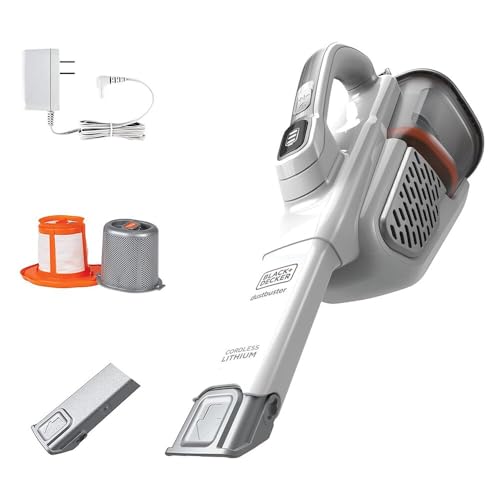
BLACK+DECKER AdvancedClean+ (HHVK320J10) — Best Runtime from a Major Brand
BLACK+DECKER built the handheld category with the dustbuster line, and the HHVK320J10 is the model its listing positions around runtime: the title leads with “Extended Runtime” and pairs it with powerful suction and an extra-long crevice tool, in the AdvancedClean+ series. For buyers who want the endurance brief answered by a brand with decades of handheld history and widely available filters and parts, this is the pick.
Strengths
- Extended-runtime positioning stated in the listing itself
- Extra-long crevice tool reaches deep between car seats and along baseboards
- Major-brand parts, filters, and support availability
Trade-offs
- The listing does not state a minute figure in its title; confirm the full runtime specification and its conditions on the product page
- Mid-tier pricing above the value brands
- Like all handhelds, runtime drops on the highest power use and with a clogged filter
Key specs (from the verified listing): brand BLACK+DECKER; dustbuster AdvancedClean+ series; model HHVK320J10; extended runtime stated; extra-long crevice tool; cordless rechargeable.
The honest way to choose between this and the BSRCO is to decide what you trust: a stated minute figure from a value brand, or an extended-runtime design brief from the category’s founding brand. Both are defensible; for a household that will own the vacuum for years and wants filters on any hardware-store shelf, the BLACK+DECKER is the safer long-term home.
Best for: brand-loyal buyers wanting an extended-runtime dustbuster for home and car. / Not suited for: shoppers who require a printed minute figure before buying.
Check the current price on Amazon

BLACK+DECKER dustbuster AdvancedClean (CHV1410L) — Best Overall Classic
The CHV1410L is the classic dustbuster formula that has anchored kitchen counters for years: a rotating nozzle, a crevice tool, a charging station that keeps it parked and topped up, and a large dust bowl by handheld standards. Its endurance story is the dock. A handheld that lives on its charger starts every job at full charge, and over a year of ownership that readiness beats a nominally larger battery that lives in a drawer.
Strengths
- Charging station keeps the vacuum stored, visible, and fully charged
- Rotating nozzle and crevice tool cover counters, corners, and car mats
- Large dust bowl means fewer interruptions mid-cleanup
- One of the longest-running, most proven designs in the category
Trade-offs
- No runtime figure stated in the listing title; check the product page for the full specification
- An older platform than the newest models here; charging is via its station, not USB-C
- Counter-space commitment: the dock needs a permanent home
Key specs (from the verified listing): brand BLACK+DECKER; dustbuster AdvancedClean; model CHV1410L; rotating nozzle; crevice tool; charging station; large dust bowl.
Choose the CHV1410L if your handheld’s real job is fifty small jobs a week rather than one long one: crumbs under a high chair, litter by the door, flour on the counter. For that pattern, dock-readiness is battery life, and this is the dock-based classic the category is measured against.
Best for: kitchens and busy households wanting an always-charged countertop handheld. / Not suited for: buyers wanting USB-C charging or a stated minute rating.
Check the current price on Amazon

Shark WANDVAC (WV201BK) — Best Lightweight
The WANDVAC’s contribution to the endurance question is weight: at a stated 1.4 lb, it is light enough that a long cleanup, a full car, a flight of stairs, does not end because your arm gave up before the battery did. It pairs that with a charging dock, one-touch emptying, and a duster crevice tool, in a slim profile that stores on a counter without dominating it. Shark positions it for pet hair as well as daily debris, and the dock keeps it charged between grabs.
Strengths
- Stated 1.4 lb, the lightest pick in this guide
- Charging dock keeps it ready; one-touch empty reduces mid-job friction
- Slim, attractive storage footprint for counters and utility rooms
Trade-offs
- Compact dust cup suits quick jobs, not whole-car deep cleans without emptying
- No minute runtime stated in the listing title; verify the full specification on the product page
- Premium tier for its size class
Key specs (from the verified listing): brand Shark; WANDVAC model WV201BK; stated weight 1.4 lb; charging dock; one-touch empty; duster crevice tool; Black on this listing.
The WANDVAC is the pick for stairs and for anyone who has stopped using a heavier handheld because carrying it was the chore. In endurance terms, the vacuum you will carry for ten minutes beats the vacuum you put down after three, whatever their batteries claim.
Best for: stairs, quick daily pickups, and anyone prioritizing light weight. / Not suited for: long single-session deep cleans without emptying.
Check the current price on Amazon

Bissell Pet Hair Eraser (2390A) — Best for Pet Hair
Bissell’s Pet Hair Eraser is the specialist for the job that drains handheld batteries fastest: pulling pet hair out of upholstery, where the nozzle works against fabric friction the whole time. Its verified listing states a lithium-ion battery for consistent power, and consistency is the endurance feature that matters here: lithium-ion packs deliver steadier suction across the charge instead of fading gradually, so the last sofa cushion cleans like the first. The listing positions it for home, auto, and upholstery pet-hair pickup, which is exactly the circuit pet owners run weekly.
Strengths
- Lithium-ion battery stated, for consistent power across the charge
- Purpose-built for pet hair on upholstery, in the home and the car
- From a brand whose floor-care parts and filters are widely stocked
Trade-offs
- No minute runtime stated in the listing title; confirm the full specification on the product page before ordering
- A specialist tool; generalists may prefer the classic dustbuster above
- Pet-hair work is the hardest duty for any handheld’s filter; clean it often to protect runtime
Key specs (from the verified listing): brand Bissell; Pet Hair Eraser model 2390A; lithium-ion battery stated; cordless; home, auto, and upholstery pet-hair positioning.
For pet households, this is the endurance pick that matters: not the longest number, but consistent power through the specific, battery-hungry work of de-hairing furniture. Pair it with a routine of emptying and filter checks after each session and it will hold that consistency far longer.
Best for: pet owners cleaning upholstery and car interiors weekly. / Not suited for: buyers who need a printed runtime figure or a generalist-only tool.
Check the current price on Amazon

Shark UltraCyclone Pet Pro Plus (CH951) — Best Pet Power
The UltraCyclone Pet Pro Plus is the heavy-duty end of this guide: a cordless hand vacuum with a pet power brush for working hair out of fabric, an XL dust cup that extends the time between emptyings on big jobs, a crevice tool, and a scrubbing brush, positioned for car and home. On a long pet-hair session, the XL cup is an endurance feature in disguise: every avoided trip to the bin is working time saved, and the power brush does in one pass what a plain nozzle does in three, which is battery time saved again.
Strengths
- Pet power brush works hair out of upholstery instead of skimming it
- XL dust cup extends working time between emptyings
- Full tool set for the car-and-home circuit: crevice tool and scrubbing brush included
Trade-offs
- Larger and heavier in the hand than the WANDVAC; long overhead work will feel it
- No minute runtime stated in the listing title; check the product page’s full specification
- Premium positioning within Shark’s handheld range
Key specs (from the verified listing): brand Shark; UltraCyclone Pet Pro Plus model CH951; pet power brush; XL dust cup; crevice tool; scrubbing brush; Black on this listing.
Choose the UltraCyclone when the job is a seasonal deep clean: the car after a winter of dog trips, the sofa before guests, the stairs that have not been done properly in months. For daily crumbs it is more tool than you need; for the big jobs, its cup and brush turn battery minutes into finished work more efficiently than anything else here.
Best for: deep pet-hair sessions in cars and on furniture. / Not suited for: buyers wanting the lightest possible daily grab-and-go vacuum.
Check the current price on Amazon
Comparison Table
| Pick | Badge | Key spec | Best for |
|---|---|---|---|
| BSRCO Cordless Handheld | Best Stated Runtime | Stated 25-30 min, 12kPa, USB-C, 1.65 lb | Cars and budget runtime shopping |
| BLACK+DECKER AdvancedClean+ HHVK320J10 | Best Runtime, Major Brand | Extended runtime stated, long crevice tool | Brand-loyal home and car use |
| BLACK+DECKER dustbuster CHV1410L | Best Overall Classic | Charging station, large dust bowl | Always-ready kitchen duty |
| Shark WANDVAC WV201BK | Best Lightweight | Stated 1.4 lb, charging dock | Stairs and daily pickups |
| Bissell Pet Hair Eraser 2390A | Best for Pet Hair | Lithium-ion stated, upholstery focus | Pet hair on furniture and cars |
| Shark UltraCyclone Pet Pro Plus CH951 | Best Pet Power | Pet power brush, XL dust cup | Deep pet-hair cleanups |
How to Judge Handheld Vacuum Battery Life Like an Engineer
Since the category will not give you one clean number, learn to triangulate. First, look for a stated runtime and its conditions: a figure quoted at standard power on hard floors is honest but optimistic for upholstery work; treat any unstated-condition figure as a ceiling, not a promise. Second, look at the battery platform: lithium-ion, stated on the Bissell here, holds voltage more steadily and tolerates partial charging better than older chemistries, which matters because handhelds live on partial charges. Third, count the friction in the job: dust-cup size, filter access, and whether emptying requires tools or a sink trip; a vacuum that empties in five seconds with one touch converts more of its battery into cleaning than a slightly longer-running vacuum that fights you at the bin. Fourth, weight the dock: a charging dock or station, offered by the WANDVAC and the CHV1410L, is the single strongest predictor that the vacuum will be full when you grab it, and a full start is worth more than a big number that begins at half charge. Fifth, consider charge speed and connector: USB-C models like the BSRCO can recover on the chargers already in your car and kitchen, which changes real-world availability completely.
Then match the vacuum to your longest realistic job and buy headroom for it. Time yourself once: a thorough car interior usually takes ten to twenty minutes of actual trigger time, a flight of carpeted stairs five to ten, a sofa five. If your longest job sits near a model’s stated ceiling, step up in platform or plan to work in two dock-charged sessions. Batteries also age; a vacuum that barely covers your job when new will not cover it in year three, which is another argument for headroom and for brands whose replacement filters and parts remain available.
How to Get the Most Runtime Out of Any Handheld Vacuum
Runtime is partly maintenance. Keep the filter clean: a clogged filter forces the motor to work harder for the same suction, draining the battery faster and cleaning worse, so rinse or replace filters on the maker’s schedule and always let washed filters dry fully before refitting. Empty the dust cup before it is packed full; suction falls and motor load rises as the cup fills, and the last third of a stuffed cup is cleaned at the worst efficiency the vacuum ever reaches. Store the vacuum on its dock or charger if it has one, in a cool spot, since heat is the enemy of battery longevity and a docked vacuum is a charged vacuum. Work smart: use the lowest power setting that does the job on hard surfaces and save max power for upholstery and car mats, because max settings commonly cut working time by half or more. Plan the route of a long job, car or stairs, so the vacuum is not idling in your hand between sections. And if your model offers a removable battery, a second pack is the one honest way to double runtime; check the product page for whether your model supports it rather than assuming.
Common Buying Mistakes
The first mistake is comparing a stated runtime from one brand against silence from another and treating silence as zero; most major brands simply do not print the figure in the title, which is why this guide reports exactly what each listing states and no more. The second is believing a runtime measured on max power marketing or, conversely, assuming the standard-power figure applies to upholstery work. The third is buying by suction numbers alone; a strong vacuum with a tiny cup and a clogged-prone filter finishes less work per charge than a balanced one. The fourth is leaving the vacuum uncharged in a closet and blaming the battery. The fifth is using a handheld as a whole-house vacuum; these are spot and session tools, and stretching them across a full home guarantees disappointment. The sixth is ignoring filter maintenance for a year and concluding the battery died, when the battery is fine and the airflow is not.
Final Recommendation
If a stated number is what you need, buy the BSRCO and its listed 25-30 minutes. If you want the runtime brief from the category’s founding brand, buy the BLACK+DECKER AdvancedClean+. For daily kitchen readiness, the docked CHV1410L; for stairs and light weight, the WANDVAC; for pet hair, the Bissell for weekly consistency or the UltraCyclone Pet Pro Plus for deep sessions. For adjacent vacuum decisions, see our guides to the Best Handheld Vacuums For House, Best Handheld Vacuums For Carpeting On Stairs, Best Corded Handheld Vacuums For Pet Hair, and Best B And D Hand Held Cordless Vacuums.
Handheld Vacuums for Specific Jobs: Car, Stairs, and Small Spaces
The car is the handheld vacuum’s hardest exam, and the one where battery life is won or lost. A proper car session means footwells full of grit, seat rails that swallow crumbs, mats that hold gravel in their pile, and upholstery that may also hold a season of pet hair, all in a space where you work bent over with the vacuum in one hand. For that job, reach and tools outrank raw minutes: the BSRCO’s flexible hose and crevice nozzle and its LED light for dark footwells, or the BLACK+DECKER AdvancedClean+’s extra-long crevice tool, will finish a car that a more powerful but rigid vacuum leaves half-done. Work the car in a fixed order, driver’s footwell, passenger footwell, rear seats, boot, so no section gets cleaned twice on a fading battery, and empty the cup once mid-job rather than letting it pack solid. Stairs reward the opposite virtues: the WANDVAC’s 1.4 lb and dock-readiness, because stair cleaning is a dozen short bursts separated by climbing, and the vacuum’s weight in your hand matters more than its total runtime. Small spaces, dorms, RVs, and boats, reward storage and charging flexibility above all: a USB-C model that charges from any port and a footprint that lives in a drawer will be used; a dock-based model with no counter to dock on will not. Match the vacuum to the job’s shape, not to the biggest number on the page, and the battery you have will feel longer than it is.
When a Handheld Vacuum Is the Wrong Tool (and What to Use Instead)
Honesty about limits is part of this guide’s job. A handheld vacuum, however long its battery, is the wrong tool for whole-room carpet cleaning: the dust cup is too small, the nozzle too narrow, and the battery math collapses across a thousand square feet. Use a stick or upright vacuum for rooms, and let the handheld do the spot work it was born for. It is also the wrong tool for wet spills unless the specific model is rated for wet pickup, which none of the picks in this guide claims; check the product page before ever vacuuming liquid, because a dry-only motor and a cup of water are a short, expensive relationship. Construction debris, plaster dust in quantity, and fireplace ash are likewise beyond handheld filters and will clog or damage them; ash in particular belongs to specialized equipment because of its fineness and possible heat. Finally, if your real pattern is a weekly whole-car deep clean plus a pet-heavy house, consider whether your household is actually a two-vacuum household, a docked handheld for daily duty and a larger cordless for the weekly session, rather than asking one handheld to be both. The picks in this guide are excellent inside their design brief; respecting the brief is how they stay excellent for years.
Battery Care: Making the Pack Last for Years
A handheld vacuum’s battery is a consumable with a lifespan you can stretch or shorten. Lithium-ion packs, like the one stated in the Bissell listing, prefer partial cycles to deep drains: top the vacuum up after sessions rather than running it to empty every time, and use the dock as its home so that habit is automatic. Heat is the pack’s enemy, so store and charge the vacuum away from radiators, sunny windowsills, and hot cars; a vacuum that lives in a summer car boot ages its battery in dog years. Cold is the temporary enemy: a vacuum stored in an unheated garage will feel weak on winter mornings and recover indoors, which is normal chemistry, not failure. If your model will sit unused for months, leave it at a partial charge rather than full or empty, and give it a top-up every few months. When runtime does eventually fade after years of service, check whether the brand sells replacement packs or filters for your model before replacing the whole vacuum; the major brands in this guide, BLACK+DECKER, Shark, and Bissell, support their platforms with parts far longer than value brands typically do, which is a real, if unglamorous, part of the long-battery-life question: the longest-lasting battery is the one you can maintain and, eventually, replace.
Reading a Handheld Vacuum Listing Like a Skeptic
Because runtime marketing in this category is loose, a two-minute skeptical routine on any product page will protect you better than any single review, including this one. First, find the runtime claim and its conditions: a figure without a stated power level or surface is advertising, not specification, and should be discounted accordingly; the listings in this guide were chosen partly because their claims are stated plainly enough to quote. Second, find the battery description: chemistry, whether it is removable, and whether replacements are sold; a removable, replaceable pack from a major brand is worth more over five years than a sealed pack with a bigger first-year number. Third, weigh the vacuum’s working system, not just its motor: dust-cup volume, filter type and washability, and the tool set in the box, because those decide how much of each charge becomes finished cleaning. Fourth, check the charging story: dock, wall mount, USB-C, or a proprietary plug, and where the vacuum will actually live in your home, since a vacuum without a home is a vacuum without a charge. Fifth, read the warranty and the brand’s parts availability with fresh eyes; handhelds are used hard, dropped, and clogged, and the difference between brands appears in year two, not week two. Apply that routine to the six picks here and they hold up, which is why they are here; apply it to any other listing you are tempted by and you will quickly see which products are engineered and which are merely described.
The Two-Vacuum Household: A Sensible Endpoint
Many households that start by shopping for one long-runtime handheld end, happily, with two vacuums playing different roles, and it is worth describing that endpoint so you can buy toward it deliberately. The daily driver is the docked, always-ready handheld, the CHV1410L or WANDVAC pattern, stationed where messes happen, used twenty times a week for thirty seconds at a time, and valued for readiness above all. The session tool is the heavier lifter, the UltraCyclone for pet-deep cleans or a runtime-stated model like the BSRCO for the car, brought out for planned jobs where its cup, tools, and battery are spent in one deliberate pass. This division is not indulgence; it mirrors how kitchens end up with a chef’s knife and a paring knife rather than one compromised blade, and it usually costs less over five years than repeatedly replacing a single vacuum asked to do both jobs and resented for each. If you are buying your first handheld today, buy the role you need most, daily readiness for most homes, and let the second role arrive when its job becomes undeniable. The Final Recommendation above maps each pick to its role so that today’s purchase becomes the correct half of a future pair instead of an obstacle to it.
A Week With a Handheld: What Ownership Actually Feels Like
Specifications describe a vacuum; routines reveal it. In a typical week, a docked handheld in a family kitchen works twenty or more times: cereal under the table, coffee grounds by the machine, litter tracked from the door, the mysterious crumbs that appear under every high chair ever made. None of those jobs lasts a minute, and all of them together are why readiness beats runtime for most homes, and why the CHV1410L pattern, parked, charged, visible, has survived every trend in this category. The car vacuum lives a different week: one planned session, seats folded, mats out, the full tool set in play, and that is the session where the BSRCO’s stated minutes and hose, or the AdvancedClean+’s long crevice tool, earn their place in this guide. Pet households add a third rhythm, the upholstery pass, where the Bissell’s consistent lithium-ion power or the UltraCyclone’s brush turns a chore people postpone into a ten-minute routine they actually keep, and the keeping is the point: pet hair managed weekly never becomes the deep-clean emergency. Stairs, hallways, and the RV or boat extend the pattern rather than changing it. Notice that in every rhythm, the vacuum that gets used is the one that is charged, reachable, and light enough, and the vacuum that disappoints is the one with impressive numbers and no home. Buy for your rhythms, station the vacuum where its rhythm happens, and the battery question mostly answers itself, which is the most honest conclusion a guide about battery life can offer.
That is also why this guide’s final advice is unglamorous: after choosing, spend the first month building the station, the dock’s spot, the filter routine, the emptying habit, before judging the purchase. Owners who build the routine report that their handheld feels like it runs forever; owners who skip it report that the same model dies constantly. The battery was never the whole story, and a guide that pretended otherwise would be selling you a number instead of a result.
Handheld Vacuum Safety and Storage Basics Worth Thirty Seconds
A few practical rules protect both the vacuum and the household, and they belong in any complete guide. Charge and store lithium-ion vacuums indoors at room temperature, away from heat sources and out of the hot car they may clean, because the same heat that ages a battery in a boot is a safety matter at extremes; a vacuum that has been dropped hard, has a damaged or swelling battery, or smells unusual while charging should be retired and handled per the maker’s instructions rather than nursed along. Never vacuum liquids with a dry-only model, never pick up ash, embers, or anything smoldering, and never use a handheld to clear construction dust in quantity, both for the motor’s sake and for yours. Empty the cup outdoors or over a bin with the filter tapped clean away from your face if household allergies are a concern, and wash your hands after filter maintenance, the unglamorous hygiene of owning any vacuum. Store the vacuum where children cannot treat it as a toy with a trigger, and keep charging cables tidy, because a dock cable across a hallway is a trip hazard that no runtime figure justifies. None of this is complicated, and all of it is the difference between a tool that serves quietly for years and one that becomes a story. With those basics in place, the picks in this guide can get on with the only job you bought them for: being charged, ready, and strong enough, every single time you reach for them.
Comparing the Six Picks Head to Head on the Endurance Question
It is worth gathering the endurance evidence for all six picks in one place, because it is scattered across listings in different vocabularies. Only one pick states minutes: the BSRCO, at 25-30 minutes, and it pairs that figure with USB-C charging, which multiplies its practical availability. One pick states an extended-runtime design brief from a major brand: the BLACK+DECKER AdvancedClean+, whose claim is qualitative rather than numerical, backed by the category’s deepest parts network. One pick states its battery chemistry: the Bissell, lithium-ion, which is the chemistry associated with consistent power delivery across a charge and tolerance of the partial charging that handheld life consists of. Two picks answer endurance with infrastructure rather than numbers: the CHV1410L and the WANDVAC live on charging stations and docks, converting storage into readiness, and the WANDVAC adds the lightest stated weight in the guide, 1.4 lb, which extends the user’s endurance rather than the battery’s. One pick answers with throughput: the UltraCyclone’s XL cup and pet power brush finish more work per minute of battery than any rival here, which is endurance measured in results rather than time. Read that way, the six picks are six different, honest answers to the same question, and the right choice is the answer that matches your constraint: a number, a brand, a chemistry, a dock, a weight, or a workload. A guide that forced all six into one runtime ranking would have to invent the numbers to do it, and this guide’s refusal to invent them is precisely why its comparisons can be trusted.
A Note on Colors, Bundles, and Variant Listings
Some picks in this guide are offered in other colors or bundles, the WANDVAC being the obvious example, with several finishes of the same WV201 design on the market. Color variants of a verified model are the same vacuum for endurance purposes, and you can choose on looks with a clear conscience. Bundles deserve one extra check: confirm that the core model in the bundle is the exact model reviewed here, since bundle listings sometimes pair a different base unit with richer accessories, and confirm which tools are actually in the box against the review’s description. When a listing groups multiple models under one page, the model number, CHV1410L, HHVK320J10, WV201BK, 2390A, CH951, is the identity that matters, and it is printed in every review heading in this guide precisely so you can match it in your cart before paying.
Whichever pick you choose, give it its station, its routine, and its first month before you judge it, because handheld vacuums are the rare product whose performance genuinely improves as the household around them organizes itself. The battery you bought is fixed; the readiness you build around it is not, and readiness, in the end, is what this entire category is really selling.
Start tonight: charge it fully, give it its place, and let tomorrow’s first small mess be the beginning of the routine.
Frequently Asked Questions
How long should a handheld vacuum run on one charge?
Enough for your longest regular job with headroom. In this roundup, the one listing that states a figure states 25-30 minutes; most major brands do not state minutes in their titles at all. Time your longest job, car, stairs, or sofa, and buy a platform that covers it comfortably rather than exactly.
Why don’t big brands print runtime on their listings?
Because runtime depends on power setting, surface, and filter condition, a single number invites misleading comparisons, so many brands describe the battery platform or an extended-runtime design instead. This guide reports what each listing states and flags the rest for you to confirm on the product page.
Does a charging dock really extend battery life?
It extends readiness, which is what owners experience as battery life. A docked vacuum starts every job fully charged and is stored correctly; a vacuum kept in a drawer starts at whatever charge it was left with. For daily small jobs, readiness beats raw capacity.
What drains a handheld vacuum’s battery fastest?
Max power settings, upholstery and carpet friction, and a clogged filter, in roughly that order. Use the lowest effective setting, keep the filter clean, and empty the cup early, and any model in this guide will work noticeably longer per charge.
Is USB-C charging a real advantage in a handheld vacuum?
Yes, in practice. A USB-C model like the BSRCO can top up from car ports, power banks, and the chargers already around a modern home, so it spends less time sitting empty. It does not change the battery’s capacity, but it changes how often the battery is full.
When should I choose a corded handheld instead?
For workshop and garage duty with unlimited session length, a corded model removes the battery from the equation entirely. Our companion guide to corded handhelds for pet hair covers that branch; for home and car convenience, the cordless picks here are the right tools.


