Disclosure: airfryerkitchensupply.com is reader-supported. When you buy through links on our site, we may earn an affiliate commission at no extra cost to you.
Where to buy
If you are choosing among the best gas grills for apartment balcony spaces, start with the tape measure, then this shortlist. Balcony grilling is a geometry problem before it is a cooking problem: the grill must fit the slab, keep its heat away from the railing, sip fuel from a small canister, and make as little smoke and noise as a shared building demands. Every pick below is a verified listing chosen on those physical terms — compact footprints, tabletop or folding formats, 1 lb canister compatibility where the listing states it, and lids that keep smoke behaviour civilised. Measure your balcony first; the tape measure is the most important tool in this guide.
- Weber Q 1200N Portable Propane Gas Grill (Best Overall for Balconies) — Check the current price on Amazon
- Cuisinart Grillster Portable Gas Grill (CGG-059A) (Best Ultra-Compact) — Check the current price on Amazon
- Megamaster Tabletop 1 Burner Gas Grill (Best for 1 lb Canisters) — Check the current price on Amazon
- Charbroil 1-Burner Portable Gas Grill (465640214) (Best Stainless Tabletop Value) — Check the current price on Amazon
- Weber Q 2800N+ Portable Grill (Best Step-Up Temperature Range) — Check the current price on Amazon
- Char-Broil Patio Bistro TRU-Infrared Electric Grill (Best When Gas Is Not an Option) — Check the current price on Amazon
Finding the best gas grills for apartment balcony use starts with a tape measure, not a burner count. The best gas grills for apartment balcony cooks are the ones whose footprint leaves room for the cook, whose heat stays clear of the railing and the wall, and whose fuel comes from a small canister that stores in a cupboard — because a balcony is not a small patio. It is a slab in the sky, shared with neighbours above, below and beside you, and every physical choice you make is felt by all of them.
This guide therefore judges grills on balcony physics. Footprint and format come first: tabletop models that live on a sturdy table, folding models that store flat, and compact bodies that leave walking room. Fuel comes second: 1 lb disposable canisters are the balcony standard because a full-size tank is heavy, awkward to store and often unwelcome in lifts and stairwells. Smoke and noise come third — a lidded grill cooking at sane temperatures, with its grease managed, is a good neighbour; an open flare-up machine is a complaint with a date on it.
One boundary before the picks: buildings and local rules govern whether any flame grill may be used on a balcony at all, and a sibling guide on this site covers the regulatory side in depth. This guide assumes you have checked your building’s position and focuses on the physical fit — and it ends with an electric pick for the many balconies where gas is simply not the answer.
In this guide
Quick Picks
The Q 1200N is the balcony benchmark for cooking quality per square inch. The Grillster is the smallest serious option, the Megamaster is built around the 1 lb canister, the Charbroil 1-Burner is the stainless tabletop value, the Q 2800N+ is the step-up for temperature range, and the Patio Bistro is the electric escape hatch.
- Best Overall for Balconies — Weber Q 1200N Portable Propane Gas Grill. A compact cast body with porcelain-enameled cast-iron grates and electronic ignition — full-size cooking behaviour in a tabletop footprint a balcony can host. Check price on Amazon.
- Best Ultra-Compact — Cuisinart Grillster Portable Gas Grill (CGG-059A). 146 sq. in., an 8,000 BTU burner that reaches 600°F, a dishwasher-safe grate and just 13 lbs — the smallest verified grill here that still cooks like one. Check price on Amazon.
- Best for 1 lb Canisters — Megamaster Tabletop 1 Burner Gas Grill. Built around the 1 lb propane canister per its listing, with 11,000 BTU, a warming rack and 360 sq. in. of claimed cooking space on folding legs. Check price on Amazon.
- Best Stainless Tabletop Value — Charbroil 1-Burner Portable Gas Grill (465640214). A stainless steel single-burner tabletop from an established brand — the simple, durable, low-cost way to put a real burner on a balcony table. Check price on Amazon.
- Best Step-Up Temperature Range — Weber Q 2800N+ Portable Grill. A verified 250–700°F temperature range with a dedicated searing burner — the tabletop that roasts low and sears hard on the same balcony. Check price on Amazon.
- Best When Gas Is Not an Option — Char-Broil Patio Bistro TRU-Infrared Electric Grill. A TRU-Infrared electric grill with no flame, no tank and no canister — the balcony answer for buildings where gas is off the table entirely. Check price on Amazon.
How These Picks Were Chosen
Selection began with the tape measure. Every pick had to be a tabletop, folding or compact format whose footprint leaves a small balcony usable, verified from its listing’s format description. Full-size cart grills were excluded regardless of quality — a great grill that consumes the balcony is a bad balcony grill.
Fuel was the second filter. Priority went to designs built around 1 lb canisters or compact propane use, because fuel storage and transport dominate real balcony ownership. The third filter was neighbourliness: lidded cooking, managed grease paths and formats that cook efficiently at moderate temperatures, which together decide a grill’s smoke and noise signature. One electric pick was included deliberately, because for a large share of apartment balconies it is the only honest recommendation.
Listings were verified, and every specification quoted — areas, outputs, weights, temperature ranges — comes from those listings. Where a listing is spare, the review says so rather than filling gaps from imagination.
The 6 Best Gas Grills For Apartment Balcony
The picks are ordered by how most balcony cooks will use them: the benchmark first, then smaller, simpler and more specialised options, with the electric answer at the end. Your balcony’s dimensions, not our order, should make the final call.

Weber Q 1200N Portable Propane Gas Grill — Best Overall for Balconies
The Q 1200N is the balcony default for a reason: its cast body cooks like a real grill, its footprint sits on a sturdy outdoor table without dominating it, and its single burner sips from small canisters for everyday cooking. The verified listing confirms porcelain-enameled cast-iron grates and electronic ignition in the charcoal grey finish.
Strengths
- Compact tabletop footprint leaves the balcony usable for humans, not just the grill
- Porcelain-enameled cast-iron grates sear properly and clean with a brush
- Cast body holds heat, so small meals cook fast with less fuel and less smoke time
Trade-offs
- One burner means one heat zone — batch delicate and fierce foods rather than mixing them
- Needs a genuinely sturdy table; a wobbly balcony table and a hot grill are a bad pairing
- Stand and cover are separate purchases to plan for
| Burners (listing) | 1 |
| Grates (listing) | Porcelain-enameled cast iron |
| Ignition (listing) | Electronic |
| Format (listing) | Portable tabletop |
Smoke discipline is where the Q quietly wins balcony life. Because the cast body heats quickly and the lid seals the cooking, food spends less time smoking on an open grate, and the grease funnels to a disposable pan instead of dripping and flaring. Cook with the lid down — as this grill is designed to be used — and the smoke signature shrinks to brief, ordinary cooking smells rather than a plume your upstairs neighbour can set a watch by.
Storage completes the case. The Q’s shape tucks against a wall or into a storage box, its canister disconnects in seconds, and there is no tank standing in the corner of a small slab all winter. On a balcony, the grill you can put away is the grill that stays welcome.
Best for: Balcony cooks who want real grilling quality in a tabletop footprint / Not suited for: Cooking for more than four people at once
Check on Amazon — check price on Amazon before you decide, because grill pricing moves with the season.

Cuisinart Grillster Portable Gas Grill (CGG-059A) — Best Ultra-Compact
Some balconies are wide; some are a doorstep with a railing. The Grillster is for the second kind: 146 square inches of cooking area, 13 pounds of total weight, and a burner the listing says reaches 600°F, so small does not mean feeble. It is the grill that fits the balcony, the storage cupboard and the car boot with equal ease.
Strengths
- 13 lb weight and a tiny footprint suit the smallest balconies and easiest storage
- Dishwasher-safe grate turns the worst cleaning job into a loading job
- Reaches 600°F per the listing — real searing heat from a genuinely small grill
Trade-offs
- 146 sq. in. cooks for one or two, in batches for three
- Small body loses heat fast in wind — position it sheltered
- Push-button ignition and light build reward gentle handling
| Cooking area (listing) | 146 sq. in. |
| Burner (listing) | 8,000 BTU, to 600°F |
| Weight (listing) | 13 lbs |
| Grate (listing) | Dishwasher-safe |
| Ignition (listing) | Push-button |
The dishwasher-safe grate deserves its headline. Balcony grilling’s hidden friction is cleaning without a yard, a hose or a utility sink — and a grate that goes in the dishwasher removes the friction entirely. Pair that with a body light enough to carry inside for storage, and the Grillster solves the two problems that make balcony grills end up abandoned: the scrub and the storage.
Cook within its scale and it delights: two steaks, a pair of chicken breasts, a tray of vegetables in rotation. Ask it to cater and it will make you queue. For the solo cook or couple it was sized for, that is not a limitation — it is the correct tool.
Best for: Tiny balconies, solo cooks and couples, and anyone who hates cleaning grates / Not suited for: Group cooking or windy, exposed high-rise slabs
Check on Amazon — check price on Amazon before you decide, because grill pricing moves with the season.

Megamaster Tabletop 1 Burner Gas Grill — Best for 1 lb Canisters
The Megamaster’s listing states the balcony’s favourite sentence plainly: it uses 1 lb propane. No tank to haul, store or apologise for — a canister screws on for the cook and unscrews into a cupboard after. Around that fuel choice it builds a surprisingly complete tabletop: 11,000 BTU, a built-in thermometer, push ignition and a warming rack.
Strengths
- Designed for 1 lb canisters — the balcony-friendly fuel format, stated in the listing
- Warming rack keeps finished food hot while the next batch cooks
- Folding legs make storage and transport genuinely flat and simple
Trade-offs
- A 1 lb canister is a session fuel, not a season fuel — keep spares for longer cooks
- 360 sq. in. includes rack space; plan the main grate for realistic loads
- Tabletop format still needs that sturdy, heat-safe surface
| Fuel (listing) | 1 lb propane canister |
| Output (listing) | 11,000 BTU |
| Cooking space (listing) | 360 sq. in. incl. warming rack |
| Extras (listing) | Built-in thermometer, push ignition, folding legs |
Fuel logistics decide balcony habits more than cooking specs do. A grill that needs a 20 lb tank needs a plan — carrying it through the building, storing it on the slab, exchanging it on a Saturday. A canister grill needs a cupboard. The Megamaster leans fully into that simplicity while keeping the thermometer and warming rack that make actual dinners easier, which is why it earns the canister crown here.
The warming rack is the feature couples will feel most: on a one-burner grill, sequencing is everything, and a rack that holds the vegetables warm while the protein sears turns a juggling act into a dinner. Keep two spare canisters and this is a complete balcony cooking system at a budget tier.
Best for: Balcony cooks who want canister simplicity with family-size ambitions / Not suited for: Long, low cooks that would drain small canisters
Check on Amazon — check price on Amazon before you decide, because grill pricing moves with the season.

Charbroil 1-Burner Portable Gas Grill (465640214) — Best Stainless Tabletop Value
Not every balcony needs a design icon. The Charbroil 1-Burner is a stainless tabletop grill of the classic school: one burner, a compact body, and the backing of a major brand’s parts culture. Its verified listing is spare — stainless steel, one burner, portable — and that simplicity is the point.
Strengths
- Stainless body shrugs off balcony weather better than painted budget steel
- Single-burner simplicity means little to maintain and less to store
- Major-brand backing for parts and support at a value tier
Trade-offs
- Listing is light on detail — confirm grate and dimensions for the exact unit before ordering
- One zone, modest area: a couples’ grill, not a party grill
- No thermometer or warming rack frills at this tier
| Burners (listing) | 1 |
| Body (listing) | Stainless steel |
| Format (listing) | Portable tabletop |
| Model (listing) | 465640214 |
Balconies are weather-exposed in a particular way: wind-driven rain reaches under covers, and a grill lives outdoors in a space too small for a shed. Stainless construction is the practical answer at the value tier, resisting the cosmetic rust that makes painted portables look abandoned within a season. Wipe it down, keep the burner port clear, and this little grill simply continues.
Cooking is honest single-zone work — burgers, sausages, skewers, vegetables in rotation — and for the price tier that is the correct ambition. Buy it as the low-commitment way to learn whether balcony grilling fits your life before investing in the premium picks above.
Best for: Value buyers who want stainless durability in the smallest format / Not suited for: Feature seekers or cooks feeding groups
Check on Amazon — check price on Amazon before you decide, because grill pricing moves with the season.

Weber Q 2800N+ Portable Grill — Best Step-Up Temperature Range
The Q 2800N+ is the balcony step-up: the listing’s 250–700°F range is the story, because it means one compact grill can hold a gentle roast and then produce a genuine sear without a second appliance. For the balcony cook who has outgrown a basic tabletop’s single personality, this is the upgrade that stays the same size.
Strengths
- 250–700°F verified range covers low roasting and hard searing in one body
- Dedicated burner for searing per the listing — crust on demand
- Same balcony-friendly tabletop logic as the smaller Q, with more headroom
Trade-offs
- Premium pricing for the portable class
- Larger and heavier than the ultra-compact picks — check your table and storage
- Range is capability, not obligation: most balcony dinners live in the middle of it
| Temperature range (listing) | 250–700°F |
| Extras (listing) | Dedicated searing burner |
| Format (listing) | Portable tabletop |
| Colour (listing) | Charcoal grey |
Temperature range is a smoke and courtesy feature too, oddly enough. A grill that can roast gently at the low end cooks with its lid down and its smoke contained, while the fierce top end finishes food fast — less time smoking, less time with the balcony door open to the smell. The 2800N+ gives the balcony cook that control, which is the difference between grilling at your neighbours and grilling near them.
Size it honestly: this is the top of the tabletop class, and it asks for a solid table and a real storage spot. In return it is the only pick here that a growing cook will not outgrow within a season — the balcony grill you keep when the hobby takes hold.
Best for: Keen balcony cooks who roast and sear and want one grill for both / Not suited for: The tightest balconies or the lightest budgets
Check on Amazon — check price on Amazon before you decide, because grill pricing moves with the season.
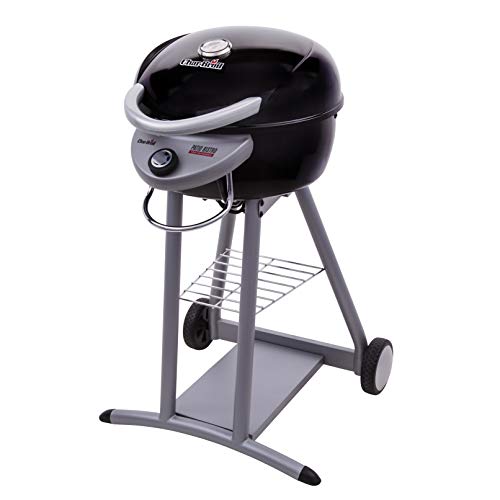
Char-Broil Patio Bistro TRU-Infrared Electric Grill — Best When Gas Is Not an Option
Some balconies will never host a gas grill, and pretending otherwise helps nobody. The Patio Bistro is the electric alternative with genuine grilling credentials: TRU-Infrared cooking that sears and juicily cooks rather than steaming, in a compact body made for exactly this setting. It is in this guide as the honest fallback, clearly labelled electric.
Strengths
- No open flame, no fuel storage — sidesteps the entire gas-on-balcony problem
- TRU-Infrared system delivers real searing behaviour for an electric grill
- Compact footprint designed for patios and balconies
Trade-offs
- It is electric — no gas flavour profile and it needs an outdoor outlet
- Infrared electric heat still produces cooking smoke; it reduces risk, not aroma
- Power limits peak performance compared with the gas picks on the coldest, windiest days
| System (listing) | TRU-Infrared electric |
| Format (listing) | Compact patio grill |
| Colour (listing) | Black |
| Model (listing) | 20602107 |
Judge the Bistro on what balcony cooks actually need: weeknight dinners for one to four, cooked outdoors, with a sear that satisfies. Infrared electric delivers that with a plug, and it removes the two balcony frictions gas can never fully solve — fuel storage and open flame. For many apartment dwellers this is not the consolation pick; it is the correct primary pick, and the gas models are the fantasy.
Keep expectations calibrated on smoke: infrared reduces flare-up smoke dramatically because drips vaporise on the emitter, but cooking food produces aroma no matter the fuel. What changes is the risk profile and the rulebook — and on a balcony, those are often the whole game.
Best for: Balconies where gas is banned, impractical or simply unwanted / Not suited for: Gas loyalists or balconies without an accessible outdoor outlet
Check on Amazon — check price on Amazon before you decide, because grill pricing moves with the season.
Comparison Table
Footprint and fuel come first in this table, because on a balcony those two columns decide whether the grill gets used or gets complained about.
| Pick | Badge | Key spec | Best for |
|---|---|---|---|
| Weber Q 1200N Portable Propane Gas Grill | Best Overall for Balconies | Tabletop, enamel cast-iron grates, 1 burner | Balcony cooks who want real grilling quality in a tabletop footprint |
| Cuisinart Grillster Portable Gas Grill (CGG-059A) | Best Ultra-Compact | 146 sq. in., 13 lbs, dishwasher-safe grate | Tiny balconies, solo cooks and couples, and anyone who hates cleaning grates |
| Megamaster Tabletop 1 Burner Gas Grill | Best for 1 lb Canisters | 1 lb canister fuel, 11,000 BTU, warming rack | Balcony cooks who want canister simplicity with family-size ambitions |
| Charbroil 1-Burner Portable Gas Grill (465640214) | Best Stainless Tabletop Value | 1 burner, stainless tabletop | Value buyers who want stainless durability in the smallest format |
| Weber Q 2800N+ Portable Grill | Best Step-Up Temperature Range | 250–700°F range, searing burner | Keen balcony cooks who roast and sear and want one grill for both |
| Char-Broil Patio Bistro TRU-Infrared Electric Grill | Best When Gas Is Not an Option | Electric infrared, no fuel storage | Balconies where gas is banned, impractical or simply unwanted |
How to Choose a Gas Grill for an Apartment Balcony
Measure three things before browsing: the slab’s usable depth, the table or surface the grill will sit on, and the storage space when grilling season pauses. A tabletop grill needs a surface that is sturdy, level and heat-tolerant, positioned so its lid opens without meeting the wall and its heat plume clears the railing and any overhang. If the numbers say the grill plus a standing cook do not fit, believe the numbers and go a size smaller — the ultra-compact pick in this guide exists for exactly that balcony.
Fuel planning is the second decision. One-pound canisters are the balcony standard: they store in a cupboard, travel in a tote, and remove the tank problem entirely. Their limit is session length, so match canister cooking to balcony reality — weeknight dinners, not eight-hour smokes. If your cooking ambitions are bigger, the honest answers are a step-up tabletop with an adapter option confirmed for the exact model, or the electric route, not a full tank squeezed onto a small slab.
Finally, shop for neighbourliness. A lidded grill with a managed grease path, cooking at the temperature the food needs rather than maximum inferno, produces a fraction of the smoke of an open, flaring grill. Add a small fan habit — cooking when the breeze carries smells away from the building — and balcony grilling becomes a pleasure your neighbours may envy rather than endure.
Balcony Safety Distances and Setup That Actually Work
Set the grill on its table as far from the building wall and the railing as the slab allows, with the lid’s opening arc clear of both. Keep the area beneath and around it free of the things balconies accumulate — cushions, planters with dry foliage, storage boxes — and never leave a lit grill unattended on a balcony, where a gust can do in seconds what a calm patio would never allow. A small fire extinguisher rated for grease, kept inside the door, is the cheapest peace of mind in this entire guide.
Wind deserves its own paragraph because balconies live in it. Wind steals heat, bends flames and carries smoke horizontally into other people’s homes. Position the grill in the slab’s most sheltered corner, cook with the lid down to shield the burners, and accept that the windiest evenings are electric-grill or indoor-cooking evenings. The step-up picks with strong temperature ranges recover fastest when a gust does get through.
Budget Tiers for Balcony Grills
Balcony grills divide into three sensible tiers. The value tier — the Charbroil tabletop and the Grillster — buys real cooking for one or two people and total storage simplicity. The mid tier — the Q 1200N and the Megamaster — buys better materials, enamel grates and features like warming racks that make couples’ dinners easy. The step-up tier — the Q 2800N+ — buys temperature range and headroom to grow. The electric Bistro sits across all three as the alternative axis: choose it by rules and outlets, not by tier. In every tier, reserve a little budget for the unglamorous essentials: spare canisters, a cover that fits, and a table that deserves the grill’s trust.
How to Set Up and Cook on a Balcony Grill, Step by Step
A repeatable routine turns a small slab into a reliable outdoor kitchen. This is the sequence balcony owners settle into after the first month.
- Bring the grill out or uncover it, and set it on its table in the sheltered position, clear of the wall and railing, with the lid arc unobstructed.
- Fit a fresh drip pan or empty the grease tray, and connect a 1 lb canister hand-tight, checking for the smell of gas before ignition — any hiss or smell means stop, disconnect and investigate.
- Open the lid, ignite, and preheat with the lid down for five to ten minutes; a compact grill reaches temperature fast, which is part of its charm.
- Brush the hot grate, oil the food rather than the grate to minimise smoke, and load the grill without crowding — small grills cook in batches by design.
- Cook with the lid down as much as the food allows; it holds temperature, cuts smoke, and finishes food faster in balcony wind.
- Rest the food indoors, then brush the grate again while it is still warm and let the grill cool fully before covering or storing.
- Disconnect the canister once cool, cap it, and store it upright in a ventilated cupboard — never beside a heat source.
- Wipe the table and check the slab for drips while they are fresh; a clean balcony is a balcony you are allowed to keep grilling on.
Follow that loop and balcony grilling becomes a fifteen-minute weeknight ritual rather than an event. The routine, more than any single product, is what makes the best gas grills for apartment balcony living work in practice.
Smoke, Noise and Being a Good Neighbour
Most balcony friction is not about rules; it is about smoke drifting through an open window and a grill that sounds like a jet on a quiet evening. You control more of both than you think. Fatty foods flare and smoke the most, so trim excess fat, keep the grease path clean, and favour the grill’s middle temperatures over maximum heat for everyday cooking. Marinated and sugary sauces smoke and burn when applied early — sauce at the end, always. For noise, the compact picks here are inherently quiet: small burners, lidded cooking, no roaring sear stations. Time helps too — a weeknight dinner cooked at a civilised hour bothers nobody the way a midnight session does.
And when in doubt, the oldest neighbour technology of all still works: a knock, a heads-up, and occasionally a plate of whatever smelled so good. Balconies are shared airspace; the cooks who thrive on them treat that as a social fact, not an obstacle.
The Balcony Kit: Everything Around the Grill
A balcony grill works as a system, and the supporting kit is small enough to list completely. The table comes first — sturdy, level, heat-tolerant, and sized so the grill’s lid arc clears it at the back. Then the consumables: spare canisters in rotation, drip pans matched to your model, and a cover that fits the grill’s actual shape rather than a generic rectangle that balloons in the wind. Then the tools, kept balcony-short: compact tongs, a brush matched to your grate surface, heat gloves, and an instant-read thermometer that lives in the same storage box as everything else.
Two safety items complete the kit and are not optional at height: a small extinguisher rated for grease, mounted or stored just inside the balcony door, and a habit — never leaving the lit grill unattended — that costs nothing at all. Add a small bin for ash-free, cool debris and a caddy that carries the whole kit in one trip from cupboard to slab, and the system is complete. Balcony grilling succeeds as logistics before it succeeds as cooking, and this kit is the logistics, solved once.
Two Balconies, Two Dinners: The Picks at Work
Picture the standard balcony on a Tuesday: the Q 1200N on its table in the sheltered corner, canister on, lid down for the preheat while the salad is made indoors. Two chicken breasts and a foil tray of peppers cook in one lidded session; the grate gets its hot brush, the grill cools while dinner is eaten, and the whole station is covered and quiet inside forty minutes, with nothing but cooking smells briefly crossing the railing. That unremarkable evening, repeated twice a week, is the entire case for the benchmark pick — balcony grilling as routine, not event.
Now the generous terrace on a Saturday: the Q 2800N+ holding a low roast through the afternoon at the gentle end of its range, then finishing flatbreads at full heat as guests arrive, the grill’s wide temperature span doing the work of two appliances while the slab still seats six. The same physics, the same discipline — measure, shelter, lid down, clean as you go — scaled to the space. Your balcony is one of these two pictures, or between them, and the picks in this guide map onto that spectrum without a wasted option.
Matching the Grill to the Balcony You Actually Have
Balconies sort into three honest types, and each has a correct grill in this guide. The Juliet and micro-balcony — a door, a railing, standing room for one — belongs to the Grillster class: a grill that stores in a cupboard and cooks for one or two, because anything larger turns the space into storage with a view. The standard apartment balcony, a few square metres with room for a table and two chairs, is Q 1200N and Megamaster territory: a real tabletop station that sets up and packs away in minutes. The generous terrace balcony — deep enough for a dining set — can host the Q 2800N+ and still leave the evening usable, which is the true test: the grill should join the balcony’s life, not evict it.
Measure with the cook included. The working footprint is grill plus you plus a landing spot for a tray, and if that arithmetic fails on paper it will fail worse with hot food in your hands. Balcony veterans also measure the door and the lift: a grill that cannot travel between storage and slab without a wrestling match will be left wherever it is least welcome. Every pick here was chosen to pass that journey gracefully.
Finally, match the grill to your building’s sightlines. A compact tabletop under the railing line is a quieter neighbour than a tall cart looming over it — a small thing, until the first conversation with the building manager, when it becomes the whole thing.
Canister Economics and Storage, Without the Headaches
One-pound canisters trade capacity for freedom, and balcony cooks should understand the trade in practical terms. A canister covers several ordinary dinners — burgers, chicken, vegetables — because compact grills sip rather than gulp. Long, low cooking and big preheats are what drain them, so the balcony pattern is: canisters for the week’s grilling, and no guilt about it. Keep two spares in rotation and the empty-canister-mid-dinner scenario simply never occurs.
Storage discipline is simple and non-negotiable: canisters upright, caps on, in a ventilated indoor cupboard away from heat sources and never in a sealed box on a sun-baked balcony. Disconnect after every cook — the habit takes five seconds and removes the slow-leak question entirely. Part-used canisters are normal and safe to store by the same rules; mark the lightest one and use it first for short cooks like vegetables, saving full canisters for steak night.
Disposal completes the loop: fully empty canisters go out with your building’s metal recycling or hazardous-waste route as local rules direct — never punctured, never into general rubbish while pressurised. It is a small liturgy, and like the rest of balcony grilling, it becomes invisible with repetition.
Wind, Weather and the High-Rise Balcony
Height changes grilling. A fifteenth-floor balcony can be calm at street level and gusting at the railing, and wind is the balcony cook’s true opponent: it strips heat from the box, leans flames away from the food, and ferries smoke sideways into the building. The countermeasures are built into this guide’s picks and routine — lidded cooking always, the grill tucked into the slab’s sheltered corner, and the step-up models’ stronger temperature ranges for recovery when a gust does get through.
Weather also decides storage. A balcony grill lives in driven rain that finds angles a patio never sees, so the cover matters and the cool-down matters: never cover a warm or wet grill, and after storms, lift the cover and let the station dry before the next cook. Stainless and enamel finishes — both represented in the picks — forgive this life best. Choose them, keep the routine, and the high-rise balcony becomes what it should be: the best seat in the building, with dinner cooked on it.
A Season on the Balcony: How the Routine Settles In
The first month of balcony grilling is experimentation: where the grill sits, which corner shelters it, how the smoke behaves on a still evening versus a breezy one. By the second month, balcony cooks report the same settling: the grill has a home position, the canister rotation runs itself, and the cook has learned the building’s air the way a sailor learns a harbour — which evenings carry smells away, which pin them to the facade, and which are electric nights by choice rather than by rule.
By the first season’s end, the balcony has usually changed around the grill: a better table, a hook for the tools, perhaps herbs in a planter within arm’s reach, because a working outdoor kitchen attracts its own improvements. This is the quiet success metric of the picks in this guide — not a single great cookout, but a balcony that gradually becomes the household’s favourite room, with the grill as its hearth.
Winter then asks its small question — store the grill indoors or cover it on the slab — and either answer works for the compact class here, provided the grill goes away clean and the canisters come inside. Spring’s first cook, on a machine that was stored properly, is the balcony cook’s reward for the liturgy: light, preheat, dinner, as if the season never paused.
Common Buying Mistakes
Buying a cart grill for a balcony
A full-size cart consumes the slab, crowds the railing and turns storage into a season-long problem. Balconies reward tabletops that store away — measure first, admire later.
Storing a big propane tank on a small balcony
Beyond the space it eats, a full tank on a balcony is unwelcome in many buildings and miserable to exchange. The canister format exists precisely for this life; use it.
Grilling with the lid open in wind
Open-lid cooking on a windy balcony loses heat, bends flames and maximises smoke. These grills are designed for lid-down cooking — use the design.
Ignoring the grease path
On a balcony, drips land on a slab you must clean and neighbours below can see. Empty the tray, use the drip pans, and wipe the table after every cook.
Assuming electric means no cooking smoke
Electric infrared removes flame and fuel storage, not aroma. It solves the rulebook problem, and reduces flare smoke — but dinner will still smell like dinner.
Final Recommendation
For most balconies, the Weber Q 1200N is the answer: real grilling, tabletop footprint, canister fuel, civilised smoke behaviour. The Grillster takes the tiniest slabs, the Megamaster takes canister cooking furthest, the Charbroil 1-Burner is the stainless value route, and the Q 2800N+ is the upgrade for cooks who roast as well as sear.
And if your building’s answer to gas is no — or your own answer is — the Patio Bistro keeps balcony cooking alive without flame or fuel. Measure your slab, pick the format that fits your life, and run the routine in the how-to section. A small balcony with the right grill outcooks a big patio with the wrong one, every week of the year.
- Weber Q 1200N Portable Propane Gas Grill — best overall for balconies.
- Cuisinart Grillster Portable Gas Grill (CGG-059A) — best ultra-compact.
- Megamaster Tabletop 1 Burner Gas Grill — best for 1 lb canisters.
Round out your research with the neighbouring guides: Best Gas Grills For Apartments for the wider apartment picture, Best 1lb Gas Grills for more canister-fed options, Best Compact Gas Grills for small-format picks, Best Portable Gas Grills for travel-ready grills, and Best Balcony Grills for the broader balcony category.
Related guides
Frequently Asked Questions
Can I really use a gas grill on an apartment balcony?
Physically, yes, if the grill is a compact tabletop run on small canisters and set up with clear space from walls and railings. Whether you may is a separate question governed by your building and local rules — check first, and if gas is not allowed, the electric pick in this guide is the honest alternative.
Why are 1 lb canisters better than a tank on a balcony?
Storage and transport. A canister lives in a cupboard, travels in a bag and needs no exchange trip; a 20 lb tank occupies balcony space permanently and is unwelcome in many buildings. The trade-off is session length — canisters suit dinners, not day-long smokes.
How do I keep balcony grilling smoke down?
Cook with the lid down, keep the grease tray and drip pan fresh so old grease cannot smoke, trim excess fat, apply sugary sauces only at the end, and use the middle of the grill’s temperature range for everyday food. A clean, lidded, moderate grill is a remarkably discreet one.
What table should a balcony grill sit on?
One that is sturdy, level, heat-tolerant and heavy enough not to wobble when you press on a steak. Metal or solid wood outdoor tables are the usual answer; glass-topped and plastic folding tables are not. If in doubt, the grill’s own stand or cart, sized for the model, is the safest surface.
How much space does a balcony grill need around it?
Enough that the lid opens fully without touching wall or railing, the heat plume rises clear of overhangs and stored items, and you can stand and work without leaning over the grill. On very small slabs, the ultra-compact pick in this guide is designed around exactly that arithmetic.
Is an electric grill a real alternative for a balcony?
For weeknight cooking, yes. Infrared electric models sear credibly, need no fuel storage and remove the open-flame question entirely. They still produce cooking aroma and need an outdoor outlet, but for many apartment balconies they are not a compromise — they are the correct tool.


