Disclosure: airfryerkitchensupply.com is reader-supported. When you buy through links on our site, we may earn an affiliate commission at no extra cost to you.
Where to buy
If you are shopping for best gas grills for balcony, start here: every grill in this guide was confirmed through Amazon listing for this site, so the links below go to the exact model reviewed. Availability and configuration (propane or natural gas, with or without a cart) change over time, so check price on Amazon and confirm the fuel type on the listing before ordering:
- Weber Q 1200N Portable Propane Gas Grill (Midnight Black) — check price on Amazon
- Weber Q 2800N+ Portable Grill (Midnight Black) — check price on Amazon
- Weber Spirit E-210 Gas Grill — check price on Amazon
- Nexgrill Tabletop 1-Burner Gas Grill — check price on Amazon
- Megamaster Tabletop 1-Burner Gas Grill — check price on Amazon
- Kenmore 2-Burner Portable Gas Grill (Tabletop) — check price on Amazon
Finding the best gas grills for balcony use starts with a question no product page can answer for you: does your building, lease, and local fire code allow a gas grill on your balcony at all? Rules vary by city and by building, many properties ban open-flame cooking on upper-floor balconies entirely, and some allow only small-canister tabletops. Check first, buy second — every pick below assumes gas is permitted where you live. Within that boundary, balcony grilling is a discipline of small flames, honest clearance from railings and walls, modest grease loads, and grills you can store out of the weather. This guide favors compact tabletops and one small cart grill, each verified, and each judged on fire-safety practicality as much as cooking power.
In this guide
Quick Picks
- Weber Q 1200N Portable Propane Gas Grill (Midnight Black) — Best Overall for Balconies: If your balcony allows a gas grill at all, this is the safest shape of answer: a compact single-burner tabletop that keeps flame size, grease load, and total heat output modest while still cooking like a real grill rather than a camping toy. Check on Amazon
- Weber Q 2800N+ Portable Grill (Midnight Black) — Best for Searing on a Balcony: Most balcony grills top out at temperatures that grey a steak rather than crust it. This one is listed with a 250–700°F range and a burner intended for searing, which makes it the pick when the whole point of grilling outside is a proper crust. Check on Amazon
- Weber Spirit E-210 Gas Grill — Best Cart-Style Balcony Grill: Some balconies — larger terraces, ground-floor patios, townhouse decks — can honestly fit a small cart grill. This two-burner is the controlled way to do it: full two-zone cooking, a proper lid, and a footprint that does not swallow the whole outdoor space. Check on Amazon
- Nexgrill Tabletop 1-Burner Gas Grill — Best Budget Tabletop: Not every balcony needs a premium badge. This cast-aluminum tabletop covers the core job — burgers, dogs, skewers, and vegetables for one or two people — in the smallest, easiest-to-store format in this guide. Check on Amazon
- Megamaster Tabletop 1-Burner Gas Grill — Best for Larger Tabletop Batches: Tabletop usually means tiny. This one stretches the format to 360 sq in with a warming rack, which suits balcony cooks who host a friend or two and would rather cook in two calm batches than crowd a small grate. Check on Amazon
- Kenmore 2-Burner Portable Gas Grill (Tabletop) — Best Two-Burner Tabletop: This is the balcony compromise many people actually want: two burners and a warming rack like a ‘real’ grill, in a foldable tabletop that disappears into a closet when the cooking is done. Check on Amazon
How These Picks Were Chosen
We started from gas grills already confirmed through Amazon listing, then filtered hard for balcony reality: total heat output a small space can tolerate, footprints that leave real clearance from railings, lids and grease systems that keep flare-ups contained, and formats that store indoors or under a cover. Full-size cart grills were excluded except for one deliberately small two-burner, because a balcony pick that ignores clearance is not a pick at all.
We also weighed fuel format. Several balconies are limited to small propane canisters by building rules, while others allow standard tanks; picks that accept more than one tank size scored higher for restricted buildings. Ignition reliability in wind, corrosion-resistant frames for outdoor storage, and warming racks that reduce batch juggling rounded out the scoring.
A final honesty note: no grill makes a banned grill legal. If your building prohibits gas on balconies, the correct purchase is no purchase — or an electric alternative where those are allowed. Everything below is written for readers whose rules permit gas, and the safety guidance in each review should be treated as part of the product, not fine print.
A note on what did not make this list, because balcony exclusions are as instructive as inclusions. Full-size three- and four-burner carts were cut on footprint and fire load alone, however well they cook — a balcony guide that recommends them has stopped guiding. Charcoal was out of scope by the search itself, and pellet grills, whatever their merits, bring a fire-and-smoke profile and a size that balcony rules rarely welcome. What remains is a deliberately narrow field: small gas grills whose total heat, grease load, and storage format a balcony can honestly absorb.
We also re-checked every pick against the small-print reality of balcony life: can one person carry it, can it be cleaned without a hose and a driveway, does its grease stay inside it, and can it be stored without becoming balcony furniture nobody wanted. A grill that fails those tests gets used three times and abandoned, which is the most common balcony outcome of all. The six here passed, in ascending order of size and ambition, and the reviews say plainly where each one’s ceiling is.
The 6 Best Gas Grills for Balcony Cooking

Weber Q 1200N Portable Propane Gas Grill (Midnight Black) — Best Overall for Balconies
If your balcony allows a gas grill at all, this is the safest shape of answer: a compact single-burner tabletop that keeps flame size, grease load, and total heat output modest while still cooking like a real grill rather than a camping toy.
Strengths
- Smallest full-featured footprint here — sits on a sturdy table and stores indoors or under a cover
- Porcelain-enameled cast-iron grates hold heat well for a 1-burner grill and leave real sear marks
- Electronic ignition is reliable in wind, which matters on exposed upper-floor balconies
Trade-offs
- One burner means one heat zone — no true indirect cooking for large cuts
- Uses small 1 lb cylinders on its standard regulator, so frequent cooks go through canisters quickly
- No lid thermometer on the listing spec, so you judge heat by time and touch until you learn it
| Spec | Detail (from listing) |
|---|---|
| Burners | 1 burner |
| Output | 10,000 BTU (per listing) |
| Grates | Porcelain-enameled cast-iron |
| Ignition | Electronic ignition |
Balcony cooking is mostly a clearance and control problem, and this grill is built around both. The single burner keeps the total flame small, which makes it far easier to respect the distance your building and local fire code require between the grill and railings, siding, and anything stored outside. The cast-iron grates are the surprise at this size: they retain enough heat that burgers and chicken thighs brown properly instead of steaming, provided you preheat with the lid down and resist opening it every minute. Because it is light enough to carry, you can also do the thing balcony grillers should do more often — bring it inside or under cover after it cools, which keeps the burner dry and dramatically slows rust. Pair it with a small metal drip tray routine: let it cool, wipe the grease cup every few cooks, and never let a season of drippings build up under a hot burner on a wooden or composite deck. Used that way, it covers weeknight cooking for one to three people without the fire-load of a full cart grill.
Best for: small balconies where rules allow a compact propane grill, and cooks who want real grate marks from a tabletop unit / Not suited for: households cooking for five or more, or anyone whose building bans gas grills outright — no grill fixes a lease rule
Check the current price on Amazon

Weber Q 2800N+ Portable Grill (Midnight Black) — Best for Searing on a Balcony
Most balcony grills top out at temperatures that grey a steak rather than crust it. This one is listed with a 250–700°F range and a burner intended for searing, which makes it the pick when the whole point of grilling outside is a proper crust.
Strengths
- Listing temperature range reaches 700°F, unusually high for a portable — thick steaks are realistic
- Also settles down to 250°F for slower roasting, so it is not a one-trick sear box
- Portable format keeps the fire load balcony-appropriate while outperforming most tabletops
Trade-offs
- Bigger and heavier than the smallest tabletops — measure your table and storage spot first
- High maximum heat demands more discipline about railing clearance, not less
- At full sear output it consumes small cylinders noticeably faster
| Spec | Detail (from listing) |
|---|---|
| Temperature range | 250–700°F (per listing) |
| Role | Portable propane grill with a dedicated searing burner capability |
| Use cases | Searing and low-temperature roasting (per listing) |
The honest way to use that extra heat on a balcony is in short, attended bursts: preheat fully, sear with the lid open for the first minute so flare-ups are visible, then close the lid to finish. Keep the grill centered on a stable, non-combustible surface with the widest clearance you can manage on the railing side, and never walk inside while it runs at high output — small spaces forgive nothing. At the low end of its range it is equally useful, holding roasting temperatures for chicken pieces or vegetables while the burner cycles gently. That two-ended range is why it earns a balcony slot despite its size: one appliance covers the sear night and the slow night, so you are not storing two grills in a flat that barely has room for one. Clean the grease tray after fatty cooks in particular; at 700°F, old grease is the difference between a sear and a smoke incident your neighbors will remember.
Best for: balcony cooks who prioritize steakhouse-style searing and can give the grill proper clearance / Not suited for: tiny rail-side balconies with no safe clearance, or anyone who wants set-and-forget cooking
Check the current price on Amazon

Weber Spirit E-210 Gas Grill — Best Cart-Style Balcony Grill
Some balconies — larger terraces, ground-floor patios, townhouse decks — can honestly fit a small cart grill. This two-burner is the controlled way to do it: full two-zone cooking, a proper lid, and a footprint that does not swallow the whole outdoor space.
Strengths
- A real two-zone cart grill in a small-grill footprint — indirect cooking finally works
- Snap-Jet ignition lights each burner individually, useful in balcony wind
- Weber Works rails accept prep accessories that save precious balcony table space
Trade-offs
- A cart grill needs a level, stable patch of balcony — not every balcony has one to spare
- Two burners and a larger lid produce more total heat than tabletops; clearance rules apply in full
- Costs sit in the premium tier for its size class
| Spec | Detail (from listing) |
|---|---|
| Burners | 2 burners |
| Grates | Porcelain-enameled cast-iron |
| Ignition | Snap-Jet ignition |
| Extras | Weber Works rails (per listing) |
The two-burner layout changes what balcony cooking can be. You can run one side hot for searing and park food on the cool side to finish, roast a whole chicken indirectly without scorching the skin, or keep vegetables warm while steaks rest. The porcelain-enameled cast-iron grates behave like the grates on full-size Webers because they are the same concept in miniature: heavy, heat-retentive, and easy to brush clean while warm. On a balcony, the discipline is placement. Put it on the most open side of the space, lid opening away from the wall, with nothing stored above or beside it, and confirm your building permits a grill of this size with a standard tank — some buildings allow small-canister tabletops but not 20 lb tanks, and that distinction decides this purchase before any feature does. If the rules allow it, this is the balcony grill you will not outgrow in a year.
Best for: larger balconies and terraces where a small two-burner cart is permitted and fits with clearance / Not suited for: small or rule-restricted balconies, and anyone whose building limits grills to small-canister tabletops
Check the current price on Amazon
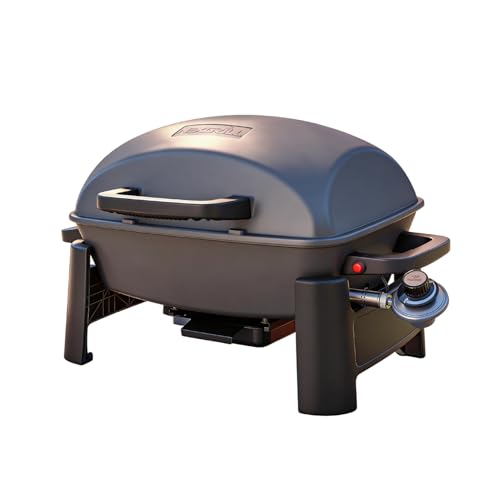
Nexgrill Tabletop 1-Burner Gas Grill — Best Budget Tabletop
Not every balcony needs a premium badge. This cast-aluminum tabletop covers the core job — burgers, dogs, skewers, and vegetables for one or two people — in the smallest, easiest-to-store format in this guide.
Strengths
- 183 sq in is honestly sized for two people — no wasted balcony footprint
- Locking lid and light build make it genuinely easy to store indoors after cooking
- Cast aluminum frame shrugs off the corrosion that kills cheap steel tabletops
Trade-offs
- Piezo ignition is less consistent than electronic ignition in gusty conditions
- Single zone only; thick cuts need a flip-and-move routine rather than indirect heat
- Small grease capacity — empty it often, especially after burgers
| Spec | Detail (from listing) |
|---|---|
| Burners | 1 burner |
| Output | 10,000 BTU (per listing) |
| Cooking space | 183 sq in (per listing) |
| Frame | Cast aluminum frame, locking lid, piezo ignition |
Budget tabletops usually fail in two places: thin steel that rusts through in two seasons, and igniters that give up by July. The cast aluminum frame addresses the first problem directly, since aluminum does not rust the way painted steel does, and on a balcony where a grill may live under a simple cover rather than a garage, that matters more than extra features. The cooking area is small and the listing says so plainly, which is a virtue: you buy exactly the grill your space can hold. Working method matters at this size. Preheat five minutes with the lid down, cook in small batches rather than crowding the grate, and use the warming effect of the closed lid between batches. For balcony safety it asks little: modest total output, a locking lid that keeps it tidy in storage, and a size that keeps it well away from railings on any reasonably deep table. It is the grill to buy when the alternative is not grilling at all.
Best for: one- or two-person households wanting the simplest, most storable balcony grill / Not suited for: regular cooking for groups, or anyone who needs two heat zones
Check the current price on Amazon

Megamaster Tabletop 1-Burner Gas Grill — Best for Larger Tabletop Batches
Tabletop usually means tiny. This one stretches the format to 360 sq in with a warming rack, which suits balcony cooks who host a friend or two and would rather cook in two calm batches than crowd a small grate.
Strengths
- 360 sq in is the largest tabletop cooking area in this guide — batch cooking works
- Built-in thermometer helps you manage a single zone more intelligently
- Warming rack keeps finished food hot while the next batch cooks
Trade-offs
- A 360 sq in tabletop still needs a big, stable table — check your balcony furniture
- Single burner across a wide grate means edge-to-center heat differences to learn
- Foldable legs must be locked and checked before every cook on an elevated surface
| Spec | Detail (from listing) |
|---|---|
| Burners | 1 burner |
| Output | 11,000 BTU (per listing) |
| Cooking space | 360 sq in (per listing) |
| Extras | Warming rack, built-in thermometer, foldable legs |
The extra area changes the cooking style more than the burner count suggests. With one burner under a wide grate, the center runs hottest, so treat the grill as a natural gradient: sear over the center, slide finished pieces toward the edges and the warming rack, and rotate skewers and vegetables through the hot zone in turns. The built-in thermometer is genuinely useful here because single-zone grills live or die on lid-down heat management. On the balcony side, respect the format: the legs fold for storage, which is excellent for small flats, but that means you verify the legs are locked and the table is rock-stable before lighting, every time. Keep it away from the railing edge, keep the grease path clean — a wide grate produces more drippings than a small one — and store it folded indoors if you can. For balcony households that cook for three or four, it is the practical middle ground between a mini tabletop and a cart.
Best for: balcony cooks feeding three or four people who have a large, stable table / Not suited for: very small balconies, or cooks who want true two-zone control
Check the current price on Amazon
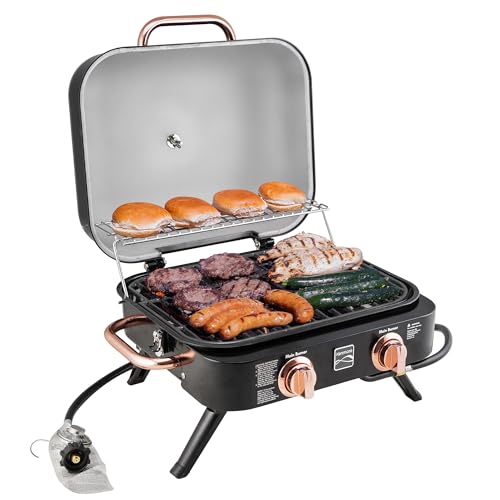
Kenmore 2-Burner Portable Gas Grill (Tabletop) — Best Two-Burner Tabletop
This is the balcony compromise many people actually want: two burners and a warming rack like a ‘real’ grill, in a foldable tabletop that disappears into a closet when the cooking is done.
Strengths
- Two stainless burners give a real hot zone and warm zone in a tabletop body
- Accepts both small and standard tanks, so it adapts to your building’s fuel rules
- Warming rack and foldable legs suit balconies that double as storage-free zones
Trade-offs
- Two burners in a compact body still need full clearance discipline
- Tank flexibility means you must confirm which tank size your building allows
- Tabletop format means no enclosed storage — accessories live indoors
| Spec | Detail (from listing) |
|---|---|
| Burners | 2 burners, stainless steel |
| Fuel | Fits 5 lb and 20 lb propane tanks (per listing) |
| Extras | Warming rack, foldable legs |
Two burners transform tabletop technique. You can sear on the left and hold on the right, run both for a full load of burgers, or light one for a two-person weeknight dinner and save fuel. The stainless burners are the durability detail to notice, because burner corrosion is what ends most budget grills, and on a balcony the grill breathes humid outside air all season. Fuel flexibility deserves emphasis in a balcony guide: the listing states it fits both 5 lb and 20 lb tanks, and since buildings differ — some cap tank size, some ban standard tanks on upper floors — being able to run the smaller tank can be the difference between allowed and not allowed. Check your rules first, then choose the tank. Placement advice is the same as for every pick here: stable surface, maximum railing clearance, grease tray emptied often, and a cover or indoor storage between uses. Within those rules, this is the most complete tabletop in the guide.
Best for: balcony cooks who want two-zone cooking without a permanent cart grill / Not suited for: anyone whose balcony cannot provide safe clearance for a two-burner unit
Check the current price on Amazon
Comparison Table
| Pick | Badge | Key spec | Best for |
|---|---|---|---|
| Weber Q 1200N Portable Propane Gas Grill (Midnight Black) | Best Overall for Balconies | 1 burner | small balconies where rules allow a compact propane grill, and cooks who want real grate marks from a tabletop unit |
| Weber Q 2800N+ Portable Grill (Midnight Black) | Best for Searing on a Balcony | 250–700°F (per listing) | balcony cooks who prioritize steakhouse-style searing and can give the grill proper clearance |
| Weber Spirit E-210 Gas Grill | Best Cart-Style Balcony Grill | 2 burners | larger balconies and terraces where a small two-burner cart is permitted and fits with clearance |
| Nexgrill Tabletop 1-Burner Gas Grill | Best Budget Tabletop | 1 burner | one- or two-person households wanting the simplest, most storable balcony grill |
| Megamaster Tabletop 1-Burner Gas Grill | Best for Larger Tabletop Batches | 1 burner | balcony cooks feeding three or four people who have a large, stable table |
| Kenmore 2-Burner Portable Gas Grill (Tabletop) | Best Two-Burner Tabletop | 2 burners, stainless steel | balcony cooks who want two-zone cooking without a permanent cart grill |
How to Choose the Best Gas Grills for Balcony Spaces
Clearance is the first specification, and it is yours, not the manufacturer’s. Measure the distance from your intended grill position to the railing, the wall, and anything stored on the balcony, then compare it with your local fire code and building rules, which commonly require several feet from combustible structures. If the honest measurement is tight, choose the smallest tabletop in this guide rather than the most capable grill — on a balcony, the safest grill is the one that fits with room to spare.
Fuel rules decide the shortlist next. Many apartment and condo buildings that allow gas grills at all restrict tank size, often to small canisters. A grill that runs on 1 lb canisters, or one listed to fit both small and standard tanks, keeps you legal in more buildings. Standard 20 lb tanks belong on ground-level patios unless your rules explicitly allow them upstairs.
Total heat matters more than burner count. A single 10,000–11,000 BTU burner produces a manageable fire load and cooks perfectly well for two to four people in batches. Two burners add zone control, which is genuinely useful, but they also double the flame you are responsible for in a small space. Match the grill to the space first and the menu second.
Grease management is a fire-safety feature, not a cleaning chore. Small grills have small grease cups, and a balcony flare-up over a full grease tray is the most common way balcony grilling goes wrong. Prefer grills whose grease path you can see and empty easily, and build the habit: cool, empty, wipe, every few cooks, and always after fatty foods.
Storage decides lifespan. A balcony grill that folds, locks, and comes indoors — or at least under a fitted cover — will outlast a larger grill left exposed, because burners and igniters die from moisture, not from cooking. If your balcony has no storage corner, weight and folded size belong on your spec sheet next to BTU.
One more balcony variable deserves its own paragraph: wind. Upper-floor balconies are windier than the patios most grills are designed for, and wind does three unhelpful things at once — it bends flames toward one side of the box, strips heat from the lid, and pushes smoke and heat toward the building and the balcony above. Position the grill in the most sheltered spot your clearance allows, cook with the lid down whenever the recipe permits, and accept that the windward side of any balcony grill runs cooler. On genuinely gusty evenings, the correct balcony decision is sometimes to cook inside; a small grill gives you the flexibility to make that call without feeling you have wasted a large setup.
Sound and smoke are part of the balcony specification too, because your grill shares air with neighbors above, below, and beside you. Fatty foods on a hot grate produce the most smoke, so the balcony menu that keeps the peace leans on trimming excess fat, avoiding sugary marinades at maximum heat, and keeping the grease system clean so old residue is not smoking on every cook. A quick word to the neighbor above before a longer session costs nothing and converts a potential complaint into a relationship. Balcony grilling is a social technology as much as a cooking one, and the cooks who keep their privileges are the ones whose neighbors never have a reason to test the building’s rules.
Consider the balcony floor itself as part of the purchase. A grill mat rated for the purpose protects decking and composite boards from heat and grease, and on rented balconies it protects the deposit as reliably as the boards. Drips that reach a balcony floor also reach, eventually, the balcony below — one more reason the grease routine in this guide is written as a rule rather than a suggestion.
Think, finally, about the exit plan. A balcony grill you can carry is a grill you can take to a friend’s garden, a campsite, or your next home, and several picks here double as genuinely good portable grills for exactly that reason. In small-space living, the appliances that earn their keep are the ones with more than one life. Choose the balcony grill that can leave the balcony, and the purchase stays right even when the address changes.
How to Set Up a Gas Grill Safely on a Balcony
Step one happens before the grill arrives: confirm in writing, if you can, that your building and local code allow a gas grill of the type and tank size you plan to use. Keep that confirmation; if a question ever arises, ‘I checked first’ is the only good answer. Then choose the position with the greatest clearance from railings, walls, and stored items, on a stable, level, non-combustible surface — a proper grill mat under a tabletop adds a layer of protection for decking.
Step two is assembly and a leak check. Connect the regulator, open the tank valve slowly, and brush soapy water on the connections; bubbles mean a leak, and the grill does not light until it is fixed. This thirty-second habit matters more in a small space than anywhere else, because gas pooling under a balcony grill has nowhere to go.
Step three is the first burn: run the grill empty on high for ten to fifteen minutes to burn off manufacturing residues, watch how the flame behaves in your balcony’s wind pattern, and note where heat and smoke travel relative to your door, windows, and the neighbor above. Adjust position now, not during a dinner.
Step four is routine: cook attended, keep a lid within reach to smother flare-ups, never leave a lit grill alone on a balcony, and let everything cool fully before moving or covering it. After cooking, close the tank valve first and let the line burn clear. Balcony grilling done this way is unremarkable — which is exactly the point.
Keep a balcony-specific kit together so the routine never depends on memory: a small spray bottle for the leak check solution, a brush sized to the grate, a spare canister if your grill runs on them, and a metal container with a lid for cooled grease and ash-free drippings disposal. When the kit lives in one box by the door, the safe setup and the full clean-down take minutes, and habits that take minutes are the ones that survive busy weeks.
Learn your grill’s balcony map in one deliberate session. Cook a full load of something cheap and forgiving — chicken thighs or sausages — and note where the hot center sits, how the windward edge behaves, and how long recovery takes between batches with the lid working for you. Write nothing down if you like; the point is that after one mapping cook, every later balcony session runs on knowledge instead of hope, and small grills reward that knowledge more than big ones because their margins are smaller.
Balcony Grilling Rules, Safety, and Neighbor Reality
Start with the legal stack, because it has four layers and any one of them can say no. National and local fire codes commonly restrict open-flame cooking on balconies of multi-family buildings, particularly above ground floor and within a set distance of the structure. Your lease or condo documents add a second layer, building management a third — many properties publish grill rules in handbooks nobody reads until a violation letter arrives — and your insurer quietly forms a fourth, since a fire caused by a prohibited grill is a coverage problem as well as a fire. The picks in this guide assume you have checked the layers that apply to you. That is not boilerplate; on a balcony, permission is the first product feature.
Fire safety on a balcony is mostly about denying a small incident the chance to become a large one. The grill sits on a stable, non-combustible surface with the greatest clearance the space allows. Nothing combustible is stored above it, beside it, or on the railing line it faces. The tank valve is reachable without leaning over the grill. A lid is always within arm’s reach to cut oxygen to a flare-up, and the cook stays present — the unattended grill is the common thread in nearly every balcony fire report ever written. None of this requires equipment beyond attention, which is precisely why it works.
Grease deserves a second mention at this depth because it is the balcony hazard owners underestimate longest. A tabletop’s grease cup can fill in a handful of fatty cooks, and once full, every additional drip lands somewhere hot. The routine that prevents the problem is embarrassingly small: let the grill cool, empty the cup into a metal container, wipe the grease path, done. Schedule it by cooks, not by calendar — every three or four sessions, and always after burgers or anything rendered heavily. On a balcony, that two-minute habit is the difference between a hobby and an incident report.
Storage rules are the quiet part of balcony compliance. Propane — canister or tank — is stored outdoors, upright, and ventilated, never in a sealed box, a storage bench with no vents, or inside the flat. The grill itself, cooled fully, can live indoors if it folds or lifts easily, which several picks here are designed to do, and that indoor storage doubles as the best corrosion protection available to a balcony cook. If the grill lives outside, a fitted cover is the minimum viable shelter, and the tank valve stays closed between uses without exception.
Finally, the neighbor layer, which no code can write for you. Balcony smoke drifts up and across; balcony cooking smells travel further than balcony cooks think. The households that grill happily on balconies for years tend to share three habits: they keep the grill and grease clean so smoke stays modest, they avoid the smokiest cooks at the hours when every window above is open, and they are known to the neighbors as considerate before they are known as grillers. Rules decide whether you may grill on a balcony. Habits decide whether it stays that way.
Common Buying Mistakes
Mistake one is buying the grill before reading the rules. Every season, balcony grills get returned or resold because a lease banned them. Read the lease, ask the building, check the local code — in that order — before any product research.
Mistake two is placing the grill against the railing for the view. The railing side is where clearance matters most and where wind pushes flame and heat toward the building line and the balcony above. Center the grill in the safest spot the space offers.
Mistake three is ignoring the grease tray because the grill is small. Small trays fill faster. A balcony flare-up is almost always old grease meeting new heat, and it is entirely preventable with a two-minute clean.
Mistake four is storing the tank indoors or in a sealed balcony box. Propane tanks belong outdoors, upright, and ventilated, per the tank and grill manuals. A compact grill does not change propane storage rules.
A Balcony Cookout, Run Properly From Start to Finish
Picture the session this guide is built for. Late afternoon, the grill comes out of its storage corner or from under its cover and onto its mat, positioned for maximum railing clearance. Tank connected, leak check done with the spray bottle from the balcony kit, lid thermometer — or the grill’s own gauge — watched through a five-to-ten-minute preheat while the food is seasoned indoors, away from the wind. Nothing about the setup is rushed, because on a balcony, setup is the safety system.
The cook itself runs in calm batches. Burgers or chicken first, in a single layer with space between pieces, lid down between planned turns, the warming rack or the gentle zone holding finished food while the second batch cooks. The cook stays on the balcony — this is the rule with no exceptions — and the lid lives in one hand’s reach for the one flare-up that fatty food eventually produces, which arrives, is smothered in seconds, and becomes a story instead of an incident because the grease tray was emptied two cooks ago.
Close-down is where balcony cooks are made. Food in, burners off at the tank first, grates brushed while warm, and the whole unit left to cool completely before it is moved, covered, or carried inside. Grease cup checked, mat inspected, tank valve confirmed closed. Ten unhurried minutes that leave the balcony exactly as it was — plus dinner. Run every session that way and a balcony grill stops being a compromise appliance and becomes what it should be: the smallest, most honest outdoor kitchen a home can have.
Accessories That Earn Their Space on a Balcony
Small-space cooking runs on a short, honest kit. A fitted cover sized to your exact pick — or a storage spot indoors — is the first purchase, because it is the one that decides how long everything else lasts. A grill mat for the surface beneath comes second on any deck worth protecting. After that, the list is deliberately short: tongs that suit the grill’s scale, a brush that fits the grate, a spare fuel canister if your model runs on them, and a small metal container for cooled grease. Every item either protects the grill, protects the balcony, or protects the cook; anything else is a drawer looking for a home you do not have.
Resist the accessory catalog’s gravity. Balcony storage is the scarcest resource in this entire guide, and every gadget bought is space taken from the grill’s own storage, the chairs, or the plants that make the balcony worth cooking on. The test for any addition is a single question: did a real cook in the last month fail or fumble for want of this? If not, the money belongs in the fuel and food budget, where it will be enjoyed on schedule.
One upgrade does pass that test for many balcony cooks: a small, stable side surface if your balcony lacks one — a folding table that lives against the wall and opens only for cooking. Landing space for a platter is the difference between a composed cook and a juggling act over a railing, and on a balcony, juggling is the one technique this guide will never recommend. Buy the surface before the second gadget, every time.
Final Recommendation
For most permitted balconies, start with the Weber Q 1200N: it is the most controllable, storable, and honest small grill here. If searing is your priority and your clearance allows it, the Q 2800N+ adds a listed 700°F ceiling no other portable here matches. The Nexgrill and Megamaster tabletops cover tight budgets and bigger batches respectively, the Kenmore adds true two-zone tabletop cooking, and the Spirit E-210 is the step up for larger terraces where a small cart is allowed.
Whichever you choose, treat the safety routine — clearance, leak checks, grease discipline, attended cooking — as part of the purchase. A balcony grill used carefully for years beats a powerful grill used carelessly once.
- Weber Q 1200N Portable Propane Gas Grill (Midnight Black) — check price on Amazon
- Weber Q 2800N+ Portable Grill (Midnight Black) — check price on Amazon
- Weber Spirit E-210 Gas Grill — check price on Amazon
- Nexgrill Tabletop 1-Burner Gas Grill — check price on Amazon
- Megamaster Tabletop 1-Burner Gas Grill — check price on Amazon
- Kenmore 2-Burner Portable Gas Grill (Tabletop) — check price on Amazon
Best Gas Grills For Apartments Best Balcony Grills Best Small Gas Grills Best Portable Gas Grills Best 2 Burner Gas Grills Best Gas Grills For Small Spaces
Frequently Asked Questions
Can I use a gas grill on any apartment balcony?
No. Many buildings, leases, and local fire codes prohibit gas grills on balconies, especially upper floors, and some allow only small-canister or electric models. Check your lease, building rules, and local code before buying — this guide assumes gas is permitted where you live.
How much clearance does a balcony grill need?
Follow your local code and the grill manual; requirements commonly call for several feet from railings, walls, and combustible materials, and never grilling under an overhang. Measure honestly and choose a smaller grill if clearance is tight.
Are 1 lb propane canisters safer than a 20 lb tank on a balcony?
They store far less fuel, which is why many buildings allow only small canisters upstairs. They are not exempt from safe handling: connect them carefully, leak-check, store them outdoors and ventilated, and never bring a leaking canister indoors.
What size grill is right for a small balcony?
For most small balconies, a one-burner tabletop around 180–360 sq in covers one to four people in batches. Two-burner tabletops and small carts suit larger balconies and terraces where clearance and rules allow them.
How do I stop flare-ups on a balcony grill?
Keep the grease tray and grates clean, trim excess fat, sear with the lid open so you can see flames, and keep the lid nearby to smother a flare. Most balcony flare-ups trace back to built-up grease.
Should I store my balcony grill indoors?
If it folds or is light enough, indoor storage after it cools fully extends its life significantly and keeps burners dry. If it stays outside, use a fitted cover and still close the tank valve between uses.
What should I do if my building bans gas grills but allows electric ones?
Follow the rule and shop the electric category instead — several compact electric grills are designed exactly for restricted balconies. Never try to disguise or quietly use a prohibited gas grill: the fire risk is real, and a violation can cost your lease and your insurance position.


