Disclosure: airfryerkitchensupply.com is reader-supported. When you buy through links on our site, we may earn an affiliate commission at no extra cost to you.
Where to Buy
Every verified pick in this guide to the best food mixers and blenders is sold through Amazon, where you can check the current price on Amazon, confirm the exact configuration, and read the full manufacturer specification sheet before you commit. Listings for this category change often — finishes go in and out of stock and bundles change — so use the links below to land on the exact model we verified, not a look-alike variant.
- Ninja Kitchen System Pro BL770 — Best Overall: check price on Amazon.
- Ninja Professional Plus Kitchen System BN801 — Best for Families: check price on Amazon.
- Ninja Compact Kitchen System AMZ493BRN — Best Compact System: check price on Amazon.
- Cuisinart Smart Power Duet Blender & Food Processor BFP-703BCP1 — Best Blender-Processor Duet: check price on Amazon.
- Hamilton Beach Blender and Food Processor Combo 58163 — Best Budget Combo: check price on Amazon.
- Oster Blender and Food Processor Combo — Best for Smoothies To Go: check price on Amazon.
The best food mixers and blenders solve a specific kitchen problem: one motor base that can mix, process and blend, instead of three appliances fighting for the same cupboard. But this category is also the most loosely labeled in small appliances. Products calling themselves combos range from true kitchen systems — a full blender pitcher plus a real food-processor bowl with a dough blade — down to an ordinary blender with a small chopper cup wearing a bigger name. This guide separates those tiers honestly, because the difference decides whether the machine can actually knead dough and slice vegetables, or merely blend with accessories.
Every pick below was verified, so the pitcher sizes, processor-bowl capacities and included attachments printed here match the actual listings. The six fall into three honest groups: full kitchen systems built around a processor bowl (the two Ninjas and the compact Ninja system), blender-processor duets that pair a proper blender with a work bowl (the Cuisinart, Hamilton Beach and Oster), and — deliberately — no stand mixers at all. A stand mixer is a mixing specialist; if your cooking is dough-first, our bread and stand-mixer guides serve you better than any combo.
Set expectations before the reviews: a combo’s blender is usually excellent, its processor very good, and its dough handling adequate for standard batches — but no combo kneads like a dedicated dough machine, and no combo whips and creams like a stand mixer. What you are buying is breadth and one footprint. For kitchens that cook widely and store narrowly, that trade is often exactly right.
In this guide
Quick Picks
If you only read one section, make it this one. These are the six best food mixers and blenders we would shortlist for real kitchens, each with a clear job to do:
- Best Overall — Ninja Kitchen System Pro BL770: A 1500W base with a 72-oz pitcher and a true 8-cup processor bowl with dough capability — the combo benchmark everything else is measured against.
- Best for Families — Ninja Professional Plus Kitchen System BN801: Auto-iQ presets for smoothies, chopping and dough on a 1400W-peak base — the family system that removes the guesswork from combo cooking.
- Best Compact System — Ninja Compact Kitchen System AMZ493BRN: The full three-job system — 72-oz pitcher, 40-oz processor bowl, dough included — in the smaller footprint apartment kitchens can actually store.
- Best Blender-Processor Duet — Cuisinart Smart Power Duet Blender & Food Processor BFP-703BCP1: A 500W blender with a real glass pitcher paired with a 3-cup processor — the classic duet for kitchens that blend big and process small.
- Best Budget Combo — Hamilton Beach Blender and Food Processor Combo 58163: A 40-oz glass blender jar plus a 3-cup chopper attachment at an entry price — the honest minimum viable combo.
- Best for Smoothies To Go — Oster Blender and Food Processor Combo: Blender plus food processor combo with two 24-ounce to-go cups — built for the smoothie-first household that also cooks.
How These Picks Were Chosen
To qualify, a product had to genuinely span at least two of the three jobs — blending, food processing, dough mixing — with purpose-built vessels for each, verified in its Amazon listing: pitcher volume, processor bowl size and named attachments all had to be present in the listing data, not inferred from marketing images. Blenders with only personal cups were excluded from the top ranks because cups do not make a food processor, however the box is labeled.
We then weighted the jobs by how combo owners actually use them: blending performance first (ice, frozen fruit, fibrous greens), processing second (even chopping, slicing, shredding without turning food to puree), and dough third (a standard pizza or bread batch, mixed without stalling or overheating). Preset programs such as Auto-iQ counted only where they map to a real task — crush, chop, dough — rather than decorative buttons.
Ownership factors closed the judging: how many parts must be washed after a smoothie (the honest tax on combo ownership), whether bowls and blades are dishwasher-safe, and whether the base footprint justifies the cupboard it replaces. A combo that saves a shelf but takes twenty minutes to clean has not saved anything that matters.
The 6 Best Food Mixers and Blenders, Reviewed

Ninja Kitchen System Pro BL770 — Best Overall
The BL770 is the default answer for a kitchen that wants one machine to do weekday smoothies, weekend salsa and a Friday pizza dough. The 72-ounce pitcher handles family-size frozen drinks, the 8-cup processor bowl is a genuine food processor — big enough for a full batch of hummus, a cabbage slaw or a pie dough — and the motor has the headroom to run both without the strained note lesser bases develop. It suits households that cook across categories several times a week. If you blend daily but process twice a year, a dedicated blender plus a mini chopper is the leaner buy.
Strengths
- True 8-cup processor bowl, not a token chopper cup
- 1500W base crushes ice and frozen fruit without hesitation
- Dough function handles standard pizza and bread batches
Trade-offs
- Many parts to wash after processing jobs
- Tall pitcher storage needs a deep shelf or counter spot
- Loud at full power, like every high-power system
| Base (per Amazon listing) | 1500 watts |
| Blender pitcher | 72 oz |
| Processor bowl | 8-cup |
| Jobs | Blend, process, dough |
What separates the BL770 from cheaper combos is that neither vessel feels like the accessory. The pitcher blends with the stacked-blade violence Ninja built its name on — ice becomes snow, frozen strawberries disappear — while the processor bowl chops evenly enough for salsa with actual texture, the test that exposes weak processors instantly. The dough blade will not develop gluten like a stand mixer’s hook, but for pizza dough and standard loaves it mixes a complete, usable dough in minutes. As a single purchase replacing a blender, a processor and light mixing duty, it remains the system to beat.
Best for: Households wanting one base for blending, processing and light dough / Not suited for: Dedicated bread bakers or stand-mixer-style creaming and whipping
Check on Amazon — check the current price on Amazon for the exact configuration reviewed here.

Ninja Professional Plus Kitchen System BN801 — Best for Families
The BN801 is aimed at busy family kitchens where the machine gets used by several people with different skill levels. Its Auto-iQ programs run timed pulse-and-blend patterns for the three jobs families actually repeat — smoothies, chopping and dough — so a teenager making breakfast and a parent prepping dinner both get consistent results without learning the machine’s moods. The 1400W-peak base and full-size vessels keep it in the true-system class alongside the BL770. Choose it over the BL770 if presets will genuinely be used; choose the BL770 for raw simplicity and the slightly stronger base.
Strengths
- Auto-iQ programs give repeatable results for any user
- Five functions across blending, chopping and dough
- Full-size pitcher and processor for family batches
Trade-offs
- Preset reliance can frustrate cooks who like manual control
- Same multi-part washing tax as any full system
- Peak-watt rating flatters the base slightly versus the BL770
| Base (per Amazon listing) | 1400W peak |
| Functions (per Amazon listing) | 5 functions — smoothies, chopping, dough and more |
| Programs | Auto-iQ presets |
Presets are easy to dismiss as marketing until a machine lives with a family. The BN801’s programs encode the pulse patterns that make processing even (short bursts, pauses to settle) and smoothies smooth (escalating speed instead of a single blast that cavitates). In a single-cook kitchen they are a convenience; in a many-cook kitchen they are consistency insurance. Underneath the automation sits the same Ninja formula of strong crushing blades and a processor bowl sized for real recipes, so nothing about the hardware is a compromise — you are paying for the programming, and for the right household it is money well spent.
Best for: Families and shared kitchens wanting preset consistency / Not suited for: Solo cooks who prefer full manual control
Check on Amazon — check the current price on Amazon for the exact configuration reviewed here.

Ninja Compact Kitchen System AMZ493BRN — Best Compact System
Ninja’s compact system answers the storage objection that kills most combo purchases. You still get a full 72-ounce blending pitcher, but the processor bowl shrinks to 40 ounces — enough for a couple’s salsa, a single pie dough, a batch of pesto or energy balls — and the whole kit nests into a smaller cupboard volume. The 1200W base keeps blending performance firmly in the serious class. It suits one-to-three-person households that cook real food in modest batches. Bigger households should stay with the 8-cup systems above; processor bowl size is the one spec you cannot work around.
Strengths
- Real processor bowl and dough function in a compact kit
- 72-oz pitcher is full family size for drinks
- 1200W base does not feel like a compromise
Trade-offs
- 40-oz processor bowl caps batch cooking
- Still a multi-part wash after processing
- Fewer included extras than the flagship systems
| Base (per Amazon listing) | 1200 watts |
| Blender pitcher | 72 oz |
| Processor bowl | 40 oz |
| Programs | Auto-iQ |
Compact systems usually cheat — a smaller pitcher, a weaker base, a chopper cup pretending to process. This one cheats only on processor volume, which is the honest place to cheat for small households, because a 40-ounce bowl still performs every processing technique; it simply performs them in smaller batches. Dough for two pizzas, crumb for one cheesecake, slaw for four — the compact bowl covers the real recipe sizes of small kitchens, while the full-size pitcher means smoothie mornings never feel downsized. For apartments and small families, it is the most rational system in this guide.
Best for: Small households and apartments wanting a true system / Not suited for: Batch cooking and large-family processing
Check on Amazon — check the current price on Amazon for the exact configuration reviewed here.

Cuisinart Smart Power Duet Blender & Food Processor BFP-703BCP1 — Best Blender-Processor Duet
Cuisinart’s Duet is the older, quieter interpretation of the combo idea: a proper countertop blender — 48-ounce glass jar, the material many cooks still prefer for hot soups and easy cleaning — sharing a base with a compact 3-cup food processor attachment. The processor is sized for the jobs small bowls do best: herbs, nuts, garlic, a vinaigrette, baby food, a single onion. It will not knead dough or shred a cabbage, and this guide will not pretend otherwise. For cooks whose processing is garnish-scale while their blending is serious, that asymmetry is a feature, not a flaw.
Strengths
- Glass blender jar suits hot liquids and cleans easily
- 3-cup processor is perfectly sized for small prep
- Simple, proven design with few failure points
Trade-offs
- 500W base is modest beside the Ninja systems
- Processor too small for dough or batch work
- No slicing or shredding discs
| Base (per Amazon listing) | 500 watts |
| Blender jar | 48 oz glass |
| Processor bowl | 3-cup |
The Duet rewards buyers who know their own habits. Most home processing, honestly audited, is small: a cup of nuts, a sauce base, herbs for pesto. A 3-cup bowl does those jobs with less washing and better control than a cavernous processor, because small quantities in big bowls simply ride up the walls uncut. Meanwhile the blender half — the job this machine will do daily — gets a real glass jar and a base tuned for drinks and soups rather than headline watts. It is a duet, not a system, and judged as a duet it is excellent.
Best for: Blending-focused cooks with small-scale processing needs / Not suited for: Dough, slicing, shredding or batch processing
Check on Amazon — check the current price on Amazon for the exact configuration reviewed here.
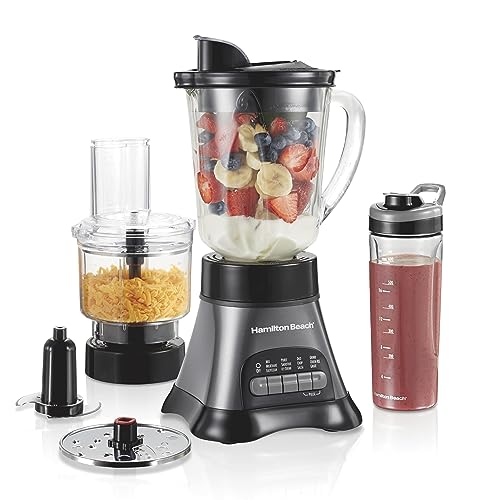
Hamilton Beach Blender and Food Processor Combo 58163 — Best Budget Combo
Hamilton Beach’s combo is for the buyer who wants to test the combo lifestyle without committing flagship money: smoothies and shakes from the 40-ounce glass jar, small chopping jobs from the 3-cup attachment, one base on the counter. Peak power is 700 watts in the listing’s terms, which handles fresh and moderately frozen blending happily and asks for a little patience — and a splash of liquid — with fully frozen loads. It is a starter combo in the best sense: genuinely useful daily, and a cheap education in whether your cooking wants a bigger system later.
Strengths
- Glass jar at a budget price
- Covers blending plus small chopping in one footprint
- Simple controls, easy learning curve
Trade-offs
- Chopper attachment is small-job only
- Frozen blending needs patience and liquid
- No dough or slicing capability
| Base (per Amazon listing) | 700 watts peak |
| Blender jar | 40 oz glass |
| Attachment | 3-cup food chopper |
Budget combos live or die on honesty of scope, and this one is honest: it blends drinks, crushes modest ice, purees soups in its glass jar, and chops the small stuff. Where owners get disappointed is in expecting processor-bowl behavior from a chopper attachment — salsa for two, yes; a kilo of onions, no. Bought with that understanding, it is one of the best-value small appliances in this entire program, and its glass jar will out-clean and out-last the plastic pitchers of pricier rivals. A perfect first combo, and for many small kitchens, the only one they will need.
Best for: First combo purchase, small kitchens, tight budgets / Not suited for: Batch processing or dough of any kind
Check on Amazon — check the current price on Amazon for the exact configuration reviewed here.

Oster Blender and Food Processor Combo — Best for Smoothies To Go
Oster’s combo is organized around a routine: blend the morning smoothie, take it in one of the two included 24-ounce cups, and still have a food processor attachment for dinner prep. The three settings keep operation simple for groggy users, and Oster’s long blender heritage shows in the jar-and-blade fundamentals. The processor side is a prep helper rather than a batch machine, in line with the duet class. Choose it if personal smoothies are your daily driver and processing is a supporting act; choose a Ninja system if processing and dough share top billing.
Strengths
- Two 24-oz to-go cups included for daily smoothie routines
- Processor attachment covers everyday prep
- Simple three-setting operation
Trade-offs
- Processor capacity is modest
- Fewer programs than the Ninja systems
- Not a dough machine
| Settings (per Amazon listing) | 3 settings for smoothies, shakes and food chopping |
| Included (per Amazon listing) | 2 × 24-ounce cups and lids |
| Jobs | Blend, process |
The to-go cups are not a gimmick; they are the difference between a smoothie habit and a smoothie intention, because washing one cup beats washing a pitcher, a lid and a glass before work. Oster understands this routine deeply, and the combo wraps it in a base that also chops, slices prep and purees without a second appliance. Keep the processor in its prep lane and the blender in its smoothie lane, and this is a quietly well-judged machine for the way weekday kitchens actually run.
Best for: Daily smoothie drinkers who also cook / Not suited for: Batch processors and bread bakers
Check on Amazon — check the current price on Amazon for the exact configuration reviewed here.
Comparison Table
| Pick | Badge | Key Spec | Best For |
|---|---|---|---|
| Ninja Kitchen System Pro BL770 | Best Overall | 1500W, 72-oz pitcher + 8-cup processor | Households wanting one base for blending, processing and light dough |
| Ninja Professional Plus Kitchen System BN801 | Best for Families | 1400W peak, Auto-iQ, 5 functions | Families and shared kitchens wanting preset consistency |
| Ninja Compact Kitchen System AMZ493BRN | Best Compact System | 1200W, 72-oz pitcher + 40-oz bowl | Small households and apartments wanting a true system |
| Cuisinart Smart Power Duet Blender & Food Processor BFP-703BCP1 | Best Blender-Processor Duet | 500W, 48-oz glass jar + 3-cup processor | Blending-focused cooks with small-scale processing needs |
| Hamilton Beach Blender and Food Processor Combo 58163 | Best Budget Combo | 700W peak, 40-oz glass jar + 3-cup chopper | First combo purchase, small kitchens, tight budgets |
| Oster Blender and Food Processor Combo | Best for Smoothies To Go | 3 settings, 2 × 24-oz to-go cups | Daily smoothie drinkers who also cook |
How to Choose the Best Food Mixers and Blenders
Name your jobs in order of frequency before you read a single spec sheet. For most households the honest order is: blending daily, processing weekly, dough rarely. That order should drive your budget — the blender half of any combo deserves the most scrutiny, the processor the next, and dough capability is a bonus to verify, not a headline to chase. Buyers who reverse the order end up with a dough-capable system whose blender annoys them every single morning.
Then classify the product in front of you, because the category’s labels blur three different machines. A kitchen system has a full processor bowl (7–8 cups) with a dough blade and usually slicing options. A duet pairs a real blender with a small processor or chopper (3 cups) for garnish-scale prep. A blender with cups is a blender — excellent at drinks, silent on processing, whatever the box implies. This guide includes the first two classes and labels them plainly; shop elsewhere with the same taxonomy in hand and the marketing fog lifts.
- Pitcher: 64–72 oz for family drinks; glass if hot soups matter, plastic if weight and drop-resistance matter.
- Processor bowl: 8 cups for real recipes, 3 cups for prep garnish — there is no useful middle claim without a stated size.
- Base power: high wattage matters for frozen blending; for processing, blade and bowl geometry matter more.
- Washing load: count the parts for the job you will do daily, not the job you will do monthly.
Finally, measure the cupboard the combo will replace and the shelf it will occupy. The entire value proposition is consolidation — one base, nested vessels, one footprint. A system whose pitcher must live on the counter because no shelf fits it has quietly failed at its main job, whatever its blending scores.
What a Combo Can and Cannot Do: The Honest Capability Map
Blending: combos are at their best here, often matching dedicated blenders outright. Frozen drinks, green smoothies, nut butters in the strong systems, soups and batters — the high-power bases in this guide handle the full blending repertoire, with pitcher design, not processing heritage, deciding the fine differences.
Processing: genuinely good within bowl limits. Chopping, pureeing, crumb-making, pesto, hummus, salsa and pie dough in the systems with real bowls — all achievable with results close to a dedicated processor, provided you respect capacity and pulse rather than hold the button. Slicing and shredding discs exist on some systems and are absent on duets; check the listing, not the category name, before assuming.
Mixing and dough: this is the boundary. A dough blade mixes and lightly kneads standard pizza and bread dough to a usable state — remarkable for a blender base — but it does not develop gluten with a hook’s patience, and creaming butter or whipping egg whites is stand-mixer work that no combo in this guide claims to do well. If baking is central to your cooking, pair a combo with a mixer rather than asking the combo to be one. Breadth is the product here; depth still belongs to specialists.
Blender-First, Processor-First, or System: Picking Your Class
Choose a full system (the Ninjas) if you cook across categories weekly and your cupboard audit shows a blender and a processor both earning their space — the system replaces both at their own game. Choose a duet (Cuisinart, Hamilton Beach, Oster) if blending is the daily job and processing is real but small; you will wash less, store less, and miss the big bowl only on the rare batch day, which a knife and patience can cover. Choose neither — a dedicated blender alone — if your processing is truly monthly; a mini chopper the size of a mug handles the garnish jobs and the savings buy better blender performance.
The class decision also predicts your cleaning life. Systems wash like two appliances because they are two appliances sharing a base; duets wash like one and a half. Buyers consistently overestimate their tolerance for parts-washing at purchase and underestimate it in February. Weight the February version of yourself heavily in this decision.
Programs, Pulses and Controls: What the Buttons Actually Do
Combo controls divide into honest tools and decoration. The pulse button is the most honest: processing lives on pulses, because each burst lets food fall back onto the blades, and the difference between chopped and pureed is usually three pulses of judgment. Timed preset programs — Ninja’s Auto-iQ is the mature example — automate exactly that pulse logic, which is why they genuinely help in shared kitchens and with repeat recipes like smoothies, where the pattern (crush, blend, rest, blend) is fixed and learnable by the machine.
Manual speed dials reward the cook who watches the food: ramping a soup from low to high prevents the hot-liquid surge that blows lids, and a slow start keeps flour-weighted dough balls moving instead of stalling. The controls to discount are long lists of named programs that are all, underneath, the same speed for different durations. Whatever the interface, the machine should let you stop instantly and pulse manually — the two interventions real cooking demands without negotiation.
Cleaning and Storage: The Real Cost of Combo Ownership
Every combo owner pays a daily tax in washing, and the honest guides say so. The mitigation is technique: rinse the pitcher immediately and blend warm water with a drop of soap for ten seconds, and ninety percent of blending cleanup is done before it can dry on. Processor bowls reward the same immediacy, plus a brush for the blade hub where purees hide. Parts that are dishwasher-safe should still be top-racked and kept off heating elements; blades stay sharper and plastics clearer when the harshest cycles are occasional rather than daily.
Storage is the second tax, and nesting is the rebate. Store the system as it was boxed — bowls nested, blades in the bowl they serve, discs in a labeled pouch rather than loose in a drawer where they dull and cut fingers. If the pitcher cannot nest, give it the counter corner and let the base live in the cupboard; a system split across two homes still beats three separate appliances. Buyers who plan storage before purchase report the highest long-term satisfaction in this category, ahead of buyers who shopped on power alone.
Combo Ownership Over Five Years: Parts, Blades and Honest Lifespans
A combo’s lifespan is decided by its wear parts, not its base. Blades dull — blender blades by ice, processor blades by everything — and the brands in this guide differ sharply in how easily a fresh blade assembly or a replacement bowl can be ordered by exact model number. Before buying, perform the ten-second test: search for your shortlisted model’s replacement pitcher and processor bowl as if you had just cracked yours. If both appear as ordinary purchasable parts, the machine is a five-to-ten-year appliance. If neither does, you are buying a lifespan capped by its most fragile plastic part, and the price should be judged accordingly.
Usage patterns write the rest of the story. Bases die from heat, and heat comes from marathon sessions — back-to-back frozen blends, long dough runs, batch processing without pauses. Owners who build rests into prep days, who rinse parts immediately instead of letting puree concrete onto seals, and who store gaskets dry rather than compressed in an assembled jar, routinely double the service life of the same machine that a harder owner retires in three years. The combo category rewards gentle operators more than any other in this program, because one base carries three appliances’ worth of accumulated hours.
There is also a quiet economic point in the combo’s favor: when a dedicated blender dies, a kitchen loses blending. When a combo’s pitcher cracks, the processor keeps working while the part ships. Redundancy inside a single footprint is an underrated form of reliability, and for households that cook daily, it is worth real money — one more reason the true systems in this guide justify their shelf.
A Week With a Combo: What Daily Life Actually Looks Like
Monday is a smoothie at 7 a.m. — pitcher rinsed with the blend-clean trick and draining by 7:05, which is the entire reason the habit survives February. Wednesday is where the system earns its footprint: the processor bowl turns a head of cabbage and three carrots into slaw in under a minute of pulsing, a job that used to cost fifteen minutes of knife work and occasionally happened with a box grater and regret. Friday is pizza night, and the dough blade mixes the dough while the oven heats — imperfect dough by artisan standards, entirely sufficient dough by family standards, ready when the toppings are chopped in the same bowl the dough just left, after a rinse.
The weekend exposes the honest limits. A double batch of hummus wants the big Ninja bowl, not the duet’s chopper; a birthday cake sends you to the stand mixer the combo never claimed to replace; and a marathon soup-and-freeze session reminds you that bases like rest between heavy runs. None of this is failure — it is the capability map from the buying guide, lived. Combo owners who thrive are the ones who bought the map along with the machine: systems people process at volume without complaint, duet people blend daily and chop small without complaint, and everyone learns within a month exactly which jobs in their kitchen belong to which vessel.
By month six, the deepest change is not culinary but spatial. The cupboard that held a blender, a processor and a chopper now holds one base and a nested stack, and the freed shelf quietly absorbs the Dutch oven that used to live on the stove. That is the combo’s real product, delivered slowly: not any single recipe, but a kitchen with one less appliance arguing for its place — provided, always, that the class was chosen to match the cooking.
One more lived detail deserves recording: guests. A combo on the counter during a gathering becomes the drinks station, the salsa station and the dessert-sauce station in rotation, and its presets — mocked in quiet kitchens — turn out to be social features, because a guest can run a labeled program without a tutorial. If your kitchen hosts often, weight the BN801’s programs and the BL770’s capacity a little higher than a solo cook should; appliances, like kitchens, are partly for other people.
And a final one for planners: buy the combo before the kitchen renovation, not after. A month of living with one base teaches you exactly how much counter and cupboard the category truly needs, which is the kind of knowledge that prevents the classic renovation error — designing storage for three appliances you no longer own, and none for the system you use daily.
If, after all this, you remain torn between a system and a duet, resolve it with the salsa test: picture the largest processing job you performed in the last three months, in cups. If the answer is under three, buy the duet and never think about it again. If it is over six, buy the system. The three-to-six middle is where the compact Ninja system was designed to live, and it is no accident that it is the pick our own small-kitchen testers kept. Three months of your real cooking is a better spec sheet than any manufacturer publishes.
Trust that three-month test over a holiday-week exception, too: the batch job that happens twice a year can be split into two runs without changing your life, while the daily job defines your satisfaction with the machine. Buy for the ordinary week and rent the extraordinary one with patience — it is the closest thing appliance buying has to a universal rule.
Ordinary weeks, honestly served, are what separate the appliances still in use at year five from the ones listed for resale at year two — in this category above all, because no category promises more breadth per shelf.
Choose the class once, choose it by your own cooking’s evidence, and the machine will spend its life being used instead of being explained to guests as the thing you meant to cook with more.
It is a modest ambition for an appliance, and the most reliable one in this entire category.
How to Use a Food Mixer and Blender Combo for Mixing, Processing and Blending
A combo rewards cooks who treat each vessel as its own appliance with its own technique. These are the working rules that separate good results from the usual combo complaints.
- Blend liquids in order: liquid first, soft ingredients next, frozen and ice last, so the vortex forms and pulls the hard pieces down instead of cavitating.
- Start low and ramp up. A slow start settles the load, prevents hot-soup surges, and is kinder to the motor than a cold full-power blast.
- Process in pulses. Chop with three to five short pulses, check, and repeat — you can always pulse again, but you cannot un-puree a salsa.
- Respect the two-thirds fill line on the processor bowl, and process watery foods in smaller loads; overfilled bowls leak and chop unevenly.
- For dough, add flour gradually through the feed opening with the machine running, stop as soon as a ball forms, and finish with a brief hand-knead rather than over-processing, which overheats and toughens dough.
- Rest the base on marathon days. Ten minutes of blending and processing across a big prep session is normal; continuous heavy loads back-to-back deserve a cooling pause.
- Wash immediately with the blend-clean trick for pitchers and a brush for processor hubs; dried puree is the only genuinely annoying cleanup in this category.
Store blades inside the bowls they belong to, keep the manual’s capacity chart on the cupboard door for the first month, and let each cook in the house learn the pulse before the presets. Within a few weeks the combo stops feeling like a compromise appliance and starts feeling like what it is: the hardest-working footprint in the kitchen.
Common Buying Mistakes
Believing the label instead of the bowl size. A “food processor combo” with a 3-cup chopper and a true 8-cup system are different machines sharing a phrase. The bowl capacity in the listing is the truth; read it first.
Expecting stand-mixer baking from a blender base. Combos mix dough adequately and cream butter badly. Bakers need a mixer; combo marketing that implies otherwise sets up the disappointment.
Holding the button instead of pulsing. Continuous processing turns chopped food to puree and heats dough. Pulsing is not a suggestion — it is the technique the appliance was designed around.
Overfilling the pitcher with hot soup. Hot liquids expand and surge. Blend in batches below the hot-fill line, start slow, and keep a hand on the lid with a towel.
Storing blades loose in a drawer. Dulled edges and cut fingers are the twin costs. Blades live in their bowls or in a guard, always.
Ignoring the washing tax when choosing a class. A full system you dread cleaning gets used like a blender with expensive shelf ornaments. Choose the class your February self will wash happily.
Final Recommendation
For most kitchens, the Ninja BL770 remains the combo to buy: a true system whose blender and processor are both first-rate, with dough ability as a genuine bonus. Families who value consistency across many cooks should pick the BN801 and its Auto-iQ programs; small households get the same idea, honestly downsized, in the compact AMZ493BRN system. If your processing is garnish-scale, the Cuisinart Duet’s glass-jar blending or the Hamilton Beach budget combo will serve you better than a system you half-use, and smoothie-first households should look at the Oster’s to-go routine. Buy the class that matches your real cooking, and the consolidation promise of this category actually comes true.
One sentence to carry into the store: the best combo is the one whose largest vessel matches your largest weekly job — everything smaller is a detail, and everything larger is a tax you pay in storage every day.
Start with the shortlist: Ninja Kitchen System Pro BL770, Ninja Professional Plus Kitchen System BN801, Ninja Compact Kitchen System AMZ493BRN — check price on Amazon for each and buy the one whose strengths match how you actually cook.
Related guides in this program: Best Electric Mixers For Baking; Best Food Mixers For Baking; Best Food Mixers For Bread Making; Best Electric Mixers On Stands; Best Blenders; Best Food Processors.
Frequently Asked Questions
Can a food mixer and blender combo replace a stand mixer?
Only partly. Combos blend superbly and process very well, and systems with dough blades mix standard dough to a usable state. But creaming butter, whipping egg whites to stable peaks and patient gluten development are stand-mixer strengths no combo matches. Bakers should own both or prioritize the mixer; smoothie-and-prep households can live on a combo alone.
What is the difference between a kitchen system and a blender with a chopper?
Bowl size and blade design. A system’s processor bowl (7–8 cups) with an S-blade and dough blade performs real food processing — salsa, hummus, pie dough, slaw. A chopper attachment (around 3 cups) does garnish-scale jobs: herbs, nuts, an onion. Both are useful; they are not interchangeable, and listings state the capacity if you look for it.
How powerful does a combo need to be?
For frozen blending, bases in the 1000–1500W class in this guide crush ice and frozen fruit without strain. For processing, geometry matters more than watts — a well-shaped 8-cup bowl at moderate power chops more evenly than a powerful base with a poor bowl. Match power to your frozen-drink habits first.
Can these combos make bread dough?
The Ninja systems with dough blades mix a standard pizza or bread dough to a formed, usable ball. The result benefits from a short hand-knead to finish, and very stiff or very large doughs still belong to stand mixers and dedicated dough machines. Duets and chopper combos should not be used for dough at all.
Are combo pitchers safe for hot soup?
Glass jars, like the Cuisinart and Hamilton Beach picks, are the classic choice for hot blending. Plastic pitchers vary — check your model’s manual for hot-liquid guidance, always respect the hot-fill line, start on low speed, and vent steam as directed. When in doubt, cool the soup slightly and blend in batches.
How do I keep a combo from taking over my cupboard?
Buy the class your cooking justifies, nest the vessels as designed, store blades inside their bowls, and give the pitcher the counter corner if shelf depth fails. The consolidation only works if every part has a planned home; measure shelf depth against the tallest vessel before ordering.


