Disclosure: airfryerkitchensupply.com is reader-supported. When you buy through links on our site, we may earn an affiliate commission at no extra cost to you.
Where to buy
Every linked pick in this guide to the best food dehydrators for backpacking is sold on Amazon by the maker or an authorised seller. Because you will dry food at home and carry the results, compare tray material, timer length and temperature range on the current listing, then check price on Amazon on the day you order.
- COSORI Food Dehydrator, 5 BPA-Free Trays (350W) — check price on Amazon
- Nesco FD-37 Food Dehydrator — check price on Amazon
- COSORI Food Dehydrator, 5 Stainless Steel Trays (Compact) — check price on Amazon
- Excalibur Food Dehydrator Select Series, 8-Tray — check price on Amazon
- Magic Mill Food Dehydrator, 5 Stackable Stainless Steel Trays — check price on Amazon
- Hamilton Beach Digital Food Dehydrator, 5 Stackable Trays — check price on Amazon
The best food dehydrators for backpacking are not carried on the trail — they work at home, in the days before a trip, turning cooked dinners, fruit and jerky into food that weighs a fraction of the original and needs nothing but hot water at camp. That job sets the buying criteria: enough tray space to dry a full menu in one run, temperature control that covers delicate herbs and meat-based meals, a timer long enough for overnight runs, and trays that survive tomato sauce and curry without holding the smell forever.
It also helps to be honest about how you hike. A weekend walker drying two dinners and some fruit needs a different machine from a thru-hiker preparing resupply boxes for a month. This guide is organised around that difference, with compact and budget options for short trips and high-capacity shelf machines for serious batch prep. One premium name you may expect, the folding Brod & Taylor Sahara, is discussed in the buying guide rather than the picks: Amazon check returned only its carrying case and baking mats, not the dehydrator itself, so it carries no purchase link here.
Every linked pick below was verified against Amazon’s catalogue, and the specifications quoted come from those verified listings. Prices are never printed in this guide because they move; each pick links out so you can check the current price on Amazon.
One more expectation is worth setting before the picks. No home dehydrator makes backpacking food that beats a good dinner at home — that is not the contest. The contest is against the weight in your pack and the price and sameness of bought trail meals. Against those, a home machine wins clearly: dinners cost less per portion, taste like your own cooking, and can be tuned to your appetite, your spice tolerance and your dietary needs in a way no pouch range can match. Judge the machines below by how reliably they deliver that win, trip after trip, and the right choice for your kitchen usually becomes obvious.
In this guide
Quick Picks
Six machines, six different backpacking styles. Match the badge to the way you actually prepare trail food, then read the full review before deciding.
COSORI Food Dehydrator, 5 BPA-Free Trays (350W) — Best Overall. The tray size, 48-hour timer and expandable design suit a backpacker who dries a full weekend menu in one run and wants the machine to shut itself off afterwards. check price on Amazon.
Nesco FD-37 Food Dehydrator — Best Budget. A simple, proven entry point for hikers who want to test home-dried trail food — apple chips, banana, jerky and herbs — without committing to a premium machine. check price on Amazon.
COSORI Food Dehydrator, 5 Stainless Steel Trays (Compact) — Best Compact. A compact horizontal-airflow box with stainless trays and a 176°F ceiling — the small-kitchen answer for hikers who dry serious food in a small flat. check price on Amazon.
Excalibur Food Dehydrator Select Series, 8-Tray — Best for Big Batches. Eight trays of shelf-style drying for the hiker who batch-processes a whole season of trail meals in a few long weekends. check price on Amazon.
Magic Mill Food Dehydrator, 5 Stackable Stainless Steel Trays — Best Stainless Stackable. Digital control and a 48-hour timer over five stainless stackable trays — the middle path between the budget Nesco and the big shelf machines. check price on Amazon.
Hamilton Beach Digital Food Dehydrator, 5 Stackable Trays — Best for Mixed Snack Loads. Five trays and 4.2 square feet of drying space with digital control — a roomy, straightforward machine for hikers whose loads mix fruit, vegetables and jerky. check price on Amazon.
How These Picks Were Chosen
Picks were chosen for backpacking use specifically, not general kitchen drying. The first filter was tray capacity relative to trip length: a machine had to dry at least a long weekend of food for two in one run, or justify its place with exceptional compactness. The second filter was temperature range and control, because trail food spans herbs that scorch, fruit that case-hardens if rushed, and cooked meat dishes that must dry thoroughly. Timers mattered because most drying happens overnight or during a workday, and a machine that stops itself prevents the brittle, over-dried results that ruin a batch.
Tray material was the third filter. Stainless steel trays earned preference for wet, acidic and strongly spiced foods; BPA-free plastic trays stayed in the guide where the overall package — price tier, size, simplicity — made them the right tool. Every product was then verified on this site’s own Amazon connection: the listing title had to match the product described, and only verified listings received purchase links. Products that could not be verified, like the folding Sahara dehydrator itself, are discussed honestly in prose instead.
Finally, each pick had to earn a distinct badge. If two machines did the same job for the same hiker, only the stronger one stayed. That is why this list contains a budget starter, two compact options with different tray materials, a stainless stackable, a roomy digital all-rounder and a genuine production machine — six answers to six different versions of the same question.
The 6 Best Food Dehydrators for Backpacking

COSORI Food Dehydrator, 5 BPA-Free Trays (350W) — Best Overall
This is the pick for backpackers who plan food a trip at a time: a pot of chilli, a batch of fruit and a tray or two of vegetables can all dry in a single load, and the timer means the run can finish overnight without anyone watching it. It suits couples and small groups drying shared meals. It is less ideal for solo ultralight hikers who dry two portions at a time and would rather own the smallest machine on this list.
Strengths
- Five trays hold a full multi-meal batch, expandable to seven when a group trip needs more
- 48-hour timer with temperature control up to 165°F covers everything from herbs to cooked meals
- 350W draw is modest, so overnight runs stay cheap and the unit is easy to store between trips
Trade-offs
- BPA-free plastic trays rather than stainless steel, which some buyers prefer for very long runs
- Stackable trays need rotating on thick loads for perfectly even results
- No built-in storage for the fruit-roll sheets and mesh screens you will want for trail sauces
| Trays | 5 BPA-free trays, expandable to 7 |
| Temperature control | Up to 165°F |
| Timer | 48 hours |
| Power | 350W |
Backpacking food lives or dies on water weight, and this machine attacks the problem at the right scale. A cooked meal dried on a tray typically loses most of its weight as water, and five trays let you process a stew, a sauce and a side in parallel instead of running the machine three nights in a row. The 165°F ceiling matters because cooked meat dishes and leftovers should be dried hot enough to be safe, while the low end handles herbs and delicate fruit without cooking them. In practice the workflow is simple: cook the meal exactly as you would eat it, spread it thin, dry it overnight, and portion it into bags in the morning.
The expandable tray system is the quiet advantage for group trips. Add trays and the same base unit handles a four-person menu; remove them and it stores in a cupboard instead of dominating a counter. Buy the mesh screens and fruit-roll sheets from the start, because backpacking food is wetter than jerky or apple chips — sauces and mashed dishes will drip through open trays without them, and that single accessory decision is the difference between clean trays and a sticky cleanup after every batch.
Best for: backpackers drying full multi-day menus at home, including group trips / Not suited for: solo hikers who only ever dry one or two portions at a time
Check on Amazon — check the current price on Amazon before you buy.

Nesco FD-37 Food Dehydrator — Best Budget
The FD-37 suits the hiker who is dehydrating-curious: you want to know whether home-dried meals beat shop-bought pouches before spending serious money. Its fixed, fan-driven heat is tuned for the classic snack loads — fruit, herbs and jerky — which is exactly where most backpackers start. It is not the machine for precise low-temperature work or for drying large cooked dinners, where a digital model with a timer earns its keep.
Strengths
- Lowest commitment in this guide: a long-running, widely owned design with cheap extra trays
- Top-mounted fan keeps drips from wet trail meals away from the motor
- Light, simple and quick to clean, so it actually gets used before every trip
Trade-offs
- No adjustable thermostat or timer, so delicate items need checking rather than programming
- Round trays give less usable area per tray than square shelf-style machines
- Plastic construction feels basic next to the stainless models in this guide
| Format | Round stackable trays, top-mounted fan |
| Listing focus | Herbs, snacks, fruit and beef jerky (per Amazon title) |
There is a real argument that the best backpacking dehydrator is the one that gets used weekly, and simple machines win that argument. With no settings to debate, you load fruit or a marinade-soaked batch of jerky, switch it on, and rotate trays once or twice. For the classic trail snacks — the foods that make up most of what hikers actually dry — that simplicity is enough, and the money saved buys a vacuum sealer or quality storage bags, which protect dried food far more than a fancier dehydrator does.
Where it asks for compromise is cooked meals. Without a timer, an overnight stew run needs an alarm or a plug-in timer, and without temperature steps you cannot drop the heat for herbs after a hot start. Treat it as a snack and jerky specialist and it is excellent value; treat it as a full meal-prep station and the digital COSORI or Hamilton Beach below will frustrate you less. For a first season of experimenting with trail food, that trade is usually worth it.
Best for: first-time dehydrators making trail snacks, fruit and jerky on a budget / Not suited for: precise cooked-meal drying that needs a timer and temperature steps
Check on Amazon — check the current price on Amazon before you buy.
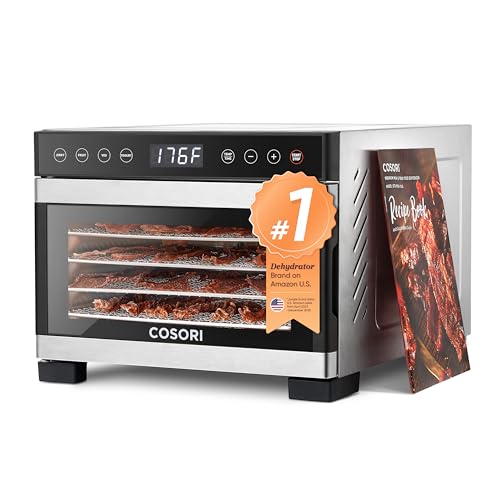
COSORI Food Dehydrator, 5 Stainless Steel Trays (Compact) — Best Compact
Apartment-dwelling backpackers are this machine’s audience. The compact footprint stores like a small microwave, the rear fan blows horizontally so trays do not need rotating, and stainless trays handle acidic tomato sauces and marinated meals without staining. The 176°F top temperature is the highest in this guide, useful headroom for meat-based trail meals. Solo hikers and couples drying two to four days of food per run are its sweet spot.
Strengths
- Horizontal airflow dries evenly without tray rotation, even on mixed loads
- Stainless steel trays: no plastic contact with food, and they shrug off acidic sauces
- 176°F maximum temperature plus 4 presets and a 48H timer give real control in a small box
Trade-offs
- 3.1 square feet of drying space is the smallest here — big group menus need two runs
- Compact box shape holds fewer trays than the full-size COSORI below in the wider range
- Presets help, but thick meals still need a mid-run check for wet centres
| Trays | 5 stainless steel trays |
| Drying space | 3.1 ft² |
| Temperature control | Up to 176°F, 4 presets |
| Airflow | Horizontal |
| Timer | 48 hours |
Horizontal airflow is the feature backpackers feel most. In stackable machines the trays nearest the fan dry fastest; in this box the air crosses every tray, so a tray of chilli and a tray of apple rings finish together and you bag one consistent batch. For trail food that consistency is safety as much as convenience: evenly dried food stores longer and rehydrates predictably at camp, instead of one leathery portion and one still-damp portion in the same bag.
The stainless trays also change what you can dry. Tomato-based sauces, curry and anything with turmeric or berries will stain and hold smells in plastic; steel scrubs clean and goes straight back into service. The honest limit is volume — 3.1 square feet dries a long weekend for two, not a week for four. If your trips are mostly short and your kitchen is small, that limit rarely bites; if you batch-cook monthly, step up to the larger Excalibur or the seven-tray Magic Mill Pro class of machine instead.
Best for: apartment backpackers who want even drying and stainless trays in a compact box / Not suited for: large-group or week-long batch drying in a single run
Check on Amazon — check the current price on Amazon before you buy.

Excalibur Food Dehydrator Select Series, 8-Tray — Best for Big Batches
This is the production machine of the group: thru-hiker resupply boxes, hunting-season jerky and families who dry a month of backpacking dinners at once. Shelf-style trays slide out like oven racks, so checking one tray does not disturb the rest, and eight trays swallow several full meals simultaneously. It is far more machine than a casual weekend hiker needs, and its footprint demands a permanent home on a counter or utility shelf.
Strengths
- Eight trays give the largest single-run capacity in this guide
- Shelf layout makes loading, checking and unloading thick meal trays easy
- Adjustable temperature control suits everything from jerky to vegetables and fruit
Trade-offs
- Large footprint: this is a dedicated-station appliance, not a cupboard machine
- Premium tier positioning — overkill if you dry food a few times a year
- Trays this big make small test batches feel wasteful
| Trays | 8 trays |
| Temperature | Adjustable temperature control |
| Listing focus | Jerky, fruit, vegetables, herbs, pet treats (per Amazon title) |
Batch economics decide whether home-dried backpacking food actually saves money, and capacity is the lever. Running a dehydrator costs roughly the same electricity for four trays as for eight, so the Excalibur halves the cost and time per meal for anyone preparing resupply boxes or a season of trips. Shelf trays also suit the way meal prep really works: a tray of rice, a tray of sauce, a tray of vegetables and a tray of meat can each be pulled the moment they are done rather than waiting for the slowest stack-mate.
Plan the storage side before you buy. Eight trays of dried meals is a lot of food, and it needs bags, labels and a cool dark cupboard or freezer space to stay at its best. Owners who set up that system — dry, portion, label with the date and the water needed to rehydrate — get the full value. Owners who dry enthusiastically for one weekend and then improvise storage usually conclude, wrongly, that home drying does not keep. The machine does its half of the job superbly; the system around it is yours.
Best for: thru-hikers, resupply prep and families drying many meals per run / Not suited for: occasional weekend hikers with limited counter space
Check on Amazon — check the current price on Amazon before you buy.
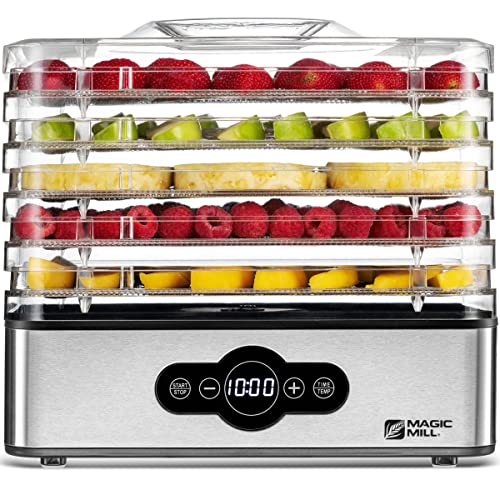
Magic Mill Food Dehydrator, 5 Stackable Stainless Steel Trays — Best Stainless Stackable
Choose this one if you like the stackable format but want it grown up: stainless trays instead of plastic, a digital timer instead of guesswork, and temperature you can set for the food in front of you. It fits backpackers drying mixed loads — some jerky, some fruit, a cooked meal or two — several times a month. Buyers who want the absolute largest capacity or a rear-fan box design should look at the Excalibur or the larger COSORI instead.
Strengths
- Stainless steel trays handle sauces and marinades without staining or holding odours
- 48-hour digital timer and adjustable temperature bring set-and-forget convenience
- Stackable format stores smaller than a fixed box with the same tray count
Trade-offs
- Stackable airflow still benefits from one tray rotation on very wet loads
- Five trays is mid-size: fine for couples, tight for group batch prep
- Digital controls add a learning step the simple Nesco avoids
| Trays | 5 stackable stainless steel trays |
| Timer | 48H digital adjustable timer |
| Temperature | Adjustable temperature control |
The Magic Mill’s appeal is that it removes the two annoyances of entry-level stackable dehydrators — plastic trays that stain, and heat you cannot adjust — while keeping the format’s small storage footprint. For backpacking use that matters in a specific way: the foods worth drying at home are often the wet, strongly flavoured ones, the curries and chillies and tomato sauces that make trail dinners worth eating. Stainless trays take those foods repeatedly without carrying last month’s curry into this month’s fruit leather.
The 48-hour timer quietly changes your schedule. Long, low runs for fruit leather or herbs can start in the evening and finish while you are at work, and the machine stops instead of over-drying the load into crisps. Set a phone reminder to check thick items once mid-run; no stackable design fully escapes gravity and airflow differences between top and bottom trays. Judged as an all-rounder for a two-person hiking household, this is one of the easiest picks in the guide to live with.
Best for: regular backpackers who want stainless trays and digital control in a stackable body / Not suited for: maximum-capacity batch prep or buyers who want a rear-fan box
Check on Amazon — check the current price on Amazon before you buy.

Hamilton Beach Digital Food Dehydrator, 5 Stackable Trays — Best for Mixed Snack Loads
This Hamilton Beach suits the backpacker whose drying is snack-led: fruit for trail mix, vegetables for soups, jerky for the pack, with the occasional full meal. The 4.2 square feet of tray space is generous for its class, and digital control keeps the process repeatable — write down the time and temperature that worked and repeat it exactly next month. It is a sensible main machine for one or two hikers, less so for resupply-scale production.
Strengths
- 4.2 sq. ft. of drying space across five trays — roomy for its tier
- Digital control makes successful batches repeatable season after season
- A mainstream brand with widely available extra trays and accessories
Trade-offs
- Stackable design: rotate trays on thick or very wet meal loads
- No standout high-temperature or preset story versus the COSORI models
- Trays and lid need hand care to stay clear and odour-free over years
| Trays | 5 stackable trays |
| Drying space | 4.2 sq. ft. |
| Listing focus | Fruit, jerky, vegetables and more (per Amazon title) |
Repeatability is the underrated virtue in trail food. A digital machine lets you treat drying like a recipe: this chilli, this thickness, this temperature, this many hours. The Hamilton Beach gives you that discipline at a mid-range tier, and its tray area is honestly sized — 4.2 square feet swallows a family-size pot of stew spread thin, or a serious haul of orchard fruit turned into the trail snacks that disappear by day two of any trip.
Use the included-style accessories properly and it punches higher: fine-mesh sheets keep small vegetables like peas and sweetcorn from falling through as they shrink, and solid sheets turn leftover smoothie or tomato sauce into fruit leather and sauce leather that rehydrate into real meals. Without those sheets, new owners often judge a dehydrator on jerky alone and miss most of what it can do for a backpacking menu. Budget for the sheets when you buy and this machine covers the full menu.
Best for: snack-led backpackers who also dry the occasional full meal / Not suited for: resupply-scale production runs
Check on Amazon — check the current price on Amazon before you buy.
Comparison Table
| Pick | Badge | Key spec | Best for |
|---|---|---|---|
| COSORI Food Dehydrator, 5 BPA-Free Trays (350W) | Best Overall | 5 trays, expandable to 7; 48H timer | backpackers drying full multi-day menus at home, including group trips |
| Nesco FD-37 Food Dehydrator | Best Budget | Simple fixed-heat round-tray design | first-time dehydrators making trail snacks, fruit and jerky on a budget |
| COSORI Food Dehydrator, 5 Stainless Steel Trays (Compact) | Best Compact | 5 stainless trays, 3.1 ft², 176°F, horizontal airflow | apartment backpackers who want even drying and stainless trays in a compact box |
| Excalibur Food Dehydrator Select Series, 8-Tray | Best for Big Batches | 8 shelf-style trays, adjustable temperature | thru-hikers, resupply prep and families drying many meals per run |
| Magic Mill Food Dehydrator, 5 Stackable Stainless Steel Trays | Best Stainless Stackable | 5 stainless stackable trays, 48H digital timer | regular backpackers who want stainless trays and digital control in a stackable body |
| Hamilton Beach Digital Food Dehydrator, 5 Stackable Trays | Best for Mixed Snack Loads | 5 trays, 4.2 sq. ft. drying space, digital control | snack-led backpackers who also dry the occasional full meal |
Read the table by trip style first and specifications second. Capacity decides how often you run the machine; tray material and airflow decide how pleasant each run is. A smaller machine used every week beats a production machine that feels like a project. Note also what the table cannot show: how a machine sounds running overnight in a small home, and how its trays feel after fifty washes. Those ownership details are covered in the reviews above and the living-with-it section below, and for an appliance that runs for half a day at a time, they matter as much as any number in a specification list.
How to Choose a Food Dehydrator for Backpacking
Start with your menu, not the machine. List what you genuinely dry: if it is fruit, jerky and herbs, almost any controlled machine works and budget models shine. If it is cooked dinners — chilli, curry, pasta sauce, risotto — you need trays that take wet food, mesh and solid sheets, and enough temperature control to dry meat-containing dishes thoroughly. Backpackers who dry full meals should weight tray material and airflow far above headline tray count.
Capacity is best measured in meals per run. Five standard trays dry roughly a long weekend of dinners for two, spread thin; eight or more trays move you into resupply and group territory. Remember that dried food keeps for weeks to months when stored well, so a bigger machine also lets you dry seasonally — orchard fruit in autumn, garden herbs in summer — and hike on the results all year.
Temperature control and a timer are the two features that separate trail-food machines from snack machines. A range reaching the mid-160s Fahrenheit handles meat dishes; low settings protect herbs and fruit leather. A 48-hour timer covers the longest legitimate runs and, more importantly, stops the machine when the food is done instead of hours later. Digital controls add repeatability: the batch notes you keep — dish, thickness, temperature, hours — become recipes you can trust at resupply time.
A note on the folding Brod & Taylor Sahara: its folding design is genuinely attractive for small homes, and it is well regarded for proofing as well as drying. It is not a linked pick here because Amazon listing data search returned only its case and mats, so no verified listing could be attached. If storage space is your overriding problem, research it separately as a premium-tier, unlinked option and compare its tray area honestly against the compact COSORI in the picks.
Tray Materials, Airflow and the Accessories That Matter
Airflow direction shapes your routine. Stackable machines blow air vertically through the trays, which keeps them cheap and compact but dries unevenly on thick loads; one mid-run rotation fixes it. Horizontal, rear-fan machines blow across shelf trays and dry mixed loads evenly without rotation, at the cost of a bigger, pricier box. Neither is wrong — the question is whether you would rather rotate trays or give up cupboard space.
Tray material decides what foods are practical. Stainless steel handles acidic, oily and strongly spiced food indefinitely and scrubs clean; plastic trays are lighter and cheaper but can stain and hold odours, which matters when last week’s curry meets this week’s fruit leather. Whichever you choose, two accessories are close to mandatory for backpacking: fine-mesh sheets, which stop peas, sweetcorn and herbs falling through as they shrink, and solid fruit-roll sheets, which make sauces, soups and fruit leathers possible at all.
Storage is the unglamorous half of dehydrating. Dried meals keep best cool, dark and airtight; vacuum sealing extends life further, and a freezer extends it most of all. Label every bag with the dish, the date and the amount of water needed to rehydrate it — at camp, tired and hungry, that label is the difference between a good dinner and a guess. A dehydrator bought alongside bags, sheets and labels is a system; a dehydrator bought alone is an experiment.
Budget Tiers for Backpacking Dehydrators
Budget-tier machines, like the Nesco in the picks, cover snacks, fruit, herbs and jerky well and are the right way to test whether home drying fits your hiking life. What you give up is control: timers, temperature steps and tray materials all simplify at this tier, and cooked meals ask more of your attention.
Mid-tier machines add the features meal-driers actually use — digital timers, adjustable temperature, stainless trays — and are where most backpackers should land. Premium-tier machines buy capacity and airflow: shelf layouts, big tray counts and even drying for production runs. Pay for the premium tier when you prepare food for groups, resupply boxes or a whole season; otherwise the mid tier does the same job in a smaller box.
What Actually Dries Well: A Trail Menu Reality Check
Not every favourite dinner survives drying, and knowing the short list saves wasted batches. The reliable core of a backpacking menu is saucy, finely textured food: chilli, bolognaise-style sauce, curries with small-cut vegetables, lentil dishes, risottos and thick soups. These spread thin, dry evenly and rehydrate into something close to the original. Fruit — apples, bananas, mangoes, berries — dries almost foolproof and carries morale as much as calories. Jerky remains the classic protein, dried from lean cuts with a marinade you enjoy eating cold.
The awkward list is shorter but important. Anything fatty — sausage, creamy sauces, cheese-heavy dishes — dries poorly and keeps worse. Large chunks dry unevenly, with leathery outsides and damp centres; cut food small before cooking, not after. Eggs divide opinion and reward careful cooks only. Whole pasta shapes can turn sharp when dry and puncture bags; small shapes or broken pieces behave better, and many backpackers dry the sauce alone and carry the pasta dry as bought, cooking both together at camp.
Rehydration is where planning pays. Meals dried as complete dishes need only their labelled water and ten patient minutes. That simplicity is worth real weight on a tired evening, and it is why this guide favours machines that handle wet, cooked food well rather than jerky-only specialists. A dehydrator that dries a full dinner turns a supermarket shop into a week of trail meals; one that only dries snacks is a smaller, though still pleasant, thing.
Running Costs, Noise and Living With the Machine
A dehydrator is one of the few kitchen appliances that runs for eight to fourteen hours at a stretch, so running character matters. Fan noise is the main complaint with stackable designs — plan overnight runs in a utility room, garage or spare room rather than a studio flat’s kitchen corner. Electricity cost per batch is modest for the wattages in this guide, and it falls per meal as tray count rises, which is the quiet economic argument for the bigger machines when you genuinely fill them.
Cleaning decides long-term ownership more than any specification. Trays that fit in a sink, lids that wipe clean and bases that never meet drips — top-fan designs shine here — keep the machine in weekly use. Before buying, picture the counter it will live on and the cupboard it will store in, and measure both. The best food dehydrator for backpacking is ultimately the one that is set up, loaded and running the week before every trip, not the one with the longest feature list.
How to Dry a Backpacking Dinner, Step by Step
The method below works for the most useful trail dinner of all — a cooked chilli, curry or stew — on any machine in this guide. The principles transfer to almost any cooked meal.
- Cook the meal exactly as you would serve it, but keep added fat low: fat does not dry, shortens storage life and can turn rancid. Lean mince, beans, lentils and vegetables dry best.
- Let the meal cool, then spread it thin and even on trays lined with solid fruit-roll sheets. Thin layers dry evenly; thick pools stay wet in the centre.
- Set a temperature in the mid-150s to mid-160s Fahrenheit for meat-containing dishes, lower for purely vegetable dishes, following your machine’s guidance for cooked meals.
- Dry until the pieces are hard and brittle with no cool, moist centre when broken. Expect many hours; a timer lets the run finish overnight without over-drying.
- Condition the batch: seal it loosely in a jar for several days, shaking daily. If moisture appears on the glass, return it to the dehydrator — this step catches uneven batches before they spoil in storage.
- Portion into bags, label with the dish, the date and the water volume needed, and store cool and dark. At camp, add the labelled amount of hot water, rest ten minutes, and eat.
Portioning deserves one more minute of thought. Dry and bag meals in the portion sizes you actually eat after a full day walking, which are usually larger than kitchen portions — a hungry hiker under-served by a neat little bag will raid tomorrow’s food and unravel the whole plan. Weigh a test portion at home, eat it after a long day walk, and adjust. Record the final weight and water volume on the label, and your future self, standing in a windy camp kitchen, will not have to think at all.
Two habits separate reliable trail food from disappointing trail food. The first is drying thinner than feels necessary; the second is rehydrating patiently — most home-dried meals need a full ten minutes in hot water, ideally insulated in a cosy or a wrapped pot, before the texture comes back. Judge your first batch at home, not on a mountain: cook one portion in the kitchen, adjust seasoning and water, and write the result on the bag label.
Common Buying Mistakes
Buying capacity for trips you never take
A production machine is wonderful for resupply prep and a burden for a hiker who dries two dinners a month. Match tray count to your real trip calendar; compact machines get used more, and used machines are the ones that save money.
Drying fatty meals and expecting them to keep
Fat is the enemy of dried-food storage. Rich, oily dishes taste great fresh and turn rancid in the bag. Cook lean for the trail, and add flavour with dried spices and a small oil sachet carried separately instead.
Skipping the mesh and solid sheets
Without sheets, sauces drip, small vegetables fall through, and half the backpacking menu is off the table. Sheets cost little, wash easily and are the highest-value accessory in this entire category.
Forgetting to label water amounts
Every dried meal rehydrates at a different ratio. Unlabelled bags become campfire guesswork. Write the water volume on every bag at portioning time, while the kitchen scales and notes are in front of you.
Storing dried food warm and lit
Heat and light degrade dried food quietly. A cool, dark cupboard or the freezer preserves the work you did; a bag on a sunny shelf undoes it in weeks.
Final Recommendation
If you buy one machine from this guide, make it the COSORI 5-tray: it covers the full backpacking menu, expands when a group trip demands it, and its timer suits the overnight rhythm of trip preparation. Apartment hikers should look hard at the compact stainless COSORI instead, and anyone preparing resupply boxes or group food should step straight to the Excalibur 8-tray.
On a budget, the Nesco FD-37 remains the honest starter: it will tell you within one season whether home-dried trail food is your thing, and its snack and jerky work is genuinely good. The Magic Mill and Hamilton Beach sit between those poles — stainless stackable control from one, roomy digital simplicity from the other.
Whichever you choose, buy the mesh and solid sheets at the same time, keep batch notes, and label every bag. The machine dries the food; the system around it is what puts a hot, light, good dinner in your hands at the end of a long day on the trail.
If you want the shortest possible shortlist, start with the COSORI Food Dehydrator, 5 BPA-Free Trays (350W), keep the Nesco FD-37 Food Dehydrator as the value alternative, and step up to the COSORI Food Dehydrator, 5 Stainless Steel Trays (Compact) only when its extra capacity or control matches how you actually cook.
Best Food Dehydrators Best Commercial Food Dehydrators Best Affordable Food Dehydrators Best Dehydrators For Raw Food Diet Best At Home Food Dehydrators Best Buy Food Dehydrators
Frequently Asked Questions
Do backpackers carry a dehydrator on the trail?
No. Dehydrating happens at home before the trip. The machine removes water from cooked meals, fruit and jerky so the food you carry is light, compact and shelf-stable; at camp you add hot water back. The dehydrator itself stays in the kitchen.
How long does home-dried backpacking food keep?
Properly dried, conditioned and stored cool, dark and airtight, most meals keep for weeks to a few months, and longer in a freezer. Fat content is the main limit — lean dishes keep best, which is why trail recipes are cooked lean and flavoured with spices.
What temperature should cooked meals dry at?
Meat-containing dishes are typically dried at the top of a home dehydrator’s range, around the mid-160s Fahrenheit, until hard and brittle throughout. Follow your machine’s guidance for cooked meals, spread food thin, and use the conditioning step to catch any damp pieces before storage.
Are stainless steel trays worth it for trail food?
For snack-only drying, plastic trays are fine. For cooked meals — especially acidic or spiced dishes like tomato sauce and curry — stainless trays resist staining and odours, scrub clean, and last indefinitely. Frequent meal-driers usually find them worth the step up.
How much food should I dry per trip?
A practical rule is one tray-load per two to three days of dinners for two people, plus snacks. New dehydrators should dry one test batch, eat it at home to check seasoning and water ratios, and only then scale up to a full trip menu.
Can I dry a whole meal together, or ingredients separately?
Both work. Whole-meal drying is simpler and rehydrates into a finished dish; separate ingredients give flexibility to recombine at camp but need more bags and notes. Most backpackers dry whole dinners for weeknights on the trail and keep a few separate staples — vegetables, sauce leather — for variety.


