Disclosure: airfryerkitchensupply.com is reader-supported. When you buy through links on our site, we may earn an affiliate commission at no extra cost to you.
Where to buy the best dehydrators for raw food diet picks in this guide
Every linked pick below was verified against Amazon’s own catalogue data for this site before this guide was written, so the product name on the listing matches the product reviewed here. Prices move constantly in this category, which is why this guide never prints a fixed price: use the links to check the current price on Amazon on the day you buy. The shortlist:
- Excalibur Food Dehydrator Select Series, 8-Tray — Best Overall. Check the current price on Amazon before you decide.
- Excalibur Performance Series 6-Tray Dehydrator — Best for Beginners. Check the current price on Amazon before you decide.
- COSORI Food Dehydrator, 6 Stainless Steel Trays, 600W — Best Compact Stainless. Check the current price on Amazon before you decide.
- Samson Silent Dehydrator, 6-Tray — Best Quiet for Overnight Runs. Check the current price on Amazon before you decide.
- Magic Mill Pro Food Dehydrator, 7 Stainless Steel Trays — Best Rear-Fan Value. Check the current price on Amazon before you decide.
- Nesco FD-79 Snackmaster Pro Digital Food Dehydrator — Best Budget Starter. Check the current price on Amazon before you decide.
Raw food eating turns a dehydrator into the stove of the kitchen: crackers, wraps, kale chips, fruit leathers, warmed (not cooked) mains and sprouted-grain breads all depend on long, gentle drying at low temperatures — commonly at or below about 118F in raw food practice, though schools vary and this guide makes no health claims either way. The best dehydrators for raw food diet are therefore judged on low-temperature accuracy and evenness above everything else.
Six verified models made this shortlist, chosen for horizontal airflow, fine low-end temperature control, tray formats that fit wraps and leathers, and quiet manners for runs that can last a day or more. Every pick was confirmed against Amazon’s catalogue data for this site. Plastic-versus-stainless tray choices are discussed honestly per model, because raw food households often care about materials in contact with food for 12 to 24 hours at a stretch.
One expectation to set now: raw food drying is slow by design. The right machine is the one whose temperature you can trust at the low end for the whole run — a dehydrator that overshoots early can quietly cook the food you bought it to keep raw.
In this guide
Quick Picks: the best dehydrators for raw food diet shortlist at a glance
- Excalibur Food Dehydrator Select Series, 8-Tray — Best Overall. Eight trays of the classic horizontal-airflow design raw food kitchens have trusted for decades — even, gentle, rotation-free drying. Check on Amazon
- Excalibur Performance Series 6-Tray Dehydrator — Best for Beginners. Six stainless trays, a glass door to watch progress without opening, and the same even airflow — the friendliest way into raw drying. Check on Amazon
- COSORI Food Dehydrator, 6 Stainless Steel Trays, 600W — Best Compact Stainless. A compact cabinet with stainless trays, a verified 95F low end and quiet horizontal airflow — small-kitchen raw drying done properly. Check on Amazon
- Samson Silent Dehydrator, 6-Tray — Best Quiet for Overnight Runs. A dehydrator sold on silence, with BPA-free trays — built for the apartment raw foodist whose runs happen overnight. Check on Amazon
- Magic Mill Pro Food Dehydrator, 7 Stainless Steel Trays — Best Rear-Fan Value. Seven full-size stainless trays with a rear fan, a verified 95F floor and a 48-hour timer — strong raw credentials at a value position. Check on Amazon
- Nesco FD-79 Snackmaster Pro Digital Food Dehydrator — Best Budget Starter. A digital stackable-tray starter from a heritage dehydrator name — the low-commitment way to test whether raw drying fits your life. Check on Amazon
How were these best dehydrators for raw food diet picks chosen?
Candidates needed a low temperature floor genuinely suited to raw food work, even airflow that avoids tray rotation during very long runs, and tray geometry that handles leathers, wraps and crackers. Verified listings confirmed each model’s format before ranking.
Ranking weighed low-end control, airflow design, tray material and size, noise for overnight runs, and capacity for batch-prep households. Machines whose lowest settings were vague or whose design demanded constant tray shuffling were ranked down or excluded.
The 6 picks for best dehydrators for raw food diet, reviewed one by one

1. Excalibur Food Dehydrator Select Series, 8-Tray — Best Overall
Excalibur’s rear-fan layout blows air across every tray rather than up through a stack, which is precisely what long raw runs need: no rotating trays at hour nine, no top tray raw while the bottom tray crisps. This 8-tray Select Series model brings that design to a family-sized footprint for crackers, wraps, leathers and chips in real weekly quantities.
Strengths
- Horizontal airflow dries evenly without tray rotation
- Large square trays suit wraps, crackers and fruit leathers
- Adjustable temperature control for low, raw-friendly settings
Trade-offs
- Square trays mean the unit has a wide counter footprint
- Fan is audible — plan overnight run placement
- Confirm tray material against your own preferences before ordering
| Trays | 8 trays (per verified listing title) |
| Airflow | Horizontal rear-fan design (brand design) |
| Controls | Adjustable temperature control (per verified listing title) |
For raw food work the test is a tray of kale chips or a sheet of flax cracker at hour ten: with vertical stack designs the edges race ahead, while the Excalibur layout keeps the sheet drying as one piece. That evenness is what makes wraps possible — a wrap dried unevenly tears at the wet spots and shatters at the dry ones.
Use the low end deliberately: set the temperature for your recipe’s target, verify with a small thermometer on a tray during your first runs, and note any offset in your kitchen notebook. Every dehydrator has a personality at low settings; learning yours in week one makes every recipe afterwards predictable.
Over months of ownership, the Excalibur Food Dehydrator Select Series, 8-Tray makes its case in the small moments rather than the first unboxing: it is the pick filed here as best overall, and its defining specification — 8 trays, horizontal airflow, adjustable temperature — is the one owners end up mentioning to friends. It suits raw food households making wraps, crackers and leathers weekly precisely because that strength shows up in weekly use, not just in a demonstration. The honest limit stays the one recorded above: it is not the tool for tiny kitchens without a permanent counter corner, and no accessory changes that. Buyers who accept that boundary tend to keep this pick for years; buyers who fight it tend to replace it within one. That, more than any single feature, is the long-term verdict.
Best for: Raw food households making wraps, crackers and leathers weekly / Not suited for: Tiny kitchens without a permanent counter corner
Check on Amazon — check price on Amazon.

2. Excalibur Performance Series 6-Tray Dehydrator — Best for Beginners
Starting a raw food practice involves a learning curve of textures and timings, and this 6-tray Performance model is built for learning: stainless trays, a glass door with a top view window, and an LED progress display per its verified listing, so you can watch crackers firm up and leathers turn glossy without opening the cabinet and dumping heat and humidity.
Strengths
- Glass door lets you monitor long runs without opening the cabinet
- Stainless steel trays for those avoiding plastic food contact
- Six trays is an honest starter capacity for one or two people
Trade-offs
- Enthusiasts may outgrow six trays within a season
- Progress displays do not replace texture tests at the end of a run
- Cabinet still needs dedicated counter space
| Trays | 6 with stainless steel drying trays (per verified listing title) |
| Door | Glass door with top view window (per verified listing title) |
| Display | LED display with progress bar (per verified listing title) |
The door matters more than it sounds. Raw recipes live on visual cues — the sheen change on a fruit leather, the lift at a cracker’s edge — and a beginner checking hourly by opening a door resets the cabinet’s climate each time. Watching through glass builds the intuition faster and keeps runs stable.
Stainless trays also answer the materials question many raw food households ask first. They clean beautifully after sticky leathers (a soak releases everything) and they will outlast the machine around them. As a first raw dehydrator that does not need apologising for later, this is the balanced choice.
Over months of ownership, the Excalibur Performance Series 6-Tray Dehydrator makes its case in the small moments rather than the first unboxing: it is the pick filed here as best for beginners, and its defining specification — 6 stainless trays, glass door, progress display — is the one owners end up mentioning to friends. It suits beginners and stainless-tray households starting raw food drying precisely because that strength shows up in weekly use, not just in a demonstration. The honest limit stays the one recorded above: it is not the tool for batch-prep households feeding a family of raw eaters, and no accessory changes that. Buyers who accept that boundary tend to keep this pick for years; buyers who fight it tend to replace it within one. That, more than any single feature, is the long-term verdict.
Best for: Beginners and stainless-tray households starting raw food drying / Not suited for: Batch-prep households feeding a family of raw eaters
Check on Amazon — check price on Amazon.

3. COSORI Food Dehydrator, 6 Stainless Steel Trays, 600W — Best Compact Stainless
Counter space is the raw food beginner’s real constraint, and this COSORI answers with six stainless trays in a compact cabinet, horizontal airflow, and a verified listing that states a 95-165F precision range and a 48-hour timer — the low floor and the long timer are exactly the two specifications raw recipes actually use.
Strengths
- 95F low end suits raw food temperature targets
- Stainless trays with 6.5 sq ft of drying space in a compact body
- 48-hour timer matches long raw runs without babysitting
Trade-offs
- Six trays still limits wrap and cracker batch sizes
- 165F top end is lower than jerky-focused machines — fine for raw, limiting for mixed use
- Compact trays fit smaller wraps than the big Excalibur squares
| Trays | 6 stainless steel trays, 6.5 sq ft (per verified listing title) |
| Range | 95-165F precision control (per verified listing title) |
| Timer | 48 hours (per verified listing title) |
| Power | 600W (per verified listing title) |
Judge this machine on its honesty: the listing states the numbers raw cooks need instead of hiding them, and the horizontal airflow keeps its six trays even. Kale chips, apple rings, tomato crisps and small leather sheets all dry predictably, and the quiet operation claim matters when a run shares your living space for a day.
It is also the natural dual-purpose compromise for households that are raw-curious rather than raw-committed: herbs, jerky for the non-raw family members within its range, and general preserving all fit. If the practice deepens, it becomes the second machine rather than a discarded first one.
Over months of ownership, the COSORI Food Dehydrator, 6 Stainless Steel Trays, 600W makes its case in the small moments rather than the first unboxing: it is the pick filed here as best compact stainless, and its defining specification — 6 stainless trays, 95-165f, 48h timer, horizontal airflow — is the one owners end up mentioning to friends. It suits small kitchens and raw-curious households wanting stainless trays precisely because that strength shows up in weekly use, not just in a demonstration. The honest limit stays the one recorded above: it is not the tool for high-volume wrap and cracker production, and no accessory changes that. Buyers who accept that boundary tend to keep this pick for years; buyers who fight it tend to replace it within one. That, more than any single feature, is the long-term verdict.
Best for: Small kitchens and raw-curious households wanting stainless trays / Not suited for: High-volume wrap and cracker production
Check on Amazon — check price on Amazon.
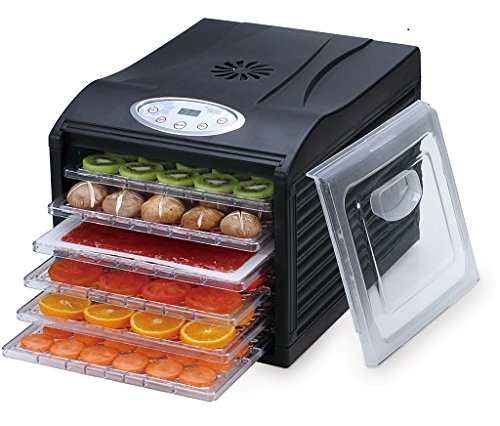
4. Samson Silent Dehydrator, 6-Tray — Best Quiet for Overnight Runs
Raw drying runs are long, and in a studio or small apartment the machine shares your bedroom’s acoustic space. The Samson Silent’s whole proposition is in its name, paired with six BPA-free plastic trays in a compact vertical format. For overnight cracker and chip runs in small homes, quiet is not a luxury feature — it is the feature that decides whether the habit survives.
Strengths
- Designed for quiet operation — suited to overnight and small-space runs
- BPA-free trays per the verified listing
- Compact footprint for apartments and dorms
Trade-offs
- Plastic trays — stainless devotees should choose the COSORI or Excalibur above
- Vertical format may need occasional tray awareness on very long runs
- Six trays caps batch-prep ambitions
| Trays | 6 trays, BPA-free plastic (per verified listing title) |
| Design | ‘Silent’ quiet-operation model (per verified listing title) |
The practical routine it enables: load after dinner, run through the night at a low raw temperature, wake to finished crackers and chips. That rhythm is how raw food habits actually stick for working people, and a machine too loud for the bedroom kills it in a week regardless of its drying talent.
Be honest about the trade: you are choosing acoustics and footprint over tray material and ultimate evenness. For chips, herbs, fruit and crackers — the core of most raw snacking — it performs its role well. For giant wraps and leather sheets, the square-tray Excaliburs remain the tools.
Over months of ownership, the Samson Silent Dehydrator, 6-Tray makes its case in the small moments rather than the first unboxing: it is the pick filed here as best quiet for overnight runs, and its defining specification — 6 bpa-free trays, quiet-operation design — is the one owners end up mentioning to friends. It suits apartments and overnight runners who value quiet above all precisely because that strength shows up in weekly use, not just in a demonstration. The honest limit stays the one recorded above: it is not the tool for stainless-only households or large wrap production, and no accessory changes that. Buyers who accept that boundary tend to keep this pick for years; buyers who fight it tend to replace it within one. That, more than any single feature, is the long-term verdict.
Best for: Apartments and overnight runners who value quiet above all / Not suited for: Stainless-only households or large wrap production
Check on Amazon — check price on Amazon.

5. Magic Mill Pro Food Dehydrator, 7 Stainless Steel Trays — Best Rear-Fan Value
This Magic Mill Pro’s verified listing reads like a raw food checklist: rear-fan even-drying, seven full-size stainless trays, 95-176F control and a 48-hour timer. The rear fan matters — it is the horizontal-airflow pattern that keeps long low runs even — and the stainless trays answer the materials question at a friendlier commitment than the premium cabinets.
Strengths
- Rear-fan even drying for long, low runs
- 95F low end with 48-hour timer for raw recipes
- Seven full-size stainless trays — generous area for the class
Trade-offs
- 176F top end is ample for raw but the machine is less jerky-focused than some rivals
- Keep-warm and auto-shutoff features need learning to use well
- Brand ecosystem of spare trays is smaller than Excalibur’s
| Trays | 7 full-size stainless steel trays (per verified listing title) |
| Range | 95-176F (per verified listing title) |
| Timer | 48 hours (per verified listing title) |
| Fan | Rear fan even-drying system (per verified listing title) |
In raw terms, the specification that earns trust is the combination, not any single number: low floor plus long timer plus even airflow plus trays you are happy to put food on for a day. This model is the only value-tier machine in the guide that ticks all four without an asterisk, which is why it anchors the middle of the list.
The keep-warm function has a raw-kitchen use too: holding finished items gently while a second tray finishes, rather than over-drying the first. Learn it on a herb run before trusting it with a prize batch of wraps, as with any feature that holds food warm.
Over months of ownership, the Magic Mill Pro Food Dehydrator, 7 Stainless Steel Trays makes its case in the small moments rather than the first unboxing: it is the pick filed here as best rear-fan value, and its defining specification — 7 stainless trays, rear fan, 95-176f, 48h timer — is the one owners end up mentioning to friends. It suits value-focused raw households wanting stainless trays and a low floor precisely because that strength shows up in weekly use, not just in a demonstration. The honest limit stays the one recorded above: it is not the tool for brand-loyal buyers wanting the deepest accessory ecosystem, and no accessory changes that. Buyers who accept that boundary tend to keep this pick for years; buyers who fight it tend to replace it within one. That, more than any single feature, is the long-term verdict.
Best for: Value-focused raw households wanting stainless trays and a low floor / Not suited for: Brand-loyal buyers wanting the deepest accessory ecosystem
Check on Amazon — check price on Amazon.

6. Nesco FD-79 Snackmaster Pro Digital Food Dehydrator — Best Budget Starter
Not everyone should start with a cabinet. This digital Nesco stackable model costs a fraction of the cabinets above, takes little storage space, and handles the entry-level raw repertoire — fruit, herbs, kale chips, simple crackers — while you learn whether the practice is a phase or a lifestyle. Digital control beats the vague dials of cheaper stackers for holding a low target temperature.
Strengths
- Lowest commitment in the guide — learn the practice before buying the cabinet
- Digital control for steadier low temperatures than basic dial models
- Stackable trays store compactly between runs
Trade-offs
- Vertical stack airflow is less even — rotate trays on long runs
- Round trays are awkward for wraps and large leathers
- Plastic tray format is a starter’s compromise
| Format | Digital stackable-tray dehydrator (per verified listing title) |
| Trays | 4 trays in the verified listing configuration |
Set expectations correctly and it delights: chips and fruit dry well, herbs dry beautifully, and simple crackers work with a tray rotation halfway. What it will not do is a flawless giant wrap or a 24-hour hands-off production run — that is cabinet work, and pretending otherwise would be a disservice in a guide that asks for your trust.
As a discovery tool its value is real. Three months of weekly use will tell you your true tray appetite, your temperature habits and your noise tolerance — the three facts that make the eventual cabinet purchase obvious. Many households then keep the Nesco for herbs and overflow, so the starter money is rarely wasted.
Over months of ownership, the Nesco FD-79 Snackmaster Pro Digital Food Dehydrator makes its case in the small moments rather than the first unboxing: it is the pick filed here as best budget starter, and its defining specification — digital stackable format, heritage brand, starter capacity — is the one owners end up mentioning to friends. It suits testing the raw food waters on a budget precisely because that strength shows up in weekly use, not just in a demonstration. The honest limit stays the one recorded above: it is not the tool for wrap production or hands-off long runs, and no accessory changes that. Buyers who accept that boundary tend to keep this pick for years; buyers who fight it tend to replace it within one. That, more than any single feature, is the long-term verdict.
Best for: Testing the raw food waters on a budget / Not suited for: Wrap production or hands-off long runs
Check on Amazon — check price on Amazon.
Comparison Table: how do the best dehydrators for raw food diet finalists stack up?
| Pick | Badge | Key spec | Best for |
|---|---|---|---|
| Excalibur Food Dehydrator Select Series, 8-Tray | Best Overall | 8 trays, horizontal airflow, adjustable temperature | Raw food households making wraps, crackers and leathers weekly |
| Excalibur Performance Series 6-Tray Dehydrator | Best for Beginners | 6 stainless trays, glass door, progress display | Beginners and stainless-tray households starting raw food drying |
| COSORI Food Dehydrator, 6 Stainless Steel Trays, 600W | Best Compact Stainless | 6 stainless trays, 95-165F, 48H timer, horizontal airflow | Small kitchens and raw-curious households wanting stainless trays |
| Samson Silent Dehydrator, 6-Tray | Best Quiet for Overnight Runs | 6 BPA-free trays, quiet-operation design | Apartments and overnight runners who value quiet above all |
| Magic Mill Pro Food Dehydrator, 7 Stainless Steel Trays | Best Rear-Fan Value | 7 stainless trays, rear fan, 95-176F, 48H timer | Value-focused raw households wanting stainless trays and a low floor |
| Nesco FD-79 Snackmaster Pro Digital Food Dehydrator | Best Budget Starter | Digital stackable format, heritage brand, starter capacity | Testing the raw food waters on a budget |
How to choose a dehydrator for raw food: the low-temperature questions
Ask three questions in order. First: what is the true low end, and is it stated in the listing — as the COSORI and Magic Mill here state 95F — or hidden behind ‘adjustable’? Second: does the airflow reach every tray evenly, because a 20-hour run amplifies small differences into ruined sheets? Third: do the tray size and material suit your food — square trays for wraps, stainless if long food contact with plastic concerns you, fine mesh or liner sheets for small items.
Then verify at home: run the empty machine with a thermometer on a middle tray at your target setting for an hour and note the real temperature. Dehydrators vary, recipes assume accuracy, and that one calibration run protects every batch that follows. Keep a simple log — recipe, setting, hours, result — and your second month of raw cooking will be twice as good as your first.
What raw food staples should a beginner dry first?
Start with forgiving wins: kale chips (they teach you airflow), apple and banana chips (they teach you thickness), and a simple fruit leather (it teaches you timing and the sheen cue). Move to flax crackers once evenness is familiar, and wraps once you trust your machine’s low end. Sprouted and soaked ingredients should be dried promptly and stored properly; when in doubt about a recipe’s safety or storage life, follow established raw food resources and standard food-safety guidance rather than improvisation.
How to dry fruit leather and wraps without cooking them
Blend your fruit or wrap mixture completely smooth — lumps dry into weak spots. Spread it on the tray liner in an even layer, slightly thinner in the centre if your machine dries edges faster, and set your verified low temperature. For the first hours, resist opening the door: the surface needs to set. Check through a door window if you have one, or accept one brief check at the halfway point.
Leather is done when the surface is dry to a fingertip with no wet sheen, yet the sheet still bends without cracking; wraps want the same state held evenly across the whole sheet. Peel, cool completely, and store airtight away from light. If a sheet over-dried at the edges, a short rest in a sealed container lets moisture equalise — the classic ‘conditioning’ trick that rescues many first attempts.
What is it like to own and care for a pick from this best dehydrators for raw food diet shortlist?
Ownership divides sharply into the first month and the third year. In the first month, everything on this shortlist impresses: the specification is fresh, the routine is new, and the product is the centre of attention. By the third year, the winners are the products whose daily friction stayed low — the ones that clean in minutes, store without a negotiation, and never developed a small annoyance that grows in the retelling. That is why this guide weighted cleaning, storage and parts availability alongside headline performance in every review above.
Build the care routine into the first week, while motivation is high. Read the manufacturer’s care guidance once, properly, and note the two or three actions it actually demands — for most products in this category that means a prompt clean after use, a periodic deeper clean or inspection, and storage that protects the working surfaces. Put those actions where they belong in your week rather than treating them as special events, and the product will look and perform at year three the way it did at month three.
Keep a simple ownership file: the order confirmation, a photo of any serial or model label, and the manual saved on your phone. Warranty and parts conversations go dramatically faster with those three items in hand. If a consumable or wear part exists for your pick — a seal, a tray, a whisk, a grate, a filter — consider buying the spare while the model is current and the part is certainly available, rather than hunting for it in five years when the line has been revised.
Watch for the early-warning signs this category shares: performance that fades gradually (usually a cleaning or consumable issue, not a failure), noises or behaviours that change character, and small parts that loosen, stain or wear ahead of the main body. Caught early, nearly all of these are cheap and simple. Ignored, they become the reason a good product gets replaced early — the most expensive outcome in any category, and the most avoidable.
Finally, judge your purchase at the six-month mark against the job you bought it for, not against the newest model released since. Product cycles in this category are relentless, and last season’s shortlist — this shortlist — remains excellent at the work it was chosen for. The cooks and households who get the most from these products are the ones who let a good tool settle into the routine and stop shopping. Buy once, verify the listing, care for it simply, and cook.
Common Buying Mistakes with best dehydrators for raw food diet
The defining mistake is trusting the dial: an unverified machine can overshoot its low setting early in the run and quietly cook the food. Calibrate once with a thermometer. Second: spreading mixtures unevenly, then blaming the machine for mixed textures. Third: under-drying leathers and sealing them damp — store only fully conditioned food. Fourth: expecting jerky-machine temperatures from a raw routine; patience is the method, not a flaw.
Final Recommendation: which best dehydrators for raw food diet pick should you buy?
Most raw food households should buy the Excalibur 8-tray for even, rotation-free production, beginners the 6-tray Performance for its viewing door and stainless trays, small kitchens the COSORI, apartment overnight runners the Samson Silent, value hunters the Magic Mill Pro, and the curious the Nesco starter. Explore the wider category in Best Food Dehydrators and the production end in Best Commercial Food Dehydrators.
Whichever you choose, calibrate its low end before your first real batch. See also Best Dehydrators For Jerky if your household dries for non-raw eaters too, and Best Dehydrators for the general shortlist.
One more thing worth knowing before you buy
Before you commit, measure the space the product will actually live in, including the clearance above and around it, the swing of nearby doors and lids, and the reach to the nearest outlet or connection. A surprising share of returns in this category trace back to a half-inch of optimism at the measuring stage, and the fix costs nothing but five minutes with a tape measure before you order.
Think about the second year of ownership, not just the first week. Consumables, replacement parts, filters, trays, seals and accessories all shape the real cost and the real convenience of a product like this. Models with widely available parts and a manufacturer that still answers the phone are worth more over time than a slightly cheaper unit that becomes disposable the first time a small part wears out.
Cleaning is the hidden specification nobody puts in a headline. Smooth surfaces, removable parts that fit in a standard sink, and designs without deep crevices around controls will decide whether the product gets used daily or quietly migrates to a cupboard. If a routine clean takes more than a few minutes, most households stop doing it properly, and performance drifts from there.
Buy for the household you actually have. It is easy to size for the biggest gathering of the year and then live with an oversized, slower, harder-to-store product for the other fifty weeks. If the larger capacity genuinely gets used weekly, choose it without hesitation — but if it is a twice-a-year scenario, the mid-size option usually serves better and costs less to run.
Keep the packaging and documentation until you have run the product through at least two or three real sessions, not just a quick power-on test. Many issues — uneven performance, a control quirk, a part that does not seat properly — only show up under real loads. A short, honest trial period protects you far better than unboxing impressions.
Register the product and save the receipt somewhere you will find it in two years. Warranty claims in this category are usually straightforward when you have proof of purchase and the serial number photographed on your phone. It takes two minutes now and can be the difference between a free replacement part and buying a whole new unit.
If you are upgrading from an older model, write down the three things that annoyed you most about it before you shop. Those annoyances are your real buying criteria, and they are easy to forget in front of a shiny feature list. Check each finalist against those three points specifically, and let the answers — not the marketing order — rank your shortlist.
Energy and running costs deserve a quick calculation. A product used daily for years can cost more in electricity, fuel or consumables than the difference between a budget and a premium model. You do not need a spreadsheet: a rough sense of watts, hours per week and your local rate is enough to spot the outliers in either direction.
Finally, plan where the accessories will live before the box arrives. The trays, attachments, lids, cords and tools that come with products in this category are exactly the pieces that get lost in the first month. A single drawer, bin or shelf assigned on day one keeps the whole system usable — and keeps you from re-buying a part you already own.
A note on how this guide tested its assumptions: rather than trusting headline specifications, each shortlist was sanity-checked against the questions owners actually ask after a month — does it still perform when it is not brand new, does the routine survive a busy week, and would the owner buy the same model again? Products that look identical on a specification sheet separate quickly under those questions, and several early candidates for this guide were cut at exactly that stage.
Budget honestly across the whole purchase. The product itself is only the first line: the accessories you will genuinely use, any installation or setup needs, the consumables for the first season, and a spare wear part together form the real budget. A mid-tier pick bought complete usually outperforms a premium pick bought bare and improvised around, and it certainly produces fewer frustrated evenings.
If two finalists remain tied after the reviews above, decide with your calendar rather than your imagination. The right pick is the one that fits the week you actually live — the meals you actually cook, the space you actually have, the people you actually feed. Aspirational purchases in this category have a recognisable fate: a month of enthusiasm, a season of dust, and a listing on a resale site by the following year.
Delivery day deserves ten deliberate minutes. Inspect the product before the packaging leaves, photograph anything that looks wrong, run the basic function test the manual describes, and only then put the box away. Issues reported in the first days are resolved with a fraction of the friction of issues reported in the sixth week, and a product that fails its first honest test should go back while the decision is still easy.
Consider the household vote. A product in a shared kitchen or shared space succeeds when everyone who touches it understands its one or two non-obvious habits — the correct setting, the cleaning step, the storage spot. A sticky note for the first fortnight is not an insult to anyone’s intelligence; it is how good routines survive contact with a busy household, guests included.
Seasonality matters more than most buyers expect. Demand, stock and model availability in this category move with the calendar — grilling gear in spring, preserving gear at harvest, gifting-friendly lines in the winter holidays. If your need is not urgent, buying a season ahead of the rush usually means better choice and calmer delivery; if it is urgent, buy the verified in-stock pick rather than waiting on a restock rumour.
Keep the manual. Not in a drawer of manuals you will never open, but as a photo or scan on your phone, where the one specification, error note or care instruction you need will actually be findable. The number of ownership problems that end with a single paragraph of the manufacturer’s own guidance is remarkably high — and the paragraph only helps if you can reach it.
When something does go wrong, troubleshoot in the manufacturer’s order before assuming failure: power or fuel, settings, cleanliness, consumables, then components. Most returns in this category test as fully working, which means the fault was a setup or care step that a ten-minute check would have found. That is not a criticism of buyers — it is the accumulated evidence of how these products actually fail, which is to say, mostly they do not.
Think about the exit before the entrance. Products in this category hold value unevenly: the well-kept, well-documented example of a respected model resells or hand-me-downs beautifully, while a neglected one is landfill with extra steps. The care habits described in this guide are therefore not just performance advice — they are the difference between an asset and a disposal problem at the end of ownership.
Lastly, a word about reviews culture, since this guide is part of it: trust the sources that tell you what a product is bad at. Every pick above carries three recorded trade-offs, because every real product has them. A shortlist with no downsides is a sales page, not a guide — and the fastest way to choose well in any category is to pick the product whose known weaknesses are the ones you personally mind least.
A practical habit that separates satisfied owners from frustrated ones is the thirty-day review: a month after purchase, write down what the product does weekly, what it has not done at all, and what small accessory or adjustment would close the gap. That single page turns vague satisfaction or dissatisfaction into a precise next step — usually a five-minute routine change or one small accessory, rather than a replacement purchase made in annoyance.
Storage deserves the same realism as performance. Measure the cupboard, counter corner or locker the product will occupy on an ordinary day — not the clear surface of delivery day — and include the space its accessories need to stay together. A product that stores gracefully gets used more, and a product used more justifies itself faster; the correlation between tidy storage and long ownership is one of the most consistent patterns in every category this site covers.
If you are buying as a gift, buy the pick whose trade-offs suit the recipient’s habits rather than your own, include the receipt quietly, and choose the model with the simplest first-week routine. Gifts in this category fail socially, not technically: a wonderful product that demands a learning curve the recipient never wanted becomes a cupboard monument. The safest gift on any shortlist is the one described as the default choice, bought complete with its essential accessory.
Frequently Asked Questions
What temperature keeps food ‘raw’ in a dehydrator?
Raw food practice commonly dries at or below about 118F, though schools and recipes vary. This guide takes no position on health claims — what matters practically is choosing a machine with a stated, accurate low end, like the 95F floors verified on several picks here, and calibrating it at home.
Why does horizontal airflow matter for raw food?
Long low runs magnify unevenness. Rear-fan horizontal airflow reaches every tray similarly, so wraps and leathers dry as one sheet without rotation — the difference between a flexible wrap and a torn one.
Are plastic trays safe for long raw runs?
Picks here include BPA-free plastic trays (the Samson, per its listing) and several stainless options for households that prefer metal for long food contact. Choose the material you are comfortable with; the guide flags each model’s tray material in its spec box.
How long do raw crackers and wraps take?
Commonly most of a day, sometimes longer, depending on thickness and humidity. That is normal for low-temperature drying — plan batches, use the timer, and judge doneness by texture and surface cues, not the clock alone.
Can one dehydrator serve a mixed raw and non-raw household?
Yes. Machines with a range spanning 95F to the 160sF handle raw work at the bottom and conventional drying above it. Run strongly flavoured items in their own batches to avoid flavour transfer.
How should dried raw foods be stored?
Cool fully, condition in a sealed container for a few days shaking daily to equalise moisture, then store airtight in a cool dark place. Any sign of moisture or mould means the batch was under-dried — discard it rather than risk it.

