Disclosure: airfryerkitchensupply.com is reader-supported. When you buy through links on our site, we may earn an affiliate commission at no extra cost to you.
Where to buy
Every pick in this guide to the best fish cookers was checked against live Amazon listings before publication, and only models with a confirmed listing carry a buy link. Prices move constantly on large appliances and countertop cookers alike, so we never print a fixed price here — use the links to check the current price on Amazon, confirm the exact configuration, and read the delivery and installation terms before you order.
Bayou Classic 2212 Aluminum Outdoor Fish Cooker Set — Check the current price on Amazon
Bayou Classic B135 Sportsman’s Choice Aluminum Fish Cooker — Check the current price on Amazon
Bayou Classic 700-725 2.5-Gallon Stainless Bayou Fryer — Check the current price on Amazon
Bayou Classic 700-727 2.5-Gallon Stainless Bayou Fryer Workstation — Check the current price on Amazon
Bayou Classic 700-704 4-Gallon Stainless Bayou Fryer with Cart — Check the current price on Amazon
Bayou Classic 700-709 9-Gallon Stainless Bayou Fryer — Check the current price on Amazon
First, an honest definition, because this search misleads people: a ‘fish cooker’ in the real market is not a countertop appliance. Search the listings and the category resolves to outdoor propane fish-frying equipment — burner-and-pot sets for the backyard, patio and fish camp, and dedicated stainless fryers with baskets, thermometers and drain valves. That is what this guide to the best fish cookers covers: the verified equipment people actually buy to fry fish properly, outdoors, at scale.
And frying is the right job for this gear. A fish fry is a high-heat, high-volume, splattering event — dozens of fillets, hushpuppies, fries — that punishes an indoor stove and rewards a powerful outdoor burner with a big pot of oil that holds its temperature batch after batch. All six picks are from Bayou Classic, the Louisiana brand that defines this category; that single-brand outcome is a result of verification, not preference — rival brands’ listings could not be confirmed despite repeated searches, and we do not link what we cannot verify.
Every pick below was matched to its live Amazon listing — model, capacity and configuration confirmed. The range runs from an inexpensive aluminium pot set for occasional fries to a 9-gallon stainless fryer station for feeding a crowd, with the safety guidance this equipment demands woven through the guide.
In this guide
Quick Picks
If you only have a minute, these are the short answers. Each pick below earned its badge for a different reason, and the badge stays the same in the detailed reviews further down, so you can jump straight to the model that matches your kitchen.
- Bayou Classic 2212 Aluminum Outdoor Fish Cooker Set — Best Budget Set. The entry ticket to real fish fries: a burner-and-pot set from the category’s defining brand, at the friendliest tier in this guide. Check price on Amazon.
- Bayou Classic B135 Sportsman’s Choice Aluminum Fish Cooker — Best for Fish Camps. A 10-qt fry pot and basket on a 21-inch tall cooker, with a 5-inch fry thermometer included — the camp-ready upgrade. Check price on Amazon.
- Bayou Classic 700-725 2.5-Gallon Stainless Bayou Fryer — Best Overall. The dedicated-fryer step up: 2.5 gallons of stainless, a mesh basket, thermometer, drain valve and a braided LPG hose — freestanding or tabletop. Check price on Amazon.
- Bayou Classic 700-727 2.5-Gallon Stainless Bayou Fryer Workstation — Best Workstation Setup. The same proven 2.5-gallon stainless fryer formula, presented as a workstation for cooks who fry as a production, not an event. Check price on Amazon.
- Bayou Classic 700-704 4-Gallon Stainless Bayou Fryer with Cart — Best for Crowds. Four gallons, two baskets and a cart: the fryer for feeding a crowd without the oil temperature collapsing between batches. Check price on Amazon.
- Bayou Classic 700-709 9-Gallon Stainless Bayou Fryer — Best Event Scale. Nine gallons, three baskets, a cart with a side shelf: the full event station for the biggest fries on the calendar. Check price on Amazon.
How These Picks Were Chosen
We chose along the category’s real axis: batch size and duty cycle. Casual fish-fry households need a burner, a pot and a basket that store easily (the two aluminium sets). Regular hosts need a dedicated fryer whose oil volume holds temperature across back-to-back batches and whose drain valve ends the worst part of cleanup (the 2.5- and 4-gallon stainless models). Event-scale cooks — church fries, team fundraisers, family reunions — need the 9-gallon station.
Construction was the second filter. Stainless fryers cost more and last longer, resist rust in outdoor storage, and clean more easily; aluminium sets are lighter and cheaper, heat fast, and ask for more careful handling. Thermometers, baskets that fit the vessel, regulators and hoses included in the box were all counted — a fish cooker that needs three extra purchases is not the bargain it appears.
Verification closed the list: each model’s listing was confirmed (brand, model number, capacity and included components), and only confirmed listings carry links. We also applied a safety screen: every pick is outdoor propane equipment with a proper regulator, and the how-to section covers the non-negotiables — outdoor use only, never leave frying oil unattended, keep water and ice away from hot oil.
The 6 Best Fish Cookers
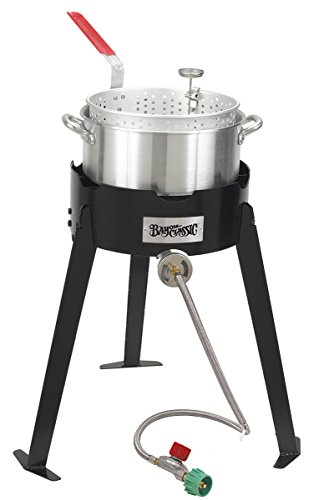
Bayou Classic 2212 Aluminum Outdoor Fish Cooker Set — Best Budget Set
The 2212 is where most backyard fish-fry traditions start: Bayou Classic’s aluminium outdoor fish cooker set — a propane burner stand and fry pot with basket — sized for family batches of fillets, shrimp and hushpuppies, and priced so that trying the hobby does not require a committee.
Strengths
- Complete starter set: burner, pot and basket in one box
- Aluminium heats fast and keeps the whole rig light to move and store
- The brand’s ecosystem of parts and accessories fits around it
Trade-offs
- Aluminium needs gentler handling than stainless — no dropping, no scouring
- Batch size suits families, not events
- Like all open-pot frying, temperature is managed by you and the thermometer
| Specification | Detail |
|---|---|
| Type | Outdoor propane fish cooker set |
| Model | 2212 |
| Material | Aluminum |
| Fuel | Propane (outdoor use only) |
What a set like this teaches you is the rhythm of a fish fry: oil to temperature, fillets in a single layer, basket out to drain while the next batch goes in, the burner adjusted by ear as the oil recovers. Aluminium’s fast response suits that rhythm — it comes back to frying temperature quickly between batches — and the whole kit breaks down to a pot and a stand that live on a garage shelf.
Its limits are the honest limits of the tier: you are the thermostat, the pot is sized for family appetites, and aluminium will dent if it lives a hard life in a truck bed. For the household that fries fish a handful of times a year — the catch of the day, a summer gathering — those limits rarely bite, and the 2212 remains the category’s sensible front door.
Best for: first-time fish fryers and families frying a few times a year / Not suited for: event cooks or anyone wanting a dedicated fryer with a drain valve
Check on Amazon to see the current price, configuration options and delivery terms for the Bayou Classic 2212.

Bayou Classic B135 Sportsman’s Choice Aluminum Fish Cooker — Best for Fish Camps
The B135 Sportsman’s Choice is the 2212 idea made more serious: a 10-quart aluminium fry pot with basket, a taller 21-inch cooker stand that is kinder to your back over a long fry, and — the detail that matters — a 5-inch fry thermometer in the box, because guessing oil temperature is how fish comes out greasy or burnt.
Strengths
- Thermometer included: proper oil temperature from your first fry
- 21-inch height is more comfortable for long sessions
- 10-qt pot handles fish, shrimp, chicken, hushpuppies and fries
Trade-offs
- Still an open-pot manual system — you manage the heat
- Aluminium care rules apply
- Family-scale, not crowd-scale
| Specification | Detail |
|---|---|
| Capacity | 10-qt fry pot |
| Model | B135 |
| Height | 21-in tall cooker |
| Includes | Fry pot, basket, 5-in fry thermometer |
| Material | Aluminum |
The thermometer deserves its headline. Fish fries fail on temperature more than any other variable: too cool and the batter drinks oil; too hot and the crust races ahead of the fish. A long-stem fry thermometer clipped to the pot turns that guesswork into a number you can hold across every batch — and it is why we rank this set above bare burners for anyone who will fry more than once.
The taller stand is the other quality-of-life upgrade nobody appreciates until hour two of a fry: less stooping over a hot pot, a more natural lift with a full basket. For fish camps, tailgates and hunting-season gatherings — the Sportsman’s Choice name is literal — this is the set built for the setting.
Best for: camp, tailgate and backyard cooks who fry regularly and want temperature control / Not suited for: buyers wanting stainless construction or a drain valve
Check on Amazon to see the current price, configuration options and delivery terms for the Bayou Classic B135.
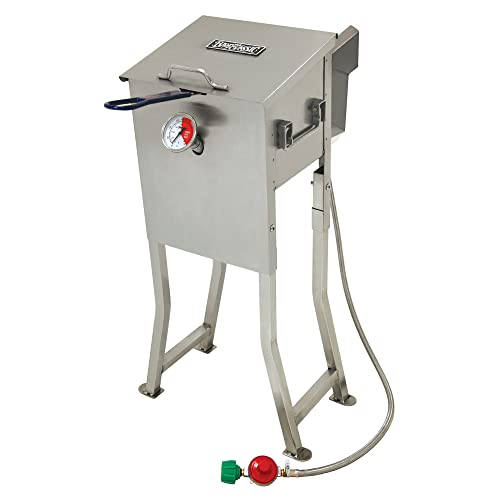
Bayou Classic 700-725 2.5-Gallon Stainless Bayou Fryer — Best Overall
The 700-725 is where a fish cooker becomes a fryer in the dedicated sense: a 2.5-gallon stainless vessel that holds frying temperature with authority, a stainless mesh basket, a fry thermometer, and the feature veterans refuse to give up once owned — a drain valve that turns oil handling from a ladling ordeal into opening a tap. It runs freestanding or on a tabletop.
Strengths
- Drain valve transforms oil draining, filtering and cleanup
- Stainless construction: durable, rust-resistant, easy to clean
- Complete kit: basket, thermometer, regulator and braided hose included
Trade-offs
- Higher tier than the aluminium sets — a real investment
- 2.5 gallons suits serious families, not large events
- Stainless rig is heavier to move than the pot sets
| Specification | Detail |
|---|---|
| Capacity | 2.5-gal |
| Model | 700-725 |
| Material | Stainless steel |
| Includes | Mesh basket, fry thermometer, drain valve |
| Hose | 48-in stainless braided LPG hose with regulator |
Oil volume is temperature stability. In a thin pot, a cold batch of fillets crashes the oil temperature and the crust steams instead of crisping; 2.5 gallons of oil in a stainless vessel shrugs off a basket-load and recovers while you plate. That is the core cooking difference between the sets above and this fryer — not features, physics — and it is why dedicated fryers exist.
The drain valve is the ownership difference. Hot-oil handling is the risky, messy part of frying; a valve lets you drain cooled oil for filtering and reuse, or disposal, without lifting a sloshing pot. Add the braided stainless hose and proper regulator in the box, and the 700-725 is the complete, grown-up version of the fish cooker idea — our overall pick for households that fry often enough to mean it.
Best for: regular fish-fry households wanting stable temperature and easy oil handling / Not suited for: occasional fryers (a set suffices) or event-scale cooks (size up)
Check on Amazon to see the current price, configuration options and delivery terms for the Bayou Classic 700-725.

Bayou Classic 700-727 2.5-Gallon Stainless Bayou Fryer Workstation — Best Workstation Setup
The 700-727 takes the 700-725’s formula — 2.5-gallon stainless fryer, mesh basket, thermometer, drain valve, high-pressure regulator and braided hose — and packages it as a workstation, for the cook who sets up a proper frying station: landing zone for raw fillets, draining space for cooked ones, everything within reach of the basket.
Strengths
- Workstation format suits organised, high-throughput frying
- Same stainless, drain-valve, full-kit virtues as the 700-725
- Ideal for cooks who fry fish plus sides in sequence
Trade-offs
- Overlaps heavily with the 700-725 — choose on setup preference and availability
- Same 2.5-gal ceiling for crowds
- Premium tier over the aluminium sets
| Specification | Detail |
|---|---|
| Capacity | 2.5-gal |
| Model | 700-727 |
| Material | Stainless steel |
| Includes | Mesh basket, fry thermometer, drain valve |
| Hose | 48-in stainless braided LPG hose with regulator |
Why a workstation? Because a fish fry is a small production line, and the bottleneck is rarely the oil — it is the cook juggling raw trays, a draining basket and a platter with one free hand. A station layout gives each stage its place, which keeps batches moving, keeps raw and cooked food properly separated, and keeps the cook’s attention on the thermometer where it belongs.
Choose between this and the 700-725 on how you fry: the 725’s freestanding/tabletop flexibility suits varied locations (patio today, camp next month), while the 727’s workstation suits a semi-permanent backyard setup where the fry station lives. The fryer at the heart of both is the same class of tool; the difference is the choreography around it.
Best for: organised backyard producers with a regular frying spot / Not suited for: mobile cooks who set up in a different place every time
Check on Amazon to see the current price, configuration options and delivery terms for the Bayou Classic 700-727.

Bayou Classic 700-704 4-Gallon Stainless Bayou Fryer with Cart — Best for Crowds
When the guest list grows — reunions, church suppers, the whole street — the 700-704 is the pick: a 4-gallon stainless fryer on a cart, with two mesh baskets so one batch drains while the next fries, a thermometer, drain valve, regulator and braided hose. This is throughput equipment, sized so the oil stays hot and the line keeps moving.
Strengths
- 4-gal oil volume holds temperature across continuous batches
- Two baskets enable a fry-drain-fry rhythm with no idle oil
- Cart format moves the whole station and stores it as a unit
Trade-offs
- A large rig: storage space and setup area required
- More oil to buy, filter and eventually dispose of
- Beyond the needs (and budget sense) of family-only fryers
| Specification | Detail |
|---|---|
| Capacity | 4-gal |
| Model | 700-704 |
| Material | Stainless steel |
| Includes | 2 mesh baskets, fry thermometer, drain valve |
| Format | Fryer with cart |
Crowd frying is a logistics problem disguised as cooking. The two-basket system is the answer this fryer gives: while basket one drains over the oil (returning oil to the pot, not the platter), basket two is already frying, so the oil’s recovery time overlaps with serving instead of idling. Combined with 4 gallons of thermal mass, the result is batch after identical batch — the definition of a successful fish fry at scale.
The cart matters more than it looks: a 4-gallon fryer full of oil is not something you carry, and a station that rolls to its spot, fries, cools and rolls back to storage is a station that gets used. If your fries regularly feed fifteen or more, this is the size where the equipment stops being the limiting factor — the cook becomes the bottleneck, as it should be.
Best for: reunions, fundraisers and hosts frying for fifteen-plus people / Not suited for: small households or anyone short on storage
Check on Amazon to see the current price, configuration options and delivery terms for the Bayou Classic 700-704.

Bayou Classic 700-709 9-Gallon Stainless Bayou Fryer — Best Event Scale
The 700-709 is the top of the verified range: a 9-gallon stainless fryer on a cart with a side shelf, three mesh baskets for a genuine multi-batch rotation, a fry thermometer and a 10-psi regulator on a braided hose. This is the rig for festival fries, big fundraisers and extended-family gatherings where “enough fish” is measured in dozens of pounds.
Strengths
- 9-gal capacity: event-scale thermal mass and throughput
- Three baskets keep a continuous fry-drain-serve rotation
- Cart with side shelf stages the whole production
Trade-offs
- Serious size, oil volume and storage demands
- Far beyond household needs — buy for events you actually run
- Oil costs and disposal at this volume need a plan
| Specification | Detail |
|---|---|
| Capacity | 9-gal |
| Model | 700-709 |
| Material | Stainless steel |
| Includes | Three mesh baskets, fry thermometer |
| Regulator | 10-psi with 48-in braided hose |
| Format | Cart with side shelf |
At event scale, the limiting factors become oil management and workflow, and the 700-709 is specified for both: three baskets mean one frying, one draining, one being loaded — a rotation that keeps the oil working continuously — while the side shelf stages battered fish in and finished fish out without crossing paths. The 10-psi regulator gives the burner the authority a vessel this size demands.
Be honest about the commitment: nine gallons of oil is a purchase, a filtration routine and a disposal plan, and the rig needs a home between events. For organisations and families whose calendar genuinely includes big fries, that commitment buys the end of the equipment question — this station, properly run, will out-fry any crowd you can assemble.
Best for: festivals, fundraisers and very large family gatherings / Not suited for: households — every smaller pick exists for you
Check on Amazon to see the current price, configuration options and delivery terms for the Bayou Classic 700-709.
Comparison Table
| Pick | Badge | Key spec | Best for |
|---|---|---|---|
| Bayou Classic 2212 Aluminum Outdoor Fish Cooker Set | Best Budget Set | Aluminum pot + burner set, propane | first-time fish fryers and families frying a few times a year |
| Bayou Classic B135 Sportsman’s Choice Aluminum Fish Cooker | Best for Fish Camps | 10-qt pot, 21-in stand, thermometer incl. | camp, tailgate and backyard cooks who fry regularly and want temperature control |
| Bayou Classic 700-725 2.5-Gallon Stainless Bayou Fryer | Best Overall | 2.5-gal stainless, drain valve, full kit | regular fish-fry households wanting stable temperature and easy oil handling |
| Bayou Classic 700-727 2.5-Gallon Stainless Bayou Fryer Workstation | Best Workstation Setup | 2.5-gal stainless workstation fryer | organised backyard producers with a regular frying spot |
| Bayou Classic 700-704 4-Gallon Stainless Bayou Fryer with Cart | Best for Crowds | 4-gal stainless, 2 baskets, cart | reunions, fundraisers and hosts frying for fifteen-plus people |
| Bayou Classic 700-709 9-Gallon Stainless Bayou Fryer | Best Event Scale | 9-gal stainless, 3 baskets, cart + shelf | festivals, fundraisers and very large family gatherings |
How to Choose the Best Fish Cookers
Start with your real headcount and frequency, because this category scales hard. A family fry a few times a year: an aluminium pot set (2212 or B135) is the rational buy. Monthly fries for a big family: the 2.5-gallon stainless fryers earn their tier in temperature stability and the drain valve alone. Regular crowds of fifteen-plus: the 4-gallon. Actual events: the 9-gallon. Oversizing wastes money, oil and storage; undersizing shows up as soggy third batches when the oil gives up.
Understand the temperature-stability principle, since it is the category’s core physics: oil temperature drops when cold food goes in, and the drop is proportional to how much oil surrounds the food. More oil (and a vessel that holds heat) means a smaller drop, faster recovery, and crust that crisps instead of absorbing grease. That — not burner bragging rights — is what you are buying as you move up this list.
Then the ownership details: a thermometer is non-negotiable (included with most picks here); a drain valve transforms cleanup and oil reuse; baskets should match the vessel so food fries submerged in a single layer; and the regulator and hose should be proper, rated parts — the listings here include stainless braided hoses, which is the standard to insist on. Finally, storage: these rigs live outdoors or in garages, which is why stainless dominates the upper half of the list.
Fish Cooker Safety: The Non-Negotiables
Outdoor only, always. Propane burners produce carbon monoxide and open frying produces splatter and flare risk; every unit in this guide is designed for outdoor use on a stable, level, non-flammable surface, away from structures and overhangs. Never fry in a garage, under a porch roof, or indoors — no exceptions for weather.
Oil discipline prevents nearly every fish-fry accident: never overfill the vessel (oil expands and food displaces — leave generous headroom), keep water, ice and wet food surfaces away from hot oil (pat fish dry; water flashing to steam is what causes boil-overs), never leave frying oil unattended, and keep a lid and a suitable extinguisher within reach — never water on an oil fire. Let oil cool completely before draining or moving the fryer, keep children and pets out of the cooking zone, and manage propane connections with leak checks each season. Frying is joyful, communal cooking; it rewards cooks who treat the setup with respect.
Steaming and Boiling: The Other Half of Fish Cookery
A fair question: what about steamed or boiled fish — the other great traditions? The same burner stands under these pot sets are the engines of the backyard boil (crawfish, shrimp, crab) with a larger stockpot, which is why our internal links point to the crawfish cooker cluster. For steaming specifically, the pot-and-basket sets can steam over water or stock for a lighter take on the catch — the burner does not care what is in the pot.
Indoor steaming and delicate fish cookery belong to different equipment — the rice-cooker steamers and multi-cookers elsewhere in this programme — and we say so rather than pretend a propane fryer is a universal fish machine. The fish cooker category is the outdoor frying tradition, done properly; within that tradition, these six verified rigs cover every scale from a couple of fillets to a festival.
Choosing and Managing Frying Oil for Fish
Oil is the working fluid of the whole category, and choosing it well matters more than any burner specification. For fish frying you want a neutral oil with a smoke point comfortably above frying temperature — peanut oil is the traditional Southern choice for its flavour and stability, with refined vegetable and canola oils as the common alternatives. Whatever you choose, consistency helps: your thermometer readings and timing instincts calibrate to one oil’s behaviour, so pick a lane and learn it.
Management decides how long that oil serves. Heat it gradually, hold it at temperature rather than letting it smoke between batches (every excursion past the smoke point shortens its life), skim the crumbs that fall from battered fish before they carbonise, and let it cool completely before filtering through a fine strainer or cheesecloth into a clean, sealed container stored cool and dark. Retire oil that has darkened substantially, smells stale, foams persistently or has fried many batches — and dispose of it through local household-waste routes, never into drains or soil. Treated this way, oil is a reusable tool; treated carelessly, it is the reason fried fish gets a bad name it does not deserve.
Batter, Breading and the Crisp Crust Playbook
The cooker supplies the heat; the coating decides the crust. Three systems cover nearly every fish fry. Beer batter — flour, seasoning and cold beer whisked to a thin cream consistency — gives the puffy, golden shell of fish-and-chip shops; keep it cold and thin, and fry immediately. Cornmeal dredge, the Southern catfish standard, wants seasoned fine cornmeal (often with a little flour), fish pressed firmly into it and rested a few minutes so the coating hydrates and adheres — the rest is the step home cooks skip and regret. Panko crumb, egg-washed first, gives the shattering crunch for delicate fillets and shrimp.
Across all three, the working rules are the same: dry fish before coating (surface water is the enemy of adhesion and the friend of oil splatter), coat in small batches just ahead of the fryer so coatings do not go soggy waiting, and fry in the single layers your rig handles without a temperature crash. Season the fish itself, not only the coating, and season again the second it leaves the oil. Do those things and the rig you bought — at any size in this guide — will produce crusts that taste like the fish fries people drive across a county for.
Beyond Frying: What Else a Fish Cooker Station Does
A burner stand and a big pot are the most versatile outdoor cooking platform a household can own, and owners quickly discover the fry is only the first act. The same rig runs the seafood boil — crawfish, shrimp, crab, corn and potatoes in seasoned water — which is why this guide’s internal links point into the crawfish-cooker cluster. It fries turkeys where the manufacturer’s equipment and instructions are rated for it (a discipline of its own, with strict oil-level rules), renders big batches of wings and fries for games, and serves as the outdoor canning and stock-making burner that keeps a steamy job out of the kitchen in August.
The dedicated stainless fryers are narrower by design — oil vessels with baskets and drains — but within frying they cover fish, chicken, fries, hushpuppies, onion rings and the whole carnival canon. Either way, the station earns its storage: a fish cooker bought for the catch becomes the backyard’s general-purpose heavy artillery, which is how a seasonal purchase turns into a year-round fixture of how a household cooks and gathers.
The Fish Fry Menu: Building a Complete Outdoor Spread
A fish cooker earns its keep as the centre of a menu, and the classic spread is engineered around the fryer’s rhythm. The fish itself fries in batches; hushpuppies — the cornmeal batter that uses the same hot oil — traditionally fry between fish batches, both to serve hot and to give the cook a timing buffer. Fries or wedges can share the oil earlier in the session (they season it least), while coleslaw, made ahead and kept cold, supplies the acid and crunch the plate needs. That menu is not tradition for its own sake: it is a production schedule disguised as a meal, each element slotted where the oil and the cook have capacity.
Scale the menu to the rig honestly. A pot set handles fish and hushpuppies for a family with the sides made in the kitchen. The cart fryers turn the whole menu into an outdoor production for a crowd, with the side shelf staging the rotation. Drinks cold, a bin for spent batter bowls, a lined tray for every batch — the difference between a fry that feels like a party and one that feels like a shift is almost entirely staging, and it costs nothing but forethought. That, plus fish cooked at the right temperature in the right-sized batches, is the entire secret the great fish-fry families have been keeping in plain sight.
Storing, Transporting and Winterising Your Fish Cooker
Outdoor cooking gear dies in storage more often than in service, and fish cookers have three specific enemies: residual oil, moisture and neglect of the gas train. After the season’s last fry — or any long pause — the routine is fixed. Oil: drain it cooled, filter what is worth keeping into a sealed container stored cool and dark, and dispose of the rest properly; never store a fryer full of oil, which turns rancid in the vessel and invites pests. Vessel and baskets: wash hot and soapy, dry completely — completely is the operative word for steel and aluminium alike — and store the pot inverted or lidded so it does not become a rain gauge or a home for anything with wings.
The burner and gas train want their own minute: brush the burner ports clear, check the hose for cracks or rodent interest (a braided hose, as supplied with the fryer picks here, resists both weather and teeth better than plain rubber), close the tank valve, and store the regulator and hose coiled loosely rather than kinked. A cover over the whole rig, in a ventilated spot, finishes the job; sealed plastic over a damp cooker is a rust incubator, not protection.
Transport follows the same logic: cool, empty, dry, and secured so the pot cannot become a projectile in a truck bed — the aluminium sets travel lightest, the cart fryers roll to the vehicle and ride best with baskets nested inside and the lid strapped. Do the storage routine faithfully and a fish cooker’s lifespan is measured in decades of summers; skip it, and you will be shopping again while your neighbour’s identical rig fries on.
Cleaning the Rig: The Ten Minutes That Decide Next Season
Post-fry cleaning has a right order, and it begins with patience: oil cools completely before anything moves. Once cool, drain through the valve where fitted, filter what you are keeping, and set the oil aside sealed. The vessel then gets hot, soapy water and a non-scratch scrub — stainless tolerates enthusiasm, aluminium asks for a gentler hand — with attention to the basket mesh, where batter residue hides and turns rancid if left. The burner gets a brush-down once cold, its ports checked clear, and the thermometer gets washed and dried like the instrument it is.
Dry everything as if rust were watching, because it is: a towel, then air, then storage covered in a ventilated spot. Ten honest minutes, every time, is the entire maintenance programme of this category — and it is why well-kept rigs fry for decades while neglected ones are replaced. The fish fry is a ritual; the cleanup is part of the ritual, and the cooks who embrace that are the ones still frying, happily, in their twentieth season.
Matching the Rig to the Catch: A Quick Field Note
Different catches reward the rigs differently, and a moment’s thought before the season saves a season of small frustrations. Delicate freshwater fillets — perch, crappie, walleye — fry fast and suit every rig here, with the smaller sets perfectly adequate for family catches. Thick catfish and saltwater fillets, fried in quantity, are where the dedicated fryers’ temperature stability stops being a luxury: batch after batch, the crust stays crisp instead of slowly surrendering to a cooling pot.
Whole small fish and thick bone-in pieces want the deepest oil and the most headroom, which argues for the larger vessels even at family scale if that is your catch. Match the rig to the fish you actually bring home — not the fish you hope to — and every pick in this guide will feel less like equipment and more like the natural end of a day on the water.
How to Run a Backyard Fish Fry: Setup to Serving
A good fish fry is a routine, not an improvisation. This sequence works with any rig in this guide and scales from the 2212 set to the 9-gallon station.
- Set up outdoors on level, stable ground away from structures; assemble the burner, connect the propane with the regulator and hose provided, and leak-check connections with soapy water (bubbles mean stop and refit).
- Fill the vessel with frying oil to the level the manual specifies — never above — leaving headroom for displacement and bubbling when food goes in.
- Heat the oil gradually to your frying temperature, monitoring with the fry thermometer clipped to the pot; while it heats, set your stations: raw fish (patted dry, seasoned or battered), landing trays lined for draining, and serving platters.
- Fry in single-layer batches sized to the rig — the oil temperature should dip, not crash. If it crashes, your batches are too big; if the crust browns before the fish cooks through, ease the burner down.
- Lift baskets to drain over the pot for a few seconds, then move fish to the lined trays; season immediately while the crust is hot and receptive.
- Let the oil recover to temperature between batches — the thermometer, not the clock, gives the all-clear — and skim crumbs that would burn and bitter the oil.
- When frying is done, turn off the burner and the tank valve, and let the oil cool completely — completely — before draining through the valve (on fryer models) for filtering, reuse or disposal per local guidance.
- Clean the cooled rig, dry it thoroughly, and store it covered; a clean, dry fryer is next season’s head start.
Common Buying Mistakes
Frying indoors or under a roof. These are outdoor appliances. Carbon monoxide, splatter and flare risk make indoor or covered use genuinely dangerous, not merely discouraged.
Overfilling the pot. Oil expands with heat and food displaces it; an overfilled pot plus a wet batch of fish is the classic boil-over. Respect the fill line and pat fish dry.
Guessing the oil temperature. No thermometer, no consistency: greasy fish when cool, burnt crust when hot. Every serious pick here includes one — use it for every batch.
Batches too big for the rig. A crashed oil temperature steams the crust soggy. Smaller batches in a smaller rig beat heroic batches in any rig.
Moving or draining hot oil. Oil stays dangerous long after the burner is off. Cool completely, then drain or move — and never use water anywhere near hot oil or an oil fire.
Final Recommendation
For most households, the Bayou Classic 700-725 is the fish cooker to own: stainless, stable, drain-valved and complete in the box. Families starting out should take the 2212 set, camp cooks the thermometer-equipped B135, production-minded hosts the 700-727 workstation, crowd feeders the 4-gallon 700-704, and event organisers the 9-gallon 700-709.
Whichever scale you choose, run it by the book: outdoors, thermometer clipped on, batches sized to the rig, oil cooled before it moves. Do that, and a fish cooker is the most joyful cooking equipment a backyard can hold — the centre of gatherings people remember by the food.
Shortlist first: Bayou Classic 2212 Aluminum Outdoor Fish Cooker Set, Bayou Classic B135 Sportsman’s Choice Aluminum Fish Cooker, Bayou Classic 700-725 2.5-Gallon Stainless Bayou Fryer — check price on Amazon for each before you decide.
Keep exploring the cooker cluster: Best Crawfish Cookers Best Camp Cookers Best Cookers For Camping Best Barbecue Cookers Best Fast Cookers
Frequently Asked Questions
What exactly is a fish cooker?
In the current market, a fish cooker is outdoor propane frying equipment: either a burner stand with a fry pot and basket, or a dedicated fryer vessel (usually stainless) with baskets, a thermometer and often a drain valve. It is built for frying fish — and shrimp, chicken, hushpuppies and fries — outdoors in batches. It is not an indoor countertop appliance, and listings that use the name refer to this outdoor category.
Can I use a fish cooker indoors or in the garage?
No. Propane burners emit carbon monoxide and open-oil frying carries splatter and fire risk; these units are designed for outdoor use only, on a stable surface away from structures and overhangs. Weather is not an exception — postpone the fry rather than move it inside.
How much oil do I need, and can I reuse it?
Fill to the manufacturer’s level for your vessel — never above — which on the dedicated fryers corresponds to their gallon capacities. Frying oil can typically be cooled completely, strained and reused a limited number of times if it has not overheated or taken on burnt flavours; store it sealed and cool, and dispose of spent oil through local household-waste guidance, never down a drain.
Why does my fried fish come out greasy?
Oil temperature, almost always: too cool and the crust absorbs oil instead of crisping. Use the thermometer, let the oil fully recover between batches, fry in single layers sized to your rig, and drain baskets over the pot before plating. A larger oil volume (the dedicated fryers) holds temperature steadier, which is their core advantage.
Aluminium set or stainless fryer — which should I buy?
Aluminium sets are lighter, cheaper and heat fast — right for occasional family fries and camp use. Stainless fryers hold temperature better across batches, resist rust in storage, clean more easily and add the drain valve — right for regular and large-scale frying. Match the material to your frequency and headcount, not to the biggest rig you can imagine using once.
Can I boil or steam with a fish cooker set?
The burner-and-pot sets are general outdoor cooking stations: with a suitable stockpot they run seafood boils (see our crawfish cooker guides), and the pot-and-basket format can steam over water or stock. The dedicated fryers, by contrast, are single-purpose oil vessels — use them for frying only, and never put water in a fryer that has held oil until it is thoroughly cleaned and dried.


