Disclosure: airfryerkitchensupply.com is reader-supported. When you buy through links on our site, we may earn an affiliate commission at no extra cost to you.
Where to Buy
Every model in this guide to the best camp cookers was checked against its live Amazon listing before this guide was written. This guide covers camp cookers in the car-camping and basecamp sense: two-burner propane stoves that ride in a vehicle, set up on a picnic table or their own legs, and cook real meals for groups — not pocket backpacking stoves, which are a different tool covered in the companion camping guide in this program.
- Camp Chef Everest 2X 2-Burner Portable Camping Stove — Best Overall — Check the current price on Amazon
- Coleman Triton+ 2-Burner Propane Camping Stove with InstaStart — Best for Most Campers — Check the current price on Amazon
- Camp Chef Explorer 2-Burner Outdoor Camping Stove — Best for Groups and Basecamps — Check the current price on Amazon
- Gas One Propane Double Burner Two Burner Camp Stove — Best High-Pressure Burner — Check the current price on Amazon
- ROVSUN 2 Burner Gas Stove with Side Shelves, 150,000 BTU — Best Outdoor Kitchen Station — Check the current price on Amazon
- Coleman Triton 2-Burner Propane Stove — Best Budget — Check the current price on Amazon
Camp stoves sell under several model generations with similar names, and propane fittings differ, so confirm the exact model, BTU rating and regulator type on the product page before ordering. If a pick is unavailable, the buying guide below explains how to compare camp stoves on paper.
The best camp cookers turn a campsite into a kitchen, and the difference between a good one and a frustrating one is rarely the cooking itself — it is wind, simmer control and whether the stove fits the pots you actually own. A two-burner propane stove is simple technology: gas, burners, grates, a lid that becomes a windscreen. But campsites are windy, mornings are cold, groups are hungry, and the stove that boils water heroically while being unable to hold a gentle simmer for pancakes will quietly ruin more breakfasts than any other gear you pack.
This guide covers six verified two-burner propane camp stoves across the real spread of the category. At one end sit the classic suitcase stoves from Coleman and Camp Chef that most car campers picture — self-contained, wind-guarded, sized for two pans. At the other end are the standing outdoor cookers from Camp Chef, Gas One and ROVSUN: legged, high-output machines built for group basecamps, big pots, brewing and frying, which cook less like a picnic accessory and more like a range you can fold into a truck.
Every pick was verified against its Amazon listing during this guide’s research, with ASINs taken from the listing responses — several of them from a single search session that returned the category’s main contenders side by side, which made cross-checking model names and BTU figures unusually direct.
One scope note, stated plainly: these are vehicle-supported stoves. None of them belongs in a backpack, and none belongs indoors — every pick here is an outdoor-only propane appliance, and the safety section of the buying guide treats that as the hard rule it is. If your camping is the walk-in kind, the companion guide to camping cookers in this program covers the compact end of the stove world.
In this guide
Quick Picks
Six verified two-burner propane camp cookers, from suitcase classics to standing basecamp ranges. Badges match the detailed reviews.
- Camp Chef Everest 2X 2-Burner Portable Camping Stove — Best Overall: two 20,000 BTU cast-aluminum burners, matchless ignition and a three-sided windscreen — the most powerful suitcase stove in the guide, with the simmer control to match. — check price on Amazon
- Coleman Triton+ 2-Burner Propane Camping Stove with InstaStart — Best for Most Campers: 22,000 BTU across two adjustable burners with wind guards and push-button InstaStart — the default camp stove, done right, from the brand that defined it. — check price on Amazon
- Camp Chef Explorer 2-Burner Outdoor Camping Stove — Best for Groups and Basecamps: 60,000 BTU on detachable legs with a 448-square-inch cooking area and a whole accessory system — less a stove, more a portable range for feeding a crowd. — check price on Amazon
- Gas One Propane Double Burner Two Burner Camp Stove — Best High-Pressure Burner: a high-pressure double burner with an adjustable PSI regulator, 4-foot hose and removable legs — built for boils, frying and wok heat rather than gentle picnics. — check price on Amazon
- ROVSUN 2 Burner Gas Stove with Side Shelves, 150,000 BTU — Best Outdoor Kitchen Station: a standing two-burner station with side shelves, wind panels and a headline 150,000 BTU rating — a backyard and basecamp cooking station for the biggest jobs. — check price on Amazon
- Coleman Triton 2-Burner Propane Stove — Best Budget: the base Triton — the same 22,000 BTU and wind guards as the Plus, at the lowest price in the guide, with match lighting as the honest trade. — check price on Amazon
How These Picks Were Chosen
Verification followed the program standard, with a useful twist: the models were searched by brand and model through the airfryerkitchensupply.com Amazon listing data connection, and the listed the category’s leading contenders together, allowing direct cross-checking of model names, burner counts and BTU figures against the Amazon titles.
Selection filtered on three things. First, format honesty: every pick is a genuine two-burner propane camp cooker for vehicle-supported camping — no single-burner backpacking stoves and no indoor appliances wearing camping language. Second, coverage of the category’s real branches: suitcase stoves at three power levels, a standing accessory-platform stove, and two high-output standing burners. Third, stated specifications in the verified listing itself — BTU, cooking area, ignition and wind protection are quoted only where the Amazon title states them.
The 6 Best Camp Cookers, Reviewed
Each review separates the two formats in this category — suitcase stoves that need a table, and standing burners that bring their own legs — because that choice comes before any other. Prices are not printed; check the current price on Amazon through the links.

Camp Chef Everest 2X 2-Burner Portable Camping Stove — Best Overall
The Everest 2X is what the classic camp stove becomes when a maker decides power is the point. Each of its two cast-aluminum burners is rated at 20,000 BTU per the verified listing — double or more what standard suitcase stoves offer per burner — under a 215-square-inch cooking surface with a three-sided windscreen and matchless ignition. That output boils big pots of water in genuinely short order, which is the job camp cooks actually time.
| Output | 40,000 BTU total (two 20,000 BTU burners) |
|---|---|
| Burners | Cast aluminum |
| Cooking area | 215 sq in per listing |
| Ignition | Matchless ignition |
| Wind protection | 3-sided windscreen |
Strengths
- Two 20,000 BTU burners — the strongest suitcase format here
- Matchless ignition: no matches, no lighter, no fumbling at dawn
- Three-sided windscreen protects flames on exposed sites
Trade-offs
- Power this high drinks propane faster than standard stoves — pack fuel accordingly
- Suitcase format still means two pans, not three, whatever the BTU says
- Premium tier within the suitcase class
The number that matters most is not the headline 40,000 but how the burners behave at the bottom of their range, because camp cooking fails at simmer far more often than at boil. Camp Chef’s burner and valve design has a long reputation for holding a low, steady flame — the pancakes-and-eggs setting — better than most high-output rivals, which tend to offer a choice between off and rocket. A stove that can do both ends of the range is the stove that cooks a whole menu, and that dual character is why the Everest takes the overall badge over several cheaper and one more powerful pick.
The windscreen deserves its mention too: at altitude and on open sites, wind is the difference between a ten-minute boil and a twenty-five-minute one, and between even heat and a pan with one hot edge. A three-sided screen that is part of the stove — not an accessory you forgot — quietly fixes both. Add the matchless ignition, which removes the single most common camp stove annoyance, and the Everest 2X is the most complete execution of the classic format in this guide.
Best for: car campers and basecamp cooks who want maximum power with real simmer control in a suitcase stove / Not suited for: backpackers, ultralight campers, or anyone counting propane ounces
Check the current price on Amazon
Coleman Triton+ 2-Burner Propane Camping Stove with InstaStart — Best for Most Campers
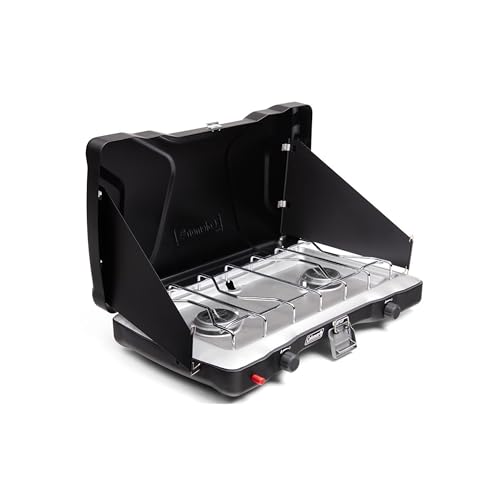
The Triton+ is the camp stove most campers should buy, and its argument is balance. Twenty-two thousand BTU is enough for any two-pan campsite meal without the fuel appetite of the high-output machines. The burners adjust across a useful range, the wind guards handle ordinary breezes, and InstaStart ignition means the stove lights with a button rather than a match ritual. Coleman has iterated this formula for decades, and the Triton+ is its current, polished form.
| Output | 22,000 BTU total |
|---|---|
| Burners | Two adjustable burners |
| Ignition | InstaStart push-button |
| Wind protection | Wind guards |
| Stated uses | Camping, tailgating, outdoor cooking, emergencies |
Strengths
- Balanced 22,000 BTU output suits real campsite cooking without guzzling fuel
- InstaStart push-button ignition, standard on this Plus model
- Coleman’s support and propane accessory ecosystem is everywhere
Trade-offs
- Less raw power than the Camp Chef picks — big pots of water take longer
- Wind guards help in breezes, not in genuine mountain wind
- No legs or stand: it needs a table or tailgate to work on
There is a reason the default recommendation in this category is a Coleman, and it is not nostalgia. It is the ownership experience around the stove: replacement parts, propane cylinders and compatible accessories are available in every sporting goods store and most gas stations in the country, and the design’s quirks are known to every camp cook alive. When a stove is one component of a trip rather than the hobby itself, that ecosystem is worth more than a spec-sheet advantage.
Against its own sibling — the base Triton reviewed below — the Plus earns its premium in the ignition and refinements. Campers light a stove a dozen times a trip, often with cold hands, often before coffee. A button that simply works, every time, is not a luxury feature in that context; it is the feature. If the budget forces the choice, the base Triton cooks identically once lit. If it does not, the Plus is the one you will be glad of on the third morning.
Best for: most car campers, tailgaters and emergency-preparedness kits wanting the proven default / Not suited for: group basecamps cooking in very large pots, or wind-blasted high-altitude sites
Check the current price on Amazon

Camp Chef Explorer 2-Burner Outdoor Camping Stove — Best for Groups and Basecamps
The Explorer is where camp cooking stops being a picnic and becomes a kitchen. Two 30,000 BTU cast-aluminum burners on detachable steel legs, a cooking area more than double the suitcase stoves’, and compatibility with Camp Chef’s 14-inch accessory line — griddles, grill boxes, pizza ovens that mount on the same burners. Scout troops, hunting camps, tailgate crews and family reunions cook on Explorers because the machine scales to the group instead of the group rationing itself to the stove.
| Output | 60,000 BTU total (two 30,000 BTU burners) |
|---|---|
| Cooking area | 448 sq in per listing |
| Legs | Detachable steel legs |
| System | Compatible with 14-inch Camp Chef accessories |
Strengths
- 60,000 BTU handles the largest stockpots and fastest boils in this guide
- Accessory system turns the same burners into a griddle, grill or pizza oven
- Standing height cooks like a range — no crouching over a picnic table edge
Trade-offs
- Size and weight are vehicle-only, and not small vehicles at that
- Open design has less wind shelter than a lidded suitcase stove
- Accessories that make it magical are separate purchases
The accessory compatibility is the strategic reason to buy an Explorer over a merely powerful stove. A basecamp kitchen grows: this season two burners, next season a griddle for the breakfast crowd, later a grill box. The Explorer is the platform all of that mounts on, and Camp Chef has supported the 14-inch system for years. Buyers who know their camp cooking is becoming a group institution should buy the platform once rather than upgrading stoves twice.
The honest costs are bulk and exposure. The Explorer packs like furniture, not like a suitcase, and its open burners sit in the weather; experienced owners cook behind a vehicle or a windbreak on rough days. It is also, emphatically, a group tool — for a couple cooking two pans, it is three times the stove the job needs, and the Everest or Triton above will serve them better in every way that matters.
Best for: groups, scout and hunting camps, tailgaters and basecamp kitchens that will grow / Not suited for: solo campers, small cars, or two-pan cooking for two
Check the current price on Amazon
Gas One Propane Double Burner Two Burner Camp Stove — Best High-Pressure Burner
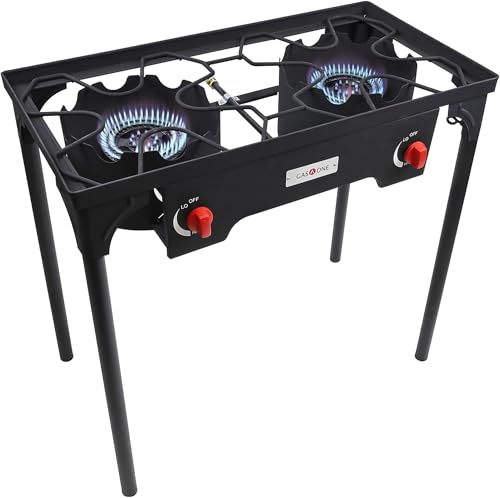
The Gas One double burner belongs to a different branch of the camp stove family: high-pressure burners, the kind used for crawfish boils, turkey frying, home brewing and wok cooking, where the job is maximum heat into a very large pot. Its adjustable PSI regulator and 4-foot hose let you run it from a standard propane tank at a distance, and the removable legs set it at working height. This is a tool for volume and velocity, not for simmering sauces.
| Type | High-pressure propane double burner |
|---|---|
| Regulator | Adjustable PSI regulator per listing |
| Hose | 4 ft hose included |
| Legs | Removable legs |
Strengths
- High-pressure output boils huge pots and heats woks like nothing else here
- Adjustable regulator gives real control over that output
- 4-foot hose keeps the tank clear of the cooking area
Trade-offs
- High pressure means a loud, fierce flame — poor at gentle simmering
- Open burner design is fully exposed to wind
- Demands respect and clearance: this is the least forgiving stove in the guide
Buyers should understand what “high pressure” buys and costs. A standard camp stove regulator delivers gas at a low, fixed pressure suited to controlled flames. A high-pressure system delivers far more fuel to the burner, producing the roaring output that brings twenty quarts of water to a rolling boil or gets a wok genuinely hot. The cost is finesse: the low end of the flame range is still a lot of flame, and delicate cooking is a fight. Match the tool to the menu — boils, fries, brews and sears here; eggs and sauces on the suitcase stoves.
Safety framing for this pick is not boilerplate. High-pressure burners produce serious heat at serious distances, need generous clearance from anything combustible, must never be used in enclosed spaces, and — for frying — demand the full discipline of outdoor fryer safety, including a thawed, dry bird and a watched pot. Used as intended, outdoors, by an attentive cook, the Gas One is the most capable heat source in this guide. It simply asks the most of its operator.
Best for: boils, brewing, turkey frying, wok cooking and large-pot camp production / Not suited for: gentle simmering, small campsites, or cooks who want a forgiving stove
Check the current price on Amazon

ROVSUN 2 Burner Gas Stove with Side Shelves, 150,000 BTU — Best Outdoor Kitchen Station
The ROVSUN is less a camp stove than a portable outdoor kitchen: a standing two-burner unit with side shelves for prep and landing hot pans, wind panels around the burners, and a headline output figure aimed squarely at the boil-brew-fry workload. It is aimed at the buyer whose “camp” is a basecamp, a backyard or a tailgate with real cooking ambitions — the person who cans, brews or fries outdoors because the kitchen cannot or should not host the job.
| Output | 150,000 BTU headline rating per listing |
|---|---|
| Design | Standing stove with side shelves |
| Legs | Removable legs |
| Extras | Wind panels, regulator included |
| Stated uses | Camping, backyard cooking, brewing, canning, turkey frying |
Strengths
- Side shelves transform workflow — prep and hot-pan space at the stove
- Wind panels give big-burner cooking some weather protection
- Standing format with removable legs suits long cooking sessions
Trade-offs
- The 150,000 BTU headline should be read as marketing arithmetic across burners — judge it as a very high-output stove, not a laboratory figure
- Largest pack size in this guide; this is vehicle-and-garage equipment
- ROVSUN lacks the decades-deep support ecosystem of Coleman or Camp Chef
The shelves are the feature to take seriously, because they solve the problem every standing-burner cook knows: where does the hot pot go when it comes off, and where do the ingredients wait? A stove with landing space cooks like a kitchen; a bare burner frame cooks like a balancing act. For canning days, brew days and fry days — long sessions with heavy pots in motion — that workflow difference is worth more than any BTU number on the box, including this one’s very large one.
On that number: treat headline BTU totals on standing burners as a class indicator, not a measurement. What matters practically is that this class of burner brings large volumes to temperature fast and holds a boil against a big pot’s losses — and by every account of the format, it does. Buy the ROVSUN for the station design and the output class, confirm the regulator and fittings on the listing, and it will handle the heaviest outdoor cooking in this guide.
Best for: basecamp and backyard production cooking — canning, brewing, frying and big-batch days / Not suited for: compact camping, small vehicles, or brand-support-first buyers
Check the current price on Amazon

Coleman Triton 2-Burner Propane Stove — Best Budget
The base Triton is the budget door into this entire category, and it is a better door than most: the same 22,000 BTU output and wind-guarded two-burner layout as its Plus sibling, from the same maker, at the lowest cost in this guide. What the savings cost you is convenience — principally push-button ignition, which this model omits in favor of a match or lighter. Everything that touches the food is the same.
| Output | 22,000 BTU total |
|---|---|
| Burners | Two adjustable burners |
| Wind protection | Wind guards |
| Stated uses | Camping, tailgating, outdoor cooking, emergencies |
Strengths
- Full 22,000 BTU two-burner cooking at the guide’s lowest tier
- Wind guards included — not an accessory upsell
- Coleman parts and propane availability everywhere
Trade-offs
- Match or lighter lighting — carry a lighter, and a spare
- Same table-dependent format as the Plus: no legs, no stand
- Fewer refinements than the Plus in grates and controls
Budget picks earn their badge two ways: by being cheap, or by being the cheapest version of a genuinely good thing. The Triton is the second kind. Its cooking performance is its sibling’s cooking performance, and its compromises live entirely in the lighting ritual and the trim. Generations of campers cooked on match-lit stoves without considering themselves deprived; the lighter simply joins the packing list, next to the propane.
This is also the pick for the emergency kit and the second stove — the one that lives in the garage for power outages and gets lent to friends without anxiety. At this tier, a stove is close to a commodity, and the Coleman badge on a commodity buys you the parts counter and the known design. If it will be your one and only stove and the budget stretches, the Plus above is worth it. If not, buy this one without a moment’s regret.
Best for: budget campers, emergency kits and second-stove duty / Not suited for: anyone who knows they will resent match lighting by the third morning
Check the current price on Amazon
Comparison Table
The six picks side by side, with key specifications taken from each product’s verified listing.
| Pick | Badge | Key Spec | Best For |
|---|---|---|---|
| Camp Chef Everest 2X 2-Burner Portable Camping Stove | Best Overall | 2× 20,000 BTU burners, 215 sq in, windscreen | car campers and basecamp cooks who want maximum power with real simmer control in a suitcase stove |
| Coleman Triton+ 2-Burner Propane Camping Stove with InstaStart | Best for Most Campers | 22,000 BTU, InstaStart, wind guards | most car campers, tailgaters and emergency-preparedness kits wanting the proven default |
| Camp Chef Explorer 2-Burner Outdoor Camping Stove | Best for Groups and Basecamps | 2× 30,000 BTU, 448 sq in, standing legs | groups, scout and hunting camps, tailgaters and basecamp kitchens that will grow |
| Gas One Propane Double Burner Two Burner Camp Stove | Best High-Pressure Burner | High-pressure burners, adjustable regulator | boils, brewing, turkey frying, wok cooking and large-pot camp production |
| ROVSUN 2 Burner Gas Stove with Side Shelves, 150,000 BTU | Best Outdoor Kitchen Station | Standing station, side shelves, wind panels | basecamp and backyard production cooking — canning, brewing, frying and big-batch days |
| Coleman Triton 2-Burner Propane Stove | Best Budget | 22,000 BTU, wind guards, match-lit | budget campers, emergency kits and second-stove duty |
BTU figures are the listings’ own ratings and are best used to compare classes — standard suitcase, high-output suitcase, standing burner — rather than as laboratory measurements.
How to Choose the Best Camp Cooker for Your Kind of Camping
Choose the format first, because it decides what the stove can cook and where it can cook it. A suitcase stove is a two-pan, table-top appliance for campsite meals: breakfasts, pasta, skillet dinners, coffee. It packs flat, stores in a vehicle easily and sets up in a minute. A standing burner is a pot-size appliance: it exists to put serious heat under stockpots, canners, brewers’ kettles and fryers, at standing height, for as long as the job takes. Groups that cook meals buy suitcases; groups that process food buy standing burners; serious basecamps eventually own both.
Within suitcases, shop the flame’s low end as hard as its high end. Boiling is easy — every stove here boils. Simmering is the skill: holding a flame low and steady enough for rice, pancakes and sauces without scorching or blowing out in a breeze. Burner design and valve quality decide it, which is why the Everest and the Colemans earn their places. If your camp menu is mostly boil-and-serve, any pick here works; if it involves actual cooking, simmer control is your first specification.
Wind protection is the third filter, and the one campers underrate until their first exposed site. A lid-and-side-panel windscreen, like the Everest’s three-sided design or the Colemans’ guards, can halve boiling times in a breeze and keeps flames heating the pan instead of streaming sideways. Open standing burners have no such shelter and need a vehicle, a windbreak or a calm day. Match the stove to the exposure of the places you actually camp.
Finally, plan the fuel system. Suitcase stoves typically run on small disposable propane cylinders or, with an adapter hose, a refillable tank. Standing burners run on tanks with regulator hoses. High-output cooking drinks fuel at a rate that makes small cylinders a poor plan for a long trip. Decide your fuel before the trip, carry more than the arithmetic says, and never run any of these stoves inside a tent, vehicle or building — that rule has no exceptions and appears again in the safety notes below for a reason.
How Much BTU Does a Camp Cooker Actually Need?
BTU ratings in this category are honest as class indicators and slippery as precise numbers, so use them in bands. A standard two-burner suitcase in the low twenty-thousands total — the Colemans here — cooks any normal campsite meal, boils a family pot of pasta water in reasonable time and simmers respectably. A high-output suitcase around forty thousand — the Everest — boils noticeably faster, shrugs off wind and cold better, and handles bigger pans. Standing burners from sixty thousand upward are not really about cooking dinner faster; they are about pot size, bringing stockpot volumes to temperature and holding hard boils against big thermal losses.
More is not automatically better. Output you do not need costs fuel, noise and low-end control: the fiercest burners are the hardest to simmer on, which is why the Gas One and ROVSUN picks carry explicit trade-offs rather than unqualified praise. The correct question is not “how much power can I buy” but “what is the biggest pot and the gentlest dish on my actual menu” — and the right stove is the one whose range covers both.
Altitude quietly taxes every figure. Thinner air means less oxygen per breath of the burner and slower boils, which is one reason mountain campers gravitate to the higher-output picks and to windscreens. Sea-level picnickers will never notice. Buy for the altitude and exposure of your real trips.
What Cookware Actually Fits a Camp Cooker?
Camp stoves fail more meals through cookware mismatch than through any mechanical flaw, so check your pans against the stove before the trip. On a suitcase stove, two pans share a grate roughly the size of a home stovetop: a 10-inch skillet and a medium pot is the comfortable pairing, while two 12-inch pans will crowd, overhang and heat unevenly. The Explorer’s 448 square inches relax that arithmetic considerably, and standing burners accept genuinely large stockpots — but even they have grate diameters, and a pot far wider than the burner wastes heat up its sides.
Material matters outdoors. Cast iron is the camp classic for good reason: it holds heat against wind gusts, survives any flame in this guide and doubles as serving ware. Its cost is weight, which vehicles forgive. Thin backpacking pots, by contrast, scorch on high-output burners and belong on the compact stoves of the companion guide. Whatever you bring, bring a lid for every pot — in wind and cold, a lid is worth more than thousands of BTU — and bring the long lighter, the heatproof gloves and a stable place for hot pans to land.
Griddles deserve a special word because they change what a camp stove is for. A two-burner griddle turns the suitcase stove into a breakfast station — pancakes, bacon, eggs and hash in rotation — and turns the Explorer, with its purpose-built griddle accessories, into a short-order line. If your group’s camp cooking has a flagship meal, buy the stove-and-griddle combination that serves it, and let the rest of the menu adapt.
Camp Stove Safety: The Short, Non-Negotiable Version
Every stove in this guide burns propane outdoors. Outdoors means outdoors: never in a tent, never in a vehicle, never in a garage with the door “mostly open.” Propane burners produce carbon monoxide, which is colorless, odorless and lethal in enclosed spaces, and they do it while working perfectly normally. This is the single most important paragraph in the article.
Set the stove on a stable, level, non-combustible surface, away from overhanging branches, tent walls and fuel storage. Check every connection for leaks with soapy water when you set up — bubbles mean stop and fix, not proceed carefully. Keep the propane tank upright and, on hose-fed burners, positioned as the instructions direct. Light the burner before turning the gas to full, keep children and pets behind the cook, and let everything cool before packing: a stove that feels cool on top can hold serious heat in its frame.
Frying deserves its own sentence, because two picks here can run a fryer: fry only outdoors on level ground, with a thawed and dried bird or batch, never overfill the pot with oil, and never leave it unattended. Those rules, plus a fire extinguisher rated for grease within reach, are the difference between a tradition and an incident.
How to Set Up and Cook on a Two-Burner Camp Stove
A good setup takes three minutes and decides the whole meal. This sequence works for every suitcase stove in this guide; standing burners follow the same logic with their legs and hoses.
- Pick the spot like it matters. Level, stable, sheltered from the worst of the wind, and far enough from the tent that heat, grease and carbon monoxide are non-issues. A picnic table is the classic surface; a tailgate or a flat rock works. Never cook inside the tent or the vehicle, whatever the weather is doing.
- Connect and leak-check the fuel. Thread the propane cylinder or regulator hose on firmly, then brush soapy water over the connections and open the valve: bubbles mean a leak to fix before any flame appears. This ten-second habit is the professional difference between camp cooks and lucky ones.
- Light correctly, one burner at a time. On InstaStart and matchless models, turn the burner knob and press the igniter as the instructions direct. On match-lit models, light the match or lighter first, then open the gas — never the reverse, which builds a pocket of gas that lights all at once.
- Preheat the pan, then respect the simmer. Give skillets and griddles a minute to come to temperature before food goes on, and learn your stove’s low end on the first morning with something forgiving, like pancakes. Every stove’s simmer point sits at a slightly different knob position; finding yours is the whole skill of camp cooking.
- Cook with the windscreen working for you. Keep the lid and side panels up while cooking on suitcase stoves — they are the windscreen, not packaging. Angle the stove so the screen blocks the prevailing breeze, and expect boil times to reward you for it.
- Shut down and cool before you pack. Burners off, valve closed, and patience: let the stove cool fully before folding it. Disconnect the cylinder only when cool, cap it, and store fuel upright and outside living spaces. A stove packed hot warps grates and melts whatever it touches in the gear bin.
Do those six things by habit and a camp stove becomes what it should be: invisible infrastructure under good meals, in any weather a campsite reasonably offers.
Common Buying Mistakes
Cooking in the tent “just this once” because of rain
Carbon monoxide does not care about the rain. Every season, campers are killed by stoves and heaters used in enclosed spaces during bad weather. Cook under a tarp or an open shelter with full ventilation, eat sandwiches, or wait it out — those are the options, and they are all better than the alternative.
Buying maximum BTU for a simmer menu
The fiercest burner in this guide would be a misery for the pancake-and-sauce cook, just as the gentlest suitcase would fail a crawfish boil. Menu first, output second. Buyers who reverse that order spend trips fighting their own stove.
Forgetting the fuel math
High-output burners and long trips consume propane at rates that surprise first-time owners, and a stove without fuel on day three is a heavy paperweight. Estimate generously, prefer a tank-and-hose setup for long or high-output trips, and carry a backup ignition source even with matchless models.
Skipping the leak check to save ten seconds
Threaded propane connections loosen in transit. The soapy-water check at setup is the only thing standing between a loose fitting and a fire where you did not plan one. Ten seconds, every setup, no exceptions — the habit that separates experienced camp cooks from lucky beginners.
Setting a suitcase stove on the ground
Suitcase stoves are table appliances: on the ground they sit in the dirt, cook at ankle height, collect grit in the burners and invite trips and burns. If no table exists, a standing model from this guide is the right tool — which is why format choice comes before brand choice in the buying guide above.
Final Recommendation
For most car campers, the Coleman Triton+ is the camp cooker to buy: balanced power, button ignition, wind guards and the deepest support ecosystem in the category. Cooks who want more — more power, better simmer, a real windscreen — should step up to the Camp Chef Everest 2X, the best suitcase stove here. Groups and growing basecamps belong on the Camp Chef Explorer platform, and the production jobs — boils, brews, fries and canning-day volumes — belong to the Gas One and ROVSUN standing burners, with the safety discipline those tools demand.
The budget Triton proves the category’s floor is a good place: same cooking, fewer conveniences, no regrets. Whichever pick fits your campsite, run it outdoors, leak-check it at setup, and learn its low flame on the first morning. The meals will take care of themselves.
To re-check the shortlist before you buy: Camp Chef Everest 2X 2-Burner Portable Camping Stove, Coleman Triton+ 2-Burner Propane Camping Stove with InstaStart, Camp Chef Explorer 2-Burner Outdoor Camping Stove. Each link goes to the verified Amazon listing, where you can check the current price on Amazon.
For a related shortlist, see Best Camping Cookers. For a related shortlist, see Best Cookers For Camping. For a related shortlist, see Best 12 Volt Cooker. For a related shortlist, see Best Combo Cookers. For a related shortlist, see Best Commercial Pressure Cookers. For a related shortlist, see Best 12 Volt Coffee Maker For Camping.
Frequently Asked Questions
What is the difference between a camp cooker and a camping stove?
In this program’s guides, the terms divide by format. Camp cookers — this guide — are vehicle-supported stoves: two-burner propane models that cook group meals at a campsite, on a table or on their own legs. Camping cookers, in the companion guide, lean compact: smaller stoves for lighter travel, minimalist camps and backpacking-adjacent cooking. The overlap is real, but the size and weight line is the honest divider.
How many BTUs do I need in a camp stove?
For ordinary two-pan campsite meals, a total in the low twenty-thousands — like both Coleman picks — is genuinely sufficient. Step up toward forty thousand for faster boils, bigger pans, wind and altitude. Reserve the sixty-thousand-and-up standing burners for large pots and production jobs like boiling, brewing and frying. More output than your menu needs costs fuel and simmer control, so buy the band your cooking actually uses.
Can I use a camp stove indoors during a power outage?
No. Propane camp stoves produce carbon monoxide and are designed and labeled for outdoor use only. A garage, a porch with walls, or a kitchen with a window open does not make it safe. During outages, cook outdoors and bring the food in. This is the one rule in camp cooking with no workarounds.
Do I need a windscreen for a camp stove?
If you camp anywhere exposed — mountains, desert, lakeshores, most real campsites — effective wind protection is close to essential. Wind steals heat sideways, doubles boil times and makes flames heat pans unevenly. The suitcase picks here build the screen into the stove. Standing burners have little or none, which is why their owners cook behind vehicles or windbreaks on rough days.
What fuel do camp cookers use, and how long does it last?
Most run on propane: small disposable cylinders for suitcase stoves on short trips, or refillable tanks via regulator hoses for long trips, standing burners and high-output cooking. Runtime depends on output and menu — a gentle suitcase sips, a high-pressure burner gulps. Carry meaningfully more than your estimate, especially in cold weather, which reduces cylinder pressure and performance.
Can I cook with a Dutch oven or a griddle on these stoves?
Yes — that is half the point of the format. Suitcase stoves handle griddles across both burners and modest Dutch ovens on one. The Camp Chef Explorer goes further, with a purpose-built accessory system of griddles and grill boxes sized to its burners. Check that your cookware fits the grate spacing and the windscreen clearance before the trip, not at the campsite.


