Disclosure: airfryerkitchensupply.com is reader-supported. When you buy through links on our site, we may earn an affiliate commission at no extra cost to you.
Where to buy
If you are shopping for the best electronic air cleaners for smokers, start here: every linked model below is a genuine whole-house electronic air cleaner whose listing was verified for this guide, and the two dealer-only models are covered honestly in prose because they are not sold through Amazon. Use the links to check price on Amazon, and measure your furnace filter slot before you order anything, because an electronic air cleaner that is one inch too tall is a return, not an upgrade.
- Honeywell F300E1035 Whole House Electronic Air Cleaner 20×25 — Best Overall: Check the current price on Amazon
- Honeywell F300E1027 Electronic Air Cleaner 20×20 with Post-Filter — Best for Odor-Heavy Smoke: Check the current price on Amazon
- Trion HE2000 Electronic Air Cleaner with AFS — Best Washable-Cell Alternative: Check the current price on Amazon
- Honeywell F300E1001 Electronic Air Cleaner 16 inch — Best for Smaller Furnaces: Check the current price on Amazon
- Aprilaire Model 5000 Electronic Air Cleaner — Best Hybrid for Low Maintenance: sold through HVAC dealers and specialty retailers rather than Amazon, so this pick is covered in prose below with no purchase link.
- Carrier Infinity Air Purifier (Dealer-Installed) — Best Dealer-Installed Premium: sold through HVAC dealers and specialty retailers rather than Amazon, so this pick is covered in prose below with no purchase link.
The best electronic air cleaners for smokers solve a problem that ordinary furnace filters barely touch. Cigarette and cigar smoke is made of extremely fine particles, most of them well under one micron across, and those particles drift straight through the cheap fiberglass panel filters that protect most furnaces. An electronic air cleaner — the technology is called electrostatic precipitation — charges those particles as air passes through the unit and then traps them on oppositely charged collector plates. There is no dense filter mat for the smoke to squeeze through, which is why this category has been the default recommendation for smoking households for decades: it catches fine smoke particles without choking your blower the way a very high-rated media filter can.
It is important to be clear about what this category is and is not. These are whole-house units that install in your ductwork at the furnace or air handler, usually in place of, or just ahead of, the existing filter slot. They are not portable room purifiers, and this guide does not pretend otherwise. A portable HEPA unit with a deep carbon bed is a fine tool for a single smoking room, and several guides on this site cover that approach. The electronic cleaners below are for the household that wants every room treated every time the blower runs, with washable collector cells instead of a recurring bill for replacement media.
One more piece of honesty before the picks. Electronic air cleaners are excellent on smoke particles, but smoke is two problems, not one: particles and odor gases. Electrostatic plates do almost nothing for odor on their own, which is why the strongest setups in this guide pair the electronic cleaner with a post-filter or a carbon stage, and why one pick below earns its badge specifically for odor-heavy households. Read the trade-offs in each review carefully, because the maintenance rhythm of this category — washing cells every month or two in a smoking home — is the real price of ownership, and it is very different from swapping a disposable filter four times a year.
In this guide
Quick Picks
Six models cover the realistic market: three sizes of the dominant Honeywell F300 line, the long-running Trion HE2000, and two dealer-channel hybrids that many installers will quote you even though Amazon does not sell them.
- Honeywell F300E1035 Whole House Electronic Air Cleaner 20×25 — Best Overall: The largest of the three verified F300 sizes, rated by Honeywell at 2000 CFM, and the natural default for a smoking household with a full-size furnace: washable cells, a proper pre-filter, and airflow headroom to spare. Check price on Amazon
- Honeywell F300E1027 Electronic Air Cleaner 20×20 with Post-Filter — Best for Odor-Heavy Smoke: The 20 by 20 F300 configuration that ships with Honeywell’s performance-enhancing post-filter, making it the most complete smoke answer in this guide for mid-size systems. Check price on Amazon
- Trion HE2000 Electronic Air Cleaner with AFS — Best Washable-Cell Alternative: The long-running Trion alternative to the Honeywell line, with an air-flow sensor arrangement that runs the cleaner with the blower, for households that want a different cell design and control approach. Check price on Amazon
- Honeywell F300E1001 Electronic Air Cleaner 16 inch — Best for Smaller Furnaces: The compact member of the verified F300 family for 16-inch-class filter slots and smaller air handlers, bringing the same washable-cell electrostatic cleaning to systems the big cabinets cannot fit. Check price on Amazon
- Aprilaire Model 5000 Electronic Air Cleaner — Best Hybrid for Low Maintenance: The well-known hybrid that pairs electrostatic charging with a deep media element, sold through HVAC dealers — included in prose because many installers will quote it, and its once-a-year media rhythm suits smokers who will not wash cells monthly.
- Carrier Infinity Air Purifier (Dealer-Installed) — Best Dealer-Installed Premium: Carrier’s whole-house in-duct purifier, designed to integrate with Infinity system controls and sold through Carrier dealers — the premium dealer route, covered in prose for quote comparison.
How These Picks Were Chosen
Each pick was chosen first on technology honesty: the unit had to be a true electrostatic precipitator or a genuine hybrid that combines electronic collection with media, not a portable ionizer wearing whole-house language. Small plug-in ionizers were excluded entirely, both because they cannot treat a whole home and because weak ionizers can produce ozone without delivering meaningful cleaning. Every linked model was verified against its own Amazon listing before a link was added, and the specifications quoted in the mini spec boxes come from those verified listings.
Second, picks were matched to real duct sizes. Whole-house cleaners live or die on fit, so this guide deliberately spans the common residential sizes — a compact 16-inch class unit, a 20 by 20, and the high-airflow 20 by 25 rated by its maker at 2000 CFM — rather than listing six versions of the same box. Airflow rating matters for smokers in particular: an undersized cleaner forces the blower to work harder and lets smoke-laden air bypass around a poorly sealed frame.
Third, maintenance reality was weighted heavily. In a smoking home, collector cells load with tar-rich residue faster than the schedules printed for ordinary dust, so picks were favored when their cells are straightforward to remove, wash, and fully dry, and when replacement post-filters are easy to source. Finally, two dealer-only models were kept in the guide as a pick without a link because any honest shortlist for this category has to acknowledge them; pretending the market is only what Amazon sells would make the guide less useful, not more.
The 6 Best electronic air cleaners for smokers
The reviews below follow the same order as the quick picks. Note the pattern as you read: the differences that matter are size, airflow headroom, whether an odor-handling post-filter is included, and how forgiving the cell-washing routine is — not headline efficiency claims, which are measured on test dust and say little about tobacco smoke in a real house.

Honeywell F300E1035 Whole House Electronic Air Cleaner 20×25 — Best Overall
The F300E1035 is the pick to start from if your furnace takes a 20 by 25 filter, which is one of the most common residential sizes in North America. It is the flagship configuration of Honeywell’s long-running F300 electronic air cleaner line: incoming air passes a pre-filter that catches lint and hair, then an ionizing section charges the fine particles — including the sub-micron fraction that dominates tobacco smoke — and collector cells pull those charged particles out of the airstream. For a smoker, that sequence matters more than any single efficiency number, because smoke control is a whole-evening, whole-house problem, and this unit treats the air every time your system circulates it.
Strengths
- Highest airflow rating in this guide at 2000 CFM per the verified listing, so it suits larger furnaces without starving the blower
- Washable collector cells replace the recurring cost of large disposable media filters, which adds up quickly in a smoking home
- Two-stage arrangement with a pre-filter ahead of the cells keeps the collector plates cleaner for longer between washes
Trade-offs
- Cells in a smoking home need washing roughly monthly, and they must dry completely before reinstalling or performance drops
- Does not remove smoke odor by itself; households sensitive to smell should pair it with the post-filter option discussed in the guide
- Professional installation is the norm, since the cabinet must be sealed into the ductwork and wired to the system
| Specification | Detail |
|---|---|
| Type | Whole-house electrostatic electronic air cleaner |
| Nominal size | 20 x 25 in class |
| Airflow rating | 2000 CFM (per verified listing) |
| Collector cells | Washable, reusable |
| Install position | Return-air duct at furnace or air handler |
What separates the F300E1035 from smaller cleaners in daily smoking use is headroom. When a collector cell loads with residue, resistance rises slightly and capture efficiency on the finest particles slips; a unit that starts with generous airflow capacity keeps performing acceptably deeper into the interval between washes. In practice, owners of the largest F300 tend to describe the difference in a smoking household as the house simply smelling fresher between cleanings, and that tracks with the physics: more air changes through an effective precipitator means less smoke settling into upholstery and drapes in the first place.
The honest limitation is odor. Electrostatic collection is a particle technology, and the gases that make a room smell like an ashtray the next morning pass through the plates untouched. Honeywell’s own answer inside this product family is the post-filter configuration covered in the next pick; on the E1035, plan on either adding a downstream carbon stage in the system or accepting that this unit handles the visible haze and the particulate load while odor control happens elsewhere. Judged on what it is actually built to do — whole-house smoke particle capture with washable, reusable cells — it remains the strongest overall choice in the category.
Best for: Smoking households with a 20×25 furnace slot that want maximum whole-house particle capture / Not suited for: Anyone expecting odor removal from the electronic cleaner alone
Check the current price on Amazon
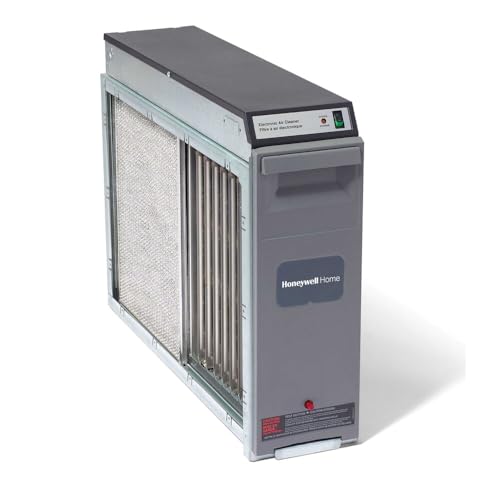
Honeywell F300E1027 Electronic Air Cleaner 20×20 with Post-Filter — Best for Odor-Heavy Smoke
If the complaint in your house is less about visible haze and more about the smell that soaks into everything, the F300E1027 is the configuration to look at first. It is built on the same F300 electronic platform as the overall pick — pre-filter, ionizing section, washable collector cells — but the verified listing specifies a performance-enhancing post-filter downstream of the cells. That extra stage is exactly what a smoking household needs: the plates strip out the fine particles, and the post-filter polishes what remains, including a meaningful share of the odor load that a bare precipitator lets through.
Strengths
- Post-filter included in this configuration, addressing the odor weakness that limits bare electronic cleaners
- Same washable-cell F300 platform as the overall pick, in the common 20 by 20 size
- Pre-filter ahead of the cells slows tar buildup on the collector plates
Trade-offs
- Post-filters are consumables that need periodic replacement, reintroducing a running cost the washable cells avoid
- Slightly more airflow resistance than the bare-cell configuration, so very marginal blowers should be checked by an installer
- Still a particle-first technology; heavy cigar smoke in one closed room may still want a dedicated room unit as backup
| Specification | Detail |
|---|---|
| Type | Whole-house electrostatic electronic air cleaner |
| Nominal size | 20 x 20 in |
| Extra stage | Performance-enhancing post-filter (per verified listing) |
| Collector cells | Washable, reusable |
| Install position | Return-air duct at furnace or air handler |
The post-filter is doing quiet but important work in this configuration. In the F300 design it sits after the collector cells, so it sees air that is already stripped of most of its particle load; that means it clogs slowly and can spend its capacity on finer residual particles and surface adsorption rather than on bulk dust. For smokers, the practical effect is a house where the morning-after smell is noticeably reduced compared with a bare electronic cleaner, even though no one should promise you a smoke-free smell from any single device in a home where smoking happens daily.
Sizing is the other reason this pick exists. The 20 by 20 slot is standard in a large share of furnaces and air handlers, particularly in homes where the bigger 20 by 25 cabinet will not fit the return. If that is your system, this is not a compromise pick — it is the correct-size version of the same technology, with the odor stage included. Budget honestly for post-filter replacements and for the same monthly cell-washing rhythm as any F300 in a smoking home, and this is arguably the most balanced configuration in the entire guide.
Best for: Smokers whose main complaint is lingering odor throughout the house / Not suited for: Buyers who want zero consumable parts to replace
Check the current price on Amazon

Trion HE2000 Electronic Air Cleaner with AFS — Best Washable-Cell Alternative
Trion has built electronic air cleaners for decades, and the HE2000 is its residential whole-house entry: an electrostatic unit that installs in the return duct and, per the verified listing, includes AFS — an air-flow sensing arrangement that switches the cleaner in step with your system’s airflow rather than relying on the furnace’s control board alone. For a smoking household, that detail is more than a footnote. Smoke lingers in indoor air for hours after a cigarette, and a cleaner that runs whenever air moves — including fan-only circulation — keeps treating that air instead of sitting idle between heating or cooling calls.
Strengths
- Air-flow sensing means the cleaner works during fan-only circulation, which is when much smoke cleanup actually happens
- Established Trion cell design with a long parts and support history
- Washable collector cells keep consumable costs low, like the Honeywell picks
Trade-offs
- Smaller dealer and installer network than Honeywell in many regions, which can matter at installation time
- Like all bare precipitators here, it does not meaningfully remove smoke odor gases on its own
- Cell washing discipline is just as non-negotiable as with the F300 line in a smoking home
| Specification | Detail |
|---|---|
| Type | Whole-house electrostatic electronic air cleaner |
| Control | AFS air-flow sensing (per verified listing) |
| Power | 120V (per verified listing) |
| Collector cells | Washable, reusable |
| Install position | Return-air duct |
The HE2000 earns its place as the alternative pick rather than a duplicate because its control philosophy differs. Many electronic cleaners are wired to run only when the furnace calls for heat or cooling. In shoulder seasons, or in homes where the thermostat is satisfied for long stretches, a smoking household can end up with the cleaner off precisely while smoke is accumulating. An air-flow-sensed unit paired with a thermostat’s circulation setting closes that gap: set the blower to circulate periodically and the Trion treats the air on the same schedule, steadily diluting the smoke load instead of letting it settle into soft furnishings.
Performance expectations should be set the same way as for the Honeywell units: excellent on the fine particle fraction that makes smoke visible and that carries much of its residue into fabrics, limited on odor without help. Where the HE2000 can edge ahead for some buyers is the ownership experience — Trion’s Forever Filter positioning around washable cells is the core of the design, and owners who keep to a monthly wash in smoking season report consistent results for years. If your local installer knows Trion better than Honeywell, this is the pick to let them install.
Best for: Households that circulate air with the blower between heating and cooling calls / Not suited for: Buyers who want the largest installer network and parts availability
Check the current price on Amazon
Honeywell F300E1001 Electronic Air Cleaner 16 inch — Best for Smaller Furnaces
Not every furnace has room for a 20 by 25 cabinet. Compact air handlers, closet installs, and many condo and townhome systems use a 16-inch-class filter slot, and for years those households were simply told electronic cleaning was not for them. The F300E1001 is Honeywell’s answer in that footprint: the same F300 sequence of pre-filter, ionizing section, and washable collector cells, scaled to the smaller slot. For a smoker in a smaller home, that is genuinely good news, because smaller homes concentrate smoke faster — the same cigarette loads a small apartment’s air far more than a large house’s.
Strengths
- Brings true electrostatic smoke capture to compact systems the larger F300 cabinets cannot fit
- Washable cells and a pre-filter, matching the low-consumable ownership model of the bigger picks
- Part of the F300 family, so installer familiarity and parts support are strong
Trade-offs
- Lower airflow capacity than the 20×25 pick, so it is not a substitute in a large home
- In a small, heavily smoked-in home the cells load faster and need the most frequent washing in this guide
- Odor limitation is the same as the rest of the bare-cell family; no post-filter is specified in this listing
| Specification | Detail |
|---|---|
| Type | Whole-house electrostatic electronic air cleaner |
| Nominal size | 16 in class (per verified listing) |
| Collector cells | Washable, reusable |
| Install position | Return-air duct at compact furnace or air handler |
The physics that make this pick work are worth understanding, because they explain why a smaller electronic cleaner can still be the right answer for a smoker. Electrostatic capture does not depend on forcing air through a dense mat; it depends on charge and residence time. A compact unit on a compact system moves less air per minute, but a compact home also has less air to treat, so the number of full air changes per hour — the figure that actually determines how fast smoke clears — can be perfectly respectable. What you must not do is install this size on a large furnace to save money: undersizing is the one unforgivable error in this category.
Ownership in a small smoking home has one extra wrinkle. With less cell area collecting the same smoking habit, the interval between washes shrinks, and the honest routine here is a wash every three to four weeks rather than the six to eight a non-smoking home might stretch to. That is still a modest chore — the cells slide out, wash, and must dry fully — but buyers who know they will not do it should look at the media-hybrid prose pick below instead and accept its replacement-filter cost as the price of their own habits.
Best for: Smokers in condos, townhomes, and small homes with compact HVAC systems / Not suited for: Large homes, where the 20×25 configuration is the correct size
Check the current price on Amazon
Aprilaire Model 5000 Electronic Air Cleaner — Best Hybrid for Low Maintenance
The Aprilaire Model 5000 occupies a distinct niche in this category: it is an electronic air cleaner by design — air passes an ionizing section that charges particles — but instead of collecting those particles on washable metal plates, it collects them on a deep, pleated media element that the charge makes far more effective than the same media would be alone. The result is a cleaner that behaves like an electronic unit for fine smoke particles while asking for attention roughly once a year, when the internal media is replaced, instead of every month at the utility sink.
Strengths
- Hybrid design targets fine smoke particles with charged-media collection rather than washable plates
- Annual media replacement rhythm suits owners who know they will not wash cells monthly
- No collector-cell washing, drying, or reinstallation routine at all
Trade-offs
- The internal media is a genuine recurring cost, unlike the washable cells on the Honeywell and Trion picks
- Sold and installed through dealers, so pricing and availability vary by region and it is not an Amazon purchase
- Odor gases still pass through; it is a particle solution like the rest of this category
| Specification | Detail |
|---|---|
| Type | Hybrid electronic (charged-media) whole-house cleaner |
| Collection | Replaceable deep media element |
| Sales channel | HVAC dealers and installers |
Why include a pick you cannot click to buy? Because in real quotes for whole-house smoke control, this model comes up constantly, and a guide that ignored it would leave you unable to evaluate the quote your installer hands you. The honest comparison is about maintenance philosophy. Washable-cell cleaners like the F300 picks cost little to run but demand a monthly habit; the Model 5000 converts that habit into an annual purchase. In a smoking home, where neglected cells lose efficiency quietly, the hybrid’s consistency is a real advantage for real households — a cleaner that is serviced once a year on schedule beats a theoretically superior cleaner whose cells have not been washed since spring.
Set expectations the same way as for every pick in this guide: particles yes, odor only partially and indirectly, because removing the particles that carry smoke residue does reduce how much smell soaks into a home over time. If your installer quotes this unit, the questions to ask are the installed size against your duct dimensions, the replacement media interval they recommend for a smoking household specifically, and whether a carbon stage can be added downstream if odor is your main complaint.
Best for: Smokers who want electronic cleaning without a monthly cell-washing routine / Not suited for: Buyers who want to order online and avoid all recurring media costs
Unlinked pick: no verified Amazon listing, so no purchase link is provided for this model.
Carrier Infinity Air Purifier (Dealer-Installed) — Best Dealer-Installed Premium
The second dealer-channel pick in this guide exists for one reason: if you already own, or are about to buy, a Carrier Infinity heating and cooling system, your dealer will likely propose this in-duct purifier as the air-cleaning component, and you deserve an independent frame for that conversation. It installs in the ductwork like the other whole-house units here, uses a charged-media approach rather than washable collector plates, and integrates with the Infinity control so its status lives in the same interface as the rest of your system.
Strengths
- Integrates with Carrier Infinity system controls instead of living as a separate appliance
- Charged-media collection avoids the cell-washing routine entirely
- Dealer installation includes duct sealing and airflow verification as part of the job
Trade-offs
- Only sensible inside the Carrier ecosystem; it is not a standalone retrofit for other brands
- Replacement media is proprietary and dealer-priced
- Not sold through Amazon, so there is no click-to-compare price transparency
| Specification | Detail |
|---|---|
| Type | In-duct whole-house purifier, charged-media |
| Integration | Carrier Infinity system controls |
| Sales channel | Carrier dealers |
Judged purely as air cleaning, this unit competes with the Aprilaire hybrid above: both trade washable cells for replaceable charged media, and both therefore deliver consistent performance in households where maintenance discipline is the weak point — which, in smoking homes where cells foul fastest, is most households. The Carrier’s extra claim is integration. Filter-life reminders, system diagnostics, and a single control on the wall have genuine value, but they are ecosystem value, not cleaning value, and they evaporate if you later replace the furnace with another brand.
The buying advice is therefore narrow and honest. If you are already committed to an Infinity system, this purifier is a reasonable, low-hassle way to add whole-house particle control for smoke, and bundling it into a system installation usually produces the cleanest ductwork result. If you are not in that ecosystem, the verified Honeywell and Trion picks above deliver the same category of smoke-particle control without locking your air cleaner to your furnace brand — and you can order them today instead of scheduling a sales visit.
Best for: Homeowners already buying or running a Carrier Infinity system / Not suited for: Anyone with another furnace brand, or who wants online price transparency
Unlinked pick: no verified Amazon listing, so no purchase link is provided for this model.
Comparison Table
The table compresses the six picks into the four facts that decide this purchase: what it is, what it does best, and who should buy it. Size and airflow figures come from the verified listings; the two dealer models are marked as unlinked throughout this guide.
| Pick | Badge | Key spec | Best for |
|---|---|---|---|
| Honeywell F300E1035 Whole House Electronic Air Cleaner 20×25 | Best Overall | 20×25 class, 2000 CFM, washable cells | Smoking households with a 20×25 furnace slot that want maximum whole-house particle capture |
| Honeywell F300E1027 Electronic Air Cleaner 20×20 with Post-Filter | Best for Odor-Heavy Smoke | 20×20, F300 platform plus post-filter | Smokers whose main complaint is lingering odor throughout the house |
| Trion HE2000 Electronic Air Cleaner with AFS | Best Washable-Cell Alternative | Electrostatic, AFS air-flow sensing, 120V | Households that circulate air with the blower between heating and cooling calls |
| Honeywell F300E1001 Electronic Air Cleaner 16 inch | Best for Smaller Furnaces | 16-inch class F300, washable cells | Smokers in condos, townhomes, and small homes with compact HVAC systems |
| Aprilaire Model 5000 Electronic Air Cleaner | Best Hybrid for Low Maintenance | Charged-media hybrid, annual media change | Smokers who want electronic cleaning without a monthly cell-washing routine |
| Carrier Infinity Air Purifier (Dealer-Installed) | Best Dealer-Installed Premium | In-duct charged-media, Infinity integration | Homeowners already buying or running a Carrier Infinity system |
How to Choose the Best Electronic Air Cleaners for Smokers
Start with your filter slot, not with a brand. Measure the existing filter’s height, width, and depth, and note the furnace or air handler model. Whole-house electronic cleaners are built in cabinet sizes that correspond to those slots — the 16-inch class, 20 by 20, and 20 by 25 configurations in this guide exist precisely because those are the slots in most homes. A cleaner that does not match the slot cannot be made to work with enthusiasm and tape; gaps around the frame let smoke-laden air bypass the cells entirely, and bypassed air is untreated air no matter how good the technology inside the cabinet is.
Next, match airflow. Your system’s blower moves a rated volume of air, and the cleaner must be rated at or above it — the 2000 CFM figure on the largest pick in this guide is the kind of number to compare against your system’s tonnage and blower spec, which an installer can read off the data plate. Undersizing an electronic cleaner does not just clean less; it adds resistance the blower was not designed for, which can shorten blower life and reduce comfort in the rooms furthest from the furnace. Oversizing within the same slot family, by contrast, is harmless and usually buys you longer intervals between cell washes.
Then decide your maintenance philosophy honestly, because this is where electronic air cleaner purchases succeed or fail. Washable-cell models — the Honeywell F300 configurations and the Trion — cost almost nothing to run but ask for a monthly wash in a smoking home, with full drying before the cells go back in. Charged-media hybrids like the two dealer picks convert that chore into an annual media purchase. Neither answer is wrong. The wrong answer is buying washable cells while knowing, if you are truthful with yourself, that they will be washed twice a year. A neglected precipitator is worse than a fresh media filter, because it gives you confidence without capture.
Finally, plan for odor separately. Every unit in this guide is a particle device. If lingering smell is half your complaint — and for most smoking households it is more than half — either choose the configuration with a post-filter, budget for a downstream carbon stage, or accept a portable carbon-heavy unit in the main smoking room as a companion. Installers who promise that any electronic cleaner alone will make a smoking home smell neutral are selling, not advising. The particle cleanup alone will reduce how much residue settles into carpets and upholstery, which helps odor over weeks, but it is a slow improvement, not a switch.
Electronic Air Cleaners vs Media Filters vs Portable Purifiers for Smoke
A high-efficiency media filter is the simplest alternative: a deep pleated filter in an enlarged cabinet can capture fine particles well, and it asks only for a replacement a few times a year. Its weakness in a smoking home is loading. Smoke residue is sticky and fine, media filters load from the surface inward, and as they load, resistance climbs and airflow falls — the blower works harder for less air. Electronic cleaners hold their airflow far more steadily between services, which is the core technical reason they remain the classic recommendation for smoke specifically, even though good media cabinets beat them for set-and-forget convenience in non-smoking homes.
Portable purifiers solve a different geometry problem. A whole-house cleaner treats air only when the blower runs and treats the smoking room at the same rate as every other room; a portable unit with a serious carbon bed, placed where smoking actually happens, treats that room many times per hour and attacks odor directly. Many smoking households end up happiest with both: the whole-house electronic cleaner keeping the background particle load down everywhere, and one portable in the smoking room handling peaks and smell. The guides on this site to room purifiers for smoke cover the portable side in depth; this guide’s job is the ducted side, and the two are complements, not rivals.
How to Maintain an Electronic Air Cleaner in a Smoking Home
Installation of a whole-house unit belongs to an HVAC installer — the cabinet must be cut into the return duct, sealed, and wired safely. Maintenance, however, is yours, and in a smoking home it is the difference between a cleaner that works for a decade and one that quietly stops working in its second year. The routine below is written for washable-cell models like the Honeywell and Trion picks; hybrid owners replace the media step with an annual media change.
- Set a smoking-home schedule. Wash collector cells every four weeks while smoking happens indoors daily; stretch to six weeks only if smoking is occasional. Put it on the same calendar anchor as another monthly chore so it actually happens.
- Power down properly. Switch the cleaner off at its own switch and, if your installer wired it through the furnace, switch the system to off at the thermostat before opening the access door.
- Remove the pre-filter and cells in order. Slide out the pre-filter first, then the collector cells, noting their orientation. Take a phone photo the first time; cells reinstalled backwards are a common silent failure.
- Wash the pre-filter. Rinse it under a strong spray until the water runs clear, shake off excess water, and set it aside to dry.
- Soak the collector cells. Fill a tub with hot water and a small amount of automatic dishwasher detergent — the low-foam kind — and soak the cells for twenty to thirty minutes. Tobacco residue is tarry; the soak does most of the work. Never use a pressure washer and never scrub the fine ionizing wires.
- Rinse and inspect. Rinse until the water is clear, then hold each cell up to the light. Broken or sagging ionizing wires and bent plates should be flagged to your installer; a damaged cell arcs and cleans poorly.
- Dry completely. This step is not optional. Cells must be fully dry — most owners give them several hours, many give them overnight — before reinstallation. Damp cells snap, arc, and can trip the unit’s protection.
- Reinstall, restore power, and listen. Slide everything back in the photographed orientation, close the door, restore power, and run the blower. An occasional soft tick from the cells is normal; loud repeated snapping means a cell went back in damp or damaged.
Two habits multiply the benefit of this routine. Run your thermostat’s fan in circulation mode for a few hours each evening, so the cleaner keeps treating air after smoking is done rather than only during heating or cooling calls. And if your configuration has a post-filter, replace it on the maker’s schedule rather than when it looks dirty — by the time a post-filter looks loaded, it has been bypassing odor for weeks.
Common Buying Mistakes
Buying by headline efficiency instead of by size. The most common failure in this category is a excellent cleaner in the wrong cabinet size, leaking smoky air around its frame. Measure the slot, match the size, and let efficiency arguments come second.
Expecting odor removal from a particle device. Electrostatic plates do not scrub gases. Households that buy a bare precipitator expecting the smell to vanish are disappointed within a week; choose the post-filter configuration or plan a carbon stage from the start.
Washing cells on a non-smoking schedule. The intervals printed for ordinary household dust do not survive contact with tobacco tar. Monthly washing in a smoking home is not caution; it is the baseline the technology assumes.
Reinstalling damp cells. It causes arcing, noise, and tripped protection, and owners then conclude the unit is faulty. Full drying is part of the wash, not an optional extra.
Choosing a plug-in ionizer instead. Small room ionizers are not whole-house electronic air cleaners, deliver a fraction of the treated airflow, and can generate ozone. The category in this guide exists because ducted electrostatic units actually move and treat the home’s full air volume.
Final Recommendation
For most smoking households, the Honeywell F300E1035 is the answer: correct for the common 20 by 25 slot, rated at 2000 CFM, and built on washable cells that keep running costs near zero as long as you keep the monthly wash. If odor is the louder half of your complaint, the F300E1027’s post-filter configuration is the more complete purchase. Smaller systems should take the F300E1001 without feeling they settled, and households that know they will not wash cells should pay for the Aprilaire hybrid’s annual media rhythm instead of pretending otherwise. The Trion HE2000 is the right call when your installer knows Trion or when fan-circulation hours matter most, and the Carrier unit makes sense only inside an Infinity system.
Whichever route you take, treat the purchase as a system decision: right size, sealed install, honest maintenance, and a separate plan for odor. Do that, and an electronic air cleaner remains what it has been for decades — the most effective whole-house answer to smoke particles that exists.
- Honeywell F300E1035 Whole House Electronic Air Cleaner 20×25 (Best Overall): Check price on Amazon
- Honeywell F300E1027 Electronic Air Cleaner 20×20 with Post-Filter (Best for Odor-Heavy Smoke): Check price on Amazon
- Trion HE2000 Electronic Air Cleaner with AFS (Best Washable-Cell Alternative): Check price on Amazon
- Honeywell F300E1001 Electronic Air Cleaner 16 inch (Best for Smaller Furnaces): Check price on Amazon
Keep exploring this cluster: Best Air Purifiers For Smokers · Best Hepa Air Purifiers For Smokers · Best Air Purifiers For Cigarette Smoke · Best Exhaust Fan For Smokers · Best Fan For Smokers
Frequently Asked Questions
Do electronic air cleaners really work on cigarette smoke?
Yes, on the particle side of smoke, which is most of it by mass. Tobacco smoke particles are very fine, and electrostatic precipitation is specifically good at that size range because it does not rely on sieving air through a dense mat. What they do not remove is the gas phase — the odor — which is why this guide pairs its recommendations with post-filter and carbon advice instead of promising a smell-free home from plates alone.
How often do the cells need washing in a smoking home?
Monthly is the honest baseline when smoking happens indoors every day. Tobacco residue is tarry and coats collector plates faster than ordinary dust, and a coated plate captures less with every week it is left. Occasional-smoking households can stretch to about six weeks. Cells must always dry completely before they go back in.
Will an electronic air cleaner remove the smell of smoke from my house?
Not by itself. It removes the particles, and over time that reduces how much residue settles into carpets and furniture, which does soften background odor. For active odor control, choose a configuration with a post-filter, add a carbon stage, or run a carbon-heavy portable purifier in the smoking room alongside the whole-house unit.
Can I install a whole-house electronic air cleaner myself?
Most homeowners should not. The cabinet has to be cut into the return duct, sealed against bypass, and wired into the system safely, and a poorly sealed install quietly defeats the technology. Professional installation is a one-time cost; maintenance — the cell washing — is the part that is genuinely yours.
Electronic air cleaner or a big media filter — which is better for smokers?
For smoke specifically, the electronic cleaner usually wins on ownership experience: airflow stays steadier between services and there is no large media bill several times a year. Media cabinets win on simplicity and need no washing. The deciding question is your own discipline: committed washers should buy electronic; everyone else should buy media or a charged-media hybrid and pay the consumable cost.
Do electronic air cleaners produce ozone?
Properly functioning whole-house electrostatic units produce very small amounts, and reputable models are designed and certified with that in mind. This is a different world from cheap plug-in ionizers, which this guide excludes. If anyone in the home has significant respiratory sensitivity, discuss the choice with your installer and clinician, keep cells clean — dirty, arcing cells are the main real-world source of excess ozone — and never run a damaged cell.


