Disclosure: airfryerkitchensupply.com is reader-supported. When you buy through links on our site, we may earn an affiliate commission at no extra cost to you.
Where to buy
This is our verified shortlist for the best electric smokers under 100. Read this section first, because it changes how to use the whole guide: at the time of writing we could not verify any full-size electric smoker as genuinely selling under $100 new. The picks below are the lowest-tier credible electric smokers we could verify — the machines closest to this budget — each with a link to check the current price on Amazon, because prices move and sale pricing is exactly how this tier gets reached honestly.
- Smokehouse Little Chief Front Load Smoker — Check the current price on Amazon
- Char-Broil Analog Electric Smoker 18202077 — Check the current price on Amazon
- Royal Gourmet SE2805 28-inch Electric Smoker — Check the current price on Amazon
- Grills House SE2806 28-inch Analog Electric Smoker with Window — Check the current price on Amazon
- Masterbuilt 30-inch Analog Electric Smoker MB20070210 — Check the current price on Amazon
- Smokehouse Big Chief Electric Smoker — Check the current price on Amazon
The best electric smokers under 100 is a keyword that deserves a straight answer before it deserves a list: the honest answer is that a new, full-size electric smoker from a reputable maker, verifiably under $100, barely exists. Heating elements, cabinets, racks and controllers cost what they cost, and the models that crowd this price line in marketplace searches are usually accessories, replacement parts, toy-scale novelty smokers or listings whose price has already drifted above the line that the headline promised.
So this guide does the useful thing instead of the dishonest thing. It rounds up the lowest-tier real electric smokers we could verify — simple analog cabinets and the low-temperature Smokehouse specialists — and treats $100 as the budget discipline it is: check the current price on every pick, buy during the deep sale windows when these models genuinely dip toward the line, consider the used market with the safety checks in our guide section, and know exactly which compromises each near-tier machine asks of you.
What you will not find here is a fabricated ‘under $100’ champion. What you will find is a realistic map of the bottom of the electric smoker market: which simple machines are worth owning at all, which foods the cheapest specialists genuinely excel at, and how a strict budget buys the most smoking per dollar without buying junk that will be replaced by spring.
In this guide
Quick Picks
Six real machines at the floor of the market: two low-temperature specialists that own fish and jerky, and four simple analog cabinets — every one a check-the-price proposition rather than a promised price.
- Smokehouse Little Chief Front Load Smoker — Best Under-Budget Specialist: The low-temperature specialist: decades-proven for fish, jerky, cheese and sausage. — Check price on Amazon
- Char-Broil Analog Electric Smoker 18202077 — Best Budget All-Rounder: Char-Broil’s simple analog cabinet — one dial, major-brand backing, occasional-use honesty. — Check price on Amazon
- Royal Gourmet SE2805 28-inch Electric Smoker — Best Compact Budget Cabinet: The compact insulated option: double-wall 28-inch cabinet, 454 sq in, sized for small households. — Check price on Amazon
- Grills House SE2806 28-inch Analog Electric Smoker with Window — Best Budget Pick for Beginners: Compact analog smoking with a window — learn by watching, not by opening. — Check price on Amazon
- Masterbuilt 30-inch Analog Electric Smoker MB20070210 — Best Budget Masterbuilt: The simple dial-controlled Masterbuilt — cheaper, tougher, and more hands-on than its digital siblings. — Check price on Amazon
- Smokehouse Big Chief Electric Smoker — Best for Budget Batch Processing: The production version of the Chief formula: 50 lb of low-temperature fish and jerky capacity. — Check price on Amazon
How These Picks Were Chosen
Selection began with a verification pass, not a price scrape: we looked for electric smokers — complete, food-cooking appliances from identifiable makers — that could be matched confidently in verified catalogue data, then ranked them by how close their market tier sits to the $100 line and how honestly they perform once bought. Accessories, smoker boxes for gas grills, replacement elements and novelty miniatures were excluded no matter how their listings are titled, because a buyer type this query wants to smoke food, not to accessorise a grill they may not own.
Because our rules forbid printing static prices — prices that would be stale within weeks anyway — this guide cannot and does not certify any pick as under $100 today. Instead each review states the machine’s tier position plainly and tells you the buying conditions under which it reaches the budget: seasonal sales, warehouse-club rotations, and the used market, where simple analog smokers are among the safest second-hand purchases in outdoor cooking because there is so little in them to be broken.
Performance expectations were set with equal honesty. At this end of the market you are buying analog control, modest insulation and small-to-mid capacity, and the guide judges each machine against what its tier can deliver — fish, jerky, ribs, chicken and small butts cooked well — rather than pretending any of them is a discounted version of a premium digital cabinet.
The 6 Best electric smokers under 100

Smokehouse Little Chief Front Load Smoker — Best Under-Budget Specialist
The Little Chief is a specialist, not a generalist: a low-to-mid temperature electric smoker that has served fish smokers, jerky makers and cheese smokers for decades. Buy it for salmon and snacks, not for brisket.
Strengths
- Low-temperature control range suits fish, cheese and jerky
- Simple, proven design with generations of user knowledge
- Small footprint and gentle power draw
Trade-offs
- Cannot do hot-and-fast or large barbecue cuts
- Temperature follows ambient conditions more than digital cabinets
- Pan-fed smoke requires periodic attention
| Specification | Detail |
|---|---|
| Format | Front-load electric smoker, 24.5 x 11.5 in (per Amazon title) |
| Temperature role | Low to mid temperature (per Amazon title) |
| Best foods | Fish, jerky, cheese, sausage (per Amazon title) |
Judging the Little Chief as a small barbecue smoker misses what it is. This is a cold-to-warm smoking tool from a tradition of Pacific Northwest fish smoking, where the goal is gentle smoke over hours at temperatures a brisket cabinet would consider a warming drawer. For salmon, trout, jerky strips, nuts and cheese, that restraint is precisely the capability money cannot easily buy in a hotter machine. Its simplicity is the other half of the appeal: minimal controls, a pan of chips, and a design old enough that every problem and fix is documented by owners. The limits are absolute — it will not cook a pork butt properly and weather pushes its temperatures around — so it belongs in a two-machine life or a fish-first life. Within its true job description, few products in this entire roundup are as proven.
Little Chief ownership is measured in decades by many families: rinse the racks, brush the pan, keep the drip areas clean, and store the unit dry. There is almost nothing to break and nothing to update. The one discipline is fuel — chips kept dry — and the one consumable mindset is patience, since gentle smoking cannot be hurried. It is the lowest-maintenance product in this entire programme.
For fish and jerky households the Little Chief reframes the budget entirely: it is not a cheap version of something else, it is the correct tool at a gentle price tier — and a salmon specialist that outperforms premium cabinets at its one job is the best value in this entire list.
Best for: Fish, jerky, cheese and snack smokers / Not suited for: Barbecue cuts, hot smoking or crowd cooking

Check on Amazon — check the current price on Amazon before you decide, and confirm the exact model code on the listing matches the model reviewed here.
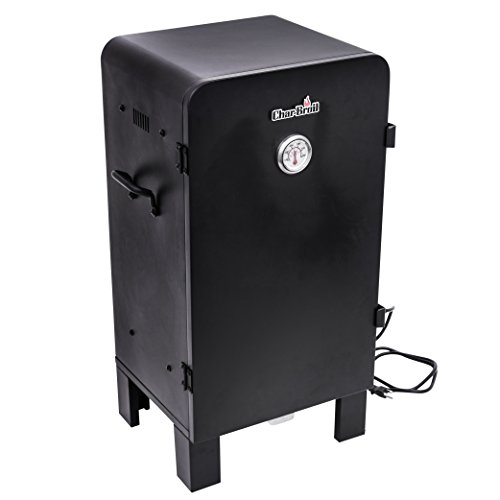
Char-Broil Analog Electric Smoker 18202077 — Best Budget All-Rounder
Char-Broil’s analog electric cabinet is a straightforward, lower-tier alternative from a major grill brand — suited to occasional smokers who want simple dial control, mainstream brand support and no app, screen or digital controller in the loop.
Strengths
- Major-brand dealer and parts network behind it
- Dead-simple analog operation
- Accessible tier for occasional use
Trade-offs
- Analog swings require thermometer vigilance
- Fewer convenience features than digital rivals
- Chip management means opening the cabinet
| Specification | Detail |
|---|---|
| Format | Vertical analog electric smoker |
| Controls | Analog temperature control |
| Brand | Char-Broil (model 18202077) |
There is a durable appeal to a smoker with one dial. Char-Broil’s analog electric model serves buyers who smoke a few times a season — holiday turkey breast, summer ribs, a salmon side — and want a recognised brand’s support network without paying for digital control they will not exploit. The cooking contract is the analog one: you are the controller, checking a thermometer and adjusting as conditions change, which in mild weather is a pleasant ritual and in gusty cold becomes work. Judge it against the Masterbuilt analog as a brand-preference call between two simple cabinets, and against the digitals as an involvement call: if the phrase ‘set the temperature and check the probe later’ sounds like your kind of afternoon, save toward digital; if tending is the hobby, this Char-Broil covers the fundamentals honestly at its tier.
Char-Broil ownership leans on the brand’s dealer network: elements and small parts are the kind of thing a major grill maker keeps available, which matters in year five more than in week one. Care is analog-simple — clean pans, a wiped seal, a cover outdoors — and the dial wants the same calibration habit as any analog: check it against a probe each season.
The Char-Broil is the pick for the budget buyer who still wants one machine for ribs, chicken and the occasional butt: simple, supported by a major brand’s parts network, and the model most likely to reward patient sale-watching at this end of the market.
Best for: Occasional smokers who want simple, major-brand analog kit / Not suited for: Low-attention cooks or anyone smoking in harsh weather often
Check on Amazon — check the current price on Amazon before you decide, and confirm the exact model code on the listing matches the model reviewed here.

Royal Gourmet SE2805 28-inch Electric Smoker — Best Compact Budget Cabinet
A compact 28-inch analog cabinet with double-wall construction on its specification — an interesting budget-tier combination for small households, couples and balcony-adjacent patios where a 30-inch cabinet is more box than the cooking justifies.
Strengths
- Double-wall construction is unusual and welcome at this tier
- 1350W element gives a small cabinet brisk recovery
- Compact 454 sq in footprint stores easily
Trade-offs
- Capacity limits whole briskets and party loads
- Analog control needs the usual thermometer attention
- Three grates means tighter vertical spacing for tall items
| Specification | Detail |
|---|---|
| Cooking area | 454 sq in (per Amazon title) |
| Power | 1350W (per Amazon title) |
| Format | 28-inch vertical, 3 grates |
| Construction | Double-wall (per Amazon title) |
Small cabinets get dismissed as starter toys, but for one- and two-person households they are often the right-sized tool: faster to heat, cheaper to run, easier to store, and big enough for the ribs, chicken and fish that make up most real-world smoking. The SE2805 strengthens the small-cabinet case with double-wall construction — insulation is the feature budget smokers usually lack, and it steadies the analog element’s work in cool weather. Its 1350W element in a small volume also means quick recovery after the door closes. The limits are geometric and permanent: tall items crowd three closely spaced grates, and a crowd-feeding cook simply does not fit. Buy it as a deliberate small-household choice, not as a cheap version of a big smoker, and it delivers exactly the cooks it promises.
Compact ownership is easy ownership: the SE2805 heats fast, cools fast and stores in spaces a 40-inch cabinet cannot enter. Keep the double-wall vents unobstructed, empty the small pans before they overflow — small cabinets forgive less here — and the machine’s insulation does its quiet work. A fitted cover and dry indoor chip storage complete a very short list.
Small households should take the SE2805’s double-wall specification seriously at this tier — insulation is the feature cheap smokers never have, and in a compact cabinet it buys steadier cooks than a larger, thinner box at similar money.
Best for: Small households wanting a compact, insulated analog cabinet / Not suited for: Crowd feeding or whole-brisket ambitions
Check on Amazon — check the current price on Amazon before you decide, and confirm the exact model code on the listing matches the model reviewed here.
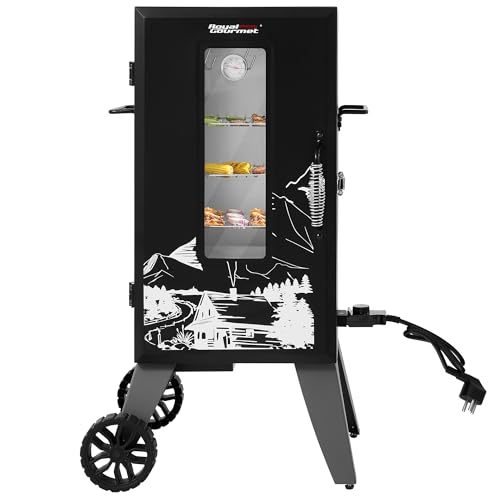
Grills House SE2806 28-inch Analog Electric Smoker with Window — Best Budget Pick for Beginners
The SE2806 pairs the compact 28-inch analog format with a clear viewing door — suited to beginners who learn by watching, and to fish and cheese smokers who want visual checks without heat-dumping door openings.
Strengths
- Viewing window supports learn-by-watching cooking
- 1350W element in a compact cabinet recovers heat quickly
- Three chrome racks cover everyday small-batch smoking
Trade-offs
- Window needs cleaning to stay useful
- Analog control still demands thermometer checks
- 454 sq in caps batch size firmly
| Specification | Detail |
|---|---|
| Cooking area | 454 sq in (per Amazon title) |
| Power | 1350W (per Amazon title) |
| Format | 28-inch vertical, 3 chrome racks |
| Door | Clear viewing window |
Beginners open smoker doors too often — it is how you learn what bark, colour and rendering look like — and a window converts that curiosity from a temperature penalty into a feature. The SE2806 builds its compact analog cabinet around a clear door, so a first brisket flat or a tray of salmon can be monitored visually while the 1350W element holds its rhythm undisturbed. As with all windows, usefulness is a cleaning habit away from disappearing under smoke film; a quick wipe while the cabinet is warm keeps it honest. Beyond the door, this is the standard small-cabinet bargain: three racks, modest area, simple dial. For learners, small households and low-temperature fish work where visual checks matter most, it is a thoughtfully aimed budget pick rather than a stripped-down big smoker.
The SE2806’s window wants the same warm-wipe habit as any glazed smoker door, and its compact pans want prompt emptying. Beyond that it is simple analog care: racks washed, interior wiped, cord stored dry. Beginners should keep a small notebook of dial positions against probe readings for their first season — this machine teaches, and notes compound the lesson.
Learning smokers open doors; the SE2806’s window forgives that habit at the lowest tier in this list, which makes it the kindest first smoker here for someone teaching themselves bark, colour and rendering by sight.
Best for: Beginners and fish smokers who cook by sight / Not suited for: High-volume cooks or buyers who will not maintain a window
Check on Amazon — check the current price on Amazon before you decide, and confirm the exact model code on the listing matches the model reviewed here.
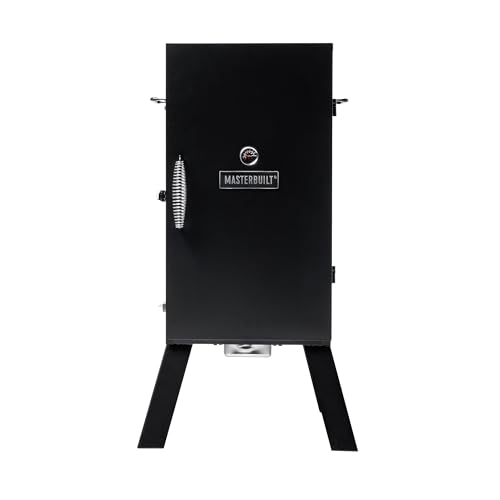
Masterbuilt 30-inch Analog Electric Smoker MB20070210 — Best Budget Masterbuilt
The analog 30-inch Masterbuilt is the simple, lower-tier route into the brand’s cabinet format: a dial instead of a digital controller, a smaller cooking area, and fewer parts to fail — suited to occasional smokers and budget-led buyers who accept a more hands-on cook.
Strengths
- Simple analog control is intuitive and cheap to live with
- Masterbuilt cabinet layout with wide parts availability
- Lower tier positioning makes it an accessible first smoker
Trade-offs
- Dial control swings temperature more than digital models
- 535 sq in is the smallest Masterbuilt cabinet here
- No side loader — adding chips means opening the door
| Specification | Detail |
|---|---|
| Cooking area | 535 sq in (per Amazon title) |
| Format | 30-inch vertical, chrome racks |
| Controls | Analog temperature dial |
| Smoke | Wood chip tray |
Analog cabinets ask more of the cook and give back simplicity. Without a digital controller holding a set point, temperature management becomes a rhythm of checking a thermometer and nudging a dial, which experienced smokers often enjoy and beginners find one variable too many. The reward is a machine with very little to go wrong electronically and a purchase tier that lowers the stakes of trying smoking at all. Capacity is the other honest limit: 535 square inches covers ribs, a butt or a couple of chickens, but it is not a party machine. Read this pick as the apprenticeship option — if you smoke monthly and like being involved, it teaches the craft cheaply; if you already know you want overnight-style, low-attention cooks, the digital models in this list are where your money belongs instead of saving a little here and upgrading within a year.
Analog Masterbuilt ownership is refreshingly mechanical: a dial, an element and a cabinet, each replaceable, with no software in the story at all. Keep a spare element in mind as the machine ages, wipe the interior while warm after greasy cooks, and store the chip tray dry. Owners who cover these cabinets routinely report service lives that embarrass smarter machines.
The analog Masterbuilt is the upgrade-path pick: learn the craft on the dial, in the cabinet format the brand’s whole ecosystem supports, and if smoking becomes your hobby you already know exactly which digital sibling your experience points to.
Best for: Budget-led beginners who enjoy a hands-on cook / Not suited for: Set-and-forget cooks or anyone feeding crowds
Check on Amazon — check the current price on Amazon before you decide, and confirm the exact model code on the listing matches the model reviewed here.

Smokehouse Big Chief Electric Smoker — Best for Budget Batch Processing
The Big Chief scales the Little Chief formula to a stated 50 lb capacity — for anglers processing a catch, hunters making jerky in batches, and households who smoke snacks and fish in quantity rather than barbecue cuts.
Strengths
- 50 lb batch capacity for fish and jerky production
- Same simple, proven Smokehouse operating model
- Front loading suits tray-based batch work
Trade-offs
- Still a low-to-mid temperature specialist, not a barbecue cooker
- Batch smoking consumes chips and time in quantity
- Ambient weather influences cabinet temperature
| Specification | Detail |
|---|---|
| Capacity | 50 lb (per Amazon title) |
| Format | Front-load electric smoker, 24.5x18x12 in |
| Role | Low to mid temperature smoking |
When the job is twenty pounds of salmon or a deer season’s worth of jerky, the Big Chief’s proposition is throughput at gentle temperatures — rack after rack of fish and strips moving through mild smoke in a way no hot barbecue cabinet replicates well. The design philosophy is unchanged from its smaller sibling: simple electric heat, pan-fed smoke, front-loading trays, and a user community that has documented every technique over decades. That simplicity cuts both ways, since there is no digital controller rescuing a cook from a cold snap, and production-scale batches demand a rhythm of pan refills. Position it correctly — as processing equipment for fish, jerky, cheese and sausage rather than a brisket machine — and it is one of the most purpose-honest products in these lists, which is exactly why it has outlived generations of trendier smokers.
Big Chief ownership is batch logistics: racks in rotation, pans managed across long production days, and a cleaning session scaled to the load — which is still simple, because the machine is simple. Keep generous chip stocks dry and sealed, since production smoking consumes them in quantity. Owners treat it as equipment rather than appliance, and it returns the respect with years of service.
Anglers and jerky makers working in volume should read the Big Chief as processing equipment that happens to sit near this budget’s neighbourhood — cost per pound of finished jerky or smoked salmon is where its value case lives.
Best for: Anglers and jerky makers processing large gentle-smoke batches / Not suited for: Hot barbecue cooking of brisket, butts or ribs
Check on Amazon — check the current price on Amazon before you decide, and confirm the exact model code on the listing matches the model reviewed here.
Comparison Table
| Pick | Badge | Key spec | Best for |
|---|---|---|---|
| Smokehouse Little Chief Front Load Smoker | Best Under-Budget Specialist | Front-load electric smoker, 24.5 x 11.5 in (per Amazon title) | Fish, jerky, cheese and snack smokers |
| Char-Broil Analog Electric Smoker 18202077 | Best Budget All-Rounder | Vertical analog electric smoker | Occasional smokers who want simple, major-brand analog kit |
| Royal Gourmet SE2805 28-inch Electric Smoker | Best Compact Budget Cabinet | 454 sq in (per Amazon title) | Small households wanting a compact, insulated analog cabinet |
| Grills House SE2806 28-inch Analog Electric Smoker with Window | Best Budget Pick for Beginners | 454 sq in (per Amazon title) | Beginners and fish smokers who cook by sight |
| Masterbuilt 30-inch Analog Electric Smoker MB20070210 | Best Budget Masterbuilt | 535 sq in (per Amazon title) | Budget-led beginners who enjoy a hands-on cook |
| Smokehouse Big Chief Electric Smoker | Best for Budget Batch Processing | 50 lb (per Amazon title) | Anglers and jerky makers processing large gentle-smoke batches |
At this tier the table’s job is triage: it separates the specialists (Smokehouse) from the generalist analog cabinets, and flags the one double-wall and one windowed design — the two features that punch above this price class.
How to Choose electric smokers under 100
How to actually buy at this budget
Timing is the strategy. The models in this guide reach their lowest prices in predictable windows — late-autumn clearance as grilling season ends, major sale events, and warehouse rotations — so a patient buyer with a price-check habit pays materially less than an impulsive one. Set the discipline before you shop: a total budget that includes a thermometer, chips and a cover, because a smoker bought at the line with nothing left for the thermometer that makes analog cooking work is a false economy.
The used market: this tier’s secret weapon
Simple analog electric smokers are unusually good used purchases: a cabinet, an element, a dial — each testable in minutes. Inspect for rust-through at the base, a door that seals, racks that are sound, and an element that heats evenly; run it empty before money changes hands if the seller allows. Avoid used digital models at this budget unless you can watch a full heat cycle, because a failing controller costs more than the saving. A used Little or Big Chief with honest wear is often the single best under-budget smoker a fish household can own.
What the money cannot buy — plan around it
At this tier you give up digital holding, strong insulation and generous capacity, and pretending otherwise wastes cooks. Compensate with workflow: smoke in mild, sheltered conditions when you can, preheat fully, keep a good probe thermometer as your controller’s partner, and choose cuts that forgive temperature swings — butts, ribs and fish rather than precision brisket flats. Budget smoking done knowingly produces excellent food; budget smoking done in denial produces frustration and a machine on a kerb by summer.
Safety checks that matter more at low prices
Verify any rock-bottom listing is a complete smoker from an identifiable maker, with a legible model number and a cord in sound condition. Be wary of no-name imports with unverifiable electrical certification — an electric heating appliance is the last place to gamble on paperwork. If a deal’s price seems to defy the cost of steel and elements, it is usually an accessory, a part, or a listing error, and the time to discover that is before checkout, not at the door.
Reading a listing like an inspector
Before any budget purchase, read the listing’s specification block rather than its title: does it name a heating element, a cooking area and a temperature control? Does the model number resolve to a real product on the maker’s site? Are the photographs of a complete cabinet or of a component? Ninety seconds of this reading eliminates most of this tier’s traps, and the habit remains valuable at every tier above it.
The first three cooks on a budget smoker
Spend them learning, in order: an empty calibration run to map your dial against a probe thermometer; an easy, forgiving cook — chicken or ribs — to learn chip timing; then a pork butt, the budget cabinet’s finest subject, to learn your machine across a long session. By the fourth cook you will know your smoker’s personality, which is worth more than any single feature at this tier.
Ready to shortlist? Start with the benchmark of this guide, the Smokehouse Little Chief Front Load Smoker: Check the current price on Amazon.
Why a real smoker costs more than $100
It is worth understanding the floor rather than resenting it. A smoker is a weather-exposed steel cabinet containing a heating element, a temperature control, racks, pans and a door that must seal thousands of times. Materials and electrical safety compliance set a manufacturing cost that honest retail pricing cannot go far below — which is why the sub-$100 space fills with things that are not quite smokers: boxes that add smoke to a grill you must already own, elements sold as replacements, and miniatures that smoke a handful of wings as a novelty.
None of that makes budget smoking a fantasy; it makes it a discipline. The machines in this guide are the real floor — simple, proven, and priced within reach of the line when bought at the right moment or second-hand. A buyer who understands why the floor sits where it does shops it calmly, recognises genuine bargains, and walks past the mirages without disappointment.
The specialist exception: when cheap is actually best
The Smokehouse Chiefs complicate the budget story in a happy way. For salmon, trout, jerky, cheese and sausage, their low-temperature specialisation is not a compromise at all — a premium digital cabinet costing several times more is often worse at holding genuinely gentle temperatures and offers nothing the fish can taste. In this corner of smoking, the budget tool is the correct tool, full stop.
That exception teaches the wider lesson of this guide: value lives in fit, not in price or prestige. A household that smokes fish monthly and ribs twice a year is better served by a Chief and a borrowed grill than by any single ‘serious’ smoker at any tier. Read the picks through your own cooking diary, and the right budget answer usually names itself.
A brief defence of cheap smokers
Outdoor cooking culture can be snobbish about equipment, and budget smokers attract more of it than they deserve. The historical record is on the cheap machine’s side: generations of excellent barbecue came off simple, inexpensive smokers tended by cooks who understood them, while expensive machines in inattentive hands produced expensive mediocrity. The variable that matters most sits between the smoker and the meal, and it is not sold by the pound.
That is not an argument against better equipment — digital control and insulation are real goods, covered honestly in this cluster’s other guides. It is an argument for respecting the budget cook’s results and the budget machine’s role: it teaches the craft, feeds the household, and asks only attention in exchange for its low price. Many lifelong smokers started exactly here and remember the machine fondly.
When to upgrade, and what to upgrade to
Upgrade when a named frustration repeats: overnight cooks you cannot attend, capacity your gatherings exceed, or winter swings your workflow cannot tame. Each frustration maps to a tier — digital holding in the under-$400 list, capacity in the under-$500 list, insulation-minded designs in the northern guide — and buying against a named frustration is how upgrades satisfy instead of merely costing.
Keep the budget machine when you do. A simple analog cabinet remains useful as a second smoker, a fish-and-jerky specialist or a loaner that recruits friends into the hobby. The cheapest smoker you own may end up the one that cooks at other people’s houses — which is its own kind of value.
A Realistic First Season on a Near-$100 Smoker
Picture the season honestly and it looks good: a calibration afternoon in spring, ribs that surprise your household in May, a salmon habit by July that justifies the machine alone, and a pork butt in September that has your neighbours asking questions. The machine will swing its temperatures, you will learn its dial like a language, and at least once you will open the door too often and pay for it in time. That is not a failed purchase; that is smoking, learned the way it has been learned for generations.
What the season will not include is an overnight brisket slept through in January — and if that picture is the one you actually want, this guide’s honest advice is to let the budget grow toward the digital tiers rather than asking a near-$100 analog cabinet to be what it is not. Tools bought for the life you have, rather than the life in the brochure, are the ones still cooking in year five.
Keeping a Budget Smoker Alive for Years
Budget machines die of neglect, not of price. The rituals that extend their lives are short and dull: empty the pans before residue hardens into varnish, wipe the interior while it is still warm, keep the cord dry and un-kinked in storage, and cover the cabinet if it lives outside. An element kept clean and dry, in a cabinet kept sealed and covered, will commonly outlast the owner’s interest in upgrading — at which point the machine becomes a gift, a loaner or a second smoker, still cooking.
Keep one more habit: a small notebook, or a note on your phone, recording each cook’s dial setting, weather and result. On an analog machine that notebook is your memory of the controller’s personality, and it converts your first season’s experiments into every later season’s consistency. It costs nothing, and at this tier nothing else you can do is worth more.
How to Get Great Results from a Budget Electric Smoker
Budget analog smokers reward technique more than any other class. This workflow assumes a simple cabinet from the picks and a basic probe thermometer — your most important accessory.
Step 1: Preheat longer than the dial suggests
Analog cabinets and their thermometers are approximate. Preheat fully — thirty minutes is a sane default — and confirm the chamber with your probe thermometer at rack level before meat goes in.
Step 2: Season and dry the meat’s surface
A dry surface takes smoke and colours better. Pat cuts dry, season in advance where the recipe allows, and let fish form its pellicle — the tacky surface that holds smoke — before it meets heat.
Step 3: Load once, with everything ready
Chips loaded, water pan filled if you use one, meat probed and arranged — then one opening, one loading, one closing. Budget cabinets lose heat like sieves when fiddled with; do not fiddle.
Step 4: Cook to the probe, never the clock
Analog temperature swings make recipe times decorative. Your probe thermometer is the cook’s truth: tenderness and internal temperature decide doneness, on their schedule.
Step 5: Manage chips in small, planned additions
Add chips at natural milestones — the wrap, the halfway check — rather than opening for smoke alone. Smoke flavour accumulates early; late smoke adds little but bitterness.
Step 6: Rest and slice with the same care as any smoker
The cheapest smoker in this guide can produce a butt worth resting properly. Budget refers to the machine, never to the standards at the table.
Follow this workflow and the tier’s limitations shrink to what they truly are — smaller capacity and more attention — while the food, which is the point, closes most of the gap to machines costing far more.
Common Buying Mistakes
Believing a headline price without checking the listing
Accessory and parts listings are titled to catch this search. Confirm you are buying a complete smoker — cabinet, element, racks, control — before any bargain celebration.
Spending the whole budget on the machine
A budget smoker without a probe thermometer, chips and a cover is an unfinished purchase. Hold back accessory money deliberately; the thermometer alone is worth a model tier.
Expecting digital behaviour from an analog dial
Analog cabinets swing. Buyers who expect set-and-forget precision at this tier end up hating good machines. Either embrace the tending or save toward digital — both are respectable choices.
Buying novelty miniatures as a main smoker
Countertop mini smokers have their place as gifts and experiments. As a household’s only smoker they disappoint on the first rib cook. Buy a real cabinet, even a simple one.
Skipping the used-market inspection
Second-hand is this tier’s best route and its easiest trap. Run the element, check the seal, look for rust-through — ten minutes of diligence separates a bargain from scrap.
Smoking precision cuts first
Learn your budget cabinet on forgiving food — butts, ribs, chicken, fish. Save the brisket flat for when you know your machine’s moods, whatever tier it is.
Final Recommendation
If your budget is firm and your patience is real, start with the Char-Broil analog or the Masterbuilt analog — whichever your sale-watching finds first — and put the money you save toward a good probe thermometer. Small households should look hard at the double-wall Royal Gourmet, and beginners who learn by watching will get the kindest start from the windowed Grills House.
And if your smoking is fish, jerky and cheese, ignore the cabinet contest entirely: a Little Chief — or a Big Chief for batch work — is not the budget compromise but the correct tool, at any budget. That is the healthiest way to leave this guide: knowing the floor of this market is real, navigable, and — bought knowingly — genuinely delicious.
Start with the Smokehouse Little Chief Front Load Smoker if you want the safest single recommendation in this list: Check the current price on Amazon.
The strongest alternative is the Char-Broil Analog Electric Smoker 18202077: Check the current price on Amazon.
Keep exploring the cluster: Best Electric Smokers Under $200 Best Electric Smokers Under $400 Best Electric Smokers For Northern Climates Best Electric Smokers That Use Pellets Best Electric Smokers Smokin It
Frequently Asked Questions
Can I really buy an electric smoker for under $100?
Occasionally — during deep seasonal sales, clearance events or on the used market — the simple analog models in this guide reach or approach the line. As an everyday, verifiable claim, no: no full-size electric smoker from a reputable maker could be confirmed as genuinely under $100 new at the time of writing, which is why this guide shows its picks with check-price links instead of printed promises.
Why do so many listings claim to be under $100?
Because accessories, replacement parts, smoker boxes for existing grills and miniature novelty smokers are all titled to catch this search. Read any rock-bottom listing carefully and confirm it describes a complete smoker — cabinet, heating element, racks and a temperature control — from an identifiable maker before treating it as a bargain.
Is a used electric smoker a good idea at this budget?
For simple analog models, often yes — there is very little in them to be secretly broken. Inspect for rust-through at the base, a door that seals, sound racks and a clean cord, and run the element before buying if you can. Be more cautious with used digital models, where a failing controller can cost more than the saving.
What can a budget electric smoker actually cook well?
A great deal: ribs, pork butts, chicken, salmon and other fish, jerky, cheese and sausage — especially on the low-temperature Smokehouse specialists. What budget analog machines do worst is precision work in bad weather, where their thin insulation and approximate controls are stretched. Choose forgiving foods, use a probe thermometer, and the food gap to expensive machines shrinks dramatically.
What else do I need to budget for besides the smoker?
A probe thermometer is essential with analog control — it is effectively half the control system. Add wood chips in a couple of varieties, heat-safe gloves and a cover if the smoker will live outdoors. Buying the machine with nothing left for the thermometer is the classic false economy at this tier.
Should I save up instead of buying at this tier?
If you know you want digital temperature holding and overnight, low-attention cooks, yes — the under-$200 and under-$400 tiers will serve that ambition better than a budget machine bought twice. If you smoke fish, jerky or occasional ribs, or you are testing whether smoking is your hobby at all, this tier is a rational place to start rather than a compromise to apologise for.


