Disclosure: airfryerkitchensupply.com is reader-supported. When you buy through links on our site, we may earn an affiliate commission at no extra cost to you.
Where to buy
Every pick in this guide to the best electric range cookers was checked against live Amazon listings before publication, and only models with a confirmed listing carry a buy link. Prices move constantly on large appliances and countertop cookers alike, so we never print a fixed price here — use the links to check the current price on Amazon, confirm the exact configuration, and read the delivery and installation terms before you order.
Frigidaire Electric Convection Range with Steam Cleaning & Air Fry (5.3 Cu. Ft.) — Check the current price on Amazon
Frigidaire GCRI3058AF 30-Inch Induction Range with Air Fry — Check the current price on Amazon
Frigidaire Professional 30-Inch Slide-In Electric Range with Air Fry and Total Convection — Check the current price on Amazon
Kenmore 5.6 Cu. Ft. Front Control Electric Range Oven (Stainless Steel) — Check the current price on Amazon
Cosmo COS-305AERC 30-Inch Vista Electric Range (5 Cu. Ft.) — Check the current price on Amazon
Avanti Electric Range Oven, 20-Inch (2.1 Cu. Ft., Stainless Steel) — Check the current price on Amazon
If you are shopping for the best electric range cookers, start with an honest truth about this category: a range is the one kitchen purchase you will live with for a decade or more, it needs a dedicated high-amperage circuit, and the differences that matter day to day — how evenly the oven bakes, how fast the cooktop boils, how easy the surface is to clean — are not the differences that jump off a product photo. This guide is built around those everyday differences.
The six ranges below cover the realistic spread of the electric market: a mainstream freestanding convection range, two induction models for people who want gas-like response without gas, a front-control slide-in for a built-in look, a European-style convection range, and a compact 20-inch model for apartments and small kitchens. Every one was verified against a live Amazon listing through a listing check before it earned a place here, and only verified listings carry buy links.
One framing note before the picks: budget tiers in this category are about features, not survival. Entry-level electric ranges cook perfectly well; what extra money buys is convection, induction, air fry modes, better cooktop element layouts and easier cleaning systems. We describe tiers in words rather than prices, because range pricing swings with sales events — check the current price on Amazon for any model you shortlist.
In this guide
Quick Picks
If you only have a minute, these are the short answers. Each pick below earned its badge for a different reason, and the badge stays the same in the detailed reviews further down, so you can jump straight to the model that matches your kitchen.
- Frigidaire Electric Convection Range with Steam Cleaning & Air Fry (5.3 Cu. Ft.) — Best Overall. The mainstream answer for most kitchens: a freestanding 30-inch smoothtop with convection, an air fry mode and a gentle steam-clean cycle, in stainless steel. Check price on Amazon.
- Frigidaire GCRI3058AF 30-Inch Induction Range with Air Fry — Best Induction. Induction speed and control in a mainstream freestanding range, with convection and air fry in the oven below. Check price on Amazon.
- Frigidaire Professional 30-Inch Slide-In Electric Range with Air Fry and Total Convection — Best Slide-In Look. Front controls, five elements and Frigidaire’s Total Convection in a slide-in body that makes a standard opening look built-in. Check price on Amazon.
- Kenmore 5.6 Cu. Ft. Front Control Electric Range Oven (Stainless Steel) — Best True Convection Value. A roomy 5.6 cu. ft. true-convection oven, five elements and front controls from a value-minded mainstream brand. Check price on Amazon.
- Cosmo COS-305AERC 30-Inch Vista Electric Range (5 Cu. Ft.) — Best European Convection Style. European-style true convection, a triple-element burner that adapts to pan size, and a warming centre on a ceramic glass top. Check price on Amazon.
- Avanti Electric Range Oven, 20-Inch (2.1 Cu. Ft., Stainless Steel) — Best for Small Kitchens. A genuine 20-inch range — four coil burners, a real oven with broiler and a storage drawer — for apartments, ADUs and galley kitchens. Check price on Amazon.
How These Picks Were Chosen
We chose these picks by starting from the questions range buyers actually get wrong. First, format: freestanding, front-control and slide-in ranges all fit a standard 30-inch opening but look and clean differently, so the list includes each style. Second, cooktop technology: radiant smoothtop and induction behave very differently, and both are represented, alongside one coil model in the compact slot where coil still makes practical sense.
Third, oven performance. Every full-size pick here offers convection in some form, because a fan genuinely evens out multi-rack baking, and most add an air fry mode that uses that same fan at higher intensity. Fourth, ownership reality: cleaning systems (steam clean versus traditional self-clean), storage drawers, and element layouts that fit real pan sizes were weighed as heavily as headline capacity.
Finally, verification. Each model was matched to its manufacturer listing — brand, model number and configuration confirmed — before a dp link was attached. Where a well-known brand’s electric model could not be confirmed in the listing result (one major brand’s search returned only its gas ranges), we left that brand out rather than guess at a listing.
The 6 Best Electric Range Cookers

Frigidaire Electric Convection Range with Steam Cleaning & Air Fry (5.3 Cu. Ft.) — Best Overall
This is the range we would point to first for a typical family kitchen replacing a worn-out electric model. It keeps the familiar freestanding format with a backguard control panel, pairs a smoothtop cooktop with a 5.3 cu. ft. convection oven, and adds the two features buyers now expect at this level: air fry and steam cleaning.
Strengths
- Convection oven evens out multi-rack baking and roasting
- Air fry mode built in, so a separate countertop unit is optional
- Steam cleaning loosens light soil without a high-heat self-clean cycle
Trade-offs
- Freestanding backguard styling looks less integrated than a slide-in
- 5.3 cu. ft. is mid-pack — very large sheet pans still need checking
- Steam clean handles light soil only; baked-on spills need manual work
| Specification | Detail |
|---|---|
| Format | 30-inch freestanding, stainless steel |
| Oven capacity | 5.3 cu. ft. |
| Oven system | Convection with air fry |
| Cleaning | Steam clean |
| Cooktop | Electric smoothtop (per listing) |
In daily use, the convection fan is the feature that justifies this pick. Cookies on two racks brown at the same rate, a chicken roasts with more even skin, and frozen foods crisp instead of steaming. The air fry mode is the same physics pushed harder — high fan speed plus top heat — and it works best with the perforated tray style cooking the manual describes, in a single layer.
Steam cleaning deserves a plain explanation: you add water to the oven floor, run the cycle, and wipe out softened residue. It will not incinerate a year of lasagne overflow, but used monthly it keeps the oven from ever needing the harsh, hours-long high-heat cycle, and it avoids the fumes that make people open windows in winter. For most households that trade is the right one.
Best for: families replacing a standard 30-inch electric range who want convection and air fry without paying for induction / Not suited for: buyers who want a flush slide-in look, or cooks who need the instant response of induction
Check on Amazon to see the current price, configuration options and delivery terms for the Frigidaire convection range.

Frigidaire GCRI3058AF 30-Inch Induction Range with Air Fry — Best Induction
The GCRI3058AF is the pick for cooks who want the induction experience — water that boils startlingly fast, a low simmer that will not scorch, and a cooktop surface that stays comparatively cool — without stepping up to a premium brand. It pairs the induction top with a convection oven that includes an air fry mode.
Strengths
- Induction elements heat pans directly: faster boils, finer low-end control
- Spills do not bake onto a surface that only gets hot from the pan
- Convection oven with air fry covers roasting, baking and crisping
Trade-offs
- Cookware must be induction-compatible (a magnet must stick to the base)
- Freestanding format with backguard, not a slide-in silhouette
- Induction can hum or buzz lightly with some pans at high power
| Specification | Detail |
|---|---|
| Format | 30-inch freestanding induction range |
| Model | GCRI3058AF |
| Cooktop | Induction |
| Oven feature | Air fry (per listing) |
| Finish | Stainless steel (per listing family) |
The honest case for induction is control at both ends of the dial. At the top end, a big pot of pasta water gets to a rolling boil noticeably sooner than on a radiant smoothtop, because energy goes into the pan rather than into heating glass first. At the bottom end, induction can hold a chocolate-melting, butter-warming simmer that radiant elements, which cycle on and off, struggle to match.
The cookware check is the one real gate. Cast iron and most stainless steel work; many aluminium and copper pans do not unless they have a magnetic base layer. Budget a few minutes with a fridge magnet before ordering, and if half your pans fail the test, either plan replacements into the purchase or choose the radiant Best Overall pick instead.
Best for: keen home cooks who want fast, precise cooktop control and already own (or will buy) induction-ready pans / Not suited for: households attached to non-magnetic cookware, or anyone who dislikes touch-style cooktop controls
Check on Amazon to see the current price, configuration options and delivery terms for the Frigidaire induction range.

Frigidaire Professional 30-Inch Slide-In Electric Range with Air Fry and Total Convection — Best Slide-In Look
If the renovation goal is a kitchen that looks custom without a custom appliance budget, this Frigidaire Professional slide-in is the pick. Controls move to the front panel, the cooktop edges overlap the countertop to close the crumb gap, and the oven upgrades to the brand’s Total Convection system with air fry included.
Strengths
- Slide-in, front-control design gives an integrated, built-in appearance
- Five-element cooktop adds flexibility for odd pan sizes and warming
- Total Convection is the brand’s most even baking system
Trade-offs
- Front controls are within reach of curious toddlers — use the lockout
- Slide-in styling rewards precise cutout measurements; verify your opening
- Sits in a higher tier than freestanding equivalents with similar capacity
| Specification | Detail |
|---|---|
| Format | 30-inch slide-in, front control |
| Elements | 5-element electric cooktop |
| Oven system | Total Convection with air fry |
| Finish | Stainless steel |
The practical difference between this and the freestanding picks is not cooking power — it is the twenty minutes a week you do not spend digging crumbs out of the gap between range and counter, and the way front controls keep you from reaching across hot elements to adjust the oven. Those ergonomic wins are exactly what slide-in buyers are paying for, and this model delivers them in a mainstream package.
Total Convection adds a more powerful fan and heating element arrangement around it, which matters most when all racks are loaded — holiday baking, a sheet-pan dinner plus a side dish, or dehydrating and air frying larger batches. If you routinely cook on two or more racks at once, this is the oven system in the list tuned for you.
Best for: renovators who want a built-in look and keen bakers who load multiple racks / Not suited for: renters or anyone whose 30-inch opening cannot be measured and confirmed before ordering
Check on Amazon to see the current price, configuration options and delivery terms for the Frigidaire Professional slide-in.
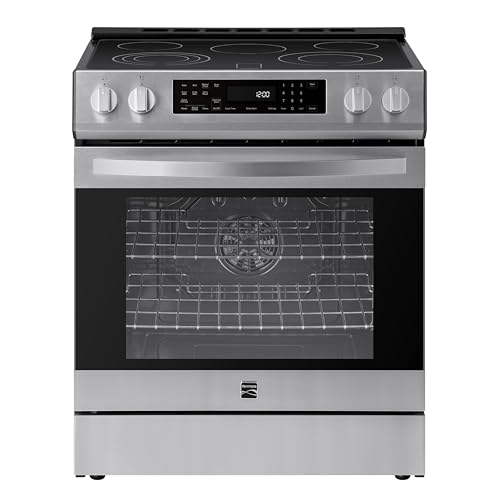
Kenmore 5.6 Cu. Ft. Front Control Electric Range Oven (Stainless Steel) — Best True Convection Value
Kenmore’s front-control range is the quiet value in this list: a larger-than-average 5.6 cu. ft. oven with true convection (a heating element around the fan, not just a fan), five cooktop elements, steam cleaning and a big viewing window, in a front-control format that usually costs more.
Strengths
- True convection element gives even results on full loads
- 5.6 cu. ft. oven swallows large roasters and tall stockpots
- Five elements plus a proper broil function cover varied pan sizes
Trade-offs
- Steam clean only — heavy soil still needs elbow grease
- Front-control panel styling is functional rather than premium
- Brand service networks vary by region; confirm local support
| Specification | Detail |
|---|---|
| Format | Front-control electric range |
| Oven capacity | 5.6 cu. ft. |
| Oven system | True convection |
| Elements | 5 |
| Cleaning | Steam clean |
| Racks | Chrome racks (per listing) |
True convection versus standard convection is worth one clear paragraph. A fan alone circulates air that the bake element heated, which helps; a fan with its own element delivers air that is already at temperature, which helps more — especially in the first minutes after you load cold food. On this Kenmore, that shows up as casseroles that set evenly edge to centre and frozen pizzas that do not need rotating.
The large window and interior light sound like brochure filler until you own a range without them. Being able to check a rising cake or a browning gratin without opening the door — and dumping the heat you paid for — is a genuine cooking advantage, and it is one this model gets right at a mainstream tier.
Best for: families who want the biggest oven and true convection without a premium badge / Not suited for: buyers who need a pyrolytic self-clean cycle or a Wi-Fi-connected range
Check on Amazon to see the current price, configuration options and delivery terms for the Kenmore front-control range.
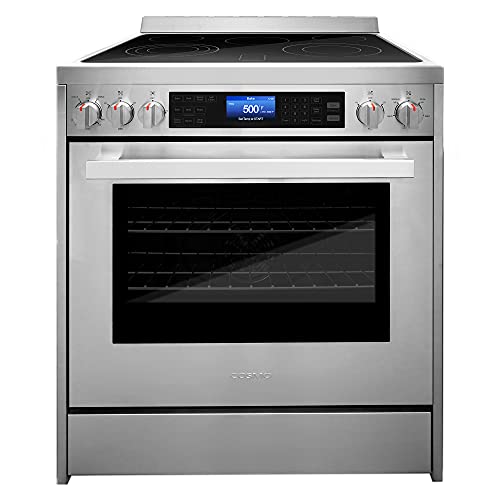
Cosmo COS-305AERC 30-Inch Vista Electric Range (5 Cu. Ft.) — Best European Convection Style
Cosmo’s Vista range brings a European design accent to the standard 30-inch slot: a ceramic glass cooktop with five cooking zones including a warming centre, a triple-element burner that fires one, two or three rings to match your pan, and what the brand calls Turbo True European Convection in the 5 cu. ft. oven.
Strengths
- Triple-element burner matches heat ring to pan diameter — less wasted energy
- Warming centre keeps sides at serving temperature without an element hogging space
- True European convection uses multiple elements for balanced baking
Trade-offs
- Ceramic glass needs the right cleaners to stay looking new
- Smaller brand: confirm warranty and service coverage for your area
- 5 cu. ft. oven is a touch smaller than the biggest picks here
| Specification | Detail |
|---|---|
| Format | 30-inch electric range, stainless steel |
| Model | COS-305AERC |
| Oven capacity | 5 cu. ft. |
| Cooktop | Ceramic glass, 5 burners incl. warming centre |
| Oven system | Turbo True European Convection |
The triple-element burner is the detail cooks notice weekly. A small saucepan on a big radiant element wastes energy and heats the kitchen; firing only the inner ring fixes that, while the full three rings under a wide skillet give edge-to-edge heat that single-ring burners cannot. Combined with the warming centre, the cooktop layout is genuinely thoughtful for people who cook several components at once.
European convection, in this context, means the oven draws on more than one heating element with the fan, which tends to produce gentler, more uniform results for pastry and delicate bakes. If your baking leans towards breads, meringues and layered cakes rather than weeknight casseroles, this oven philosophy suits you — and the styling stands apart from the mainstream brands if the kitchen is design-led.
Best for: design-conscious cooks and bakers who value pan-matched elements and European convection / Not suited for: buyers who want the largest possible oven or the biggest local service network
Check on Amazon to see the current price, configuration options and delivery terms for the Cosmo Vista range.

Avanti Electric Range Oven, 20-Inch (2.1 Cu. Ft., Stainless Steel) — Best for Small Kitchens
Most “compact range” advice quietly assumes a 24- or 30-inch opening. The Avanti is for the kitchens where that assumption fails: true 20-inch width, four coil burners on top, a 2.1 cu. ft. oven with a built-in broiler below, and even a storage drawer — a full range, shrunk honestly rather than replaced by a hot plate and a toaster oven.
Strengths
- True 20-inch footprint fits openings no standard range can use
- Four coil burners handle any cookware, including battered pans
- Real oven with broiler, framed glass door and storage drawer
Trade-offs
- 2.1 cu. ft. oven will not fit a large holiday turkey or full sheet pans
- Coil burners heat and cool slowly compared with smoothtop or induction
- No convection fan — baking needs a little more attention and rotation
| Specification | Detail |
|---|---|
| Format | 20-inch freestanding electric range |
| Oven capacity | 2.1 cu. ft. |
| Cooktop | 4 coil burners |
| Features | Built-in broiler, storage drawer |
| Finish | Stainless steel |
Coil burners deserve a fair hearing in this size class. They are indifferent to warped pan bottoms, they tolerate cast iron being slid around, replacement elements are cheap and swap in minutes, and in a rental or accessory dwelling unit those ownership traits beat the prettier smoothtop. The trade — slower response — matters less when the largest pot in the kitchen is a medium saucepan.
Plan meals around the oven honestly: quarter sheet pans, a standard loaf, a chicken, a casserole for two to four — all fine. A 20-pound turkey or a baker’s full-size sheet pan is not. Owners who accept that envelope generally love these ranges; owners who discover it at Thanksgiving do not. Measure your favourite pans against the oven before ordering.
Best for: apartments, in-law units, cabins and galley kitchens with a 20-inch opening / Not suited for: large families or bakers who need full sheet pans and a big bird in the oven
Check on Amazon to see the current price, configuration options and delivery terms for the Avanti 20-inch range.
Comparison Table
| Pick | Badge | Key spec | Best for |
|---|---|---|---|
| Frigidaire Electric Convection Range with Steam Cleaning & Air Fry (5.3 Cu. Ft.) | Best Overall | 5.3 cu. ft. convection oven, air fry, steam clean | families replacing a standard 30-inch electric range who want convection and air fry without paying for induction |
| Frigidaire GCRI3058AF 30-Inch Induction Range with Air Fry | Best Induction | Induction cooktop, convection oven with air fry | keen home cooks who want fast, precise cooktop control and already own (or will buy) induction-ready pans |
| Frigidaire Professional 30-Inch Slide-In Electric Range with Air Fry and Total Convection | Best Slide-In Look | 5 elements, Total Convection, front controls | renovators who want a built-in look and keen bakers who load multiple racks |
| Kenmore 5.6 Cu. Ft. Front Control Electric Range Oven (Stainless Steel) | Best True Convection Value | 5.6 cu. ft., true convection, 5 elements | families who want the biggest oven and true convection without a premium badge |
| Cosmo COS-305AERC 30-Inch Vista Electric Range (5 Cu. Ft.) | Best European Convection Style | Triple-element burner, warming centre, 5 cu. ft. | design-conscious cooks and bakers who value pan-matched elements and European convection |
| Avanti Electric Range Oven, 20-Inch (2.1 Cu. Ft., Stainless Steel) | Best for Small Kitchens | 20-inch width, 2.1 cu. ft., 4 coil burners | apartments, in-law units, cabins and galley kitchens with a 20-inch opening |
How to Choose the Best Electric Range Cookers for Your Kitchen
Start with the opening, not the features. Measure the width of your cutout (30 inches is standard; 20 and 24 inches are the compact standards), the depth including how far a handle will project, and the height to the underside of anything above. Then confirm the electrical supply: a full-size electric range needs a dedicated 240V circuit with the amperage the manufacturer specifies, and the outlet position matters — a plug in the wrong spot can stop a slide-in sitting flush. These five minutes with a tape measure prevent the most common and most expensive range mistake.
Next, choose your cooktop technology honestly. Radiant smoothtop is the mainstream: affordable, compatible with any flat-bottomed pan, easy to wipe, but slow to respond and it holds heat after you turn it off. Induction is the performance choice: fast, precise, cooler to work around, but it demands magnetic cookware and sits in a higher tier. Coil is the utility choice, now mostly found on compact and budget models, prized for durability and cheap parts. There is no wrong answer — there is only the wrong answer for your pans and your patience.
Then the oven. Capacity figures are measured to a standard, but usable capacity depends on rack positions and element placement, so treat cu. ft. as a rough guide and check that your largest roaster fits the stated interior width. Convection is worth having for anyone who bakes or roasts on multiple racks; air fry modes are a bonus that genuinely works for frozen foods and wings. Finally, cleaning: steam clean is gentle and fine for tidy cooks, while traditional high-heat self-clean handles heavy soil at the cost of heat, smell and time. Pick the system that matches how you actually cook, not how you aspire to.
Freestanding, Front-Control and Slide-In: What Actually Differs?
These three formats fit the same standard opening, and the cooking hardware inside them is often identical — what changes is ergonomics and appearance. A freestanding range has a raised backguard with the controls on it and finished sides, so it can stand at the end of a run of cabinets. It is the simplest to install and usually the least expensive route to a given feature set, which is why two of our picks use it.
Front-control (sometimes called slide-in style) models put the controls on the front panel and leave the cooktop surface uninterrupted, so your backsplash shows through and the range reads as built-in. True slide-ins add overlapping cooktop edges that seal the gap to the counter. The cooking is the same; you are paying for the look, the sealed gap, and not reaching over hot pans to set the oven. If children can reach the front panel, check for a control lock — most modern models include one, and it takes seconds to engage.
What Air Fry Mode on a Range Really Does (and Does Not Do)
Range air fry is not marketing fiction, but it is widely misunderstood. A countertop air fryer is a small box with a powerful fan that blasts a small amount of food at close range. A range in air fry mode uses its convection fan and elements in a much larger cavity, so it needs a few accommodations to match results: a dark, perforated or mesh tray, a single layer of food, and usually no preheat in the way the brand’s instructions describe. Follow those rules and wings, fries and roasted vegetables come out convincingly crisp, in batches far larger than any countertop unit can handle.
Where the countertop unit still wins is speed on small portions and energy use — heating a 5 cu. ft. oven to fry one portion of nuggets is overkill. The sensible household pattern is: range air fry for family-size batches and sheet-pan cooking, countertop fryer (if you keep one) for snacks. If you do not yet own either, a range with air fry covers the family case first, which is why four of our six picks include it.
Range Ownership: The Costs and Chores Nobody Lists
A range’s purchase price is the beginning of its cost story, and thinking about the rest of it before you buy is what separates satisfied owners from resentful ones. Installation is the first extra: many deliveries assume a like-for-like swap, but a change of format (freestanding to slide-in), a cord that does not match your receptacle, or a circuit that needs uprating turns a drop-off into a project. None of this is a reason to avoid the upgrade — it is a reason to get the full quote before the old range leaves, while you still have a working kitchen and negotiating calm.
Running costs are dominated by the oven, not the cooktop: an hour of baking draws far more energy than an hour of simmering, and convection quietly helps here by cooking evenly at slightly lower temperatures or shorter times for many dishes. Induction cooktops are the efficiency champions of the top half, putting most of their energy into the pan instead of the room. None of these differences will make or break a household budget on their own, but over a decade of daily cooking they are real, and they reward the technologies this guide already favours for cooking reasons.
Maintenance is refreshingly light compared with gas: no burners to strip, no ignition to fail. The weekly job is the cooktop — a smoothtop kept clean with the right cleaner and a razor scraper for burnt rings stays glossy for years, while neglected spills bake into permanent shadows. The monthly job is the oven’s steam clean or a wipe-down. The annual job is checking the door seal and the anti-tip bracket. Put those on the calendar and a modern electric range is close to a fit-and-forget appliance.
Smoothtop Care: Keeping Glass Cooking Surfaces Looking New
Ceramic glass is tougher than it looks and easier to scar than owners expect — both facts come from the same property: the surface is glass. It shrugs off heat and weight, but sugar is its enemy. A sugary spill (jam, caramel, sweet sauces) left to cool on a hot zone can pit the glass as it contracts, which is why the first rule of smoothtop ownership is to wipe sugary spills while the surface is still warm, with a mitt, immediately. The second rule is the razor scraper: held at a low angle, it lifts burnt-on rings that no amount of soaking will shift, without scratching when used as directed.
Daily cleaning is a damp cloth and a drop of the cream cleaner made for glass cooktops, buffed dry to prevent water marks. Avoid abrasive pads, avoid sliding rough cast-iron bases across the surface (lift, do not drag), and avoid the folk remedy of baking soda pastes left to dry — they can dull the finish. Induction tops need even less: because the glass only gets hot from the pan, spills rarely bake on at all, which is one of induction’s least-advertised ownership pleasures. Treat the top this way and it will still look like the showroom photo when the range is a decade old.
Cooking on Electric: Techniques That Close the Gap With Gas
The honest difference between gas and electric cooking is response: gas changes now, radiant electric changes in thirty seconds, and cooks raised on gas sometimes read that lag as inferiority. The professional answer is technique, not regret. Preheat pans fully before food goes in — an electric element’s steady output rewards a properly hot pan with an excellent sear. Cook by residual heat: turn the element off a minute or two before the dish is done and let the stored heat finish it, which is free energy and finer control at the gentle end. And treat the element as a thermostat with momentum: move the pan half off the ring for an instant drop in heat, the electric equivalent of lifting a pan from a flame.
In the oven, electric has always been the professional’s quiet preference for baking: dry, even heat without combustion moisture, and with convection, results that gas ovens struggle to match for pastry. The cooks who thrive after switching are the ones who stop trying to make the electric range imitate gas and instead exploit what it does better — stability, evenness and precision at low temperatures. Give it a month of honest technique and most converts stop missing the blue flame entirely.
Range Sizes and Formats Beyond 30 Inches
Thirty inches dominates this guide because it dominates the housing stock, but the format map is wider and worth knowing before a renovation locks you in. Compact 20- and 24-inch ranges (the Avanti pick is the 20-inch exemplar) serve apartments, ADUs, cabins and office kitchens, trading oven volume for a footprint nothing else can fit. At the other end, 36-inch and wider ranges exist for serious cooks, but in the electric world they are far rarer than in gas and dual-fuel, and they demand their own cutout and circuit planning — they are a deliberate build decision, not an upgrade you drift into.
Double-oven ranges deserve a specific mention for bakers and entertainers: two cavities (usually a smaller over a larger) let you roast at one temperature and bake at another, or keep sides warm while the main finishes. The trade is that each cavity is smaller than a single-oven equivalent, and the lower oven sits low to the floor. If your cooking calendar is full of two-temperature Sundays, the format earns its compromises; if it is full of single big birds, the single large cavity in our Kenmore or Cosmo picks is the better tool. Choose for the meals you actually cook in December, not the ones you cook in magazines.
Buying a Range Online: Delivery, Haul-Away and the First Week
Large appliances bought online live or die in the delivery details, so read them before the price tempts you. Confirm what the delivery actually includes: threshold drop-off, room-of-choice placement, connection to an existing compliant outlet, and haul-away of the old range are four different service levels, and the difference between them is the difference between cooking dinner that night and staring at a boxed range in the hall. Measure the route, not just the kitchen: door widths, stair turns and lift dimensions have ended more range deliveries than any cutout ever has. Photograph the existing outlet and breaker before ordering so any mismatch is discovered while returns are still easy.
When the range arrives, inspect before you sign: door alignment, cooktop glass, racks, and the anti-tip bracket in the box. Power it on within the first day and run the checks in our setup section — every element, the fan, the broiler, the light — because a fault reported in week one is a replacement, while the same fault reported in month two is a repair appointment. Register the warranty the same week; it takes five minutes and it is the step everyone intends to do.
Then give the first week a fair trial: bake something you know by heart, boil the biggest pot of water you own, and run the air fry mode on a tray of something frozen. A range reveals its character in your own recipes, not in test dishes. If the oven runs hot or cool — many do, slightly — note it now and adjust with the calibration setting most modern ranges provide, rather than compensating forever. By the end of that week you should know your range the way you knew the old one, which is the real end of any appliance purchase.
How to Set Up a New Electric Range Safely
Installation of a hardwired-or-cord electric range is within reach of a careful homeowner, but it involves a high-amperage circuit: if anything about your outlet, cord or breaker does not match the range manual, stop and hire an electrician. Anti-tip safety is not optional — a range can tip if a child or a heavy pan load pulls on the open door, and every range ships with a bracket to prevent it.
- Turn off the breaker for the range circuit and verify the outlet is dead with a tester before touching anything.
- Unpack and inspect the range; confirm the model and configuration match your order before removing all packaging.
- Fit the power cord (3- or 4-prong) exactly as the manual diagrams for your home’s wiring, or confirm the existing cord matches the outlet type.
- Install the anti-tip bracket into the floor or wall at the position the template specifies — this step is a safety requirement, not an accessory.
- Level the range with its adjustable legs so pans sit flat and the door seals evenly; a rocking range bakes unevenly.
- Slide the range in, restore power, and set the clock and basic settings per the manual.
- Run a first burn-off: heat the empty oven as the manual directs (typically a moderate bake cycle) with the kitchen ventilated, to clear manufacturing residues.
- Test every cooktop element and the oven light, broiler and convection fan before the delivery crew (if any) leaves or the return window starts closing.
Common Buying Mistakes
Skipping the electrical check. Ordering a range before confirming your circuit amperage, outlet type and outlet position is the classic way to turn delivery day into a reschedule. Five minutes with the breaker panel and a tape measure prevents it.
Buying induction without the magnet test. Induction only heats pans a magnet sticks to firmly. Test every pan you care about before ordering an induction range, and budget replacements for any that fail into the true cost of the switch.
Assuming all 30-inch openings are identical. Depth, counter height and the gap behind for the cord all vary. Slide-in models in particular reward exact measurements of the cutout, not just the width.
Judging the oven by capacity alone. A bigger cu. ft. number with awkward rack spacing fits less real food than a slightly smaller, well-laid-out oven. Check interior width against your largest roaster or sheet pan.
Forgetting ventilation and clearance. A range is a heat source under your cabinets. Confirm the clearances in the manual for the surfaces above and beside the cooktop, especially if you are replacing gas with a high-output electric model.
Final Recommendation
For most kitchens, the Frigidaire convection range (Best Overall) is the safe, satisfying default: convection, air fry and steam cleaning in the standard format. Cooks who want real control should step to the GCRI3058AF induction model, and renovators chasing a built-in look should take the Frigidaire Professional slide-in or the Kenmore front-control, which adds the biggest oven here. Bakers with a design eye will enjoy the Cosmo Vista, and small kitchens finally get a real answer in the 20-inch Avanti.
Whichever you choose, measure twice, check the circuit once, and run the magnet test if induction is on your list. A range is a ten-year decision; an extra half hour of checking is the cheapest upgrade in this entire guide.
Shortlist first: Frigidaire Electric Convection Range with Steam Cleaning & Air Fry (5.3 Cu. Ft.), Frigidaire GCRI3058AF 30-Inch Induction Range with Air Fry, Frigidaire Professional 30-Inch Slide-In Electric Range with Air Fry and Total Convection — check price on Amazon for each before you decide.
Keep exploring the cooker cluster: Best Electric Top Cookers And Ovens Best Electric Cookers With Induction Hobs Best Dual Fuel Cookers 60cm Best Cookers For Camping Best Electric Slow Cook Pressure Cookers
Related guides
Frequently Asked Questions
Is induction really better than a regular electric smoothtop?
It is faster and more precise: energy goes straight into the pan, so boils start sooner and simmers hold steadier, and the surface stays cooler because it is only heated by the pan. The costs are a higher tier price and the cookware requirement — pans must be magnetic. If your pans pass the magnet test and you cook daily, induction is the upgrade most owners say they would not give back.
What size range do I need?
Thirty inches is the standard residential width and every full-size pick here fits it. Compact 20- and 24-inch ranges exist for apartments and small kitchens — our Avanti pick is a true 20-inch model. What matters more than width is oven interior size versus your largest pan, so check that measurement against the manufacturer’s stated interior dimensions.
Do I need a special circuit for an electric range?
Yes. Full-size electric ranges require a dedicated 240V circuit with the amperage specified in the manual, and either a 3- or 4-prong receptacle depending on your home’s wiring era and local code. Compact ranges may differ. If your current setup does not match, an electrician visit is part of the real cost of the change.
Steam clean or self-clean: which is better?
They solve different problems. Steam clean is a short, low-temperature cycle that softens light soil for a wipe-down — gentle, quick and fume-free, but weak on baked-on grease. Traditional self-clean uses very high heat to ash heavy soil, at the cost of hours, heat and smell. Tidy cooks do fine with steam; heavy roasters and broilers may prefer self-clean.
Can an electric range replace my air fryer?
For family-size batches, largely yes: air fry mode plus a perforated tray crisps wings, fries and vegetables in quantities no countertop unit can match. For a single snack portion, a countertop fryer still heats faster and uses less energy. Many households end up using the range mode for dinners and keeping a small countertop unit for snacks — or skipping the countertop unit entirely.
How long should an electric range last?
Ranges are among the longest-lived kitchen appliances, commonly serving well beyond a decade with basic care: keep the cooktop clean so elements cycle evenly, avoid slamming the door (the seal matters), and replace a failed element promptly rather than cooking around it. Choosing a model with available parts and local service support — a point we weigh in the reviews — matters more to lifespan than any single feature.


