Disclosure: airfryerkitchensupply.com is reader-supported. When you buy through links on our site, we may earn an affiliate commission at no extra cost to you.
Where to buy
This guide to the best electric indoor cookers spans the appliance types designed for cooking inside the home — multi-cookers, pressure cookers, slow cookers and countertop multi-pots. Every pick was verified against live Amazon catalogue data for type, capacity and functions, and each links to its listing so you can check price on Amazon and confirm the current model before ordering.
- Ninja PossibleCooker PRO 8.5-Qt (MC1001) (Best Overall) — check price on Amazon
- Instant Pot Rio 6 Qt (Best Pressure Multi-Cooker) — check price on Amazon
- COSORI 6QT Pressure Cooker, 9-in-1 (Best Ceramic Pot) — check price on Amazon
- Presto 06009 10-Quart Kitchen Kettle XL Multi-Cooker (Best for Frying and Steaming) — check price on Amazon
- Hamilton Beach Set & Forget 8 Quart Programmable Slow Cooker (Best Slow Cooker) — check price on Amazon
- Chefman 6-Quart 13-in-1 Electric Pressure Cooker (Best Budget Multi-Cooker) — check price on Amazon
The best electric indoor cookers share a job description: they cook real food, inside a real home, without a stove, an oven or an open flame. That covers a wider family than it first appears — pressure multi-cookers that turn out a stew in under an hour, slow cookers that work all day while you do not, and sear-and-slow multi-pots that brown meat and then braise it in the same vessel. What unites them is that they plug into a wall socket and ask almost nothing of the kitchen around them, which is why they are the first appliances bought for rentals, dorms, annexes, offices and small homes.
Choosing between the types matters more than choosing between brands. Pressure cooking is the speed option: intense, fast, and sealed, brilliant for beans, grains and tough cuts. Slow cooking is the patience option: gentle, forgiving and unmatched for set-and-forget weekday dinners. The newer multi-pots split the difference, searing and slow cooking in one pot without pressure. The picks below include the strongest example of each approach, so the right first decision is which kind of cook you are.
A word on indoor practicality. All of these appliances are designed for indoor use — no fuel, no fumes, modest heat output compared with an oven. They still produce steam and hot surfaces, so give them counter clearance and keep them away from the wall while they vent. With that ordinary care, any of them can run a kitchen almost single-handedly.
In this guide
Quick Picks
Six indoor electric cookers covering the three great approaches — pressure, slow and sear-and-slow — plus the budget and versatility picks. Choose your cooking style first; the model follows.
- Ninja PossibleCooker PRO 8.5-Qt (MC1001) — Best Overall. The sear-and-slow champion: browns meat in the pot, then slow cooks, steams or braises — and the pot can finish in the oven. — Check on Amazon
- Instant Pot Rio 6 Qt — Best Pressure Multi-Cooker. The modern face of the classic Instant Pot formula: pressure, slow, rice, steam, sauté and yogurt in a 6-quart family size. — Check on Amazon
- COSORI 6QT Pressure Cooker, 9-in-1 — Best Ceramic Pot. A 9-in-1 pressure cooker with a ceramic pot and a sous vide mode — the easy-clean, feature-rich alternative to the default brand. — Check on Amazon
- Presto 06009 10-Quart Kitchen Kettle XL Multi-Cooker — Best for Frying and Steaming. A giant, simple multi-cooker kettle that steams corn, boils pasta, roasts and deep fries — the old-school indoor workhorse. — Check on Amazon
- Hamilton Beach Set & Forget 8 Quart Programmable Slow Cooker — Best Slow Cooker. A big programmable slow cooker that switches itself to warm when the time is up — the set-and-forget weekday dinner solution. — Check on Amazon
- Chefman 6-Quart 13-in-1 Electric Pressure Cooker — Best Budget Multi-Cooker. A touchscreen 13-in-1 pressure multi-cooker at a budget tier — the lowest-cost route into the full indoor-cooker formula. — Check on Amazon
How These Picks Were Chosen
‘Indoor cooker’ is a loose retail label, so this guide defined it strictly before choosing: electric appliances designed to cook full meals indoors without a stove — pressure multi-cookers, slow cookers and sear-and-slow multi-pots. Grills, air fryers and rice-only cookers were excluded as specialists covered in their own guides. Every pick was then verified against live Amazon catalogue data for type, capacity and function set.
Because the types differ so fundamentally, ranking weighed each model against its own job first: the pressure cookers on speed and reliability, the slow cooker on programmability and gentleness, the multi-pot on searing, the kettle on capacity. Cross-type recommendations in the final section translate those judgements into buying advice by cooking style, which is how this category should be bought.
No prices are printed; indoor cookers are among the most heavily promoted appliances on Amazon and printed figures would mislead within weeks. Each pick links to its live listing — check price on Amazon there, and confirm capacity and functions on the current listing before ordering.
Scope discipline shaped this guide as much as quality did: several excellent specialist appliances — air fryers, rice cookers, electric grills — were deliberately left to their own guides rather than padded into this one, because a buyer choosing an indoor cooker needs the generalist comparison, not a catalogue of everything that plugs in.
Geography quietly influenced the shortlist too: every pick is a model with established availability and support in the US market, because an indoor cooker is often a household’s primary cooking appliance and a machine without local support is a risk out of proportion to any saving. Exotic imports with impressive listings but no support footprint were passed over deliberately.
Finally, every pick had to pass a simple test of domestic realism: could this appliance, alone on a counter, produce a proper dinner tonight for its intended household, from ordinary supermarket ingredients, without specialist knowledge? Specialists and gimmicks fell away at that question; the six survivors are the indoor cookers that answer it without qualification.
The 6 Best Electric Indoor Cookers, Reviewed
Three cooking philosophies, six machines. Read the type line in each review first — matching the appliance to your cooking style matters more than any ranking here.

Ninja PossibleCooker PRO 8.5-Qt (MC1001) — Best Overall
The PossibleCooker PRO represents the third way in indoor cooking: no pressure, but direct heat in the base and sides of the pot, so it sears like a pan and then slow cooks, steams, braises or keeps food warm in the same vessel. At 8.5 quarts it is sized for families and batch cooking, and the removable pot goes to the table or into the oven to finish a dish.
| Capacity | 8.5 quarts |
| Functions | 8-in-1 multi-cooker |
| Heating | Triple Fusion Heat — bottom, side and steam heat |
| Pot | Removable pot, oven-safe |
Strengths
- True searing in the same pot you slow cook in
- Large 8.5-quart capacity for families and batches
- Oven-safe removable pot adds finishing options
Trade-offs
- No pressure cooking — tough cuts take hours, not minutes
- Large footprint on the counter
- Pot is hand-wash preferred to protect its coating
The searing ability is not a gimmick; it changes what slow cooking tastes like. Most slow cookers ask you to brown meat in a separate pan or skip browning entirely, and the flavour difference is the difference between a good braise and a grey one. The PossibleCooker’s heated base and sides brown properly, deglaze properly, and then hold a gentle braise — one pot, one wash-up, full flavour.
It also steams, proofs and works as a generous warmer for parties, which makes it the hardest-working non-pressure appliance here. If your cooking leans toward braises, chillies, curries and big comforting pots — and you do not need pressure speed — this is the indoor cooker to build a kitchen around.
A use case owners discover late: the PossibleCooker as a party appliance. Its size, keep-warm behaviour and serve-from-the-pot design make it a natural chafing-dish replacement for meatballs, mulled drinks and buffet curries. Appliances that entertain as well as they cook tend to survive kitchen clear-outs, and this one’s second life at gatherings is a genuine part of its value.
One more PossibleCooker habit worth adopting: because the pot sears and then cooks in place, it is the natural home of the one-pot pasta and the stove-to-table casserole — dishes that begin as frying and end as braising. Owners who build three or four such recipes into their rotation find the machine displacing not just the slow cooker but half their hob work too.
Best for: families who love braises and one-pot meals without pressure cooking / Not suited for: cooks who need beans and tough cuts cooked fast under pressure
Check on Amazon — check the current price on Amazon before you decide, because listings and included accessories change over time.
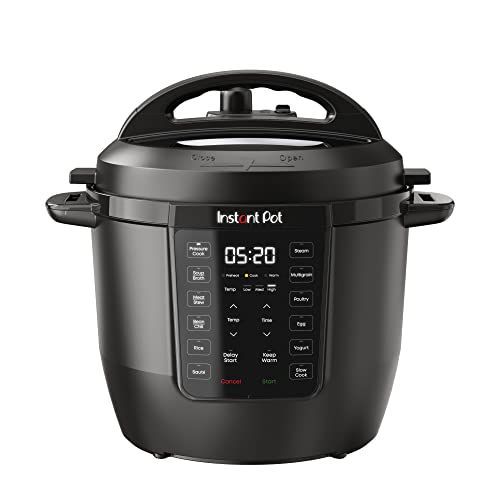
Instant Pot Rio 6 Qt — Best Pressure Multi-Cooker
The Rio is Instant Pot’s updated mainstream model — the same 7-in-1 formula that made the category, in a refreshed body with a friendlier steam release and a cleaner control layout. Six quarts is the family standard size, and the function set covers the weekly rotation: pressure-cooked dinners, rice, slow-cooked weekends, steamed vegetables and homemade yogurt.
| Capacity | 6 quarts |
| Functions | 7-in-1: pressure cook, slow cook, rice, steam, sauté, yogurt, keep warm |
| Design | Updated Rio body with easy steam release |
| Pot | Stainless steel inner pot |
Strengths
- The proven Instant Pot formula, updated
- Huge recipe and accessory ecosystem
- Stainless pot and a full core function set
Trade-offs
- No air fryer function without a separate lid purchase
- Slow cook mode runs cooler than a dedicated slow cooker
- Interface still rewards reading the manual once
The ecosystem argument is real with Instant Pot: recipes online are written for these machines by default, replacement pots and gaskets are everywhere, and any cooking question you have has been answered by thousands of owners. For a first indoor cooker, that support blanket has genuine value beyond the hardware.
As a pressure cooker it does the category’s core work — beans without soaking, grains in minutes, tough cuts tender in under an hour — with the steady reliability the brand built its name on. Buyers who want air frying too should look at the Duo Crisp in our pressure cooker guide; buyers who want the classic, this is it in current form.
New owners should know the Rio’s slow cook mode runs on the gentler side, as with most pressure multi-cookers: recipes written for a dedicated slow cooker often want the higher slow setting or extra time. This is normal for the type, not a defect in the unit — but it is exactly the kind of expectation-setting that separates a happy first month from a frustrated one.
The Rio’s keep-warm behaviour deserves a practical note: it holds food safely at serving temperature for extended periods, which makes it a forgiving dinner host for households whose members eat at different times. Pressure cook at six, serve from the pot at seven and eight — that flexibility is a real part of why these machines anchor busy family kitchens.
Best for: most households wanting one proven pressure multi-cooker / Not suited for: buyers who specifically want air frying built in
Check on Amazon — check the current price on Amazon before you decide, because listings and included accessories change over time.
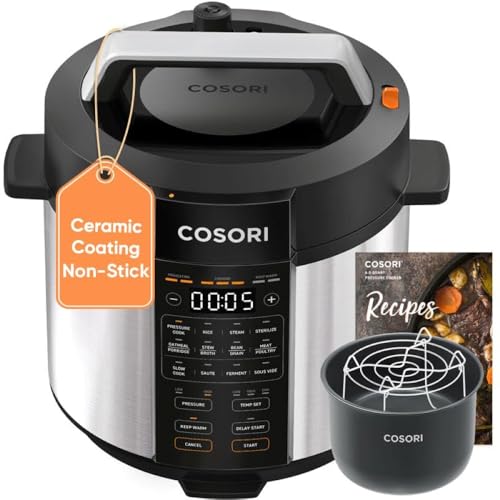
COSORI 6QT Pressure Cooker, 9-in-1 — Best Ceramic Pot
COSORI built its name in air fryers and brings the same formula here: a well-specified pressure cooker with a ceramic-coated pot, a sous vide function most rivals omit, and a clear emphasis on safety features. It suits cooks who like the Instant Pot concept but prefer a nonstick-style pot and a slightly more modern control experience.
| Capacity | 6 quarts |
| Functions | 9-in-1 including sous vide |
| Pot | Ceramic-coated inner pot |
| Safety | 12 safety features |
Strengths
- Ceramic pot releases food and cleans easily
- Sous vide mode is a genuine extra
- Strong stated safety feature set
Trade-offs
- Coated pot needs gentle utensils
- Smaller recipe ecosystem than Instant Pot
- No air fryer lid system
The ceramic pot changes daily life with the machine more than any other single feature: rice releases, oatmeal does not weld itself to the base, and washing up is a rinse rather than a soak. The trade is the usual one — treat the coating kindly, with silicone and wood, and it will last; abuse it and stainless would have been the wiser buy.
Sous vide in a pressure cooker sounds odd until you try it: the sealed, insulated pot holds water temperature steadily, and for a household curious about the technique it removes the need for a separate circulator. As an overall package, this is the strongest challenger-brand pick in the guide.
COSORI’s accessory range is worth a pre-purchase glance: spare pots and lids in the brand’s ecosystem determine how gracefully the machine ages, and COSORI supports its cooking appliances better than most challenger brands. A second inner pot — one in the dishwasher, one in service — is the accessory owners of any pressure cooker rate highest, and it is worth confirming availability for this model before you commit.
A COSORI detail for the safety-conscious: the brand publishes its safety mechanisms prominently — lid-locking, pressure regulation and overheat protection among the twelve listed features. All modern pressure cookers carry such systems, but a manufacturer that itemises them is signalling the engineering culture behind the appliance, and in this category that culture is a buying criterion.
Best for: cooks who want easy cleanup and a sous vide extra / Not suited for: heavy users who prefer an all-stainless pot
Check on Amazon — check the current price on Amazon before you decide, because listings and included accessories change over time.

Presto 06009 10-Quart Kitchen Kettle XL Multi-Cooker — Best for Frying and Steaming
The Presto Kitchen Kettle is a different species from the digital multi-cookers: a deep 10-quart countertop pot with a dial, a basket, and the ability to steam, boil, roast, stew and deep fry. It is the appliance for big, simple jobs — a seafood boil, a batch of fried chicken, a mountain of corn on the cob — done indoors without commandeering the stove.
| Capacity | 10 quarts |
| Type | Countertop multi-cooker / kitchen kettle |
| Functions | Steams, roasts, boils, and deep fries with basket |
| Brand | Presto |
Strengths
- Huge 10-quart capacity for crowd-sized jobs
- Deep frying and steaming with the included basket
- Dead-simple dial control, nothing to program
Trade-offs
- No pressure cooking and no digital programs
- Basic temperature dial rather than precise control
- Large to store
There is a refreshing honesty to the Kitchen Kettle: it is a heated pot, superbly sized, and it pretends to be nothing else. For households that entertain, fry, or process garden and market hauls, that capacity and simplicity beat a dozen programs. The basket makes frying and steaming controlled and lift-out easy.
It will not cook rice by program or pressure-cook a bean. It is the specialist bruiser of this guide, and for the kitchens that need one — big families, keen fryers, preserving households blanching vegetables — nothing else here does its job at all.
The Kitchen Kettle’s basket deserves its own sentence, because it converts the pot from a vessel into a system: vegetables blanch and lift out in one motion, fried foods drain over the pot, and a seafood boil serves without fishing. Owners processing garden produce or feeding crowds at fish fries describe the basket, not the capacity, as the feature they would not give up.
The Presto also moonlights as the household’s blanching station during preserving season: a rolling boil, a basket of vegetables, a lift and drain — the exact motion canning prep requires, at counter height, without tying up the stove that the canner itself needs. Preservers who own one describe it as the assistant that makes canning day a one-person job.
Best for: big-batch frying, steaming and boiling indoors / Not suited for: cooks wanting programmed, set-and-forget meals
Check on Amazon — check the current price on Amazon before you decide, because listings and included accessories change over time.
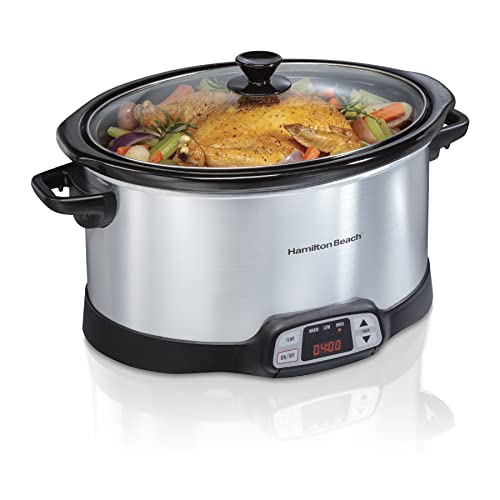
Hamilton Beach Set & Forget 8 Quart Programmable Slow Cooker — Best Slow Cooker
Dedicated slow cookers still do one thing better than multi-cookers: gentle, even, all-day cooking with zero supervision. This 8-quart Hamilton Beach adds the feature that makes slow cooking work for real schedules — programmability, with the cooker switching to keep-warm when the cooking time ends, so dinner is ready when you are rather than when the recipe assumed you would be.
| Capacity | 8 quarts |
| Controls | Programmable with flexible time and heat settings |
| Design | Set & Forget series with secure lid features |
| Use | All-day slow cooking for large households |
Strengths
- Programmable timing with automatic keep-warm
- True slow-cooker gentleness multi-cookers imitate imperfectly
- Big 8-quart capacity for families and batch cooking
Trade-offs
- One job only — no pressure, no searing programs
- Slow cooking cannot be hurried
- Large crock is heavy to wash
The case for a dedicated slow cooker in a world of multi-cookers is texture and timing. Long, low heat breaks down connective tissue into silkiness that pressure cooking approximates but does not duplicate, and the programmable warm switch removes the classic slow-cooker failure — food overcooking because life ran late.
At 8 quarts it handles the big roasts, double batches of soup and party-sized pulled pork that smaller crocks cannot. If your weekday life suits loading a pot in the morning, this remains the most civilised way to have dinner cook itself.
The Set & Forget name rests on a workflow worth copying even on other machines: load, program the cooking time rather than a vague setting, and let the automatic switch to warm protect the meal from your schedule. The practical result is that slow cooking stops requiring you to be home at a recipe’s convenience — which was always the point of the appliance, finally delivered by the timer.
A note on the Hamilton Beach’s crock: at 8 quarts it is a serious piece of stoneware, and it rewards the two-handled lift and a trivet under it when it lands on the counter. Owners who treat the crock as the heavy object it is get decades from it; the slow cooker’s only real fragility is the human habit of treating a full crock casually.
Best for: busy households that cook dinner by loading a pot in the morning / Not suited for: cooks who need dinner fast at the end of the day
Check on Amazon — check the current price on Amazon before you decide, because listings and included accessories change over time.

Chefman 6-Quart 13-in-1 Electric Pressure Cooker — Best Budget Multi-Cooker
Chefman’s 13-in-1 brings the full pressure multi-cooker formula — pressure, slow, steam, sauté, delay start, keep warm — to the budget end of the market, with a touchscreen panel that looks a class above its tier. For a first multi-cooker, a student kitchen or a second machine, it covers the whole brief for notably less commitment.
| Capacity | 6 quarts |
| Functions | 13-in-1 multicooker |
| Controls | Touchscreen |
| Programs | Slow cooker, steamer, sauté, soup, chili, delay start and keep warm |
Strengths
- Full function set at a budget position
- Touchscreen controls are clear and modern
- Delay start and keep warm included
Trade-offs
- Fit and finish below the premium brands
- Smaller long-term support and accessory ecosystem
- Preset count flatters the true function list
Judge the function count realistically — thirteen includes variations on the core modes — but the core itself is complete, and that is what matters at this tier. Pressure cooking performance is the make-or-break, and the Chefman seals, pressurises and cooks the standard repertoire without drama.
The compromises are longevity questions rather than day-one ability: coating durability, gasket availability and brand support over years. As an entry point that lets a household learn whether multi-cooking suits its life, it is an easy recommendation; heavy users cooking daily should consider the mainstream picks above as the buy-once option.
Treat the Chefman’s touchscreen as its long-term question as well as its selling point: touch panels are the component most exposed to steam and splashes over years of use. Wiping the panel dry after cooks and avoiding scouring cleaners on it costs nothing and materially extends its life. Budget appliances reward small kindnesses of ownership more than premium ones do.
The Chefman’s value case strengthens for renters and movers: at its tier, it is the indoor cooker you can buy for a temporary home without the sunk-cost anxiety of a premium machine, and its full function set means a kitchen in boxes still eats properly. Not every appliance purchase is a decade decision, and this pick serves the other kind honestly.
Best for: first-time multi-cooker buyers on a budget / Not suited for: daily heavy users wanting a decade-long appliance
Check on Amazon — check the current price on Amazon before you decide, because listings and included accessories change over time.
Comparison Table
| Pick | Badge | Key spec | Best for |
|---|---|---|---|
| Ninja PossibleCooker PRO 8.5-Qt (MC1001) | Best Overall | 8.5 qt, 8-in-1, sear/sauté and slow cook, oven-safe pot | families who love braises and one-pot meals without pressure cooking |
| Instant Pot Rio 6 Qt | Best Pressure Multi-Cooker | 6 qt, 7-in-1 electric pressure cooker | most households wanting one proven pressure multi-cooker |
| COSORI 6QT Pressure Cooker, 9-in-1 | Best Ceramic Pot | 6 qt, 9-in-1, ceramic-coated pot, sous vide | cooks who want easy cleanup and a sous vide extra |
| Presto 06009 10-Quart Kitchen Kettle XL Multi-Cooker | Best for Frying and Steaming | 10-quart multi-cooker, deep fry/steam/roast versatility | big-batch frying, steaming and boiling indoors |
| Hamilton Beach Set & Forget 8 Quart Programmable Slow Cooker | Best Slow Cooker | 8 qt programmable slow cooker with probe option | busy households that cook dinner by loading a pot in the morning |
| Chefman 6-Quart 13-in-1 Electric Pressure Cooker | Best Budget Multi-Cooker | 6 qt, 13-in-1, touchscreen controls | first-time multi-cooker buyers on a budget |
The honest summary of the table: pressure cookers (Rio, COSORI, Chefman) buy you time; the slow cooker buys you freedom from timing; the PossibleCooker buys you flavour from searing; the Presto buys you sheer volume. Most kitchens eventually own two of these types, because they solve different problems.
Capacity comparisons need care: a 6-quart pressure cooker and an 8-quart slow cooker serve similar households, because pressure cooking’s working fill is lower. Judge by portions you cook, not by the biggest number on the box.
How to Choose an Electric Indoor Cooker
Choose the cooking method before the model. If your pain point is time — dried beans, tough meat, grains on a weeknight — pressure cooking is the answer and everything else is a compromise. If your pain point is schedule — dinner must be ready when work ends, whenever that is — a programmable slow cooker is the answer. If your pain point is flavour depth in one-pot meals, the sear-and-slow multi-pot is the answer. Naming your actual problem first makes the rest of the decision almost automatic.
Size by portions, honestly. A 6-quart pressure cooker or an 8-quart slow cooker feeds a family and batches for the freezer; a single person who hates leftovers will find both oversized and should look at compact models in the same ranges. Remember pressure cookers fill to about two-thirds in practice, so their usable volume is smaller than the headline.
Then weigh the ownership details: inner pot material (stainless lasts, coatings clean easily), spare gasket availability for pressure models, and whether the control style suits you — some cooks love touchscreens, others want a dial they can use with wet hands. Finally, measure the counter and the cupboard. Indoor cookers are bulky friends; the one that fits your kitchen gets used, and the one that does not gets sold.
- Method first: pressure for speed, slow for schedule, sear-and-slow for flavour
- Size by portions cooked, not by headline quarts
- Pot material matched to how you treat equipment
- Spares availability for pressure cooker gaskets and seals
- Counter footprint and storage measured before ordering
Running a Kitchen on Indoor Cookers: What It Is Really Like
Plenty of households — in studios, rentals, annexes and during kitchen renovations — cook for months on indoor electric cookers alone, and the experience teaches a clear lesson: one pressure multi-cooker plus one slow or sear-and-slow pot covers roughly ninety percent of home cooking. Curries, stews, soups, grains, braises, steamed vegetables, even yogurt and simple cakes all live inside these two pots.
The remaining ten percent is high-heat theatre: a hard-seared steak, a blistered pizza, crisp roast potatoes. A small countertop oven or air fryer covers most of that if it matters to you. The point of this guide is not that stoves are obsolete — it is that indoor electric cookers, chosen by method rather than by marketing, can carry a kitchen far further than most people expect.
Pressure, Slow or Sear-and-Slow: Choosing Your Indoor Cooking Method
Since this guide’s central advice is to choose a method before a model, the methods deserve a fuller comparison. Pressure cooking works by sealing steam inside a pot, raising the boiling point of water and forcing heat into food faster than any open method. Its signature results: dried beans tender without soaking, tough cuts collapsing in under an hour, grains in minutes, and flavours that meld with a depth that suggests far longer cooking. Its limits are equally physical: no browning happens inside the sealed, wet environment, textures trend tender, and you cannot taste and adjust mid-cook.
Slow cooking is pressure’s opposite in every way: gentle heat over many hours, wraparound warmth, and a tolerance for neglect that no other method matches. Collagen melts into silk, flavours marry slowly, and the cooker’s schedule bends around yours. Its costs are planning — dinner starts in the morning — and the absence of searing, which is why the classic slow-cooker workflow browns meat in a pan first, or accepts a paler result.
Sear-and-slow multi-pots exist to close that last gap: direct heat in the pot browns properly, then the same vessel braises gently. What they cannot do is pressure’s speed. So the honest triangle is this — pressure buys time, slow buys freedom, sear-and-slow buys flavour — and most experienced indoor cooks eventually own two corners of the triangle. Buy first the corner that solves your loudest problem.
Indoor Cooker Safety and Good Practice
These appliances are designed for home indoor use and are safe when used as directed, but a few habits keep them that way. Give pressure cookers open air above the vent — never under low cabinets — and keep faces and hands out of the steam path during release. Keep cords away from the appliance’s own hot surfaces and from the counter edge where a passing hip can catch them. Place any indoor cooker on a stable, heat-safe surface; a wobbling board under a full slow cooker is an accident arranging itself.
Electrical sense matters too: these are among the higher-draw appliances in a kitchen, so run one per outlet circuit where you can, and avoid power strips not rated for appliance loads. Food safety completes the picture — keep-warm modes hold food at serving temperature for a reasonable window, not indefinitely, and cooked food should be refrigerated within a couple of hours like any other. None of this is onerous; all of it is the difference between an appliance that serves for a decade and a story you tell about one that did not.
Energy and Running Costs: Indoor Cookers vs the Oven
Indoor cookers win their running-cost argument on physics. An oven heats a large insulated box and the air in it; a slow cooker or pressure cooker heats a small insulated pot and the food in it. Pressure cooking adds a second saving — time — cutting most dishes to a fraction of their oven duration. Slow cooking draws modest power for many hours and still typically totals less than an oven’s single hour. For households watching energy bills, shifting the week’s braises, soups and roasts from oven to indoor cooker is one of the few changes that saves money without changing a single menu.
There is a comfort dividend in summer as well: an oven turns a kitchen into a sauna for an hour; an indoor cooker releases a fraction of that heat into the room. In small homes and warm climates, that difference decides whether a cooked dinner happens at all on a hot evening — which is an energy saving of a more human kind.
Building the Two-Cooker Kitchen: The Combination Most Households End Up With
Experience — ours and that of thousands of small-kitchen households — converges on a pairing: one pressure multi-cooker and one slow or sear-and-slow pot. The logic is coverage without collision. The pressure cooker owns weeknight speed and grains; the second pot owns the all-day braise and the party-sized batch. Crucially, they also rescue each other: the day the pressure cooker is busy with a main, the slow cooker holds the side, and holiday cooking stops being a one-pot traffic jam.
If you are furnishing from zero, buy them in pain order: whichever problem — speed or schedule — costs you more dinners this month is the first purchase. Add the second when the first has proven its rhythm, usually within a season. The picks in this guide were chosen so that any pressure pick pairs sensibly with either the Hamilton Beach or the PossibleCooker, and that pairing, more than any single appliance, is the real recommendation of this guide.
How to Set Up an Indoor Cooker Kitchen That Actually Works
Whether you are equipping a small home or supplementing a full kitchen, this arrangement gets the most from the appliances in this guide.
- Give the cooker a permanent home. Indoor cookers get used when they live on the counter with clearance above for steam. A cooker stored in a deep cupboard is a cooker used monthly, not daily.
- Keep steam away from cabinets. Position pressure cookers so the release valve vents into open room air, not under a cupboard. A simple habit: pull the machine forward to the counter edge before releasing pressure.
- Build a small accessory kit. A steamer basket, a spare gasket for pressure models, silicone utensils for coated pots and a trivet cover most techniques these machines offer. Store them with the cooker, not across the kitchen.
- Learn three foundation recipes per machine. One grain, one protein, one full meal you can cook without thinking. Mastery of three reliable dishes beats a folder of fifty untested ones, and the repertoire grows from there.
- Plan the week by method. Pressure cooker for weeknight speed, slow cooker or multi-pot for the day you load in the morning. Matching the machine to the day’s shape is the real skill of indoor cooking.
- Wash seals and lids properly. Gaskets absorb odours and valves clog with starch. A weekly wash of lids, seals and valves keeps flavours clean and pressure behaviour predictable.
A final practical note: keep the manuals. Indoor cookers have model-specific quirks — a valve position, a slow-cook temperature behaviour — and the manual is the fastest answer when a dish behaves unexpectedly.
Common Buying Mistakes
Buying a type before choosing a method. A slow cooker will never cook fast and a pressure cooker will never be truly set-and-forget. Decide whether you need speed, schedule freedom or searing flavour first.
Oversizing for an imaginary household. Big cookers cook small meals badly and dominate counters. Buy for the portions you cook weekly.
Ignoring gasket spares on pressure models. The seal is a wear part. If spares for your model are unavailable, the cooker’s lifespan is capped by a rubber ring.
Venting steam under cabinets. Repeated steam release damages cabinet finishes and swells wood. Vent into open air, every time.
Expecting a multi-cooker to be best at everything. Multi-cookers are good at many things and rarely the best at any single one. If you slow cook daily, a dedicated slow cooker still wins; the guide’s per-type picks exist for this reason.
Final Recommendation
If one indoor cooker must do the most, choose by your life: the Instant Pot Rio for all-round pressure cooking with the deepest support ecosystem, or the Ninja PossibleCooker PRO if your cooking is braise-led and pressure speed means little to you. The COSORI is the easy-clean alternative, the Hamilton Beach remains the weekday-dinner champion for planners, the Presto kettle owns the big-batch jobs, and the Chefman is the sensible budget door into the whole category.
Most households that cook this way end up with a pressure cooker plus one of the slow or sear-and-slow pots — buy the one matching your biggest pain point first, and add the second when the first has earned its counter space. Related guides are linked below.
Check the Ninja PossibleCooker PRO 8.5-Qt (MC1001) on Amazon. Check the Instant Pot Rio 6 Qt on Amazon. Check the COSORI 6QT Pressure Cooker, 9-in-1 on Amazon.
Best Electric Multipot Cookers Best Electric Multi Use Pressure Cookers Best Electric 8 Qt Pressure Cookers Best Electric Egg Cookers Best Electric Bacon Cookers
Frequently Asked Questions
What is the difference between a multi-cooker and a slow cooker?
A slow cooker does one job — long, gentle cooking — and does it with total simplicity. A multi-cooker combines several methods, usually including pressure cooking, slow cooking, sautéing and steaming, in one appliance. Multi-cookers are more versatile; dedicated slow cookers are gentler and more forgiving for all-day cooking.
Can an electric indoor cooker replace a stove?
For most everyday meals, largely yes: pressure and slow cookers plus a searing multi-pot cover the great majority of home cooking. What they do not replicate is high-heat work like hard searing, wok cooking or baking at scale. Many small households run happily on indoor cookers plus a small oven or air fryer.
Are indoor electric cookers safe to leave unattended?
Slow cookers are designed for unattended all-day cooking on a stable, heat-safe surface away from clutter. Pressure cookers complete most recipes in under an hour and are best used while you are home. In both cases, follow the manual, keep cords and vents clear, and place the appliance on a firm, level counter.
What size indoor cooker do I need?
As a guide: 6-quart pressure cookers and 8-quart slow cookers serve families of four to six and batch cooking; smaller households do better with compact models. Remember pressure cookers should only be filled about two-thirds full, so their working capacity is below the headline number.
Do indoor cookers use much electricity?
They are among the most efficient ways to cook: insulated pots, low wattage relative to an oven, and — for pressure cookers — much shorter cooking times. A slow cooker running all day typically uses less energy than an oven running for a single hour.
Which is better for beginners, pressure or slow cooking?
Slow cooking is the gentlest start: forgiving timings, no pressure concepts, and meals that wait for you. Pressure cooking has a short learning curve — fill lines, releases, liquid minimums — and then becomes the faster daily tool. Many beginners start slow and add pressure within the year.
Can I use an indoor cooker in a dorm room or office?
Usually, subject to the building’s rules: electric indoor cookers produce no fumes or open flame, which is why they are the standard answer for dorms, offices and annexes. Check the venue’s appliance policy, keep the cooker on a heat-safe surface with clearance, and favour smaller models — a compact slow cooker or mini multi-cooker — where space and circuits are shared.
Can indoor cookers be used on any countertop surface?
They need a stable, level, heat-resistant surface with clearance around and above — especially above a pressure cooker’s vent. Avoid placing them on surfaces that heat can damage, and never on a cloth or board that lets the appliance slide. A plain kitchen worktop, used as intended, is exactly right.


