Disclosure: airfryerkitchensupply.com is reader-supported. When you buy through links on our site, we may earn an affiliate commission at no extra cost to you.
Where to buy
Camping electrics live on portability and power manners, so every pick below is verified with its format stated plainly. Check price on Amazon, then check your power plan — hookup, RV outlet or power station capacity — before any grill joins the camping kit.
- Cuisinart CEG-115 2-in-1 Portable Outdoor Electric Grill — Check price on Amazon
- Weber Lumin Compact Portable Electric Grill — Check price on Amazon
- Weber Q 1400 Portable Electric Grill — Check price on Amazon
- George Foreman Indoor/Outdoor Electric Grill with Stand, 15-Serving — Check price on Amazon
- Elite Gourmet 12-Inch Indoor Electric Grill EMG6505G — Check price on Amazon
- Techwood 1500W Smokeless Electric Grill with Glass Lid — Check price on Amazon
The best electric camping grills come with an honest disclaimer that this guide will repeat until it sticks: electric camping means powered camping. These grills are for RV sites, campgrounds with electrical hookups, cabin decks and properly sized power stations — not for a backpack, a canoe trip or a dry tent site. Within that honest boundary, they are superb: no charcoal bans to fear, no propane to haul, no fire danger in dry country, and grilled dinners at sites where open flame is restricted or simply unwelcome.
Why campers choose electric is a longer list than most expect. Many campgrounds restrict charcoal during fire season while permitting electric appliances. RV owners already carry shore power and resent a second fuel. Power-station campers want cooking that is silent, fume-free and usable under an awning in the rain. And campground cooking is usually small — two to four people, simple menus — which matches portable electric formats perfectly.
The verified picks cover the powered-camping map: Cuisinart’s stand-or-tabletop portable with the strongest stated heat, Weber’s premium compact and its classic Q portable, a big stand grill for RV basecamps and group sites, a tiny 1200W tabletop that sips power politely, and a compact lidded smokeless-design grill for awning cooking. Each is judged on the camper’s real criteria: packed size, weight class, power draw manners and cooking for a small crew.
Read the power section of the buying guide before the picks if you are new to powered camping. The right grill on the wrong power plan is a cold dinner; the right grill on the right plan is the easiest camp cooking there is.
In this guide
Quick Picks
Best Overall — Cuisinart CEG-115 2-in-1 Portable Outdoor Electric Grill: The camper’s dual-posture champion: stand it at the site, table it at the picnic bench, with a verified 550-degree ceiling for real searing on hookup power. Check price on Amazon
Best Premium Camping — Weber Lumin Compact Portable Electric Grill: Weber quality in the most packable premium form: a compact portable outdoor electric for campers who buy gear once and keep it for a decade. Check price on Amazon
Best Classic Camping — Weber Q 1400 Portable Electric Grill: The proven road companion: Weber’s Q 1400 has cooked at more campsites than any electric here — 1560 watts, cast-grate character, shelf-small storage. Check price on Amazon
Best for RV Basecamp and Groups — George Foreman Indoor/Outdoor Electric Grill with Stand, 15-Serving: Basecamp scale: a 15-serving stand grill for group sites and RV gatherings — then the head lifts off for storage or counter duty. Check price on Amazon
Best Low-Draw Tabletop — Elite Gourmet 12-Inch Indoor Electric Grill EMG6505G: The power-station friendly pick: a verified 1200W, 12-inch tabletop grill with glass lid — the gentlest draw here for modest electrical setups. Check price on Amazon
Best Under the Awning — Techwood 1500W Smokeless Electric Grill with Glass Lid: A compact 1500W grill with tempered glass lid and smokeless design — the considerate choice for awning cooking and close-quarters sites. Check price on Amazon
How These Picks Were Chosen
Camping selection weighted packed format, dual-posture designs (stand or tabletop), modest power manners and small-crew capacity over raw specifications. Every model was verified through the Creators API for this site, brand and model matched to the returned title, with ratings and formats — the Cuisinart’s stated 550-degree grilling, the Elite Gourmet’s 1200W draw, the Weber Q’s 1560-watt rating — taken only from those verified listings.
We excluded fixed patio grills and indoor-only presses that could not plausibly travel, and we included one large stand grill deliberately: RV basecamp and group-site camping is real camping, and its practitioners need capacity the compacts cannot give. It is labeled as the basecamp pick so tent-and-hookup campers can skip it with confidence.
No prices are printed. Check price on Amazon, and budget for the camper’s supporting kit: a heavy-duty outdoor-rated cord approved for the load, a cover or storage case for transit, and — for power-station users — the capacity math in the guide below, done before the trip, not at the picnic table.
The 6 Best Electric Camping Grills

Cuisinart CEG-115 2-in-1 Portable Outdoor Electric Grill — Best Overall
The Cuisinart CEG-115 is the electric camping grill perfected in format: the verified 2-in-1 design works on its own stand or as a tabletop, which maps exactly onto campsite reality — stand beside the RV, tabletop on the site’s picnic table, countertop in a cabin. The stated 550-degree grilling from a wall outlet means camp steaks sear like home steaks, a claim few portable electrics can make with a straight face.
Strengths
- Stand or tabletop — fits every site layout
- Stated 550F heat for real camp searing
- Compact chamber heats fast on hookup power
Trade-offs
- Full-power draw wants a proper site outlet
- Compact capacity: small crews only
- Stand and grill pack as separate pieces
| Detail | Verified note |
|---|---|
| Type | Portable outdoor electric grill, stand or tabletop (per API title) |
| Max heat note | 550F grilling (per API title) |
Power manners matter at shared campground pedestals, and this grill’s focused compact chamber heats fast and cooks small-crew meals efficiently. It is the pick for campers who move every few days and cook most dinners at the site: quick to deploy, quick to pack, and capable across the whole camp menu from breakfast eggs on a griddle accessory to seared chops at dusk.
The CEG-115’s stand deserves a campsite compliment: it assembles into a stable cooking posture on the uneven ground real sites provide, and the tabletop alternative covers the rest. Camp gear earns trust by handling the unplanned — a sloped pad, a missing picnic table — and this dual format is a small masterclass in handling it.
Best for: RV and hookup campers who cook most dinners at the site / Not suited for: dry camping and backpacking — no electric grill applies
Check on Amazon — check price on Amazon before you buy, since availability and configuration change.

Weber Lumin Compact Portable Electric Grill — Best Premium Camping
Serious campers buy equipment the way backpackers do — once, well, and for years — and the Weber Lumin Compact fits that philosophy. The verified compact portable format packs into an RV bay or car trunk without drama, and Weber’s build quality tolerates the road’s vibration and weather in a way budget shells do not. At the site it cooks with the evenness the brand is known for, at two-to-four-person scale.
Strengths
- Premium build tolerates travel and weather
- Compact pack size for RV bays and trunks
- Even cooking at camp scale
Trade-offs
- Premium tier for a compact grill
- Small capacity by design
- Needs hookup or serious power station
| Detail | Verified note |
|---|---|
| Type | Compact portable outdoor electric grill (per API title) |
The premium tier buys longevity and cooking polish rather than size, which is the correct trade for travel gear. Pair it with a proper cover or case for transit and it will outlast several tents. Campers who cook simply and well — fish from the lake, vegetables from the farm stand, steaks on Saturday — will find it the most satisfying long-term companion in this guide.
Lumin owners on the road develop a packing ritual: cool, wipe, case, bay. The grill’s compact discipline rewards the ritual by simply never being the item that does not fit. In RV storage economics, where every cubic inch is contested, a premium grill that packs like a small suitcase is paying rent correctly.
Best for: long-term RV and car campers who buy quality once / Not suited for: budget kits and group cooking
Check on Amazon — check price on Amazon before you buy, since availability and configuration change.

Weber Q 1400 Portable Electric Grill — Best Classic Camping
The Q 1400’s camping credentials are earned over years of picnic tables. Its verified 1560-watt/120-volt rating feeds a compact lidded chamber that preheats willingly and grills with cast character, and the portable format stores in the footprint of a small suitcase. Generations of RVers have standardized on Q grills for a reason: they work, parts exist everywhere, and the cooking is honestly good.
Strengths
- Proven at campsites for years
- 1560W element, willing preheat
- Deep parts and accessory support on the road
Trade-offs
- Highest draw among the compact picks
- Table or stand needed at the site
- Two-to-four portions per session
| Detail | Verified note |
|---|---|
| Type | Portable outdoor electric grill (per API title) |
| Power | 1560-watt / 120 volt (per API title) |
At the site, the Q wants a sturdy table or its stand solution and a proper outlet; in return it handles the camp menu completely — burgers, brats, chicken, corn in foil at the edges. Its 1560-watt appetite is the largest draw among the compacts here, so power-station users should do their math with its rating, not a guess. On hookups, it is simply the classic choice.
The Q 1400 has a campsite social life: neighbors recognize it, parts and advice are universal, and its cooking needs no explanation. There is comfort in owning the standard — if anything ever does go wrong far from home, every RV park contains three people who have owned one and fixed everything on it.
Best for: hookup campers wanting the proven classic / Not suited for: small power-station users — check the 1200W pick
Check on Amazon — check price on Amazon before you buy, since availability and configuration change.
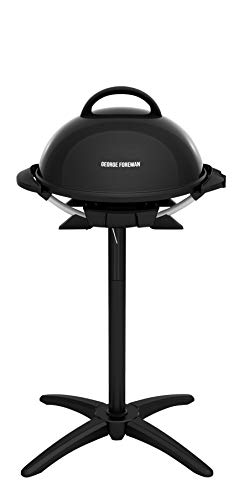
George Foreman Indoor/Outdoor Electric Grill with Stand, 15-Serving — Best for RV Basecamp and Groups
Some camping is a gathering: multi-family sites, RV rallies, a basecamp that feeds a hiking crew. The George Foreman Indoor/Outdoor’s verified 15-serving class serves that world from a site pedestal, standing on the patio slab like a home grill while the group cooks in one session instead of four. When the trip ends, the head lifts off the stand for storage — a big grill that packs smaller than it cooks.
Strengths
- 15-serving sessions for group sites
- Stand for the slab, head for storage
- Electric legality at fire-restricted campgrounds
Trade-offs
- Bulkiest travel format here
- Full loads test element recovery
- Overkill for solo and couple camping
| Detail | Verified note |
|---|---|
| Type | Indoor/outdoor electric grill with removable stand (per API title) |
| Capacity class | 15-serving (per API title) |
Honesty about format: this is vehicle camping gear, not a trunk-space afterthought, and its full-load element rhythm demands the lid discipline described in our method section. Basecamp cooks who master it feed crowds on electric power with an ease charcoal cannot match at fire-restricted sites. For the solo tent camper it is absurd; for the rally host it is the only pick that applies.
The Foreman at basecamp becomes infrastructure: coffee-adjacent breakfast duty on a griddle-friendly morning, burgers at noon for the returning hikers, a full dinner service at dusk. Infrastructure gear is judged on reliability across the whole day, and a simple, capacious electric with no fuel to manage is infrastructure at its most dependable.
Best for: RV basecamps, rallies and group-site hosts / Not suited for: minimalist car and tent campers
Check on Amazon — check price on Amazon before you buy, since availability and configuration change.

Elite Gourmet 12-Inch Indoor Electric Grill EMG6505G — Best Low-Draw Tabletop
Power math decides power-station camping, and the Elite Gourmet’s verified 1200W rating is the friendliest number in this guide. Paired with its 12-inch tabletop format, glass lid and five temperature settings, it is the grill for campers running modest power stations, small RV inverters or shared pedestals where a full-power grill would be antisocial. It stores in a cabinet or bin and deploys on any picnic table.
Strengths
- 1200W — the gentlest draw in this guide
- 12-inch format stores anywhere
- Glass lid and five settings for small cooks
Trade-offs
- One-to-two portions only
- Gentler searing than full-power picks
- Tabletop format needs a stable site table
| Detail | Verified note |
|---|---|
| Type | Indoor electric grill (per API title) |
| Size / power | 12-inch, 1200W (per API title) |
| Controls | 5 temp settings, glass lid, drip tray (per API title) |
The trade is scale and speed: one-to-two portions, gentler searing, and a tabletop indoor grill’s manners — which we state plainly rather than dress up. For a solo camper or a couple whose electrical budget is tight, those are the right trades. Dinner for two under the awning, from a quiet battery, with a glass lid to watch it cook: that is a genuinely lovely camp evening, and this is its grill.
The Elite Gourmet’s quietest virtue is acoustic: on a small power station it cooks without a generator’s roar, preserving the campsite sounds that are half the reason for being there. Silent cooking is a luxury the electric format owns outright, and this low-draw pick extends it to the smallest electrical setups.
Best for: power-station campers and small electrical setups / Not suited for: hookup campers wanting maximum heat and capacity
Check on Amazon — check price on Amazon before you buy, since availability and configuration change.

Techwood 1500W Smokeless Electric Grill with Glass Lid — Best Under the Awning
Campsite cooking happens close to neighbors, tents and awnings, and the Techwood’s verified design — 1500W, tempered glass lid, smokeless positioning — suits those quarters. The lid contains the cook, the compact format sits on a camp table, and the reduced-smoke character keeps the awning livable while dinner grills. For RVers who cook beside their rig nightly, that civility is a daily quality-of-life feature.
Strengths
- Lidded, smokeless design suits close quarters
- Compact tabletop format for rig-side cooking
- 1500W gives real grilling pace
Trade-offs
- Compact capacity class
- Lid and parts need camp-friendly cleaning routine
- Tabletop only — no stand format
| Detail | Verified note |
|---|---|
| Type | Indoor electric grill, smokeless design (per API title) |
| Power | 1500W (per API title) |
| Lid | Tempered glass lid (per API title) |
Smokeless design is not magic — fatty foods will still perfume the evening, pleasantly — but the lidded, contained format is measurably more neighborly than an open grill. Capacity is compact-class: couples and small families cooking in relaxed batches. If your camping style is a settled rig, an awning and dinner at home-base every night, this pick understands your life.
The Techwood under an awning on a rainy evening is the format’s postcard: lid down, glass glowing faintly, dinner proceeding while the weather does its worst outside the drip line. Campers remember those evenings disproportionately — comfort maintained against the elements is the oldest pleasure in the outdoors.
Best for: RVers and awning cooks in close-quarters sites / Not suited for: open-site cooks wanting stand format and max sear
Check on Amazon — check price on Amazon before you buy, since availability and configuration change.
Comparison Table
| Pick | Badge | Key spec | Best for |
|---|---|---|---|
| Cuisinart CEG-115 2-in-1 Portable Outdoor Electric Grill | Best Overall | 550F per verified title, stand or tabletop | RV and hookup campers who cook most dinners at the site |
| Weber Lumin Compact Portable Electric Grill | Best Premium Camping | Compact portable outdoor electric, Weber | long-term RV and car campers who buy quality once |
| Weber Q 1400 Portable Electric Grill | Best Classic Camping | 1560W/120V portable electric (per title) | hookup campers wanting the proven classic |
| George Foreman Indoor/Outdoor Electric Grill with Stand, 15-Serving | Best for RV Basecamp and Groups | 15-serving, removable stand | RV basecamps, rallies and group-site hosts |
| Elite Gourmet 12-Inch Indoor Electric Grill EMG6505G | Best Low-Draw Tabletop | 12-inch, 1200W, glass lid (per title) | power-station campers and small electrical setups |
| Techwood 1500W Smokeless Electric Grill with Glass Lid | Best Under the Awning | 1500W smokeless design, glass lid (per title) | RVers and awning cooks in close-quarters sites |
Camping Power, Honestly: Hookups, Inverters and Power Stations
Campground hookups are the easy case: a standard site pedestal outlet runs any pick here, though the grill should still have the circuit largely to itself. RV inverters are the middle case — check your inverter’s continuous rating against the grill’s draw, using verified figures where they exist (1200W for the Elite Gourmet, 1500W for the Techwood, 1560W for the Weber Q) and the product page for others. Many RV inverters cannot serve a full-power grill at all; shore power can.
Power stations are the math case. A grill drawing around 1500 watts empties a 1000-watt-hour station in well under an hour of full-power cooking — fine for a twenty-minute dinner, useless for an evening of batch cooking. Size the station to the menu: short, hot cooks on compact grills are the sweet spot, and the 1200W tabletop pick stretches a modest station furthest. Do this arithmetic at home; the picnic table is a bad classroom.
Fire Bans, Campground Rules and Where Electrics Shine
Electric camping’s killer feature is legality. During fire restrictions, charcoal and often propane face limits while electric appliances typically remain permitted — but ‘typically’ varies by park, season and current conditions. Check the specific campground’s rules when booking and again on arrival; conditions change with the weather. Carry the grill’s documentation and you will answer most ranger questions before they are asked.
Even where flame is allowed, electric earns its place: no charcoal disposal problem (a real campground headache), no fuel to store near bedding, no sparks in dry grass, and silent operation that suits quiet hours. The format is not a compromise at powered sites — it is often the most considerate tool for the shared outdoors.
Packing and Site Setup for Electric Camp Cooking
Pack the grill as the fragile-ish appliance it is: cool and clean, cord secured, lid latched or padded, in a bin or case that keeps campsite grit out of the element area. At the site, choose a level, stable table or stand spot within sane cord reach of the pedestal — never solve distance with a light extension cord; if a cord is necessary it must be short, heavy-gauge and outdoor-rated for the load.
Cook with campground manners: grease contained, drip tray emptied into proper waste (never the ground or fire ring), and the grill cooled and stored before wildlife investigates. Electric camping done neatly leaves the next camper — and the campsite — exactly as welcoming as you found it.
Camp Menus That Suit Electric Grills
Electric camp cooking shines on the classic site menu: burgers and brats, chicken thighs, foil-packet vegetables finished on the grate, breakfast sandwiches, quesadillas and every farm-stand vegetable between here and the campground. These cook fast within a power budget, need no marinade infrastructure, and clean up with a wipe — the three virtues camp cooking actually runs on.
Plan one anchor dinner per trip — the steak night, the fresh-fish night — and let the other evenings be simple. Electric grills reward that rhythm because their startup cost is zero: no fire to build for a quesadilla, no coals wasted on a snack. The format’s ease quietly upgrades the whole trip’s eating, not just the anchor night.
Storing and Transporting Electric Grills Safely
Transport rules are simple and absolute: grill fully cool, fully clean, cord secured, lid protected, and the unit immobilized so road vibration does not turn it into a maraca of loose parts. A dedicated bin with the cord, brush and a roll of paper towels inside becomes the grill’s travel home — grab one bin and camp cooking is packed.
At home between trips, store the grill dry with its drip tray emptied and a breath of air circulation if it lives in a garage bin. Camp gear dies in storage more often than in service; the electric grill that is put away clean and dry in October is the one that lights instantly the following May.
How to Cook a Camp Dinner on an Electric Grill
A simple, repeatable site routine turns hookup power into the easiest camp cooking there is.
- Set the grill on a stable table or its stand, plug into the pedestal or your planned power source, and preheat with the lid closed while you prep.
- Cook in the camp order: longest items first (chicken, thick chops), quick items last (vegetables, brats, bread) so everything lands together.
- Keep the lid down against evening breezes — campsite wind is the electric grill’s natural predator, and the lid is your whole defense.
- Use the grill’s hot zone for searing and its edges for holding finished food warm while the last items cook.
- Serve straight from the site table; rest meats briefly while vegetables finish in the residual heat.
- Once cool, wipe down, empty the drip tray into proper waste, and store the grill secured — a clean grill is a critter-proof grill.
Two or three dinners in, you will have your site’s rhythm: how the pedestal handles the load, how the evening wind hits your table, which zone sears best. That local knowledge is camp craft, and electric grills reward it as surely as any fire ever did.
Electric vs Propane vs Charcoal at the Campsite
Charcoal owns flavor and loses on logistics: bans, disposal, sparks, and a lighting ritual in the wind. Propane owns convenience and carries its own freight: canisters to store and refill, flame rules in some districts, and wind that bullies open burners. Electric owns legality, silence and simplicity at powered sites, and concedes flavor theater and any claim on dry camping. The mature camper chooses per trip rather than per ideology.
Many experienced RVers carry electric as the default and flame as the exception, because most nights are powered sites and most camp dinners are simple. The reverse suits boondockers. What this guide insists on is only honesty: match the grill to the power you will actually have, and every format in the comparison becomes a good one.
A final practical note: electric grills double as cabin, guest-house and tailgate-with-outlet cookers, which spreads their cost across more of your year than a dedicated camp stove ever sees. Versatility is a camping virtue too — gear that only works ten nights a year must be very good indeed to earn its storage.
Field Notes: Powered Camping, Practiced Well
The First Evening Test
Every new camp grill deserves a first-evening test before it earns a place on a real trip: cook a full dinner on your actual power setup — pedestal, inverter or station — in the driveway or at a nearby site. You will learn its preheat appetite, its draw behavior and its packing list in one low-stakes session. Camp gear that has passed a home test rarely surprises in the field; gear that skipped it almost always does, at dusk, in front of an audience.
Cooking for the Campground Table
Camp meals are communal by architecture — the picnic table seats six whether your crew is two or seven — so cook with sharing in mind: a grate of mixed sausages, peppers and onions that lands in the table’s center outperforms plated individual portions in both effort and spirit. The compact picks handle this family-style format beautifully, because the menu, not the headcount, sets the batch size.
Rain Plans and Awning Craft
Powered sites plus an awning equal the all-weather kitchen, and electric is the only grill format fully at home there: no flame to blow out, no smoke column trapped under the canopy when the lidded picks are used considerately. Set the grill near the awning’s edge for ventilation, keep connections dry and elevated, and a rainy evening becomes the trip’s coziest dinner instead of its soggiest failure.
The Power Station Cook’s Ledger
Station campers should keep a simple ledger for the first trips: station size, grill used, minutes at high heat, percentage remaining at cleanup. Three entries calibrate your whole system — which dinners are free, which cost half the battery, and which belong on hookup nights. That ledger, kept honestly, turns power anxiety into power planning, and planning is the difference between a gimmick and a method.
Leaving the Site Better
Electric camping’s footprint is admirably small — no ash, no coals, no fuel cans — and the practiced camper keeps it that way: drip trays to the trash, grease never to the ground, the grill wiped before it is stored, and the table left cleaner than the last crew left it. The format’s cleanliness is its reputation in shared spaces; every tidy departure defends every future camper’s permission to plug in and grill.
Camp Grill Decisions: The Pre-Trip Interrogation
What Power Will I Actually Have, Site by Site?
List your next three trips and name the power at each: hookup pedestal, RV shore power, station-only, or none. The grill that serves the majority is your grill; the trip with no power is a different menu, not a different purchase. This exercise kills more bad purchases than any review can, because camping gear fails by itinerary mismatch far more often than by quality. Do it on paper, before the cart, every time the fleet changes.
How Much Pack Space Is the Grill Allowed?
Measure the bin or bay the grill may occupy and treat the number as law. The compacts here were chosen to respect typical RV bays and car trunks; the basecamp stand grill is honest about needing real estate. A grill that fits gets packed; a grill that almost fits gets left, and a left grill cooks nothing. Campers who measure once pack happily for a decade.
Who Is Cooking, and How Do They Cook at Home?
The camp cook’s home style predicts camp success: the home improviser thrives on any format; the home precision cook wants the dual-posture control of the CEG-115 or the Weber evenness; the home minimalist wants the Elite’s ninety-second deployment. Buy the grill your actual cook will enjoy at dusk after a hiking day — not the one a catalogue thinks a camper should want.
What Is the Trip’s Menu, Really?
Write the actual dinners: two grill nights, one pasta night, one town restaurant, one leftovers night is a typical honest itinerary. Two grill nights need a good grill, not a great one — which recalibrates budgets across the whole list. The campers who overbuy are planning for seven grill nights that exist only in the brochure version of the trip. Cook the real itinerary and every pick here is sufficient; choose among them by power and pack, not by fantasy.
What Happens When Something Fails at the Site?
Electric’s failure modes are mercifully diagnosable: no heat means power — check the pedestal, the breaker, the GFCI, in that order — and a backup meal that needs no cooking covers the rest. Carry the grill’s cord and your patience, know where the campground host lives, and remember that a failed grill night at a powered site is an inconvenience with a story attached, not an emergency. The format’s simplicity is its own insurance policy.
Camp Cooking Systems Around the Grill
The Breakfast Question
Electric grills are dinner heroes, but camp breakfasts decide trips. The lidded picks handle eggs in a skillet set on the grate, breakfast sandwiches and reheated anything with ease, while the tabletop models double as the coffee crowd’s warming station. Plan one real grill breakfast per trip — it converts skeptics faster than any dinner, because nobody expects elegance from a campsite at eight in the morning.
Coffee, Kettles and Circuit Diplomacy
The grill shares its pedestal with the kettle and the coffee maker, and circuit diplomacy is sequencing: kettle first, grill for dinner, coffee after, never the hungry trio at once. Campsite power is a shared resource with a breaker for an referee; the campers who sequence politely never meet the referee. Write the sequence into the trip plan like any other choreography and the system runs silently all week.
The One-Bin Kitchen
Veteran powered campers consolidate: grill, cord, brush, tongs, thermometer, oil, salt and a small cutting board in a single bin that is the kitchen. Everything else — plates, pans, food — lives elsewhere, but the bin guarantees that wherever the grill lands, cooking can begin in five minutes. Systems like this are why some campsites produce dinner effortlessly while identical neighbors produce expeditions. The grill is the same; the bin is the difference.
The Quiet Campground: Electric Cooking and Camp Etiquette
Campgrounds are shared acoustic spaces, and electric cooking is the quietest hot food there is: no generator if you are on hookups, no chopping and fire-tending theater, no smoke column announcing your menu to forty neighbors. In an era of crowded parks, that quiet is a genuine courtesy, and rangers and hosts increasingly say so.
Etiquette extends to light and timing: a grill’s work is mostly done by dusk, drip trays go to proper waste, and nothing greasy meets the ground or the fire ring. Electric campers who keep those habits become the neighbors everyone hopes for — and the format’s reputation, which protects everyone’s permission to use it, stays golden.
There is also a wildlife clause: in bear and raccoon country, a clean stored grill is not optional. Electric’s easy wipe-down is an underappreciated safety feature — no ash, no grease bucket, no scented charcoal bag. The tidy format is the safe format, in the woods most of all.
Pedestal reality check: campground outlets vary in age and mood. Plug the grill in and run its preheat before committing the good steaks — a weak pedestal reveals itself in a slow preheat, and you would rather learn that with an empty grill than a loaded one. A minute of testing is the camper’s mise en place.
Wind screens earn their weight at exposed sites: a simple barrier on the windward side of the table can be the difference between a grill that holds temperature and one that fights all evening. Keep it clear of the hot grill itself, and let the lid do the rest.
For power-station campers, cook order is battery strategy: sear early while the station is full and the grill’s demand is steadiest, and let residual heat finish vegetables as the session winds down. Thinking of watt-hours as an ingredient — measured, spent deliberately — turns a constraint into a small craft of its own.
Finally, the electric camp grill’s second life at home — patio, balcony, tailgate with an outlet — means its cost-per-cook collapses across the year. Gear that only camps is a luxury; gear that camps and cooks at home is an appliance. Buy accordingly and the math will please you.
A word for the campground-curious who have never cooked outside: powered sites plus an electric grill is the gentlest possible first outdoor kitchen. No fire to build, no fuel to manage, no smoke in the tent — just the home skill of grilling, transplanted under trees. Many lifelong campers started exactly here and added fire skills later, from confidence rather than necessity. Starting easy is not cheating; it is how hobbies survive their first season.
Pack a paper notebook with the grill bin and log each site’s power behavior for a season: which parks’ pedestals are strong, which sites’ wind needs the screen, which dinners the station handled easily. That notebook becomes the trip-planning asset nobody can buy, and it compounds in value every year the same parks reappear on the calendar.
Finally, teach a kid to run the camp grill. Electric’s forgiveness — no flame, no coals, instant off — makes it the safest first cooking station in the outdoors, and camp skills passed down at a picnic table have a way of lasting sixty years. The grill you buy for this summer’s trips may be teaching somebody’s grandchildren. Choose it like it matters, because at a campsite, it does.
One more itinerary truth: the grill earns its pack space on the trips where dinner plans collapse — the late arrival, the closed town restaurant, the fishing that produced actual fish. A packed electric grill plus a powered site is a standing answer to all three, and trip veterans pack it for the collapses as much as for the plans. Insurance you can eat is the best kind there is.
Camp cooking also teaches a portion honesty that home kitchens avoid: two people, one compact chamber, exactly enough. The compact picks here institutionalize that honesty, and campers consistently report eating better — fresher, hotter, less wastefully — from a small grill at a picnic table than from a big one at home. Constraint, again, is a teacher with excellent references.
So choose the grill that fits your power, your pack and your crew, test it once at home, and then go — the sites are waiting, the pedestals are humming, and dinner under trees has never been easier to arrange. The electric camping grill is a modest appliance with an immodest promise: that the outdoors can feed you as well as your kitchen does. On the evidence of these six, the promise is kept.
Common Buying Mistakes
Planning electric grilling for a dry site. No hookup, no inverter capacity, no dinner. Match the grill to a verified power plan before the trip, every trip
Undersizing the power station. Watts are appetite, watt-hours are the meal. A big grill on a small station is a fifteen-minute grill — do the math at home
Solving cord distance cheaply. Light extension cords overheat and starve the grill. Short, heavy-gauge, outdoor-rated — or move the grill closer to the power
Leaving a greasy grill out overnight. Wildlife treats it as a reservation. Clean, cool and store the grill after every camp cook
Final Recommendation
For most powered campers, the Cuisinart CEG-115 is the complete answer: dual posture, serious stated heat and compact manners. The Weber Lumin Compact is the premium long-term companion, the Q 1400 the proven classic, and the Elite Gourmet the power-station diplomat with its gentle 1200W draw. Basecamp hosts take the George Foreman’s 15-serving scale; awning cooks take the Techwood’s lidded civility.
Choose by power plan first, crew size second and menu third — in that order — and electric camping stops being a compromise category and becomes what its owners already know it is: the easiest good cooking in the outdoors.
Shortlist again for convenience: Cuisinart CEG-115 2-in-1 Portable Outdoor Electric Grill, Weber Lumin Compact Portable Electric Grill, Weber Q 1400 Portable Electric Grill.
Best Electric Grills For Apartments Best Electric Bistro Grills Best Electric Barbecue Grills Best Egg Shaped Grills
Frequently Asked Questions
Can you really camp with an electric grill?
Yes — at powered sites. Campgrounds with electrical hookups, RV shore power, cabin decks and properly sized power stations all run electric grills happily. What electric cannot do is dry camping with no power source; for that, you need a fuel grill and this guide does not pretend otherwise.
How big a power station do I need for a camping grill?
Match watt-hours to your menu. A grill drawing 1200–1560 watts cooks a twenty-to-thirty-minute dinner comfortably on a mid-size station, but long or batch cooking drains small stations fast. The lowest-draw pick here is the verified 1200W tabletop; do the arithmetic with your grill’s actual rating before the trip.
Are electric grills allowed during fire bans?
Usually yes, because there is no open flame — but rules are set locally and change with conditions. Confirm with the specific campground or park for your dates, and follow any ranger guidance on arrival. Never assume last summer’s rule survived this summer’s drought.
What is the best electric grill for an RV?
The dual-posture Cuisinart CEG-115 for most RVers: stand or tabletop, compact storage and serious heat on shore power. Premium buyers choose the Weber Lumin Compact; group hosts choose the 15-serving stand grill. Check your inverter’s rating before assuming you can grill unplugged from shore power.
Can I run a camping grill from my car?
Not responsibly for full-power models — vehicle outlets and small inverters are far below a grill’s draw. The low-draw tabletop pick still needs a properly rated inverter or power station. If your power plan is ‘the car’, your grill plan should be fuel, not electric.
How do I keep an electric grill clean at a campsite?
Scrape warm, wipe with a damp cloth once cool, and empty the drip tray into proper waste after every cook. A lidded grill stored clean in its bin stays critter-proof and ready. Avoid soaking any electrical parts — a wipe-down routine is all camp cleaning should ever be.


