Disclosure: airfryerkitchensupply.com is reader-supported. When you buy through links on our site, we may earn an affiliate commission at no extra cost to you.
Where to buy
An honest starting point for the best electric bullet smokers: the classic bullet smoker, the tall charcoal cylinder in the Weber Smokey Mountain mould, is a charcoal design, and a true factory electric bullet is one of the rarest shapes in smoking. What does exist, and what this guide ranks, are the electric smokers that deliver the bullet experience, compact vertical footprint, stacked racks, water-pan humidity and set-and-forget cooking, without charcoal. Every linked pick below is a verified electric vertical; the charcoal originals are discussed openly in prose where they belong, as the benchmark these machines replace.
- Masterbuilt 30-Inch Analog Electric Smoker MB20070210 — Check the current price on Amazon
- Char-Broil Analog Electric Smoker 18202077 — Check the current price on Amazon
- Masterbuilt 30-Inch Digital Electric Smoker MB20071117 — Check the current price on Amazon
- CLIVIA Electric Smoker, 4-Rack Digital Commercial — Check the current price on Amazon
- EAST OAK 30-Inch Electric Smoker with Wheels — Check the current price on Amazon
- Bradley Smoker 4-Rack Digital Smoker BTDS76P — Check the current price on Amazon
In this guide
Quick Picks
Read these six as the electric answer to the bullet question, ordered by how closely each matches the way bullet owners actually cook: small footprint, vertical stacking, moist heat and minimal fire management. Badges describe the electric job each machine does best.
Masterbuilt 30-Inch Analog Electric Smoker MB20070210 — Best Bullet-Style Simplicity: This is the electric machine a charcoal bullet owner will understand in ninety seconds. — Check price on Amazon
Char-Broil Analog Electric Smoker 18202077 — Best Compact Analog Alternative: Char-Broil built its name on the charcoal bullet shape, and its analog electric smoker is the brand’s own answer for cooks who want that heritage without the charcoal. — Check price on Amazon
Masterbuilt 30-Inch Digital Electric Smoker MB20071117 — Best Digital Upgrade from a Bullet: If the bullet experience you love is the food and the footprint, but the experience you hate is lifting off the top section mid-cook to reach the fire, this Masterbuilt is your upgrade. — Check price on Amazon
CLIVIA Electric Smoker, 4-Rack Digital Commercial — Best Low-Temperature Control: The CLIVIA brings a capability charcoal bullets struggle with: precise, genuinely low temperatures, held digitally. — Check price on Amazon
EAST OAK 30-Inch Electric Smoker with Wheels — Best Mobile Vertical: Bullets live in corners and get carried out to cook. — Check price on Amazon
Bradley Smoker 4-Rack Digital Smoker BTDS76P — Best Hands-Off Smoke Supply: The bullet’s hidden labour is smoke management: charcoal and wood, tended in cycles. — Check price on Amazon
How These Picks Were Chosen
Selection began by defining the bullet experience rather than the bullet silhouette: a compact vertical footprint, two or more stacked cooking levels, a water pan buffering the heat, and long unattended cooks. Any electric machine was then judged on how faithfully it reproduces that experience, because chasing a cylinder shape for its own sake would have produced a worse guide.
Every linked pick was verified against Amazon listing data for this site, and only genuinely electric machines were eligible for links. Charcoal bullets appear in this guide as unlinked context, clearly labelled, because pretending they are electric would mislead the exact readers this search attracts: people who want bullet cooking without charcoal because of balconies, fire rules, convenience or all three.
Within the electric field, the ranking weighted footprint and simplicity first, then smoke-feeding convenience, then capacity. Bullet owners are, by self-selection, cooks who value a compact machine that disappears into a patio corner and asks little. The picks honour that priority order instead of defaulting to the biggest cabinet.
The 6 Best Electric Bullet Smokers
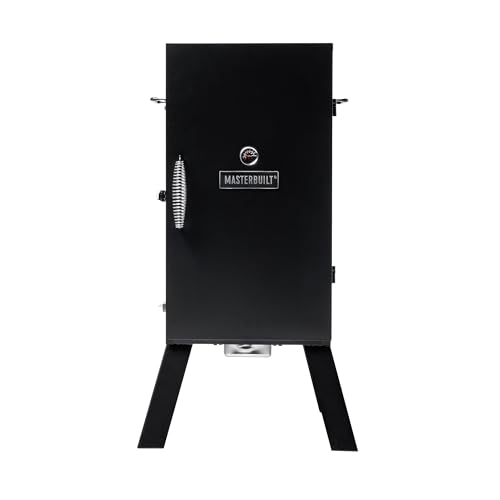
Masterbuilt 30-Inch Analog Electric Smoker MB20070210 — Best Bullet-Style Simplicity
This is the electric machine a charcoal bullet owner will understand in ninety seconds. A compact vertical cabinet, a simple dial, a chip tray and stacked racks: the workflow is the bullet workflow with the fire-tending deleted, which is precisely what most people type this query are asking for.
Strengths
- Analog dial control matches the bullet philosophy: set it and leave it
- 535 sq in of stacked vertical cooking in a compact footprint
- Chip tray smoking with none of a charcoal bullet’s fire management
Trade-offs
- Analog control means the cook, not the machine, watches the temperature band
- Smaller cooking area than the digital 30-inch cabinets
- No loader, so adding chips means opening the cabinet
| Specification | Detail |
|---|---|
| Cooking area | 535 sq in (from listing title) |
| Format | 30-inch vertical cabinet, chrome racks |
| Control | Analog dial |
| Smoke source | Wood chip tray |
The 535 square inches are arranged vertically, so the footprint stays patio-corner small while ribs, sausages and a shoulder stack the way they would in a bullet. What you give up against charcoal is the combustion flavour edge and the ritual; what you gain is a cook that holds its course while you do something else. For apartments, small patios and anyone whose local rules frown on charcoal, this is the most faithful electric translation of the bullet idea in the guide.
Best for: former bullet owners who want the format without charcoal / Not suited for: cooks who want digital precision and remote monitoring
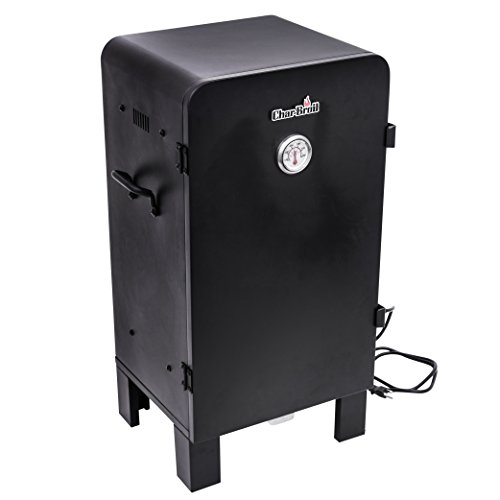
Char-Broil Analog Electric Smoker 18202077 — Best Compact Analog Alternative
Char-Broil built its name on the charcoal bullet shape, and its analog electric smoker is the brand’s own answer for cooks who want that heritage without the charcoal. It earns its place here as the compact, uncomplicated option: plug in, set the dial, smoke.
Strengths
- Char-Broil’s analog electric format is as simple as smoking gets
- Vertical cabinet layout keeps the footprint small
- A natural step for cooks leaving a charcoal bullet behind
Trade-offs
- Analog dial demands occasional checking on long cooks
- Listing gives fewer stated details than rivals, so compare carefully
- Chip tray access means brief heat loss when reloading smoke
| Specification | Detail |
|---|---|
| Format | Vertical analog electric smoker |
| Control | Analog dial |
Judge this machine on honesty rather than features. It will not report to your phone or hold a degree-perfect line through a windy night, and it does not pretend to. What it does is reproduce the essential bullet bargain, small footprint, vertical stacking, gentle moist heat, for cooks whose priority is dinner rather than data. Pair it with a decent probe thermometer, learn its dial’s personality over two or three cooks, and it will smoke the full bullet repertoire without a bag of charcoal in sight.
Best for: budget-minded cooks wanting the simplest electric bullet alternative / Not suited for: data-driven cooks who want digital control and probes built in

Masterbuilt 30-Inch Digital Electric Smoker MB20071117 — Best Digital Upgrade from a Bullet
If the bullet experience you love is the food and the footprint, but the experience you hate is lifting off the top section mid-cook to reach the fire, this Masterbuilt is your upgrade. The side loader and digital control remove the two defining chores of charcoal bullet ownership while keeping the vertical, stacked cooking that made the format popular.
Strengths
- Side chip loader fixes the bullet’s worst chore: refuelling without dismantling
- 710 sq in exceeds what mid-size charcoal bullets offer
- Digital control removes the vent-juggling that defines charcoal bullet cooking
Trade-offs
- A cabinet, not a cylinder, so the silhouette and storage differ
- Costs more than analog electric alternatives
- Rack layout suits flat cuts better than hanging in some loads
| Specification | Detail |
|---|---|
| Cooking area | 710 sq in (from listing title) |
| Format | 30-inch vertical cabinet, 4 chrome racks |
| Smoke source | Side wood chip loader |
| Control | Digital |
The capacity jump is real: 710 square inches swallows the loads that strain a mid-size bullet, and the chamber holds its temperature through the door openings that wrapping and spritzing require, because there is a door, rather than a lid-and-barrel separation. Keep your bullet instincts, water pan filled, meat stacked thoughtfully, smoke applied patiently, and this cabinet will feel like the same craft with the friction engineered out.
Best for: bullet owners ready to trade ritual for convenience / Not suited for: purists for whom tending charcoal is the point of the exercise

CLIVIA Electric Smoker, 4-Rack Digital Commercial — Best Low-Temperature Control
The CLIVIA brings a capability charcoal bullets struggle with: precise, genuinely low temperatures, held digitally. Its verified range starts far below barbecue territory, which opens the bullet repertoire’s delicate end, fish, cheese-adjacent work and sausage, to the same set-and-forget confidence as a pork shoulder.
Strengths
- Verified 86–248°F range reaches the low bands bullet cooks use for fish and sausage
- Stainless cabinet with four racks stacks food the vertical way
- Timer with auto shutoff suits set-and-forget sessions
Trade-offs
- Top temperature caps hot finishing work
- A less familiar brand, so verify seller support before ordering
- Digital interface has more to learn than an analog dial
| Specification | Detail |
|---|---|
| Temperature range | 86–248°F (from listing title) |
| Format | 4-rack stainless steel cabinet |
| Timer | 0–12H timer with auto shutoff (in listing title) |
| Control | Digital |
Four racks in a stainless cabinet keep the vertical stacking that defines bullet cooking, while the timer and auto shutoff suit the shorter, gentler cooks this machine specialises in. It is the pick for the bullet fan whose cooking has drifted toward the low and delicate, and who would rather have digital certainty at 180 degrees than headroom they never use at temperatures a bullet rarely visits either.
Best for: low-temperature specialists: fish, sausage and delicate loads / Not suited for: cooks who regularly finish food hot in the smoker

EAST OAK 30-Inch Electric Smoker with Wheels — Best Mobile Vertical
Bullets live in corners and get carried out to cook. The EAST OAK on wheels answers the same storage reality at cabinet scale: roll it out, smoke all day on 725 square inches, roll it back. For garages, shared patios and any space that must return to normal life after the cook, mobility is not a luxury feature; it is the feature.
Strengths
- Wheels solve the bullet owner’s storage shuffle in one feature
- 725 sq in with a side loader for long uninterrupted smoking
- Digital 12-hour timer matches long bullet-style cooks
Trade-offs
- Larger and heavier than a true bullet, wheels notwithstanding
- Timer encourages set-and-forget habits that still need probe checks
- Matte finish needs a wipe-down to stay smart in a visible spot
| Specification | Detail |
|---|---|
| Cooking area | 725 sq in (from listing title) |
| Format | 30-inch vertical cabinet on wheels |
| Timer | Digital 12-hour timer (in listing title) |
| Smoke source | Side chip loader |
The cooking credentials stand on their own: side loader for sealed smoke feeding, a 12-hour timer matched to brisket-length sessions, and digital steadiness through the cook. Stack your loads vertically as a bullet cook would, keep the water pan honest, and the machine behaves like the format’s modern form: same stacked, moist, patient cooking, engineered for how people actually store and move a smoker in 2026.
Best for: cooks who must move and store the smoker between sessions / Not suited for: static setups where the smoker never leaves one spot

Bradley Smoker 4-Rack Digital Smoker BTDS76P — Best Hands-Off Smoke Supply
The bullet’s hidden labour is smoke management: charcoal and wood, tended in cycles. The Bradley deletes that labour more completely than any other electric design, feeding a fresh bisquette on a timer for as many hours as you set, then letting the cabinet simply hold temperature for the rest of the cook.
Strengths
- Automatic bisquette feed ends mid-cook fuel handling entirely
- Vertical 4-rack cabinet preserves the stacked bullet layout
- Digital timing separates smoke hours from total cook hours
Trade-offs
- Proprietary bisquettes are an ongoing consumable commitment
- Flavour profile differs from the loose-chip smoke bullet owners know
- Cabinet output is gentle, aimed at low cooking rather than heat
| Specification | Detail |
|---|---|
| Format | 4-rack vertical cabinet |
| Smoke source | Automatic bisquette feed (Bradley system) |
| Control | Digital |
For the cook whose bullet frustration is specifically the fire, this is the fullest answer in the guide. The vertical cabinet keeps the stacking and the small footprint, the smoke arrives with metronome consistency, and an overnight shoulder becomes a planning exercise instead of a vigil. The commitment is real, bisquettes in the cupboard or no smoke at all, but planned cooks are exactly where this system shines, and bullet cooking was always a planned cook.
Best for: planners who want smoke supply fully automated / Not suited for: improvisers who smoke with whatever wood is at hand
Comparison Table
| Pick | Badge | Key spec | Best for |
|---|---|---|---|
| Masterbuilt 30-Inch Analog Electric Smoker MB20070210 — Check price on Amazon | Best Bullet-Style Simplicity | 535 sq in, analog dial, vertical cabinet | former bullet owners who want the format without charcoal |
| Char-Broil Analog Electric Smoker 18202077 — Check price on Amazon | Best Compact Analog Alternative | Analog control, vertical electric cabinet | budget-minded cooks wanting the simplest electric bullet alternative |
| Masterbuilt 30-Inch Digital Electric Smoker MB20071117 — Check price on Amazon | Best Digital Upgrade from a Bullet | 710 sq in, side loader, digital control | bullet owners ready to trade ritual for convenience |
| CLIVIA Electric Smoker, 4-Rack Digital Commercial — Check price on Amazon | Best Low-Temperature Control | 86–248°F range, 4 racks, stainless cabinet | low-temperature specialists: fish, sausage and delicate loads |
| EAST OAK 30-Inch Electric Smoker with Wheels — Check price on Amazon | Best Mobile Vertical | 725 sq in, wheels, 12-hour timer | cooks who must move and store the smoker between sessions |
| Bradley Smoker 4-Rack Digital Smoker BTDS76P — Check price on Amazon | Best Hands-Off Smoke Supply | 4 racks, automatic bisquette feed, digital timing | planners who want smoke supply fully automated |
How to Choose an Electric Bullet Alternative
Start by naming what you actually want from the bullet format. If it is the small footprint and stacked racks, any compact vertical cabinet in this guide qualifies, and your choice turns on control type and smoke feeding. If it is the charcoal flavour and the ritual, no electric machine will satisfy you, and the honest purchase is another charcoal bullet, a conclusion this guide states plainly because a disappointed electric buyer helps nobody.
Control is the second decision. Analog dials reproduce the bullet’s simplicity and ask you to be the thermostat; digital controls hold the band for you and cost more. Long, overnight-style cooks argue for digital. Shorter, attended cooks, ribs, chicken, sausage, are perfectly served by analog, especially paired with a probe thermometer you trust.
Smoke feeding is the third. Tray machines are cheapest and ask for door openings; loader machines feed through the side; the Bradley feeds itself. Map that ladder to your cook lengths: the longer your typical session, the more each avoided door opening is worth, in temperature stability and in bark.
Finally, check your constraints before your wishes. Balcony rules, strata or landlord terms, local fire codes and available outdoor power decide whether electric is merely preferable or actually mandatory. Where charcoal is banned, the electric bullet alternative is not a compromise at all; it is the only way the format survives, and the machines above make it a good one.
Bullet Cooking Technique, Translated to Electric
The water pan is the bullet’s soul, and it survives the translation intact. In charcoal bullets the pan blocks direct heat and humidifies the chamber; in electric cabinets it does the same work against a drier heat source, which makes it more important, not less. Keep it filled for long cooks, and expect to top it up whenever a loader feed or a wrap gives you a legitimate opening.
Stacking strategy also translates. In a bullet, the top rack runs hottest and driest; in a vertical electric cabinet, position relative to the element and the door creates its own map. Learn your machine’s map with cheap, forgiving loads, sausages and chicken thighs, before trusting it with a brisket, and rotate racks on long cooks if your early results show a gradient.
What does not translate is vent craft. There are no dampers to feather, no charcoal bed to arrange, no minion method to master. Electric bullet alternatives replace that skill with a different one: patience with a machine that recovers heat slowly and rewards cooks who open it rarely. Former bullet owners already own the patience; they simply spend it differently now.
How to Set Up a Vertical Electric Smoker for a Bullet-Style Cook
Season a new cabinet before its first real cook: run it empty at a moderate temperature with a small load of wood, letting the interior take on its working coating and burning off manufacturing residue. While it seasons, map the racks, decide where your water pan sits, and practise loading and unloading with cold food so the choreography is familiar when everything is hot.
On cook day, preheat with the pan filled and let the temperature settle fully. Load from the top rack down, spacing pieces so air and smoke move between them, because a vertical cabinet overfilled behaves like a steamer, not a smoker. Feed smoke early, when the meat’s surface is cool and receptive, and resist opening the cabinet for the first hours entirely.
Finish with the same discipline: probe for tenderness rather than time, rest the meat properly, and while it rests, empty ash and drips, wipe the racks, and store the machine dry. Vertical electrics reward this rhythm because their enemies are moisture left inside and residue left on sensors, both of which a ten-minute close-down prevents.
The Charcoal Bullet Itself: What the Electric Machines Are Replacing
To judge the electric alternatives fairly, the original deserves its paragraph. The charcoal bullet, commercialised most famously as a tall, three-section cylinder with a water pan between fire and food, earned its following honestly: it is inexpensive, portable, durable for decades, and capable of barbecue that wins arguments. Its costs are equally real: charcoal to buy and light, vents to learn, ash to manage, a mid-cook architecture that makes reaching the fire an operation, and a fuel that many balconies, landlords and fire codes simply prohibit.
The verified charcoal benchmark in this programme’s data, Char-Broil’s 16-inch bullet, illustrates the format’s compact honesty: a small cylinder that smokes real food for real families. Nothing in this guide claims the electrics out-cook it in skilled hands. The claim is narrower and, for the readers of this search, decisive: the electrics reproduce the bullet’s cooking geometry, vertical stacking over buffered heat, while deleting the fire management, and for cooks whose constraint is charcoal itself, that deletion is not a compromise but the entire point.
If you are reading this guide while owning a charcoal bullet that you love and are allowed to use, the correct purchase may be no purchase. Keep the bullet for the cooks where the ritual is the reward, and consider an electric vertical only for the cooks where it is not: the windy Tuesday, the overnight shoulder before a working day, the balcony the charcoal never visits. Many households end up owning both, using each where it is strongest, and that outcome is a success of honest categorisation rather than a failure of either machine.
Water Pan Mastery in a Vertical Electric Cabinet
The water pan is the component electric converts most often mistreat, either filling it from habit without understanding it or omitting it because the manual made it sound optional. Its work is threefold: it blocks direct radiant heat from the element, it humidifies a chamber that electric heat would otherwise dry, and its thermal mass softens the element’s on-off cycling into a steadier cooking climate. For long cuts, all three services matter, and the pan should be treated as part of the machine rather than as an accessory.
Practice is simple and specific. Fill the pan before preheating, with hot water if you want the cabinet to settle faster, and check it at every legitimate opening, because a pan that boils dry at hour seven announces itself in the bark at hour ten. For shorter or fattier cooks, chicken, sausages, ribs on a humid day, a half-filled or even empty-but-present pan is a legitimate choice, since the blocking and buffering services remain while the humidity contribution reduces. The pan as a dial, rather than as a rule, is the mark of a cook who understands it.
Flavoured pan liquids, stock, juice, beer, are the tradition’s most debated footnote. The honest summary is that their contribution is subtle, mostly aromatic near the meat’s surface, and entirely optional. Water does the pan’s real work. Spend your experimentation budget on wood species and seasoning, where differences are unmistakable, and let the pan be the quiet, reliable component it was designed to be.
Capacity Honesty: What Actually Fits in a Vertical Electric
Vertical cabinets advertise area, but cooks live in three dimensions, and the bullet tradition is the perfect teacher of the difference. A rack’s square inches describe a flat load of wings or sausages accurately and a brisket hardly at all, because the brisket cares about the rack’s length and the clearance above it. Before buying any pick in this guide, measure the two or three loads you cook most, a rack of ribs laid flat, your usual brisket, a whole chicken’s height, and compare them with rack dimensions rather than with headline areas.
Hanging changes the arithmetic for the foods that suit it. Ribs hung from the top of a tall cabinet, sausages hung in loops, and fish hung or racked high use the vertical dimension that flat area ignores, which is why bullet cooks, whose machines are all height, learned hanging early. Several cabinets here accept hooks or a hanging arrangement readily, and for rib-heavy or sausage-heavy households that adaptability is worth more than another hundred square inches of rack.
The final honesty is about batch rhythm. A cabinet that fits one brisket beautifully and two badly will serve most households better than a cavern bought for the annual party, because weekly cooking is the machine’s real life. The bullet format became beloved at modest sizes for exactly this reason: it matched the food real families cook, in the spaces real families have. The electric picks honour that match deliberately, and your own measuring tape should have the last word over every figure in this guide.
From Bullet to Electric: A Convert’s First Three Cooks
The first cook should be the one your charcoal bullet did best, cooked your usual way, because comparison teaches faster than novelty. Expect the electric version to feel quieter in every sense: no vent adjustments, no fire checks, a temperature line that simply holds. Expect also to notice the missing charcoal note in the flavour, present but not dominant, and to be surprised by how much of the result, tenderness, moisture, bark, arrived intact. That surprise is the conversion, and it usually happens by the second slice.
The second cook should exploit what electric does better: a long, low session you would not have attempted on a work night with charcoal. A shoulder set in the evening, monitored by probe, finished without a single fire intervention, demonstrates the format’s actual product, which is not smoke but time, returned to the cook in hours. Converts consistently report that this cook, not the first, is the one that changes their habits.
The third cook should be the honest audit: the food your household is most critical about, cooked for the people whose opinions you trust, with the charcoal comparison invited rather than avoided. If the electric cabinet passes your own table, the question this search asked is answered for your household, and the bullet, kept or sold, becomes a choice rather than a necessity. That is all any of the machines in this guide are trying to earn.
Accessories That Matter for a Vertical Electric Cabinet
The accessory list for a vertical electric should be short, deliberate and earned by your cooking rather than by a catalogue. First and non-negotiable is the independent probe thermometer, doubly so on the analog picks, where it completes the control system, and valuably even on digital models, where it audits the built-in sensor. A probe you trust converts every other question in this guide, doneness, stall behaviour, cabinet gradient, from opinion into measurement.
Second comes hanging hardware where your menu wants it: hooks or a simple dowel arrangement for ribs and sausages, chosen to fit your cabinet’s height and bought after measuring, not before. Third is the humble cover, the highest-value protection a cabinet stored outdoors can own, bought fitted rather than approximate. Fourth, and last, a stock of the wood your machine actually uses, kept dry and labelled by species, because a smoker without its fuel at hand is a cabinet of good intentions.
What the list excludes matters as much. Gadgets that promise to fix flavour, speed the stall or automate judgement mostly automate spending. The vertical electric format is a simple machine for a patient craft, and its best accessories share that character: they measure, they hang, they protect, they fuel. Everything else should have to argue its way into the kit against a season of your own cooking notes, and most of it, argued honestly, will not make the cut.
Vertical Electrics Beyond Barbecue: Fish, Sausage, Vegetables and More
A cabinet bought for bullet-style barbecue discovers a second life quickly, because vertical, gentle, smoke-bearing heat suits a wide parish of foods. Fish is the first convert: fillets and whole fish take smoke delicately at the cabinet’s low end, and the vertical format’s racks suit them perfectly. The technique is restraint, mild wood, short sessions, and a respect for the specific recipe’s curing and safety guidance where the fish is being prepared for keeping rather than for dinner.
Sausage is the second convert, and it has its own full guide in this programme because the fit is so close: low temperatures held patiently, links hung in the tall chamber, smoke applied thinly across hours. Vegetables and the barbecue sides form the third parish: beans that catch smoke beneath a fatty cut, peppers and onions softened into sweetness, cheeses and nuts in the careful, low, recipe-guided territory where gentle cabinets excel and hot machines cannot follow.
The point of the parish is utilisation, the same economic argument this programme makes everywhere. A vertical electric used for fish on Friday, ribs on Saturday and a batch of smoked nuts for the week’s cooking is a machine whose cost per cook falls every month, and whose owner becomes, almost accidentally, a broadly skilled smoker of things. The bullet format was always a generalist wearing a barbecue hat, and its electric translation inherits the whole wardrobe.
The Bullet Format Around the World: Why Vertical Won
The vertical smoker’s dominance is not an accident of one brand’s marketing; it is thermodynamics wearing a shape. Heat rises, so a vertical chamber stacks its cooking levels along the heat’s own path, using a footprint no wider than its largest rack. Moisture rises with it, basting the upper levels in the lower levels’ breath, which is why bullet cooks learned to place the fattiest cuts high and the delicate ones low, a choreography every vertical electric in this guide inherits intact.
Cultures arrived at the shape independently wherever fuel was precious and space was tight: the tandoor’s vertical fire, the hanging ovens of northern China, the barrel smokers of the Caribbean and the American backyard bullet are cousins under the skin, all of them trading width for height and fire management for patience. The electric cabinet is simply the newest member of that family, the one that replaced the fire with an element and discovered that the family’s virtues, economy, moisture, stacked abundance, survived the substitution almost entire.
Knowing the lineage clarifies the purchase. A buyer choosing among this guide’s picks is not choosing a gadget but adopting a tradition at its most convenient point of entry, with the fire-tending, the tradition’s tuition fee, waived. The cooks who thrive in the format are the ones who learn its native skills, stacking, hanging, pan management and patience, and those skills, unlike any particular machine, are permanent property. Buy the cabinet that fits your space and your control preference, and then invest in the tradition; it has been compounding interest for a very long time.
Electric Bullet Alternatives for Renters and Balcony Cooks
A disproportionate share of this search’s readers share a circumstance rather than a preference: they rent, or their outdoor space is a balcony, and charcoal is prohibited by a lease, a building or a code they did not write. For those readers the electric bullet alternative is not a compromise to be apologised for but the only lawful form of the craft available to them, and this section addresses their specific situation directly, because a guide that serves only homeowners serves half its audience.
The balcony checklist runs: confirm the building’s rules cover electric smokers explicitly, since some prohibit all smoking devices regardless of fuel; confirm a suitable outdoor socket exists and its circuit is not shared with the household’s heavy appliances; plan the storage, because a cabinet that lives on a small balcony must earn its square footage weekly; and plan the courtesy, cooking at sociable hours with the door discipline that keeps electric smoke, already the gentlest form, a pleasure rather than a grievance for the neighbours who share your air.
Sized for that life, the analog and compact picks in this guide make their strongest case: small footprints, simple controls, no fuel store beyond a bag of chips, and a machine that can be cleaned in a kitchen sink’s orbit. The renter who smokes a shoulder on a balcony on a Sunday, lawfully, considerately and well, is not practising a lesser barbecue. They are practising the same craft the tradition has always practised, inside the constraints of their actual life, which is the only place any craft has ever really lived.
A Note on Smoke Rings, Bark and Judging Electric Results
Former bullet owners judging their first electric cooks should know which yardsticks transfer and which do not. Tenderness transfers completely: the probe’s slide into a finished brisket feels identical whatever made the heat. Bark transfers with technique: seasoning, surface drying and door discipline build it in an electric chamber as surely as in a charcoal one. Moisture transfers through the water pan’s honest work. The smoke ring does not transfer, because it is a signature of combustion gases that an electric element barely produces, and its absence says nothing about the smoke flavour on the meat, which is real, wood-derived and judgeable by the only instrument that matters, the palate of the person eating. Converts who grade their new machine on the transferred yardsticks usually keep it; converts who grade it on the ring are measuring a photograph, and no meal survives being judged as a photograph for long.
Storing a Vertical Electric in a Small Home
The bullet tradition’s last gift to its electric heirs is storability, and it deserves a practical word. A vertical cabinet’s footprint is its rack’s footprint, which means the machine stores in the corner a horizontal grill would never fit: the garage’s dead angle, the utility room’s end wall, the balcony’s sheltered metre. Store it clean and dry, with the racks inside, the cable coiled, and the cover on if the storage is dusty or damp, and keep the wood stock beside it in its labelled bags, so the whole craft occupies one honest corner of the home. That compactness is not a footnote to the format’s appeal; for the apartment and small-house cooks this search serves, it is the feature that makes smoking a resident of their lives rather than a visitor, and the picks in this guide were sized with exactly those corners in mind.
The Verdict in One Paragraph
The electric bullet, as a factory product, barely exists, and this guide has said so from its first section rather than disguising the fact. What exists, abundantly and well, is the bullet’s cooking idea in electric form: vertical, stacked, water-buffered, patient, and freed from charcoal. The six machines ranked here carry that idea at six levels of control, capacity and automation, and any of them will smoke the bullet repertoire honestly for the cook whose life, lease or preference has closed the charcoal door. Choose by the chore you most want deleted, reloading, fire-tending, smoke-feeding or storage, and the right pick will already be standing in this guide with its badge on.
Common Buying Mistakes
The first mistake is buying an electric cabinet while secretly wanting a charcoal bullet. The flavour is close cousins, not twins, and the ritual is gone entirely. Decide which you actually love, the food or the fire, before spending, because this guide’s picks serve the food lovers completely and the fire lovers not at all.
Second is ignoring local rules until after purchase. Balconies, rental terms and fire codes are the whole reason many readers need electric; confirm your situation allows the machine, its power draw and its outdoor socket before the box arrives.
Third is overfilling a vertical cabinet. Stacked cooking works because air moves between the racks. Pack every level edge to edge and you have built a humid cupboard that steams meat grey instead of smoking it.
Fourth is treating analog control as set-and-forget. A dial holds a setting, not a temperature, and wind, cold and load size all move the real number. A probe thermometer is not an accessory on an analog machine; it is the other half of the control system.
Final Recommendation
For the closest electric translation of bullet cooking, start with the Masterbuilt analog for simplicity or its digital sibling for control, and consider the Char-Broil analog the budget route into the same idea. Choose the CLIVIA if your cooking leans low and delicate, the EAST OAK if the smoker must roll away after every cook, and the Bradley if smoke-feeding labour is the chore you most want abolished.
And if this guide has clarified that what you truly want is charcoal, smoke and ritual, buy the charcoal bullet with a clear conscience. The best electric bullet smoker is the one whose compromises you have chosen on purpose.
Check the Masterbuilt 30-Inch Analog Electric Smoker MB20070210 on Amazon · Check the Char-Broil Analog Electric Smoker 18202077 on Amazon · Check the Masterbuilt 30-Inch Digital Electric Smoker MB20071117 on Amazon
Best Electric Barbecue Smokers Best Electric Bullet Smokers With Lava Rocks Best Electric Smokers Best Electric Outdoor Smokers Best 30 Inch Electric Smokers
Frequently Asked Questions
Does a true electric bullet smoker exist?
Essentially not as a mainstream product. The bullet shape is a charcoal design, and manufacturers build electric smokers as cabinets instead. The honest electric equivalent is a compact vertical cabinet with stacked racks and a water pan, which is what this guide ranks.
How does electric bullet-style smoking differ in flavour?
The wood smoke is real, from chips or bisquettes, so the flavour family is the same. It is typically cleaner and milder than charcoal bullet cooking, because there is no charcoal combustion underneath it, and there is usually little or no smoke ring.
Why do people switch from charcoal bullets to electric?
Balcony and fire rules, convenience on long cooks, and the wish to stop tending a fire. Electric verticals hold temperature without vent work and feed smoke with far less intervention, at the cost of the charcoal ritual.
Do I still need a water pan in an electric vertical?
Yes, for long cooks. Electric heat is dry, and the pan’s humidity protects bark and moisture exactly as it does in a charcoal bullet. Short, delicate cooks can run without it, but brisket and shoulder should not.
Analog or digital for a bullet-style electric smoker?
Analog for simplicity and shorter attended cooks; digital for long, overnight-style sessions where the machine must hold the band alone. Either way, a reliable probe thermometer belongs in the kit.
Can an electric vertical handle a full brisket?
The 30-inch digital cabinets in this guide can, with trimming or rack placement as needed. The smaller analog models suit brisket flats and smaller packers better; measure your usual cuts against rack dimensions before buying.


