Disclosure: airfryerkitchensupply.com is reader-supported. When you buy through links on our site, we may earn an affiliate commission at no extra cost to you.
Where to Buy
Every verified pick in this guide to the best durable microwaves is sold through Amazon, where you can check the current price on Amazon, confirm the exact configuration, and read the full manufacturer specification sheet before you commit. Listings for this category change often — finishes go in and out of stock and bundles change — so use the links below to land on the exact model we verified, not a look-alike variant.
- Panasonic NN-SN97JS 2.2 Cu.Ft Countertop Microwave with Cyclonic Inverter — Best Overall Durable: check price on Amazon.
- Panasonic NN-SN76LS 1.6 Cu.Ft Cyclonic Inverter Microwave — Best Mid-Size Durable: check price on Amazon.
- Toshiba 1.6 Cu.Ft Countertop Microwave with Inverter Technology — Best Inverter Value: check price on Amazon.
- Sharp SMC1662KS 1.6 Cu.Ft Countertop Microwave — Best Stainless Workhorse: check price on Amazon.
- Panasonic NN-SN65KB 1.2 Cu.Ft Microwave with Inverter Technology — Best Compact Durable: check price on Amazon.
- Toshiba 1.6 Cu.Ft Countertop Microwave with Smart Sensor — Best Family Reheating Workhorse: check price on Amazon.
The best durable microwaves are not the ones with the longest feature lists — they are the ones still reheating evenly in year eight, with a door that latches like it did on day one and a turntable that has never stalled under a casserole. Microwave durability is a specific, knowable thing: it lives in the door latch assembly (the component that fails most), the magnetron drive design, the keypad construction, and whether the manufacturer still sells parts for the model when something eventually wears. This guide ranks on those terms, not on preset counts.
Every pick was verified, so capacities, wattages and technologies below match the real listings. You will notice a pattern: inverter models dominate. That is not fashion. A conventional microwave cooks by blasting full power in on-off cycles, which thermally stresses components and food alike; an inverter delivers continuous, adjustable power, which is gentler on the magnetron’s supporting electronics and dramatically better at low-power tasks like defrosting and melting. For a buyer whose first criterion is lifespan, the inverter’s smoother electrical life is a genuine durability argument, not just a cooking one.
A second pattern: the brands here are the ones with deep service networks and long model runs. A microwave is a 7–12 year appliance in most kitchens, and the difference between a repairable one and a disposable one is usually decided at purchase, by badge and parts culture, long before anything breaks.
In this guide
Quick Picks
If you only read one section, make it this one. These are the six best durable microwaves we would shortlist for real kitchens, each with a clear job to do:
- Best Overall Durable — Panasonic NN-SN97JS 2.2 Cu.Ft Countertop Microwave with Cyclonic Inverter: Cyclonic inverter cooking in a full 2.2 cu ft stainless body — the durability benchmark for family-size countertop microwaves.
- Best Mid-Size Durable — Panasonic NN-SN76LS 1.6 Cu.Ft Cyclonic Inverter Microwave: The same Cyclonic Inverter durability logic in a 1.6 cu ft body — the right-sized long-life pick for most kitchens.
- Best Inverter Value — Toshiba 1.6 Cu.Ft Countertop Microwave with Inverter Technology: Inverter cooking, smart sensor and a 13.6-inch turntable in black stainless — the long-life technology at a mid-range tier.
- Best Stainless Workhorse — Sharp SMC1662KS 1.6 Cu.Ft Countertop Microwave: Sharp’s 1100W stainless countertop with a 13.6-inch Carousel turntable — the brand that built its name on microwave reliability.
- Best Compact Durable — Panasonic NN-SN65KB 1.2 Cu.Ft Microwave with Inverter Technology: 1200W of inverter power in a 1.2 cu ft body — proof that compact microwaves do not have to be disposable.
- Best Family Reheating Workhorse — Toshiba 1.6 Cu.Ft Countertop Microwave with Smart Sensor: 1200W, a position-memory turntable that returns your mug handle to you, and sound on/off — the family-proof daily driver.
How These Picks Were Chosen
Candidates were verified model-by-model, then judged on durability evidence rather than launch-day impressions: drive technology (inverter preferred for the reasons above), construction (stainless surfaces, door and latch design, turntable support), the manufacturer’s parts and service footprint, and the model’s time on the market — a design that has sold for years without a redesign has usually had its weak points engineered out or exposed, and either outcome is information.
We excluded the category’s known disposables: ultra-cheap compact models with membrane keypads that delaminate, house-brand specials with no parts channel, and any model with a door or latch safety recall. We also weighted evenness of cooking as a durability proxy — a microwave that develops hot spots and a stalling turntable in year two is not durable in any sense that matters at the table, whatever its cabinet is made of.
Badges follow ownership realities: overall durability, the big-family workhorse, inverter value, stainless build, compact durability, and the sensor-equipped family pick. Prices are deliberately absent — check price on Amazon — because a durable appliance should be compared on cost per year, and that arithmetic needs today’s price, not a printed one.
The 6 Best Durable Microwaves, Reviewed
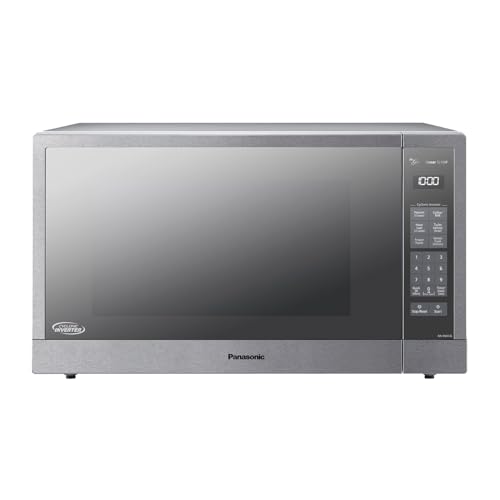
Panasonic NN-SN97JS 2.2 Cu.Ft Countertop Microwave with Cyclonic Inverter — Best Overall Durable
The NN-SN97JS is the pick for a household that uses its microwave like a second oven and expects it to last like one. The 2.2-cubic-foot cavity takes full casserole dishes and dinner plates without negotiation, the Cyclonic Inverter system delivers even, continuous power instead of the usual on-off blasting, and Panasonic’s Genius Sensor handles reheating by humidity rather than by guesswork timers. It is a big machine — measure your counter depth — and it is priced like a flagship. For smaller households the 1.6 cu ft Panasonic below delivers the same philosophy in a saner footprint.
Strengths
- Cyclonic Inverter gives even cooking and gentler component stress
- Full 2.2 cu ft cavity fits family cookware
- Panasonic’s parts and service network is among the deepest in the category
Trade-offs
- Large footprint demands real counter depth
- Flagship pricing
- Power is wasted on dorm-scale reheating jobs
| Capacity | 2.2 cu ft |
| Power (per Amazon listing) | 1250 watts |
| Technology (per Amazon listing) | Cyclonic Wave Inverter, Genius Sensor |
| Installation | Countertop / built-in capable per listing |
Durability in a microwave is mostly the story of its hardest-working parts, and the inverter redesigns the hardest one. Instead of cycling the magnetron at full blast, the NN-SN97JS modulates power continuously, which cooks defrosting food without the frozen-center, cooked-edge failure and subjects the high-voltage components to smoother electrical duty across thousands of cycles. Pair that with a manufacturer that stocks parts and publishes service documentation, and a cavity sized so the turntable is never overloaded by family cookware, and you have the formula that produces decade-long service. This is the microwave to buy when replacing a dead one for the last time in a while.
Best for: Families wanting a long-life, full-size microwave / Not suited for: Small counters and single-person reheating
Check on Amazon — check the current price on Amazon for the exact configuration reviewed here.

Panasonic NN-SN76LS 1.6 Cu.Ft Cyclonic Inverter Microwave — Best Mid-Size Durable
Most kitchens do not need 2.2 cubic feet, and the NN-SN76LS is Panasonic’s inverter durability in the size that fits real counters and real cooking. At 1.6 cubic feet it swallows a full dinner plate and most family side dishes, the 1250W Cyclonic Inverter cooks with the same evenness as its bigger sibling, and the Genius Sensor takes reheating judgment out of tired hands. Choose it over the flagship if your counter depth is standard and your largest dish is a 9×13 that can travel at a slight angle. It is the durability pick we would hand to most buyers without a follow-up question.
Strengths
- Cyclonic Inverter evenness in a standard footprint
- 1250W power matches the flagship
- Sensor reheating reduces the overcooked-food wear on patience and machine alike
Trade-offs
- Still a substantial countertop presence
- Premium over transformer models of the same size
- No convection or air-fry extras — deliberately
| Capacity | 1.6 cu ft |
| Power (per Amazon listing) | 1250 watts |
| Technology (per Amazon listing) | Cyclonic Inverter, Genius Sensor Cooking |
There is a durability argument for buying the mid-size model that rarely gets made: machines live longer when they are not strained, and a 1.6 cu ft inverter microwave in a normal household runs well inside its design envelope almost all the time — plates fit, loads are moderate, the turntable turns freely. The NN-SN76LS adds the inverter’s smooth power delivery and Panasonic’s service depth to that comfortable sizing. If the flagship is the pick for the biggest kitchens, this is the pick for the most kitchens, and its balance of size, power and longevity engineering is why it sits near the top of this guide.
Best for: Most households wanting inverter durability at a sane size / Not suited for: Very large cookware and commercial-scale reheating
Check on Amazon — check the current price on Amazon for the exact configuration reviewed here.

Toshiba 1.6 Cu.Ft Countertop Microwave with Inverter Technology — Best Inverter Value
Toshiba’s inverter model is how buyers get the durability-relevant technology — continuous power delivery — without paying flagship prices. The 1.6 cu ft cavity and 13.6-inch turntable handle family plates and bowls, the smart sensor manages reheating and defrosting by actual food condition, and the black stainless finish hides the fingerprints of a busy kitchen gracefully. It suits households that reheat and defrost daily and want that work done evenly for years. Absolute longevity shoppers with flagship budgets may still prefer Panasonic’s deeper service culture; value shoppers get most of the engineering here for notably less commitment.
Strengths
- True inverter technology at a mid-range tier
- Smart sensor for reheating and defrosting
- Generous 13.6-inch turntable in a 1.6 cu ft body
Trade-offs
- Service network is thinner than Panasonic’s
- Black stainless shows dust more than it hides it
- Membrane-style controls need gentle treatment to age well
| Capacity | 1.6 cu ft |
| Power (per Amazon listing) | 1250 watts |
| Technology (per Amazon listing) | Inverter Technology, Smart Sensor, Auto Defrost |
| Turntable (per Amazon listing) | 13.6-inch |
The durability case for this Toshiba is the same physics as the Panasonics — inverter power is smoother power — delivered at a price that changes the cost-per-year arithmetic in its favor even if its ultimate lifespan lands a year or two shorter. Its defrost performance is the daily proof: inverter low power thaws evenly instead of cooking the edges of frozen chicken while the center stays icy, which is the task that makes owners hate or keep a microwave. For a household replacing a transformer model that died young, this is the upgrade that addresses the actual cause.
Best for: Value-focused buyers wanting inverter longevity / Not suited for: Buyers prioritizing the deepest possible parts network
Check on Amazon — check the current price on Amazon for the exact configuration reviewed here.

Sharp SMC1662KS 1.6 Cu.Ft Countertop Microwave — Best Stainless Workhorse
Sharp invented much of the modern microwave’s vocabulary — the Carousel turntable is theirs — and the SMC1662KS is their straightforward stainless workhorse: 1.6 cubic feet, 1100 watts, a removable 13.6-inch Carousel, and controls that favor clarity over novelty. It suits buyers who want a proven, repairable-feeling machine from a microwave specialist rather than a generalist brand’s side line. There is no inverter here, so defrosting is good rather than great; in exchange you get a simpler, time-tested drive design that independent repair shops know intimately. For many households that trade is exactly the durability play.
Strengths
- Microwave-specialist brand with a long service culture
- Stainless build and a proven Carousel turntable system
- Straightforward controls that age gracefully
Trade-offs
- No inverter — defrost evenness is a step behind
- 1100W is adequate rather than fast
- Styling is utilitarian
| Capacity | 1.6 cu ft |
| Power (per Amazon listing) | 1100 watts |
| Turntable (per Amazon listing) | Removable 13.6-inch Carousel |
There are two philosophies of durability in this guide: newer technology that stresses components less (the inverters), and mature technology that everyone can fix (this Sharp). The SMC1662KS embodies the second. Its design language is conservative because its failure modes are known, its parts channel is stocked because the model family has volume, and its turntable system has been refined over decades of production. Owners who keep appliances by repairing them once rather than replacing them twice will recognize this machine as their kind of purchase — unglamorous, well understood, and built by a company that has made microwaves its main business for generations.
Best for: Buyers who value repairability and a specialist brand / Not suited for: Defrost perfectionists — choose an inverter model
Check on Amazon — check the current price on Amazon for the exact configuration reviewed here.

Panasonic NN-SN65KB 1.2 Cu.Ft Microwave with Inverter Technology — Best Compact Durable
Compact microwaves are where durability goes to die — the category is full of 700W disposables — and the NN-SN65KB is the exception that proves a small machine can be a long-life one. It packs Panasonic’s inverter system and 1200 watts into 1.2 cubic feet, with Genius Sensor one-touch cooking and Turbo Defrost that actually deserves the name. It suits apartments, offices, small households and anyone whose microwave works daily in a small footprint. Families will find the cavity tight for big dishes; everyone else gets flagship technology and build at compact scale, which is a rare combination at any price.
Strengths
- Full inverter system in a compact body
- 1200W — no compact-class power compromise
- Turbo Defrost performance from the inverter’s low-power control
Trade-offs
- 1.2 cu ft cavity limits large dishes
- Costs what full-size budget models cost
- Black finish only in this configuration
| Capacity | 1.2 cu ft |
| Power (per Amazon listing) | 1200 watts |
| Technology (per Amazon listing) | Inverter Technology, Genius Sensor, Turbo Defrost |
The compact-durability trick is that nothing about this machine is a cost-cut drive design wearing a small cabinet. The inverter, the sensor and the power output are the same technologies Panasonic sells in its flagships, scaled to a cavity that suits small kitchens — which means the two classic compact failure stories (underpowered magnetron cooking unevenly, disposable build) simply do not apply. For a single person or couple who will use a microwave four times a day for a decade, this is the correct purchase: buy the technology once, in the size you need, and stop participating in the replace-every-three-years cycle the compact category assumes.
Best for: Apartments, offices and small households wanting real longevity / Not suited for: Family-size dishes and big-batch reheating
Check on Amazon — check the current price on Amazon for the exact configuration reviewed here.

Toshiba 1.6 Cu.Ft Countertop Microwave with Smart Sensor — Best Family Reheating Workhorse
Family durability is partly about surviving the household, and this Toshiba is specced for household reality: 1200 watts for fast reheating, a smart sensor that rescues leftovers from timer-guessing, a position-memory turntable that rotates the dish back to the position it started in (mug handles where you left them — a small mercy, daily), and a sound on/off control that silences beeps in a sleeping house. The 13.6-inch turntable and 1.6 cu ft cavity fit family plates. It is a transformer-drive machine, so it sits a tier below the inverters on defrost finesse; as an everyday family workhorse built for abuse and convenience, it earns its badge.
Strengths
- Position-memory turntable is a genuine daily convenience
- Smart sensor reheating suits varied family leftovers
- Sound on/off for quiet households
Trade-offs
- Transformer drive — less even low-power cooking than inverters
- Family-proof, not commercial-proof
- Finish options are limited
| Capacity | 1.6 cu ft |
| Power (per Amazon listing) | 1200 watts |
| Features (per Amazon listing) | Smart Sensor, Position Memory Turntable, Sound On/Off |
| Turntable (per Amazon listing) | 13.6-inch |
Rate this Toshiba by the job families actually give a microwave: reheating, in endless variety, at speed, by operators of every age and attention level. The sensor is the durability feature nobody lists as one — by judging doneness itself, it prevents the chronic overcooking cycles that dry out food and the repeated re-runs that multiply the machine’s working hours. Position memory sounds like a gimmick until the hundredth time a handle faces you instead of the back wall. In a house where the microwave door opens thirty times a day, those small engineering kindnesses, on a solid 1200W platform, are what a workhorse badge means.
Best for: Busy families reheating constantly / Not suited for: Defrost specialists and inverter purists
Check on Amazon — check the current price on Amazon for the exact configuration reviewed here.
Comparison Table
| Pick | Badge | Key Spec | Best For |
|---|---|---|---|
| Panasonic NN-SN97JS 2.2 Cu.Ft Countertop Microwave with Cyclonic Inverter | Best Overall Durable | 2.2 cu ft, 1250W Cyclonic Inverter | Families wanting a long-life, full-size microwave |
| Panasonic NN-SN76LS 1.6 Cu.Ft Cyclonic Inverter Microwave | Best Mid-Size Durable | 1.6 cu ft, 1250W Cyclonic Inverter | Most households wanting inverter durability at a sane size |
| Toshiba 1.6 Cu.Ft Countertop Microwave with Inverter Technology | Best Inverter Value | 1.6 cu ft, 1250W inverter, smart sensor | Value-focused buyers wanting inverter longevity |
| Sharp SMC1662KS 1.6 Cu.Ft Countertop Microwave | Best Stainless Workhorse | 1.6 cu ft, 1100W, Carousel turntable | Buyers who value repairability and a specialist brand |
| Panasonic NN-SN65KB 1.2 Cu.Ft Microwave with Inverter Technology | Best Compact Durable | 1.2 cu ft, 1200W inverter | Apartments, offices and small households wanting real longevity |
| Toshiba 1.6 Cu.Ft Countertop Microwave with Smart Sensor | Best Family Reheating Workhorse | 1.6 cu ft, 1200W, position-memory turntable | Busy families reheating constantly |
How to Choose the Best Durable Microwaves
Shop for the failure points, not the features. In rough order of how microwaves actually die: door latch and interlock wear (the door stops registering as closed), keypad failure (membrane panels delaminate and lose keys), turntable motor and roller wear, magnetron decline (cooking slows and unevenness grows), and control-board faults. A durable purchase is one where each of those is either engineered conservatively or economically repairable — which is why this guide favors established models from microwave specialists with real parts channels over feature-stuffed newcomers.
Choose the drive technology deliberately. Inverter models cook with continuous, adjustable power: better defrosting, gentler component duty, and typically the longest-lived cooking performance. Transformer models are simpler and cheaper, with on-off power cycling that is harder on food at low settings but built on decades of repair knowledge. Neither is a wrong answer; the wrong answer is buying on presets and finishes while ignoring which drive is inside.
- Size honestly: a turntable that cannot rotate your largest dish freely will stall and wear; leave clearance around the plate.
- Power: 1000–1250W is the family sweet spot; below 900W, cooking slows enough that the machine works longer per meal.
- Controls: physical-feel buttons and simple layouts outlast novelty touch panels in steamy kitchens.
- Ventilation: built-in and over-range installations need their clearances respected — heat is the silent lifespan tax.
Finally, do the parts test before buying: search for your shortlisted model’s turntable motor, roller ring and door latch as purchasable parts. If all three are ordinary catalog items, you are looking at a maintainable appliance. If none are, you are looking at a sealed lifespan, and the price should be judged as rent, not ownership.
Inverter vs Conventional Microwaves: The Durability Angle
A conventional microwave has two power states — full and off — and simulates lower settings by cycling between them. Food experiences this as bursts; the high-voltage components experience it as repeated full-load switching. An inverter microwave converts power electronically and delivers any level continuously, so ‘power 3’ is truly thirty percent power, all the time. The cooking consequences are famous (defrosting without cooked edges, sauces that do not split), but the durability consequence is the one this guide cares about: smoother electrical duty across the machine’s life, and cooking performance that stays even as components age, because the control system compensates continuously rather than cycling harder.
The honest counterweight is repairability. Inverter boards are more complex, and when one does fail, the repair is a board replacement rather than a cheap component swap — which is why brand and parts culture matter more, not less, on inverter models. The Panasonics and Toshiba in this guide come from manufacturers with the volume to stock those boards. Bought from a no-name label, an inverter is a gamble; bought from a specialist, it is currently the best longevity bet in the category.
Where Microwaves Wear Out (and How to Slow It Down)
The door is the hardest-worked part of the appliance: slammed, leaned on, and latched thousands of times, with safety interlocks that must agree perfectly before the magnetron fires. Close it with the handle rather than a shove, never hang towels or weight on it, and treat a door that needs a ‘special touch’ to start as a service call, not a personality quirk — interlocks are safety devices, not conveniences. The cavity is the second wear site: food splatter baked onto the waveguide cover carbonizes over time and can arc, so a weekly wipe and a splatter cover on messy foods are genuine lifespan maintenance, not housekeeping fussiness.
Steam is the third. Microwaves vent moisture into their own door seals and control areas, which is why over-range and built-in installations suffer when clearances are ignored, and why a microwave should not live directly beside a kettle’s permanent steam plume. Give the vents air, keep the seals clean, and run the machine empty never — an empty cavity reflects energy back into the components that made it. None of this is burdensome; all of it together is roughly the difference between the seven-year and the twelve-year version of the same appliance.
Cost Per Year: The Only Price Math That Matters Here
Durability shopping inverts normal price logic. A budget microwave replaced three times in a decade costs more — in money, in landfill, in Saturday mornings — than a flagship bought once, even before counting the cooking-quality difference across all those years. Run the arithmetic with your own numbers when you shop: divide the check-price figure by the realistic service years (five for a disposable-tier compact, eight to twelve for the class of machines in this guide) and the ‘expensive’ picks routinely become the cheap ones. This is also why this article prints no prices: the comparison only works with today’s numbers, and the habit of computing cost per year will serve you in every appliance category after this one.
Two costs hide inside the arithmetic. Disposal and replacement hassle — the delivery windows, the counter re-measuring, the learning of new controls — are real even when unpriced. And cooking quality is a cost too: a microwave whose defrost ruins the edges of frozen meat taxes every meal it touches. The durable pick is rarely the one with the lowest number attached; it is the one whose total decade costs the least, and on that ledger the inverter flagships and the specialist workhorse in this guide are the bargains.
Reading a Microwave Listing Like a Repair Technician
Technicians read listings differently: they look for the model family’s age (years on the market without a forced redesign signals sorted engineering), the manufacturer’s name for the drive (inverter systems are branded proudly; silence means transformer), and whether the turntable is a standard size with a standard roller ring — the two parts you are most likely to replace and the easiest to source when they are common. They also note the door: a positive-latch metal-framed door reads as serviceable; a featherweight all-plastic door reads as a countdown.
You can borrow the whole method in five minutes per model. Search the model number plus ‘parts’ and see a catalog or a void. Search it plus ‘door latch’ and see whether the common failure is a known, stocked, inexpensive component. Search it plus the word ‘recall’ once, because that is cheaper than learning later. The six models in this guide passed those searches before they passed any cooking judgment — which is, in one sentence, what makes this a durability guide rather than another feature roundup.
When to Repair, When to Replace
A durable microwave earns one repair in its life without apology, and the decision framework is simple. Repair when the fault is a wear part — turntable motor, roller ring, door latch or switch, cavity light, a keypad membrane on a model whose board is healthy — and the machine’s cooking is still even. Those are the microwave equivalent of brake pads: expected, bounded, and cheaper than replacement by a wide margin. Replace when the magnetron’s output has faded (cooking times creeping up across all foods), when the control board fails on a model whose parts channel has dried up, or when any door or interlock fault involves damage rather than wear — safety components do not get second chances.
The gray zone is the eight-year-old machine with a mid-cost fault, and there the honest tiebreaker is the rest of the appliance: a clean cavity, a true door and even cooking argue for the repair; rust at the cavity seams, a sagging door and hot spots argue that the fault is a symptom, not the disease. Owners of the machines in this guide will face that decision later than most, which is the entire point of buying durability in the first place — and when they do, the parts searches in the previous section will tell them which side of the line they are on.
Durability by Installation Type: Countertop, Built-In and Over-Range
The picks in this guide are countertop machines, and that is partly a durability decision in itself. A countertop microwave lives in open air, vents freely, can be pulled out for cleaning and service in thirty seconds, and can be replaced without touching cabinetry — every one of those facts extends practical service life. Built-in installations trap heat around the cabinet unless the trim kit’s ventilation is installed exactly as specified, and the penalty for ignoring that is paid by the control board years later. If you are planning a built-in, the NN-SN97JS in this guide is listed as built-in capable; honor its trim kit and clearances as engineering requirements, not suggestions.
Over-range microwaves live the hardest life in the category: they inhale steam, grease vapor and heat from the cooktop below on every single day of service, and their door and control areas age accordingly. No over-range model appears in this guide’s top ranks for exactly that reason — the most durable over-range unit still works in a harsher environment than the most ordinary countertop machine. Households replacing a dead over-range unit for the second time should at least price the alternative honestly: a countertop inverter from this list plus a dedicated vent hood frequently outlasts, out-cooks and out-vents the combination unit it replaces.
Whichever installation you choose, write the install date and the water-test baseline inside the manual’s cover. Durability is a long game played in years, and the owners who win it are the ones who can tell, in year six, whether their machine is truly fading or merely feels different — because they measured it when it was new. That single habit converts vague dissatisfaction into a decision, and it costs one cup of water and thirty seconds.
There is a final, unfashionable durability variable worth naming: how the household treats the appliance in its first month, which tends to become how it is treated forever. The family that learns handle-closing, splatter covers and the weekly wipe in week one will still be doing them, unthinkingly, in year nine — and their microwave will look and cook like it. Durability is partly purchased and partly practiced, and this guide has tried to sell you both halves in the right proportions.
If you take only one practice from this page, take the splatter cover. It is the cheapest object mentioned anywhere in this guide, it takes two seconds to use, and it quietly prevents the single most common cause of premature microwave retirement that has nothing to do with engineering. Somewhere in that fact is the whole philosophy of buying durable appliances: choose well once, then protect the choice with habits so small they feel like nothing — because compounded over a decade, nothing is exactly what they cost, and everything is what they save.
The same philosophy explains this guide’s silences. There are no novelty finishes ranked here, no preset-count contests, no smart features scored — not because those things are worthless, but because none of them has ever kept a microwave alive into its second decade, and a durability guide that scored them would be lying about its subject. What remains, once the noise is removed, is a short and rather reassuring list: a sound drive, an honest door, a clean cavity, moving air, stocked parts, and an owner with two or three small habits. Every pick above was chosen because it gives you the first five; the sixth is yours to supply, and it is the only one that cannot be bought.
How to Set Up and Maintain a Microwave for a Long Life
A microwave’s lifespan is substantially decided in its first week and its weekly five minutes thereafter. Set it up like this and maintain it like this, and the durable machine you bought stays durable.
- Place it on a level, stable surface with the manual’s ventilation clearances genuinely honored — sides, top and rear. Heat with nowhere to go is the silent lifespan tax.
- Check the turntable before first use: roller ring seated, tray centered, and a full rotation by hand with no grinding or wobble.
- Run the water test once: a cup of water should heat briskly and evenly at full power. This is your baseline — repeat it yearly, and a fading magnetron announces itself in the comparison.
- Use a splatter cover for messy foods from day one. The waveguide cover stays clean, and the cavity stops accumulating baked-on carbon.
- Wipe the cavity and door seals weekly with a damp cloth; loosen dried splatter with a microwaved bowl of water and lemon first rather than scrubbing.
- Close the door with the handle, every time, and teach the household the same. Latch assemblies die of slams, not of openings.
- Keep the vents dust-free and never run the machine empty. If a turntable stalls under a heavy dish, lighten the load rather than letting the motor strain.
Once a year, do the technician’s minute: inspect the door seal and latch for play, look at the cavity seams for rust bubbles, check the roller ring for flat spots, and repeat the water test against your baseline. Ten minutes a year is the entire maintenance budget of a well-bought microwave — the rest is just cooking.
Common Buying Mistakes
Buying the cheapest compact and replacing it forever. The compact category’s disposables are the most expensive microwaves in this article over any ten-year window. The NN-SN65KB exists to break that cycle.
Judging durability by weight and stainless panels. Cabinet heft is not component quality. Drive technology, latch design and parts availability decide lifespan; finishes decide fingerprints.
Ignoring ventilation clearances to make it fit. A durable machine suffocated in a tight cubby will die like a cheap one. Measure the space with its air gaps before the machine, not after.
Slamming the door and hanging towels on it. The latch and interlock assembly is the number-one wear site. Handle-closing is a lifespan habit, and doors are not towel rails.
Never cleaning the waveguide cover. Carbonized splatter on the mica cover eventually arcs. A weekly wipe is the cheapest insurance in the appliance world.
Replacing at the first wear-part fault. A turntable motor or roller ring is a small, stocked part on every pick in this guide. Repair the wear parts; replace the machine when cooking itself fades.
Final Recommendation
Buy the Panasonic NN-SN97JS if your kitchen is big and your horizon is long; buy its 1.6 cu ft sibling, the NN-SN76LS, if your kitchen is like most kitchens — together they are the durability center of this guide. The Toshiba inverter brings the same core technology to a friendlier tier, the Sharp SMC1662KS is the repairable traditionalist’s pick, the little NN-SN65KB ends the disposable-compact cycle, and the sensor Toshiba is the family workhorse that survives households with grace. Whichever you choose, close the door gently, keep the cavity clean, and run the parts test before you buy — and the microwave you install this year has every chance of being the one you are still using when everything else in the kitchen has been replaced around it.
That division of labor — manufacturer supplies the engineering, owner supplies the habits — is the real subject of every durability claim ever printed, and the reason the same model can be a three-year disappointment in one kitchen and a twelve-year fixture in another. Buy the engineering well, and the habits are a small price for a decade of even reheats.
Start with the parts search, end with the water test, and let the years in between be uneventful — uneventful is what success looks like in this category, and it is worth paying for exactly once.
Every other appliance in the kitchen will be replaced on fashion’s schedule; let the microwave be the one replaced on its own.
That, in the end, is the purchase this guide is actually recommending, and it is worth making carefully.
Start with the shortlist: Panasonic NN-SN97JS 2.2 Cu.Ft Countertop Microwave with Cyclonic Inverter, Panasonic NN-SN76LS 1.6 Cu.Ft Cyclonic Inverter Microwave, Toshiba 1.6 Cu.Ft Countertop Microwave with Inverter Technology — check price on Amazon for each and buy the one whose strengths match how you actually cook.
Related guides in this program: Best Drawer Microwaves; Best Drawer Microwaves With Convection; Best Countertop Microwaves; Best Inverter Microwaves; Best Microwaves; Best Over The Range Microwaves.
Frequently Asked Questions
How long should a good microwave last?
A well-bought countertop microwave from a specialist brand should give eight to twelve years of daily service; budget compacts often manage three to five. The biggest variables are door and latch treatment, ventilation, cavity cleanliness, and whether wear parts get replaced instead of the whole machine being retired at the first fault.
Are inverter microwaves more reliable?
They cook more evenly and their continuous power delivery is gentler electrical duty than on-off cycling, which supports longevity. Their boards are more complex, so brand and parts availability matter — bought from Panasonic or Toshiba, an inverter is currently the strongest durability bet; the article explains the repairability trade honestly.
What part of a microwave fails first?
Most commonly the door latch and interlock switches, followed by keypad membranes and turntable motors. All are wear parts, and on the models in this guide all are stocked, inexpensive components — which is precisely why those models were chosen. A machine is durable when its likely failures are cheap.
Is a stainless steel microwave more durable?
Stainless surfaces resist staining and clean well, but durability lives inside: drive design, latch construction and parts support. Buy stainless for the kitchen, by all means — just do not mistake the finish for the engineering. The Sharp in this guide earns its place on service culture, not on its panels.
Can a microwave be repaired, or are they all disposable?
Wear-part repairs — turntable motors, roller rings, latches, switches, lights — are routine and economical on established models. Magnetron and control-board failures are the economic borderline. The parts test in this guide (search the model plus “parts”) tells you in advance which kind of appliance you are buying.
Why is my old microwave cooking unevenly?
Usually a stalling or worn turntable system, a tired magnetron, or carbon buildup on the waveguide cover — in that order of likelihood and repair cost. Check the roller ring and tray first, clean the cavity and cover, and use the one-cup water test against a new machine’s baseline to judge whether the magnetron itself is fading.


