Disclosure: airfryerkitchensupply.com is reader-supported. When you buy through links on our site, we may earn an affiliate commission at no extra cost to you.
Where to Buy
Every verified pick in this guide to the best drawer microwaves is sold through Amazon, where you can check the current price on Amazon, confirm the exact configuration, and read the full manufacturer specification sheet before you commit. Listings for this category change often — finishes go in and out of stock and bundles change — so use the links below to land on the exact model we verified, not a look-alike variant.
- Sharp SMD2470ASY 24-Inch Microwave Drawer Oven — Best Overall: check price on Amazon.
- Sharp SMD2479MW Smart Microwave Drawer Oven with Easy Wave Open — Best Smart Drawer: check price on Amazon.
- Sharp SMD3070ASY 30-Inch Microwave Drawer Oven — Best 30-Inch Drawer: check price on Amazon.
- Sharp SMD2430MS 24-Inch Microwave Drawer Oven — Best Automatic Drawer: check price on Amazon.
- Sharp SMD2440JS 24-Inch Microwave Drawer Oven — Best Value Configuration: check price on Amazon.
- Cosmo COS-12MWDSS-NH 24-Inch Microwave Drawer (Haven Collection) — Best Alternative to Sharp: check price on Amazon.
The best drawer microwaves all share a surname, and this guide will not pretend otherwise: Sharp invented the microwave drawer, holds the foundational patents, and — as Amazon listing data verification for this article confirmed — dominates the category on Amazon: most verified drawer listings are Sharp models, with Cosmo the only other brand fielding a verified drawer line of its own and KoolMore a recent entrant with an electric-opening drawer (the subject of our convection companion guide). That is not a failure of research; it is the market. Other appliance brands sell drawer microwaves through kitchen dealers and their own channels, but in the verifiable Amazon catalog, drawer microwaves means Sharp first, in two widths and several generations of controls.
What you are buying, whichever badge below you choose, is the same core proposition: a microwave that installs under a counter or in an island, opens like a drawer rather than swinging like a door, and loads from the top. That format changes kitchen ergonomics more than any feature list — no reaching up into a hot cavity over a cooktop, no door swinging into a walkway, and a natural home in the island and under-counter spaces modern kitchens are designed around. Capacity is standardized across the line at 1.2 cubic feet and power at 950 watts in the verified listings, so the real differences are width (24 or 30 inch), control style, opening mechanism and smart features.
Because this is a built-in appliance, the buying guide and installation sections matter as much as the reviews: cabinet cutout dimensions, electrical requirements and ventilation decide whether a drawer microwave succeeds in your kitchen at all. Read those sections before ordering, measure twice, and treat this purchase like the cabinetry decision it is.
In this guide
Quick Picks
If you only read one section, make it this one. These are the six best drawer microwaves we would shortlist for real kitchens, each with a clear job to do:
- Best Overall — Sharp SMD2470ASY 24-Inch Microwave Drawer Oven: The reference drawer microwave: 24-inch, 1.2 cu ft, 950W, with the concealed control panel that defines the modern Sharp drawer.
- Best Smart Drawer — Sharp SMD2479MW Smart Microwave Drawer Oven with Easy Wave Open: Easy Wave Open hands-free opening, a concealed glass touch panel and smart compatibility — the current-generation drawer.
- Best 30-Inch Drawer — Sharp SMD3070ASY 30-Inch Microwave Drawer Oven: The same proven drawer in the 30-inch width, for kitchens designed around pro-width appliances and wider cabinet bays.
- Best Automatic Drawer — Sharp SMD2430MS 24-Inch Microwave Drawer Oven: An automatic drawer system and ADA-compliant design with sensor cook — the accessibility-forward pick of the line.
- Best Value Configuration — Sharp SMD2440JS 24-Inch Microwave Drawer Oven: The JS-series 24-inch drawer: 950W, angled touch controls and the full drawer format in the line’s most straightforward configuration.
- Best Alternative to Sharp — Cosmo COS-12MWDSS-NH 24-Inch Microwave Drawer (Haven Collection): The one verified non-Sharp drawer line: 1.2 cu ft, 1000W, 11 power levels and automatic presets from Cosmo’s Haven Collection.
How These Picks Were Chosen
Every candidate was verified: model number, width, capacity and control features had to match the actual Amazon listing, and anything calling itself a drawer microwave that turned out to be a countertop model, a warming drawer or a range accessory was excluded. The searches confirmed the category’s structure — ten verified Sharp drawer models across the current and recent generations, plus a verified drawer line from Cosmo — and the six picks below were chosen from that verified set to cover the real decision points: the default 24-inch, the smart generation, the 30-inch width, the automatic/ADA design, the value configuration, and the one credible alternative brand.
Judging weighted what differs between these near-identical-on-paper machines: how the drawer opens (manual pull, automatic, or wave-activated), how the controls present (concealed tilt panels versus angled fixed panels — a genuine usability split when the machine sits below counter height), sensor cooking quality, and finish options for matching surrounding appliances. Installation requirements are common across the line and are covered once, thoroughly, in the how-to section rather than repeated per model.
One category honesty note: drawer microwaves are premium built-ins, and their per-cubic-foot cost is far above countertop models. You are paying for the format, the installation flexibility and the ergonomics — the sections below help you decide whether your kitchen will actually collect on that investment.
The 6 Best Drawer Microwaves, Reviewed

Sharp SMD2470ASY 24-Inch Microwave Drawer Oven — Best Overall
The SMD2470ASY is the model most drawer buyers should start from, because it is the design the category is benchmarked against: a 24-inch under-counter drawer with a concealed control panel that tilts out when needed and disappears when it does not, a digital LCD display, and Sharp’s sensor cooking in the standard 1.2 cu ft / 950W format. It suits the typical island or under-counter installation in a standard 24-inch cabinet bay. Choose a sibling instead only for a specific reason — the 30-inch width, the smart features, or the automatic drawer below — because as an all-round drawer, this is the one.
Strengths
- Concealed tilt-out control panel keeps the front clean
- The category’s reference design, with deep parts and installer familiarity
- Sensor cooking in the standard, proven drawer format
Trade-offs
- Manual drawer opening — no automatic or wave-open assist
- No smart connectivity in this generation
- Premium built-in pricing, like the whole category
| Width | 24-inch |
| Capacity (per Amazon listing) | 1.2 cu ft |
| Power (per Amazon listing) | 950 watts |
| Controls (per Amazon listing) | Concealed control panel, digital LCD display |
The concealed panel is more than a styling trick: on an under-counter appliance, a control panel that presents itself at an angle when open is simply easier to read and press than a fixed vertical strip, and when closed it leaves the drawer front as a clean stainless plane that matches modern cabinetry. Underneath, this is the mature version of Sharp’s drawer mechanism — the glide system that made the format viable — paired with the sensor cooking that handles the drawer’s daily work of reheating and defrosting. As the safe, central choice of the line, it is also the model installers have fitted most often, which quietly reduces installation surprises.
Best for: Most under-counter and island installations / Not suited for: Buyers wanting smart features or hands-free opening
Check on Amazon — check the current price on Amazon for the exact configuration reviewed here.

Sharp SMD2479MW Smart Microwave Drawer Oven with Easy Wave Open — Best Smart Drawer
The SMD2479MW is the drawer for the cook whose hands are never free: its Easy Wave Open sensor lets you open the drawer with a wave, which sounds like a novelty until the first time you approach it holding a hot, heavy casserole with both hands. The concealed glass touch control panel keeps the front sleek, and the model’s smart compatibility (per the verified listing) brings it into the connected-kitchen fold. It is the current generation of the 24-inch format, and priced like it. If your kitchen is not smart and your hands are usually free, the SMD2470ASY above gives you the same cooking for less commitment.
Strengths
- Easy Wave Open is genuinely useful with full hands
- Concealed glass touch panel — the sleekest front in the line
- Smart compatibility for connected kitchens
Trade-offs
- Premium pricing for the newest generation
- Smart features need the app ecosystem to matter
- Glass touch controls prefer dry hands
| Width | 24-inch |
| Capacity (per Amazon listing) | 1.2 cu ft |
| Power (per Amazon listing) | 950 watts |
| Controls (per Amazon listing) | Concealed glass touch control panel |
| Opening | Easy Wave Open (per Amazon listing) |
Judge the wave-open feature by kitchen reality rather than showroom skepticism: drawers are loaded from above, usually with both hands occupied, and a door you can trigger without setting anything down is an ergonomic improvement of the same kind that made the drawer format itself worthwhile. The rest of the machine is the proven 24-inch Sharp platform — same capacity, same power class, same sensor-cooking job — with the control experience modernized. For a new kitchen build with connected appliances elsewhere, this is the drawer that belongs; for a like-for-like replacement in a traditional kitchen, it is a pleasant over-specification.
Best for: Smart kitchens and cooks who load with full hands / Not suited for: Traditional kitchens that will never use the connectivity
Check on Amazon — check the current price on Amazon for the exact configuration reviewed here.

Sharp SMD3070ASY 30-Inch Microwave Drawer Oven — Best 30-Inch Drawer
Some kitchens are planned around 30-inch appliances, and the SMD3070ASY exists for them: the Sharp drawer platform widened to a 30-inch front, with the same 1.2 cu ft capacity and 950 watts, a concealed angled touch control panel, and a presence that matches pro-style ranges and wider island designs. The wider front is about proportion and cabinet fit, not capacity — the drawer inside cooks the same loads as its 24-inch siblings. Choose it when your cabinetry or your design calls for the width; choose the 24-inch models when it does not, and spend the difference elsewhere in the kitchen.
Strengths
- 30-inch width matches pro-style kitchen designs
- Same proven capacity and power as the 24-inch line
- Concealed angled panel reads easily from above
Trade-offs
- No capacity gain for the extra width
- Needs a genuine 30-inch cabinet plan
- Fewer finish and configuration options than the 24-inch line
| Width | 30-inch |
| Capacity (per Amazon listing) | 1.2 cu ft |
| Power (per Amazon listing) | 950 watts |
| Controls (per Amazon listing) | Concealed angled touch control panel, digital LCD display |
The 30-inch drawer is a design-led purchase and makes no apology for it: in a kitchen built around a 30- or 36-inch range and wide island runs, a 24-inch drawer front can look like an afterthought, while the SMD3070ASY holds the elevation line. Functionally you lose nothing — the drawer mechanism, sensor cooking and capacity are the platform’s standards — and the wider drawer mouth is marginally easier to load with wide dishes at an angle. Buy it as part of a coherent kitchen plan and it is the right machine; buy it hoping for more microwave and the honest answer is that the extra width is frontage, not volume.
Best for: 30-inch kitchen designs and wide island installations / Not suited for: Standard 24-inch cabinet bays and capacity seekers
Check on Amazon — check the current price on Amazon for the exact configuration reviewed here.
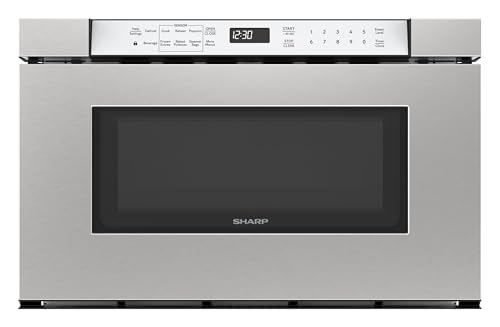
Sharp SMD2430MS 24-Inch Microwave Drawer Oven — Best Automatic Drawer
The SMD2430MS is built around access: its automatic drawer system opens and closes the drawer powered rather than by pull, and the model is ADA compliant per the verified listing, which makes it the natural choice for universal-design kitchens, seated users, and anyone planning to age in place with their kitchen. Sensor Cook technology handles the cooking itself. In a category that is already the most ergonomic microwave format — top-loading, below-counter, no overhead reaching — this model pushes the advantage furthest. If powered opening is unnecessary for your household, the manual models above are simpler machines with fewer moving parts.
Strengths
- Powered automatic drawer opening and closing
- ADA compliant design for accessible kitchens
- Sensor Cook in the current-generation platform
Trade-offs
- Powered mechanism is one more system to maintain
- Newer model with a shorter field history
- Premium tier pricing
| Width | 24-inch |
| Capacity (per Amazon listing) | 1.2 cu ft |
| Controls (per Amazon listing) | Touch control panel |
| Features (per Amazon listing) | Sensor Cook Technology, Automatic Drawer System, ADA Compliant |
Accessibility features in appliances are often afterthoughts; here the powered drawer is the design center, and it changes who the kitchen works for. A drawer that glides open on command, at below-counter height, loading from the top, removes the three classic microwave barriers — height, door swing and reach — in one product. For multigenerational households and anyone designing a forever kitchen, that is worth more than any cooking preset. The sensor cooking underneath is the line’s standard competence, which is all it needs to be: this model’s job is to be usable by everyone in the house, every day, for years.
Best for: Accessible and multigenerational kitchens, aging-in-place design / Not suited for: Buyers who prefer the simplest possible mechanism
Check on Amazon — check the current price on Amazon for the exact configuration reviewed here.

Sharp SMD2440JS 24-Inch Microwave Drawer Oven — Best Value Configuration
The SMD2440JS is the value route into the drawer format: the same 24-inch, 1.2 cu ft, 950W platform with an angled touch control panel — fixed rather than concealed — and without the smart or powered extras of the flagships. The angled panel is arguably the most practical control layout of all for an under-counter machine, since it faces up toward the user standing over it. It suits remodels adding a drawer for the format itself, without paying for connectivity or motorized glides. Compare its current price against the SMD2470ASY before deciding; the value case depends on the day’s listings, and either machine cooks identically.
Strengths
- Full drawer format without flagship extras
- Angled panel is easy to read from standing height
- Same capacity and power as the premium models
Trade-offs
- No concealed panel, smart features or powered drawer
- Fixed panel collects more kitchen dust than concealed designs
- Value depends on current pricing versus the 2470
| Width | 24-inch |
| Capacity (per Amazon listing) | 1.2 cu ft |
| Power (per Amazon listing) | 950 watts |
| Controls (per Amazon listing) | Angled touch control panel |
Strip the drawer category to its essence and this is what remains: a well-built under-counter drawer that cooks with sensors and loads from the top. The JS configuration’s honesty is refreshing in a premium category — you are paying for the format and the mechanism, the two things that actually change your kitchen, and declining the connected and powered layers that change it less. For a remodel budget that has already survived cabinetry and counters, that restraint can be the difference between a drawer microwave and another decade of an over-range unit nobody liked. Check its price against the 2470ASY on the day you buy; take whichever is keener, and do not look back.
Best for: Remodels wanting the drawer format at its most direct price / Not suited for: Buyers wanting the concealed-panel look or smart features
Check on Amazon — check the current price on Amazon for the exact configuration reviewed here.

Cosmo COS-12MWDSS-NH 24-Inch Microwave Drawer (Haven Collection) — Best Alternative to Sharp
Cosmo’s Haven Collection drawer is the answer for buyers who want the format without the category’s default badge — or who are matching other Cosmo appliances in a suite. The verified specification is competitive on paper: 24-inch, 1.2 cu ft, 1000 watts (a touch above Sharp’s 950), 11 power levels, automatic presets including melt, soften, popcorn and beverage, and defrost by weight or time with a rack included. What you give up versus Sharp is depth: two decades of drawer-specific field history, the widest installer familiarity, and the deepest parts channel. What you gain is a genuine alternative, US-based support per the listing, and a matte black sibling model for darker kitchens.
Strengths
- A real second brand in a one-brand category
- 1000W and 11 power levels edge the Sharp standard on paper
- Defrost rack and full preset set included
Trade-offs
- Thinner drawer-specific track record than Sharp
- Parts and installer familiarity are shallower
- No smart or concealed-panel flagship tier
| Width | 24-inch |
| Capacity (per Amazon listing) | 1.2 cu ft |
| Power (per Amazon listing) | 1000 watts |
| Levels (per Amazon listing) | 11 power levels |
| Exterior (per API features) | 23.87 in W x 24.5 in D x 15 in H; 120V/60Hz |
Judge the Cosmo as the category’s challenger and it acquits itself well: the fundamentals match the incumbent, the preset set is complete, and the included defrost rack is a small, practical touch Sharp’s line does not emphasize. The honest unknowns are temporal — how the glide mechanism and controls age across a decade of family use is a question only Sharp has had time to answer publicly. Buyers who value the alternative, or whose kitchen suite is already Cosmo, can choose it with open eyes; buyers optimizing purely for proven longevity should stay with the Sharp picks above. And for completeness: the founding Sharp KB6524PSY remains the replacement-in-kind for existing KB-era cutouts, a role no challenger can contest.
Best for: Buyers wanting a second brand or matching a Cosmo suite / Not suited for: Buyers prioritizing two decades of drawer-specific field history
Check on Amazon — check the current price on Amazon for the exact configuration reviewed here.
Comparison Table
| Pick | Badge | Key Spec | Best For |
|---|---|---|---|
| Sharp SMD2470ASY 24-Inch Microwave Drawer Oven | Best Overall | 24-inch, 1.2 cu ft, 950W, concealed panel | Most under-counter and island installations |
| Sharp SMD2479MW Smart Microwave Drawer Oven with Easy Wave Open | Best Smart Drawer | 24-inch, Easy Wave Open, glass touch panel | Smart kitchens and cooks who load with full hands |
| Sharp SMD3070ASY 30-Inch Microwave Drawer Oven | Best 30-Inch Drawer | 30-inch, 1.2 cu ft, 950W | 30-inch kitchen designs and wide island installations |
| Sharp SMD2430MS 24-Inch Microwave Drawer Oven | Best Automatic Drawer | 24-inch, automatic drawer, ADA compliant | Accessible and multigenerational kitchens, aging-in-place design |
| Sharp SMD2440JS 24-Inch Microwave Drawer Oven | Best Value Configuration | 24-inch, 1.2 cu ft, 950W, angled panel | Remodels wanting the drawer format at its most direct price |
| Cosmo COS-12MWDSS-NH 24-Inch Microwave Drawer (Haven Collection) | Best Alternative to Sharp | 24-inch, 1.2 cu ft, 1000W, 11 levels | Buyers wanting a second brand or matching a Cosmo suite |
How to Choose the Best Drawer Microwaves
Start with the cabinet, not the catalog. A drawer microwave is a built-in that lives inside a cabinet bay, so your first specification is the cutout: 24-inch models are the standard and fit the cabinetry most kitchens are planned with, while the 30-inch SMD3070ASY serves designs built around wider appliances. Confirm your cabinet can provide the required opening width, depth and support — drawers carry their load on the cabinet structure — and plan the electrical supply (a dedicated circuit is the norm for built-ins) before falling for any particular model.
Then choose your generation by the two features that actually differ across the line. Opening: manual glide (most models), powered automatic (SMD2430MS), or wave-activated (SMD2479MW) — pick by who uses the kitchen and how they carry dishes. Controls: concealed tilt panels (2470ASY, 3070ASY) for a clean front, angled fixed panels (2440JS, KB6524PSY) for at-a-glance readability, or the glass touch panel on the smart model. Capacity and power are constant across the verified line — 1.2 cu ft and 950W — so no model wins on cooking muscle; they win on fit and interaction.
- Installation setting: island installations are the drawer’s showcase — confirm the island has power and the depth the unit needs.
- Users: seated users and shorter cooks gain the most from the format; the ADA model extends that advantage.
- Finish: stainless dominates the verified listings; a black stainless variant (SMD2470AH) appears in the line for matching suites.
- Ventilation and clearances: built-ins specify them for a reason — heat management decides control-board lifespan.
Finally, budget honestly for the whole job: the appliance, any cabinet modification, and the electrical work if a circuit must be added. Drawer microwaves reward kitchens planned around them and punish impulse purchases more than any countertop appliance in this program.
Is a Drawer Microwave Right for Your Kitchen?
The format’s advantages are ergonomic and spatial. Loading from the top into a below-counter cavity ends the overhead reach into a hot over-range microwave — a genuine safety improvement with heavy, sloshing dishes — and eliminates the swinging door from tight galley walkways. In islands, a drawer microwave is often the only microwave placement that works at all, which is why it anchors so many open-plan designs. For seated users and shorter cooks, it is simply the most reachable microwave ever made.
The costs are equally real. Capacity is modest and fixed — 1.2 cubic feet will not take the largest casserole-and-lid combinations or a full-size dinner plate with a tall cover in every case — and 950 watts cooks more slowly than a flagship countertop’s 1250. The purchase price per cubic foot is the highest in the microwave world, and installation is a project, not an unboxing. Kitchens that reheat mugs and plates all day will adore it; kitchens that microwave family-scale cookware should measure their largest dish against the drawer before committing, and some will rationally conclude that a countertop inverter plus a drawer elsewhere in the budget serves them better. This guide’s job is to make that an informed decision rather than a showroom regret.
Drawer vs Countertop vs Over-Range: Placing the Microwave
Each placement optimizes a different kitchen. Countertop models optimize flexibility and value: the most cooking per dollar, zero installation, and a cavity as large as you like — at the cost of counter space. Over-range models optimize space in small kitchens by combining microwave and vent, at the cost of the worst ergonomics and the harshest operating environment. Drawer models optimize ergonomics and design integration: reachable by everyone, invisible in the run of cabinetry, and the only island-friendly option — at premium cost and fixed modest capacity.
The mature kitchen often combines two: a drawer for the daily reheating traffic it handles so gracefully, and cooking capacity elsewhere (a countertop unit in a pantry, or the range’s oven) for the oversized jobs. If budget forces one choice, let your largest weekly dish and your shortest cook cast the deciding votes — the drawer wins more of those votes, in more kitchens, than its price suggests, which is why the format has survived as a premium niche for two decades.
The Sharp Stronghold: Why One Brand Dominates This List
Newcomers to this category sometimes read an all-Sharp list as laziness. It is closer to a patent history. Sharp developed the microwave drawer, defended the design, and licensed it selectively, which is why the format never became the free-for-all that countertop microwaves are. Other premium brands — the luxury kitchen names — sell drawer microwaves through dealer networks, frequently built on licensed Sharp-derived mechanisms, at prices and through channels that do not appear in Amazon’s verifiable catalog. Our brief for this program is strict: only Creators-listing-verified listings get links, and in that catalog the drawer category is Sharp-led — ten Sharp listings deep, with Cosmo’s Haven Collection the one verified alternative line and a single KoolMore electric drawer appearing in our follow-up searches.
The practical consequences for buyers are mostly reassuring. A Sharp-led category means deep installer familiarity, a parts channel stocked across generations, and genuine choice concentrated where it matters — width, opening and controls — rather than spread across badge engineering, with Cosmo now applying at least some competitive pressure. The residual risk is the mirror image: the format’s center of gravity still rides on one manufacturer’s commitment. Twenty years into the drawer’s life, that commitment looks durable; but a buyer planning a kitchen around a drawer cutout should know they are planning primarily around one brand’s platform, and this guide would rather say so plainly than disguise it with filler picks from categories that are not drawers at all.
Sensor cooking deserves its own sentence in a drawer context, because the format changes the sensor’s job: a top-loading cavity is opened and checked more casually than a door microwave, and Sharp’s sensor reheating — which judges by humidity rather than by clock — forgives the drawer owner’s habit of adding thirty seconds by feel. Between the format and the sensor, reheating quality in daily life is better than the wattage figure predicts, which is the kind of sentence only a month of ownership teaches.
What 1.2 Cubic Feet and 950 Watts Actually Cook Like
Every verified drawer in this guide shares the same core numbers, so it is worth translating them into kitchen reality once. A 1.2 cu ft drawer cavity takes standard dinner plates, soup bowls, mugs in pairs, medium casserole dishes and the general traffic of reheating, defrosting and beverage work that makes up ninety percent of microwave use. What it refuses are the extremes: the largest lidded roasting dishes, tall covered bowls, and family-scale cookware that flagship countertop cavities swallow. Measure your three most-microwaved vessels before ordering — if they fit, the drawer’s capacity will never cross your mind again; if the biggest does not, decide now whether it can be retired to oven duty.
At 950 watts, cooking runs a touch slower than a 1200–1250W countertop flagship: the same mug of water or plate of leftovers takes roughly a fifth to a quarter longer, a difference measured in tens of seconds on real tasks. Sensor cooking narrows the practical gap further, because the drawer stops when the food is right rather than when a timer guesses. For a format bought for ergonomics and design, that is the correct trade, and owners consistently report forgetting the wattage within a week — while using the top-loading drawer, gratefully, several times a day.
Living With a Drawer Microwave: The First Month
New drawer owners report a consistent adjustment arc, and knowing it in advance smooths the purchase. Week one is delight at the obvious things: loading soup without lifting it overhead, sliding the drawer shut with a hip while carrying a plate, and the small ceremony of the concealed panel tilting out on the 2470. Week two is calibration: you learn which of your bowls ride best, discover that the tallest travel mug needs the lid off, and develop the centering habit that keeps liquids level on the glide. By week four the drawer has quietly reorganized the kitchen’s traffic — reheating migrates to it completely, the over-range unit (if one remains) becomes a clock with a light, and guests ask about it more than any other appliance you own.
The frictions are equally predictable and equally survivable. Bent-over loading is real: a below-counter appliance asks a small bow of every tall user, several times a day, and households should be honest about backs before they are honest about budgets. Spills hide: a cavity below sight level forgives a splatter today and presents it, baked, next week, so the wipe habit matters more here than in any eye-level microwave. And children discover the drawer at exactly handle height — the control lock exists for this reason and should be part of the household setup from day one. None of these outweigh the format for the kitchens it suits, but all of them belong in a guide that expects to be believed.
Finishes, Suites and Designing Around the Drawer
Because a drawer microwave reads as cabinetry, its finish decision is a design decision. Stainless fronts — the finish across the verified listings in this guide — disappear into modern and transitional kitchens and match the widest range of surrounding appliances. The line’s black stainless variant (the SMD2470AH, verified in our API search) suits the darker suites that have become common in remodels, and panel-ready thinking does not apply here: these are appliance fronts, meant to be seen as appliances, and their clean, handle-forward design is the aesthetic. Choose the finish with the range and refrigerator in the same conversation, because the drawer front sits at the visual center of the lower cabinet run.
Placement within the design rewards one specific thought: put the drawer where the dishes are. Islands facing the dining side, bases near the refrigerator, and the cabinet run between sink and table all outperform the traditional beside-the-range slot, because the drawer’s work is reheating and serving rather than cooking support. A drawer microwave placed by workflow rather than by symmetry is used twice as often — and an appliance used twice as often is the only kind worth a premium. Let the kitchen’s daily paths, not the elevation drawing, cast the final vote on position.
One more design note, for the remodelers: because the drawer platform has kept the same core dimensions across generations, a kitchen designed around today’s 24-inch cutout is not designing itself into a corner. When the appliance eventually retires — a decade or more out, on this platform’s record — the same bay accepts its successor. Built-ins live or die by that continuity, and it is a quiet, structural argument for the category leader that no feature comparison captures.
Budget the design honestly, too: the drawer itself is the visible cost, but the cabinet modification, the electrical run and the installer’s half-day are the rest of the invoice, and they arrive together. Kitchens that plan the whole number in advance report the drawer as a favorite purchase; kitchens that discover the number in stages report the same appliance as an extravagance. The machine does not change between those stories. The planning does.
How to Install and Use a Drawer Microwave: Setup Essentials
A drawer microwave is cabinetry first and an appliance second. Professional installation is recommended — most owners should treat the steps below as the checklist to verify with their installer rather than a DIY script, because electrical and cabinet work vary by kitchen and code.
- Confirm the cutout against the model’s installation manual before ordering: opening width and height, minimum depth, and the support structure beneath the unit. Drawer microwaves are heavy and carry dynamic load when the drawer moves.
- Plan the electrical supply: a dedicated, properly grounded circuit per the manual and local code, positioned so the cord is not pinched by the unit or the drawer’s travel.
- Have the cabinet bay level and square. A drawer mechanism amplifies small misalignments into rubbing, noise and uneven glide — the time to fix the bay is before the unit goes in.
- Slide the unit in with two people, secure it with the manufacturer’s anti-tip and mounting hardware, and confirm the drawer travels its full stroke without contacting adjacent cabinet faces or handles.
- Test the controls and sensor cooking with a cup of water and a plate of leftovers before the installer leaves, and check the drawer seals evenly around its full perimeter.
- Register the appliance and file the installation manual with your kitchen documents — built-ins outlive their paperwork more often than any other appliance class.
In daily use, treat the drawer like the precision mechanism it is: load dishes centered rather than slammed to one side, keep liquids below the rim for the glide’s sake, wipe spills promptly (the cavity is below the counter and forgotten spills linger), and never sit or lean on the open drawer. Used that way, the mechanism that defines this category will glide for the life of the kitchen.
Common Buying Mistakes
Ordering before measuring the cabinet bay. A drawer microwave that does not fit its cutout is an expensive return. Cutout dimensions and support requirements come first, model second.
Assuming 30-inch means more capacity. The 30-inch Sharp is wider at the front, not bigger inside — both widths are 1.2 cu ft in the verified listings. Buy width for design fit, not volume.
Expecting flagship countertop speed. At 950W the drawer cooks somewhat slower than a 1250W countertop. That is the format’s known trade for its ergonomics; buy it with open eyes.
Skipping the electrical plan. Built-ins need a proper circuit in the right place. Discovering that after the cabinet is closed is the most expensive sentence in this category.
Loading the drawer like a countertop cavity. Tall, top-heavy and overfilled loads ride badly on a moving drawer. Center loads, mind liquid levels, and check your tallest covered dish before the first dinner party.
Assuming every brand’s drawer is equally proven. Sharp’s platform depth — parts, installers, twenty years of field history — is a real advantage over the newer Cosmo line, however competitive the Cosmo is on paper. Price that difference honestly rather than pretending it is zero in either direction.
Final Recommendation
For most kitchens, the SMD2470ASY is the drawer to buy: the reference design, the concealed panel, the deepest installer familiarity. Choose the SMD2479MW when hands-free wave opening and smart features match your kitchen’s life, the SMD3070ASY when the design calls for 30 inches, and the SMD2430MS when accessibility is a design requirement rather than a preference — it is the most thoughtfully inclusive model in the line. The SMD2440JS keeps the format honest on price, the Cosmo Haven drawer gives brand-loyalty shoppers a verified alternative, and the older KB6524PSY keeps existing drawer kitchens running in kind. Measure the cabinet first, plan the circuit second, and the drawer you install will quietly become the best-placed appliance in the kitchen.
A closing word on expectations: a drawer microwave will not out-cook the big countertop flagships in our other guides, and it is not trying to. It is trying to be in the right place, at the right height, opening the right way, every single day — and in the kitchens it suits, that turns out to be worth more than wattage. Buy the placement, and the cooking takes care of itself.
Measure the bay, check the circuit, pick the opening your household will love, and join the quiet consensus of drawer owners: nobody goes back to a swinging door at head height willingly.
That is the whole case for the drawer format, stated as plainly as the category allows, and for the right kitchen it is considerably more than enough, every day.
Start with the shortlist: Sharp SMD2470ASY 24-Inch Microwave Drawer Oven, Sharp SMD2479MW Smart Microwave Drawer Oven with Easy Wave Open, Sharp SMD3070ASY 30-Inch Microwave Drawer Oven — check price on Amazon for each and buy the one whose strengths match how you actually cook.
Related guides in this program: Best Drawer Microwaves With Convection; Best Durable Microwaves; Best Microwaves; Best Countertop Microwaves; Best Built In Microwaves; Best Over The Range Microwaves.
Frequently Asked Questions
Who makes the best drawer microwaves?
Sharp, primarily — they invented the format and hold ten of the verified listings in Amazon check for this guide. Cosmo is the one other brand with a verified drawer line on Amazon (its Haven Collection, one of our six picks), and KoolMore sells an electric-opening drawer covered in our convection companion guide. Other luxury brands sell drawers through kitchen dealers rather than Amazon.
Are drawer microwaves worth the premium over countertop models?
If your kitchen collects on the ergonomics — island placement, top loading, no overhead reaching, a clean cabinet line — yes. If you mainly need raw capacity and speed per dollar, a countertop inverter wins easily. The drawer is a design and accessibility purchase that also microwaves, and it should be budgeted that way.
What size cabinet does a drawer microwave need?
Most picks here are 24-inch models for standard cabinet bays; the SMD3070ASY needs a 30-inch plan. Exact cutout dimensions, depth and support requirements are in each model’s installation manual and must be confirmed against your cabinetry before ordering — built-ins are unforgiving of approximate measurements.
Can a drawer microwave replace an over-range microwave?
For cooking, yes, and with better ergonomics — but it does not ventilate. Replacing an over-range unit with a drawer means planning separate ventilation for the cooktop. Many remodels do exactly this and gain a proper hood in the bargain.
How much can a drawer microwave hold?
The verified Sharp line is standardized at 1.2 cu ft — dinner plates, bowls, mugs and medium casseroles fit comfortably; the largest lidded roasters and tallest covered dishes may not. Measure your most-used vessels against the cavity before committing, as the buying guide advises.
Do drawer microwaves cook as fast as countertop models?
Slightly slower: the line runs 950W against 1000–1250W for countertop flagships, which adds tens of seconds to typical reheats. Sensor cooking keeps results consistent. Owners generally find the ergonomic gain worth the small time cost within the first week.


