Disclosure: airfryerkitchensupply.com is reader-supported. When you buy through links on our site, we may earn an affiliate commission at no extra cost to you.
Where to buy
This guide to the best double bowl stainless steel kitchen sinks starts with the gauge. This roundup stays inside one material and goes deep: double bowl stainless steel kitchen sinks, compared on the things that actually separate them — gauge, split, divider height, corner radius, depth and included kit. Every pick was confirmed in Amazon’s catalog data for this site, with specs taken from verified listing titles. If you have already decided on stainless (most buyers have), this is the comparison that matters.
- Kraus KHU104-33 Standart Pro 60/40 Double Bowl Sink — check price on Amazon
- Kraus KWU112-30 Double Bowl Undermount Workstation — check price on Amazon
- Elkay Crosstown 16-Gauge Double Bowl Sink Kit — check price on Amazon
- Kraus Fairlane KHU632-33 Double Bowl Sink — check price on Amazon
- Elkay ELUHAQD32179 Lustertone Classic 40/60 with Aqua Divide — check price on Amazon
- Kraus KBU32 Premier Low Divider Double Bowl — check price on Amazon
When the brief is the best double bowl stainless steel kitchen sinks, the honest work is in the details, because the category looks uniform from a distance: silver, two bowls, undermount. Up close it is anything but. A 16-gauge workstation with a low divider and a 18-gauge bare equal-bowl sink are different tools that happen to share a material, and the six picks below were chosen to make those differences legible — each one is the strongest verified example of a distinct stainless configuration.
Three decisions structure the whole category. First, gauge: 16 is the quality standard for dent resistance and sound; 18 is the budget tier that still serves lighter households well. Second, geometry: 50/50 versus 60/40 splits, full versus low dividers, tight versus rounded corners — the geometry decides what fits and how you work. Third, system: bare sink versus kit versus full workstation, which decides what else you buy and how the sink integrates with prep.
A note on scope: every pick here is stainless steel by design. If you are still weighing materials — composite’s quiet, fireclay’s tradition, copper’s drama — the double basin sibling roundup covers that comparison. This page assumes steel and spends its words on choosing well within it.
A practical promise for this page: no pick appears here on brand fame alone. Each earned its slot by being the clearest example of a configuration a real buyer might choose — and where a famous name’s configuration is weaker than a rival’s for a given brief, the verdict lines say so. Configuration first, badge second, is the order that keeps a twenty-year fixture from becoming a twenty-year annoyance.
In this guide
Quick Picks
Best Overall — Kraus KHU104-33 Standart Pro 60/40 Double Bowl Sink. The reference configuration at full size: 33 inches, 60/40 split, 16-gauge steel, undermount — the double bowl stainless sink most kitchens should benchmark against. Check the current price on Amazon.
Best Workstation — Kraus KWU112-30 Double Bowl Undermount Workstation. A 30-inch workstation in TRU16 steel: integrated ledge, low divider, board and rack included, NoiseDefend sound pads — the most system per inch in stainless. Check the current price on Amazon.
Best Premium Kit — Elkay Crosstown 16-Gauge Double Bowl Sink Kit. Elkay’s Crosstown at the premium spec: 16-gauge steel, 10-inch-deep equal bowls, sold as a kit — the big-brand answer to the Kraus workstations. Check the current price on Amazon.
Best Large 33-Inch Value — Kraus Fairlane KHU632-33 Double Bowl Sink. The full 33-inch footprint in 18-gauge steel — maximum size per dollar for kitchens with the cabinet to hold it and lighter demands on the steel. Check the current price on Amazon.
Best Low-Divide from Elkay — Elkay ELUHAQD32179 Lustertone Classic 40/60 with Aqua Divide. Elkay’s Lustertone Classic pairs a 40/60 split with the Aqua Divide — a lowered divider that lets long items rest across both bowls, in Elkay’s signature Lustertone finish. Check the current price on Amazon.
Best Budget Low-Divider — Kraus KBU32 Premier Low Divider Double Bowl. The low-divider idea at a budget price: 32 inches, 50/50, 18-gauge, both strainers included — flexibility first, thickness traded away openly. Check the current price on Amazon.
How These Picks Were Chosen
Verification was: brand-and-model search, listing title matched, ASIN and stated specifications (gauge, size, split, depth, kit contents) taken from the verified title only. Models whose titles did not state the facts a steel buyer needs were not shortlisted.
The six picks span the real decision tree: two workstation configurations, a 60/40 in both Kraus lines, two Elkay Crosstown/Lustertone classics at 16 and 18 gauge, and the budget Premier — across 30 to 33 inches, 50/50 and 60/40, full and low dividers. Together they let a buyer choose by configuration first and brand second, which is the order that avoids regret.
The 6 Best Double Bowl Stainless Steel Kitchen Sinks

Kraus KHU104-33 Standart Pro 60/40 Double Bowl Sink — Best Overall
The Standart Pro KHU104-33 is the category’s center of gravity executed without gimmicks: a big 33-inch body, the useful 60/40 split, true 16-gauge stainless, undermount installation. The large bowl takes sheet pans and stockpots flat; the small bowl runs prep, rinsing and the disposal. If a kitchen has the 36-inch cabinet this class wants, this is the default recommendation.
Strengths
- 60/40 split at the full 33-inch size — maximum big-bowl capacity here
- 16-gauge steel: dent resistance and sound quality at the standard
- Standart Pro line is Kraus’s workhorse — accessories and support are plentiful
Trade-offs
- Needs the larger cabinet class — measure before falling for it
- No workstation ledge; prep stays on the counter
- Bare configuration — grids and accessories are separate decisions
| Size | 33 in |
| Split | 60/40 double bowl |
| Material | 16-gauge stainless steel |
| Mount | Undermount |
| Line | Kraus Standart Pro |
Benchmark status is earned by the absence of weaknesses: the gauge is right, the split is the useful one, the size is the generous one, and the brand’s accessory ecosystem (grids, racks, strainers) is deep enough to complete the setup your way. Kitchens that cook at volume and keep a sink for the long term should start their comparison here and demand a specific reason to buy anything else.
The Standart Pro’s accessory depth deserves emphasis: grids cut for both bowls, racks and strainers are catalog items, so the KHU104-33 can be completed precisely rather than approximately. In a 36-inch cabinet with a disposal on the small bowl, it forms the exact center of a serious home kitchen — which is why it benchmarks this roundup rather than merely appearing in it.
Best for: Full-size kitchens and serious home cooks as the default choice / Not suited for: 33-inch cabinets or buyers wanting workstation features built in
Check on Amazon — check price on Amazon before you order; commercial configurations and included accessories vary by listing.

Kraus KWU112-30 Double Bowl Undermount Workstation — Best Workstation
The KWU112-30 packs the category’s three best ideas into 30 inches: a workstation ledge that turns the sink into a prep surface, a low divider that lets big pans bridge both bowls, and 16-gauge TRU16 steel with NoiseDefend padding so the whole system sounds as engineered as it is. The included cutting board and roll-up rack mean the system works the day it is installed.
Strengths
- Ledge plus included accessories — a complete prep-and-wash station
- Low divider flexibility inside a 50/50 layout
- TRU16 steel with full sound deadening
Trade-offs
- 30 inches is the compact class — big households may outgrow it
- Undermount only
- Accessory replacements are Kraus-sized
| Size | 30 in |
| Split | 50/50 with low divider |
| Material | 16-gauge TRU16 stainless steel |
| Mount | Undermount workstation |
| Included | Cutting board, roll-up rack |
In a smaller kitchen, counter space is the scarcest resource, and this sink manufactures it: chop on the ledge board over one bowl, sweep scraps straight in, rack the washed items over the other. The low divider quietly removes the size penalty by bridging pans across. For 33-inch cabinets and cooks who prep seriously, it is not a compromise pick — it is the clever one.
Notice what the included kit does to the real cost comparison: board and roll-up rack are items other picks charge separately for, and the ledge they ride on is structural, not an add-on. Priced as a system, the KWU112-30 is more competitive than its shelf position suggests — and it arrives complete, which anyone mid-renovation will tell you is worth money by itself.
Best for: Smaller kitchens that cook seriously and lack counter space / Not suited for: Buyers wanting a plain, accessory-free basin
Check on Amazon — check price on Amazon before you order; commercial configurations and included accessories vary by listing.
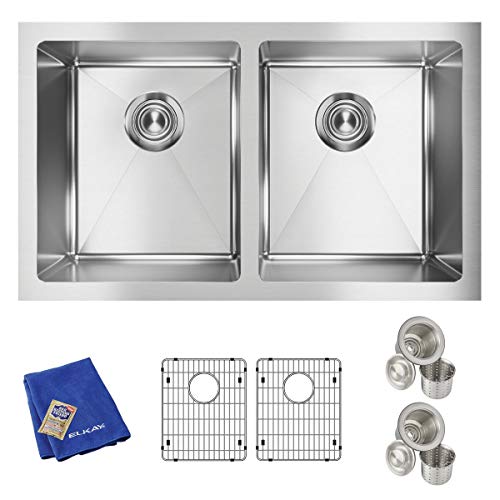
Elkay Crosstown 16-Gauge Double Bowl Sink Kit — Best Premium Kit
This Crosstown configuration is Elkay playing at full strength: 16-gauge steel (matching the Kraus picks), generous 10-inch depth in equal bowls across a 30-3/4 x 18-1/2 inch body, and kit packaging so the setup arrives complete. The tight, modern Crosstown styling suits contemporary kitchens, and Elkay’s support network stands behind all of it.
Strengths
- 16-gauge steel with Elkay’s parts and accessory depth
- 10-inch bowls — the deepest equal-split capacity here
- Kit format removes accessory guesswork
Trade-offs
- Equal bowls with a full divider — no bridging for oversized pans
- 10-inch depth asks shorter users to reach
- Premium positioning within the steel category
| Size | 30-3/4 x 18-1/2 in |
| Depth | 10 in |
| Split | Equal double bowl |
| Material | 16-gauge stainless steel |
| Format | Undermount sink kit |
Depth is this pick’s argument: a 10-inch bowl hides a full day’s dishes below the rim, swallows a stockpot for soaking, and keeps splash contained at a hard-running faucet. Households that batch their washing — cook big, wash once — feel that depth daily. Paired with 16-gauge steel and Elkay’s long support tail, it is the premium classic of this roundup: no ledge, no gimmick, just a deep, thick, well-supported sink.
Ten-inch bowls change cleanup math after big cooking days: the stockpot soaks fully submerged, the roasting pan sits below the rim, and a day’s dishes hide out of sightlines. For households that cook in batches and wash in batches, the Crosstown kit’s depth is not a spec — it is the daily experience, backed by 16-gauge steel that keeps the deep bowls quiet under a hard-running faucet.
Best for: Batch-cooking households wanting depth and brand support / Not suited for: Fans of low dividers or workstation ledges
Check on Amazon — check price on Amazon before you order; commercial configurations and included accessories vary by listing.

Kraus Fairlane KHU632-33 Double Bowl Sink — Best Large 33-Inch Value
The Fairlane KHU632-33 answers a specific brief: the big 33-inch double bowl, undermount, at the friendliest cost the size allows. The trade is stated in its own title — 18-gauge steel. For households whose cookware is moderate and whose budget has other priorities, trading two gauges for the full footprint is a legitimate, even savvy, exchange.
Strengths
- Full 33-inch size at an 18-gauge price position
- Undermount cleanliness and modern line
- Kraus ecosystem for grids and accessories
Trade-offs
- 18-gauge drums more and dents easier than the 16-gauge picks
- Add bottom grids from day one to protect the thinner floor
- Check the split and interior dimensions on the listing for your cookware
| Size | 33 in |
| Material | 18-gauge stainless steel |
| Mount | Undermount |
| Model | Kraus Fairlane KHU632-33 |
| Type | Double bowl |
Size is a feature people underrate until they wash a roasting pan in a too-small bowl. The Fairlane buyer is choosing presence: basins that fit the holiday cookware, in the cabinet that can hold them, while accepting steel that asks for grids and a little care. In a household of moderate cookware and careful habits, that trade pays out every single wash day.
The Fairlane pairs naturally with a mid-range faucet upgrade: the money saved on gauge buys the pull-down sprayer whose reach a 33-inch double bowl genuinely needs. Planned as a package that way, the KHU632-33 kitchen feels premium at every touchpoint a user actually touches — a smarter allocation than thickness nobody sees, for households whose cookware is kind to sinks.
Best for: Large-cabinet kitchens prioritizing size on a budget / Not suited for: Cast-iron-heavy cooking or dent-prone households
Check on Amazon — check price on Amazon before you order; commercial configurations and included accessories vary by listing.

Elkay ELUHAQD32179 Lustertone Classic 40/60 with Aqua Divide — Best Low-Divide from Elkay
The Aqua Divide is Elkay’s answer to the low-divider idea: a divider dropped low enough that cookie sheets and long pans bridge across the 40/60 split, while daily washing keeps its two-zone order. The Lustertone finish — Elkay’s fine, even luster — is the other half of the appeal: it hides the micro-scratching of daily use better than bright finishes and ages gracefully.
Strengths
- Aqua Divide gives low-divider flexibility with Elkay support
- 40/60 split puts the bigger bowl where most cooks want it
- Lustertone finish camouflages everyday wear
Trade-offs
- Premium classic line pricing
- Undermount requirements apply
- Confirm exact dimensions and cabinet minimum on the listing
| Split | 40/60 double bowl |
| Divider | Aqua Divide (low) |
| Finish | Lustertone |
| Mount | Undermount |
| Brand | Elkay Lustertone Classic |
This is the connoisseur’s pick in the roundup: buyers who know Elkay’s lines choose Lustertone for how it looks in year five, and the Aqua Divide for how it works on sheet-pan day. It lacks the workstation theater of the Kraus, and for kitchens with counters enough, that restraint plus the finish is exactly the point. A sink chosen for a decade should be chosen on how it ages — this one ages best in class.
Lustertone’s fine finish has a practical side: it releases dried food films more readily than bright-polished steel and shows fewer water spots between cleanings. Combined with the Aqua Divide’s low profile, the ELUHAQD32179 is the pick for owners who want their sink to demand the least daily attention while still bridging the big pans on weekends.
Best for: Long-term owners valuing finish longevity and low-divide flexibility / Not suited for: Workstation seekers or the tightest budgets
Check on Amazon — check price on Amazon before you order; commercial configurations and included accessories vary by listing.

Kraus KBU32 Premier Low Divider Double Bowl — Best Budget Low-Divider
The KBU32 is the smart budget configuration: Kraus’s Premier line spends the money on the feature that changes daily life — a low divider in a 32-inch 50/50 undermount — and saves it on gauge (18) and extras, while still including both strainers. For a first home or a rental with standards, it is the double bowl that feels modern without the flagship bill.
Strengths
- Low divider flexibility at the budget tier
- 32-inch standard size fits the common cabinet class
- Strainers included — a complete install package
Trade-offs
- 18-gauge steel — grids strongly recommended
- Basic sound padding at this tier
- No workstation ledge or premium accessories
| Size | 32 in |
| Split | 50/50 with low divider |
| Material | 18-gauge stainless steel |
| Mount | Undermount |
| Included | Strainers (x2) |
Budget buying is about choosing which compromise you will feel least. A thinner gauge, mitigated by grids, is a compromise you feel rarely; a full-height divider fighting your sheet pan is one you feel weekly. The KBU32 picks the right compromise, which is why it — and not a thicker full-divider budget sink — takes this slot. Add the grids and it is a genuinely satisfying sink at its tier.
The KBU32 is also a renter-friendly landlord pick: a modern low-divider layout that photographs like an upgrade, installs in the standard 32-inch class, and includes its strainers so the install bill has no surprises. For a first home, it delivers the one feature — pan bridging — that owners actually write home about, at the tier where every feature must earn its place.
Best for: Budget remodels and first homes wanting low-divide flexibility / Not suited for: Heavy cookware households that need 16-gauge resilience
Check on Amazon — check price on Amazon before you order; commercial configurations and included accessories vary by listing.
Comparison Table
| Pick | Badge | Key spec | Best for |
|---|---|---|---|
| Kraus KHU104-33 Standart Pro 60/40 Double Bowl Sink | Best Overall | 33 in · 60/40 · 16-gauge undermount | Full-size kitchens and serious home cooks as the default choice |
| Kraus KWU112-30 Double Bowl Undermount Workstation | Best Workstation | 30 in · low divide · workstation · 16-gauge | Smaller kitchens that cook seriously and lack counter space |
| Elkay Crosstown 16-Gauge Double Bowl Sink Kit | Best Premium Kit | 30.75 in · equal · 10 in deep · 16-gauge kit | Batch-cooking households wanting depth and brand support |
| Kraus Fairlane KHU632-33 Double Bowl Sink | Best Large 33-Inch Value | 33 in · 18-gauge · undermount | Large-cabinet kitchens prioritizing size on a budget |
| Elkay ELUHAQD32179 Lustertone Classic 40/60 with Aqua Divide | Best Low-Divide from Elkay | 40/60 · Aqua Divide · Lustertone finish | Long-term owners valuing finish longevity and low-divide flexibility |
| Kraus KBU32 Premier Low Divider Double Bowl | Best Budget Low-Divider | 32 in · 50/50 low divider · 18-gauge | Budget remodels and first homes wanting low-divide flexibility |
How Does Stainless Steel Compare With Composite and Fireclay, Honestly?
Since this roundup is steel-only by brief, here is the honest cross-material summary for buyers still deciding. Granite composite beats steel on quiet, color and water-spot invisibility, and loses on weight, price and the shock of a dropped pan being a (small) crack risk rather than a dent. Fireclay beats steel on traditional looks and sheer mass, and loses on chip risk, weight and configuration choice. Copper beats everything on character and loses on maintenance and price.
Steel’s case is the all-rounder’s: lightest, cheapest per configuration, immune to thermal shock, happy with any cleaner, available in every size and split, and repairable in appearance with a paste and a wipe along the grain. Most kitchens, most of the time, are right to choose it — which is why this page exists to choose within it carefully.
What Should You Verify at Delivery and Install of a Stainless Sink?
Inspect before the counter goes on: check the bowls for shipping dents (especially at corners and the divider), confirm the template matches the sink, and verify the stated gauge if you have calipers — reputable brands match their listings, and catching a mismatch at delivery is painless compared to after install. Confirm all listed kit contents are in the box; strainers and templates are the items most often separated in transit.
At install, verify the undermount support is structural (not just adhesive optimism), the reveal is even on all sides, and the drain assemblies are sealed and tested with a full bowl of water before the cabinet is closed up. Photograph the installed plumbing. A stainless sink installed this carefully will not move, drum or leak for the life of the kitchen.
How to Read a Stainless Sink Listing Like a Pro
Five numbers and phrases decide everything, and listings do not always volunteer them in order: gauge (16 over 18), steel grade (T-304 is the food-safe standard all these picks use), interior bowl dimensions (not the outer size), divider height (full versus low), and corner radius (tight looks modern and holds more; rounded cleans easier). Train yourself to extract those five before looking at a single lifestyle photo.
Then the quiet lines: sound padding coverage (full pads versus token strips), what’s in the box (strainers, grids, templates), and the minimum cabinet size. A listing that states these plainly — as the verified titles in this roundup do — is usually a listing from a brand that supports its products. Vagueness on gauge in particular should be read as 18-gauge until proven otherwise.
Corner Radius: The Small Spec With Daily Consequences
Tight or zero-radius corners give a sink its crisp, commercial-kitchen look and maximize flat interior space — your pans sit level and the bowls hold their stated volume honestly. The cost is cleaning: tight corners collect grime and need a brush worked into them weekly. Rounded (large-radius) corners wipe clean with a sponge pass and give up a little interior room and the modern look.
Neither is wrong; they suit different households. Meticulous cleaners and design-led kitchens take tight radius (the Ruvati in the sibling roundup, the Crosstown’s modern lines here). Households optimizing for the fastest possible cleanup take generous radii. Decide by who cleans your sink and how they feel about corners — a genuinely personal spec hiding in a technical list.
Depth, Sound and the Daily Experience of Steel
Depth trades capacity against ergonomics. Nine inches is the category’s sweet spot; ten inches (the Crosstown kit above) suits batch washers and tall users; shallower bowls suit shorter users and ADA-conscious design. Judge depth against your own height and your biggest pot, not against a showroom impression.
Sound is the other daily-quality spec. A steel sink’s drumming under a running faucet comes from thin gauge and sparse padding; the fixes are known — 16-gauge, full-coverage pads, bottom grids, a tight undermount. If you have ever been annoyed by a loud sink, weight these specs heavily, because you will hear your choice every day for years. The picks above flag padding where the verified titles state it (NoiseDefend on the Kraus workstation) — where unstated, grids and gauge do the work.
How to Complete a Stainless Double Bowl Setup
Whatever model you choose, three additions complete it. Bottom grids in both bowls protect the floor, quiet impacts and lift items out of standing water. A pull-down faucet with reach across both bowls turns the two-zone layout into a one-faucet workflow. And a roll-up rack or drying mat over one bowl adds the draining station every double bowl kitchen ends up improvising.
Sequence the spending: sink and grids first (grids protect from day one, when the steel is most scratch-visible), faucet matched at install, rack when your routine proves the need. Buying the sink as part of this system — rather than as a standalone trophy — is what separates kitchens that work from kitchens that merely photograph well.
How to Care for a Stainless Steel Double Bowl Sink
Stainless steel’s reputation for being maintenance-free is almost true — it asks for a light, consistent routine rather than none at all. This is the routine that keeps a double bowl looking brushed and new instead of gray and scratched.
- Rinse and wipe after heavy loads: acids (tomato, citrus, vinegar) and strong dyes left standing can mark any stainless finish; a thirty-second rinse is the whole defense.
- Clean with the grain: use a soft sponge and mild detergent or a baking-soda paste, always wiping along the brush lines so micro-scratches blend into the finish instead of crossing it.
- Dry the bowls when you can: most ‘stains’ on stainless are mineral deposits from evaporated water; a quick towel pass after the last wash keeps water spots from building into haze.
- Protect the floor: keep bottom grids in place, lift cast iron rather than sliding it, and never leave a wet cast iron pan sitting in the bowl — rust blooms transfer.
- Skip the harsh chemistry: no steel wool, no bleach soaks, no oven cleaner; a paste of baking soda handles nearly everything a kitchen sink legitimately faces.
- Refresh monthly if your water is hard: a vinegar-water wipe dissolves mineral film; rinse well and dry, and the brushed finish returns to its original tone.
Ten minutes a week of this rhythm keeps stainless at its best for the sink’s whole life — which, in 16-gauge, can be the life of the kitchen. The material rewards consistency and punishes only neglect; that is precisely why it owns this category.
The Stainless Decision, Distilled
Within stainless, the whole purchase reduces to four verifiable facts and one preference. The facts: gauge (16 for the long and heavy game, 18 for the lighter and leaner), interior dimensions against your largest pan, divider design against your workflow (full for separation, low for bridging), and cabinet minimum against your measured cabinet. The preference: the system around the steel — bare basin, complete kit, or full workstation — chosen by how your kitchen actually preps, not by how the accessory photos look.
Run those five and this roundup’s six picks resolve into a sequence of personalities: the KHU104-33 as the benchmark, the KWU112-30 as the small-kitchen system, the Crosstown kit as the deep classic, the Lustertone Aqua Divide as the graceful ager, the Fairlane as size-per-dollar, the KBU32 as flexibility-per-dollar. There is no trap pick among them — only mismatches between a configuration and a household. Match deliberately, fit the grids on day one, wipe along the grain, and stainless steel will do what it has done in a million kitchens: disappear into reliable service for as long as the kitchen stands.
How Do You Verify a Sink Is Really the Gauge Advertised?
Gauge fraud is rare among the established brands in this roundup, but the category’s no-name fringe has earned buyers a verification habit. The practical checks: the listing states the gauge plainly (all six picks’ verified titles do); the product’s shipping weight is consistent with its size and claimed gauge — a 33-inch 16-gauge sink is noticeably heavier than its 18-gauge twin; and a magnet-and-caliper check at delivery settles any doubt before the counter is cut.
If a listing avoids the word gauge entirely, read it as the thinner tier and price it accordingly. The brands competing honestly in this category print the number because it is a selling point. Silence on the single most important steel spec is itself a specification — of the seller.
What Is the Best Stainless Configuration for a Rental or Multi-Family Property?
Rentals invert the homebuyer’s priorities: durability under varied care, standard sizes for future replacement, and accessories that can be re-ordered without archaeology. The configuration that wins is a 32-inch undermount or top-mount in the heaviest gauge the budget allows, equal bowls (the most universally understood layout), with grids fitted from day one to protect the floor from tenant cookware.
Elkay’s support depth and Kraus’s Premier value line both serve this brief well, in different mounts. What matters more than the brand is the file: record the model, keep the template, and photograph the install. The property that can replace a sink in a decade with the same model, from a photo and a part number, owns the real luxury in rental kitchens — a boring maintenance log.
How Do You Match a Stainless Sink to Your Countertop?
Undermount stainless is the chameleon of sinks — it works under quartz, granite, marble, solid surface and butcher block (with the right sealing) — but the reveal choice changes the relationship. A small positive reveal shows a rim of steel that protects the counter’s edge and reads traditional; a flush or negative reveal hides the steel and reads modern, at the cost of a silicone line that must be maintained. Decide the reveal with your fabricator, in words, before cutting.
Color temperature is the subtler match: brushed stainless is a cool gray that sits naturally with cool counters and can fight warm, creamy stones. In warm kitchens, the Lustertone-style satin finishes above soften the contrast. Bring a finish sample home if you can — the sink is the one surface you will see under task lighting, full of water, every single day.
What Water Quality Does to Stainless, and How to Stay Ahead of It?
Hard water is stainless steel’s only persistent enemy: mineral film builds into a hazy gray that owners mistake for finish failure. It is not failure — it is deposit, and it yields to a vinegar-water wipe and a dry towel. Households with very hard water should build that wipe into the weekly routine and consider it the entire maintenance budget of the material. Soft water households may never see it at all.
Chlorides are the second caution: prolonged contact with bleach-heavy cleaners or salty standing water can mark any stainless grade. The defense is the same rinse-and-don’t-soak habit the care section teaches. Managed this way — which is to say, barely managed at all — T-304 stainless keeps its finish for the life of the kitchen, which is the whole reason it owns this category.
How Should You Think About Resale and the Next Owner?
A kitchen sink is one of the few renovation choices the next owner will judge daily, and the judgment is predictable: standard sizes, quality gauge, neutral configuration, documented model. The 32-inch class in 16-gauge with a mainstream split — the KHU104-33’s and Crosstown’s territory — is the resale-safe center of the category, because it fits the widest range of households and cabinets.
That does not mean avoiding the personal picks — the workstation, the low divider, the deep kit — if your household will use them for a decade. A fixture’s first job is serving the people who bought it. But when two finalists are otherwise equal, the standard-configuration one is the tiebreaker that costs you nothing today and may pay you at sale. Keep the paperwork either way; a documented sink is a selling point in itself.
How Are Stainless Sink Finishes Different, and Which Hides Wear Best?
Brushed finishes — fine lines in the steel — are the category’s camouflage: daily micro-scratches land inside an existing texture and disappear. Satin finishes split the difference, softer in sheen. Bright or mirror finishes photograph beautifully and then report every water spot and scratch like a diary, which is why they are rare in serious kitchens. Elkay’s Lustertone, featured above, is a refined brushed-satin engineered specifically to keep its even luster as wear accumulates.
Whatever the finish, care follows the grain: wiping and scrubbing along the brush lines keeps the texture uniform, while cross-grain scouring writes visible scars. It is the single most useful habit in stainless ownership, and it costs nothing but attention.
What Cabinet and Counter Details Make or Break an Undermount Install?
Three details decide whether an undermount double bowl feels engineered or improvised. First, support: the sink’s loaded weight (steel, water, a full bowl of dishes) should ride on a proper support system — rails, frame or fabricator-installed clips rated for it — not on sealant alone. Second, the reveal: an even, deliberate reveal around the rim looks intentional and cleans predictably; a wandering one collects grime unevenly forever.
Third, the faucet deck: confirm the strip of counter behind the cutout fits your faucet’s footprint plus any dispenser, with room for hands during install. All three are five-minute conversations with a fabricator before cutting — and permanent facts afterward. This is the stage where a stainless sink’s twenty-year life is actually decided.
Common Buying Mistakes
Assuming all stainless sinks are the same
Gauge, padding, radius and divider design make same-looking sinks perform completely differently. The spec boxes in this roundup exist because the differences are the purchase.
Buying 18-gauge at a 16-gauge price
Marketing leads with size and photos. Always find the gauge line in the listing before comparing prices — a 33-inch 18-gauge and a 33-inch 16-gauge are different products wearing the same silhouette.
Forgetting grids until the floor is scratched
The first month’s scratches set the visual pattern for years. Fit bottom grids before the first pan lands, not after the first scar appears.
Choosing depth by showroom feel
Bowls feel fine in a store and different at your counter height with your posture. Match depth to your height and washing style — 9 inches for most, 10 for batch washers, shallower for shorter users.
Final Recommendation
Benchmark first: the Kraus KHU104-33 is the default full-size answer — 60/40, 16-gauge, 33 inches. The KWU112-30 wins smaller kitchens with its workstation ledge and low divider. The Elkay Crosstown kit brings 16-gauge depth with big-brand support; the Lustertone Aqua Divide is the aging-gracefully connoisseur pick; the Fairlane trades gauge for full 33-inch size on a budget; and the KBU32 puts low-divider flexibility at the friendliest price in the roundup.
Verify gauge, interior dimensions and cabinet minimum on the exact listing before ordering, and check price on Amazon the day you buy — kit contents vary between listings of the same model.
- Best Overall: Kraus KHU104-33 Standart Pro 60/40 Double Bowl Sink — check price on Amazon
- Best Workstation: Kraus KWU112-30 Double Bowl Undermount Workstation — check price on Amazon
- Best Premium Kit: Elkay Crosstown 16-Gauge Double Bowl Sink Kit — check price on Amazon
- Best Large 33-Inch Value: Kraus Fairlane KHU632-33 Double Bowl Sink — check price on Amazon
- Best Low-Divide from Elkay: Elkay ELUHAQD32179 Lustertone Classic 40/60 with Aqua Divide — check price on Amazon
- Best Budget Low-Divider: Kraus KBU32 Premier Low Divider Double Bowl — check price on Amazon
Keep exploring the cluster: Best Double Bowl Kitchen Sinks · Best Double Basin Kitchen Sinks · Best Kitchen Sinks · Best Undermount Kitchen Sinks · Best 60 40 Kitchen Sinks
Frequently Asked Questions
Is 16-gauge really better than 18-gauge for a kitchen sink?
For dent resistance and sound, yes — measurably. For hygiene and rust resistance, they are the same T-304 steel. Heavy-cooking households should buy 16; lighter households can take 18 with bottom grids and lose little. The mistake is paying 16-gauge prices without confirming the gauge.
What does T-304 stainless steel mean?
It is the food-grade stainless alloy standard for quality sinks — 18/8 or 18/10 chromium-nickel content that resists rust and staining in kitchen service. All the picks in this roundup that state their steel use T-304; treat an unstated alloy as a question to ask before buying.
Why do some double bowls have a low divider?
So long and wide items — sheet pans, roasting tins, grill grates — can rest across both bowls while daily loads still get two-zone separation. It is the most practical innovation in the category in years, and it anchors several picks above.
Can stainless steel sinks rust?
The sink itself resists rust; what owners sometimes see is surface rust transferred from cast iron or steel items left wet in the bowl, which cleans off with a baking-soda paste. Lift wet iron out, keep grids in place, and the issue rarely appears.
How do I know if a 33-inch sink fits my kitchen?
Check the manufacturer’s minimum cabinet size for the model (typically a 36-inch cabinet for 33-inch sinks) and measure your cabinet’s interior. Also confirm the counter cutout if you are keeping an existing counter — undermount cutouts are model-specific.
Are workstation ledges worth it on a stainless sink?
If your counters are scarce and you prep daily, yes — the ledge converts the sink into prep space and the included boards and racks get used constantly. If your kitchen has generous counters, the ledge is a nice-to-have and a plain basin serves just as well.
Does stainless steel match modern kitchen appliances?
Yes — it is the original appliance material, and brushed stainless sinks sit naturally with stainless ranges and refrigerators. Composite and colored sinks are chosen when the design wants the sink to disappear into the counter or contrast with it instead.
Can I use bleach or steel wool on a stainless sink?
Avoid both: bleach can stain and pit stainless with prolonged contact, and steel wool scratches across the grain and can leave rust-prone particles. Mild detergent, baking-soda paste and a soft sponge handle real kitchen soil without the damage.
Are all the sinks in this roundup undermount?
The six picks are undermount models, which is the stainless category’s dominant format for stone and quartz counters. If your counter cannot take an undermount, the sibling double bowl roundup includes a top-mount workstation (the Kraus KWT302-30) built for exactly that situation.
Will a stainless sink work with a farmhouse-style kitchen?
The apron-front silhouette is the farmhouse signature, and most apron sinks are fireclay or copper — but a stainless double bowl suits modern-farmhouse kitchens well, especially in a brushed finish with a bridge-style faucet. Choose the silhouette your cabinetry supports; stainless undermounts need no cabinet modification.
How do I remove a scratch from a stainless sink?
Fine scratches blend by rubbing a baking-soda paste or a dedicated stainless refinishing pad strictly along the grain — never across it, and never with steel wool. Deep gouges are a professional refinishing conversation. Prevention (grids, lifting pans) remains cheaper than any cure.


