Disclosure: airfryerkitchensupply.com is reader-supported. When you buy through links on our site, we may earn an affiliate commission at no extra cost to you.
Where to buy
This guide to the best double basin kitchen sinks starts with the split and the material. Double basin is the classic name for a two-bowl kitchen sink — one basin for washing, one for rinsing, soaking or drying. This roundup covers the material range honestly: stainless steel, granite composite, fireclay, cast iron and copper, because at two basins the material changes the kitchen as much as the layout does. Every pick was confirmed in Amazon’s catalog data for this site. Measure your cabinet before anything else: most double basins want a 33–36 inch cabinet, and that single number eliminates half the catalog.
- Kraus KWU112-30 30-Inch Double Bowl Undermount Workstation — check price on Amazon
- Ruvati RVM4350 32-Inch 50/50 Double Bowl Sink — check price on Amazon
- Blanco Precis 60/40 Double Bowl Sink (443080) — check price on Amazon
- Elkay Dayton 33-Inch Equal Double Bowl Drop-In Sink — check price on Amazon
- American Standard Quince 33×22 Double Bowl Cast Iron Sink — check price on Amazon
- Sinkology Lange 32-Inch Copper Farmhouse Double Bowl Sink — check price on Amazon
Shopping for the best double basin kitchen sinks means deciding two things at once: how you will split the work between the basins, and what the sink is made of. The split — equal 50/50 basins or an offset 60/40 — decides whether two big pans can soak at once or whether one basin swallows sheet pans while the other handles prep. The material decides the sound, the upkeep and the look: stainless is the practical default, granite composite the quiet modern upgrade, fireclay and cast iron the traditional heavyweights, copper the statement piece.
The six picks below were chosen to give each material its strongest verified representative, led by a stainless workstation that most kitchens should buy and ending with the copper farmhouse that a few kitchens will love and everyone else should admire from a distance. Every model was confirmed through this site’s catalog verification, and the spec boxes stick to what the verified listings state.
One terminology note so the rest of your research goes smoothly: basin, bowl and compartment all mean the same thing in sink listings, and ‘double basin’ skews traditional in catalogs while ‘double bowl’ skews modern. The products are the same category — which is why this roundup and its double bowl sibling cross-reference each other rather than pretending to be different worlds.
One more decision hides inside this category and deserves naming early: the sink is the only kitchen fixture you touch with your hands a hundred times a week, in water, under load. Small ergonomic facts — basin depth against your height, divider height against your pans, faucet reach against your arms — compound across years. The picks below call those facts out per model so the choice is made on the life you will live with the sink, not the photo.
In this guide
Quick Picks
Best Overall — Kraus KWU112-30 30-Inch Double Bowl Undermount Workstation. A 30-inch 16-gauge stainless workstation with an integrated ledge, low divider, and cutting board and rack in the box — the most complete double basin package here. Check the current price on Amazon.
Best Value in 16-Gauge Steel — Ruvati RVM4350 32-Inch 50/50 Double Bowl Sink. A straightforward 32-inch, 16-gauge, equal-basin undermount with a brushed finish that hides scratches — the honest steel double basin at a working price. Check the current price on Amazon.
Best Granite Composite — Blanco Precis 60/40 Double Bowl Sink (443080). Blanco’s SILGRANIT composite in a 33-inch 60/40 layout with a low divide, in Soft White — the quiet, stain-resistant alternative to steel. Check the current price on Amazon.
Best Budget Drop-In — Elkay Dayton 33-Inch Equal Double Bowl Drop-In Sink. The classic American drop-in double basin: 33 inches, equal bowls, stainless, from Elkay — the replace-it-this-weekend sink. Check the current price on Amazon.
Best Cast Iron — American Standard Quince 33×22 Double Bowl Cast Iron Sink. Enameled cast iron in Brilliant White, 33×22 top mount with three faucet holes — the heavyweight traditional double basin with a surface that feels like a porcelain tub. Check the current price on Amazon.
Best Statement Piece — Sinkology Lange 32-Inch Copper Farmhouse Double Bowl Sink. Hand-hammered solid copper, apron front, double bowl, antique patina — the double basin as furniture, for kitchens designed around it. Check the current price on Amazon.
How These Picks Were Chosen
Each sink was verified — brand-and-model search, listing title matched, ASIN taken from the verified record. We prioritized models whose titles state the facts a buyer needs: size, split, material and mount type, so the spec boxes could stay honest.
The shortlist balances the five real material choices with the two splits, and weights what double-basin owners actually report valuing after a year: bowl depth that fits real cookware, a divider height that suits how they wash, sound deadening on steel, and accessory ecosystems (grids, racks, cutting boards) that keep counters clear.
The 6 Best Double Basin Kitchen Sinks

Kraus KWU112-30 30-Inch Double Bowl Undermount Workstation — Best Overall
The KWU112-30 is what the modern double basin has become: a 50/50 split across a low divider — so a sheet pan can rest across both basins — wrapped in a workstation ledge that holds the included cutting board and roll-up rack at counter height. In 16-gauge TRU16 stainless with NoiseDefend padding, it is also built to the spec sheet purists ask for, in a 30-inch body that fits cabinets many 32- and 33-inch sinks cannot.
Strengths
- Low divider gives 50/50 separation plus across-both-basins capacity for big pans
- Workstation ledge with board and rack included keeps prep off the counter
- 16-gauge steel with sound pads — thick, quiet, dent-resistant
Trade-offs
- 30 inches is compact for households that wash for a crowd daily
- Undermount only — needs a solid-surface or stone counter and pro install confidence
- Workstation accessories reward staying in the Kraus ecosystem
| Size | 30 in |
| Split | 50/50 with low divider |
| Material | 16-gauge T-304 stainless steel |
| Mount | Undermount |
| Included | Cutting board, roll-up rack |
The low divider is the idea to steal even if you buy another sink: it preserves the two-basin workflow — wash on one side, rinse on the other — while removing the classic double basin failure, the roasting pan that fits in neither side. Add the ledge, and prep, washing and drying stack into one footprint. For a 30-inch cabinet run, no other verified pick here does as much per inch.
Day to day, the KWU112-30’s ledge becomes the kitchen’s staging area: vegetables wait on the board over the wash basin, the roll-up rack holds glasses over the rinse side, and the low divider means the faucet’s swing covers both zones without a stretch. Owners of small kitchens consistently describe this class of sink as gaining them a counter they did not have — the highest praise a 30-inch product can earn.
Best for: Most kitchens — especially smaller ones that cook seriously / Not suited for: Buyers wanting a top-mount install or a farmhouse front
Check on Amazon — check price on Amazon before you order; commercial configurations and included accessories vary by listing.
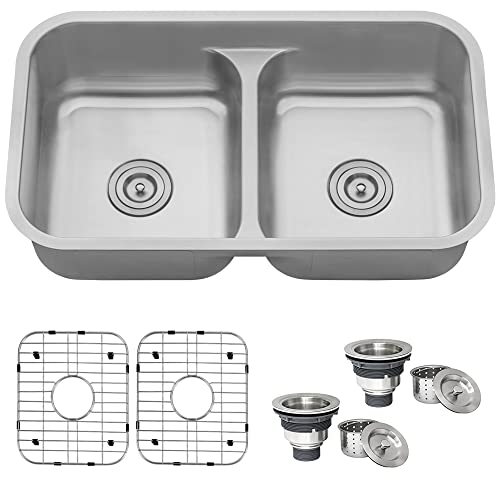
Ruvati RVM4350 32-Inch 50/50 Double Bowl Sink — Best Value in 16-Gauge Steel
Ruvati’s RVM4350 skips the workstation theater and delivers the fundamentals at a high level: true 16-gauge T-304 steel, equal basins, undermount installation, and a brushed finish chosen because it camouflages the scratches a working sink collects. If your kitchen already has its prep system, this is the basin-first buy.
Strengths
- Real 16-gauge steel at a mid-market position
- Brushed finish hides daily scratching better than mirror finishes
- Equal basins suit symmetric wash/rinse workflows
Trade-offs
- Full-height divider — oversized pans sit across the top, not in a basin
- No workstation ledge or included prep accessories
- Undermount install only
| Size | 32 in |
| Split | 50/50 equal |
| Material | 16-gauge T-304 stainless steel |
| Mount | Undermount |
| Finish | Brushed |
There is a quiet argument for the simple sink: every feature you skip is a feature that cannot date, break or lock you into an accessory system. The RVM4350 is that argument in steel — deep equal basins, thick gauge, honest finish. Kitchens that wash big loads daily and do their prep on counters will not miss the ledge; they will notice the gauge every time a cast iron pan lands without a dent or a clang.
The RVM4350 ages the way brushed 16-gauge should: the finish absorbs the micro-scratches of daily pans into its grain, so year three looks much like month three. Pair it with Ruvati’s matching bottom grids and the basin floor stays unmarked under cast iron. It is the pick for owners who measure a sink by how it looks after a thousand wash-ups, not after the first one.
Best for: High-volume home washing in a classic equal-split layout / Not suited for: Buyers wanting workstation prep features
Check on Amazon — check price on Amazon before you order; commercial configurations and included accessories vary by listing.

Blanco Precis 60/40 Double Bowl Sink (443080) — Best Granite Composite
Granite composite is the material buyers choose when they are tired of steel’s noise and water spots, and Blanco’s SILGRANIT line is its reference standard. The Precis pairs a 60/40 split — big basin for pans, smaller for prep — with a low divide, in a Soft White that suits light kitchens the way stainless never will. Composite is also noticeably quieter under running water and dropped cutlery.
Strengths
- SILGRANIT resists scratches, stains and heat better than most surfaces in the kitchen
- Low divide plus 60/40 split handles both sheet pans and split workflows
- Soft White color integrates with light stone counters seamlessly
Trade-offs
- Composite is heavy — cabinet support and install help are real considerations
- Light colors show turmeric and tomato sins until cleaned properly
- Premium pricing versus comparable steel
| Size | 33 x 18 in |
| Split | 60/40 with low divide |
| Material | SILGRANIT granite composite |
| Mount | Undermount |
| Color | Soft White |
The Precis buyer is usually renovating for the long term and choosing calm: a sink that does not clang, does not show every droplet, and does not fight the countertop for attention. Composite’s care rules are simple — clean with mild abrasives, avoid leaving strong dyes standing overnight — and its payoff is a basin that looks composed after a dinner party’s worth of washing. If your kitchen leans light and quiet, this is the double basin to build around.
Composite ownership has one learning curve: strong dyes. Turmeric, beet juice and red wine should not stand overnight in any light composite basin — rinse after colorful loads and the Soft White stays true. In exchange, the Precis shrugs off the dropped pan that would dent steel and the thermal shock that owners of lesser materials worry about. It is a calm sink for a calm kitchen.
Best for: Light, quiet kitchens and long-term renovations / Not suited for: Buyers who want the lowest cost per basin or a metal finish
Check on Amazon — check price on Amazon before you order; commercial configurations and included accessories vary by listing.

Elkay Dayton 33-Inch Equal Double Bowl Drop-In Sink — Best Budget Drop-In
Elkay’s Dayton is the sink that has quietly served American rentals, starter homes and quick remodels for decades: a 33 x 19 drop-in with equal double bowls that installs from above in an afternoon, no counter replacement, no undermount hardware. Its bowls are shallower than the premium picks — about 6-7/16 inches per the listing — which is the honest trade for the price and the install simplicity.
Strengths
- Drop-in install — replaces an old sink without touching the counter
- Elkay availability: faucets, parts and replacements everywhere
- Lowest-friction route to a working double basin
Trade-offs
- Shallower bowls splash more and fit less cookware
- Thinner steel at this tier drummed more under the faucet
- The rim sits on the counter — a crumb line to clean around
| Size | 33 x 19 in |
| Bowl depth | 6-7/16 in (listing) |
| Split | Equal double bowl |
| Mount | Drop-in (top mount) |
| Material | Stainless steel |
Judge the Dayton by its mission: a functional double basin, installed fast, at a price that suits a rental refresh or a first home. It will not pamper a serious cook — the depth alone settles that — but it also never pretends to. For landlords and flippers it is close to a default answer, and for a homeowner saving the real budget for a later full remodel, it keeps the kitchen honest in the meantime.
The Dayton’s shallowness has one hidden virtue: it is kind to shorter users and to anyone washing at a standard counter for long stretches, since there is less reaching down into the basin. In a rental, that accessibility plus the afternoon install is the whole story — and for that story, decades of production have made this the safe, known quantity.
Best for: Rentals, quick remodels and budget-first replacements / Not suited for: Serious cooks who need deep basins for big cookware
Check on Amazon — check price on Amazon before you order; commercial configurations and included accessories vary by listing.

American Standard Quince 33×22 Double Bowl Cast Iron Sink — Best Cast Iron
Cast iron under enamel is the original premium sink material, and the Quince shows why it survives: a mass that swallows sound completely, an enamel surface with real depth of color, and a top-mount 33×22 footprint with three holes that drops into standard cutouts. Brilliant White cast iron suits farmhouse and traditional kitchens the way no steel can.
Strengths
- Cast iron mass — the quietest, most solid feel in this roundup
- Enamel surface resists staining and cleans to a genuine shine
- Top mount with faucet holes simplifies the whole install package
Trade-offs
- Very heavy — two-person install and a cabinet that can carry it
- Enamel can chip if heavy iron cookware strikes it hard
- White shows everything until wiped — a daily-habit sink
| Size | 33 x 22 in |
| Material | Enameled cast iron |
| Mount | Top mount, 3 holes |
| Color | Brilliant White |
| Brand | American Standard |
The Quince is a sensory purchase: the thunk-free solidity when you set down a pot, the way the enamel holds hot water’s heat during a long soak, the period-correct look with a bridge faucet. Its care contract is equally traditional — felt pads under heavy pans, prompt wiping, no steel-wool heroics. Kitchens that accept the contract get a sink that can serve for decades and looks better with age than any thin steel box.
Cast iron holds heat, which changes soaking: a basin filled hot stays hot far longer than steel, loosening baked-on pans with less detergent and patience. The Quince’s enamel also pairs with traditional bridge and wall-mount-look faucets in a way modern sinks cannot imitate. Protect the enamel with a basin mat under the heaviest iron and it will out-serve most of the kitchen around it.
Best for: Traditional and farmhouse kitchens wanting the classic material / Not suited for: Anyone unwilling to lift — or maintain — a heavyweight sink
Check on Amazon — check price on Amazon before you order; commercial configurations and included accessories vary by listing.

Sinkology Lange 32-Inch Copper Farmhouse Double Bowl Sink — Best Statement Piece
The Lange is the pick for the kitchen that wants its sink noticed: 32 inches of hand-hammered copper on an apron front, double bowls behind it, finished in an antique patina that will keep evolving with use. It fits a 36-inch cabinet per the listing, and it changes the room the way a range hood or a island does — it is a design decision first and a basin second.
Strengths
- Hand-hammered copper is a genuine one-of-one visual — no two age alike
- Copper is naturally antimicrobial as a surface material
- Apron front suits farmhouse and rustic designs nothing else here serves
Trade-offs
- Living finish: patina shifts with water, acids and cleaning — embrace it or skip copper
- Premium price and farmhouse cabinet requirements
- Copper care rules out abrasive cleaners and long acid contact
| Size | 32 in |
| Cabinet | Fits 36 in cabinet (listing) |
| Material | Hand-hammered solid copper |
| Style | Apron front farmhouse |
| Finish | Antique patina |
Copper owners divide into the delighted and the regretful, and the difference is expectation. If you want a sink that looks identical in year five, buy steel. If you want a surface that records the kitchen’s life — bright where hands and water work, deepening where they do not — the Lange rewards you daily. Pair it with a faucet finish that can age alongside it, and brief anyone who cleans your kitchen on copper’s simple rules.
Copper’s patina is a record: the basins brighten where water and hands work daily and deepen at the edges, so the sink literally maps how your kitchen lives. Owners who love that should skip lacquered expectations and clean with mild soap and water only. Sinkology positions the Lange for a 36-inch cabinet, and the apron front needs that cabinet planned — treat it as cabinetry, not as a drop-in swap.
Best for: Farmhouse and rustic kitchens designed around a statement sink / Not suited for: Buyers wanting a set-and-forget, unchanging finish
Check on Amazon — check price on Amazon before you order; commercial configurations and included accessories vary by listing.
Comparison Table
| Pick | Badge | Key spec | Best for |
|---|---|---|---|
| Kraus KWU112-30 30-Inch Double Bowl Undermount Workstation | Best Overall | 30 in · 50/50 low divide · 16-gauge workstation | Most kitchens — especially smaller ones that cook seriously |
| Ruvati RVM4350 32-Inch 50/50 Double Bowl Sink | Best Value in 16-Gauge Steel | 32 in · 50/50 · 16-gauge brushed steel | High-volume home washing in a classic equal-split layout |
| Blanco Precis 60/40 Double Bowl Sink (443080) | Best Granite Composite | 33 in · 60/40 low divide · SILGRANIT | Light, quiet kitchens and long-term renovations |
| Elkay Dayton 33-Inch Equal Double Bowl Drop-In Sink | Best Budget Drop-In | 33 in · equal bowls · drop-in · 6-7/16 in deep | Rentals, quick remodels and budget-first replacements |
| American Standard Quince 33×22 Double Bowl Cast Iron Sink | Best Cast Iron | 33×22 · cast iron enamel · top mount | Traditional and farmhouse kitchens wanting the classic material |
| Sinkology Lange 32-Inch Copper Farmhouse Double Bowl Sink | Best Statement Piece | 32 in · copper apron front · double bowl | Farmhouse and rustic kitchens designed around a statement sink |
How Do You Live With a Double Basin Day to Day?
The owners who love double basins run a simple system: one side is wet work (washing, soaking), the other is clean work (rinsing, draining, produce). A roll-up rack or grid over the clean side becomes the dish drainer, so counters stay dry. A caddy keeps sponge and brush on the wash side only. Guests and kids learn the system in a day because it matches intuition: dirty goes left, clean comes out right (or your mirror of it).
The owners who regret double basins usually skipped the system, not the sink: both basins became storage, the divider became a shelf for clutter, and the kitchen felt smaller. The fixture is a workflow tool. Set the workflow — roles, rack, caddy — in the first week and the double basin quietly organizes the busiest corner of the kitchen.
What Faucet Pairs Best With a Double Basin?
Reach is the whole question: the faucet must serve both basins comfortably, which on 32- and 33-inch sinks means a pull-down sprayer with a generous hose, mounted centered (or over the larger basin on a 60/40). High-arc designs clear stockpots in the big basin; a sprayer with a positive dock stays put instead of drooping into the wash.
Finish pairing is the second question. Stainless sinks forgive almost any faucet finish; white composite and cast iron look best with deliberate contrasts or matches chosen as design, not default; copper wants a finish that can age in the same direction. Decide the faucet with the sink, on the same order if possible — the pair is one visual object in the finished kitchen.
50/50 or 60/40: How Should the Two Basins Split?
Equal 50/50 basins suit households that wash and rinse in matched loads, or run two tasks of similar size — soaking in one, washing produce in the other. Each basin is a compromise size: fine for plates, pots and most pans, tight for the largest sheet pans and roasting tins unless the divider is low enough to bridge them.
A 60/40 split gives one genuinely large basin — the one that swallows the sheet pan, the stockpot and the grill grate — plus a smaller basin that still handles prep, rinsing and a disposal if fitted. Most cooks who entertain land on 60/40 or on a low-divide design, because the big-basin jobs are the ones that actually frustrate. Low dividers (on the Kraus and Blanco above) blur the choice helpfully: separation when you want it, one big volume when you bridge across.
How Do the Double Basin Materials Really Compare?
Stainless steel (16-gauge is the quality mark) is light, hygienic, heat-proof and the easiest to source in every configuration; its costs are noise without good padding and a finish that shows water spots. Granite composite is quieter, matte and color-through, resisting scratches and stains; it is heavier and pricier. Fireclay and enameled cast iron bring mass, silence and traditional looks, with enamel’s chip risk as the standing caution.
Copper is the outlier: a living finish that changes with use, naturally antimicrobial, demanding gentle cleaning and an owner who enjoys patina. There is no universal winner — there is a match between material temperament and household temperament. The busiest family kitchens usually land on padded 16-gauge steel or composite; design-led kitchens accept the care contracts of iron, fireclay or copper.
What Cabinet Size and Mount Type Do Double Basins Need?
Most 30–33 inch double basins specify a 33- or 36-inch cabinet; the Lange above explicitly fits a 36-inch cabinet, and wide farmhouse models often need cabinet modification for the apron. Measure the cabinet’s interior width and the counter’s cutout before ordering — ‘fits most’ is not a measurement. Undermount models also need a counter material that can carry them (stone, solid surface, quartz) and a faucet deck plan, since there is no sink deck for holes.
Mount choice follows the counter. Drop-in/top-mount (Dayton, Quince) works on any counter including laminate and is the only sane choice for a quick replacement. Undermount needs the right counter but rewards you with sweep-in cleanup and a cleaner line. Farmhouse/apron-front is a cabinet project, not a swap — plan it as part of a remodel, not a weekend.
Which Accessories Actually Earn Their Place on a Double Basin?
Bottom grids are the highest-value accessory: they protect the basin floor from pan scratches, keep items elevated out of standing water, and quiet the landing of heavy cookware. A roll-up drying rack over one basin effectively adds a third workspace — draining glasses and produce without touching counter space. Workstation ledges (Kraus above) fold the cutting board into that system.
Lower value: elaborate multi-piece accessory bundles you will store more than use, and strainer upgrades beyond a solid basket strainer that matches your disposal or drain. Buy the grid and the rack first; live with the sink a month; then add only what your actual routine misses. Accessory ecosystems differ by brand, so if accessories matter to you, choose the sink brand whose ecosystem you like — another point for the workstation picks.
How to Measure for a Double Basin Sink Replacement
Ninety percent of sink-buying regret is measurement regret. This is the measuring sequence that prevents it — fifteen minutes with a tape before you order beats a restocking fee and a sink that almost fits.
- Measure the cabinet, not the old sink: interior width between the side walls, front-to-back depth, and the height clearance under the counter for basin depth plus plumbing.
- Record the existing counter cutout (length and width) if you are keeping the counter — a drop-in replacement must cover it; an undermount must match its reveal style.
- Note your faucet plan: deck-mounted behind the sink (measure the deck strip width) or sink-deck holes on a top-mount (count the holes your faucet needs).
- Check the drain position: centered or offset in each basin, and whether a garbage disposal hangs on one side — confirm vertical clearance under that basin.
- Confirm the split against your biggest cookware: measure your largest sheet pan and stockpot, and compare against the big basin’s interior (not the sink’s outer size) — or choose a low divider that lets them bridge.
- Photograph the under-sink plumbing before ordering; if supply lines, the disposal or a water filter crowd the space, a deeper or wider double basin may not physically fit even when the cabinet math says it should.
With those six numbers and photos in hand, every listing in this roundup becomes a quick yes or no — and the sink that arrives is the sink that installs. Keep the measurements with the house paperwork; the next owner, plumber or you-in-ten-years will be grateful.
The Double Basin Decision, Distilled
Compress this category to its working essentials and three questions decide everything. What is your biggest pan, and must it lie inside a basin or may it bridge a low divider? That answer fixes the split and the divider — 60/40 or low-divide for the pan-driven, honest 50/50 for the rest. What is your cabinet, truly measured, and what is your counter made of? That answer fixes the size and the mount, and eliminates more of the catalog than any preference could. And whose care contract will your household actually keep — steel’s near-nothing, composite’s rinse-after-color, iron’s felt pads, copper’s gentle hand? That answer fixes the material, and it should be given by the person who cleans the kitchen, not the person who photographs it.
Answer those three and the shortlist in this roundup mostly selects itself: the Kraus workstation for the most kitchens, the Blanco for the quiet modern renovation, the Quince for traditional weight, the Ruvati for plain steel honesty, the Dayton for the pragmatic replacement, the Lange for the designed-around-it kitchen. What remains is the discipline of the order itself — measure, verify the listing, check what is in the box — because a double basin is a twenty-year decision made in an afternoon, and it deserves the afternoon.
How Do You Choose Faucet Holes and Configurations on Top-Mount Basins?
Top-mount basins like the Quince (three holes) and the Dayton ask a planning question undermounts skip: what mounts on the deck? A single-hole faucet with a separate sprayer, a widespread set, a soap dispenser, a filter tap, an air gap for the dishwasher in some jurisdictions — each wants a hole, and the sink’s hole count is fixed at purchase. Count your fixtures before choosing the sink, not at install.
If your plans may grow — a filter tap next year, a dispenser later — a configuration with a spare hole and a cover plate is quiet future-proofing. And measure the deck’s depth on the counter side too: a top-mount’s holes sit in the sink’s own deck, but the faucet’s body and handles still need swing and knuckle room against the backsplash.
What Should You Know About Double Basins and Dishwashers?
The two appliances divide labor rather than compete: the machine takes volume, the basins take prep, soaking and everything too big, too delicate or too wooden for the rack. Kitchens that grasp the division stop asking a double basin to be a dish pit and start using it as the flexible water station it is — which is when the second basin stops feeling redundant and starts feeling essential.
One plumbing note joins them: the dishwasher’s drain and, in some jurisdictions, its air gap live at the sink. When you plan a double basin install, plan the dishwasher’s connections in the same conversation — same cabinet, same afternoon, same plumber. The Quince’s hole count and the undermount deck plan both intersect this decision, so make it once, on paper, before anything is ordered.
How Do You Plan Plumbing Around a Double Basin?
Two basins mean two drain assemblies converging under the cabinet, plus a disposal on one side in most modern kitchens. The practical planning points: keep the trap and waste run as direct as the cabinet allows, confirm the disposal’s height against the chosen basin’s depth (deep basins and tall disposals compete for the same vertical inches), and leave yourself access — the day a strainer leaks, the person under the sink will bless the installer who left room to work.
If you are moving from a single basin, budget the plumbing as a small project rather than a swap: drain positions shift, the disposal may move sides, and supply stops sometimes need repositioning for deeper bowls. A plumber’s hour of planning before the sink arrives is cheaper than a Saturday of improvisation after it does.
What Makes a Double Basin Feel Expensive or Cheap in Daily Use?
Sound and solidity, mostly. A basin that rings when the faucet runs and flexes when a pot lands feels cheap regardless of its price tag; a basin that answers with a muted thud feels expensive even in a budget kitchen. On steel, that feel is gauge plus padding plus a tight install. On cast iron and fireclay it is mass. On composite it is the material’s inherent density. This is why the spec boxes in this roundup chase gauge, padding and material so insistently — they are the feel, reduced to print.
The second factor is water behavior: basins whose floors slope honestly to the drain dry clean, while flat-floored bargains hold puddles that spot and smell. You cannot see slope in a listing photo, but you can favor the brands and lines — Kraus, Blanco, Elkay, Ruvati above — whose reputations were built on getting these invisible things right.
How Should You Time a Sink Purchase Within a Kitchen Renovation?
The sink is chosen earlier than it is installed. Counter fabricators need the exact model — or its template — before cutting stone, and farmhouse models like the Lange shape the cabinet order itself. The safe sequence: choose the sink when the cabinets are designed, order it when the counters are templated, and have it on site before fabrication. Renovations stall famously on the sink that was ‘going to be picked later.’
If you are replacing only the sink, the sequence inverts: measure the existing cutout and cabinet first (per the how-to above), choose within those constraints, and prefer drop-in models unless the counter is being replaced anyway. Either way, the sink decision is a keystone — quietly load-bearing for the faucet, the disposal, the counter and the cabinet — and it rewards being made deliberately, once.
How Do You Choose a Basin Depth That Suits Your Household?
Depth is a body decision as much as a cookware decision. Deeper basins — nine to ten inches — hide more, splash less and swallow stockpots, but they ask shorter users and anyone with back trouble to reach further down, thousands of times a year. Shallower basins around seven inches are kinder ergonomically and fine for dishwasher-centric households, but they fill fast under hand-washing loads and splash at enthusiastic faucets.
The honest method is to stand at your current sink, note where your hands work, and imagine two inches in either direction. Households split the difference at around nine inches for good reason. And remember that undermount depth adds to the counter’s height — the installed basin floor is deeper than the same sink dropped in.
What Is the Difference Between Fireclay and Cast Iron Basins?
Both are the traditional heavyweight whites, but they are built differently. Fireclay is ceramic — clay fired at high temperature with a glazed surface — giving crisp farmhouse forms and a hard, glossy finish that can chip or craze under sharp impacts. Enameled cast iron is a metal casting coated in porcelain enamel: heavier, more impact-tolerant in the substrate, with an enamel layer that can chip to reveal the iron beneath if struck hard.
In daily life both clean beautifully, run quiet and hold heat. Fireclay owns the apron-front farmhouse look; cast iron owns the drop-in traditional look, as in the Quince above. Choose by the silhouette your kitchen wants and the cabinet you have — aprons need farmhouse cabinets, while the Quince’s top-mount form fits standard cabinetry.
Common Buying Mistakes
Ordering by outer dimensions alone
A 33-inch sink’s basins are several inches smaller inside. Big cookware fits the interior dimensions or it does not fit at all — check basin interiors against your largest pan, or choose a low-divide design.
Ignoring cabinet minimums
Manufacturers state minimum cabinet sizes for a reason: the sink must drop in, clamp and leave room for plumbing. A 36-inch-cabinet sink in a 33-inch cabinet is a remodel, not an install.
Choosing a material whose care you will not do
Copper’s patina, enamel’s chip caution, white composite’s dye discipline — every material has a contract. The best sink is the one whose contract your household will actually keep.
Forgetting the faucet until install day
Undermount sinks have no faucet deck. If your counter lacks room behind the cutout, you need a plan — new counter holes by a fabricator, or a top-mount sink with holes like the Quince. Decide before the plumber is standing there.
Final Recommendation
For most kitchens the Kraus KWU112-30 is the answer: low divider, workstation ledge, 16-gauge steel, in a 30-inch body that fits where others cannot. Traditionalists choose between the Ruvati’s plain 16-gauge honesty and the Quince’s cast iron gravitas; quiet modern renovations take the Blanco Precis; rentals and quick fixes take the Elkay Dayton without apology; and the kitchen being designed around a moment takes the Sinkology Lange.
Measure the cabinet and your largest pan before ordering anything, and check price on Amazon the day you buy — sink listings vary in included grids and accessories between sellers of the same model.
- Best Overall: Kraus KWU112-30 30-Inch Double Bowl Undermount Workstation — check price on Amazon
- Best Value in 16-Gauge Steel: Ruvati RVM4350 32-Inch 50/50 Double Bowl Sink — check price on Amazon
- Best Granite Composite: Blanco Precis 60/40 Double Bowl Sink (443080) — check price on Amazon
- Best Budget Drop-In: Elkay Dayton 33-Inch Equal Double Bowl Drop-In Sink — check price on Amazon
- Best Cast Iron: American Standard Quince 33×22 Double Bowl Cast Iron Sink — check price on Amazon
- Best Statement Piece: Sinkology Lange 32-Inch Copper Farmhouse Double Bowl Sink — check price on Amazon
Keep exploring the cluster: Best Double Bowl Kitchen Sinks · Best Double Bowl Stainless Steel Kitchen Sinks · Best Kitchen Sinks · Best Undermount Kitchen Sinks · Best Farmhouse Kitchen Sinks
Frequently Asked Questions
What is the difference between a double basin and a double bowl sink?
Nothing functional — basin, bowl and compartment are interchangeable terms for the same two-basin layout. ‘Basin’ appears more in traditional and cast iron/fireclay listings, ‘bowl’ in modern stainless ones. Shop both terms or you will miss half the catalog.
Are double basin sinks going out of style?
Single large basins trend in design media, but double basins remain the practical choice for households that hand-wash, soak and prep simultaneously, or run a disposal on one side. Low-divider models have largely answered the old objection about big pans.
Can a garbage disposal fit a double basin sink?
Yes — typically on one basin, most often the smaller one in a 60/40 split or either side of a 50/50. Confirm the drain size and the under-cabinet vertical clearance for the disposal body before ordering.
How deep should double basins be?
Most satisfied owners land around 9–10 inches: deep enough to hide a day’s dishes and fit stockpots, not so deep you stoop uncomfortably. The shallow budget tier around 6–7 inches (like the Dayton) suits light use and easy reach.
Is a low divider as useful as it sounds?
In practice, yes. It keeps wash/rinse separation for daily loads while letting sheet pans and roasting tins bridge across both basins — removing the most common double-basin complaint without giving up the two-basin workflow.
Which double basin material is easiest to maintain?
Padded 16-gauge stainless with a brushed finish is the most forgiving overall: no special cleaners, no patina, no chip risk, and scratches blend into the brushing. Granite composite is close behind, with the bonus of hiding water spots.
Can a double basin sink be installed in a 30-inch cabinet?
Generally you need the manufacturer’s stated minimum — most 30-inch double basins want a 33-inch cabinet, and larger or farmhouse models want 36. Measure the cabinet interior and compare it to the exact model’s requirement before ordering.
Do double basin sinks need two drains?
Yes — each basin has its own drain assembly, joining below into the trap and waste line. A disposal typically occupies one side. It is standard plumbing, but it is why under-cabinet clearance and drain positions belong on your pre-order checklist.


