Disclosure: airfryerkitchensupply.com is reader-supported. When you buy through links on our site, we may earn an affiliate commission at no extra cost to you.
Where to buy
Every linked cushion pad below was verified on this site, and each one is a removable seat cushion or chair pad — the add-on pad itself, which is exactly what this search asks for. That distinction matters: a cushion pad ties or grips onto the dining chair you already own, while a chair pad set sold as part of a chair, or a fully upholstered chair, is a different purchase entirely. One slot in this roundup is held unlinked because no further listing could be verified with certainty at the time of writing, and it is marked clearly rather than filled with a guessed link.
- AAAAAcessories D-Shaped Chair Cushions, Set of 4 (Best Overall): check price on Amazon
- IASEAHK Chair Cushions for Dining Chairs, Set of 4 (Best Thick Cushion): check price on Amazon
- TushGuard Chair Cushions, 4 Pack (Best Slim Profile): check price on Amazon
- Shinnwa Dining Chair Cushions, 4 Pack (Best U-Shaped Fit): check price on Amazon
- BUYUE Dining Chair Cushion, 1 Pack (Best for One or Two Chairs): check price on Amazon
Finding the best cushion for dining room chairs starts with a simple truth: most dining chairs are built for looks first and long dinners second. A hard wooden or metal seat is fine for a quick breakfast, but by the second hour of a family meal, a holiday gathering or a long board-game night, the seat is the thing everyone notices. A good seat cushion pad fixes that without replacing the chairs, changing the room’s style, or committing to upholstered furniture that is harder to clean.
The pads in this roundup are all removable dining chair pads — foam cushions with ties, straps or non-slip bottoms that sit on top of your existing seat. They differ in the ways that actually matter day to day: thickness, footprint shape (square, U-shaped or D-shaped), how they stay in place, and whether the cover comes off for washing. A thicker pad is not automatically better; on a chair that already sits high relative to the table, four inches of foam can lift you into an awkward position where your thighs press against the table apron.
This guide walks through six options — five verified listings and one honestly held slot — then explains how to measure your chairs, how thickness and shape interact with your table height, how to fit and care for the pads, and the mistakes that lead to returns. Everything is framed around dining use: meals, homework at the table, working from the dining room, and gatherings that run long.
Key Takeaways
- Measure your seat before ordering: footprint and shape (square, U or D) decide fit more than brand does.
- Two inches of foam suits most dining chairs; four inches only works when the table apron leaves thigh room.
- Ties, straps or a non-slip bottom are essential — an unsecured pad slides every time someone sits down.
- Removable, washable covers matter at a dining table, where spills are a matter of when, not if.
- Five of the six picks below are listing-verified listings; one slot is held unlinked and marked.
In this guide
Quick Picks
AAAAAcessories D-Shaped Chair Cushions, Set of 4 — Best Overall. This is the balanced default for most dining rooms. — check price on Amazon
IASEAHK Chair Cushions for Dining Chairs, Set of 4 — Best Thick Cushion. If two-inch pads still feel like sitting on the chair itself, this is the step up. — check price on Amazon
TushGuard Chair Cushions, 4 Pack — Best Slim Profile. Not every dining chair needs more height — some need less pressure. — check price on Amazon
Shinnwa Dining Chair Cushions, 4 Pack — Best U-Shaped Fit. Seat shape is the most common reason dining pads get returned, and this pick exists for one specific shape: the U. — check price on Amazon
BUYUE Dining Chair Cushion, 1 Pack — Best for One or Two Chairs. Sets of four are the market’s default, but plenty of households need one pad — for the chair at the head of the table, a desk chair pulled into dining duty, or a single uncomfortable seat. — check price on Amazon
Sweet Home Collection Chair Cushion Memory Foam Pads, 6 Pack — Best for a Six-Chair Table. This verified listing is a 6 pack of tufted memory foam chair cushion pads, U-shaped at 17″ x 16″, with a non-skid rubber back, in Wine Burgundy. — check price on Amazon
How These Picks Were Chosen
Each linked pick was cross-checked against Amazon listing data: the listing title had to confirm it is a dining or kitchen chair cushion pad, state its size or set count, and describe how it attaches or stays in place. Pads designed for car seats, office chairs or stadium benches were excluded even when they appeared in search results, because their shapes and attachment systems do not suit dining chairs.
Within that verified set, the picks were spread across the real decision points: a balanced two-inch pad, a genuinely thick four-inch option, a slim memory-foam pad for chairs that sit high, a U-shaped non-slip design, and a single-pad option for households that need one or two rather than a full set. The sixth slot — a set of six for larger tables — is filled by a verified 6 pack listing: tufted memory foam pads with a non-skid rubber back, sized 17″ x 16″ in the title.
No prices or ratings are printed anywhere in this guide. Prices move, and the honest way to compare cost is to check the current price on Amazon for the set size you need.
The 6 Best Cushions for Dining Room Chairs

AAAAAcessories D-Shaped Chair Cushions, Set of 4 — Best Overall
This is the balanced default for most dining rooms. The listing confirms a two-inch-thick D-shaped pad in a 17 by 16 inch footprint, sold as a set of four, with ties to hold it in place and a removable cover that can go in the wash — the combination that covers the widest range of ordinary dining chairs without drama.
Strengths
- Two-inch thickness adds comfort without lifting you awkwardly high at the table
- D-shape follows the curved back edge of many dining chair seats
- Removable, machine-washable cover suits a spill-prone dining setting
Trade-offs
- D-shape will not sit flush on a perfectly square seat
- Ties need re-knotting if household members untie them to move pads
- Only sold as a set of four, so single-chair households overbuy
| Format | Dining chair pads, set of 4 |
| Thickness | 2 inches |
| Size | 17″ x 16″ |
| Attachment | Ties |
| Cover | Removable, machine-washable |
Two inches is the thickness that changes how a hard seat feels across a long meal without changing your relationship to the table. Your eye line, elbow height and thigh clearance stay close to what the chair designer intended, which matters more than maximum softness for a seat you also use for laptop work and homework. The D-shape deserves attention: many wooden dining chairs have a seat that is straight at the front and curved or narrower at the back, and a D-shaped pad follows that line instead of hanging off the corners. Check your own seat shape before ordering, because on a truly square seat the curved back edge leaves a visible gap. The washable cover is the practical headline for dining use — gravy, coffee and children’s dinners make cover removal a routine event, not an emergency feature.
Best for: Dining sets of four with standard wooden chairs and normal table height / Not suited for: Square-seat chairs where a D-shape would overhang or gap
Check on Amazon — check the current price on Amazon before you decide.

IASEAHK Chair Cushions for Dining Chairs, Set of 4 — Best Thick Cushion
If two-inch pads still feel like sitting on the chair itself, this is the step up. The listing states a 15.5 by 15.5 inch footprint with a full four inches of tufted foam, in a set of four, with ties and a non-slip design — a deliberately thick pad for people who host long dinners or simply dislike hard seats.
Strengths
- Four inches of foam is the deepest cushioning in this roundup
- Tufted surface helps the pad keep its shape under daily use
- Ties plus a non-slip design give two ways of staying put
Trade-offs
- Four inches raises seat height noticeably — check table apron clearance
- Smaller 15.5-inch footprint may under-cover wide seats
- Thick foam takes longer to air out and dry after washing
| Format | Tufted foam seat cushions, set of 4 |
| Size | 15.5″ x 15.5″ x 4″ |
| Attachment | Ties, non-slip design |
| Use | Indoor, kitchen and dining room (per listing title) |
The trade is geometry. Four inches of foam lifts the sitter roughly four inches, minus compression, and on many dining sets that pushes thighs toward the underside of the table or its apron. Measure from your current seat top to the apron underside before choosing this pad; you want comfortable clearance for your legs with the pad compressed. The tufting is functional as well as decorative: stitched tufts discourage the foam from migrating and flattening in the middle, which is where thick pads usually fail first. The smaller footprint cuts the other way — on broad farmhouse-style seats a 15.5-inch pad can look and feel undersized, so this pick suits standard-width chairs best. For the right chair-and-table pairing, though, nothing else in the roundup comes close on sheer cushioning depth.
Best for: Diners who find standard pads too thin and have generous table clearance / Not suited for: High dining chairs where extra height would cause thigh squeeze
Check on Amazon — check the current price on Amazon before you decide.

TushGuard Chair Cushions, 4 Pack — Best Slim Profile
Not every dining chair needs more height — some need less pressure. This four pack of memory foam pads is described in its listing as a thin seat cushion with fixed straps and an anti-slip design, which makes it the pick for chairs that already sit at the right height but feel unforgiving after twenty minutes.
Strengths
- Thin profile adds comfort without changing seat height materially
- Fixed straps hold position better than loose ties for many users
- Memory foam surface softens pressure on hard wooden seats
Trade-offs
- Thin pad will not satisfy anyone wanting deep, plush cushioning
- Straps must suit your chair leg and rung layout to fit well
- Grey may not match every dining scheme
| Format | Memory foam chair pads, 4 pack |
| Profile | Thin seat cushion (per listing title) |
| Attachment | Fixed straps, anti-slip |
| Colour listed | Grey |
Fixed straps are the detail to weigh. Ties are universal but loosen; straps that fasten around the chair hold a pad in a set position and resist the slow sideways creep that makes people readjust a pad every time they sit. Whether they fit depends on your chair’s legs and rungs, so look at the underside of your seat before ordering. Memory foam in a thin pad behaves differently from a thick foam block: it spreads pressure across the seat bones rather than building a soft mound, which suits long, still sitting — reading, laptop work, conversation — better than perching. If your complaint is specifically that the chair feels hard rather than that it feels low or flat, this slim design answers it directly.
Best for: Chairs that already sit high, and anyone wary of thick pads / Not suited for: Shoppers who want the plushest possible seat
Check on Amazon — check the current price on Amazon before you decide.

Shinnwa Dining Chair Cushions, 4 Pack — Best U-Shaped Fit
Seat shape is the most common reason dining pads get returned, and this pick exists for one specific shape: the U. The listing confirms a four pack of U-shaped kitchen and dining seat cushions at 15 by 16 inches with a non-slip design, aimed at the many chairs whose seats are wide at the front and curve in toward the back posts.
Strengths
- U-shape suits the many dining seats that narrow toward the back
- Non-slip bottom reduces dependence on ties
- 15 x 16 inch size fits a wide range of standard chairs
Trade-offs
- U-shape looks wrong on square or D-shaped seats
- Non-slip bottoms grip less well on dusty or polished seats
- Thickness is not stated in the listing title
| Format | Indoor chair pads, set of 4 |
| Size | 15 x 16 inches |
| Shape | U-shaped |
| Bottom | Non-slip |
| Colour listed | Grey |
A U-shaped pad on the right chair disappears visually — it follows the seat edge all the way around, so the pad reads as part of the chair rather than an accessory sitting on it. The non-slip bottom handles the staying-put job without ties, which keeps the look cleaner and avoids knots catching on clothing, though it works best when both the seat and the pad’s underside are clean; a dusty polished seat defeats any grip surface. One honest limitation: the listing title does not state foam thickness, so if exact depth is your deciding factor, treat that as unknown rather than assumed, and weigh this pick on its shape and fit instead. For U-seat owners, shape is usually the deciding factor anyway.
Best for: Standard dining chairs with U-shaped seats and smooth floors / Not suited for: Anyone who needs a stated, guaranteed foam thickness
Check on Amazon — check the current price on Amazon before you decide.

BUYUE Dining Chair Cushion, 1 Pack — Best for One or Two Chairs
Sets of four are the market’s default, but plenty of households need one pad — for the chair at the head of the table, a desk chair pulled into dining duty, or a single uncomfortable seat. This listing is a one pack: a U-shaped kitchen chair pad, 2.5 inches thick, with a non-slip bottom and a removable washable cover.
Strengths
- Sold singly, so you can pad just the chairs that need it
- 2.5-inch thickness sits between the slim and thick options
- Removable washable cover plus non-slip bottom cover daily practicality
Trade-offs
- Cost per chair can exceed set pricing when you need many
- U shape will not suit square seats
- A single pack means colour matching a later second order is on you
| Format | Seat cushion, 1 pack |
| Thickness | 2.5 inches |
| Shape | U shape |
| Bottom | Non-slip |
| Cover | Removable, washable |
The 2.5-inch depth is a genuinely useful middle ground — noticeably more cushion than the standard two-inch pad, without the four-inch pad’s clearance demands. Buying singly is also the smart way to test an unfamiliar format: order one, live with it through a week of meals, and only then commit to the rest of the set. The honest downside is arithmetic — single packs rarely match set pricing per chair, so a full table is usually cheaper bought as a set once you know the shape and thickness suit you. As a trial purchase or a targeted fix for one chair, though, this is the most flexible entry in the roundup.
Best for: Households padding one or two chairs, or testing before buying a set / Not suited for: Anyone furnishing a full six-chair set in one order
Check on Amazon — check the current price on Amazon before you decide.
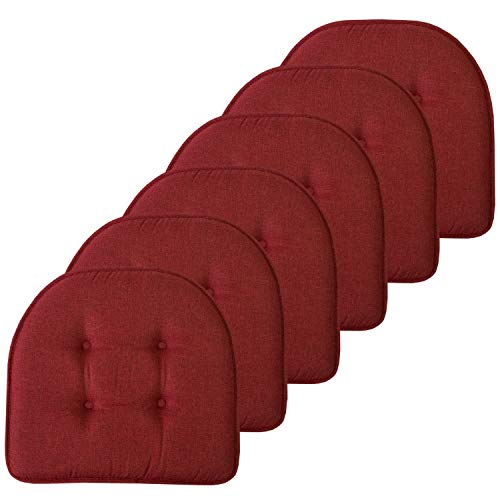
Sweet Home Collection Chair Cushion Memory Foam Pads, 6 Pack — Best for a Six-Chair Table
A set of six is the obvious purchase for a six-chair dining table, and this verified listing states the essentials in its title: chair cushion memory foam pads, tufted, U-shaped at 17″ x 16″, a 6 pack, with a non-skid rubber back instead of ties or straps, in Wine Burgundy. Foam thickness is not stated in the title, so check the live listing if thickness is your deciding factor.
Check the current price on Amazon
Strengths
- A matched set of six keeps a larger table visually consistent
- Buying one set avoids shade differences between separate orders
- The criteria below let you judge any candidate listing quickly
Trade-offs
- Foam thickness is not stated in the verified title — check the live listing
- The non-skid back replaces ties or straps, so it suits chairs you do not want to tie pads to
- You must confirm shape, size and attachment yourself before ordering
| Format | Chair cushion pads, 6 pack, U-shaped 17″ x 16″ |
| Fill | Memory foam, tufted (thickness not stated in title) |
| Attachment | Non-skid rubber back (as listed) |
Judge this set the same way the verified picks above were judged. Its U shape and 17″ x 16″ footprint must match your seats — a U-shaped pad on a square seat overhangs exactly where sitters slide in. Stay near two inches of thickness unless your table apron leaves unusual clearance, and remember a six-pad set at a family table will meet spills regularly, so check the live listing for cover care before ordering. The other five verified picks above cover sets of four and singles.
Best for: Larger dining tables seating six with U-shaped seats / Not suited for: Square or D-shaped seats, or buyers who need a stated foam thickness before ordering
Comparison Table
| Pick | Badge | Key spec | Best for |
|---|---|---|---|
| AAAAAcessories D-Shaped Chair Cushions, Set of 4 | Best Overall | Dining chair pads, set of 4 | Dining sets of four with standard wooden chairs and normal table height |
| IASEAHK Chair Cushions for Dining Chairs, Set of 4 | Best Thick Cushion | Tufted foam seat cushions, set of 4 | Diners who find standard pads too thin and have generous table clearance |
| TushGuard Chair Cushions, 4 Pack | Best Slim Profile | Memory foam chair pads, 4 pack | Chairs that already sit high, and anyone wary of thick pads |
| Shinnwa Dining Chair Cushions, 4 Pack | Best U-Shaped Fit | Indoor chair pads, set of 4 | Standard dining chairs with U-shaped seats and smooth floors |
| BUYUE Dining Chair Cushion, 1 Pack | Best for One or Two Chairs | Seat cushion, 1 pack | Households padding one or two chairs, or testing before buying a set |
| Sweet Home Collection Chair Cushion Memory Foam Pads, 6 Pack | Best for a Six-Chair Table | Memory foam pads, 6 pack, U-shaped 17″ x 16″, non-skid back | Larger dining tables seating six with U-shaped seats |
How to Choose the Best Cushion for Dining Room Chairs
Start with the seat itself. Measure its width at the front, its depth from front edge to backrest, and note its shape honestly — many people order square pads for seats that are actually U or D shaped, then blame the pad for overhang that was predictable from a tape measure. Write the measurements down and compare them with the dimensions stated in the listing title or description; a pad up to half an inch smaller than the seat in each direction usually looks intentional, while a pad larger than the seat curls at the edges and never sits flat.
Next, thickness. Two inches is the dining default because it transforms comfort while barely changing seated height. Two and a half inches adds a little more give for lighter foam. Four inches is a specialist choice for people who prioritise softness and have measured their table clearance. Slim memory-foam pads solve a different problem — pressure, not height — and suit chairs that already sit correctly. Think about which problem you actually have before choosing a number.
Then attachment. Ties are traditional, adjustable and repairable, but they loosen and can look fussy. Fixed straps hold position firmly where the chair’s structure allows them. Non-slip bottoms are the cleanest look and the fastest to lift off for cleaning, but they depend on a clean, reasonably grippy seat surface. Households with children, who climb and swing on chairs, should weight attachment more heavily than households of adults.
Finally, the cover. Dining pads live where food lands. A removable, washable cover turns a spill into laundry; a fixed cover turns it into spot-cleaning and hoping. If you eat at the table daily, treat a removable cover as close to mandatory, and check whether the listing says the cover is machine-washable rather than merely removable.
Chair Pad vs Chair Pad Set vs Upholstered Chair: Keeping the Intent Straight
This search’s intent is the removable pad, and it is worth being precise because listings blur the categories. A cushion pad is a foam pad that sits on your existing chair and attaches with ties, straps or grip. A chair pad set is simply several of those pads sold together — the set refers to quantity, not to a different product. A cushioned chair, by contrast, has its padding built into the seat by the manufacturer; you cannot remove it, wash the cover separately, or move it to another chair.
Each has its place, but they solve different problems. Pads are the fix when you like your chairs and their look but not their comfort — the cheapest, most reversible intervention. Built-in upholstery suits a full refurnish. Confusing the two leads to the classic mistake of ordering pads for chairs that are already upholstered, where the pad slides on the fabric surface and adds height the table was never designed around. If your chairs are bare wood, metal or woven seats, pads are the right tool, and this guide’s picks apply directly.
Thickness, Foam Feel and Long Meals
What makes a two-hour dinner comfortable is not initial softness — almost any foam feels fine for five minutes — but what the foam does at minute ninety. Very soft, thin foam bottoms out: it compresses fully and you end up sitting on the chair through a thin layer of fabric. Firmer or thicker foam keeps a working layer under you. Memory foam spreads load and reduces peak pressure, which is why slim memory-foam pads can feel better than their thickness suggests, but it can also feel warm and slow to respond when you shift position.
A practical home test: sit on the pad through one full meal, then stand and look at it. A pad that has flattened to a pancake in the middle and stays flat is too soft or too thin for you. A pad that recovers its shape and felt neutral — you stopped thinking about the seat — is doing its job. Neutral is the goal for dining; the best cushion is the one nobody at the table mentions.
Dining Chair Pads Room by Room: Kitchen, Dining Room and Beyond
The kitchen is where chair pads work hardest and are judged fastest. Kitchen chairs host breakfast, homework, coffee with neighbours and the cook’s own collapse at the end of cooking, often on tile or hard floors that make a hard seat feel harder. In the kitchen, prioritise the washable cover and the attachment: pads get slid on, swung on and spilled on daily, and a pad that needs re-tying every morning will simply be removed by Friday. The slim TushGuard and the two-inch AAAAAcessories formats suit kitchen duty best, because kitchen chairs also get carried, stacked and borrowed for other rooms, and a four-inch pad makes a chair top-heavy to move.
The formal dining room asks a different question: appearance over hours. Pads there are seen by guests at eye level across a table, so colour coordination and shape fidelity matter more than in the kitchen. A pad that follows the seat’s shape exactly — U on U, D on D — reads as upholstery; a pad that overhangs reads as an afterthought. If your dining chairs are design pieces, consider that the most honest option may be the slimmest pad in a matching tone, or a single test pad before committing the set. The BUYUE single pack exists for exactly that experiment: live with one pad through several dinners and judge it as your guests will, from across the table.
Beyond the dining spaces, pads migrate: to the desk chair pulled up for a laptop day, to the hallway chair, to the piano stool that is not quite the right height. That migration is an argument for buying a coherent set in a neutral colour rather than a novelty print — the pad you buy for the dining room in November is the pad that will be borrowed for the home office in February. It is also an argument for checking strap and tie compatibility across your chairs, because a pad that only fits one chair’s structure cannot migrate. Versatility is a quiet specification, but over years of household use it is the one that decides whether a set earns its drawer space.
What Dining Chair Pads Cost You in Care: A Realistic Routine
Pads are low-maintenance, not no-maintenance, and the routine is worth stating plainly so expectations are set. Weekly, in a household that eats at the table daily, pads benefit from being lifted and shaken — crumbs migrate under pads and, left there, grind into both the pad’s underside and the chair’s finish. That thirty-second habit protects the chair you bought the pad to sit on, which is the part of pad ownership nobody mentions: a pad traps debris against the seat, and the seat’s varnish pays for neglect.
Monthly, check the attachments. Ties fray at the knot point; straps lose elasticity; non-slip surfaces accumulate a film of dust and polish that quietly defeats their grip and can be restored by wiping both the pad’s underside and the seat. Foam itself should be checked by hand: press the centre of each pad and watch the recovery. A pad that recovers slowly but fully has life left; a pad that stays dented has finished its work in the high-use seat and can be rotated to the least-used chair, where its remaining life is still useful.
Covers go through the wash as their listings direct — the verified picks above with removable, machine-washable covers make this the easy part — and should be fully dry before re-fitting, because a damp cover refitted over foam in a warm dining room is a musty smell in the making. Do all of this and a set of pads lasts for years of daily meals; skip it and the same set looks tired within a season. The difference is not the product. It is the fifteen minutes a month that pad ownership actually costs.
A Short Buyer’s Checklist You Can Run in the Store of Your Phone
Run this sequence in order and a dining pad purchase takes five honest minutes. First, the photograph test: find the listing’s stated dimensions and hold them against the measurements you took of your own seat — not the measurements you remember, the ones on the note in your phone. If the listing does not state dimensions, it has failed the first check and no photograph of a happy family at a table can rescue it. Second, the shape check: say your seat’s shape out loud — square, U or D — and buy only its match. Third, the apron check: measure from your seat’s top to the underside of your table or its apron, subtract the pad’s compressed thickness, and ask whether your thighs still clear it in your normal sitting posture. If you have not measured, default to two inches and you will almost always be right.
Fourth, the attachment check, which is a question about your household rather than the product: will these pads be moved, stacked, borrowed and swung on? If yes, straps and ties outrank the clean look of a grip bottom. If the pads will live undisturbed on adult dining chairs, any of the three systems serves. Fifth, the cover check: removable and machine-washable is the dining standard, and a listing that is vague about washing is telling you something. Sixth, the count check: order for the chairs that exist, including the armchairs measured separately, plus at most one spare — pads are not improved by inventory.
Seventh, and last, the trial discipline: when the pads arrive, fit one chair completely — ties snug, position centred — and eat three real meals on it before fitting the rest. Three meals expose sliding, height and shape problems that three minutes cannot, and they do it while returning the unopened remainder is still simple. Most pad regret is not bad product; it is a full set fitted in haste on the evidence of a single sit. The checklist’s whole purpose is to slow the first hour down so the next five years do not have to pay for it. That is true of every pick in this roundup, from the two-inch default to the four-inch specialist: measured, matched, trialled — then committed.
Which Dining Chair Pad Suits Which Buyer?
If you are furnishing a family dining set for the first time and want one decision that covers most of what can happen at a table, you are the AAAAAcessories buyer: four pads, two inches, washable covers, a shape that matches most wooden chairs. Your risk is not in the product but in the measuring, so spend your effort there — seat shape, footprint, apron clearance — and then order with confidence. If the pads later migrate to kitchen chairs or a desk, so much the better; that versatility is built into the choice.
If you are the host whose dinners run three hours and whose guests have started making jokes about your chairs, you are the IASEAHK buyer — provided your table’s apron clearance passes the test in this guide. Four inches is a deliberate, almost luxurious choice, and for the right room it ends the jokes permanently. Measure twice, because the same depth that delights under a high farmhouse table will squeeze thighs under a low apron, and no amount of foam quality compensates for geometry.
If your chairs are already good chairs that simply feel hard — design chairs, inherited chairs, chairs you would never replace — you are the TushGuard or BUYUE buyer: slim or single, targeted, reversible. You are not furnishing; you are adjusting, and the correct purchase is the smallest one that removes the complaint. Start with one BUYUE pad or the slim four-pack, live with it, and let the evidence decide whether the rest of the set follows.
And if your table seats six and your household eats together nightly, sit with the unlinked slot a moment before defaulting to two sets of four. A matched set of six, bought against the criteria in that slot — stated dimensions, stated thickness, real attachment, washable covers — will look and wear more evenly than two purchases made months apart. The guide left that slot unlinked rather than guess; repay the honesty by shopping it with the checklist open.
How to Fit and Secure Dining Chair Pads Properly
A pad fitted well disappears into the chair; a pad fitted badly slides, bunches and gets returned. Ten minutes of fitting saves all of that.
- Measure each seat before unboxing the full set: front width, depth, and shape. Chairs in a set are usually identical, but check the armchairs at the table ends, which are often wider.
- Place the pad centred on the seat with its shaped edge — the curve of a U or D pad — against the backrest posts. Equal overhang on both sides looks right and sits right.
- For tie pads, pass the ties around the back posts or rear legs and knot them snugly, then sit and re-tighten once; foam compresses on first sitting and slack appears immediately.
- For strap pads, fasten the straps around the chair structure as the listing directs, checking that no strap crosses a sharp edge that could wear through it.
- For non-slip pads, wipe the seat clean first. Grip surfaces fail on dust and polish residue, not because the pad is defective.
- Sit through a full meal as a test. Note any sliding, edge curl or thigh contact with the table apron, and adjust ties or position before deciding the pad does not fit.
- Rotate pads between chairs every few weeks if some seats are used far more than others, so wear and compression even out across the set.
- Launder removable covers before first use if the listing allows it, and always re-fit covers fully dry so they sit smoothly without pulling the pad out of shape.
If a pad still slides after correct fitting, the cause is usually a mismatch between the pad’s underside and a very smooth seat, or ties fastened to a part of the chair that flexes. Move the anchor point to the back posts, or add a thin non-slip shelf liner cut to the seat size underneath the pad — an old, cheap fix that works with any pad in this roundup.
Common Buying Mistakes
Ordering by chair count instead of seat measurements. A set of four that is an inch too wide for every seat is four mistakes, not one bargain. Measure first; the dimensions are stated in the verified listings above precisely so you can.
Assuming thicker is always better. Four inches of foam under a low table apron squeezes thighs and changes posture. Thickness must be chosen against your table clearance, not as a bigger-is-better number.
Ignoring seat shape. Square, U-shaped and D-shaped seats each need their matching pad. A mismatched shape overhangs, curls and slides no matter how good the foam is.
Skipping the cover question. A dining pad without a removable, washable cover will eventually carry a permanent souvenir of a family dinner. At a dining table this is a core feature, not a bonus.
Tying pads loosely and blaming the pad. Ties fastened once, loosely, to the wrong anchor will always slip. Fit them snugly to the back posts and re-tighten after the first sitting.
Padding upholstered chairs. A loose pad on an already-cushioned seat slides on the fabric and adds unwanted height. Pads are for hard seats; upholstered chairs need a different solution.
Final Recommendation
For most dining rooms, the AAAAAcessories D-Shaped set is the right first buy: two inches of foam, a washable cover and a shape that suits the majority of wooden dining chairs. If you know you want maximum cushioning and your table allows it, the IASEAHK four-inch set is the deliberate upgrade. Slim-seat households should look at the TushGuard memory-foam pack, U-shaped seats at the Shinnwa set, and anyone testing the idea should start with a single BUYUE pad.
Whichever you choose, measure the seat, match the shape, and check your table clearance before ordering — those three steps decide satisfaction far more than brand does. Related guides in this programme cover the chairs and tables these pads sit on:
Best Dining Chairs With Kids Best Dining Room Tables 6 Chairs Best Thick Soft Area Rugs Best Cushioned Folding Chairs Best Flat Weave Rugs Best Area Rugs For Under Kitchen Table
Frequently Asked Questions
What thickness of dining chair cushion is best?
For most chairs and tables, around two inches is the sweet spot: it transforms a hard seat across a long meal without lifting you into the table apron. Two and a half inches adds a little give, and four inches suits only setups with generous clearance that you have measured first.
How do I stop chair pads from sliding?
Use the attachment the pad provides — ties knotted snugly to the back posts, straps fastened as directed, or a non-slip bottom on a clean seat. Most sliding is a fitting problem: re-tighten ties after the first sitting, when the foam has compressed and slack appears.
Can dining chair cushions go in the washing machine?
The pads with removable covers in this roundup — including the AAAAAcessories and BUYUE listings — state machine-washable or washable covers. Wash the cover, not the foam block itself, and re-fit it fully dry. Always follow the specific care instructions on your listing.
What is the difference between a chair cushion and a chair pad set?
Nothing in kind — a chair pad set is simply several individual cushion pads sold together in one pack. The set describes quantity. What matters per pad is size, shape, thickness and attachment, which are stated for each verified pick above.
Will a cushion pad fit an armchair at the head of the table?
Often not at the same size: head-of-table armchairs are frequently wider than side chairs. Measure that seat separately, and consider a single pad — like the BUYUE one pack — sized for it, rather than assuming the set covers every chair.
How long do dining chair pads last?
It depends on foam quality and use, but the honest test is recovery: a pad that springs back after sitting will keep performing, while one that stays flattened in the middle is done, whatever its age. Rotating pads between heavily and lightly used chairs evens out wear across a set.


