Disclosure: airfryerkitchensupply.com is reader-supported. When you buy through links on our site, we may earn an affiliate commission at no extra cost to you.
Where to buy
Shoppers comparing the best crock multi cookers can find every model below in Crock-Pot’s current range. Decide pressure versus slow-multi first, then check price on Amazon for your finalists.
- Crock-Pot Express Crock XL 8-Quart Programmable Multi-Cooker — Check price on Amazon
- Crock-Pot Express Easy Release Oval Max 6-Quart Multi-Cooker — Check price on Amazon
- Crock-Pot Multimeal Multicooker — Check price on Amazon
- Crock-Pot 6-Quart Cook & Carry Programmable Slow Cooker — Check price on Amazon
- Crock-Pot 7-Quart Programmable Slow Cooker With MyTime — Check price on Amazon
- Crock-Pot 6-Quart Slow Cooker With Easy-to-Clean Nonstick — Check price on Amazon
Prices and availability change often, so check price on Amazon before you decide rather than relying on any number quoted elsewhere.
Introduction: One Brand, Two Kinds of ‘Multi’
The best crock multi cookers split into two families that share a badge and a promise — one appliance doing more — but deliver it differently. Crock-Pot’s Express models add pressure to the slow cooker’s patience, compressing an eight-hour braise into an hour. The brand’s slow multis multiply everything else: two dishes at once, dinners that finish at the hour you name, pots that travel without spilling and pots that wipe clean. This guide compares all six current machines worth buying across both families, so you can decide which ‘multi’ your kitchen actually lacks.
Start with your real problem. If it is time — dinner decided at five, eaten at six — you need pressure, and the Express XL or Oval Max are your shortlist. If it is coordination — a main and a side, two diets, a meal that must travel or finish at an unpredictable hour — the Multimeal, Cook & Carry and MyTime solve problems pressure cannot. And if your problem is the washing-up that retired your last slow cooker, the nonstick model is the honest answer. Every machine below was verified as a current Crock-Pot model before inclusion, specs in the mini boxes come from the verified listings, and we say check price on Amazon throughout rather than printing numbers that stale quickly.
In this guide
Quick Picks
- Crock-Pot Express Crock XL 8-Quart Programmable Multi-Cooker — Best Overall Multi-Cooker: Crock-Pot’s pressure-capable flagship: pressure cook, slow cook, sauté and steam at a family-sized 8 quarts. — Check on Amazon
- Crock-Pot Express Easy Release Oval Max 6-Quart Multi-Cooker — Best for Meats and Roasts: An oval pressure-and-slow multi-cooker whose shape fits roasts and ribs, with an easy-release steam system designed to keep hands clear. — Check on Amazon
- Crock-Pot Multimeal Multicooker — Best for Two Dishes at Once: A dual-pot programmable multicooker that cooks two dishes simultaneously — a main and a side, on different programs, in one appliance. — Check on Amazon
- Crock-Pot 6-Quart Cook & Carry Programmable Slow Cooker — Best Travel-Ready Multi: Programmable slow cooking with a locking lid that travels — the multi-cooker for food that leaves the house. — Check on Amazon
- Crock-Pot 7-Quart Programmable Slow Cooker With MyTime — Best Set-and-Forget: MyTime technology adjusts the cooking cycle so food finishes at the hour you choose — not overcooked at whatever hour the timer ended. — Check on Amazon
- Crock-Pot 6-Quart Slow Cooker With Easy-to-Clean Nonstick — Best Easy-Clean Slow Multi: One-touch control and a nonstick ceramic-coated pot that wipes clean — slow cooking with the cleanup problem solved. — Check on Amazon
How These Picks Were Chosen
We restricted the field to Crock-Pot multi-cookers verified against current catalogue data — every model here is real and orderable — and scored them on the usefulness of their multiplication: pressure range and release design for the Express models; dual-pot coordination, travel integrity, finish-time intelligence and cleanup for the slow multis. Capacity honesty (including pressure’s two-thirds rule), pot material and care, interface clarity for whole-household use, and spare-parts availability all counted. We deliberately included both families in proportion to their real-world demand, because a guide that crowned only pressure machines would fail the households whose problems are coordination and timing. Ratings and review counts were ignored: they fluctuate constantly and cannot judge a gasket or a timer’s logic.
The 6 Best Crock Multi Cookers
Crock-Pot Express Crock XL 8-Quart Programmable Multi-Cooker — Best Overall Multi-Cooker
The best crock multi cookers promise one pot that pressure-cooks on Tuesday and slow-cooks on Sunday, and the Express Crock XL is Crock-Pot’s full-size answer: an 8-quart programmable machine that pressure-cooks, slow-cooks, sautés and steams under one locking lid.
Strengths
- True two-world cooking: pressure speed plus slow-cooker patience
- 8-quart capacity feeds crowds and batch cooks
- Programmable interface with the brand’s familiar logic
Trade-offs
- Large footprint — a permanent counter resident
- Pressure functions have the usual learning curve
- Nonstick-style pot care versus stainless rivals
| Detail | What to know |
|---|---|
| Capacity | 8 Quart (Amazon title) |
| Functions | Pressure cooker, slow cooker, sauté, steamer (Amazon title) |
| Model | SCCPPC800-V1 (Amazon title) |
| Finish | Stainless steel (Amazon title) |
The Express Crock XL earns the top badge because it covers the multi-cooker promise at full family scale without asterisk. Pressure mode delivers the category’s speed — beans, braises and broths in a fraction of stovetop time — while slow mode delivers the gentleness the Crock-Pot name was built on, and the sauté and steam functions keep the whole recipe inside one pot from first sear to final serving. Eight quarts is the size that makes both modes honest: pressure’s two-thirds fill rule still leaves a crowd-sized working volume, and slow mode takes the big roasts and double batches that 6-quart machines refuse. The programmable interface speaks Crock-Pot’s familiar language, which matters more than novelty in a machine the whole household must operate. Its costs are presence — it is a large appliance that wants a permanent station — and the standard pressure learning curve of releases and rings. For a household replacing a slow cooker and gaining pressure in the same footprint, it is the most complete answer Crock-Pot makes, and the benchmark of this guide.
XL ownership rewards two habits: use the pressure mode’s natural release for the big cuts the size invites, because a shoulder released gently stays juicier than one shocked by a vent; and keep the sealing ring washed and aired, because an 8-quart pot cooks bold food and the ring keeps the score. Batch cooks will also find the size changes the economics — a double batch costs the same electricity and one washing-up, which is how freezers get filled.
There is also a confidence arc with the XL worth naming: pressure first-timers start with soups and beans, graduate to roasts within a month, and by the second month are converting their own slow-cooker recipes by instinct — less liquid, a fraction of the time, natural release for meats. The machine’s size and familiarity accelerate that arc, because nothing about it punishes experimentation.
Best for: families wanting one cooker for fast and slow / Not suited for: small households or tiny kitchens
Check the current price on Amazon
Crock-Pot Express Easy Release Oval Max 6-Quart Multi-Cooker — Best for Meats and Roasts
Most multi-cookers are round, and roasts are not. The Oval Max bends the category to the food: an oval pot that takes a pork shoulder or a rack of ribs lying flat, pressure or slow, with a steam release designed to vent away from your hand.
Strengths
- Oval shape fits the cuts slow and pressure cookers cook best
- Easy-release system addresses the category’s scariest moment
- Full multi-cooker range in a family 6-quart size
Trade-offs
- Oval footprint is wider than round rivals
- Pressure learning curve still applies
- Fewer accessories shaped for the oval pot
| Detail | What to know |
|---|---|
| Capacity | 6 Quart (Amazon title) |
| Shape | Oval Max (Amazon title) |
| Functions | Pressure cooker, slow cooker, sauté, steamer (Amazon title) |
| Release | Easy Release steam system (Amazon title) |
Shape is the Oval Max’s insight, and it is more profound than it sounds. The foods multi-cookers cook best — pork shoulders, beef roasts, racks of ribs, whole chickens — are oval, and in a round pot they perch, poke above the liquid line and cook unevenly at the edges. Lay them flat in an oval and everything submerges, browns and braises the way recipes imagine. Add pressure and slow modes around that shape and you have the multi-cooker for meat-centred households specifically. The easy-release steam system is the second thoughtful touch: the vent is positioned and controlled to direct steam away from the hand that triggers it, which addresses the exact moment beginners fear, and fear is what keeps pressure cookers in cupboards. Capacity is a family-honest six quarts, the footprint is wider than round rivals, and oval accessories are fewer — the honest taxes on a better shape. If your multi-cooker will spend its life on roasts and ribs, this is the one designed around your actual dinners.
Oval Max cooks should exploit the shape fully: ribs laid in a single layer, roasts centred in their liquid, a whole chicken that actually fits. The easy release becomes a non-event by the third cook, which is the point — confidence compounds into frequency, and frequency is where a multi-cooker pays for itself. Keep the wide footprint in mind at purchase: measure the counter run it will live on, because this machine earns a permanent home.
A note for rib households specifically: the oval pot plus pressure mode is the weeknight rib machine — a rack cooked tender under pressure, finished under a broiler with sauce, in a timeframe a Tuesday allows. That single dish, for many owners, justifies the purchase outright; everything else the machine does is dividend.
Best for: roast, rib and shoulder households / Not suited for: buyers wanting the largest capacity
Check the current price on Amazon

Crock-Pot Multimeal Multicooker — Best for Two Dishes at Once
The Multimeal attacks a different problem: not fast versus slow, but two things at once. Its dual pots run independent dishes side by side — pulled pork in one, baked beans in the other — and a bake function extends it beyond the slow-cooker repertoire entirely.
Strengths
- Two independent dishes finish together for one meal
- Bake function adds a course no standard crock offers
- One appliance replaces a counter of single-task pots
Trade-offs
- Each pot is smaller than a full-size crock’s
- No pressure cooking — this is a slow-and-bake system
- Newer format with a thinner recipe ecosystem
| Detail | What to know |
|---|---|
| Design | Dual-pot, cooks two dishes simultaneously (Amazon title) |
| Functions | Programmable slow cooker with bake function (Amazon title) |
| Bake | Up to 350 degrees (Amazon title) |
The Multimeal is the most original idea in this guide, because it questions the assumption that a multicooker is one pot. Real dinners are systems — a main that wants four slow hours and a side that wants ninety minutes, a sauce and a grain on different clocks — and a single pot forces them into sequence or compromise. Two independent pots in one appliance let the system cook as a system: each dish on its own program, both finishing as the table is set. The bake function, reaching proper baking temperatures, stretches the idea further — a casserole in one side, a baked side in the other is a meal no conventional slow cooker can produce at all. The trade-offs are structural: neither pot is a full family crock, there is no pressure function, and the recipe literature for dual-pot cooking is young, so early owners will adapt more than they follow. But for households whose cooking problem is coordination rather than speed, it solves the actual problem — a rarer and more valuable thing than another preset.
Multimeal households develop a house style quickly: the protein anchors one pot, the accompaniment that shares its finish time anchors the other, and the bake function handles the course that used to need the oven for twenty minutes. It is a particularly strong fit for households cooking two diets at once — meat in one pot, the vegetarian main in the other, no cross-contamination and no second appliance. Coordination, once tasted, is hard to give up.
The Multimeal also suits the buffet pattern of modern gatherings: two warm dishes held at serving temperature in one footprint on a crowded sideboard, where two separate crocks would need two sockets and twice the space. Hosts notice infrastructure like that even when guests never do.
Best for: households whose meals are a main plus a side / Not suited for: pressure-cooking seekers
Check the current price on Amazon
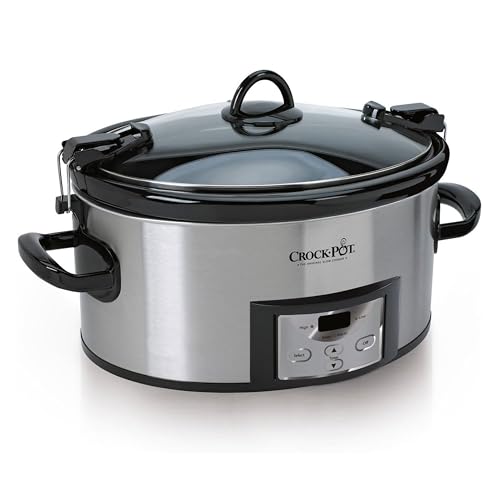
Crock-Pot 6-Quart Cook & Carry Programmable Slow Cooker — Best Travel-Ready Multi
Not every ‘multi’ needs pressure. The Cook & Carry multiplies the occasions a slow cooker serves: programmable at home all week, then locked and travelling to potlucks, games and family dinners with its gasketed lid keeping dinner inside the pot.
Strengths
- Locking lid makes transport genuinely spill-proof
- Digital timer cooks then holds warm automatically
- The potluck and holiday circuit’s favourite format
Trade-offs
- Slow cooking only — no pressure speed
- Latches must be released before serving
- Gasket needs washing after saucy trips
| Detail | What to know |
|---|---|
| Capacity | 6 Quart (Amazon title) |
| Lid | Cook & Carry locking lid (Amazon title) |
| Controls | Programmable, digital timer (Amazon title) |
The Cook & Carry’s multi is measured in places rather than pressures: kitchen, car, potluck table, holiday sideboard, home again. Its programmable slow cooking covers the week — set the hours, and it cooks then holds warm on its own — and its locking, gasketed lid converts the whole appliance into a sealed vessel that travels without decorating a car boot. That combination describes an enormous amount of real cooking: the chili for the game, the meatballs for the office, the stew that must arrive at a parent’s house hot. Owners should learn its two rituals: unlock before serving so steam escapes safely, and wash the gasket after saucy trips so last week’s tomato does not season this week’s dessert-adjacent anything. It will not pressure-cook, and it does not pretend to. As the slow cooker that goes places — the only pick in this guide designed around the journey — it has owned its niche for years because the niche is real and it serves it completely.
The Cook & Carry also rewards a home habit: cook double on Sunday, travel none of it, and let the programmable timer plus warm hold carry a staggered family’s evening — early eaters and late eaters from the same pot, in condition. The locking lid, used unlocked-but-seated at home, holds that warmth noticeably better than a resting lid. Small virtues, weekly value.
Longevity note: the Cook & Carry’s parts — crock, lid, gasket — are standard, available and inexpensive, which is why examples of this design have served potluck circuits for many years. Buy the cooker whose spares exist; this one’s do, everywhere.
Best for: cooks whose food travels / Not suited for: pressure-cooking households
Check the current price on Amazon
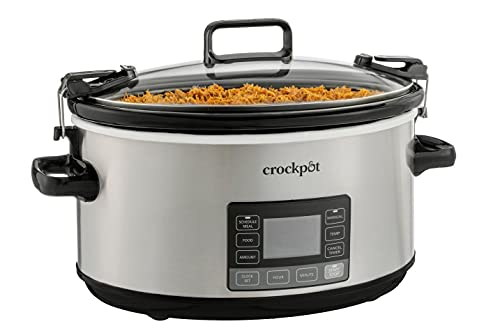
Crock-Pot 7-Quart Programmable Slow Cooker With MyTime — Best Set-and-Forget
Slow cookers have one classic flaw: dinner is done when the timer says, and stewing an extra three hours while you are stuck at work. MyTime inverts the logic — you set the time you will eat and the food type, and the cooker adjusts its cycle to finish then, ready rather than ruined.
Strengths
- Finish-time cooking ends the overcooked-by-six problem
- Generous 7-quart size with a locking travel lid
- Set by meal and hour, not by guesswork
Trade-offs
- Slow-only — no pressure functions
- The MyTime logic takes one read of the manual to trust
- Larger footprint than basic crocks
| Detail | What to know |
|---|---|
| Capacity | 7-Quart (Amazon title) |
| Technology | MyTime adjusts cooking to finish on time (Amazon title) |
| Lid | Cook & Carry locking lid (Amazon title) |
MyTime deserves explanation, because it fixes the slow cooker’s oldest complaint with genuine cleverness. A conventional programmable cooker cooks for the hours you set and then holds warm; if your day runs long, the food overcooks in the hold. MyTime instead asks when you want to eat and what you are cooking, then modulates the cycle so the dish reaches done at that hour — a stew told to be ready at six-thirty is ready at six-thirty, whether you set it at seven in the morning or noon. For working households whose evenings refuse to be scheduled, that inversion is the difference between a slow cooker that fits their life and one that punishes it. The rest of the package is generous: seven quarts, a locking lid for the trips, and Crock-Pot’s standard stoneware virtues. It is a slow-only machine, and its intelligence is in timing rather than pressure — which, for the household it targets, is exactly the intelligence that was missing.
MyTime owners should run one experiment early: set the same stew two ways — fixed hours versus finish-time — on consecutive weekends and taste what the technology is doing. The difference, a braise that is ready rather than merely done, converts sceptics. After that, the machine’s discipline is simply honesty at setup: tell it the true eating hour, and let it manage the curve you used to mismanage by hand.
The 7-quart MyTime also moonlights as the holiday overflow cooker — the second vessel that holds the mashed potatoes or the mulled drinks while the oven does its marathon — and its finish-time logic suits holiday chaos precisely, because nobody at a feast can say when anything will be eaten.
Best for: working households with unpredictable evenings / Not suited for: pressure fans
Check the current price on Amazon

Crock-Pot 6-Quart Slow Cooker With Easy-to-Clean Nonstick — Best Easy-Clean Slow Multi
The honest reason slow cookers gather dust is the soak-and-scrub crock. This Crock-Pot answers with a nonstick ceramic-coated pot and one-touch controls: the cooking is the brand’s classic gentle braise, and the washing-up is a wipe instead of a project.
Strengths
- Nonstick pot ends the overnight-soak ritual
- One-touch simplicity anyone in the house can run
- Full 6-quart family capacity
Trade-offs
- Coated pot prefers gentle utensils and hand care
- Manual-style timing versus programmable rivals
- No pressure or travel-lock features
| Detail | What to know |
|---|---|
| Capacity | 6-Quart (Amazon title) |
| Pot | Easy-to-clean nonstick ceramic coating (Amazon title) |
| Controls | One-touch (Amazon title) |
| Settings | High and low (Amazon title) |
Judge this Crock-Pot by the sink, because that is where it wins. Slow cooking’s dirty secret is the stoneware scrub: an eight-hour braise bakes a ring onto a crock that then soaks overnight and scrubs in the morning, a ritual that quietly retires many slow cookers to the back of cupboards. A nonstick ceramic-coated pot breaks the ritual — the same gentle, even braise, released with a wipe and a rinse — and one-touch controls remove the other friction, the programming nobody wanted to learn. Capacity stays a full family six quarts and the cooking settings stay the honest high and low the category runs on. The coated pot asks for gentle utensils and will not outlive stoneware across decades; there is no timer wizardry and no travel lock. But utilisation is the metric that matters — a cooker used weekly beats a cleverer one used monthly — and by removing the two frictions that retire slow cookers, this unassuming machine may be the most-used pick in the entire guide.
Nonstick care is the whole contract here: wooden and silicone tools, a soft sponge, no thermal shock from cold water into a hot pot. Kept that way, the coating serves for years of weekly cooks. Households with teenagers, incidentally, report this is the slow cooker the teenagers will actually wash — a utilisation feature no spec sheet captures and every parent understands.
Finally, this is the pick we give to slow-cooker sceptics who burned out on a stoneware crock in a previous decade. The category’s cooking was never the problem; the washing was. Remove it, and a surprising number of households rediscover that a gentle eight-hour braise is still the best weeknight technology ever sold.
Best for: households that hate washing up more than they love features / Not suited for: programmability seekers
Check the current price on Amazon
Comparison Table
| Pick | Badge | Key detail | Best for |
|---|---|---|---|
| Crock-Pot Express Crock XL 8-Quart Programmable Multi-Cooker | Best Overall Multi-Cooker | 8 qt, pressure + slow, programmable | families wanting one cooker for fast and slow |
| Crock-Pot Express Easy Release Oval Max 6-Quart Multi-Cooker | Best for Meats and Roasts | 6 qt oval, easy release, pressure + slow | roast, rib and shoulder households |
| Crock-Pot Multimeal Multicooker | Best for Two Dishes at Once | Dual pot, two dishes at once, bake function | households whose meals are a main plus a side |
| Crock-Pot 6-Quart Cook & Carry Programmable Slow Cooker | Best Travel-Ready Multi | 6 qt, locking lid, digital timer | cooks whose food travels |
| Crock-Pot 7-Quart Programmable Slow Cooker With MyTime | Best Set-and-Forget | 7 qt, MyTime technology, locking lid | working households with unpredictable evenings |
| Crock-Pot 6-Quart Slow Cooker With Easy-to-Clean Nonstick | Best Easy-Clean Slow Multi | 6 qt, nonstick pot, one-touch | households that hate washing up more than they love features |
How to Choose the Right Crock Multi-Cooker
Answer three questions in order. First: fast, or coordinated? Pressure answers fast; the slow multis answer coordinated, timed, travelled and easy-cleaned. Second: what shape and size is your food? Roasts and ribs argue for the Oval Max or the big stoneware crocks; two-dish meals argue for the Multimeal; crowds argue for the XL’s eight quarts or the MyTime’s seven. Third: who else will run it? One-touch and finish-time machines get used by the whole household; pressure machines concentrate use in the person who learned the release. The right Crock multi is the one whose multiplication matches the multiplication your dinners actually need — buy that, and ignore the rest of the feature list with a clear conscience.
How to Use a Crock Multi-Cooker: The First Week
Day one, run the water test if your machine is a pressure model — a cup of water, sealed and released — to learn its sounds and its steam with nothing at stake. Day two, cook the dish your household repeats most, in the mode you bought the machine for, and take notes: liquid, timing, result. Midweek, try the machine’s signature trick — the Express’s pressure beans, the Multimeal’s two-pot dinner, the MyTime’s finish-time stew — because the signature is what you paid for and it should be learned while enthusiasm is high. By the weekend, convert one family recipe from your old method to the new machine and write the conversion on the recipe itself. That week of deliberate use is the difference between a multi-cooker that becomes infrastructure and one that becomes storage; every pick in this guide rewards it within days.
Common Buying Mistakes
The first mistake is buying pressure for a coordination problem, or coordination for a speed problem — diagnose your dinners before your appliance. Second is sizing by headline quarts while forgetting the two-thirds pressure rule. Third is ignoring shape: round pots and oval roasts are a daily friction no program fixes. Fourth is undervaluing the boring features — a locking lid, a finish-time timer, a pot that wipes clean — which decide utilisation, and utilisation decides value. Fifth is buying smart timing and then never trusting it with a real dinner; run the experiment once and know. Finally, shop live: check price on Amazon at decision time, and let the verified model numbers in this guide anchor your comparison rather than any printed figure.
Final Recommendation
For most households, the Crock-Pot Express Crock XL is the best crock multi-cooker: pressure and slow at full family size. Meat households should take the Oval Max, two-dish households the Multimeal, travellers the Cook & Carry, unpredictable schedules the MyTime, and cleanup-first homes the nonstick 6-Quart. Explore the wider category in Best Cookers With Lids, Best Countertop Electronic Pressure Cookers, Best Crock Pots Or Slow Cookers, Best Instant Pot Cookers and Best Crawfish Cookers.
What Does ‘Multi-Cooker’ Actually Mean in the Crock World?
The term covers two genuinely different machines in this guide, and confusing them is the commonest buying error. Pressure multi-cookers — the Express Crock XL and the Oval Max — cook both fast and slow: a locking pressure lid for beans and braises in under an hour, and slow, sauté and steam modes for everything else. Slow multi-cookers — the Multimeal, Cook & Carry, MyTime and nonstick models — multiply occasions rather than pressures: two dishes at once, food that travels, food that finishes at a chosen hour, food whose pot wipes clean. Neither meaning is superior; they solve different problems. Households whose problem is time-to-dinner need pressure. Households whose problem is coordination, travel, timing or washing-up need the slow multis. Many kitchens eventually own one of each, which is not excess — it is the two halves of the category doing their separate jobs.
How Do You Convert Slow-Cooker Recipes to Pressure?
The Express models exist to run both literatures, and conversion is a learnable rhythm. As a starting frame: a dish that slow-cooks eight hours on low takes roughly thirty to forty-five minutes at pressure with a natural release, and uses less liquid — about a third less — because a sealed pot loses almost nothing to evaporation. Brown first in the same pot, deglaze thoroughly to avoid burn warnings, and keep thick sauces layered on top rather than at the base. Meats and beans get natural release; vegetables get quick release or a separate quick steam at the end. Dairy and delicate herbs go in after pressure, as they do in slow cooking’s final hour. Keep notes on your household’s conversions for a month and the translation becomes instinct — the same dinner, on two different clocks, from one machine.
How Do You Clean and Maintain a Crock Multi-Cooker?
Pressure models ask the lid discipline of their category: wash the sealing ring, clear the steam vent, store the lid ajar so the ring airs, and replace the ring when it stretches or holds odours through a wash. Slow models ask stoneware kindness — no cold water into a hot crock — or, for coated pots, gentle tools and soft sponges. Gaskets on locking travel lids earn a proper wash after anything saucy. Bases wipe clean and never immerse. None of this exceeds ten minutes after a big cook, and all of it is the difference between a multi-cooker that seals, heats and releases like new in year five and one that mysteriously underperforms in year two. These are simple machines maintained by simple rituals; the rituals are the product’s second half.
What Size Crock Multi-Cooker Do You Need?
Size by your largest regular job, with the pressure rule in mind: pressure modes fill to two-thirds, so an 8-quart Express really pressure-cooks about five quarts of food, while slow modes can fill closer to the brim. Households of two to four live happily at 6 quarts; families of five-plus, batch cooks and entertainers should take the XL’s 8 or the MyTime’s 7. The Multimeal breaks the maths deliberately — its two smaller pots suit households whose meals are two modest dishes rather than one large one. And always measure the machine’s home: multi-cookers are tall, oval models are wide, and a cooker that cannot open under your cabinets will be resented daily regardless of its talents. The right size is the one that cooks Sunday’s batch in one load and still comes out for Tuesday’s soup.
Is a Multi-Cooker Worth It If You Own a Slow Cooker?
It depends which half of the category you are missing. If your slow cooker serves you well and your problem is speed — the forgotten dinner, the dried beans at five o’clock — a pressure multi-cooker adds a genuinely new capability, and owners consistently report the old crock retiring within a season. If your problem is not speed but everything around the cooking — two dishes, travel, timing, washing — the slow multis in this guide add capability of a different kind, and the Multimeal or MyTime may serve you better than any pressure pot. If your current slow cooker already does its one job in a life that needs exactly that job, keep it and spend the money on ingredients. The honest test is the last month of dinners: count how many would have been better fast, better coordinated, better timed or better travelled, and let that count choose your machine.
What Does a Week of Multi-Cooking Look Like?
Monday belongs to pressure: dried beans for burrito bowls, cooked from the bag in the Express while rice steams — two components, one machine, forty minutes. Tuesday is the Multimeal’s showcase or the MyTime’s: a stew set by finish-time in the morning, eaten at whatever hour the day finally allows, in condition. Wednesday, the slow mode takes a pork shoulder for eight gentle hours; half becomes pulled pork, half is reserved. Thursday travels: the Cook & Carry’s meatballs go to the office potluck and return empty, which is the review that matters. Friday is pressure again — a risotto with no stirring, or ribs finished under the broiler. The weekend is for the big, slow, pleasurable cooks: a gumbo, a braise, a batch of stock from the week’s bones, and a freezer restocked in one washing-up. That rhythm is the honest advertisement for this category: not any single dish, but a week in which dinner’s logistics quietly stop being a problem, because the machine on the counter can be fast, slow, double, timed or travelling as each day requires.
Accessories and Spares: The Short, Honest List
Multi-cookers attract accessory avalanches; resist almost all of it. For the Express pressure models, the genuine list is a spare sealing ring, a second ring for sweet dishes, and the steamer basket or trivet the machine may already include. For the stoneware slow models, a ladle, a heatproof mat and a spare crock if your household cooks in sequences are the whole case. For travel models, a replacement gasket bought before the original tires is foresight, not spending. Everything else — the racks, moulds, lids and gadgets of the marketplace — should be bought only after a specific recipe has asked for it twice. These machines were chosen because they cook completely as sold; the notebook in which you record your household’s conversions and timings will improve your dinners more than any accessory in the catalogue.
Frequently Asked Questions
What is the difference between a multi-cooker and a slow cooker?
A slow cooker does one thing. The word ‘multi’ is doing real work in the product names, though, and it is worth being precise about which multiplication you are buying, because the two families in this guide share almost no parts, programs or purposes beyond the badge and the gentle-cooking heritage. Read the pick descriptions above with that lens — pressure range on one side, coordination and timing on the other — and the category stops being confusing and starts being a clear choice between two good answers to two different questions.
A slow cooker does one thing — gentle, hours-long cooking. A multi-cooker adds capabilities: pressure cooking, sautéing and steaming in the Express models, or dual pots, baking, finish-time timing and travel locks in Crock-Pot’s slow multi range.
Can a Crock-Pot multi-cooker really pressure-cook like an Instant Pot?
The Express models are genuine pressure cookers. They build, hold and release pressure under the same physical principles, with the same layered approach to safety — locking lids, float valves, regulated release — and in side-by-side cooking their results track the famous rival’s closely enough that recipes swap between them with at most a minute’s adjustment. Where the comparison honestly separates is around the cooking rather than in it: the depth of recipes published for each platform, the availability of stainless inner pots and spare parts, and the second-hand market in accessories. Judge the Express line as full members of the pressure category that happen to wear the slow-cooker badge, because mechanically, that is what they are.
The Express models are genuine pressure cookers with the same operating principle and layered safeties, and their timings track the category’s recipes closely. Instant Pot’s advantages are its recipe ecosystem and stainless pot options, not a different kind of pressure.
Which is better for a working household: pressure or MyTime?
If you can load a pot in the morning, MyTime’s finish-time slow cooking fits. There is a third pattern worth naming, because it describes a great many real households: the ingredients are known in the morning but the cook is not home to start anything at five — a teenager, a partner on an earlier shift, a neighbour doing a favour. In that house, the machine that a novice can start matters: one-touch slow models and finish-time models get started by whoever is there, while a pressure cooker’s release ritual tends to wait for its owner. Count the hands available to your dinners, not just the hours, when you choose.
If you can load a pot in the morning, MyTime’s finish-time slow cooking fits a long, unpredictable day beautifully. If your ingredients are decided at five o’clock, pressure is the only technology that helps. Many working households eventually run one of each.
Are the dual pots in the Multimeal big enough?
For a main and a side for a typical household, yes. The mental shift the Multimeal asks is from volume to composition: instead of asking how much stew one pot holds, ask what two dishes constitute dinner — a protein braise and its grain, a curry and its vegetables, a soup and a baked accompaniment — and the dual pots match that structure naturally. Households that cook composed meals find the capacity ample within a week; households that cook single vast batches should recognise themselves and buy the XL instead, with our blessing.
For a main and a side for a typical household, yes — that pairing is the design’s purpose. For a single large batch — a crowd’s worth of one stew — a full-size 6–8 quart crock is the right tool instead.
How do I stop slow-cooked food from going bland?
Brown meats before slow cooking where the model allows sautéing. Blandness in slow cooking is usually dilution and timidity rather than the method: a sealed, moist environment mutes top notes, so the fixes are concentration and contrast — reduce the sauce briefly at the end if the model allows, salt in layers rather than once, and never skip the acidic or fresh finish that wakes a long-cooked dish up. Pressure-cooked food, by contrast, concentrates as it cooks, so season it a shade lighter and adjust at the end.
Brown meats before slow cooking where the model allows sautéing, season a touch more boldly than stovetop recipes, and add bright finishes — herbs, citrus, a splash of vinegar — at serving. In pressure mode, remember less liquid evaporates, so sauces concentrate on their own.
Do these machines keep food warm safely?
Yes — the warm settings are designed to hold cooked food. Think of warm as a serving bridge, not a destination: it keeps a finished stew at a safe, appetising temperature while the table is set, the latecomers arrive or the second batch finishes, and it does that job for a few hours without meaningful loss of quality. Beyond that window the right move is the refrigerator and a reheat, which every model here also handles gracefully — slow mode on low brings a stew back to the table as if it had never left. Households that plan the hold honestly, in hours rather than in hope, never have a food-safety or a food-quality problem from this feature.
Yes — in brief, the warm settings are designed to hold cooked food at safe serving temperatures for a reasonable service window of a few hours. For longer holds, refrigerate and reheat; no warm setting is a storage plan for a whole day.


