Disclosure: airfryerkitchensupply.com is reader-supported. When you buy through links on our site, we may earn an affiliate commission at no extra cost to you.
Where to buy
Shoppers comparing the best cookers with lids can find every model below in the makers’ current ranges. Match the lid type to your cooking first, then check price on Amazon for your finalists.
- Instant Pot Duo 6-Quart 7-in-1 Electric Pressure Cooker — Check price on Amazon
- Crock-Pot Oval Manual Slow Cooker 7-Quart — Check price on Amazon
- Presto 01362 6-Quart Stainless Steel Pressure Cooker — Check price on Amazon
- Crock-Pot 6-Quart Cook & Carry Programmable Slow Cooker — Check price on Amazon
- Hawkins Stainless Steel 10-Litre Pressure Cooker — Check price on Amazon
- Instant Pot Duo Plus 6-Quart 9-in-1 Electric Pressure Cooker — Check price on Amazon
Prices and availability change often, so check price on Amazon before you decide rather than relying on any number quoted elsewhere.
Introduction: The Lid Is the Machine
The best cookers with lids share one truth: in this category the lid is not an accessory, it is the technology. A pressure lid turns water hotter than boiling and cuts cooking times by two-thirds. A glass slow-cooker lid holds a gentle, moist climate for eight hours and lets you watch it happen. A locking lid turns a pot of chili into luggage that survives the highway. This guide compares six verified cookers across all three lid philosophies — electric pressure, stovetop pressure, slow and transport — so you can buy the lid your cooking actually needs.
Start with your dominant cooking style. Weeknight speed points to pressure: beans from dry in under an hour, braises in forty minutes, stock in one. Weekend patience points to the slow cooker’s stoneware and glass. Cooking that leaves the house points to the locking lid. Households that genuinely do all three are the electric multi-cookers’ natural owners, because one locking lid system pressure-cooks, slow-cooks and steams in a single pot. Every cooker below was verified as a current model before inclusion, mini-box specs come from the verified listings, and we say check price on Amazon throughout instead of printing numbers that go stale.
In this guide
Quick Picks
- Instant Pot Duo 6-Quart 7-in-1 Electric Pressure Cooker — Best Overall: The benchmark lidded cooker: pressure cook, slow cook, rice, steam, sauté, yogurt and warm in one stainless pot. — Check on Amazon
- Crock-Pot Oval Manual Slow Cooker 7-Quart — Best Slow Cooker With Lid: A big oval stoneware crock with a glass lid, high/low/warm settings and room for a whole roast with vegetables. — Check on Amazon
- Presto 01362 6-Quart Stainless Steel Pressure Cooker — Best Stovetop Pressure Cooker: A classic stovetop pressure cooker in stainless steel — fast, repairable and free of electronics entirely. — Check on Amazon
- Crock-Pot 6-Quart Cook & Carry Programmable Slow Cooker — Best Locking Lid for Travel: A programmable slow cooker whose lid locks down tight for the car ride — the potluck and tailgate champion. — Check on Amazon
- Hawkins Stainless Steel 10-Litre Pressure Cooker — Best Large-Capacity Stovetop: A 10-litre stainless stovetop giant with Hawkins’ inner-lid design — batch cooking and big-family pressure cooking. — Check on Amazon
- Instant Pot Duo Plus 6-Quart 9-in-1 Electric Pressure Cooker — Best Premium Electric: The Duo formula upgraded: nine functions, an easier steam release and a clearer display for households that cook under pressure weekly. — Check on Amazon
How These Picks Were Chosen
We limited the field to cookers whose lids are integral to their function — pressure cookers, slow cookers and locking-lid transport cookers — and verified every model against current catalogue data before inclusion. Scoring weighted seal quality and lid design, honest usable capacity, pot material, the range of cooking the lid system enables, cleaning burden and the availability of replacement gaskets and parts, because a lidded cooker is a years-long relationship with its seal. We deliberately spanned electric and stovetop, 6 quarts to 10 litres, and three lid philosophies, so the comparison answers which kind of lidded cooking you need before which badge. Ratings and review counts were ignored: they fluctuate constantly and cannot judge a gasket.
The 6 Best Cookers With Lids

Instant Pot Duo 6-Quart 7-in-1 Electric Pressure Cooker — Best Overall
Ask for the best cookers with lids and one name defines the modern category. The Duo’s locking pressure lid, stainless pot and seven functions cover the overwhelming majority of what households actually cook, which is why it remains the default recommendation years after launch.
Strengths
- Pressure lid locks and seals automatically — set it and walk away
- Stainless inner pot sautés properly and never wears a coating out
- Slow cook, rice and steam modes replace three other appliances
Trade-offs
- Learning curve for first-time pressure users
- Sealing ring absorbs strong flavours — buy a spare for desserts
- 6-quart size is snug for very large batch cooking
| Detail | What to know |
|---|---|
| Capacity | 6 Qt (Amazon title) |
| Functions | 7-in-1: pressure, slow cook, rice, steam, sauté, yogurt, warm (Amazon title) |
| Pot | Stainless steel (Amazon title) |
The Duo’s dominance rests on the lid doing three jobs flawlessly. As a pressure lid it locks, seals and regulates with a float valve you can read at a glance, turning beans, braises and broths into weeknight-fast food. As a slow-cooker lid it simply covers, letting the same stainless pot bubble gently for hours. And the pot itself — stainless, tri-ply based — sautés before it seals, so a stew starts with properly browned meat in the same vessel it finishes in, which is where electric multi-cookers beat stovetop pressure pots for everyday cooking. The ecosystem matters too: spare rings, lids, pots and racks are everywhere and cheap, so a Duo is a platform, not a purchase. Its honest limits are capacity physics and the pressure learning curve — your first natural release will feel mysterious, your fifth will be routine. For the broadest definition of ‘cooker with a lid’ — pressure, slow, rice, steam, yogurt — nothing else in this guide covers as much ground as competently, which is why it leads the list.
Ownership tip that transforms the Duo: buy a second sealing ring immediately and colour-code your cooking — one ring for savoury, one for sweet and neutral — because the ring is the only part that remembers last week’s chili when you make this week’s rice pudding. Also learn the two releases until they are reflexes: natural release for meats and foamy foods, quick release for vegetables and seafood. Master those two habits and the Duo stops being an appliance with a learning curve and becomes simply how dinner gets made in your house.
One more Duo habit separates happy owners from frustrated ones: deglaze after sautéing. A splash of liquid and a scrape of the pot’s base before sealing prevents the burn warning and builds the sauce’s foundation in the same motion. And when the recipe is foamy — beans, split peas, oatmeal — a spoon of oil in the pot and a patient natural release keep the valve clean and the counter dry. These are thirty-second skills, learned once, used for the life of the machine, and they explain why experienced owners describe the Duo as effortless while beginners sometimes describe it as fussy: the difference is technique, not the cooker.
Best for: most households wanting one lidded cooker for everything / Not suited for: purists who slow-cook only and want ceramic
Check the current price on Amazon

Crock-Pot Oval Manual Slow Cooker 7-Quart — Best Slow Cooker With Lid
For the oldest job a lid does — keeping a slow braise moist for eight hours — the classic Crock-Pot oval is still the tool. Its glass lid lets you check without lifting and losing heat, and the oval stoneware fits roasts that round cookers refuse.
Strengths
- Oval shape fits roasts, hams and whole chickens properly
- Glass lid allows monitoring without breaking the cook
- Stoneware goes to the table and into the dishwasher
Trade-offs
- Manual settings only — no timer or programming
- Glass lid does not lock for transport
- Stoneware is heavy when full
| Detail | What to know |
|---|---|
| Capacity | 7-Quart, serves 8+ (Amazon title) |
| Settings | High/Low cook, Warm (Amazon title) |
| Insert | Removable oval stoneware (Amazon title) |
A slow cooker’s lid is a climate system: it traps the moisture the food gives up and rains it gently back, which is why lifting it ‘to check’ costs you real cooking time. This Crock-Pot’s glass lid is the kind answer to that dilemma — you can watch the braise without breaking its weather. The oval stoneware is the other half of the design: roasts, pork shoulders and whole chickens lie flat and submerged instead of perched, and the crock lifts out to serve at the table and wash in the dishwasher. Manual high/low/warm controls are a feature in disguise for many owners — nothing to program, nothing to fail, a dial that a grandparent and a teenager operate identically. What it will not do is hurry: there is no pressure here, and dinner is ready when the connective tissue says so. Households whose cooking rhythm is ‘assemble in the morning, eat in the evening’ will find this the most satisfying lidded cooker they own, and the one whose food tastes most like patience.
Slow-cooker craft, briefly: fill the crock between half and two-thirds for even cooking, put root vegetables under the meat where the heat and liquid live, and resist lifting that glass lid — every peek is heat and moisture the cook then has to rebuild. The warm setting is a holding pattern for an hour or two, not a second cooking mode. Treat the stoneware kindly — no sudden cold water into a hot crock — and it will serve for many years. This is low-technology cooking at its most reliable, and the results explain its century-long popularity.
The oval Crock-Pot also moonlights beautifully: keep mashed potatoes warm through a long dinner service, hold mulled drinks at a party, or proof a big batch of dough gently on warm in a cold kitchen — the stoneware’s even, mild heat is a general-purpose tool once you stop seeing it as a one-recipe appliance. Its glass lid makes all of those visible and therefore manageable. Few appliances in this guide reward improvisation as safely, because low heat forgives almost everything except forgetting to plug it in.
Best for: slow-cooker households cooking big, oval things / Not suited for: travelers or pressure-cooking fans
Check the current price on Amazon

Presto 01362 6-Quart Stainless Steel Pressure Cooker — Best Stovetop Pressure Cooker
Before electric models, this was the lidded cooker: a stainless pot, a locking lid with a pressure regulator, and physics. The Presto 01362 remains the pick for cooks who want pressure speed with stovetop control and nothing electronic to fail.
Strengths
- Reaches pressure fast and responds instantly to burner changes
- Stainless build with replaceable gasket and parts
- Works on any hob, at any altitude adjustment you choose
Trade-offs
- You are the timer, the sensor and the safety system
- No slow-cook, rice or keep-warm modes
- Lid and regulator need periodic inspection
| Detail | What to know |
|---|---|
| Capacity | 6-Quart (Amazon title) |
| Material | Stainless steel (Amazon title) |
| Type | Stovetop pressure cooker |
Stovetop pressure cooking is a skill with a tool, and the Presto is the honest version of that tool: stainless steel, a weighted regulator that rocks at pressure, a locking lid with a proper gasket, and parts — gaskets, handles, regulators — that have been replaceable for decades. On the burner it is faster to pressure than most electrics and instantly responsive: lift the heat, drop the heat, quick-release under a tap if the recipe demands it. It asks competence in return. You time the cook, you judge the release, you inspect the vent and gasket like a pilot walking around an aircraft — a two-minute ritual that becomes automatic. In exchange you get a cooker with no electronics to obsolesce, that works in a power cut on a gas hob, and that will plausibly be handed down. For cooks who already have stovetop instincts, it is the most satisfying pressure cooker in this guide; for households wanting dinner to manage itself, it is the wrong one, and the electrics above it exist precisely for them.
Presto ownership is a maintenance relationship: inspect the gasket for cracks each season, keep the vent pipe clear with a pipe cleaner, and replace the overpressure plug on schedule rather than on failure. None of it takes five minutes, and all of it is the price of a cooker that can outlive its owner’s kitchen remodels. Altitude matters too — above a thousand metres, add cooking time or pressure per the manual, because physics does not negotiate. Cooks who accept those terms describe a particular pleasure in the regulator’s rock: the sound of dinner happening at full pressure.
Stovetop pressure veterans develop an ear: the regulator’s steady rock is the sound of correct pressure, a frantic rattle means the heat is wasting itself, and silence means something needs checking. That feedback loop is why many cooks who learn on a Presto never fully convert to electrics — the machine talks to them. It also travels where electrics cannot: a cabin, a boat galley, a holiday rental with a gas hob. Buy it as a lifetime tool, keep its small parts refreshed, and it will repay the attention with decades of fast, controlled cooking.
Best for: experienced cooks who want durable, manual pressure cooking / Not suited for: set-and-forget households
Check the current price on Amazon
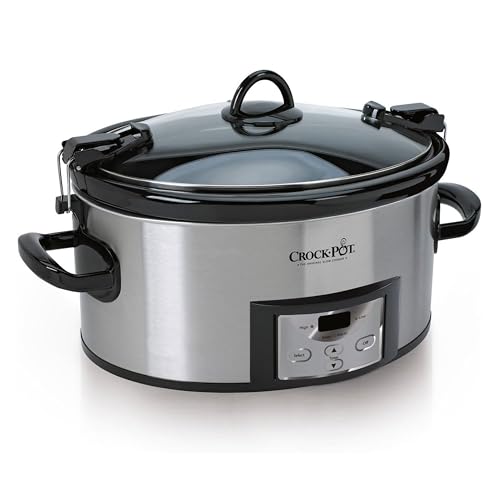
Crock-Pot 6-Quart Cook & Carry Programmable Slow Cooker — Best Locking Lid for Travel
Most slow cooker lids merely rest on top. This one clamps. The Cook & Carry’s locking lid turns a 6-quart programmable Crock-Pot into a sealed container that survives the drive to the potluck, the game or the family dinner — the entire reason it exists.
Strengths
- Locking lid genuinely prevents car-boot spills
- Digital timer cooks, then shifts to warm automatically
- Capacity and oval-friendly size suit crowds
Trade-offs
- Locking lids must be unlatched before serving — a habit to learn
- Never lock the lid during pressure-style cooking — it is a slow cooker
- Gasket ring needs a wash after saucy trips
| Detail | What to know |
|---|---|
| Capacity | 6 Quart (Amazon title) |
| Lid | Cook & Carry locking lid (Amazon title) |
| Controls | Programmable with digital timer (Amazon title) |
| Finish | Stainless steel (Amazon title) |
Every potluck veteran has a spill story; this cooker is the industry’s answer. The Cook & Carry’s lid latches to the base with a gasketed seal, converting the whole appliance into a transport container — chili, meatballs and pulled pork arrive at temperature and inside the pot, not the car. At home it is a fully programmable 6-quart slow cooker: set the hours, and it cooks then holds warm automatically, which suits workday dinners as well as parties. Two honest usage notes define ownership. First, the latches are for carrying, and the lid should be unlatched for serving so steam escapes safely away from hands. Second, the gasket that makes travel possible also holds flavours, so it earns a proper wash after anything tomato-based or spiced. Judge it as a slow cooker that travels — the only pick here designed around the journey as much as the cooking — and nothing else in its class is really competing with it.
The Cook & Carry also shines at home for a subtler reason: the locking lid holds heat and moisture during the cook’s final rest better than a resting lid, so a finished stew held for latecomers stays in condition. Just remember the golden rule owners repeat to each other — lock for the road, unlock for the table. Pair it with a proper carrying routine (flat surface in the car, a towel beneath for grip) and the potluck stops being a logistics problem. It is a small specialisation, executed completely, which is why it owns its niche in this guide.
A Cook & Carry detail worth knowing: the programmable timer and the locking lid solve two different halves of the same day. The timer means the cooking finishes on schedule while you are at work; the lock means the finished food travels while you are on the road. Together they describe the entire life of a working family’s potluck contribution, which is why owners tend to become evangelists. If your social life involves bringing food — and most social lives do — this is the slow cooker that respects the whole assignment.
Best for: potluck, tailgate and holiday cooking that travels / Not suited for: pressure-cooking seekers
Check the current price on Amazon

Hawkins Stainless Steel 10-Litre Pressure Cooker — Best Large-Capacity Stovetop
When the cooking is measured in kilos — festival batches, big-family stews, stock for the month — Hawkins’ 10-litre stainless cooker is the lidded pot that does not blink. Its inner-lid design seats the lid inside the rim, using pressure itself to strengthen the seal.
Strengths
- Huge 10-litre capacity for genuine batch cooking
- Inner-lid design is famously secure and long-lived
- Stainless body suits daily heavy use for years
Trade-offs
- Very large and heavy — needs storage and two hands
- Stovetop only: no programs, no timer
- Oversized for one- or two-person households
| Detail | What to know |
|---|---|
| Capacity | 10.0 Litre (Amazon title) |
| Material | Stainless steel (Amazon title) |
| Design | Inner-lid pressure cooker (brand design) |
Hawkins built its reputation in kitchens where a pressure cooker works daily and failure is not an option, and the 10-litre stainless model carries that DNA. The inner-lid design is the engineering signature: the lid drops inside the rim and pressure pushes it tighter against the gasket, a seal that improves exactly when it is stressed — the opposite of cheaper outer-lid designs. At ten litres it cooks for gatherings, meal-prep Sundays and stock-making sessions that would need three batches in a 6-quart electric. Stainless steel shrugs off the acidic, salty, daily punishment of big-batch cooking. The costs are physical and human: it is a serious weight full, it demands stovetop attention, and its scale is absurd for a couple’s Tuesday soup. But every category has a heavy-duty answer, and for lidded cooking at volume — especially in households with a tradition of stovetop pressure cooking — this is it, built to a standard that treats a decade as a warm-up.
Cooking at this scale rewards mise en place: with ten litres coming to pressure, everything should be chopped, measured and ready before the lid seats, because opening mid-cook to add a forgotten ingredient costs the whole pressurisation. Batch cooks also learn to love the cool-down — a pot this size holds a natural release beautifully, finishing braises gently as the pressure falls. Store it where it will actually be used; a cooker this large that lives in a high cupboard is a cooker that gets skipped. Given a home on the counter or a low shelf, it becomes the engine of a household’s food economy.
The Hawkins also rewards households that cook from cuisines built on pressure: dals, beans, tough cuts and layered rice dishes are its native language, and its capacity means a week’s worth of a staple cooks in one session. Owners in those traditions treat the whistle count as a recipe language of its own, timing dishes by ear with a precision that surprises electric-cooker users. That cultural depth is part of the product: you are buying into a mature cooking system with generations of recipes written for exactly this pot.
Best for: big families, batch cooks and stock makers / Not suited for: small kitchens or small households
Check the current price on Amazon

Instant Pot Duo Plus 6-Quart 9-in-1 Electric Pressure Cooker — Best Premium Electric
The Duo Plus takes everything that made the Duo the benchmark and polishes the daily frictions: a friendlier steam-release control, a brighter display and extra programs including sterilise and cake. Weekly pressure cooks feel the difference every single time.
Strengths
- Easier, safer-feeling steam release than the original Duo
- Nine functions including sous vide-style and sterilise programs
- Same stainless pot and accessory ecosystem as the Duo
Trade-offs
- Costs more than the Duo for convenience, not capacity
- Still a learning curve for pressure beginners
- Sealing rings remain a consumable to manage
| Detail | What to know |
|---|---|
| Capacity | 6 Qt (Amazon title) |
| Functions | 9-in-1 (Amazon title) |
| Pot | Stainless steel (Amazon title) |
The Duo Plus is a refinement study: same 6-quart stainless pot, same pressure competence, but the interactions you perform daily are redesigned. The steam release — the moment that makes beginners nervous — is a controlled, deliberate control rather than a wobbly valve; the display tells you what the machine is doing in words rather than codes; and the program list grows to cover the things Duo owners hacked their machines into doing, from sterilising jars to gentle cake baking. In weekly use those touches compound: less hesitation, fewer manual checks, more confidence to use pressure on a Tuesday. It does not cook different food from the Duo — pressure is pressure — so the upgrade case is purely ergonomic, and for occasional users the standard Duo remains the value pick. For the household that pressure-cooks three times a week, ergonomics is not a luxury; it is the difference between a machine that gets used and a machine that gets admired. The Plus is the one that gets used.
Duo Plus owners get the most from the display’s feedback: preheating, cooking and releasing are distinct phases, and learning to read them removes the guesswork that makes beginners hover. Use that confidence to expand the repertoire — the sterilise program for jars and bottles, the cake setting for a steamed pudding, yogurt overnight. The accessory ecosystem is shared with the Duo, so every rack, ring and spare pot in that world fits. It is the electric cooker for people who have decided pressure cooking is a permanent part of their kitchen, and who want the daily interface to honour that decision.
Duo Plus confidence compounds into repertoire: owners who trust the release and read the display start pressure-cooking things they once reserved for weekends — a Tuesday risotto, a weeknight stock from a roast chicken’s bones, dried beans decided at five and eaten at six-thirty. That spontaneity is the Plus’s real return on its premium: not different food, but more frequent food, cooked under pressure because the machine never makes it feel like an event. Frequency, in a kitchen appliance, is the only metric that finally matters.
Best for: frequent pressure cooks wanting the refined version / Not suited for: budget buyers — the Duo cooks the same food
Check the current price on Amazon
Comparison Table
| Pick | Badge | Key detail | Best for |
|---|---|---|---|
| Instant Pot Duo 6-Quart 7-in-1 Electric Pressure Cooker | Best Overall | 6 qt, 7-in-1, stainless pot | most households wanting one lidded cooker for everything |
| Crock-Pot Oval Manual Slow Cooker 7-Quart | Best Slow Cooker With Lid | 7 qt, stoneware, glass lid | slow-cooker households cooking big, oval things |
| Presto 01362 6-Quart Stainless Steel Pressure Cooker | Best Stovetop Pressure Cooker | 6 qt, stovetop, stainless | experienced cooks who want durable, manual pressure cooking |
| Crock-Pot 6-Quart Cook & Carry Programmable Slow Cooker | Best Locking Lid for Travel | 6 qt, locking lid, digital timer | potluck, tailgate and holiday cooking that travels |
| Hawkins Stainless Steel 10-Litre Pressure Cooker | Best Large-Capacity Stovetop | 10 litre, stovetop, inner lid | big families, batch cooks and stock makers |
| Instant Pot Duo Plus 6-Quart 9-in-1 Electric Pressure Cooker | Best Premium Electric | 6 qt, 9-in-1, upgraded controls | frequent pressure cooks wanting the refined version |
How to Choose a Cooker With the Right Lid
Decide what your lid must do on your most common cooking day. If that day is a Tuesday with forty minutes, the answer is pressure, and the choice narrows to electric convenience (Instant Pot) versus stovetop control and longevity (Presto, Hawkins). If that day is a Sunday that starts at nine and eats at five, the answer is a slow cooker’s glass-lidded stoneware. If that day ends in a car, the answer locks. Then check the unglamorous details: is the inner pot stainless or coated, does a spare gasket cost little and ship fast, will the cooker fit where it must live, and does its capacity — remembering the two-thirds pressure rule — match your real batch? Answer those and the badge chooses itself.
How to Slow Cook and Pressure Cook in the Same Kitchen
Many households end up bilingual, and the translation is simpler than it looks. Slow cooking builds flavour through time: browning first, gentle heat, moisture recycling under the lid. Pressure cooking builds it through temperature: the same browning, then a sealed, hotter, faster braise. Most recipes convert — a slow braise of six hours is roughly thirty to forty minutes at pressure with a natural release, using less liquid because almost none escapes. The electric multi-cookers in this guide exist to make that bilingualism one appliance. Whichever you use, the constants are browning for depth, enough liquid to make steam or sauce, and restraint with the lid: every unnecessary opening, in either method, is flavour and time leaving the pot.
Common Buying Mistakes
The commonest mistake is buying capacity by the headline number and forgetting the two-thirds pressure rule — a ‘6-quart’ pressure cooker cooks four quarts of food. Second is choosing a stovetop pressure cooker for a household that wants dinner to manage itself, or an electric for a cook who loves burner control; both end up resented. Third is ignoring the gasket economy: a cooker whose rings and parts are cheap and everywhere is a cooker you will still be using in a decade. Fourth is locking a transport lid and then carrying the cooker by one handle at a tilt — physics still applies. Fifth is storing a pressure cooker sealed, which marinates the ring in last month’s flavours. And as always, shop by the live listing: check price on Amazon when you decide, not by any number in print.
Final Recommendation
For most households, the Instant Pot Duo is the best cooker with a lid: one stainless pot whose locking lid pressure-cooks, slow-cooks and steams. Slow-cooking purists should take the Crock-Pot 7-Quart Oval, travellers the Cook & Carry, stovetop cooks the Presto or the mighty Hawkins, and frequent pressure users the Duo Plus. Keep exploring with Best Countertop Electronic Pressure Cookers, Best Crock Multi Cookers, Best Crock Pots Or Slow Cookers, the outdoor boil guide Best Crawfish Cookers and Best Instant Pot Cookers.
What Does a Lid Actually Do? Pressure, Glass and Locking Explained
Not all lids in this guide do the same job, and matching lid to cooking style matters more than matching brand. A pressure lid — on the Instant Pots, the Presto and the Hawkins — locks against a gasket and traps steam, raising the boiling point of water so food cooks at higher temperature and dramatically faster, while staying moist. A glass slow-cooker lid does the opposite job gently: it simply contains heat and moisture at low temperature for hours, and its transparency lets you monitor without lifting. A locking transport lid, on the Cook & Carry, adds a gasketed clamp whose purpose is the journey, not the cooking. Buy the lid your cooking needs: pressure for speed, glass for patience and visibility, locking for travel. Households that both braise slowly and cook fast under pressure are exactly who the electric multi-cookers serve, because their single lid system covers both worlds.
How Do You Use a Pressure Cooker Safely?
Modern pressure cookers are engineered with redundant safety — locking lids that cannot open under pressure, float valves, pressure regulators and backup releases — and the accidents of folklore belong to neglected antique pots. Your part is a short checklist. Fill no more than two-thirds full, and only half for foaming foods like beans and grains. Check the gasket is clean, seated and supple, and that the steam vent is clear before sealing. Let pressure come down naturally for meats and foamy dishes; use quick release only for delicate foods, standing clear of the steam. Never force a lid, and replace a hardened or cracked gasket promptly — it is a cheap part doing critical work. Follow those rules and pressure cooking is statistically one of the calmest things in your kitchen: a sealed, regulated system doing physics on your behalf.
How Do You Clean and Store Lidded Cookers?
Lids deserve the same care as pots. Wash pressure lids in warm soapy water, remove the sealing ring and wash it separately, and clear the vent and float valve so no starch film builds up — most ‘my cooker won’t pressurise’ stories are a dirty valve or a tired ring. Store rings loosely rather than sealed in the pot, ideally with the lid upside down, so odours air out instead of moving in. Slow-cooker stoneware and glass lids are dishwasher-friendly but dislike thermal shock: let a hot crock cool before cold water touches it. Stovetop pots like the Presto and Hawkins ask only for a gasket inspection each season and dry storage. Ten minutes of this attention after big cooks is the entire secret behind cookers that seal perfectly in year ten.
What Size Cooker Does Your Household Need?
Size by people and by leftovers, honestly. One or two people who cook fresh daily are served by smaller pots, but this category rewards a little headroom: pressure cookers must never be filled past two-thirds, so a 6-quart pot really cooks four quarts of food. Four-to-six-person households and anyone who meal-preps should start at 6 quarts electric or 7 quarts slow, and genuine batch cooking — stock, festival food, feeding a crowd — is what the Hawkins’ ten litres exists for. Remember that a bigger cooker also stores bigger: measure the cupboard or counter before the capacity seduces you. The right size is the one that cooks your Sunday batch in one load and still gets used on a Tuesday, and for most households in this guide that answer is six to seven quarts.
How Do Lidded Cookers Change Weeknight Cooking?
The deepest effect of a good lidded cooker is not speed or tenderness — it is the collapse of planning horizons. A slow cooker moves dinner’s decision to the morning, when you have energy, and lets the evening be about eating. A pressure cooker moves the same decision to the moment you walk in, because dried beans, frozen chicken and tough cuts all become same-evening options. Either way, the question ‘what can we possibly eat tonight’ gets a larger answer, and the takeaway menus get less business. Households feel this as a budget change and a health change, but it starts as a lid change: a sealed environment that either holds gentle heat all day or intense heat for minutes, unattended, safely, while life happens elsewhere. That is why this category, more than almost any other in the kitchen, earns owners who describe their cooker the way they describe a colleague — as something that does a job for them, reliably, every single day.
What Accessories Are Worth Buying?
Very few, which is good news. For electric pressure cookers: a second sealing ring, a spare inner pot if you cook in sequences, and a simple steamer basket or trivet — most of which the machine already includes or offers cheaply. For slow cookers: liners are a convenience some love and others find wasteful; a good ladle and a heatproof mat for the counter matter more. For stovetop pressure cookers: a spare gasket, bought the day you buy the cooker, is the whole list. Resist the accessory avalanche this category attracts; the cookers in this guide were chosen because they cook completely as sold, and the only accessory that reliably improves them is a notebook for the timings your household repeats.
Frequently Asked Questions
Why does the lid matter so much on a cooker?
Because the lid defines the cooking environment: a pressure lid raises temperature and speed. Consider what happens inside each design. Under a pressure lid, steam cannot escape, so pressure builds until water boils far hotter than it can in an open pot — and hot water cooks fast, forcing its way into dense beans and tough fibres. Under a slow cooker’s glass lid, almost nothing so dramatic occurs, and that is the point: heat stays low, moisture condenses and returns, and collagen has the hours it needs to melt into gelatin. Under a locking lid, the gasket simply refuses to let dinner become upholstery. Same pot, different lid, different cuisine. a glass slow-cooker lid holds a moist low climate you can monitor, and a locking lid makes the cooker transportable. Same pot, different lid, different cuisine.
Can a pressure cooker replace a slow cooker?
Electric multi-cookers like the Instant Pot Duo slow-cook as well as pressure-cook, and for most households they genuinely replace both. Stoneware purists still prefer a dedicated slow cooker’s gentle, even heat and table-ready crock.
Are pressure cookers safe?
Modern models are engineered with locking lids. It is worth adding that the electric models in this guide will not even begin pressurising with a badly seated lid, and will warn rather than cook when the ring is missing — the machine checks your checklist with you. Stovetop models place more of that duty on the cook, which is why their checklist matters, but their mechanical safeties — the overpressure plug, the gasket’s blow-out window, the locking handle — are layered and proven over decades of daily use in millions of kitchens. Respect the fill line, keep the vent clear, and either system is a calm, sealed, predictable way to cook.
Modern models are engineered with locking lids that cannot open under pressure, float valves and redundant pressure releases. Your part is simple: respect fill limits, keep the vent and gasket clean, and replace a worn gasket promptly.
How full can I fill a pressure cooker?
Two-thirds maximum for most foods. Think of the empty third as part of the machine: it is where steam lives, where pressure builds, and where foaming foods have room to froth without reaching the valve. Recipes written for pressure cookers assume that headroom, which is why doubling a recipe in the same pot is the one scaling move experienced users refuse to make — halve the time if you must, split the batch if you can, but never eat into the headroom. Respect it and the cooker stays clean, calm and exactly as fast as promised.
Two-thirds maximum for most foods, and only half for foaming foods like beans, grains and pasta, which expand and froth. That headroom is what lets pressure build safely and keeps the vent clear.
Why does my cooker smell of the last meal?
The silicone sealing ring absorbs strong flavours. This is chemistry, not a defect: silicone is slightly porous to aromatic compounds, which is also why it seals so forgivingly. The management routine is simple and total — wash the ring in hot soapy water or the dishwasher’s top rack after strong cooks, let it dry fully in the open air, store the lid inverted so the ring is never marinating in a closed pot, and rotate two rings by course. Owners who do this never taste chili in their cheesecake; owners who skip it eventually do, just once, and then they buy the second ring.
The silicone sealing ring absorbs strong flavours. Wash it after pungent cooks, store the lid upside down so the ring airs, and keep a second ring for sweet or delicate dishes — a cheap fix every multi-cooker owner should adopt.
Glass lid or metal lid for a slow cooker?
Glass lets you monitor without lifting and losing heat, which is why most slow cookers use it. Metal lids are tougher for transport — but for carrying a full cooker, a purpose-built locking lid like the Cook & Carry’s beats both.


