Disclosure: airfryerkitchensupply.com is reader-supported. When you buy through links on our site, we may earn an affiliate commission at no extra cost to you.
Where to buy
Every blanket below was verified against Amazon’s catalog data for this site before it earned a link: fiber, fill and dimensions are quoted only where the listing states them, and each pick’s size is printed in its name and spec box because crib blankets fail by size more than by any other measure. One safety boundary runs through the whole guide and is stated here first: these are blankets for toddlers — children past their first birthday who are transitioning to a crib blanket or toddler bed. Loose blankets do not belong in a sleep space with an infant under 12 months; for that stage, a wearable blanket is the appropriate product, and this guide links to it rather than bending the rule.
- CLoucl 100% Cotton Muslin Crib Comforter/Quilt, 41×48 — Check the current price on Amazon
- MakeMake Organics Organic Toddler Comforter, GOTS Certified, 44×60 — Check the current price on Amazon
- ZPECC Muslin Toddler Blanket, 8 Layers of Organic Cotton, 47×47 — Check the current price on Amazon
- CARUILI Toddler Blanket, Minky with Dotted Backing, 50×60 — Check the current price on Amazon
- Lukeight Toddler Blanket, Plush Dinosaur, 30×40 — Check the current price on Amazon
- HOMRITAR Baby Blanket for Kids, Minky with Dotted Backing, Dinosaurs, 30 Inch — Check the current price on Amazon
The best crib blankets for toddlers mark a specific graduation: the moment a child who has slept in wearable blankets and empty cribs becomes a toddler who can safely have a blanket of their own — to pull up, kick off, drag to the couch and claim as theirs. The best picks for that moment share a short list of traits. They are sized for a crib or toddler bed, roughly 40×48 inches and up, so the blanket covers the child without acres of excess. They are breathable, washable constructions — muslin cotton, layered cotton, or soft minky fleece — because a toddler blanket is washed more than any textile in the house. And they are honest about what they are made of, layer by layer, which is why every spec box below separates the surface fiber from the fill wherever the listing allows it.
The safety framing deserves its own paragraph, because this category is where shopping and sleep safety intersect. Mainstream safe-sleep guidance is consistent: infants under 12 months sleep safest on their backs, in a bare crib, with no loose blankets; wearable blankets exist for that stage. The blankets in this guide are for the stage after — toddlers, generally past the first birthday, many of them moving to a toddler bed where a blanket is part of the transition. Weighted blankets are a separate product class and are not included here at all: a weighted blanket should never be used for an infant, nor for any toddler who cannot remove it themselves, and none of these picks is weighted. Buy for the stage your child is actually in, not the stage the calendar says is coming.
Within those boundaries, the six picks divide by material philosophy. The muslin and layered-cotton picks (CLoucl, ZPECC) are the breathable, all-season school. The MakeMake is the certified-organic option, with its fill stated as plainly as its cover. The minky picks (CARUILI, HOMRITAR) are the soft, warm, nap-and-couch school, in large and small sizes respectively. And the Lukeight is the small, fun, travel-and-daycare size. Each review states the blanket’s real dimensions and what those dimensions mean in a crib, because a 30-inch blanket and a 50×60 blanket are different products that happen to share a name.
In this guide
Quick Picks
In a hurry? The CLoucl 41×48 muslin comforter is the best all-round crib blanket for a toddler, the MakeMake is the certified-organic pick with a cotton fill, and the CARUILI 50×60 minky is the warm, generous option for a toddler bed. For infants under 12 months, skip this category entirely and use a wearable blanket instead.
| Pick | Badge | Where to check it |
|---|---|---|
| CLoucl 100% Cotton Muslin Crib Comforter/Quilt, 41×48 | Best Overall | Check on Amazon |
| MakeMake Organics Organic Toddler Comforter, GOTS Certified, 44×60 | Best Organic | Check on Amazon |
| ZPECC Muslin Toddler Blanket, 8 Layers of Organic Cotton, 47×47 | Best Layered Muslin | Check on Amazon |
| CARUILI Toddler Blanket, Minky with Dotted Backing, 50×60 | Best Warm and Soft | Check on Amazon |
| Lukeight Toddler Blanket, Plush Dinosaur, 30×40 | Best Travel and Daycare Size | Check on Amazon |
| HOMRITAR Baby Blanket for Kids, Minky with Dotted Backing, Dinosaurs, 30 Inch | Best Small Nursery Blanket | Check on Amazon |
How These Picks Were Chosen
Candidates were verified against the Amazon catalogue data for this site: fiber, fill where stated, construction and dimensions all had to be confirmable from the listing before a blanket was written up. Swaddle blankets — however lovely — were excluded, because a swaddle is an infant product with its own safety rules (including stopping when a baby shows signs of rolling) and does not belong in a toddler blanket roundup. Weighted blankets were excluded for the safety reasons stated in the introduction.
Material honesty was the second filter. Where a listing states an organic cotton surface, the review checks what it says about the inside: the MakeMake pick states cotton infill, and that completeness is part of why it leads the organic slot. Where a listing is silent about a layer, the spec box says ‘not stated’ rather than letting the surface fiber imply the whole product. Minky picks are described as what they are — soft synthetic-feel plush blankets — without borrowing cotton language they do not claim.
Size truth was the third filter. Crib mattresses are a standard size, and a blanket’s job is to cover a toddler on one: the roundup is anchored by blankets in the 41×48 to 50×60 range, with the two smaller picks (30×40 and 30-inch) explicitly positioned as travel, stroller, daycare and nap-couch sizes rather than full crib coverage. A small blanket sold honestly is a useful product; a small blanket sold as a crib blanket is a disappointment, and the reviews keep that line bright.
- Verified listing: fiber, fill (where stated) and dimensions confirmed in API catalog data.
- Toddler stage only: no swaddles, no weighted blankets; safe-sleep boundaries stated in the guide.
- Crib-appropriate sizes lead the roundup (41×48 and up); smaller picks labeled as travel/nap sizes.
- Layer honesty: surface and fill described separately; unstated layers marked ‘not stated’.
- Washable constructions — a toddler blanket is a high-frequency laundry item.
The 6 Best Crib Blankets for Toddlers
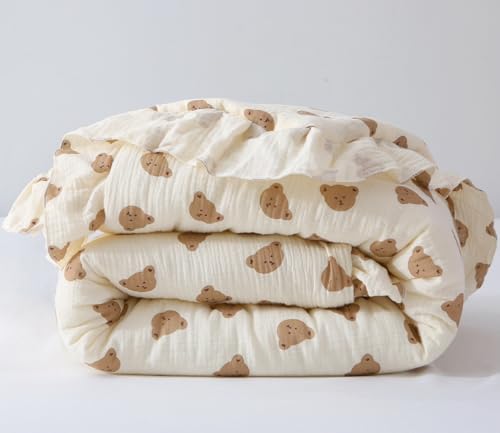
CLoucl 100% Cotton Muslin Crib Comforter/Quilt, 41×48 — Best Overall
This is the blanket the category is supposed to produce: 100% cotton muslin, sized 41×48 — the true crib-blanket footprint — reversible, and machine washable, positioned by its own listing as an all-season toddler blanket. Muslin earns the lead on breathability: its open, crinkled weave lets air move, which matters for toddlers, who are famously poor thermostat managers and kick off anything that overheats them by 2 a.m. A blanket a toddler keeps on is warmer in practice than a heavier blanket on the floor.
The 41×48 size deserves the arithmetic the other picks will be judged by: a standard crib mattress is about 28×52, so this blanket covers the width with drape to spare and runs most of the length — enough to cover a sleeping toddler fully, tuck loosely at the foot of a toddler bed, and still work as the couch nap blanket on weekends. Cotton muslin also softens with washing rather than degrading, and it will be washed constantly: toddler blankets absorb spills, sickness and the occasional marker incident, and a blanket that cannot go in the machine on a normal cycle is a blanket with a short career.
Reversibility is a small feature with a long payoff: two looks extend the blanket’s welcome in the room, and when one side is in the wash-stained penalty box mid-week, the other presents. For winter in a cold house, treat this as the breathable base and add room warmth or a warmer sleep outfit rather than piling on a second loose blanket — one blanket, well chosen, is the system.
Strengths
- True crib size (41×48) in breathable 100% cotton muslin
- Machine washable and softens with washing — built for toddler laundry reality
- Reversible, all-season positioning covers the most months of the year
Trade-offs
- Breathable muslin is not a heavy winter blanket on its own
- Cotton muslin wrinkles and crinkles by design — not a crisp look
- One blanket per purchase; rotation spares are on you
| Fiber (per Amazon title) | 100% cotton muslin |
| Size | 41 x 48 inches |
| Style | Comforter/quilt, reversible |
| Care | Machine washable |
| Season | All season (per listing) |
Best for: The main crib or toddler-bed blanket — breathable, all-season, right-sized / Not suited for: Cold rooms in winter as the only layer — muslin is breathable, not heavy
Check on Amazon — check the current price on Amazon before you decide.
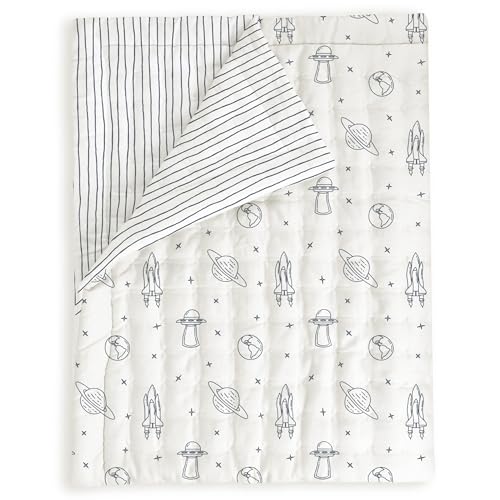
MakeMake Organics Organic Toddler Comforter, GOTS Certified, 44×60 — Best Organic
Organic claims in baby textiles often certify the cover and go quiet about the inside. This MakeMake comforter states both in its listing: GOTS-certified organic cotton and cotton infill — the fill is cotton, not an unstated synthetic — and that completeness is exactly what an organic buyer is paying for. GOTS, stated precisely, certifies organic production standards for the textile; it is a sourcing guarantee, not a softness or safety certification, and this guide credits it as the real thing it is and nothing more.
At 44×60 this is the largest blanket in the roundup, and the size cuts both ways honestly. On a toddler bed it is generous — full coverage, drape, room to grow, and a second life as the reading-couch blanket. In a standard crib it is more blanket than the space wants, and excess fabric in a crib is untidy at best; this pick is aimed at the toddler-bed transition and at families buying once for the whole toddler-to-preschool span. The tufted, reversible construction (astronaut print on one face, blue pebble on the other) keeps it from reading as a plain utility blanket in a styled nursery.
Breathability is claimed in the listing and is consistent with an all-cotton build — shell and fill in the same natural fiber behave predictably in the wash and across seasons. For the organic-committed household, this is the pick that does not require a follow-up question about what is inside, which is rarer in this category than it should be.
Strengths
- GOTS-certified organic cotton with cotton infill — both layers stated and natural
- 44×60 generous size spans toddler bed through preschool
- Tufted reversible design in a nursery-friendly print pairing
Trade-offs
- Oversized for a standard crib — best at the toddler-bed stage
- Organic, fully-cotton construction is the premium tier (check price on Amazon)
- A single large blanket is a bigger laundry load than the muslin picks
| Fiber (per Amazon title) | Organic cotton, GOTS certified |
| Fill (per Amazon title) | Cotton infill |
| Size | 44 x 60 inches |
| Style | Tufted, reversible (Astronaut + Blue Pebble) |
Best for: Families prioritizing certified-organic textiles — with the fill verified too / Not suited for: Standard cribs where 60 inches of length is more blanket than the bed needs
Check on Amazon — check the current price on Amazon before you decide.

ZPECC Muslin Toddler Blanket, 8 Layers of Organic Cotton, 47×47 — Best Layered Muslin
If the CLoucl is muslin at its airiest, the ZPECC is muslin with the volume turned up: eight layers of organic cotton muslin in a 47×47 square, which stacks the same breathable fiber into a noticeably thicker, cozier quilt. Layered muslin is a clever construction — the air between layers insulates while the cotton itself stays breathable — and it gives this blanket a working range from nap-time couch to a cool bedroom, in a square format that folds neatly for the daycare cot bag the listing explicitly names.
The 47×47 square is a deliberate shape: it covers a toddler on a crib or cot diagonally with room to spare, doubles as a stroller blanket without trailing, and folds to a compact square for travel. Eight layers also means eight layers to dry — this is the slowest-drying pick among the cotton blankets here, and households without a dryer should plan the wash day accordingly. The listing describes the blanket as hypoallergenic; this guide records that as the maker’s description of its organic cotton construction, not as a medical claim, and allergy households should treat it as materials information only.
The butterfly design and gift-box presentation make this the present-buyer’s muslin: it arrives looking like a considered gift while being, underneath, a serious eight-layer working blanket. For a warm-climate nursery, step back to the lighter CLoucl; for a cool house or a winter toddler, this is the muslin to buy.
Strengths
- Eight layers of organic cotton muslin — muslin breathability with real warmth
- 47×47 square suits crib, cot and stroller without trailing
- Gift-ready presentation on a genuinely functional blanket
Trade-offs
- Thick layered construction dries slowly after washing
- Warm — too much blanket for hot sleepers and summer in warm climates
- Square format drapes differently than rectangular crib blankets some parents expect
| Fiber (per Amazon title) | Organic cotton muslin, 8 layers |
| Size | 47 x 47 inches |
| Style | Layered quilt/blanket, butterfly design |
| Use (per listing) | Crib, stroller, daycare cot |
Best for: A thicker, cozier muslin for cooler rooms and daycare cots / Not suited for: Hot sleepers and warm climates — eight layers is real insulation
Check on Amazon — check the current price on Amazon before you decide.

CARUILI Toddler Blanket, Minky with Dotted Backing, 50×60 — Best Warm and Soft
Some blankets are equipment; this one is a possession. The CARUILI is a 50×60 minky blanket — the plush, dotted-backing construction toddlers stroke, carry and refuse to sleep without — sized generously enough to serve as a toddler bed’s full blanket and a couch fort’s roof in the same day. The purple animals print is aimed squarely at the child, not the nursery’s color scheme, and in this category that is often the correct priority: the blanket a toddler loves is the blanket that stays on the bed.
Honesty about material: minky is a plush synthetic-feel fabric, and this guide will not dress it in cotton language. Its virtues are warmth, softness and durability through washing; its cost is breathability — minky traps more heat than muslin, which is a feature in a cool room in January and a flaw for a hot sleeper in July. The dotted backing is more than a texture: the raised dots give small hands something to hold and rub, the self-soothing behavior these blankets are famous for, and the two-face construction (print plush one side, dots the other) gives the blanket a cooler and warmer face to flip between.
At 50×60 it is, like the MakeMake, a toddler-bed-first size — generous in a crib. The fill is not stated in the listing title, and the spec box records that plainly rather than guessing; the blanket’s warmth comes from its plush construction as described. Wash it on a gentle cycle and dry it low or air-dry to keep the plush pile at its best.
Strengths
- 50×60 generous size with the minky softness toddlers attach to
- Dotted backing gives the tactile, self-soothing grip kids love
- Warm construction suits cool rooms and winter
Trade-offs
- Minky is a warm plush — not the breathable choice for hot sleepers
- Fill not stated in the listing title
- Print is child-forward; it will not match a minimalist nursery scheme
| Surface (per Amazon title) | Minky plush, purple animals print |
| Backing | Dotted minky backing |
| Size | 50 x 60 inches |
| Fill | Not stated in listing title |
Best for: Warmth and softness on a toddler bed — the blanket kids claim as theirs / Not suited for: Breathability-first buyers, or hot sleepers — minky is a warm plush
Check on Amazon — check the current price on Amazon before you decide.

Lukeight Toddler Blanket, Plush Dinosaur, 30×40 — Best Travel and Daycare Size
This pick is labeled by what it is not: at 30×40 inches, the Lukeight is not a full crib blanket, and any guide that sold it as one would be setting you up for a too-small disappointment. What it is — a thick plush dinosaur blanket in the travel size class — is genuinely useful: the car-seat and stroller blanket that does not drag on wheels or pavement, the daycare nap-mat blanket that fits the mat and the cubby, the spare that lives in the car for the unplanned nap. Every toddler household ends up owning this size; the only question is whether it was bought on purpose.
The dinosaur design and gift positioning in the listing tell you its other job: it is the birthday-present blanket, the one a grandparent can give without a registry. Plush construction keeps it soft and warm for its size, and 30×40 is the right span across a toddler’s legs in a stroller or over a nap mat. In the crib at home it can serve as a light top layer in a warm room for an older toddler — but the main crib blanket should be one of the 41×48-and-up picks above, and this guide’s comparison table keeps the size difference in plain view.
Small blankets wash and dry fastest of anything in this roundup, which suits their role: the travel blanket meets the most spills and the most playground, and it can be laundered and back in the car the same day. Buy it as the second blanket and it will be the hardest-working one you own.
Strengths
- Right-sized for stroller, car seat and daycare nap mat
- Thick plush warmth in a fast-washing, fast-drying size
- Dinosaur design makes it the giftable, claimable spare
Trade-offs
- 30×40 does not cover a crib or toddler bed — not a main blanket
- Plush warmth is too much for summer travel in hot climates
- Design-led pick: plain households may prefer the HOMRITAR’s nursery prints
| Surface (per Amazon title) | Plush, thick |
| Size | 30 x 40 inches |
| Design | Dinosaur |
| Positioning | Travel/daycare/nap size — not full crib coverage |
Best for: Car seat, stroller, daycare nap mat and travel — the second blanket, not the crib blanket / Not suited for: Full crib coverage — 30×40 is honestly too small, and this guide says so
Check on Amazon — check the current price on Amazon before you decide.

HOMRITAR Baby Blanket for Kids, Minky with Dotted Backing, Dinosaurs, 30 Inch — Best Small Nursery Blanket
The HOMRITAR closes the roundup at the smallest size, and it is presented that way on purpose: a roughly 30-inch minky blanket with the same dotted-backing construction as the CARUILI, in a multicolor dinosaur print for the nursery. Its honest jobs are the stroller, the car seat, the rocking-chair nap and the extra layer — the blanket that lives where the toddler is, rather than the blanket that covers the toddler’s bed. Households building the full system often own exactly this pairing: a true crib-size blanket for the bed, and a small minky for everywhere else.
Why include two minky picks? Because they are different sizes doing different work — the CARUILI at 50×60 is a bed blanket; this HOMRITAR at about 30 inches is a carry blanket — and the guide distinguishes them by size in every table rather than pretending they are interchangeable. The minky-with-dots construction at this size is at its best: soft enough for a cheek, textured enough for small fingers, and small enough to wash constantly without a laundry event. The multicolor print hides the evidence of its working life better than any pastel.
A sizing caution stated plainly: the listing gives the size as ’30 Inches’ without a full dimension pair, so treat this as the small class and confirm the exact dimensions on the listing if a precise fit matters — for a stroller or lap blanket, the class is what counts. As a shower or first-birthday gift within its honest role, it is an easy, useful present.
Strengths
- Minky dotted construction in the handy small size class
- Multicolor print camouflages a hard working life
- Ideal stroller, car-seat and rocking-chair companion blanket
Trade-offs
- Smallest pick — not a crib or bed blanket
- Listing states a single 30-inch dimension, not a full size pair
- Minky warmth is a cool-weather asset and a warm-weather limit
| Surface (per Amazon title) | Minky, dotted backing |
| Size | 30 inches (per listing title) |
| Design | Dinosaurs, multicolor |
| Positioning | Small nursery/stroller blanket |
Best for: Nursery, stroller and tummy-time-to-toddler layering at the small end / Not suited for: Anyone shopping for the main crib blanket — this is the smallest pick here
Check on Amazon — check the current price on Amazon before you decide.
Comparison Table
| Pick | Badge | Key spec | Best for | Link |
|---|---|---|---|---|
| CLoucl 100% Cotton Muslin Crib Comforter/Quilt, 41×48 | Best Overall | 100% cotton muslin, 41×48 in, reversible, machine washable | The main crib or toddler-bed blanket — breathable, all-season, right-sized | Check on Amazon |
| MakeMake Organics Organic Toddler Comforter, GOTS Certified, 44×60 | Best Organic | GOTS-certified organic, cotton infill, 44×60 in, tufted reversible | Families prioritizing certified-organic textiles — with the fill verified too | Check on Amazon |
| ZPECC Muslin Toddler Blanket, 8 Layers of Organic Cotton, 47×47 | Best Layered Muslin | 8-layer organic cotton muslin, 47×47 in | A thicker, cozier muslin for cooler rooms and daycare cots | Check on Amazon |
| CARUILI Toddler Blanket, Minky with Dotted Backing, 50×60 | Best Warm and Soft | Minky plush with dotted backing, 50×60 in | Warmth and softness on a toddler bed — the blanket kids claim as theirs | Check on Amazon |
| Lukeight Toddler Blanket, Plush Dinosaur, 30×40 | Best Travel and Daycare Size | Plush, 30×40 in, dinosaur design | Car seat, stroller, daycare nap mat and travel — the second blanket, not the crib blanket | Check on Amazon |
| HOMRITAR Baby Blanket for Kids, Minky with Dotted Backing, Dinosaurs, 30 Inch | Best Small Nursery Blanket | Minky with dotted backing, ~30 in, multicolor dinosaur print | Nursery, stroller and tummy-time-to-toddler layering at the small end | Check on Amazon |
Safe Sleep and the Toddler Blanket: Where the Line Actually Is
This guide’s safety framing follows the widely published safe-sleep consensus, stated plainly and without embellishment. For infants under 12 months: back to sleep, a firm flat mattress, and a bare crib — no loose blankets, pillows or soft objects. Warmth at that stage comes from the room and from wearable blankets (sleep sacks), which cannot cover a face. The blankets in this roundup enter the story after that stage, for toddlers — and the transition is about the child’s development, not just the calendar: a toddler who can move freely, push a blanket away and is transitioning to a toddler bed is the child these products are made for.
Three related rules travel with that line. Swaddling stops when a baby shows signs of attempting to roll — a swaddled baby who rolls cannot use their arms to recover position — which is why swaddles are excluded from this toddler roundup entirely. Weighted blankets are never for infants, and should not be used for any toddler who cannot remove the blanket themselves; no pick here is weighted, deliberately. And blankets in the crib of a climbing toddler are a reason to move to a toddler bed on schedule, since a blanket can become a climbing aid — the blanket is part of the transition plan, not a reason to delay it.
Within the toddler stage, blanket choice still carries the safety-relevant variables this guide scores: breathability (a toddler who overheats kicks the blanket off, defeating it), appropriate size (enough to cover, not so much that it tangles), and one-blanket simplicity. Nothing in this section is medical advice — it is the standard public guidance, and any family whose child has specific medical circumstances should follow their pediatrician’s direction over any shopping guide.
How to Choose a Toddler Crib Blanket: Fiber, Fill and Size
Size first, with numbers. A standard crib mattress is roughly 28×52 inches. A blanket of about 41×48 covers a toddler fully with modest drape; 44×60 and 50×60 are toddler-bed sizes that will look and feel generous in a crib; 30×40 and below are travel and nap sizes that cannot do the crib job. Decide which job you are buying for before you fall for a print — most disappointment in this category is a size mismatch wearing a cute design.
Fiber and fill second, read as two separate lines. Muslin cotton is the breathable all-season construction, airier in a single layer (CLoucl) and warmer in eight layers (ZPECC) — same fiber, different architecture. An all-cotton build with cotton infill (MakeMake) is the certified-organic route, with shell and fill in one natural fiber. Minky plush (CARUILI, HOMRITAR) is the warmth-and-softness route: a synthetic-feel plush that toddlers adore and that breathes less than cotton. Where a listing does not state a fill, this guide’s spec boxes say so — never let a virtuous surface fiber make you assume the inside matches it.
Washability third, and treat it as a performance spec. A toddler blanket will be washed weekly at best and urgently at worst, in hot water, for years. Cotton muslin improves with that treatment; layered muslin needs drying time; minky wants a gentle cycle and modest heat to keep its pile. The blanket that survives your laundry reality is the right blanket, whatever its other virtues.
Building the Toddler Sleep Setup: Blanket, Bed and Beyond
The blanket is one component of the toddler sleep transition, and it works best bought as part of the set. The typical sequence: wearable blankets through the first year; a crib blanket introduced after the first birthday when the child shows the mobility for it; the move to a toddler bed when climbing begins, with the same blanket providing continuity across the change. Keeping the blanket constant while the bed changes is a genuinely useful trick — the familiar object carries the sleep association into the new bed, and many families find the transition goes easier with the blanket as the bridge.
Rotation is the practical system: two crib blankets minimum, so one is always in service while the other is in the wash — the same two-towel logic as every other kid textile. Add the small travel blanket (the Lukeight or HOMRITAR role) as the third piece and the system covers bed, daycare, car and grandparents’ house without the main blanket ever leaving home. Label daycare blankets with the child’s name; identical dinosaur prints are a genre, not a coincidence, and cubbies mix them up weekly.
- Keep one blanket in the crib or bed — the system is a single blanket, not a pile.
- Wash new blankets before first use to remove factory finishes and loose fibers.
- Retire a blanket that is fraying, thinning or shedding its backing dots — condition, not age, is the retirement rule.
Washing Toddler Blankets: The Laundry Reality Section
A toddler blanket’s true specification is its wash count. Between spit-up’s successors — spilled milk, stomach bugs, potty-training accidents, the mystery stickiness of a Tuesday — the main crib blanket will be washed more in two years than your own bedding is in ten, and it will often be washed at 11 p.m. against a bedtime deadline. Choose constructions that treat that as normal: cotton muslin that tolerates hot water and emerges softer, layered muslin that needs a full dry cycle planned in, minky that keeps its pile on gentle cycles and low heat. Wash every new blanket before first use to clear factory finishes and loose fibers, and keep a plain, fragrance-light detergent as the blanket standard — heavily scented products on a sleep textile are an irritant risk with no upside.
The rotation system from the previous section is what makes the laundry survivable: two main blankets alternating means a wash is never an emergency, and the travel blanket doubles as the emergency spare on the night both mains are somehow in the machine — a night every toddler household eventually has. Inspect blankets in the wash cycle, not in the crib: seams, fraying edges and, on dotted minky, the condition of the backing are easiest to judge wet and in good light. A blanket that is thinning or shedding gets retired to car duty, not kept in the sleep space out of sentiment.
How to Introduce a First Crib Blanket to a Toddler
A first blanket goes better as a short, deliberate introduction than as a surprise at bedtime. This sequence works for most families over about a week.
- Confirm the stage first: the child is past 12 months, moves freely in sleep, and can push a blanket off. If any of those is not true, stay with a wearable blanket and revisit later — the blanket will keep.
- Start at nap time, not the night sleep: introduce the blanket for the daytime nap, when the sleep stakes are lowest and you can observe how the child uses it.
- Let the child handle the blanket awake first — carry it, sit with it at breakfast, bring it to story time. Familiarity during the day is what makes it a comfort object rather than a novelty to play with at midnight.
- Place it over the child’s legs and torso once they are settled and drowsy, not over a wide-awake toddler who will treat it as a game. One blanket, no extras, in a room at a comfortable temperature.
- Check after the child is asleep for the first few nights: most toddlers kick the blanket off or migrate out from under it, which is normal and safe at this stage — the blanket is for comfort, and a toddler in a properly dressed sleep outfit does not depend on it for warmth.
- After a week of naps and nights, the blanket is simply part of the bed. Move it with the child to the toddler bed when that transition comes, unchanged — continuity is its superpower.
If the introduction stalls — the child rejects the blanket or treats it purely as a toy — shelve it for a month and retry. Toddlers adopt blankets on their own schedule, and a wearable blanket remains the right tool in the meantime.
Common Buying Mistakes
Putting a loose blanket in with an infant under 12 months. The safe-sleep consensus is unambiguous: bare crib, back sleeping, no loose blankets for infants. Wearable blankets exist for that stage. This roundup is for toddlers, and its first job is keeping that line bright.
Buying a swaddle or weighted blanket for a toddler by mistake. Swaddles are infant products with a stop-at-rolling rule; weighted blankets are never for infants and not for toddlers who cannot remove them. Neither appears in this guide, and listings that blur the categories should be read with care.
Judging by the print and missing the size. A 30-inch blanket and a 50×60 blanket share shelf space and the word ‘blanket’. One covers a stroller ride; the other covers a toddler bed. The dimensions are in every spec box here because size is the category’s number-one disappointment.
Assuming the inside matches the outside. An organic or cotton surface can hide an unstated fill. The MakeMake pick states cotton infill explicitly; where a listing is silent, the spec box here says ‘not stated’ — carry that habit to any blanket you buy beyond this guide.
One blanket, no rotation. A toddler blanket is washed constantly and always at the worst moment. Two in rotation is the minimum viable system; a single blanket guarantees a bedtime with a damp blanket eventually. Rotation also halves each blanket’s wash count across the year, which is the difference between a blanket that lasts the whole toddler stage and one that thins out by the second winter — buy the pair together if you can, in the same size, so the swap is invisible to the child.
Final Recommendation
For most families, start with the CLoucl 41×48 muslin comforter: true crib size, breathable 100% cotton, machine washable, all-season — the blanket that simply does the job for the longest stretch of toddlerhood. Choose the MakeMake instead if certified-organic construction with a stated cotton fill is your household’s standard, sizing it for the toddler bed; choose the ZPECC if you want muslin’s breathability with more warmth for a cool house. The CARUILI is the warm minky a toddler will claim as a possession, and the Lukeight and HOMRITAR complete the system as the travel and everywhere-else sizes — bought honestly as small blankets, not as crib blankets.
And keep the boundary this guide opened with, because it matters more than any pick: blankets are for toddlers past the first year who can move and push them away; before that stage, the wearable blanket is the right product and the crib stays bare. Buy for the stage your child is in, in the size their bed actually is, and the blanket will do its quiet work for years.
Start with CLoucl 100% Cotton Muslin Crib Comforter/Quilt, 41×48, MakeMake Organics Organic Toddler Comforter, GOTS Certified, 44×60, ZPECC Muslin Toddler Blanket, 8 Layers of Organic Cotton, 47×47 — check price on Amazon for each and compare against the notes above.
Related guides on this site: Best Infant Wearable Blankets; Best Organic Soft Blankets For Toddlers; Best Baby Blankets Organic; Best Baby Stroller Blankets.
Frequently Asked Questions
When can a baby start sleeping with a crib blanket?
Mainstream safe-sleep guidance puts loose blankets out of the crib for the first 12 months — infants sleep on their backs in a bare crib, with wearable blankets for warmth. Past the first birthday, as a toddler who moves freely and can push a blanket away, a crib blanket becomes appropriate, which is the stage every pick in this guide is for. When in doubt about your own child’s timing, your pediatrician’s guidance outranks any shopping guide.
What size should a toddler crib blanket be?
About 41×48 inches is the true crib-blanket size for a standard 28×52 crib mattress — full coverage with modest drape. Sizes like 44×60 and 50×60 are toddler-bed blankets: generous in a crib, ideal at the bed transition. Blankets of 30×40 and under are travel, stroller and nap sizes; they cannot cover a sleeping toddler in a crib, and this guide labels them accordingly.
Are weighted blankets safe for toddlers?
Not for infants under any circumstances, and not for any toddler who cannot remove the blanket themselves. That is why no weighted blanket appears in this roundup. If a weighted blanket is ever considered for an older child, it should be with pediatric guidance and sized to the child — it is a specialist product, not a warmer blanket.
Is muslin or minky better for a toddler blanket?
They suit different sleepers. Muslin cotton breathes — a single-layer muslin (CLoucl) is the all-season default, and layered muslin (ZPECC) adds warmth while staying cotton. Minky plush (CARUILI, HOMRITAR) is warmer and softer to the touch, the construction toddlers attach to, but it breathes less and suits cool rooms and cold sleepers. Hot sleepers and warm climates belong in muslin; cold rooms and blanket-clutchers belong in minky.
What does GOTS certification on the MakeMake blanket actually mean?
GOTS is a certification of organic production — it verifies that the textile was grown and processed to organic standards. It is a sourcing and production guarantee, not a claim that the blanket is softer, warmer or medically safer. The MakeMake also states cotton infill, so both its layers are accounted for, which is the complete version of what an organic buyer is looking for.
How many crib blankets should I buy?
Two in the main crib size, in rotation, because a toddler blanket is washed constantly and always urgently. Add one small travel-size blanket for the car, stroller and daycare, and the system is complete. More than that is collecting; fewer guarantees a bedtime standoff with a washing machine.


