Disclosure: airfryerkitchensupply.com is reader-supported. When you buy through links on our site, we may earn an affiliate commission at no extra cost to you.
Where to buy
Every pick below was confirmed through this site’s verified Amazon listing data cache before receiving a link, and sizes, age ranges and TOG values are quoted exactly as the listings state them. This is a guide to the best infant wearable blankets only — nothing else. Prices change, so picks carry check-price links instead of printed figures. One rule governs this entire guide: every pick is a wearable blanket — a sleep sack or a sleepsack swaddle designed to be worn — because loose blankets do not belong in an infant’s crib. If a product was a loose blanket, however soft or beautiful, it is not in this guide.
- HALO Micro-Fleece Sleepsack Swaddle, Newborn 0-3 Months, TOG 3.0 — Check the current price on Amazon
- Yoofoss Baby Sleep Sack, 0-6 Months, 0.5 TOG, Organic Cotton, 3 Pack — Check the current price on Amazon
- BubblePanda Sleep Sack, Rayon from Bamboo, 1.0 Tog, 0-6 Months — Check the current price on Amazon
- HALO Velboa Wearable Blanket, TOG 1.5, Large, 12-18 Months — Check the current price on Amazon
- amo nenes Baby Sleep Sack, TOG 2.5, Removable Sleeves, 6-18 Months — Check the current price on Amazon
- Baby Sleep Sack, 100% Cotton Wearable Blanket, 0.5 Tog, 3 Pack, 0-6 Months — Check the current price on Amazon
The best infant wearable blankets solve a problem that loose blankets create. Babies need warmth at night; babies also kick, roll and pull fabric toward their faces, and a loose blanket in a crib is a hazard that safe-sleep guidance has warned against for decades. The wearable blanket — a sleeveless or sleeved sack that zips around the baby, with the head and arms free — delivers the warmth with nothing loose to migrate over a face. It cannot be kicked off at 3 a.m., which is the practical reason parents love it, and it cannot cover the airway, which is the safety reason it exists. Every pick in this guide is that product, in the sizes and warmth ratings (TOG) that real nurseries need.
Three safety anchors run through everything below, and they are not optional garnish. First: babies sleep on their backs, in a bare crib — the wearable blanket is worn, and nothing else soft goes in with them. Second: swaddle-style products, like the HALO Sleepsack Swaddle that leads this guide, are for the pre-rolling stage only — the moment a baby shows signs of rolling, swaddling stops, and the arms-out sleep sack takes over. Third: warmth is matched to the room with TOG ratings, because overheating is its own risk — a TOG 3.0 sack in a warm nursery is as wrong as a TOG 0.5 sack in a cold one. The reviews state each pick’s TOG and age range from its own listing, and the buying guide explains how to match them to your room.
A note on what was excluded, because in this category exclusion is the editorial act that matters most. Loose baby blankets, receiving blankets and swaddle wraps that are not wearable sacks were all excluded, however lovely — several verified in this site’s cache, all wrong for crib sleep. Weighted products were excluded entirely: weighted blankets are not for infants, full stop, and no weighted listing appears here in any form. This guide would rather be shorter than be careless, and at six verified wearable picks, it does not need to be either.
In this guide
Quick Picks
- Best for Newborns: HALO Micro-Fleece Sleepsack Swaddle, Newborn 0-3 Months, TOG 3.0 — a 3-way adjustable swaddle sack for the pre-rolling stage, in micro-fleece for cold rooms. Check price on Amazon
- Best Lightweight Set: Yoofoss Baby Sleep Sack, 0-6 Months, 0.5 TOG, 3 Pack — organic cotton per the listing, with a 2-way zipper, for warm rooms and summer. Check price on Amazon
- Best Mid-Season: BubblePanda Sleep Sack, 1.0 Tog, 0-6 Months — rayon made from bamboo, soft and breathable, with a 2-way zipper. Check price on Amazon
- Best for Older Babies: HALO Velboa Wearable Blanket, TOG 1.5, Large, 12-18 Months — a plush wearable blanket sized for the second half of the first year and beyond. Check price on Amazon
- Best for Winter: amo nenes Baby Sleep Sack, TOG 2.5, 6-18 Months — winter warmth with removable long sleeves, so the sack adjusts as the night cools. Check price on Amazon
- Best Cotton Value: Baby Sleep Sack, 100% Cotton, 0.5 Tog, 3 Pack, 0-6 Months — a lightweight cotton 3-pack with 2-way zippers for easy night changes. Check price on Amazon
How These Picks Were Chosen
Every product was cross-checked against Amazon’s catalogue through Amazon data held by this site; only listing-confirmed listings receive links. The first filter was categorical and absolute: the product must be a wearable blanket — a sleep sack or sleepsack swaddle — in an infant size. Loose blankets, receiving blankets, stroller blankets and wrap-only swaddles all failed this filter regardless of quality, because this guide is about crib sleep, and crib sleep is wearable or bare. The second filter was information quality: the listing had to state its size or age range and, wherever warmth mattered, its TOG — because a parent matching warmth to a nursery temperature needs numbers, not adjectives. All six picks state both.
Coverage was the third filter: the set spans the first eighteen months and the realistic TOG range — 0.5 for warm rooms, 1.0 for mid-season, 1.5 for cool rooms and older babies, 2.5 for winter, 3.0 for cold-climate newborns — so a reader can assemble a rotation without leaving the guide. Fabric variety (micro-fleece, cotton, rayon from bamboo, plush velboa) reflects real nursery preferences rather than a single brand’s catalogue; two HALO picks appear because HALO’s sleepsack range genuinely covers both the newborn swaddle stage and the 12-18 month stage with stated TOGs, and excluding the second for cosmetic brand diversity would have made the guide worse.
Safety framing was checked as carefully as products: this guide recommends back-sleeping, bare cribs, an end to swaddling at the first signs of rolling, and TOG matched to room temperature. It makes no medical claims beyond that standard safe-sleep guidance, and it excludes weighted products for infants without exception.
The 6 Best Infant Wearable Blankets

HALO Micro-Fleece Sleepsack Swaddle, Newborn 0-3 Months, TOG 3.0 — Best for Newborns
The Amazon listing describes a micro-fleece sleepsack swaddle — a 3-way adjustable swaddle blanket for newborns and infants, TOG 3.0 for cold climates, described as hip healthy, in gingham tan, sized newborn 0-3 months. HALO’s Sleepsack Swaddle is the category’s reference design: a wearable sack with adjustable swaddle wings, so the newborn gets the snug, contained feeling that settles the startle reflex, in a product that stays worn and positioned instead of unwrapping into loose fabric. The 3-way adjustability — arms in, hands to face, arms out — is also the transition mechanism: as the baby approaches rolling, the wings configure arms-out and the product becomes a plain sleep sack for its final weeks of use.
Strengths
- 3-way adjustable swaddle per the listing: arms-in for newborns, arms-out configuration ready for the pre-rolling transition
- TOG 3.0 micro-fleece is the warmest newborn option here — built for cold climates and cold nurseries, stated plainly
- “Hip healthy” positioning per the listing: the sack’s roomy bottom lets legs move and flex rather than binding them straight
Trade-offs
- TOG 3.0 is for cold rooms only — in a warm nursery this sack is too much, and the 0.5-1.0 TOG picks are the correct choice; overheating is a real risk, not a comfort preference
- Swaddling of any kind ends at the first signs of rolling, which can arrive well before 3 months — the size range is a ceiling, not a promise
- Micro-fleece is a synthetic; parents wanting natural fibres against newborn skin should choose the cotton picks
| Size | Newborn, 0-3 months (per Amazon title) |
| TOG | 3.0, for cold climates (per Amazon title) |
| Fabric | Micro-fleece (per Amazon title) |
| Design | 3-way adjustable swaddle sack (per Amazon title) |
| Colour | Gingham tan |
The newborn stage is where wearable blankets earn their existence. A newborn cannot regulate the loose-blanket problem at all, startles awake without containment, and sleeps in the room where parents can least afford hourly blanket patrols. A swaddle sack answers all three facts at once — worn warmth, adjustable containment, nothing loose — and HALO’s version is the one hospitals made famous, which is why it leads this guide despite the warmth caveat being so important: TOG 3.0 is a cold-climate tool, and the guide pairs it in the same breath with its lighter siblings.
Use it with the discipline the design invites: check the nursery’s actual temperature, dress the baby in a single light layer beneath in all but the coldest rooms, and move to arms-out at the first rolling signs — a baby who rolls swaddled cannot roll back, which is precisely the scenario the transition exists to prevent.
Best for: newborns in cold climates and cold nurseries, during the pre-rolling stage only. / Not suited for: warm rooms (choose 0.5-1.0 TOG), babies showing rolling signs with arms swaddled, or natural-fibre-only households. Check on Amazon
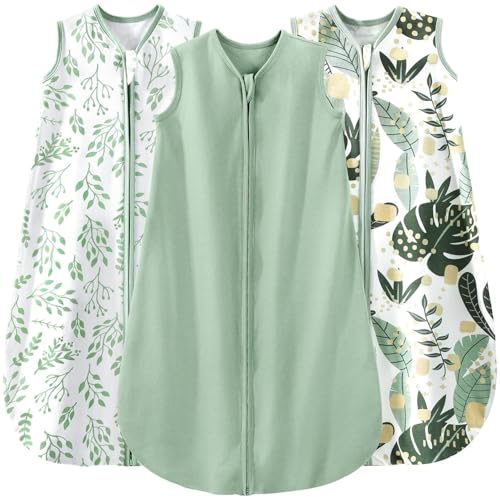
Yoofoss Baby Sleep Sack, 0-6 Months, 0.5 TOG, Organic Cotton, 3 Pack — Best Lightweight Set
Per the Amazon listing, this is a 3-pack of baby sleep sacks for 0-6 months at 0.5 TOG — 100% organic cotton per the listing, with a 2-way zipper — described as soft, lightweight wearable blankets. The 0.5 TOG rating makes this the warm-room pick: summer nurseries, heated homes, and babies who run warm. Three sacks in the pack is the quietly essential feature — night-time guarantees a spare is needed exactly when the main sack is in the wash, and a rotation of three is the difference between a system and a scramble.
Strengths
- 0.5 TOG lightweight cotton: the correct warmth for warm rooms and summer, where heavier sacks risk overheating
- 3-pack format builds the wash rotation into the purchase — one on, one clean, one spare
- 2-way zipper per the listing: night changes from the bottom without fully unzipping a sleeping baby
Trade-offs
- 0.5 TOG is warm-weather equipment only; a cool nursery needs the 1.0-2.5 TOG picks instead
- The listing claims organic cotton; parents for whom certification matters should look for the certification detail on the product page, since the title states the claim without naming a certifier
- 0-6 months is the fastest-outgrown size in babyhood — buy for the season you are in, not the one after next
| Size | 0-6 months (per Amazon title) |
| TOG | 0.5 (per Amazon title) |
| Fabric | 100% organic cotton (per Amazon title) |
| Pack | 3 pack (per Amazon title) |
| Zipper | 2-way (per Amazon title) |
The 2-way zipper deserves its paragraph, because at 3 a.m. it is the whole product. A sack that unzips from the bottom lets a parent change a nappy with the baby’s torso still covered and warm, in the dark, half-asleep — the difference between a five-minute resettle and a full wake-up. Across the hundreds of night changes in the 0-6 month window, that design detail returns more sleep than any fabric technology in this guide.
Cotton is the right warm-weather fibre for the same reason it leads adult summer bedding: it breathes, absorbs, and washes hot and often without complaint — and infant textiles are washed hotter and oftener than anything else in the house. A cotton 0.5 TOG rotation is the summer nursery, solved plainly.
Best for: warm rooms, summer babies, and parents building a wash rotation from one purchase. / Not suited for: cool or cold nurseries, or buyers needing named organic certification in the title. Check on Amazon

BubblePanda Sleep Sack, Rayon from Bamboo, 1.0 Tog, 0-6 Months — Best Mid-Season
The Amazon listing describes a sleep sack for 0-6 months at 1.0 tog — rayon made from bamboo — spanning newborn 0-3 months and 3-6 months sizing in the listing’s description, with a 2-way zipper, positioned as a soft baby wearable blanket. TOG 1.0 is the nursery’s middle gear: the rating for the in-between seasons and the average heated home, where 0.5 is skimpy and 2.5 is a winter coat. Rayon from bamboo is the fabric story — a smooth, breathable, temperature-balancing hand-feel that parents who find cotton plain and fleece synthetic tend to land on.
Strengths
- 1.0 tog is the most-used rating in temperate homes — the mid-season, average-nursery default
- Rayon from bamboo per the listing: soft, breathable and smooth against skin, with a cooler initial touch than cotton
- 2-way zipper for bottom-up night changes, and sizing that spans the 0-6 month window in the listing
Trade-offs
- Rayon fabrics reward gentler washing than cotton; follow the label if you want the surface to stay silky
- 1.0 tog still needs judgement at the edges: a genuinely cold room wants 2.5, a heatwave wants 0.5 — mid-season means mid-season
- Single-sack purchase: build the rotation with a second sack if night laundry is not your love language
| Size | 0-6 months (per Amazon title) |
| TOG | 1.0 (per Amazon title) |
| Fabric | Rayon made from bamboo (per Amazon title) |
| Zipper | 2-way (per Amazon title) |
If a household buys only one warmth rating beyond a newborn swaddle, it should usually be this one. Spring and autumn nurseries, and winter nurseries in well-heated homes, live at 1.0 tog temperatures for most of the year, and the sack that matches the median condition is the sack that gets worn nightly while the extremes wait in the drawer. The bamboo-rayon surface is also the connoisseur’s texture in this category — noticeably smoother than cotton at the same weight — and babies, who experience the world substantially through skin, are not indifferent to the difference even if they cannot review it.
Layering note: at the cool edge of 1.0 tog territory, a long-sleeved bodysuit beneath the sack is the correct adjustment — warmth is added on the baby, under the wearable, never as a loose blanket over it. That principle runs through this whole guide and is worth stating wherever a parent might improvise.
Best for: mid-season nurseries, average heated homes, and parents who prefer bamboo-rayon’s feel. / Not suited for: very cold or very warm rooms as the only sack, or hot-and-often laundry routines. Check on Amazon

HALO Velboa Wearable Blanket, TOG 1.5, Large, 12-18 Months — Best for Older Babies
Per the Amazon listing, this is a wearable blanket in velboa — an ultra-soft plushy dot sleep sack for newborns, infants and toddlers in the listing’s framing, with a hip-healthy design, machine washable, at TOG 1.5, in fawn grey, sized Large for 12-18 months. The second year changes the sleep-sack brief: the baby stands in the crib, cruises the rails, and treats bedtime as a contact sport. A wearable blanket for this stage must be roomy enough for a standing toddler’s legs, durable enough for nightly wrestling, and warm without restricting a child who may sleep in any orientation a small gymnast achieves.
Strengths
- Large 12-18 month sizing with a hip-healthy, roomy design per the listing — space for standing, stepping and sprawling
- TOG 1.5 plush velboa: the cool-room rating for the older-baby stage, in a soft dot texture toddlers themselves enjoy
- Machine washable per the listing — non-negotiable at an age where the sack meets dinner’s aftermath and teething’s everything
Trade-offs
- TOG 1.5 in plush fabric is a cool-room tool; warm nurseries should stay with the lighter ratings even at this age
- A determined toddler eventually learns zippers — if yours is an escape artist, this stage of any sack’s life is numbered, and the transition to a toddler blanket (outside the crib-safety brief of infancy, and outside this guide) approaches
- Plush velboa is synthetic; natural-fibre households will accept the trade for this stage’s durability or look to cotton in the right size
| Size | Large, 12-18 months (per Amazon title) |
| TOG | 1.5 (per Amazon title) |
| Fabric | Velboa plush (per Amazon title) |
| Care | Machine washable (per Amazon title) |
| Colour | Fawn grey |
The case for keeping a wearable blanket into the second year is consistency and containment: the sack remains the sleep signal (sack on, lights down, the routine a toddler’s body recognises), it cannot be kicked off by a child who sleeps like a windmill, and it keeps the crib bare and safe at an age when parents’ vigilance naturally relaxes. HALO’s hip-healthy roominess matters more at this stage than any other, because a standing, stepping toddler needs a sack that moves like clothing, not a bag that trips its wearer.
Fawn grey is also the grown-up colour choice in this guide — a neutral that survives the transition from nursery decor to toddler room without demanding a re-theme, and that hides the evidence of toddler life better than the pastels of the newborn stage.
Best for: 12-18 month olds in cool rooms, standing crib toddlers, and parents extending the sleep-sack routine into year two. / Not suited for: warm nurseries, or toddlers who have already mastered escaping zippered sacks. Check on Amazon

amo nenes Baby Sleep Sack, TOG 2.5, Removable Sleeves, 6-18 Months — Best for Winter
The Amazon listing describes a baby sleep sack at TOG 2.5 — a winter wearable blanket with removable long sleeves, for infants and toddlers, described as super soft, warm and comfortable, in blue-white stripes, sized 6-18 months. The removable sleeves are the design intelligence here: winter nights are not uniformly cold, and a sleeved sack at 2.5 TOG can be tuned — sleeves on for the cold small hours, off for a milder evening — without changing the whole sleep system or waking the baby to do it. Sleeves on a wearable sack are safe in a way loose layers never are, because they are part of the worn garment.
Strengths
- TOG 2.5 winter rating for the 6-18 month stage — the cold-room counterpart to the HALO Velboa’s 1.5
- Removable long sleeves per the listing: adjustable warmth across a winter night and across the season’s mild spells
- The 6-18 month size spans two winters’ worth of growth for many babies — the best longevity window in this guide
Trade-offs
- 2.5 TOG with sleeves is the warmest configuration here after the newborn fleece — in a heated nursery it will overheat a baby; room temperature decides, always
- Removable parts are losable parts; a detached sleeve in the laundry is a rite of passage, so keep the pair together in the wash
- Blue-white stripes is the verified colourway — charming, but not the neutral some nurseries want
| Size | 6-18 months (per Amazon title) |
| TOG | 2.5, winter (per Amazon title) |
| Design | Removable long sleeves (per Amazon title) |
| Colour | Blue-white stripes |
Winter is where TOG discipline pays its rent. Parents feel a cold room, panic warmly, and reach for layers — and the safe version of that instinct is exactly this product category: warmth built into the worn sack, rated by TOG, adjusted by sleeves and by what the baby wears beneath. The unsafe version — a blanket over a sleeping baby — is the thing this entire guide exists to replace. A 2.5 TOG sleeved sack over a long-sleeved bodysuit handles genuinely cold nurseries while keeping the crib bare, the baby’s face clear, and the warmth attached to the baby rather than to the mattress.
The 6-18 month span also makes this the gift pick of the guide: it fits the baby who has outgrown the newborn swaddle stage, it serves the season parents worry about most, and its adjustability forgives the giver for not knowing the nursery’s exact temperature.
Best for: cold nurseries and winter babies from 6 months, and gift-givers. / Not suited for: heated warm nurseries, or the newborn stage below its stated size. Check on Amazon

Baby Sleep Sack, 100% Cotton Wearable Blanket, 0.5 Tog, 3 Pack, 0-6 Months — Best Cotton Value
Per the Amazon listing, this is a 3-pack of baby sleep sacks for 0-6 months at 0.5 tog — 100% cotton wearable blankets, lightweight infant sleeping bags with a 2-way zipper for easy changes, described as soft and breathable. The listing does not name a brand in its title, and this guide does not invent one: it is included because its stated specification — cotton, 0.5 tog, 3-pack, 2-way zipper, correct size window — matches the warm-room brief exactly, and its role here is the honest value rotation for parents who want the Yoofoss pattern in a plain cotton claim without the organic positioning.
Strengths
- 100% cotton at 0.5 tog: the breathable warm-room specification, in the 3-pack rotation format
- 2-way zipper per the listing for bottom-up night changes — the feature that matters at 3 a.m.
- Unbranded simplicity: the specification is the product, with nothing spent on a name
Trade-offs
- No brand is stated in the Amazon title — buyers who prefer an established name should choose the Yoofoss or HALO picks
- 0.5 tog is warm-room only, like every lightweight pick here
- With an unbranded listing, check the product page’s size chart carefully against your baby’s length and weight before ordering
| Size | 0-6 months (per Amazon title) |
| TOG | 0.5 (per Amazon title) |
| Fabric | 100% cotton (per Amazon title) |
| Pack | 3 pack (per Amazon title) |
| Brand | Not stated in Amazon title |
Why carry two 0.5 TOG cotton 3-packs in one guide? Because they answer two different buyers honestly. The Yoofoss leads with an organic cotton claim for parents who shop on that claim; this pack is for parents who want the same rotation, fibre and warmth rating as a plain specification at the value end. Both were verified; both state what they are; the choice between them is a values-and-budget choice, and a guide serves its readers by presenting it cleanly rather than by pretending one of them does not exist.
Whichever warm-room pack a household chooses, the system advice is identical: three sacks in rotation, washed as hot as the label allows, with the room’s temperature — not the calendar — deciding whether 0.5 tog is tonight’s rating.
Best for: value-focused parents building a warm-room cotton rotation. / Not suited for: brand-loyal buyers, or cool nurseries needing higher TOG. Check on Amazon
Comparison Table
| Pick | Badge | Key spec | Best for |
|---|---|---|---|
| HALO Sleepsack Swaddle, Newborn | Best for Newborns | TOG 3.0, 3-way adjustable swaddle, 0-3M | Cold-climate newborns, pre-rolling |
| Yoofoss Sleep Sack, 3 Pack | Best Lightweight Set | 0.5 TOG organic cotton, 0-6M | Warm rooms and summer |
| BubblePanda Sleep Sack | Best Mid-Season | 1.0 tog rayon from bamboo, 0-6M | Average heated nurseries |
| HALO Velboa Wearable Blanket | Best for Older Babies | TOG 1.5, Large 12-18M, washable | Year-two crib sleepers |
| amo nenes Sleep Sack | Best for Winter | TOG 2.5, removable sleeves, 6-18M | Cold nurseries in winter |
| Cotton Sleep Sack, 3 Pack | Best Cotton Value | 0.5 tog cotton, 0-6M, 2-way zip | Value warm-room rotation |
Key Takeaways
- Wearable blankets only: loose blankets do not belong in an infant’s crib — every pick here is a sleep sack or sleepsack swaddle that is worn by the baby.
- Back to sleep, bare crib: the sack is the warmth, and nothing else soft goes in with the baby at any point during the night.
- Stop swaddling at the first signs of rolling; switch to an arms-out sack from that night onward, without waiting for a completed roll.
- Match TOG to room temperature: 0.5 for warm rooms, 1.0 mid-season, 1.5 cool rooms, 2.5 winter, 3.0 cold-climate newborns — overheating is a genuine risk, not a comfort issue.
- No weighted blankets for infants, in any form, ever — none appear in this guide.
- Buy the rotation, not the single sack: two per size-and-TOG at minimum, three for a sane laundry life through the fastest-growing year of your child’s life.
- Check warmth at the baby’s chest or the back of the neck, never by hands and feet, which normally run cool even when the baby is perfectly warm.
How to Choose an Infant Wearable Blanket
Start with the room, because TOG follows temperature. Measure your nursery at cot height on a typical night — not the hallway thermostat’s opinion, the room’s reality. As a working guide used across the sleep-sack industry: warm rooms (around 24°C / 75°F and above) call for 0.5 TOG; mild rooms (roughly 20-23°C / 68-73°F) for 1.0 TOG; cool rooms (roughly 16-19°C / 61-66°F) for 1.5-2.5 TOG depending on what the baby wears beneath; and genuinely cold rooms for the 2.5-3.0 TOG values with appropriate layers under the sack. When between ratings, dress the baby in one more layer beneath a lighter sack rather than jumping a full TOG — warmth should be adjustable in small steps, and the layer under the sack is the fine adjustment. Always check the baby’s chest or back of neck for warmth rather than hands and feet, which run cool normally.
Second, size by the baby in front of you, using the listing’s stated age range as a guide and the baby’s length and weight as the truth. A sack must be roomy at the hips and legs — the hip-healthy roominess the HALO listings describe — and snug enough at the neck and armholes that a small baby cannot slip down inside it. Never buy two sizes up “to grow into”: excess fabric around the neck is a hazard, not an economy. The 0-6 month sacks will be outgrown on schedule; that is the correct cost of a safe fit, and the 3-pack rotations in this guide are priced and built with that reality in mind.
Third, the stage logic. Newborn, pre-rolling: a swaddle sack is appropriate, with an arms-out transition plan — the HALO Sleepsack Swaddle’s 3-way design exists for exactly this arc. Rolling onward: arms-out sacks only, sleeveless or sleeved, full stop. Standing and cruising: roomy sacks with leg freedom, like the 12-18 month HALO Velboa. At every stage the sack is worn over ordinary sleepwear, the crib stays bare, and the baby sleeps on their back — placed on their back, every time, even after they can roll themselves into other positions.
Finally, fabric and care, because infant textiles live hard. Cotton washes hottest and most often without complaint and breathes in warm rooms; rayon from bamboo feels smoothest and asks for gentler cycles; micro-fleece and velboa bring warmth and plushness for cold rooms and older babies. Buy at least two sacks per size-and-TOG you rely on — three is the comfortable rotation — because the night a sack is in the wash is the night it is needed.
How to Use a Sleep Sack Safely, Night by Night
The nightly routine is short and worth making automatic. First, check the room temperature and choose the TOG for tonight, not for the season in general — nurseries swing several degrees between a warm evening and the cold small hours, and the adjustable picks (the amo nenes’ removable sleeves, layering beneath the BubblePanda) exist to bridge that swing. Dress the baby in the base layer that matches: a short-sleeved bodysuit under a light sack in summer, a long-sleeved one under winter ratings. Zip the sack fully, confirm the neck and armholes sit correctly with no slipping room, and place the baby on their back in the bare crib.
For changes, use the 2-way zippers as designed — unzip from the bottom, change, re-zip — keeping the baby’s torso covered and the sleep association unbroken. For the swaddle sack, re-check the wrap’s snugness at the chest (you should fit two fingers between wrap and chest) and its looseness at the hips, and re-confirm every night that rolling has not begun: the first roll is often a night event, and the arms-out transition should happen at the first sign, not the first completed roll you happen to witness. Wash sacks as the labels direct, keep a clean spare within arm’s reach of the crib, and inspect zippers and seams weekly — a failing zipper on a sleep product is retired the day it is noticed, not the week after.
TOG Explained: The One Number That Runs This Category
TOG is a measure of thermal resistance — how much warmth a textile traps — borrowed from the duvet industry, where parents may already know it from their own bedding. For sleep sacks it is the single most useful number on the listing, because it converts “warm” from an adjective into a decision. The scale in this guide runs from 0.5 (a single light cotton layer, barely more than a sheet with a zipper) through 1.0 and 1.5 (the working middle) to 2.5 and 3.0 (genuine winter insulation). Each step is meaningful: the difference between 0.5 and 1.0 is roughly the difference between a summer nursery and a spring one, and the difference between 1.5 and 2.5 is a season.
Two subtleties keep parents out of trouble. First, TOG describes the sack, not the system: what the baby wears underneath adds warmth the TOG figure does not count, which is why this guide treats the base layer as the fine adjustment and the TOG as the coarse one. A 1.0 sack over a long-sleeved bodysuit in a cool room can equal a 1.5 sack over a vest — both are legitimate, and the adjustable combinations are safer than owning one very warm sack and using it at half its intended conditions. Second, rooms are not honest at thermostat height: measure at cot level, in the corner the crib actually occupies, on the coldest night of the week rather than the average one, and then dress for the small hours, when temperatures bottom out. Babies cannot add or remove their own layers; the TOG system is how parents do it for them, accurately, in advance. Every pick in this guide states its TOG in its listing — that is not an accident of selection, it is the selection.
Sleep Sacks by Stage: Newborn, Roller, Stander
The first stage is containment. In the newborn weeks, the startle reflex wakes babies who sleep beautifully the moment they are snug, and the swaddle sack — arms in, hips free — is the wearable answer. Its lifespan is defined by development, not by the calendar or the size chart: the first rolling sign ends it, and parents should expect that ending somewhere in the two-to-four-month window and hold the arms-out configuration ready. The second stage is the roller and the back-sleeper who travels the crib in spirals: arms-out sacks, sleeveless for freedom, in the TOG the room demands. This is the longest stage and the one the 0-6 month rotations in this guide serve — the stage where the 2-way zipper earns its keep nightly and where owning three sacks stops sounding like excess.
The third stage is the stander: the baby who pulls up on the rails, cruises, and occasionally sleeps standing’s aftermath in a heap. Sacks for this stage — the 12-18 month HALO Velboa is this guide’s example — need room at the legs for a standing child’s stride, zippers that survive determined investigation, and warmth that works on a body that will not stay under anything it is not wearing. Some toddlers transition out of sacks in this window and some happily wear them toward age two; both are normal, and the deciding voice is the child’s own escape artistry. What does not change across any stage is the frame around the product: back to sleep, bare crib, no loose layers, no weight. The products rotate; the principles do not, and a household that internalises the principles can shop any future category — toddler blankets included, when that day legitimately comes — with the same clear eyes this guide has tried to lend.
Common Buying Mistakes
The first and most serious mistake is putting a loose blanket in the crib “just for naps” or “only when we’re nearby” — the wearable blanket exists precisely because that reasoning fails; this guide contains no loose blankets and neither should the crib. The second is buying by age alone and ignoring TOG, so a baby sweats in a 3.0 sack in a heated flat or chills in a 0.5 in a cold house. The third is sizing up for economy, creating dangerous slack at the neck. The fourth is continuing to swaddle after rolling signs appear. The fifth is buying a single sack — the rotation always fails on the worst night. The sixth is assuming any product marketed with “blanket” and a baby picture is crib-safe: wraps, stroller blankets and weighted products all failed this guide’s filter, and they should fail yours too.
Final Recommendation
For a newborn in a cold home, start with the HALO Sleepsack Swaddle and plan its arms-out transition from day one. For most nurseries, build the core rotation from the BubblePanda 1.0 Tog for mid-season and a 0.5 TOG cotton 3-pack — the Yoofoss for its organic cotton claim, or the unbranded cotton pack for value — for warm nights. Add the amo nenes TOG 2.5 when winter or a cold nursery demands it, and graduate to the HALO Velboa Large as the second year begins. Match TOG to the room every night, keep the crib bare, and the system does the rest.
Related guides in this programme: Best Baby Blankets Organic, Best Baby Receiving Blankets, Best Baby Large Blankets, Best Baby Stroller Blankets.
Frequently Asked Questions
Are wearable blankets safer than loose blankets for infants?
Yes — that is their entire purpose. A wearable blanket is worn like clothing, so it cannot be kicked over the baby’s face or bunch around the airway, and safe-sleep guidance consistently directs parents to keep loose blankets out of the crib. Every pick in this guide is wearable for that reason, and loose blankets were excluded categorically.
What TOG sleep sack does my baby need?
Match it to the nursery’s measured temperature: about 0.5 TOG for warm rooms (24°C / 75°F and up), 1.0 for mild rooms, 1.5-2.5 for cool rooms depending on layers beneath, and 2.5-3.0 for genuinely cold rooms. Check the baby’s chest or the back of the neck — warm and dry is right; hot or sweaty means step down a layer or a TOG.
When should I stop swaddling my baby?
At the first signs of attempting to roll — which can arrive from around two months, well inside many products’ size ranges. Switch to an arms-out sleep sack immediately; a swaddled baby who rolls onto their stomach cannot roll back. The HALO Sleepsack Swaddle in this guide is designed with an arms-out configuration for exactly that transition.
Can my baby wear a sleep sack all year?
Yes, with TOG rotation: light 0.5 TOG cotton sacks for summer, 1.0 for the in-between seasons, and 2.5 (or the newborn 3.0) for cold rooms in winter. The sack itself is a year-round system; only its warmth rating changes. Many families keep two ratings in each size for exactly this reason.
Are weighted blankets or weighted sleep sacks OK for infants?
No. Weighted products are not for infants, and none appear in this guide in any form. Infant sleep should be unweighted, on the back, in a bare crib, with warmth provided by a correctly rated wearable blanket and appropriate clothing layers beneath it.
How many sleep sacks do I need?
Two per size-and-TOG as a minimum, three for comfort — one being worn, one clean, one for the inevitable 2 a.m. incident. The 3-pack picks in this guide (Yoofoss and the cotton value pack) build that rotation into a single purchase, which is why pack format features so strongly in the recommendations.
What should my baby wear under a sleep sack?
Ordinary sleepwear, adjusted to the room: a short-sleeved bodysuit under light TOGs in warm rooms, a long-sleeved bodysuit or sleepsuit under higher TOGs in cold ones. The layer beneath is the fine adjustment; the sack’s TOG is the coarse one. Never add a loose blanket over the sack — if the combination feels insufficient, the answer is the next TOG up or one more layer beneath, not fabric over a sleeping baby.


