Disclosure: airfryerkitchensupply.com is reader-supported. When you buy through links on our site, we may earn an affiliate commission at no extra cost to you.
Where to buy
Every pick in this guide to the best cordless backpack vacuums was checked against Amazon’s own catalog data before it earned a link. Use the short list below to jump straight to a product page and check the current price on Amazon, or read the full reviews first and decide with the comparison table in front of you. If a pick is described as unlinked, it is covered honestly in the text without a purchase link, because we could not confirm a matching live listing for it.
- Makita XCV17PG 18V X2 LXT (36V) Brushless Cordless 1.6 Gallon HEPA Filter Backpack Dry Vacuum Kit — Best Overall: check price on Amazon
- Sanitaire Transport Commercial Cordless Backpack Vacuum SC580A — Best Commercial Runtime Design: check price on Amazon
- DEWALT Cordless Backpack Shop Vac DXCVXA01B, 1 Gallon, 20V Max — Best Compact Shop Vac: check price on Amazon
- Makita XCV09PT 18V X2 LXT (36V) Brushless Cordless 1/2 Gallon HEPA Filter Backpack Dry Vacuum Kit — Best Lightweight: check price on Amazon
- Atrix VACBPAIC Cordless Backpack HEPA Vacuum — Best Specialist HEPA Pick: check price on Amazon
- Milwaukee M18 Fuel 3-in-1 Backpack Vacuum — Best for M18 Owners: check price on Amazon
The best cordless backpack vacuums solve two problems at once. The backpack format removes the canister-dragging, furniture-bumping inefficiency of conventional vacuums, and the cordless part removes the outlet-hopping, cord-snagging tax on every room. Together they are why professional crews clean stairs, offices, theatres and transport with backpacks: the work simply goes faster when the vacuum is worn and untethered. This guide compares six verified cordless models across the three battery philosophies in the category — professional tool platforms, a dedicated commercial system, and a filtration specialist — and is honest about the format’s real currency, which is runtime and carry weight, not headline suction.
A note on expectations: cordless backpacks are dry vacuums for maintained spaces and detail work, not replacements for corded machines on deep-pile restoration cleans. Matched to their work, they are transformative; matched wrongly, they are expensive. The picks below are matched carefully.
A word on who should not buy one, in fairness: if your cleaning is a weekly lap of one small flat, a cordless stick is lighter, cheaper and stored in a cupboard, and this guide will not pretend otherwise. Backpack vacuums earn their place across distance — many rooms, many stairs, many desks, or a building. The six picks below assume that workload and are judged by it.
In this guide
Quick Picks
If you only have a minute, these are the short answers. Each pick below earned its badge for a different reason, and the full reviews further down explain exactly who should buy it and who should skip it.
Makita XCV17PG 18V X2 LXT (36V) Brushless Cordless 1.6 Gallon HEPA Filter Backpack Dry Vacuum Kit — Best Overall. The professional standard: a brushless 36V (two 18V batteries) backpack with a 1.6-gallon HEPA-filtered canister and a full kit — the cordless backpack crews actually buy.
Sanitaire Transport Commercial Cordless Backpack Vacuum SC580A — Best Commercial Runtime Design. Built purely for commercial cordless work: dual 24V batteries, handheld controls and an adjustable wand — a transportable backpack for crews who clean all shift.
DEWALT Cordless Backpack Shop Vac DXCVXA01B, 1 Gallon, 20V Max — Best Compact Shop Vac. A 1-gallon backpack shop vac on DEWALT’s 20V Max platform with HEPA filtration and 2.0 peak HP — the nimble pick for workshops, vehicles and quick clean-ups.
Makita XCV09PT 18V X2 LXT (36V) Brushless Cordless 1/2 Gallon HEPA Filter Backpack Dry Vacuum Kit — Best Lightweight. The light Makita: same 36V brushless LXT platform in a half-gallon pack for detail work, stairs and all-day carry where the big canister is overkill.
Atrix VACBPAIC Cordless Backpack HEPA Vacuum — Best Specialist HEPA Pick. From the filtration specialists: a cordless backpack with HEPA filtration from Atrix, the brand facilities choose when what is in the dust matters.
Milwaukee M18 Fuel 3-in-1 Backpack Vacuum — Best for M18 Owners. Milwaukee’s M18 Fuel entry converts between backpack, handheld and canister modes — one vacuum for the M18 fleet owner who cleans in three shapes of space.
How These Picks Were Chosen
Every pick had to be a true cordless backpack — battery powered and harness carried — verified against live catalog data in a fresh check for this guide; corded backpack models, however good, were excluded by the search. We weighed the working trio: capacity against carry weight, since a gallon you cannot comfortably wear is not capacity; filtration, with HEPA as the professional standard for fine dust; and battery logic, because a vacuum is only as useful as the batteries you own for it. Kit contents mattered — a kit with batteries is a working machine, a bare tool is a platform decision — and each review says which you are looking at.
The 6 Best Cordless Backpack Vacuums

Makita XCV17PG 18V X2 LXT (36V) Brushless Cordless 1.6 Gallon HEPA Filter Backpack Dry Vacuum Kit — Best Overall
Makita’s XCV17PG is what ‘cordless backpack vacuum’ means to the people who clean for a living. Two 18V LXT batteries combine for 36V brushless power, the canister holds a useful 1.6 gallons so you are not emptying it in every room, and the filtration is HEPA — the detail that separates a vacuum that cleans from one that redistributes fine dust into the air you are about to breathe. This kit version includes 6.0Ah batteries, so it arrives ready to work rather than as a bare tool awaiting a shopping list.
The backpack format is the productivity story: no cord to snag on chair legs, no canister bumping through doorways, just a harness, a hose and continuous movement through offices, stairs and between desks. Brushless motors run efficiently and last, and Makita’s LXT ecosystem means the batteries you own for drills and saws are the batteries this vacuum drinks from — a decisive practical point for anyone already on the platform.
Strengths
- 36V brushless power from two 18V LXT batteries
- 1.6-gallon capacity with HEPA filtration
- Full kit with 6.0Ah batteries, huge LXT ecosystem
Trade-offs
- Dry vacuuming only
- Premium tier purchase
- Full canister makes for a substantial carry on long shifts
Key specs
- 36V (18V X2) brushless motor
- 1.6 gallon HEPA filter backpack dry vacuum
- Kit with 6.0Ah batteries
It is a dry vacuum only, it is a premium purchase, and a 1.6-gallon backpack is a real load by the end of a long shift, so the harness fit matters and should be adjusted properly before judging comfort. For cleaning businesses, facilities teams and serious home users with big, multi-level spaces, this is the cordless backpack to beat.
Fleet buyers should note the XCV17PG’s quietest advantage: standardisation. One battery system across the vacuum, the drills and the site lights means one charger bank, one spare pool and no orphaned equipment when a machine rotates out. The vacuum itself is excellent; the system it belongs to is why facilities standardise on it and stop shopping.
Total cost of ownership closes the Makita’s case: batteries shared across a fleet, a brushless motor built for years, and filters and parts stocked like the professional supplies they are. The purchase price is the largest number in its first year and a shrinking fraction thereafter — the profile professionals actually buy.
Bottom line: the professional default. Power, capacity, filtration and platform in one kit — if a crew chief had to equip a team tomorrow, this is the order they would place.
Best for: cleaning professionals and large multi-level spaces / Not suited for: wet spills or buyers outside the Makita battery platform on a budget
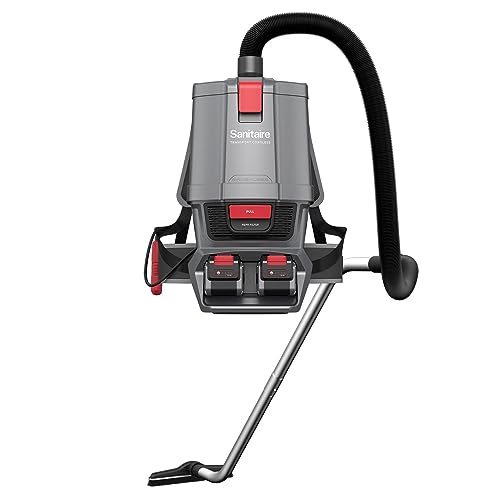
Sanitaire Transport Commercial Cordless Backpack Vacuum SC580A — Best Commercial Runtime Design
Sanitaire’s Transport SC580A starts from the commercial question — how does a crew clean cordlessly for a whole shift — and answers it with dual 24V batteries, controls at the hand rather than on the canister, and an adjustable wand that adapts the machine to the cleaner instead of the reverse. Where the Makita is a tool-platform vacuum, the Sanitaire is a dedicated cleaning appliance, and its design choices all point at uptime.
Handheld controls are the feature crews feel most: power and settings change without reaching around to the pack, which keeps the rhythm of room-to-room work unbroken. The backpack layout keeps weight centred and the profile slim for the stairwells, theatre rows and office cubicles where backpacks earn their living. As a commercial machine it is built to be serviced and kept, not replaced.
Strengths
- Dual 24V batteries designed for shift-long work
- Handheld controls keep cleaning rhythm unbroken
- Commercial build intended for service, not replacement
Trade-offs
- Dedicated battery system, not a tool platform
- Commercial tier pricing
- Less familiar brand to home buyers
Key specs
- Dual 24V battery system
- Handheld controls, adjustable wand
- Commercial backpack format, grey
The trade-offs are its dedicated nature: its battery system serves this machine rather than a tool fleet, and the commercial tier pricing reflects its intended buyer. For cleaning companies standardising on one cordless backpack, the Transport’s dual-battery, controls-at-hand design is the most purpose-built option in this guide.
The Transport’s handheld controls change one more behaviour worth naming: cleaners actually adjust power to the surface — down on hard floors, up on carpet — instead of running one setting everywhere out of reach-aversion. That adjustment saves battery across a shift, which is how a dual-battery machine turns into an all-shift machine in practice rather than on paper.
The Sanitaire’s case closes differently: it is the machine a cleaning company can hand to any crew member with five minutes of instruction, because its controls are at the hand and its design assumes a working day rather than a learning curve. In labour terms, that simplicity is worth more than any specification in this guide.
Bottom line: the dedicated crew machine. Dual batteries and hand controls built around a working shift make the Transport the commercial specialist’s choice.
Best for: cleaning crews and facilities teams / Not suited for: home users wanting one battery for many tools

DEWALT Cordless Backpack Shop Vac DXCVXA01B, 1 Gallon, 20V Max — Best Compact Shop Vac
DEWALT shrinks the backpack idea into a shop vac you wear. The DXCVXA01B carries one gallon — enough for the sawdust, fasteners and debris of a work area rather than a whole building — runs on the 20V Max batteries already in millions of workshops, and filters to HEPA standard, which matters when the dust is MDF and drywall rather than crumbs. At 2.0 peak HP it has honest shop suction in a package you climb a ladder with.
The ergonomic canister and adjustable straps make it the grab-and-go option: clean the car, the bench, the stairs and the renovation corner without dragging a wheeled vac behind you. For tradespeople, the platform logic is decisive — the same batteries run the drill on the bench and the vacuum cleaning under it.
Strengths
- Runs on the ubiquitous DEWALT 20V Max platform
- HEPA filtration for fine workshop dust
- Compact 1-gallon size climbs ladders and fits vehicles
Trade-offs
- 1-gallon capacity fills quickly in heavy debris
- Area cleaner, not a whole-building machine
- Battery and charger arrangements depend on the listing kit
Key specs
- 20V Max battery platform
- 1 gallon ergo canister, HEPA filter
- 2.0 peak HP
One gallon fills fast in serious debris, and this is a spot-and-area machine rather than a whole-building cleaner. Judged as what it is — the most portable, platform-friendly backpack vac here — it fills a niche the bigger machines cannot: the vacuum that is always within reach and therefore always used.
The DEWALT’s size also makes it the vehicle vacuum this guide would actually keep: it lives on a hook in the garage, runs on the batteries already charged there, and turns a ten-minute car clean from a production into a pause between tasks. Machines that are present get used; the cleanest car in the street belongs to the owner of the most convenient vacuum, not the most powerful one.
DEWALT’s little backpack also reframes what a shop vac is for: not the monthly disaster clean, but the two-minute clean after every job, which is the habit that keeps workshops genuinely tidy. The best vacuum is the one used daily, and no machine in this guide is easier to use daily than the one already on your back.
Bottom line: the workshop’s daily driver. Small, HEPA-filtered and always charged on the platform you own — the DEWALT turns cleaning from a chore into a reflex.
Best for: workshops, trades and vehicle cleaning / Not suited for: large-area commercial cleaning

Makita XCV09PT 18V X2 LXT (36V) Brushless Cordless 1/2 Gallon HEPA Filter Backpack Dry Vacuum Kit — Best Lightweight
Not every backpack job needs 1.6 gallons. The XCV09PT takes Makita’s 36V brushless platform and HEPA filtration and trims the canister to half a gallon, producing a noticeably lighter pack for the work backpacks do most: stairs, edges, above-floor dusting, vehicles, and the detail cleaning between desks and pews and shelves. This kit includes 5.0Ah batteries, so it is ready out of the box.
The lighter carry changes who can use a backpack comfortably and for how long; on detail routes the big canister’s capacity is wasted while its weight is not. Suction remains properly professional — this is a smaller sibling, not a toy — and the LXT ecosystem argument applies in full: batteries shared with the rest of the Makita fleet.
Strengths
- Lightest full-power option for all-day carry
- Same 36V brushless HEPA platform as its big sibling
- Kit includes 5.0Ah batteries
Trade-offs
- Half-gallon canister needs frequent emptying
- Dry vacuuming only
- Still a professional-tier purchase
Key specs
- 36V (18V X2) brushless motor
- 1/2 gallon HEPA filter backpack dry vacuum
- Kit with 5.0Ah batteries
Half a gallon in a dusty environment means frequent emptying, so pair it with the work it suits. Crews often run both Makitas — the XCV17 for area work, this one for detail — and home users with stairs and smaller spaces will find this the more liveable of the two.
The XCV09PT is also the training machine fleets hand to new staff: lighter, less fatiguing and more forgiving while route habits form, with the same controls philosophy as the big Makita so skills transfer when the cleaner graduates to area work. Any machine that makes the first month easier without teaching bad habits earns a permanent place in the fleet.
The XCV09PT’s case is ergonomic arithmetic: across a six-hour detail route, the kilos not carried compound into energy saved, and cleaners finish fresher with work done better in the last hour. Fleets measure this in consistency; home users feel it on the stairs. Light is not a lesser specification — it is the specification.
Bottom line: light done properly. Full Makita power and filtration at a carry weight that respects the person wearing it, all shift long.
Best for: detail cleaning, stairs and lighter all-day carry / Not suited for: large debris volumes or area cleaning

Atrix VACBPAIC Cordless Backpack HEPA Vacuum — Best Specialist HEPA Pick
Atrix built its reputation in environments where vacuum exhaust is a serious question — electronics facilities, clean spaces, fine and hazardous dust applications — and the VACBPAIC brings that filtration-first mindset to a cordless backpack. The HEPA system is the headline and the reason to buy: this is the pick when the point is not just picking dust up but keeping the finest fraction out of the room’s air afterwards.
As a working backpack it follows the proven pattern — harness carry, hose and tools for above-floor and detail work — in a size aimed at professional routes rather than whole-hall area cleaning. Atrix’s ecosystem of bags, filters and accessories is built for maintained fleets, which facilities managers value more than launch-day features.
Strengths
- HEPA filtration from a filtration-specialist brand
- Professional accessory and filter ecosystem
- Suited to dust-sensitive environments
Trade-offs
- Specialist positioning, less platform flexibility
- Route and detail scale rather than area cleaning
- Smaller retail presence than the tool brands
Key specs
- Cordless backpack format
- HEPA filtration
- Professional Atrix Ergo ecosystem
It is the specialist’s choice rather than the generalist’s: platform shoppers are better served by Makita or DEWALT, and area cleaners by the big Makita or the Sanitaire. When filtration pedigree is the brief — schools, clinics, electronics, allergy-conscious facilities, in comfort terms — the Atrix is the name this guide reaches for.
Atrix ownership has a paperwork virtue facilities appreciate: bags, filters and parts are catalogued like industrial supplies, with the consistency that lets a manager order consumables by number for years. In environments audited for their cleaning process, that traceability is not bureaucracy — it is the product, and it is why the specialist brand keeps its niche against bigger names.
Atrix closes its case on trust: in the facilities that buy it, the vacuum’s job is verified — the air leaving the machine is part of someone else’s compliance. If your cleaning is ever inspected, audited or simply promised to a client in writing, the specialist’s paperwork trail is the reason this pick exists.
Bottom line: filtration is the product. When the dust matters and the paperwork matters, the Atrix is the backpack with its priorities in the right order.
Best for: dust-sensitive facilities and filtration-first buyers / Not suited for: buyers wanting a shared tool-battery platform

Milwaukee M18 Fuel 3-in-1 Backpack Vacuum — Best for M18 Owners
Milwaukee’s answer to the backpack question is versatility: the M18 Fuel 3-in-1 works as a backpack for area and stair work, converts to a handheld for detail and vehicles, and sets down as a compact canister when the job is stationary. For the enormous installed base of M18 batteries, that flexibility on the platform they already own is the entire argument, and it is a strong one.
FUEL brushless power keeps suction honest in all three modes, and the conversions are genuine working configurations rather than gimmicks — the handheld mode in particular earns its keep in vehicles, plant rooms and between machinery where a hose from a backpack is clumsy. Build quality follows Milwaukee’s jobsite brief: this is a tool expected to live in a van.
Strengths
- Three working modes: backpack, handheld, canister
- FUEL brushless power on the M18 platform
- Jobsite build for van and site life
Trade-offs
- Jack of all trades: specialists beat it in each single mode
- Check kit contents — bare-tool listings exist in this range
- Premium tier within the M18 line
Key specs
- M18 battery platform, FUEL brushless
- 3-in-1 backpack / handheld / canister
- Jobsite construction
Multi-mode designs carry multi-mode compromises: it will not out-capacity the big Makita as a pure backpack nor out-specialise the Atrix on filtration. But for M18 owners who want one cordless vacuum that covers the building, the vehicle and the workshop, it is the natural fleet addition.
The 3-in-1’s handheld mode quietly solves the backpack format’s one blind spot: the car, the machine cabinet, the cluttered bench, where a hose trailing from your back is clumsy. Converting in seconds rather than fetching a second vacuum keeps one machine in play for the whole building, which is the fleet arithmetic M18 owners are really buying.
Milwaukee’s case is the fleet shelf: one more M18 tool that shares every battery and charger already there, covering three shapes of cleaning job that would otherwise need two machines. Versatility is sometimes indecision; here it is inventory discipline, and M18 owners will recognise the difference immediately.
Bottom line: one vacuum, three shapes, one battery system. For M18 owners, the 3-in-1 is not a compromise — it is the fleet made simpler.
Best for: Milwaukee M18 owners wanting one vacuum for everything / Not suited for: single-mode specialists or other battery platforms
Comparison Table
| Pick | Badge | Key spec | Best for |
|---|---|---|---|
| Makita XCV17PG 18V X2 LXT (36V) Brushless Cordless 1.6 Gallon HEPA Filter Backpack Dry Vacuum Kit | Best Overall | 36V (18V X2) brushless motor | cleaning professionals and large multi-level spaces |
| Sanitaire Transport Commercial Cordless Backpack Vacuum SC580A | Best Commercial Runtime Design | Dual 24V battery system | cleaning crews and facilities teams |
| DEWALT Cordless Backpack Shop Vac DXCVXA01B, 1 Gallon, 20V Max | Best Compact Shop Vac | 20V Max battery platform | workshops, trades and vehicle cleaning |
| Makita XCV09PT 18V X2 LXT (36V) Brushless Cordless 1/2 Gallon HEPA Filter Backpack Dry Vacuum Kit | Best Lightweight | 36V (18V X2) brushless motor | detail cleaning, stairs and lighter all-day carry |
| Atrix VACBPAIC Cordless Backpack HEPA Vacuum | Best Specialist HEPA Pick | Cordless backpack format | dust-sensitive facilities and filtration-first buyers |
| Milwaukee M18 Fuel 3-in-1 Backpack Vacuum | Best for M18 Owners | M18 battery platform, FUEL brushless | Milwaukee M18 owners wanting one vacuum for everything |
How to Choose the Best Cordless Backpack Vacuums
Start with your battery reality. If your workshop or fleet already runs Makita LXT, DEWALT 20V Max or Milwaukee M18, the backpack on your platform wins almost by default: batteries, chargers and spares are already paid for. If you are buying a standalone cleaning system, judge the Sanitaire’s dedicated dual-battery design or the Atrix on their own merits instead. Platform lock-in is the biggest decision in this category and it is made once.
Then match capacity to route. Area cleaning of offices and halls wants the 1.6-gallon class; detail work, stairs and vehicles are better served by half to one gallon carried lightly all day. Check whether the listing is a kit or a bare tool before comparing prices — the same model can appear at two very different prices for that reason alone. Finally, insist on HEPA filtration if the dust is fine or the space is occupied: a backpack vacuum’s exhaust is at breathing height, which makes filtration a courtesy to everyone in the room.
Runtime: The Number That Decides Your Day
Cordless runtime depends on battery capacity, power setting and debris load, so treat any single figure as a best case. The working strategies matter more than the brochure: carry a charged spare pair on long routes, use lower power on hard floors where suction demands are modest, and empty the canister before it is packed full, because a choked canister makes the motor work harder for less cleaning. Crews standardise on one platform partly so batteries can rotate through chargers in a loop — the vacuum never waits for power because the next set is always ready. Home users with a single set should size the job to the charge, or buy the second set with the machine.
Fitting a Backpack Vacuum Properly
A backpack vacuum is worn for hours, and five minutes of fitting decides whether it is comfortable. Load the weight onto your hips with the waist belt, not your shoulders; adjust shoulder straps to stabilise rather than carry; and route the hose on your dominant side so the wand hand and the hose agree. Work a room in a pattern that keeps the hose behind you, and take the canister’s weight seriously at the end of the route, not the start — a pack that feels fine empty at 9 a.m. is the test at 4 p.m. with a full canister.
Backpack vs Corded vs Stick: An Honest Comparison
Corded backpacks still win on unlimited runtime and raw sustained suction, and for a single large building with outlets everywhere they remain rational. Cordless backpacks win the moment the route crosses stairs, outdoor transitions, vehicles or outlet-poor spaces — which is most real routes. Stick vacuums win in small homes and lose everywhere a route lasts longer than their dust cup. The honest fleet often mixes: cordless backpacks for daily maintained cleaning, a corded machine for periodic deep work, a stick for the office kitchen. Buy the cordless backpack for the daily work and it will do ninety percent of the hours.
Cost the batteries into any comparison. A cordless backpack’s true price is the machine plus the battery sets its route consumes, while a corded machine’s true cost includes the minutes per room spent managing its cord, multiplied by every clean for years. Professional buyers do that arithmetic instinctively; it is why the cordless backpack market exists and keeps growing.
Safety and Etiquette When Cleaning Occupied Spaces
A backpack vacuum in an occupied building is a guest in other people’s workday. Announce yourself at doorways — the machine is quiet enough to startle — keep the hose and your turning circle in mind around desks and equipment, and never let the pack swing near monitors, shelving or people on stairs. Pass others on stairs by stopping and letting them by; a litre of debris and a battery pack change your balance more than you feel on flat ground.
Electrically, the cordless format removes the trailing-cable trip hazard that dominates cleaning risk assessments, which is a genuine safety argument for these machines in schools, care settings and public buildings. Keep it that way: carry spare batteries in a bag, not loose in a pocket with keys, and charge them in a ventilated spot away from the debris store.
Training a Route: Working a Building in the Right Order
Professionals clean top-down and far-to-near: start at the highest floor and the farthest room, work toward the exit and the ground, and let gravity and the route agree. Dust falls down, debris tracks toward doors, and a cleaner who fights that order cleans some rooms twice. With a backpack, the route is continuous — no returning for a canister, no re-plugging — so the order you choose is the order the building gets, uninterrupted.
Build the route around battery swaps: place the charger station at the route’s natural midpoint, swap on the pass rather than on empty, and the machine never dictates a pause. Note the rooms that load the canister fastest — entrances, workshops, pet areas — and schedule their emptying into the route instead of discovering a full pack mid-room. A route written down once saves minutes on every clean forever, which is the entire economics of this category in one sentence.
Your Pre-Purchase Checklist for a Cordless Backpack Vacuum
Decide the platform question first and in writing: which batteries do you already own, and is this vacuum joining that system or starting a new one? Confirm whether the exact listing is a kit or a bare tool, which batteries and charger it includes, and the canister capacity against your route’s real debris load. Check the filter type and the price and availability of its replacements — you will buy them for years.
Then test the carry honestly if you can: a loaded pack, on stairs, for ten minutes tells you more than any review, including this one. Plan the battery rotation — how many sets, charged where, swapped at which point on the route — before the machine arrives, because a cordless system is a logistics decision wearing a vacuum’s clothes. Get those answers right and every pick in this guide will serve for years; get them wrong and even the best machine becomes the one nobody reaches for.
What a Month With a Backpack Vacuum Actually Changes
The first change is pace, and it startles people. Rooms that took twenty minutes with a dragged canister and a managed cord take twelve, not because anyone hurries but because the stopping disappears — no unplugging, no re-plugging, no walking back for the machine left in the last room. Across a building, a route, a working week, that recovered time is the entire business case for this category, and it is why professionals who switch rarely switch back. The vacuum stops being equipment you fetch and becomes clothing you work in.
The second change is coverage. Stairs get cleaned properly instead of symbolically, because the machine climbs them on your back. The edges, the between-desk runs, the theatre rows and the vehicle interiors — the places conventional vacuums reach late, awkwardly or never — become ordinary stops on the route. Facilities look different after a month of that coverage, in the corners, which is where cleanliness is actually judged by everyone who walks in.
The third change is to the cleaner’s day. Weight carried on the hips, no cable to police, no canister banging door frames, filtration that keeps the exhaust at breathing height clean — the work becomes less of an obstacle course and more of a walk with a purpose. Crews finish fresher, home users with big houses stop dreading the task, and the machine gets used at the frequency the building actually needs. Buy the platform honestly, fit the harness properly, maintain the filters — and a month from now, the old vacuum in the cupboard will look like what it is: the slow way you used to clean.
Accessories, Spares and the Kit That Keeps a Backpack Working
A backpack vacuum’s working kit extends beyond the machine. A spare filter set, bought with the vacuum rather than after the first clog, keeps suction honest on your schedule instead of a supplier’s. A second battery set is the runtime strategy made physical for any route longer than one charge. A simple tool roll — crevice tool, dusting brush, upholstery nozzle — turns the backpack from a floor machine into the whole-building cleaner it is meant to be, because the hose is already in your hand and the tools should be at your belt, not in a cupboard two floors away.
Storage deserves the same thought: hang the pack on a hook at standing height, hose coiled loosely, batteries on their charger in the same spot, and the machine is ready in the time it takes to shrug it on. Fleets call this a station; homes call it the corner by the utility door. Either way, readiness is what converts a capable machine into a used one, and used is the only state in which any of the six excellent vacuums in this guide can repay you. Set the station up once, keep the spares in it, and the backpack will quietly become the hardest-working object you own.
One Last Thought Before You Buy
If you take nothing else from this guide, take the platform discipline: write down your battery allegiance before you fall for any single machine, because in cordless cleaning the system is the product and the vacuum is its expression. The six machines here are all excellent within their systems — Makita’s twin depths, Sanitaire’s crew logic, DEWALT’s workshop reflex, Atrix’s filtration pedigree, Milwaukee’s three shapes — and the wrong system will make even the right machine a daily friction. Decide the system, match the capacity to your route, fit the harness like it matters, and the backpack will do the rest, route after route, year after year.
How to Use and Maintain a Cordless Backpack Vacuum
Before the route: charge-check every battery, empty the canister, and inspect the filter. Backpack filters load invisibly, and a clogged HEPA quietly strangles suction while the motor works overtime. Fit the harness as described above, then do a two-minute suction test on a mat — better to find a blockage at base than on the third floor.
During work, empty earlier than feels necessary. Suction falls as the canister fills and debris compacts, so the last quarter of capacity is the least effective quarter. Keep the intake wand moving at a steady pace rather than scrubbing; backpack systems are designed around continuous motion, which is where their speed advantage comes from.
After work, empty fully, tap or replace filters on the maker’s schedule — never wash a filter not sold as washable — and store batteries at partial charge if they will sit for weeks. Log filter changes for fleet machines. The machines in this guide are built for years of service, and this unglamorous routine is the entire secret to getting them.
A Note on Buying for a Team Versus Buying for Yourself
If you are equipping a team, standardise ruthlessly: one model, one battery system, one filter type, spares on a shelf, and a one-page routine card taped inside the storage cupboard. Teams lose more time to variety — the wrong charger, the unfamiliar control, the filter nobody stocked — than to any machine’s shortcomings, and the professional picks in this guide reward standardisation with years of interchangeable everything. If you are buying for yourself, the same logic shrinks gracefully: one machine, its spare filter bought on day one, its batteries charged in one place, its harness adjusted once and left alone. The backpack format rewards systems thinking at every scale, and the buyers who think that way on day one are the ones still praising their decision in year three.
Common Buying Mistakes
Comparing a bare tool price with a kit price. The same vacuum appears at two price points depending on batteries. Check kit contents before judging value.
Buying capacity you cannot carry. A full large canister at hour six is the real weight. Match gallons to your route and your back.
Ignoring the battery platform. A vacuum whose batteries fit nothing else you own is a lifetime of dedicated chargers. Platform first, model second.
Letting the filter clog. Backpack exhaust sits at breathing height and suction dies quietly as filters load. Inspect and maintain on schedule.
Expecting corded deep-clean power. Cordless backpacks excel at maintained spaces and detail work. For restoration cleans of neglected carpet, a corded machine is still the right tool.
Final Recommendation
The Makita XCV17PG is the cordless backpack most professionals should buy: 36V brushless power, 1.6 gallons, HEPA filtration and a full battery kit on the vast LXT platform. Its lighter XCV09PT sibling owns detail work and stairs. Cleaning companies wanting a dedicated system should choose the Sanitaire Transport with its dual batteries and hand controls, workshops the compact DEWALT, filtration-first facilities the Atrix, and Milwaukee M18 owners the versatile 3-in-1. Decide your platform, match capacity to your route, and maintain the filters — a cordless backpack looked after that way will quietly become the hardest-working machine you own.
Best Backpack Vacuums
Best Cordless Vacuums
Best Makita Vacuums
Best Shop Vacs
Frequently Asked Questions
How long do cordless backpack vacuums run?
It depends on battery capacity and power level, and figures quoted are best cases. The working answer is to rotate charged spare batteries on long routes — the professional platforms in this guide make that easy because the same batteries serve many tools.
Are cordless backpack vacuums powerful enough for commercial cleaning?
For maintained commercial spaces — offices, schools, theatres, transport — yes; that is exactly the work the Makita, Sanitaire and Atrix models here are built for. For deep restoration cleaning of neglected carpet, corded machines still hold the edge.
Why choose a backpack over a normal cordless vacuum?
Speed and access. A worn vacuum never snags a cord, bumps furniture or blocks a doorway, and it climbs stairs and works between desks continuously. On multi-room and multi-level routes the time saving is substantial.
Is HEPA filtration important in a backpack vacuum?
Yes, more than in a floor vacuum, because the exhaust is at breathing height. HEPA models — every pick in this guide — keep fine dust out of the room’s air instead of redistributing it.
Kit or bare tool: which should I buy?
If you already own the platform’s batteries and chargers, a bare tool is good value. If not, buy the kit: the Makita kits in this guide include high-capacity batteries that make the machine usable from day one.
Can cordless backpack vacuums pick up wet spills?
No — every model in this guide is a dry vacuum. Wet pickup needs a wet/dry machine; using a dry backpack on liquid damages the motor and filtration.


