Disclosure: airfryerkitchensupply.com is reader-supported. When you buy through links on our site, we may earn an affiliate commission at no extra cost to you.
Where to buy
All six racks below were verified on 2026-11-22. Cooling racks look simple, and the differences that matter, grid density, steel quality, pan fit and whether they stack, are exactly the ones this guide tests each pick against.
- Ultra Cuisine Cooling and Baking Rack Set, 11.5 x 16.5 in, Set of 2 (Best Overall): Check the current price on Amazon
- Spring Chef Cooling Rack 10 x 15 in, Set of 2 (Best for Jelly Roll Pans): Check the current price on Amazon
- Checkered Chef Cooling Racks (Best No-Warp Grid Design): Check the current price on Amazon
- P&P CHEF Cooling Baking Rack 16.6 x 11.5 in, 2-Pack (Best Dense-Wire Roasting Rack): Check the current price on Amazon
- HIWARE Collapsible Cooling Rack, 3 Tier, 12 x 16.5 in (Best Tiered Rack for Batch Baking): Check the current price on Amazon
- Geesta Collapsible Cooling Rack with Adjustable Tiers (Best Adjustable Tier System): Check the current price on Amazon
The best cookie cooling racks perform a small job with outsized consequences. A cookie lifted from a hot pan onto a rack stops cooking on schedule, keeps its base crisp instead of steaming itself soft, and cools evenly enough to ice, stack or store without casualties. Leave the same cookie on the pan and residual heat keeps baking it while trapped steam softens the bottom; the difference between a good rack and no rack is tasted in every bite.
Choosing well comes down to a handful of honest variables. Grid density decides whether small or soft cookies sag between wires. Stainless steel decides whether the rack survives the dishwasher and the oven for a decade or rusts in a year. Size decides whether it fits your sheet pans, because a rack that matches your pans doubles as an oven rack for roasting and crisping. And format, single, paired, tiered or collapsible, decides how a serious baking day, with batch after batch coming out of the oven, actually flows.
The six picks below were all verified as current listings, and they cover that whole decision space: two-packs matched to half sheet and jelly roll pans, a no-warp grid design in multiple pan sizes, dense-wire roasting-grade racks, and two collapsible tiered systems that multiply a small counter’s capacity several times over. Every specification in the spec boxes comes from the verified listing title, so the comparison you are reading is built on evidence rather than adjectives.
In this guide
Quick Picks
- Ultra Cuisine Cooling and Baking Rack Set, 11.5 x 16.5 in, Set of 2 — Best Overall: A heavy-duty pair of 100 percent stainless steel racks sized for half sheet pans, oven-safe and dishwasher-safe. — Check price on Amazon
- Spring Chef Cooling Rack 10 x 15 in, Set of 2 — Best for Jelly Roll Pans: A heavy-duty stainless pair in the 10 by 15 inch jelly roll pan size, oven safe and made expressly for cookie cooling. — Check price on Amazon
- Checkered Chef Cooling Racks — Best No-Warp Grid Design: Stainless racks with a no-warp grid design, in a multi-pack fitting quarter, jelly roll and half sheet pans. — Check price on Amazon
- P&P CHEF Cooling Baking Rack 16.6 x 11.5 in, 2-Pack — Best Dense-Wire Roasting Rack: A stainless 2-pack with dense wires and smooth edges, built for cooling, baking, roasting, grilling and drying, and easy cleaning. — Check price on Amazon
- HIWARE Collapsible Cooling Rack, 3 Tier, 12 x 16.5 in — Best Tiered Rack for Batch Baking: A collapsible three-tier stainless rack system in half sheet footprint, stacking three layers of cooling into one counter space. — Check price on Amazon
- Geesta Collapsible Cooling Rack with Adjustable Tiers — Best Adjustable Tier System: An upgraded collapsible rack adjustable across two, three or four tiers with three settings, for cooling, roasting, cooking and drying. — Check price on Amazon
How These Picks Were Chosen
We chose first for the cookie job itself: wire spacing tight enough to support a warm, soft cookie without sagging, feet that lift the rack clear of the counter so air circulates underneath, and steel that tolerates both oven heat and dishwasher life. Every pick is stainless steel according to its verified title, because coated and chrome racks eventually chip or rust into early retirement.
We then balanced the formats a real baker needs. Most households want a pair of pan-matched flat racks, so three picks compete there with different sizes and grid philosophies. Batch bakers and small kitchens need vertical capacity, so two collapsible tiered systems earned places. One pick bridges both worlds as a cooling and baking rack designed to work inside the pan in the oven. The result is a shortlist where each rack is the right answer for a recognisably different kitchen.
The 6 Best Cookie Cooling Racks

Ultra Cuisine Cooling and Baking Rack Set, 11.5 x 16.5 in, Set of 2 — Best Overall
The Ultra Cuisine set is the rack pair most bakers should simply buy. The size, 11.5 by 16.5 inches, is the half sheet pan standard, so the racks drop into the pans you already own for oven work and sit on the counter for cooling with the footprint your kitchen already understands. The title’s material claims are the complete checklist: 100 percent stainless steel, oven-safe, dishwasher-safe, heavy duty wire, in a set of two.
Strengths
- Half sheet sizing matches the pans most home bakers already own
- 100% stainless steel, oven-safe and dishwasher-safe per the title, so no babying required
- Heavy duty wire in a set of two covers a full oven batch without a cooling bottleneck
Trade-offs
- Half sheet size is large for very small kitchens and single-tray bakers
- Flat racks do not stack; batch bakers with tiny counters should look at the tiered picks
- A two-pack of this size needs storage room in the pan cupboard
| Size (from listing title) | 11.5″ x 16.5″ |
| Material (from listing title) | 100% stainless steel |
| Use (from listing title) | Oven-safe, cooling and baking rack |
| Cleaning (from listing title) | Dishwasher-safe |
| Pack (from listing title) | Set of 2, heavy duty wire |
Pan-matched sizing is the quiet superpower here. In the oven, the rack elevates food inside the half sheet so hot air circulates underneath: bacon crisps without flipping, roasted vegetables brown instead of steaming in their own juices, and breaded items keep their crusts. Out of the oven, the same rack receives the next batch of cookies. One tool, both halves of the baking process, in the size your pans already speak.
The set-of-two format matches how ovens actually work. Two trays bake together; two racks cool them together. Single-rack households discover the bottleneck on their first double batch, when the second tray’s cookies sit cooking on the hot pan while the first batch occupies the only rack. This set removes that moment from your baking life permanently.
Best for: Most home bakers, especially half sheet pan owners who bake double batches / Not suited for: Very small kitchens, or bakers who need vertical stacking more than pan fit

Spring Chef Cooling Rack 10 x 15 in, Set of 2 — Best for Jelly Roll Pans
Spring Chef’s pair speaks directly to the cookie baker: the title calls it a heavy duty cookie cooling rack, sized 10 by 15 inches to fit a jelly roll pan, in stainless steel, oven safe, as a set of two. The jelly roll format is the cookie sheet of countless households, slightly smaller than a half sheet, and a rack matched to it sits properly inside the pan for oven work instead of rattling around or overhanging.
Strengths
- Jelly roll pan fit serves the cookie sheets many households actually own
- Cookie cooling is its stated purpose, with heavy duty stainless construction
- Oven safe, so the racks double as in-pan roasting and crisping racks
Trade-offs
- Smaller than half sheet racks, so very large batches cycle more times
- Bakers standardised on half sheets should take the Ultra Cuisine size instead
- Flat format only; no stacking for counter-poor batch days
| Size (from listing title) | 10″ x 15″ |
| Fit (from listing title) | Fits jelly roll pan |
| Material (from listing title) | Stainless steel, heavy duty |
| Use (from listing title) | Oven safe wire rack for baking |
| Pack (from listing title) | Set of 2 |
Size matching sounds like a detail until a mismatched rack slides inside an oversized pan, dumping a row of warm cookies, or overhangs a small pan and tips. The Spring Chef’s jelly roll specificity is its honesty: it knows which pan it serves. Households whose baking sheets are the classic 10 by 15 will feel the rightness every time the rack drops in squarely.
As cooling racks the pair does the essential work with no fuss: cookies off the pan promptly, air underneath, bases staying crisp. For the majority of home cookie baking, which is a tray or two at a time rather than a production run, this size is not a compromise at all; it is the correct scale, taking less cupboard and less counter while doing the identical job.
Best for: Jelly roll pan households and everyday cookie bakers / Not suited for: Half sheet standardised bakers, or high-volume batch producers

Checkered Chef Cooling Racks — Best No-Warp Grid Design
Checkered Chef attacks the two classic rack failures head-on. The grid design answers sagging: a crosshatch grid supports cookies far more evenly than parallel wires, so soft and small cookies rest flat instead of drooping between bars. And the title promises a no-warp design, answering the twisted rack that rocks on the counter and dumps a row of biscuits. Add stainless steel, oven use and a multi-pack spanning quarter, jelly and half sheet pan sizes, and this is the systems thinker’s pick.
Strengths
- Grid design supports small and soft cookies without sagging between wires
- No-warp design stated in the title, for racks that sit flat for life
- Multi-pack fits quarter, jelly and half sheet pans, covering a whole pan collection
Trade-offs
- Grid racks have more intersections to wash than simple parallel-wire designs
- A multi-pack is an investment if you truly own only one pan size
- Grid squares can mark very soft cookie bases if cookies rest too long warm
| Design (from listing title) | No-warp grid design |
| Material (from listing title) | Stainless steel |
| Fit (from listing title) | Fits quarter, jelly and half sheet pans |
| Pack (from listing title) | Multi-pack |
| Use (from listing title) | Cooling rack for cooking and baking, oven use |
The grid-versus-wires question is the connoisseur’s fork in this category. Parallel wires are easier to clean and fine for sturdy cookies. A grid supports everything: the thumbprint cookie still soft in the middle, the small shortbread, the delicate lace cookie that would fold over a wire. Bakers whose repertoire leans delicate will feel the grid’s value in the first batch, as every cookie comes off the rack with its shape and base intact.
The multi-size pack logic suits kitchens that bake across formats, a quarter sheet for a small batch of scones, a half sheet for the holiday production. One design language across all of them, all stainless, all oven-ready: it is the closest thing to a rack system this category offers, and for organised bakers it is deeply satisfying.
Best for: Delicate-cookie bakers and multi-pan households wanting one rack system / Not suited for: Minimalists with a single pan, or anyone who hates washing grid intersections
P&P CHEF Cooling Baking Rack 16.6 x 11.5 in, 2-Pack — Best Dense-Wire Roasting Rack
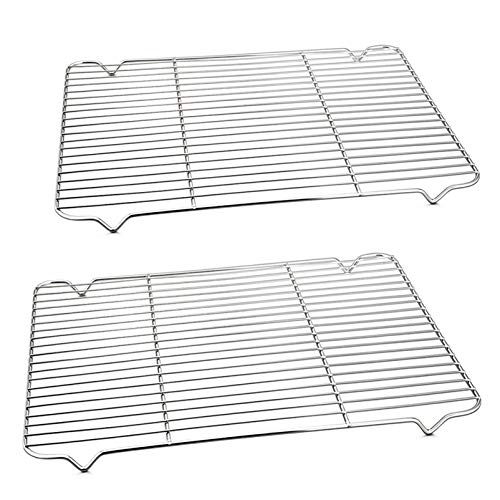
P&P CHEF’s pair leans into versatility and finish: dense wires and a smooth edge are the title’s chosen details, across a stated range of cooling, baking, roasting, grilling and drying, in stainless steel at 16.6 by 11.5 inches, as a 2-pack that promises easy cleaning. Dense wires matter beyond cookies: they support smaller items, from roasted nuts to drying herbs to grilled items that would slip through wide spacing.
Strengths
- Dense wires support small items across cooling, roasting, grilling and drying jobs
- Smooth edge finishing is kinder to hands and to nonstick pans
- Stainless 2-pack with easy-clean positioning for daily use
Trade-offs
- Dense wires hold more residue than wide spacing after sticky roasting jobs
- Size sits between standards; confirm your pans before assuming an in-pan fit
- A versatility-first design rather than a cookie specialist
| Size (from listing title) | 16.6″ x 11.5″ |
| Wires (from listing title) | Dense wires |
| Edge (from listing title) | Smooth edge |
| Material (from listing title) | Stainless steel |
| Use (from listing title) | Cooling, baking, roasting, grilling, drying; easy to clean |
| Pack (from listing title) | 2 pcs |
The smooth edge is a detail owners notice weekly. Cheap racks finish their cut wires however they fall, and the result snags dish towels, scratches pan coatings and nicks fingers during washing. A rack that advertises its edge finishing is telling you the maker sweated the ownership experience, and in a tool handled hot, wet and soapy several times a week, that sweat is worth money.
As the generalist of the group, this is the pair for kitchens where the rack’s second job, roasting and grilling support, rivals its first. Cookies cool on it perfectly well; it simply refuses to be only a cookie rack, and households that grill vegetables, dry herbs or roast small items will use its dense wires constantly.
Best for: Versatile kitchens using racks for roasting, grilling and drying as much as cooling / Not suited for: Pan-fit purists who need an exact named pan standard

HIWARE Collapsible Cooling Rack, 3 Tier, 12 x 16.5 in — Best Tiered Rack for Batch Baking
The HIWARE answers the batch baker’s eternal problem: the oven produces trays faster than the counter can receive them. Three tiers in a 12 by 16.5 inch footprint, the half sheet footprint, triple the cooling area of a flat rack while occupying the same counter square, in stainless steel, in a collapsible design that folds away when the baking day ends. For holiday production, bake sales and cookie exchanges, this is the difference between a system and a traffic jam.
Strengths
- Three tiers triple cooling capacity within one half sheet footprint
- Collapsible design stores flat, so the capacity costs no permanent cupboard space
- Stainless steel construction matches the flat racks’ durability standard
Trade-offs
- Tiered access is slower than flat racks; the middle layer is never the easiest reach
- Tall items do not fit between tiers; this is a cookie and flat-bake tool
- Assembly and collapsing add steps a casual baker will not bother with for one tray
| Tiers (from listing title) | 3 tier, stackable |
| Size (from listing title) | 12″ x 16.5″, fit half sheet |
| Material (from listing title) | Stainless steel |
| Design (from listing title) | Collapsible cooling rack |
Think of the HIWARE as seasonal infrastructure. Fifty weeks a year it lives folded in a cupboard, invisible. For the two weeks of holiday baking, or the weekend of the school bake sale, it stands on the counter tripling your cooling line, and the whole production, tray out, cookies racked, next tray in, flows without the shuffle of cooling cookies onto plates and platters. Bakers who do even one serious production a year will justify it in that single run.
Its limits are honest geometry: tiers suit flat goods, cookies, scones, crackers, small pastries, and nothing with height or a fragile dome. Within that geometry it is superb. The wise batch kitchen owns flat racks for everyday and this for the surge, which is exactly the combination this guide’s final recommendation makes.
Best for: Holiday and bake-sale batch bakers with limited counter space / Not suited for: Everyday single-tray bakers, or tall bakes needing vertical clearance

Geesta Collapsible Cooling Rack with Adjustable Tiers — Best Adjustable Tier System
The Geesta takes the tiered idea and makes it adjustable: a collapsible stackable rack configurable across two, three or four tiers with a three-setting adjustable design, aimed at cooling, roasting, cooking and drying. Where the HIWARE fixes its three tiers, the Geesta lets the structure match the day: two tiers for a normal Saturday, four for the full holiday offensive, and tier heights that adapt to what is actually cooling.
Strengths
- Adjustable two, three or four tier configuration matches capacity to the batch
- Three-setting adjustable design adapts tier spacing to the goods
- Collapsible and stackable, serving cooling, roasting, cooking and drying roles
Trade-offs
- Adjustability means more joints and more setup than a fixed rack
- Like all tiered systems, it suits flat goods and dislikes tall bakes
- Occasional bakers may never use the configurations they paid for
| Tiers (from listing title) | 2/3/4-tier, adjustable |
| Settings (from listing title) | Adjustable 3 setting design |
| Design (from listing title) | Collapsible, stackable, upgraded |
| Use (from listing title) | Roasting, cooking, drying, cooling rack for cookies and baking |
Adjustable spacing solves the tiered rack’s classic frustration: fixed tiers that are too short for muffins and wastefully tall for crackers. With settings to vary the structure, the same rack hosts a low, dense stack of biscuits one day and a taller arrangement for scones the next. For bakers whose production varies, that adaptability is the difference between a tool that fits the work and a tool the work must fit.
It also travels conceptually beyond cooling: the title’s roasting, cooking and drying roles suit a rack system that can stand in a low oven or over a tray as a drying station for herbs and fruit. Buyers who enjoy one flexible tool over three fixed ones will recognise their philosophy here, executed in a format that still folds away when the day is done.
Best for: Variable batch bakers who want tier count and spacing to adapt to the bake / Not suited for: Bakers who prefer the simplest possible fixed rack, or tall-item cooling
Comparison Table
| Pick | Badge | Key spec | Best for |
|---|---|---|---|
| Ultra Cuisine Cooling and Baking Rack Set, 11.5 x 16.5 in, Set of 2 | Best Overall | 11.5×16.5 in, stainless, set of 2, half sheet | Most home bakers, especially half sheet pan owners who bake double batches |
| Spring Chef Cooling Rack 10 x 15 in, Set of 2 | Best for Jelly Roll Pans | 10×15 in, jelly roll fit, set of 2 | Jelly roll pan households and everyday cookie bakers |
| Checkered Chef Cooling Racks | Best No-Warp Grid Design | Grid design, no-warp, multi-size pack | Delicate-cookie bakers and multi-pan households wanting one rack system |
| P&P CHEF Cooling Baking Rack 16.6 x 11.5 in, 2-Pack | Best Dense-Wire Roasting Rack | 16.6×11.5 in, dense wires, 2-pack | Versatile kitchens using racks for roasting, grilling and drying as much as cooling |
| HIWARE Collapsible Cooling Rack, 3 Tier, 12 x 16.5 in | Best Tiered Rack for Batch Baking | 3-tier collapsible, half sheet footprint | Holiday and bake-sale batch bakers with limited counter space |
| Geesta Collapsible Cooling Rack with Adjustable Tiers | Best Adjustable Tier System | Adjustable 2-4 tiers, collapsible | Variable batch bakers who want tier count and spacing to adapt to the bake |
How to Choose the Best Cookie Cooling Rack
Start with your pans. A cooling rack earns double duty when it fits inside your sheet pans, so identify your standard: half sheet owners should look at the 11.5 by 16.5 class, jelly roll owners at 10 by 15, and multi-pan kitchens at a system spanning sizes. A rack that fits your pans roasts, crisps and bakes as well as it cools, which doubles its value before a single cookie is considered.
Next, judge the surface your cookies will rest on. Parallel wires are simple and easy to clean; dense wires support smaller items; a full grid supports everything, including the softest and most delicate cookies, at the cost of more intersections to wash. Match the surface to your repertoire honestly: a shortbread and thumbprint baker needs the grid’s support, while a sturdy chocolate chip baker will never miss it.
Then decide your format by your biggest baking day, not your average one. Average days need a flat pair. Production days, holidays, bake sales, cookie swaps, need tiers, and collapsible tiers give you that surge capacity without permanent storage cost. Finally, insist on stainless steel and oven-safe, dishwasher-safe construction, as every pick here offers: a rack is a decade-long tool, and materials decide whether it lives that long.
Cooling Technique: From Oven to Rack Without Casualties
Timing is the first technique. Cookies should rest on the hot pan only briefly, a few minutes, just long enough to firm up for the move; transferred too early they fold, left too long they keep cooking and their bases steam against the pan. A thin spatula, a confident slide and a rack waiting beside the oven are the whole choreography. Bake in the order you rack: if two trays share the oven, plan which batch lands on which rack before the timer sounds.
Give cookies air on every side. The rack’s feet exist to let air pass underneath, so do not defeat them by setting the rack on a towel or a puddle of spilled batter. Space cookies with a finger’s width between them; crowded cookies steam each other and soften at the edges. Chocolate-heavy cookies benefit from a few undisturbed minutes before stacking or moving to storage, and iced cookies should be completely, patiently cool before the icing appears, or the finish slides and dulls.
Beyond Cookies: The Rack’s Second Career in Your Kitchen
A pan-fitted stainless rack is one of the hardest-working tools in a kitchen. In the oven it elevates bacon, roasted vegetables and breaded cutlets so air circulates and fat drains, producing crispness a flat pan cannot. Under a roast it becomes a trivet that keeps meat out of its juices. Over a pan it catches glaze drips from cakes and doughnuts, and beside the stove it holds fried food for the crucial draining minute that decides whether it stays crisp.
That second career is why the buying decision deserves the care this guide gives it. A rack bought only for cookies is used monthly; a rack bought for fit, steel and surface is used weekly for a decade. Choose the one your whole kitchen, not just your baking days, will thank you for.
Wire Spacing and Cookie Physics: Why Soft Cookies Sag
A cookie leaves the oven as a structure under construction: its crumb is set at the edges and still tender at the centre, held together by fats that are liquid when hot and firm when cool. Rest that cookie across widely spaced parallel wires and the soft centre does exactly what physics suggests, sinking gently between the supports and setting with a ripple. The finer the support, dense wires or a full grid, the flatter the setting surface, which is why delicate and soft-centred styles are the grid’s natural constituency.
The same physics explains the transfer timing in this guide’s technique section. Those few minutes on the pan let the centre firm just enough to survive the move, after which the rack’s airflow finishes the setting evenly from below. A baker who understands the sequence stops blaming recipes for rippled bottoms and starts crediting the rack, correctly, for the flat ones.
Stainless Steel and the Decade Test: Materials in a Tool You Wash Weekly
Few kitchen tools are washed as often and handled as hot as a cooling rack, which makes it a pure materials test. Stainless steel passes by indifference: it does not rust in the dishwasher’s steam, does not shed a coating into food, does not stain from berry fillings or turmeric glazes, and can be scrubbed without negotiation. Chrome plating fails by degrees, pitting at the welds first; nonstick coatings fail by flakes, which is why this guide’s shortlist is stainless from top to bottom.
Judge a rack in hand by its welds and its feet. Welds should be smooth and complete, because a snagged weld is where residue hides and rust would start if it could. Feet should lift the rack clear of the counter by enough to let air and a fingertip pass beneath, and they should be part of the frame’s structure rather than afterthoughts. A rack that passes those two inspections will likely outlast the oven it serves.
Organising a Baking Station: Racks, Pans and the Flow of a Baking Day
Serious home bakers eventually stop thinking in tools and start thinking in stations. The baking station arranges itself around the oven’s rhythm: pans and racks paired and stored together, the cooling zone beside the oven rather than across the kitchen, a clear landing strip for the hot tray’s first minute. When racks match pans, as this guide keeps insisting, the station assembles itself: the rack lives in the pan, travels to the oven inside it, and returns to the counter still paired.
Tiered racks belong to the station’s surge mode, stored folded with the holiday equipment and deployed when the production plan demands them. Thinking this way converts the purchase decision into a simple question: what does my station look like on an ordinary Saturday, and what does it look like on my biggest baking day? The final recommendation in this guide is, in the end, just those two pictures answered with products.
Rack Safety and Handling: Hot Pans, Sharp Edges and Small Hands
A cooling rack’s working life is spent next to hot pans and busy hands, so its safety details deserve a paragraph. Set racks on a stable, heat-tolerant surface before the tray leaves the oven, never balanced on a cloth that can slide. Keep the cooling zone out of the kitchen’s traffic lane, because a rack of warm cookies at elbow height is an invitation to burns and breakage alike, and teach younger bakers the house rule early: cookies are touched when they are cool, and the rack is carried with two hands or not at all.
The smooth-edge detail praised in the P&P CHEF review belongs in this section too. Racks are washed hot, wet and soapy, the exact conditions for a sharp wire end to find a finger. A rack finished with care is safer every single wash for a decade, which is why finishing quality, welds, edges, feet, is treated throughout this guide as a primary buying criterion rather than a cosmetic one.
Gift-Giving and Registries: Why a Great Rack Is a Smarter Present Than a Gadget
A cooling rack is an unglamorous gift that outperforms glamorous ones, because it enters the recipient’s weekly routine and stays there for a decade. For a new baker, the Ultra Cuisine or Spring Chef pair in their pan’s size quietly upgrades every bake they will ever make. For the baker who has everything, the tiered systems solve a problem they complain about every December and never solve for themselves. Either way, the gift’s value compounds with use rather than expiring with novelty.
If you are building a registry or a first serious baking kit, the order of purchase this guide implies is worth stating plainly: pans and their matching racks together, before any specialty tin. A half sheet and its rack will bake more of your life than any novelty shape, and the pair bought together, sized to each other, is the smallest complete system in baking. Everything else is expansion; this is the foundation.
Storing Racks Without Wasting the Cupboard: A Small System
Racks are awkward citizens of the cupboard: flat, wide and prone to sliding into a metallic avalanche behind the pans. The system that tames them follows from this guide’s central advice. Store each rack inside the pan it matches, so the pair travels as one object and the cupboard holds pans, not pans plus a separate rack problem. Vertical dividers, the kind sold for cutting boards and trays, give flat racks a filing system that ends the avalanche permanently for households with several sizes.
Tiered racks store as they were designed to: folded flat, with the holiday and bulk-baking equipment rather than the daily pans, because their working life is seasonal. Kept that way, a rack collection occupies almost no dedicated space at all, which removes the last practical objection to owning the right rack for each job. In a category this inexpensive and this long-lived, storage solved is the difference between a system and a pile.
A Baker’s Dozen: Small Rack Habits That Add Up
Experienced bakers accumulate micro-habits around their racks that never appear in recipes. They warm a rack for a moment in the cooling oven before receiving a delicate bake that hates temperature shock. They park a rack over the sink as a draining and glazing station that washes itself. They keep one rack permanently in the sheet pan on the stove as a trivet that is always exactly where a hot dish needs to land. They flip a rack to use its feet as handles when moving a full load of cooled cookies to the storage tin in one journey.
None of these habits requires a special product; all of them reward the pan-matched, stainless, well-finished racks this guide recommends, because a rack that fits, survives heat and washes without complaint invites improvisation. Buy the right simple tool and the habits accrete around it for years. That accretion, invisible in any specification table, is the real content of the phrase buy it for life.
How to Cool Cookies Perfectly: A Batch Routine That Scales
A repeatable routine for baking days, whether the batch is one tray or six.
- Before the first tray goes in, set your racks out: flat racks on the counter with clear space around them, or the tiered rack assembled if it is a production day.
- When a tray comes out, start a short timer: let the cookies firm on the pan for a few minutes, until they hold their shape under a spatula’s nudge.
- Slide each cookie onto the rack in one confident motion, spacing them a finger’s width apart, softest and most delicate cookies onto grid or dense-wire racks if you have them.
- While the batch cools, load the oven with the next tray; the rack system, not the counter, is now your buffer between oven pace and cooling pace.
- Move fully cooled cookies to storage or icing in the order they were racked, freeing the earliest rack for the next tray out of the oven.
- At the end of the day, racks go straight into the dishwasher or a hot soapy soak while residue is fresh; dried-on dough in grid intersections is the only hard cleaning this category ever presents.
Run this routine twice and it becomes the rhythm of your baking days: the oven never waits for the counter, and no cookie ever sits steaming on a hot pan because there was nowhere for it to go.
Common Buying Mistakes
- Leaving cookies on the hot pan to cool. Residual heat overbakes them and trapped steam softens the bases. The rack exists precisely to interrupt both.
- Buying a rack size that matches no pan you own. In-pan oven use is half a rack’s value. Measure your pans and buy the stated fit.
- Choosing coated or chrome racks to save money. Coatings chip and chrome rusts; stainless steel, as in every pick here, is the decade-long material.
- Moving cookies the second they leave the oven. Too-soft cookies fold and break. A few minutes of firming on the pan first is part of the technique, not a delay.
- Crowding cookies on the rack. Touching cookies steam each other and stick. A finger’s width of air is part of the recipe.
- Ignoring the batch-day bottleneck. One small rack and a four-tray plan guarantee chaos. Flat pairs for normal days and collapsible tiers for production days solve it permanently.
Final Recommendation
Most bakers should start with the Ultra Cuisine pair: half sheet sizing, full stainless construction and a set of two that matches how ovens actually bake. Jelly roll households take the Spring Chef pair in their pan’s own size. Delicate-cookie bakers and multi-pan kitchens should choose the Checkered Chef grid system, while versatile cooks who roast and grill on their racks will live on the P&P CHEF dense-wire pair. For production days, add a tiered system: the HIWARE for fixed three-tier simplicity, the Geesta when you want tiers and spacing that adjust to the bake.
Any of the six will transform the unglamorous minute after baking, which is where cookies are quietly won and lost. Buy for your pans, your repertoire and your biggest day, and the transformation is permanent.
The shortlist in one line: Ultra Cuisine Cooling and Baking Rack Set, 11.5 x 16.5 in, Set of 2; Spring Chef Cooling Rack 10 x 15 in, Set of 2; Checkered Chef Cooling Racks; P&P CHEF Cooling Baking Rack 16.6 x 11.5 in, 2-Pack; HIWARE Collapsible Cooling Rack, 3 Tier, 12 x 16.5 in; Geesta Collapsible Cooling Rack with Adjustable Tiers.
Keep exploring related guides on this site: Best Cookie Cooling Racks Best Cooling Racks Best Half Sheet Pans Best Cookie Sheets Best Baking Racks
Frequently Asked Questions
How long should cookies cool on a rack?
Until they reach room temperature and feel firm, typically twenty to thirty minutes for standard cookies, longer for large or dense bakes. They need a few minutes on the pan first to firm up before the move. Icing, stacking and storing should all wait for complete cooling, or finishes slide and stored cookies soften each other.
Can I put a cooling rack in the oven?
Stainless steel racks like every pick in this guide are oven-safe and are designed to double as in-pan roasting racks, elevating food so air circulates and fat drains. Always confirm a specific rack’s oven rating from its own listing, and never put coated or non-oven-rated racks into a hot oven.
What size cooling rack do I need?
Match it to your pans. Half sheet pans pair with racks around 11.5 by 16.5 inches, jelly roll pans with 10 by 15 inch racks. If you own several pan sizes, a multi-pack system covers them. A rack that fits inside your pans doubles its usefulness by working in the oven as well as on the counter.
Grid or parallel wires: which is better for cookies?
Grids support soft, small and delicate cookies best because the cookie rests on a crosshatch rather than spanning gaps between wires. Parallel and dense wires are easier to clean and entirely sufficient for sturdy cookies. Choose by your repertoire: delicate baking points to the grid, everyday sturdy cookies do not require it.
Are tiered cooling racks worth it?
For batch bakers, absolutely: collapsible tiers multiply cooling capacity several times within one counter footprint, then fold away. For a baker who never exceeds one or two trays, a flat pair is simpler and the tiers would rarely be assembled. Buy tiers for the baking days you actually have, especially holidays and bake sales.
How do I clean a cooling rack properly?
Stainless racks in this guide are dishwasher-safe, which handles routine cleaning. For baked-on residue, soak in hot soapy water first, then wash; grid intersections reward a brush. Clean racks the same day you bake and residue never hardens into a project.
Can I cool bread and cakes on a cookie rack?
Yes. Breads benefit from rack cooling exactly as cookies do, since a loaf left in its tin steams its own crust soft. Cakes should cool briefly in the tin first, then turn out onto a rack so air reaches every surface. For tall or heavy items choose a sturdy flat rack rather than a tiered one, and centre the weight over the frame.
Why do my cookies stick to the rack?
Usually they were moved while very soft and sugary, or left until a high-sugar base cooled and bonded. A brief firming rest on the pan, a confident spatula transfer, and prompt removal once cool prevent nearly all sticking. Very sticky glazes and caramel-heavy cookies can rest on a sheet of baking parchment laid over the rack for easy release.
