A cooling rack looks like the simplest tool in the kitchen, a grid of wire on little feet, and that is exactly why so many of them disappoint. The cheap ones sag in the middle the first time a heavy loaf lands on them. The wide-spaced ones let cookie edges droop between the wires and set that way. The short-footed ones trap a cushion of steam under whatever is cooling, so the bottom of a crisp crust goes soft while the top is still warm. None of these failures show up in a product photo. They show up on your counter, twenty minutes after the bake, when the damage is already done.
This guide exists to sort the racks that hold their shape from the racks that only look the part. As an Amazon Associate, this site may earn an affiliate commission on qualifying purchases made through links on this page, at no extra cost to you. Every rack below is a real, widely sold model, and each one earned its place for a concrete reason: a grid tight enough to support soft food, feet tall enough to let air move, a frame that stays flat under load, and dimensions that actually match the pans home bakers use most.
Most people buy their first rack as an afterthought, tossed into a cart beside the sheet pans, and that is how the flimsy ones get into kitchens. The second purchase is the informed one, made after a chrome grid rusts in the dishwasher, or a wide-spaced deck ruins a tray of shortbread, or a rack that claimed to fit a half sheet rides up on the rim and dumps a hot loaf. If you are reading this before the first purchase, you can skip that tuition. The details that matter fit on a spec sheet: grid pattern and spacing, foot height, true inside dimensions, material and wire weight. The reviews below translate those details into plain consequences, so you can match a rack to your pans and your habits the first time.
One size decision shapes everything else in this article. The half-sheet pan, roughly eighteen by thirteen inches, is the workhorse pan of home baking, and a rack that drops neatly inside it becomes twice as useful: it cools cookies on the counter, then rides the same pan into the oven under bacon, wings or a spatchcocked chicken, catching drips while hot air circulates underneath. Most of the picks here are built to that half-sheet footprint. A couple serve cooks who need a smaller or rounder footprint, and each review says plainly who should skip it.
What follows is a full buying guide, not a podium. The next section explains the handful of details that separate a good rack from a flimsy one, the comparison table shows how the five picks differ at a glance, and the reviews themselves are honest about trade-offs, because every rack here gives something up. Read the trade-offs as carefully as the strengths and you will end up with the right grid for the way you actually bake.
In this guide
Quick picks: best cooling racks cooks illustrated
| # | Product | Where to buy |
|---|---|---|
| 1 | Checkered Chef cooling rack | Check on Amazon |
| 2 | Ultra Cuisine cooling rack | Check on Amazon |
| 3 | Nordic Ware cooling grid | Check on Amazon |
| 4 | USA Pan cooling rack | Check on Amazon |
| 5 | Wilton cooling grid | Check on Amazon |
What to look for in a cooling rack
A grid tight enough to stop the sag
Grid spacing is the single most important detail on a cooling rack, and it is the one most listings describe the vaguest. On a wide grid, a warm chocolate chip cookie is a soft disc balanced on two wires, and its edges slump into the gaps as it cools, setting with ridges and sometimes cracking when you lift it. Delicate items suffer most: shortbread, lace cookies, scones still tender from the oven, and the bottoms of cakes turned out of their pans. A tight crosshatch grid, where wires run in both directions and the openings are small squares rather than long slots, supports food across its whole underside. Nothing droops, nothing sets crooked, and a thin spatula slides under cooled items without catching. When you compare racks, look for that crosshatch pattern and small, even openings from edge to edge, not just a few parallel bars with wide lanes between them.
Feet tall enough for real airflow
Cooling is an airflow problem. A hot cookie sheet holds heat, and food left on it keeps cooking from below while steam rises off the food and condenses underneath. A rack solves both problems only if air can move freely beneath it. Feet around an inch tall lift food clear of the counter and give that steam somewhere to go, so bottoms stay crisp and cooling happens evenly instead of in a damp patch. Very short feet, the kind that barely raise the grid, leave the rack doing little more than a trivet would. Taller feet also matter in the oven: a rack set inside a sheet pan needs clearance below so rendered fat drips away from the food instead of pooling around it, which is the difference between roasted and steamed bacon. Check the foot height in the specifications, and be suspicious of any rack that does not state it.
A true fit for your half-sheet pan
Manufacturers describe racks as fitting a half sheet when they mean anything from a loose wobble to an exact drop-in. The inside of a standard half-sheet pan measures a little under seventeen and a half by twelve and a half inches, so a rack around seventeen by twelve inches sits flat inside with a small margin for lifting it out with oven mitts. A rack that is too large rides up on the pan’s rolled rim and tilts; one that is too small slides around and wastes a third of the pan. If you bake on quarter sheets or jelly roll pans, measure the inside of your pan and match the rack to it the same way. Cooks who mostly cool cakes should also consider whether they need a round rack or a larger rectangle that spans two burners’ worth of counter space. The reviews below give each rack’s working footprint in plain terms so you can match it to the pans you own.
Stainless steel outlasts chrome and coatings
Racks come in three broad materials, and the differences show up within a year. Chrome-plated steel is the cheapest and the most fragile: the plating chips at the welds, rust blooms in the dishwasher, and the grid darkens. Nonstick-coated racks release food well at first, but the coating scratches where spatulas and pan edges rub, and most are not meant for high oven heat. Stainless steel costs more and simply keeps going: it tolerates the dishwasher, resists rust, and handles the full heat of a home oven, which matters if the rack will double as a roasting insert. Within stainless, gauge matters too. A heavier wire grid feels rigid when you press its center; a light one flexes, and flex is what lets a rack rock and sag under a heavy Dutch oven loaf. Several picks below are stainless for exactly these reasons, and the ones that are not are honest about the care they need.
Oven safety, if the rack will work double duty
Not every cooling rack belongs in the oven. If you plan to roast on yours, confirm it is sold as oven safe to a temperature your cooking actually reaches, and confirm the material backs that claim: bare stainless steel does, coated and chrome racks often do not, or only to modest heat. The rack-in-pan method rewards the effort. Wings crisp on both sides without turning, bacon cooks flat and evenly, a whole chicken roasts with air on every surface, and vegetables caramelize instead of stewing in their own juices. A tight grid helps here as well, because small items like Brussels sprouts and potato wedges cannot fall through into the drippings. If a rack is for counter cooling only, that is fine, but buy it knowing the limit rather than learning it from a warped grid and a ruined dinner.
Feet that grip and a frame that stays flat
A rack gets dragged across counters, stacked in cupboards, and loaded while hot, so small construction details add up. Feet should be welded or formed so they cannot fold or snap, and their ends should be smooth or capped so they do not scratch stone counters or tear shelf liner. The outer frame matters as much as the grid: a continuous rim wire keeps the whole rectangle true, while racks built from grid alone can twist into a slight propeller shape that rocks forever after. Lay any new rack on a flat counter and press each corner before you keep it. It should sit silent and still. That ten-second test predicts years of behavior, and it is the first thing to check on the budget picks, where quality control varies most from unit to unit.
Cleaning and storage, the unglamorous tests
A tight grid is a gift while food cools and a chore at the sink, because baked-on cheese, caramel and bacon fat lodge in every small square. Stainless racks shrug off an overnight soak and a stiff brush, and most can go straight into the dishwasher, though the grid sometimes traps water and needs a shake and a towel. Chrome and coated racks want hand washing and gentle treatment, which is worth knowing before you buy two of them. Storage is the other quiet issue: racks are awkward, flat-but-bulky objects that slide around drawers. Many cooks store them standing inside the sheet pans they fit, which keeps the pair together and the rack flat. If you bake in batches, two matching racks stack neatly and let a full oven’s worth of cookies cool at once, a point in favor of buying a matched pair from the start.
Shape, tiers and the second-rack question
Rectangles rule this category because pans are rectangles, but shape deserves a thought before you buy. Round racks suit round cakes and pies cooled on the counter, and a large rectangle can double as a trivet for a roasting pan. Some bakers solve the batch problem with tiered racks that stack cooling levels on one footprint; they work, but the lowest tier cools slowest and the whole tower is only as steady as its smallest foot. The simpler answer for most kitchens is two flat racks, which cool evenly, store flat and separate when you need one in the oven and one on the counter. If counter space is your scarcest resource, measure it before choosing: a half-sheet rack needs a clear patch roughly the size of the pan it matches, and it will compete with mixing bowls and hot pads on baking days.
Reading a listing like a skeptic
Rack listings reward careful reading. Dimensions may describe the pan a rack is meant for rather than the rack itself, so look for the rack’s own measurements and compare them with the inside of your pan, not its advertised size. Oven-safe claims deserve the same care: a temperature figure with no material behind it is marketing, while bare stainless steel quietly backs its claim. Photos can flatter grid spacing, so zoom in on the weave and count the openings across a cookie’s width if you can. None of this takes long, and it is the difference between a rack chosen on evidence and one chosen on hope. The picks in this guide were selected because their specifications survive that kind of reading, not because their photographs looked sturdy.
How the five racks compare
The table below is deliberately qualitative. It will not tell you which rack to buy, because that depends on your pans and your habits, but it shows the shape of each choice: which racks are built for the oven as much as the counter, which are sized for a half sheet and which are not, and where each one asks you to compromise.
| Rack | Grid style | Material | Half-sheet fit | Oven use | Best for |
|---|---|---|---|---|---|
| Checkered Chef | Tight crosshatch | Stainless steel | Yes, drop-in | Yes | Everyday bakers who want one rack for everything |
| Ultra Cuisine | Tight crosshatch, heavy gauge | Stainless steel | Yes, drop-in | Yes | Heavy loaves and frequent roasting |
| Nordic Ware | Crosshatch, slightly wider | Steel with nonstick finish | Yes, made for its own pans | Limited heat | Cooling big batches of cookies |
| USA Pan | Tight crosshatch | Aluminized steel, silicone coating | Yes, matched to USA Pan sheets | Moderate heat | Nonstick release for delicate bakes |
| Wilton Perfect Results | Wide parallel grid | Steel with nonstick finish | No, larger counter size | No | Cooling cakes and big trays on the counter |
Two patterns stand out. First, the stainless crosshatch racks cluster at the top because they ask the least of you: they cool, they roast, they go in the dishwasher, and they fit the standard pan. Second, the coated racks are specialists. They release sticky food beautifully and cool large batches well, but they trade away oven range and long-term durability to do it. Neither pattern is wrong. They are answers to different questions, and the reviews below keep that distinction in front of you for each model.
Feet deserve a final glance in the table’s terms, because the numbers hide a behavior. The stainless picks lift their grids high enough that a loaded rack can be slid across a counter without the food’s underside kissing the surface, and high enough that oven air reaches the bottom of whatever is roasting. The counter specialists sit lower, which keeps tall cakes steady and keeps the whole arrangement calm when a hot, heavy item lands. Neither is a flaw. Height is a trade between airflow and stability, and the right side of that trade depends on whether your rack spends its life in a pan or on a counter.
What a year of use does to a rack
Specifications describe a rack on the day it arrives. Baking describes it a year later, and the gap between those two racks is where this category separates. Chrome plating fails first at the welds, where the coating is thinnest, and once rust starts in a joint it spreads under the plating and stains whatever the rack touches. Nonstick finishes fail more gracefully but just as surely: each pass of a metal spatula, each trip through a dishwasher, each stack of pans stored on top removes a little of the surface, until sticky foods begin to grip in patches and the rack’s one talent fades. Neither failure is a scandal at the prices those racks charge, but both are worth expecting rather than discovering.
Stainless steel ages differently. It darkens slightly with oven heat, picks up a faint rainbow near the welds, and otherwise stays itself: the grid does not loosen, the feet do not bend back into true because they never left it, and the surface that released a cookie in January releases one the same way the following December. The heavier the wire, the truer this holds, because stiffness is what resists the slow twist that makes old racks rock. This is why the stainless picks dominate the top of this list even though several coated racks cool a first batch just as well. A cooling rack is a buy-it-for-years tool, closer to a good sheet pan than to a gadget, and it should be judged on its third year as much as its first week.
There is also a quieter form of aging: the rack that stays flat but becomes annoying. Feet that catch on drawer dividers, a rim that traps water and drips across the floor, a grid that whistles against the dishwasher rack and never quite sits still. None of these appear in a specification, and all of them decide whether a rack gets reached for or worked around. The reviews below weigh these lived details alongside the measurable ones, because a tool you avoid is a tool you do not really own.
The best cooling racks, reviewed

Checkered Chef Stainless Steel Cooling Rack — the dependable all-rounder
The Checkered Chef is the rack that ends most searches, and it earns that position without any single flashy feature. It is a stainless steel rectangle sized to drop into a half-sheet pan, woven in a tight crosshatch that supports food the way a solid surface would, only with air moving through it. Cookies cool flat and keep their shape, a loaf of banana bread rests without its base going gummy, and the same rack goes into the oven under a tray of wings. For a first rack, or the rack you buy when a flimsy one finally sags, this is the benchmark the rest of this list is measured against.
Strengths: The grid is the headline. Its small, even squares hold soft items across their whole base, so nothing droops between wires and nothing sets with ridges, and a thin spatula slips underneath without snagging. The stainless build takes the dishwasher, shrugs off soaking, and handles full oven heat, which makes the rack a genuine two-purpose tool rather than a counter accessory. The feet lift the grid about an inch, enough for steam to escape and for fat to drip clear when roasting. It also sits flat straight out of the package, with a rim that keeps the rectangle true, and it is light enough to move one-handed with mitts on yet rigid when you press the center.
Trade-offs: The tight grid that cools so well also holds onto baked-on cheese and caramel, and cleaning it means a soak and a brush rather than a quick rinse. The feet are bare wire ends, fine on most counters but worth a thought on soft wood or delicate stone, where a silicone-footed rival would be kinder. And like most racks at its level, it is sold one at a time, so batch bakers should budget for a pair from the start rather than discovering mid-holiday that one rack is not enough.
Who it suits: Home bakers who want one rack that cools cookies on Tuesday and roasts bacon on Saturday, and anyone replacing a chrome rack that rusted. If your baking is mostly large cakes cooled on the counter, a bigger grid below may fit better.
In daily use, its best quality is that you stop thinking about it. It lives inside its sheet pan in the cupboard, comes out when the oven does, and handles the handoff between them without drama. Wings roasted on it come up crisp on the underside, which is the test wide grids fail, and a still-warm pie cools on it without the bottom crust sweating. Owners of exactly one rack should start here and add a second of the same when batch baking demands it, because a matched pair stacks flatter and behaves identically in the oven.
For the rack that quietly does every job in this category well, check price on Amazon.
Check price on Amazon: Checkered Chef cooling rack

Ultra Cuisine Stainless Steel Cooling Rack — the heavy-gauge workhorse
Ultra Cuisine built its rack for the loads that make lesser grids bow: a crusty sourdough boule straight from a Dutch oven, a whole roasted chicken resting before carving, a dense fruitcake cooling overnight. The wire is noticeably heavier than the category average, the crosshatch is tight, and the feet are raised and reinforced so the whole structure feels less like a grid and more like a small platform. It fits a half-sheet pan the way the Checkered Chef does, but where that rack is the all-rounder, this one is the specialist in strength, and cooks who bake heavy things weekly will feel the difference every time they lift it.
Strengths: Rigidity is the story. Press the center and it barely gives, which means heavy food cools level instead of settling into a shallow hammock that steams its own underside. The raised feet give generous clearance, so airflow under a big roast is strong and drippings fall well clear when the rack works inside a pan. The stainless surface is smooth and genuinely easy to release once soaked, and the welds are clean, without the sharp whiskers that snag towels on cheaper racks. It is also fully oven capable, and its stiffness makes it the most confident rack here for moving a loaded pan from oven to counter without a wobble.
Trade-offs: Strength costs weight and money. This is the heaviest rack in the roundup, noticeable when you are washing it at the sink, and it sits at the premium end of the category, which stings if you want two. The tight grid shares the family cleaning chore, and the tall feet that help airflow also make it slightly awkward to stack in a shallow drawer. Bakers who only cool muffins and brownies will not use half of what they paid for.
Who it suits: Bread bakers, roast cooks, and anyone whose previous rack sagged under real weight. If your heaviest load is a tray of snickerdoodles, the all-rounder above gives you the same cooling for less.
It also changes how a roast rests. A chicken or a pork loin set on this grid, over a pan to catch the juices, keeps its crisp skin out of the puddle it would otherwise sit in, and the clearance under the meat lets the surface stay dry while the interior settles. Bread bakers will notice the same effect with hearth loaves: the bottom crust stays firm and resonant instead of softening against a board. These are small differences that compound across a year of Sundays, and they are exactly what the heavier wire buys you over the lighter grids in this roundup.
Bakers who load their rack like they mean it can check price on Amazon.
Check price on Amazon: Ultra Cuisine cooling rack

Nordic Ware Cooling Grid — the batch baker’s wide deck
Nordic Ware makes the half-sheet pans half of America bakes on, and its cooling grid is designed as their partner: a broad steel deck sized to the same footprint, with a crosshatch a touch more open than the stainless picks and a nonstick finish meant to let cookies slide free. Where the racks above are built to go into the oven, this one is built to receive what comes out of it, batch after batch. Three dozen cookies cool on it without crowding, and its low, wide stance makes it the steadiest place in the kitchen to set a hot pan’s worth of anything.
Strengths: Capacity and calm. The surface swallows a full half-sheet batch at once, which matters during holiday baking when oven cycles are timed in minutes and counter space is the bottleneck. The nonstick finish genuinely helps with sticky items like glazed bars and caramel-topped cookies, which lift cleanly instead of tearing. The frame is rigid and the feet are low and stable, so the deck never rocks when you set a heavy, hot load down quickly. It also nests neatly with the pans from the same maker, and the pair store together without a fight.
Trade-offs: The finish is both the appeal and the limit. It is not the rack for high-heat roasting, and the coating will wear where metal spatulas scrape, so this is a cooling specialist rather than a double-duty tool. The slightly wider grid lets the softest cookies slump a little at the edges, though far less than a parallel-bar rack. Hand washing is the kinder choice for the coating, and cooks who put everything in the dishwasher should look at the stainless picks instead.
Who it suits: High-volume cookie bakers and anyone whose baking days involve back-to-back sheets. If your rack must also roast, choose stainless; if it must mostly cool, in quantity, this deck is hard to beat.
Its low stance deserves a word of its own. Tall feet are an advantage for airflow, but a low, wide deck is an advantage for confidence: a full sheet’s worth of hot cookies sits close to the counter, nothing teeters, and sliding the loaded grid across to a cooler spot feels safe. During a long baking day that steadiness is worth real money in un-dropped trays. Pair it with one stainless rack for oven work and you have the two-tool system many serious home bakers quietly settle on: a deck for cooling volume, a grid for roasting, and no compromises asked of either.
High-volume bakers who cool sheet after sheet can check price on Amazon.
Check price on Amazon: Nordic Ware cooling grid
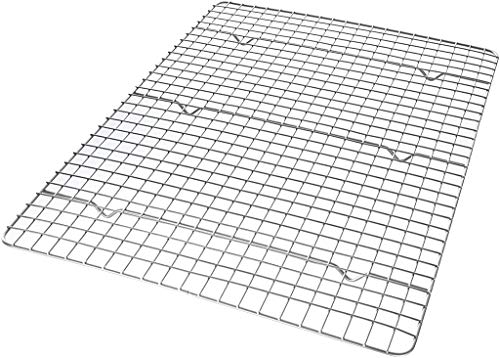
USA Pan Cooling Rack — the nonstick specialist for delicate bakes
USA Pan built its reputation on bakeware with a distinctive corrugated surface and a silicone nonstick coating, and its cooling rack applies the same thinking to the grid: aluminized steel for strength, a tight crosshatch for support, and that slick coating so the most delicate items release without a fight. Think of the foods that tear on other racks: meringues, tuiles, sticky buns, glazed scones, thin brownies that want to weld themselves to bare wire. On this rack they lift away cleanly, and that single talent justifies its place in a list otherwise dominated by bare stainless.
Strengths: Release is unmatched here. Delicate and sugary bakes come off whole, which is not a convenience but the difference between serving a dessert and serving its remains. The grid is properly tight, so support is as good as the stainless picks, and the aluminized steel frame is stiff and flat. The rack is sized to pair with the maker’s half sheets, and the coating makes cleanup the easiest in this roundup: most residue wipes or rinses away without a soak, a mercy at the end of a long baking day. For bakers whose style runs to the fragile and the glazed, it removes the most stressful step of the recipe.
Trade-offs: The coating sets the ceiling. It is meant for moderate oven temperatures rather than broiler work, and like all nonstick surfaces it has a lifespan measured in years of careful use, not decades. Metal tools are unwelcome on it, and the dishwasher is a risk to the finish even when the maker allows it. It also costs more than bare steel racks of similar size, so you are paying for release performance you may not need if your baking runs to sturdy loaves and drop cookies.
Who it suits: Pastry-leaning bakers who lose delicate work to sticking, and anyone who has ever pried a lace cookie off a wire grid in pieces. Roasting households should pair it with a stainless rack rather than asking it to do everything.
Treat it the way you would a good nonstick pan and it repays the care. Silicone and nylon tools, a soft sponge, and a towel dry instead of a dishwasher cycle keep the coating intact for years, and storing it on top of the pan stack rather than beneath protects the surface from scratches. Used that way, it becomes the rack you reach for whenever a recipe’s success hangs on a clean release: the flourless cake that must turn out whole, the sticky bun that must keep its glaze, the meringue that must not crack at the lift. Fragile baking is stressful enough without fighting the furniture.
When your bakes are too delicate to pry off bare wire, check price on Amazon.
Check price on Amazon: USA Pan cooling rack

Wilton Perfect Results Cooling Grid — the big counter rack for cakes
Not every cooling job happens on a half sheet. Layer cakes, Bundts, pies and pull-apart rolls need a broad, stable surface on the counter, and that is the Wilton grid’s whole argument: a generously sized steel deck, bigger than the half-sheet class, with a nonstick finish and a wide grid that suits large, sturdy items. It will not drop into your sheet pan and it is not meant to. It lives on the counter during baking days, receives whatever comes out of the oven, and gives big bakes the room to cool without hanging over an edge, which is how cake layers crack and pies slide.
Strengths: Size is the strength, and it is a real one. A ten-inch layer sits fully supported, a Bundt cools upright and level, and two pies fit without touching. The nonstick surface releases cake bottoms cleanly, which matters when a layer has to come away perfect for frosting. The grid is light and easy to move around a crowded counter, and the low feet keep tall items steady. For households whose baking centers on cakes rather than sheet pans, this is simply the right shape of tool, and it costs less than the stainless specialists because it is not trying to be one.
Trade-offs: The wide parallel grid that suits cakes lets small, soft cookies droop between the bars, so it should never be your only rack if you bake cookies often. It is a counter tool only: no oven work, no roasting, and the finish wants hand washing to last. It is also the least rigid deck here under a truly heavy load, fine for cakes but not the place to rest a Dutch oven’s worth of bread. Think of it as a specialist that complements a half-sheet rack rather than replacing one.
Who it suits: Cake and pie bakers, and anyone whose counter does more cooling than their pans do. Cookie-heavy households should start with a crosshatch pick and add this later if cakes enter the picture.
On a party day it earns its keep in ways the sheet-pan racks cannot. A warm quiche, a tray of pull-apart rolls, a galette that must cool without its juices soaking the base: all of them want a big, calm surface with room around them, and this grid provides it without borrowing the pan you need for the next course. Keep it hanging on a hook or standing behind the pans, and it is out of the way until the moment a cake comes out of the oven and needs somewhere dignified to land. That moment arrives in every baking household eventually, usually mid-recipe.
Cake bakers who need room for layers to cool level can check price on Amazon.
Check price on Amazon: Wilton cooling grid
Which rack for which baker
If the reviews left you between two racks, decide by the food you make most, not the food you admire. Cookie and bread bakers who also roast should take the Checkered Chef and be done; it is the only decision in this guide that requires no second thought. Bakers whose signature work is heavy, crusty and frequent should step up to the Ultra Cuisine and enjoy never wondering whether the grid will hold. Delicate bakers, the ones glazing and turning out fragile things, should put the USA Pan first and protect its coating like a good pan. Volume bakers should pair the Nordic Ware deck with any stainless pick for oven duty, and cake bakers should add the Wilton grid the first time a layer cracks for want of room. None of these choices is permanent in the way a range is permanent, but a rack chosen on your real habits will feel permanent, because you will stop shopping for one.
Getting more from a rack than cooling
A good rack earns its cupboard space on days you never bake. Set inside a sheet pan, it is the difference between roasted vegetables that caramelize and vegetables that stew: hot air reaches the undersides, moisture escapes instead of pooling, and Brussels sprouts come out with crisp leaves. The same setup fries bacon flat and evenly in the oven, drains fried chicken and schnitzel so the crust stays crisp while the oil falls away, and gives a spatchcocked chicken or a pork loin an all-over roast with no soggy bottom. Bakers use a rack over a pan to glaze cakes and dip truffles, letting the excess drip through instead of pooling around the base, and to dry herbs or hold salted eggplant while it weeps. A tight grid even works as a splatter-reducing trivet for a hot Dutch oven on a wooden table, provided the feet are bare metal and the surface can take the heat.
Care is simple and mostly about water. Wash or soak the rack soon after sticky work, before sugar and cheese set hard in the grid. A stiff brush worked from both sides clears a crosshatch faster than a sponge, and a short soak in hot soapy water loosens almost anything. Dry stainless racks promptly if your water is hard, mostly for looks, and store them flat or standing in their pans so the grid cannot be bent by a heavy pot dropped into the same drawer. Before roasting season, give any rack the corner-press test again; a grid that has warped will rock, and a rocking rack under a hot pan is a small hazard worth replacing rather than enduring.
One more use deserves mention because it saves a step every week: proofing and resting dough. A rack set over a pan catches the flour and drips from shaped loaves, and the airflow underneath keeps the bottoms of resting rounds from going damp against a board. Fried foods beyond chicken benefit the same way, from arancini to fritters to doughnuts that must shed oil without shedding their crust. Once a rack lives in your kitchen, these small jobs find it on their own, which is the real test of a simple tool: it keeps being useful in ways the purchase never promised.
If you are building out the rest of your baking setup, the racks above pair naturally with the pans and tools covered elsewhere on this site.
Wire weight, in plain language
Listings rarely state wire gauge, but your hands can judge it in seconds. Hold the rack at one end and press the center of the grid with your thumb: a heavy grid flexes a little and springs back silently, while a light one bends, creaks at the welds, and sometimes keeps a hint of the bend. Flex is not a cosmetic flaw. A grid that gives under load settles food into a shallow curve, pooling moisture at the center and slowing the cooling exactly where the item is thickest. It also worsens with heat cycles, which is why light racks rock a little more each year. When two racks share a design, the heavier one is almost always the better buy, and the weight difference is printed in the shipping details even when the product description stays silent.
Using the rack well: timing, spacing and transfer
A good rack does half the work; the other half is how you use it. Timing comes first. Cookies should rest on their hot pan just long enough to firm up, usually two or three minutes, then move to the rack while still warm, so the bottoms stop cooking and the steam escapes instead of softening the base. Bread wants the opposite patience: turn a loaf out promptly, because a crust left sitting in its pan or on a board will sweat and soften within minutes, while a rack keeps it crisp on every side. Cakes split the difference, resting in the pan briefly so the structure sets, then turning out onto the rack so the base does not go damp.
Spacing is the second habit. Food cools at the speed air can reach it, and items crowded edge to edge trap a shared cloud of steam that slows everything and softens neighbors. Leave a finger’s width between cookies, give roasted items their own territory, and resist stacking anything warm on anything else. If a batch is too big for the rack, cool in two waves rather than one pile; the first wave will be ready to move to a plate by the time the second sheet leaves the oven. For roasting, the same rule applies with more at stake: an overcrowded rack in a pan steams the food it was meant to crisp.
Placement matters more than most cooks expect. A rack set beside a hot oven or on top of a warm stovetop cools slowly, because the air around it is already heated, while a rack on a cool stretch of counter, away from the oven’s exhaust, sheds heat quickly. In a small kitchen, the top of the stove with the burners off is often the only clear space, and it works, provided nothing beneath the rack is still radiating. Never set a loaded rack on a plastic cutting board or a folded towel for long: both insulate the underside and recreate the trapped-steam problem the rack exists to solve. Bare counter, stone or wood, is the right landing, and the feet keep hot food clear of all three.
Transfer technique is the third. A wide, thin spatula or a small offset spatula slides under rack-cooled items without catching on the grid, and lifting straight up, rather than dragging, keeps delicate bases intact. For cakes, the classic double-rack turn, sandwiching the layer between two racks to flip it right side up, prevents the cracks that come from peeling a layer off a surface it has settled onto. And when you glaze or dust, set the rack over its pan first: the drips and excess fall through, the finished item lifts away clean, and the pan catches the mess for the sink instead of the counter wearing it.
Frequently asked questions
What size cooling rack should I buy first?
Buy the rack that fits your most-used pan, which for most home bakers is the half sheet: a rack around seventeen by twelve inches drops inside it and also covers most counter cooling. If you bake mainly cakes, add a larger counter grid second. Owning one right-sized rack beats owning two that almost fit, because a rack that rides on a pan’s rim tilts, and a rack that slides around a pan is a spill waiting for a hot day.
Why do my cookies sink through the rack and set with ridges?
The grid is too wide for food that soft. Warm cookies are pliable for the first few minutes out of the oven, and on a parallel-bar or wide grid their edges droop into the gaps and harden there. A tight crosshatch supports the whole base so nothing can sag. Letting cookies firm up on the pan for two or three minutes before moving them also helps, but the lasting fix is the finer grid, especially for thin, buttery and delicate recipes.
Can I put any cooling rack in the oven?
No. Bare stainless steel racks are generally oven safe to the full range of a home oven, which is why they dominate the top of this list. Nonstick-coated and chrome racks often are not, or only to modest temperatures, and a coating taken past its limit can blister and fail. Check the maker’s stated limit for your exact rack before roasting on it, and never use a coated rack under a broiler unless the maker explicitly allows it.
How do I clean baked-on food out of a tight grid?
Soak first, scrub second. Twenty minutes in hot soapy water softens sugar, cheese and batter so a stiff brush can push them out of the squares; work from both sides, since residue clings to the underside of the wires. For bacon fat and roasting residue, a paste of baking soda and water left on the grid for ten minutes cuts the grease. Stainless racks can simply go in the dishwasher, though a quick shake and towel afterward keeps water from sitting in the welds.
Is one rack enough, or should I buy two?
Two, if you bake in batches or roast and cool on the same day. A single rack becomes the bottleneck the moment a second sheet leaves the oven, and cookies left waiting on a hot pan keep cooking and steam their own bottoms soft. A matched pair of half-sheet racks also stacks for storage, so the second rack costs almost no cupboard space. If you bake one small batch at a time and never roast on a rack, one good stainless grid will serve you for years.
Every rack on this list will cool a cookie; the right one will also hold its shape under a heavy loaf, lift steam away from a crisp crust, fit the pan you reach for most, and still be flat and rust-free when the next baking season arrives. Choose the grid that matches the food you actually make, and it will quietly be the most-used tool in the kitchen. When the last tray comes out of the oven and the whole batch cools crisp, level and unbroken, a good rack has done the whole of its simple job.

