Disclosure: airfryerkitchensupply.com is reader-supported. When you buy through links on our site, we may earn an affiliate commission at no extra cost to you.
Where to buy
Every cooker below was confirmed as a live Amazon listing through this site’s product data. Two are true convection cookers; four are fan-assisted smokers with built-in circulation. Check price on Amazon on the exact model named — near-identical cabinets are sold with and without the circulation hardware.
The best convection smokers solve the oldest problem in barbecue: still air cooks unevenly. In a conventional smoker, heat rises, pools at the top, and leaves the far corners of the chamber cooler and smokier than the centre. A convection design keeps the air moving — with a sealed convection chamber, a circulation fan, or a fan-driven fire — so every rack sees nearly the same temperature and the same thin stream of smoke. The practical results are real: fewer hot spots to manage, less meat-shuffling mid-cook, and, in the true convection cookers, dramatically shorter cooking times.
Be clear about what the word means before you spend money on it, because ‘convection’ is used loosely in this category. At one end sit genuine convection cookers like the Orion, which surrounds food with convective heat and steam in a sealed ring and cooks a whole chicken in a fraction of offset time. In the middle sit pellet and charcoal smokers with powered circulation — fans that stir the chamber or drive the fire itself, evening out the gradients a still-air cabinet cannot avoid. At the far end are ordinary smokers with no fan at all wearing the word as marketing; none of those appear in this guide.
Below are the six convection and fan-assisted smokers we can stand behind, each verified, each badged for the job it does best. After the reviews: how convection changes your cooking technique, what to check before buying, a first-cook routine, and the mistakes that waste a fan’s advantages.
Shop the verified picks here: Orion Cooker 3.0 Convection Cooker & Smoker, Pellet Pro 2300 Vertical Pellet Smoker Cabinet, Masterbuilt Gravity Series 600 Charcoal Grill Smoker, Camp Chef Woodwind Pro 24, Pit Boss Navigator 3-Series Pellet Vertical Smoker, The Halftime Smoker. Every link in that list was confirmed against live Amazon product data for this guide; check price on Amazon on the exact model named before you order.
In this guide
Quick Picks
Two true convection cookers, four fan-assisted smokers. The badge on each pick here is the same badge you will find on its review heading.
- Orion Cooker 3.0 Convection Cooker & Smoker — Best Overall: The genuine article: a sealed convection cooker that surrounds food with heat and smoke on every side and cooks dramatically faster than a still-air smoker. — Check price on Amazon
- Pellet Pro 2300 Vertical Pellet Smoker Cabinet — Best Vertical Pellet with Convection Fan: A double-wall vertical pellet cabinet whose verified listing names its convection fan outright — even heat across tall stacked racks. — Check price on Amazon
- Masterbuilt Gravity Series 600 Charcoal Grill Smoker — Best Fan-Driven Charcoal: A fan does the fire-tending: charcoal feeds by gravity, a digital fan holds your set temperature, and you get real charcoal smoke with pellet-style manners. — Check price on Amazon
- Camp Chef Woodwind Pro 24 — Best Smoke Control: A fan-managed pellet grill with a smoke box for real wood chunks — dial in both temperature and smoke intensity, a control still-air cookers cannot offer. — Check price on Amazon
- Pit Boss Navigator 3-Series Pellet Vertical Smoker — Best Large Capacity: A tall five-rack pellet cabinet: the verified listing puts it at 1,118 square inches, with fan-driven pellet heat circulating through the stack. — Check price on Amazon
- The Halftime Smoker — Best for Fast Weeknight Smokes: A convection-style fast smoker whose verified listing promises smoked results in half the time — built around moving hot air rather than a long, still soak. — Check price on Amazon
How These Picks Were Chosen
We started from a strict definition: to appear in this guide, a cooker needed a genuine air-moving mechanism — a sealed convection design, a built-in circulation fan, or a fan-driven combustion system — stated in its verified Amazon listing or established product design. We then confirmed every model through Amazon data for this site, including a fresh search on the term itself, which returned the Orion Cooker 3.0 Convection Cooker and Smoker as the category’s namesake and a dedicated convection circulation fan sold for vertical smokers.
Within that definition we spread the six picks across the ways households actually cook: pure convection speed, vertical pellet capacity with a convection fan, fan-driven charcoal for smoke flavour with digital manners, a pellet grill whose fan and smoke box give unusual control, a tall pellet cabinet for batch cooking, and a fast convection-style cooker for weeknights. We deliberately left ordinary still-air electric cabinets out — good smokers, several of which we recommend in Best Consumer Smokers, but they are not convection cookers and do not belong under this search.
A note on the accessory the search surfaced: a convection circulation fan kit exists for owners of vertical and custom smokers who want to retrofit circulation. It is discussed in the buying guide below rather than ranked as a pick, because it is a component, not a cooker — but its existence tells you how much owners value moving air once they have cooked with it.
The 6 Best Convection Smokers for Even, Faster Cooks

Orion Cooker 3.0 Convection Cooker & Smoker — Best Overall
The Orion is what this search actually means. Instead of a box of still air, it cooks inside a sealed convection environment: charcoal burns in an outer ring and a top cup, heat and smoke circulate around and through the cooking chamber, and the food is bathed from every direction at once. The effect is part smoker, part convection oven, part steamer — ribs, whole chickens and turkeys cook in a fraction of the time a conventional smoker needs, and they come out strikingly moist because the sealed chamber holds the food’s own moisture in circulation.
Strengths
- True convection: the most even cooking environment in this guide
- Cooks whole birds and ribs dramatically faster than still-air smokers
- Sealed design keeps food moist without wrapping or spritzing routines
Trade-offs
- Not a low-and-slow bark machine — crust forms differently than on an offset
- You cook to its method: load, light, and leave it closed until done
- Capacity suits family cooks, not bulk batch smoking
| Design | Sealed convection cooker / smoker |
| Heat pattern | Convective heat surrounds food on all sides |
| Fuel | Charcoal ring with wood for smoke |
| Format | Freestanding outdoor convection cooker |
Cooking on the Orion rewires your habits. There is no fire to tend, no damper dance and no benefit to peeking — opening the cooker dumps the convection environment you are paying for. Season boldly, because the moist environment softens rub crust compared with an offset; many owners add a brief uncovered finish on a grill when they want firmer bark. For households whose barrier to smoking is time — a whole smoked chicken on a weeknight, ribs without surrendering a Saturday — nothing else in this guide comes close. It is also the most forgiving cooker here for beginners, precisely because there is so little to manage.
Best for: busy households that want real smoke flavour in a fraction of the time / Not suited for: bark purists who want the full offset ritual and crust
Check on Amazon — check price on Amazon before you decide, because commercial listings change configuration often.

Pellet Pro 2300 Vertical Pellet Smoker Cabinet — Best Vertical Pellet with Convection Fan
Most vertical pellet cabinets rely on rising heat and accept that the top racks run hotter. The Pellet Pro 2300 attacks that directly: its verified listing specifies a double-wall cabinet and a convection fan, and the combination is exactly what batch cooking needs — insulation to hold temperature steady, and moving air to deliver that temperature evenly from the bottom rack to the top. It suits the cook who smokes in quantity: jerky on every rack, a party’s worth of ribs, sausages hung and smoked without constant rotation.
Strengths
- Convection fan evens temperatures across the full cabinet height
- Double-wall construction steadies temperatures in cold or windy weather
- Vertical format holds large batches on a modest footprint
Trade-offs
- A specialist cabinet: no grilling or searing role
- Pellet flavour is milder than stick-burner smoke
- Large cabinet to store and keep covered between cooks
| Design | Vertical pellet smoker cabinet, double wall |
| Circulation | Built-in convection fan (verified listing) |
| Fuel | Wood pellets |
| Extras | Cover included (verified listing) |
The fan changes how you load a vertical smoker. In a still-air cabinet you arrange food around the hot spots; here you can fill racks evenly and trust the circulation, reserving the top rack for items you want finished a touch darker. Keep the fan’s intake and the cabinet’s vents clean — ash and grease are the enemies of moving-air systems — and run a thermometer probe on two different racks for your first cooks to learn your own unit’s personality. For dedicated batch smoking with pellet convenience, this is the most purpose-built tool in the guide.
Best for: batch smokers cooking jerky, sausage and ribs across many racks / Not suited for: anyone who needs one cooker to grill as well as smoke
Check on Amazon — check price on Amazon before you decide, because commercial listings change configuration often.

Masterbuilt Gravity Series 600 Charcoal Grill Smoker — Best Fan-Driven Charcoal
The Gravity Series earns its place in a convection guide honestly: its fire is quite literally fan-driven. A digital controller reads the chamber temperature and spins a fan to stoke the charcoal exactly enough to hold your setting, while fresh charcoal feeds down the hopper by gravity as the fire consumes it. The verified listing credits 600 square inches of cooking space. The result is the flavour argument of charcoal and wood with the temperament of an oven — set the temperature, and the fan does the thirty-minute tending rounds an offset demands.
Strengths
- Real charcoal and wood flavour with set-and-hold temperature control
- Fan stoking recovers temperature fast after the lid opens
- Grills and sears at high heat as well as it smokes low
Trade-offs
- Moving parts and electronics need more care than a plain steel pit
- Hopper charcoal must be kept dry and correctly sized
- Fan-driven fires use fuel differently — expect a learning curve on chunk placement
| Design | Gravity-fed charcoal grill and smoker |
| Cooking area | 600 sq. in. (verified listing) |
| Control | Digital fan-driven temperature control, WiFi |
| Fuel | Charcoal with wood chunks in the hopper or ash pan |
Layer wood chunks through the hopper with the charcoal and drop one in the ash pan as well, and the smoke profile deepens noticeably. The fan’s steady stoking keeps combustion clean, so the smoke stays thin and sweet rather than billowing. This is the cooker for the offset-curious cook who has cooked on a fan-assisted pit at a friend’s house and wants that flavour without the all-day fire watch — and for offset owners who want a second, calmer cooker for weeknights. In the wider family of Best Consumer Smokers, it is the bridge between fire craft and convenience.
Best for: cooks who want charcoal flavour without manual fire tending / Not suited for: off-grid cooking — the fan and controller need power
Check on Amazon — check price on Amazon before you decide, because commercial listings change configuration often.

Camp Chef Woodwind Pro 24 — Best Smoke Control
Every pellet grill moves air with a fan — that is how the fire burns — but the Woodwind Pro 24 turns that airflow into a cooking tool and adds the feature pellet owners ask for most: a smoke box that burns real wood chunks or charcoal above the fire pot, so you can deepen smoke flavour on demand instead of accepting whatever the pellets give you. It suits the cook who found standard pellet smoke too polite and wants a dial — figuratively and literally — for intensity.
Strengths
- Smoke box adds genuine chunk-wood flavour to pellet convenience
- Fan-managed fire holds steady temperatures in all weather
- Versatile: smoke low, roast, bake and grill on one cooker
Trade-offs
- Smoke box needs reloading on long cooks for maximum effect
- More systems to clean: ash, grease and the smoke box itself
- Pellet consumption rises when you run heavy smoke settings
| Design | Pellet grill and smoker, 24-inch |
| Circulation | Fan-managed pellet fire and chamber airflow |
| Smoke control | Smoke box for wood chunks or charcoal |
| Fuel | Wood pellets plus chunk wood in the smoke box |
Use the convection reality of this cooker: the fan keeps the chamber remarkably even, so the old pellet-grill habit of rotating everything hourly is mostly unnecessary. Run the smoke box hard for the first two hours of a brisket, when the meat takes on smoke most readily, then let the pellets carry the cook. The Woodwind Pro is the pick for the cook who reads recipes that say ‘smoke until the bark sets’ and wants equipment that responds to judgement rather than routine. Note that its larger sibling and several other Camp Chef variants did not return buyable listings in our checks, so the 24-inch model here is the one we can point you to with confidence.
Best for: pellet cooks who want adjustable, deeper smoke flavour / Not suited for: minimalists — this is a feature-rich cooker with upkeep to match
Check on Amazon — check price on Amazon before you decide, because commercial listings change configuration often.

Pit Boss Navigator 3-Series Pellet Vertical Smoker — Best Large Capacity
Capacity is the headline here and the verified listing states it plainly: 1,118 square inches across five racks in a vertical pellet cabinet. Pellet fires are inherently fan-driven — the auger feeds fuel and the fan feeds air — and in a tall cabinet that powered circulation is what keeps a five-rack load cooking as one batch instead of five different microclimates. It suits hunters processing game, families who smoke in bulk for the freezer, and anyone whose smoking day produces a season’s worth of jerky, sausage and pulled pork.
Strengths
- Largest verified capacity in this guide
- Five racks organise mixed loads by cut and finish time
- Connected controller lets you monitor a long cook remotely
Trade-offs
- A full cabinet is a lot of meat to manage and to buy
- Vertical cabinets drip downward — arrange loads so drips baste, not spoil
- Pellet smoke remains gentler than offset or charcoal smoke
| Design | Vertical pellet smoker, 5 racks |
| Cooking area | 1,118 sq. in. (verified listing) |
| Control | LCD digital controller, WiFi and Bluetooth |
| Fuel | Wood pellets |
Load the Navigator by logic, not by habit: fattier, longer-cooking cuts high, where their drips can baste leaner items below; delicate fish and cheese low and late, for the shortest time. The fan’s circulation rewards full loads — an empty tall cabinet cycles its fan more and cooks a single rack less evenly than a loaded one, a quirk shared by most big convection spaces. If your smoking is measured in weekends per year but pounds per session, this is the efficient shape of cooker to own.
Best for: bulk smokers, hunters and freezer-fillers cooking in big batches / Not suited for: single-rack weeknight cooks — the cabinet is oversized for them
Check on Amazon — check price on Amazon before you decide, because commercial listings change configuration often.
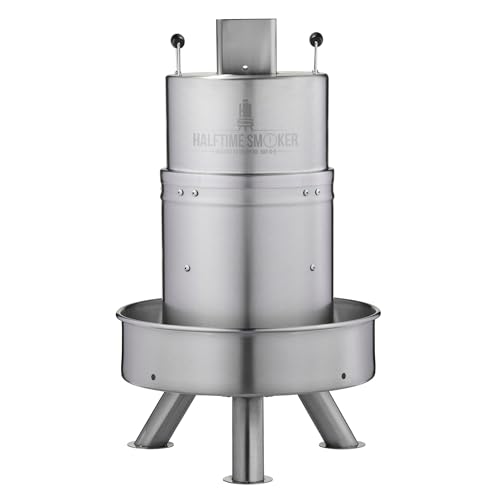
The Halftime Smoker — Best for Fast Weeknight Smokes
The Halftime Smoker makes its pitch in its name and its verified listing repeats it: smoked food in half the time. Like the Orion, it belongs to the fast convection school — designs that keep hot, smoky air moving over the food instead of letting it linger — but in a simpler, more conventional smoker format that will feel familiar to anyone who has used a standard outdoor cooker. It suits the household that loves smoked chicken, ribs and fish and refuses to plan a whole day around them.
Strengths
- Speed: convection-style cooking halves typical smoking times
- Approachable format for cooks new to smoking
- Moving air gives even cooking without constant rotation
Trade-offs
- Fast methods trade away some of the deep bark of long cooks
- Less community knowledge and fewer accessories than big brands
- Confirm the exact configuration on the listing before ordering
| Design | Fast-cooking convection-style smoker |
| Claim in listing | Smoked results in half the time |
| Format | Compact outdoor smoker |
| Fuel | See listing configuration before ordering |
Fast smokers reward precision over patience: because cooks are shorter, seasoning and timing matter more, and there is less margin to fix an under-seasoned rub mid-cook. Brines and dry brines pay off double here, doing overnight what a long cook would otherwise do slowly. Treat the Halftime as your weeknight smoker and keep expectations aligned — it will give you genuinely smoky, juicy results quickly, and it will not pretend to be a competition offset. Paired with a good reference from Best Cookbook For Smokers, it is the easiest on-ramp to smoking in this entire guide.
Best for: weeknight smokers who want real smoke without a full-day cook / Not suited for: competition-style bark chasers cooking low for twelve hours
Check on Amazon — check price on Amazon before you decide, because commercial listings change configuration often.
Comparison Table
Capacities and features below come from each cooker’s verified listing. ‘True convection’ means a sealed convection design; ‘fan-assisted’ means powered circulation or a fan-driven fire.
| Pick | Badge | Key spec | Best for |
|---|---|---|---|
| Orion Cooker 3.0 Convection Cooker & Smoker | Best Overall | True convection cooker and smoker (verified listing) | busy households that want real smoke flavour in a fraction of the time |
| Pellet Pro 2300 Vertical Pellet Smoker Cabinet | Best Vertical Pellet with Convection Fan | Double-wall cabinet with convection fan (verified listing) | batch smokers cooking jerky, sausage and ribs across many racks |
| Masterbuilt Gravity Series 600 Charcoal Grill Smoker | Best Fan-Driven Charcoal | 600 sq. in., GravityFed charcoal hopper, fan control (verified listing) | cooks who want charcoal flavour without manual fire tending |
| Camp Chef Woodwind Pro 24 | Best Smoke Control | 24-inch pellet grill, fan control plus smoke box (verified listing) | pellet cooks who want adjustable, deeper smoke flavour |
| Pit Boss Navigator 3-Series Pellet Vertical Smoker | Best Large Capacity | 1,118 sq. in., 5 racks, pellet vertical (verified listing) | bulk smokers, hunters and freezer-fillers cooking in big batches |
| The Halftime Smoker | Best for Fast Weeknight Smokes | Fast convection-style smoker (verified listing) | weeknight smokers who want real smoke without a full-day cook |
How to Choose a Convection Smoker: True Convection vs Fan-Assisted
The first decision is which kind of moving air you are buying. True convection cookers — the Orion and, in its faster format, the Halftime — cook with a circulating environment that surrounds the food. They are faster, moister and more hands-off, and they develop crust differently from classic barbecue. Fan-assisted smokers — the pellet cabinets, the Woodwind Pro and the Gravity Series — keep a recognisable smoker or grill format and use fans to steady and even out the cooking. They behave like the cookers you already know, only calmer.
Choose true convection if time is your constraint. Choose fan-assisted if flavour tradition is your constraint: pellet and charcoal smoke profiles, bark formation and grill versatility all live on that side of the line. And if you already own a vertical smoker you like, know that circulation can be retrofitted — a convection fan kit for vertical and custom smokers exists as a verified listing (the Pellet Pro Smoke Daddy fan), which tells you the upgrade is real, though fitting third-party fans is a project for confident tinkerers.
What Convection Changes in Your Technique
Moving air transfers heat faster than still air, so convection cooks run quicker and often a touch hotter at the surface. Practically: check doneness earlier than your still-air instincts say, expect skin on poultry to set better, and expect rubs to need a firmer hand because fast, moist environments soften crust. Wrapping — the crutch of still-air smoking — matters less in a sealed convection cooker and stays useful in fan-assisted cabinets for pushing brisket through the stall.
Airflow also means smoke management changes. A fan keeps fresh smoke moving across the food and out, which is why fan-assisted cooks taste cleaner at the same wood load. Do not compensate by adding more wood; compensate by adding wood earlier, when cold meat absorbs smoke most readily. In the Gravity and pellet cookers, that means loading your chunks at the start, not at hour four.
Sizing and Power: The Checks Before You Buy
Match capacity to your real batch. A five-rack cabinet is a joy twice a year and a storage problem the other fifty weeks if your typical cook is two chickens. Conversely, true convection cookers are deliberately compact — their speed depends on a tight, sealed environment — so do not expect to cater a wedding with one.
Then check the unglamorous details. Fan-assisted and pellet cookers need mains power and a dry place to live; controllers and fans dislike being stored wet. Vertical cabinets need headroom to open and load. Every cooker here needs outdoor clearance from walls and fences. Finally, confirm on the listing exactly which model and configuration you are buying — in this category especially, near-identical cabinets are sold with and without circulation hardware, and the difference is the entire point.
The Physics in Plain Language: Why Moving Air Cooks Differently
Still air is an insulator. Around any roast in a conventional smoker sits a thin boundary layer of cooler, moisture-laden air that the food itself creates, and heat must cross that layer slowly before cooking proceeds. Moving air strips the boundary layer away continuously. That single fact explains every convection claim in this guide: faster cooking, because heat arrives at the surface without queueing; more even cooking, because the chamber cannot maintain lazy pockets of hot and cold; better skin and surface setting, because the surface dries instead of steaming in its own vapour; and cleaner smoke flavour, because fresh smoke keeps arriving at the food instead of lingering and concentrating.
The same physics explains convection’s cautions. Surfaces dry faster, which is wonderful for chicken skin and a risk for lean cuts left too long. Cooking genuinely accelerates, so a recipe’s clock — written for still air — becomes a liar. And in sealed convection cookers, the moisture that cannot escape becomes part of the system, braising as it roasts, which is why their texture signature is succulence first and crust second. Understanding which of these effects your chosen design produces is the difference between buying a tool and buying a surprise.
Matching Convection Designs to Meats: A Practical Map
Whole poultry is convection’s showcase dish. Moving hot air crisps skin evenly on every side — no rotating, no pale patches — while the sealed designs keep the breast meat moist through the cook. If your smoking life centres on chickens and turkeys, the true convection cookers in this guide were built for you. Ribs follow close behind: even heat means even rendering, and the faster timeline suits a cut that punishes both undercooking and drying.
Brisket and pork shoulder, the long-cook canon, belong more naturally to the fan-assisted side of this guide — the Gravity Series and the pellet cabinets — where hours of steady, even heat and real wood smoke do the slow work, and the fan simply removes the hot-spot management. Fish and cheese sit at the gentle extreme: they want low temperatures and clean, moving smoke without intensity, which fan-assisted cabinets at their lowest settings handle gracefully. Read your own menu first and the badges second; in this category more than most, the right design is the one matched to your three most-cooked dishes.
Ownership Realities: Power, Cleaning and Where Fans Fail
Every cooker in this guide except the charcoal-ring Orion depends on electricity, and that dependency deserves planning rather than discovery. Controllers and fans need a dry, sheltered home; a cooker stored under a leaky cover with its electronics breathing damp air is a repair bill in rehearsal. Site fan-assisted cookers where an outdoor socket reaches without an extension-lead daisy chain, keep pellets and charcoal dead dry, and accept that a power cut mid-cook is an eventuality to have a plan for — even if the plan is simply an oven at the same temperature.
Cleaning is the second reality. Moving air distributes ash and grease mist everywhere the air goes, which is everywhere. Fans, intakes and sensors need periodic attention that a plain offset never asks for: ash vacuumed from fire pots, fan blades checked for grease drag, temperature probes wiped so they read truly. None of it is hard, and all of it is the price of the evenness you bought. Owners who pay it report the cookers feel precision-built for years; owners who skip it rediscover still-air cooking, badly, inside a machine designed for better.
Convection Smoking for Crowds: Scaling the Advantages
Moving air scales gracefully, which is why caterers and competition cooks quietly love fan-assisted equipment. In a loaded cabinet, still air stratifies into layers that cook at different speeds; circulation collapses those layers into one environment, so the tenth rack behaves like the first. That is the practical meaning of the big vertical picks in this guide: not merely more space, but more space that cooks uniformly. When you plan a crowd cook, load by finish logic rather than by shelf habit, keep the door discipline absolute — every opening in a full cabinet costs minutes across twenty racks, not one — and let the fan do the equalising you used to do with tongs and rotation.
The sealed convection cookers scale differently: not by volume but by repetition. Their speed turns one cooker into a relay — birds and rib batches in sequence, each finished while the previous rests — which feeds a gathering in waves of fresh food rather than one held mass. Choose your scaling style when you choose your design: cabinet volume for the single great batch, convection speed for the rolling service.
Troubleshooting Convection Cooks: Five Problems, Five Fixes
Problem: food cooks faster on one side. In fan-assisted models, check that nothing blocks the fan outlet or intake — a foil pan pushed against a vent wall is the usual culprit — and confirm the cooker is level. Problem: temperatures swing widely. Suspect fuel before electronics: damp pellets, mixed-size charcoal or a hopper bridging over the fire. Dry, uniform fuel settles most ‘controller faults’.
Problem: smoke flavour is too light. Load your wood earlier, not heavier — cold meat in the first hour takes the smoke — and in the Gravity and pellet models, place chunks where the listing’s design intends, including the ash pan trick the Gravity community swears by. Problem: skin is rubbery on poultry. The surface started wet or the finish was too gentle; dry-brine overnight and finish at a higher temperature for the final stretch. Problem: the fan sounds strained or cycles oddly. Clean it — ash and grease drag are the leading cause — and check that vents are clear before assuming a part has failed.
A Buyer’s Walkthrough: Five Checks in the Listing Before You Pay
Before any convection purchase, run these five checks on the actual listing in front of you. One: find the mechanism — the words fan, circulation or convection design should describe hardware, not adjectives, and the Orion and Pellet Pro listings in this guide show what honest wording looks like. Two: confirm the exact model variant, because this category sells near-identical cabinets with and without circulation, and the difference will not announce itself in the photographs. Three: match the power requirement to your outdoor socket’s reality, including what else shares that circuit on a cooking day.
Four: read the capacity against your three most-cooked dishes, not your largest fantasy — convection designs punish overloading more than still-air cookers do, because the air itself needs room to work. Five: check what the box includes and what the first season demands — covers, probes, spare gaskets, a second rack — and price the whole start, not the headline. Five checks, ten minutes, and the category’s only real traps (wrong variant, wrong power, wrong size) are all behind you.
Convection Myths, Corrected
Four myths follow this category around, and each deserves a short burial. Myth one: convection is a marketing word with no mechanism behind it. False in the models here — every pick moves air by sealed design, fan or fan-driven fire, and you can verify the mechanism in its listing. Myth two: faster cooking means rushed, inferior barbecue. The sealed convection cookers do trade some bark development for speed and moisture, but fan-assisted charcoal and pellet models cook at entirely conventional paces when you ask them to; the fan governs evenness, not haste. Myth three: fans make a smoker fragile. Fans and controllers are service items like any other; the owners who clean them cook for years, and the design’s benefits do not expire with the first ash bath. Myth four: convection replaces technique. It replaces one technique — hot-spot management — and leaves every other skill, from seasoning to resting, exactly where it was. Buy a convection smoker for the problem it solves, cook with the skills it still requires, and the myths become other people’s confusion.
One Last Check: The Cooker Behind the Cooker
A final, unfashionable buying note: every fan-assisted and pellet model in this guide is part appliance, and appliances are only as good as the support behind them. Before you pay, spend two minutes confirming that the brand sells replacement fans, controllers and probes for your model, and that owners of the line describe getting them without a saga. Masterbuilt, Camp Chef and Pit Boss all operate at a scale where parts exist; smaller names deserve the question asked explicitly. The sealed Orion, with no electronics to fail, quietly sidesteps the entire issue — one more reason it wears the Best Overall badge. Buy the cooker, by all means. Just glance once at the decade behind it before you do.
How to Get the Best From a Convection Smoker on Your First Cook
Step 1 — Cook something forgiving first. Choose a whole chicken or a pork shoulder. Both love moving hot air, both forgive timing errors, and both will teach you your cooker’s pace in one session.
Step 2 — Dry-brine overnight. Salt the meat the night before and rest it uncovered in the fridge. In fast, moist convection environments, a dry surface is what lets smoke and crust form properly.
Step 3 — Preheat fully. Bring the cooker to temperature and let it stabilise before food goes in. Fans and sealed chambers reward a settled start; loading into a still-warming cooker is the most common cause of a disappointing first cook.
Step 4 — Load once, then leave it closed. Convection’s advantage is a stable environment. Every peek dumps heat and humidity and resets the clock. Use a probe thermometer and trust it.
Step 5 — Check early. Start checking doneness at about two-thirds of the time a still-air recipe suggests. Convection cooks genuinely run faster, and an overcooked first brisket has ended more smoking hobbies than any equipment failure.
Step 6 — Rest properly. Rest meat at least as carefully as you cooked it: tented on a board for poultry, wrapped in a dry cooler for large cuts. For recipe ideas matched to these cookers, Best Cookbooks For Electric Smokers includes several titles whose timing guidance adapts well to fan-assisted cooking.
Common Buying Mistakes
Buying the word, not the mechanism. If a smoker has no fan, no sealed convection design and no circulation system, it is not a convection smoker whatever the headline says. Check what actually moves the air.
Cooking to still-air times. Recipes written for offsets and cabinets overcook food in convection environments. Halve your checking intervals and trust the probe, not the schedule.
Opening the cooker to admire your work. Moving-air cookers lose their advantage every time the lid lifts. Cook with the door closed and a thermometer doing the looking.
Neglecting the fan. Ash, grease and pellet dust accumulate around fans and intakes. A fan that cannot breathe turns your convection smoker back into a still-air box with worse airflow than a normal one.
Overloading a compact convection cooker. True convection designs need space around the food for air to circulate. Crowding the chamber defeats the design you paid for.
Final Recommendation
Buy the Orion Cooker 3.0 if you want the real convection experience — the speed and moisture are unlike anything else here. Buy the Gravity Series 600 if you want charcoal flavour with a fan doing the fire watch, the Woodwind Pro 24 if smoke intensity is your obsession, and the Pellet Pro 2300 or Pit Boss Navigator if your smoking happens by the rackful. The Halftime is the friendly weeknight option. Still deciding between moving air and the classics? Compare against Best Consumer Smokers overall, the traditionalists in Best Consumer Smokers Offset, and the contest-grade end of the market in Best Competition Meat Smokers.
Start your shortlist here: Orion Cooker 3.0 Convection Cooker & Smoker, Pellet Pro 2300 Vertical Pellet Smoker Cabinet, Masterbuilt Gravity Series 600 Charcoal Grill Smoker. Check price on Amazon for each, in that order, against the needs described above.
Frequently Asked Questions
What is a convection smoker, exactly?
A smoker that keeps hot, smoky air moving around the food — through a sealed convection chamber, a circulation fan, or a fan-driven fire — instead of letting it sit still. The moving air cooks more evenly and usually faster, with fewer hot spots.
Do convection smokers cook faster?
Yes. True convection cookers can cut typical smoking times dramatically, and fan-assisted smokers also cook more efficiently than still-air equivalents. Always start checking doneness earlier than a conventional recipe suggests.
Does convection smoking change the flavour?
The smoke flavour stays — you are still burning wood — but the texture changes: moisture retention is higher and bark tends to be softer in sealed convection cookers. Fan-assisted charcoal and pellet cookers taste closest to traditional barbecue.
Can I add convection to a smoker I already own?
For vertical and some custom smokers, yes: dedicated convection circulation fan kits are sold for exactly that purpose. It is a retrofit project, though, and results depend on how well the fan suits your cabinet’s size and vents.
Are convection smokers good for beginners?
They are among the most forgiving smokers a beginner can buy, because there is little or no fire to manage and the even heat removes the hot-spot mistakes that ruin first cooks. The main skill is learning the faster timing.
What should I cook first in a convection smoker?
A whole chicken. It cooks quickly, loves the moist moving air, crisps well, and teaches you your cooker’s pace in a single short session before you commit to a brisket.
Can a convection smoker replace my grill?
The fan-assisted models here — the Gravity Series and the Woodwind Pro especially — grill and sear credibly as well as smoke. The true convection cookers are specialists: superb smokers and roasters, but not open-grate grills. Most households keep a simple grill beside a specialist smoker.
Do I need special pellets or fuel for fan-assisted smokers?
No special fuel is required: standard food-grade pellets for pellet models, and ordinary charcoal with wood chunks for the Gravity Series. Dryness matters more than brand — damp fuel is the leading cause of temperature misbehaviour in fan-driven cookers.
Is a convection smoker the same as a pellet smoker?
No — pellet describes the fuel, convection describes the airflow. Many pellet smokers are fan-assisted and therefore appear in this guide, but a pellet cooker without meaningful circulation is just a pellet cooker, and a charcoal Gravity Series is convection-assisted without burning a single pellet. The two words answer different questions about the same machine.
Are convection smokers more expensive to run?
Running costs are comparable to their still-air equivalents: pellet and fan-assisted models use modest electricity plus fuel, and true convection cookers often use less fuel per meal because cooks finish sooner. The honest premium is purchase price and maintenance attention, not the cost per cook.


