Disclosure: airfryerkitchensupply.com is reader-supported. When you buy through links on our site, we may earn an affiliate commission at no extra cost to you.
Where to buy
Construction claims are the easiest thing in this category to fake with adjectives, so this guide to the best constructed kitchen faucets only links models verified against retailer catalog data — the exact brand, model and build details in each review match the verified listing. Use the links to check price on Amazon, and read the listing’s own specification details the way this guide teaches you to: looking for materials and cartridge facts, not adjectives.
- Kingston Brass Heritage Bridge KS1278ALBS — Check the current price on Amazon
- KRAUS Oletto KPF-2820MB — Check the current price on Amazon
- American Standard Colony Pro 7074000.002 — Check the current price on Amazon
- Moen Arbor 7594SRS — Check the current price on Amazon
- Kingston Brass Heritage Bridge KS1273ALBS — Check the current price on Amazon
- Delta Essa 9113-AR-DST — Check the current price on Amazon
Ask ten faucet listings what they are made of and nine will answer with poetry: premium, heavy-duty, solid feel. The best constructed kitchen faucets answer with facts instead — a brass body or a named metal alloy, a ceramic disc cartridge from a maker who sells replacements, metal rather than plastic in the parts your hand touches and the parts water touches. This guide was built by reading construction evidence the way a plumber does, and the six picks below earned their places on verifiable build details: solid brass bridge construction, brass spouts, metal-bodied pull-downs from makers with real parts catalogs.
Why does construction deserve its own guide? Because a faucet is a fifteen-year appliance disguised as a décor purchase. The finish is what you notice in the showroom; the body casting, cartridge and hose are what you live with in year nine, when the question is whether a wear part exists and whether the body underneath is still sound. A well-constructed faucet can be re-cartridged, re-hosed and re-finished by time; a poorly constructed one is replaced whole, at full price, on a weekend you did not plan for.
The picks divide into two construction philosophies. The bridge faucets from Kingston Brass represent the traditional school: solid brass bodies, exposed honest plumbing, parts you can see and service. The pull-downs from KRAUS, American Standard, Moen and Delta represent the modern school: engineered bodies, ceramic cartridges and docking systems, where construction quality shows in tolerances and support rather than in visible metal. Both schools can produce a faucet that outlives its kitchen. This guide explains how to tell, model by model.
In this guide
Quick Picks
Six construction-led picks: two solid-brass Kingston bridge faucets, a brass-bodied KRAUS pull-down, a brass-spout American Standard, Moen’s proven Arbor, and Delta’s Essa — each chosen on build evidence, not adjectives.
| Pick | Badge | Why it made the list | Amazon |
|---|---|---|---|
| Kingston Brass Heritage Bridge KS1278ALBS | Best Overall Construction | Solid brass bridge construction from the Heritage line — the traditional school’s benchmark. | Check price on Amazon |
| KRAUS Oletto KPF-2820MB | Best Modern Metal Build | Brass construction in a contemporary pull-down, with a wear-resistant matte black finish. | Check price on Amazon |
| American Standard Colony Pro 7074000.002 | Best Brass Spout Value | A brass swivel spout on a pro-line single-handle body from a plumbing institution. | Check price on Amazon |
| Moen Arbor 7594SRS | Best Proven Pull-Down | A long-running Moen pull-down whose docking system and parts ecosystem define proven construction. | Check price on Amazon |
| Kingston Brass Heritage Bridge KS1273ALBS | Best Traditional Build in Antique Brass | The Heritage bridge in antique brass, with a brass sprayer — traditional construction, warm finish. | Check price on Amazon |
| Delta Essa 9113-AR-DST | Best Single-Hole Contemporary Build | Delta’s contemporary single-hole pull-down, backed by the industry’s benchmark support ecosystem. | Check price on Amazon |
How These Picks Were Chosen
Every model here was verified against Amazon’the Amazon catalogue data for this site before it was scored: brand, model and configuration in the review match the verified listing title, and only verified models carry a purchase link. Construction research then worked from the most reliable evidence available to a buyer — the manufacturer’s own stated materials for the exact model, the cartridge system it uses, and the maker’s parts ecosystem — rather than from review sentiment, which mostly measures the first ninety days of a fifteen-year product.
Scoring weighted, in order: body and spout material (solid brass and metal bodies at the top, plastic-shell construction excluded outright); wetted-part quality, meaning lead-free certified construction as a baseline; cartridge type and replaceability; the moving parts unique to each format — bridge faucet valves and sprayers, pull-down hoses, weights and docks; and finally the manufacturer’s demonstrated willingness to sell you parts in year ten, which is where famous names earn their keep. Finishes were treated as a construction topic only where the finish method itself (bonded versus plated) affects lifespan.
Two honest caveats shaped the list. First, at the very top of the market, boutique brands build magnificent faucets that could not be verified through the catalog data available to this guide, so they are absent rather than guessed at — a construction guide that invents its evidence would betray its own premise. Second, several excellent modern faucets use engineered polymer in non-structural parts; we judged the parts that carry water, pressure and daily force, not the material label in the abstract.
The 6 Best Constructed Kitchen Faucets
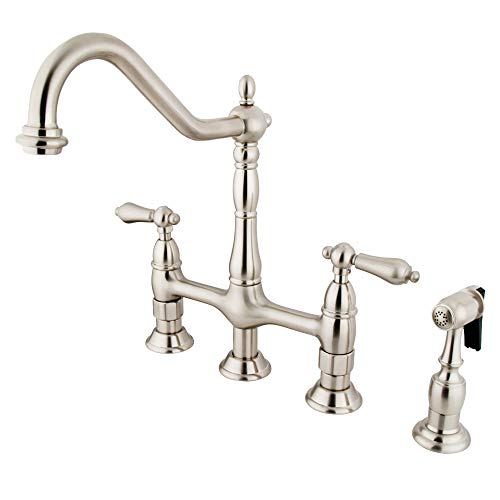
Kingston Brass Heritage Bridge KS1278ALBS — Best Overall Construction
If construction is the question, the Heritage bridge is the answer in its purest form: a solid brass body built in the traditional bridge pattern, where the hot and cold supplies meet in an exposed horizontal body above the deck. There is nowhere for cheap construction to hide in a bridge faucet, and Kingston Brass builds this one the old way.
Strengths
- Solid brass body and fittings — the benchmark material for faucet longevity and repairability
- Exposed bridge architecture makes every joint inspectable and serviceable with ordinary tools
- Two-handle valve design uses simple, widely available replacement parts
Trade-offs
- Bridge format needs an 8-inch deck drilling (or wall/farmhouse setup) — not a single-hole swap
- Two handles are slower than a single lever for one-handed operation
- Traditional styling is a commitment; it suits farmhouse and classic kitchens, not minimal ones
| Specification | Detail |
|---|---|
| Construction | Solid brass (Heritage bridge line) |
| Spout reach | 8-3/4 inches (per verified listing title) |
| Format | Bridge, two-handle |
| Finish | Brushed nickel |
Brass earned its place as the faucet material over a century: it casts cleanly, machines precisely, resists corrosion in household water, and — crucially — can be repaired. Threads can be chased, seats serviced, valves replaced. A solid brass body is effectively a lifetime part; everything that wears on this faucet is a replaceable cartridge or washer riding in a body that will outlast the kitchen around it. That is what best constructed means when the term is used seriously.
The bridge layout adds a second construction virtue: honesty. The mixing happens in the exposed bridge, the spout rises from its center, and a matching brass sprayer in this line is metal rather than the plastic wand of a budget pull-down. There are no hidden plastic manifolds and no proprietary internals a decade from now. A plumber of any generation can walk up to this faucet and understand it completely, which is a form of future-proofing no app feature matches.
Buy the Heritage bridge if your kitchen’s style allows it and you intend to keep the faucet through the next remodel and the one after that.
Best for: farmhouse and traditional kitchens, and buyers purchasing a faucet for the long term / Not suited for: single-hole modern sinks or cooks who want one-handed single-lever control
Check on Amazon — check price on Amazon before ordering, and confirm the finish and hole configuration on the listing match your sink.

KRAUS Oletto KPF-2820MB — Best Modern Metal Build
Modern faucets hide their construction, so the Oletto’s verified listing does buyers a favor by stating it: brass construction under a wear-resistant matte black finish. It is the pick for buyers who want the material story of the bridge faucets in a single-handle pull-down that suits a contemporary kitchen.
Strengths
- Brass construction stated for the exact model — rare candor in the modern category
- Wear-resistant finish engineering aimed at the scratching and chemical exposure that kill cheap black finishes
- KRAUS’s metal build and damped handle action, in a standard pull-down format
Trade-offs
- Matte black shows water spots and needs wiping to look its best
- Pull-down hoses and wands are wear items no body material can exempt — plan on eventual hose service
- Modern silhouette only: traditional kitchens should look at the bridges
| Specification | Detail |
|---|---|
| Construction | Brass (per verified listing title) |
| Finish | Matte black, wear-resistant |
| Format | Single-handle pull-down |
| Maker | KRAUS |
The modern construction question is not really about the body — reputable makers cast sound bodies — it is about everything attached to it. KRAUS builds the Oletto as a system: a metal body, a quality cartridge, a hose and wand engineered to dock thousands of times without going slack. That systems thinking is what separates constructed from assembled, and it is why this faucet, rather than a cheaper lookalike with a similar spec sheet, holds the modern spot on this page.
The finish deserves its sentence: matte black is the finish most often ruined by cheap plating, peeling at the handle and spout within a few years. A wear-resistant finish on a brass substrate is the correct way to build a black faucet — when the surface is bonded to real metal rather than stretched over plastic, chips do not bloom into peeling, and the faucet ages by mellowing instead of disintegrating.
Choose the Oletto for a contemporary kitchen where the faucet must be both black and built. It is the modern school’s most honest construction story at a sane tier.
Best for: modern kitchens wanting verified brass construction in a black pull-down / Not suited for: buyers who dislike wiping a black finish, or traditional-style kitchens
Check on Amazon — check price on Amazon before ordering, and confirm the finish and hole configuration on the listing match your sink.

American Standard Colony Pro 7074000.002 — Best Brass Spout Value
The Colony Pro’s verified listing leads with the construction detail that matters: a brass swivel spout. Spouts are the part of a faucet that flexes, swings and gets leaned on daily, and American Standard — a company that has plumbed buildings for well over a century — builds this pro-line model’s spout from brass rather than plated substitutes.
Strengths
- Brass swivel spout: the highest-stress moving part is made of the right material
- Pro-line positioning means parts and documentation through a deep plumbing network
- Single-handle convenience in a body a plumber will respect
Trade-offs
- Chrome finish shows water spots more than brushed alternatives
- Styling is professional rather than decorative — it will not be the kitchen’s centerpiece
- Confirm deck configuration on the listing; pro-line variants cover several drillings
| Specification | Detail |
|---|---|
| Spout | Brass swivel (per verified listing title) |
| Format | Single-handle |
| Finish | Chrome |
| Line | Colony Pro |
Construction judgment is often about where the money went. On this faucet it went into the spout and the pro channel: the Colony Pro line is sold for working installations, where a faucet is specified by people who will get the callback if it fails. That channel discipline shows in the details a listing can state — brass where flex happens, a cartridge system the trade stocks, and a body designed for service access rather than showroom sparkle.
American Standard’s institutional depth is the ownership argument. When a faucet’s maker has supplied buildings for generations, its parts diagrams, cartridge standards and support lines behave accordingly. For a buyer whose definition of well-constructed includes ‘someone will sell me the wear part in twelve years,’ that depth is construction quality by another name.
Buy the Colony Pro if you want trade-grade priorities — brass spout, serviceable guts, institutional support — at a working faucet’s tier rather than a designer one.
Best for: pragmatic buyers who value trade-grade build and parts depth over styling / Not suited for: design-first kitchens, or buyers who want a spot-hiding finish
Check on Amazon — check price on Amazon before ordering, and confirm the finish and hole configuration on the listing match your sink.

Moen Arbor 7594SRS — Best Proven Pull-Down
Proven is a construction claim too. The Arbor has been in Moen’s line for years, its Reflex docking system is one of the most field-tested pull-down mechanisms in the industry, and every wear part on it is a catalog item. For buyers who equate well-constructed with known-quantity, this is the pick.
Strengths
- Reflex docking keeps the wand seated and retracting smoothly over years of cycles
- Moen’s cartridge ecosystem is the deepest in residential plumbing — parts anywhere, forever
- Spot Resist finish reduces the daily evidence of hard-working hands
Trade-offs
- Transitional styling is safe rather than striking
- Pull-down hose is a wear item, as on every faucet of this format
- Power Boost spray helps rinsing but is no substitute for a deep sink on big jobs
| Specification | Detail |
|---|---|
| Height | 15.5 inches |
| Dimensions | 7.88 x 10.25 x 15.5 inches (per API cache data) |
| Docking | Reflex system |
| Finish | Spot Resist Stainless |
The Arbor’s construction story is written in its installed base. A model that survives in a major maker’s catalog for this long has passed the only test that cannot be faked: hundreds of thousands of kitchens, hard water and soft, careful owners and rough ones. Its failure modes are known, documented and cheap to fix. Compare that with a new model’s promise, however impressive its materials list, and the meaning of proven construction becomes clear — it is risk, retired.
Moen’s Reflex system deserves its reputation in this context. Docking is where pull-downs cheapen first: magnets weaken, seats wear, wands dangle. Reflex was engineered against exactly that decay, guiding the wand home and holding it there, and the Arbor’s long production run means the system’s behavior in year eight is a matter of record rather than hope.
Choose the Arbor when you want the pull-down format with the least construction uncertainty money can buy in the mainstream market.
Best for: risk-averse buyers who want a field-proven pull-down with endless parts support / Not suited for: buyers wanting a bold design statement or a two-handle traditional format
Check on Amazon — check price on Amazon before ordering, and confirm the finish and hole configuration on the listing match your sink.
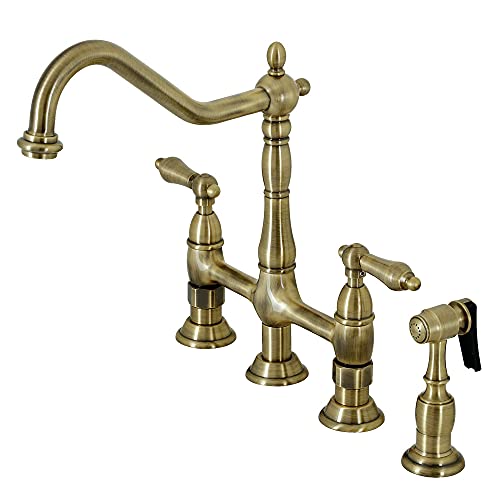
Kingston Brass Heritage Bridge KS1273ALBS — Best Traditional Build in Antique Brass
The second Heritage bridge on this page earns its own place on a construction detail the first cannot claim in the same way: a brass sprayer. Side sprayers are the most commonly cheapened component in traditional faucets — plastic wands on metal bodies — and this model’s sprayer is brass, matching the body it serves.
Strengths
- Brass sprayer instead of the plastic wand typical at this format — the whole fixture is metal
- Heritage line’s solid traditional construction in an 8-inch bridge format
- Antique brass finish suits period and farmhouse kitchens authentically
Trade-offs
- Antique brass is a living-look finish that develops character — perfectionists should choose brushed nickel
- Bridge drilling requirements apply, as with the KS1278ALBS
- Two-handle operation, with the same one-handed limitations
| Specification | Detail |
|---|---|
| Format | 8-inch bridge |
| Sprayer | Brass sprayer (per verified listing title) |
| Finish | Antique brass |
| Line | Kingston Brass Heritage |
Judge a traditional faucet by its cheapest component, because that is where the tier hides. On bridge faucets the sprayer is the tell: it is pulled, swung and dropped daily, and a plastic sprayer on a brass body announces exactly how the maker allocated cost. Kingston speccing brass for the sprayer on this Heritage model is the kind of detail a construction guide exists to reward — the fixture is metal all the way to the end of the hose.
The antique brass finish is the aesthetic half of the same philosophy. Rather than a bright coating pretending to be old, it is a warm, deep tone that sits honestly in period kitchens and ages gracefully with the brass beneath it. In a farmhouse or heritage renovation, that coherence — material, finish and format all telling the same story — is what makes a faucet look inevitable rather than installed.
Buy this Heritage when the kitchen is traditional, the sink takes an 8-inch bridge, and you want no plastic apologies anywhere in the fixture.
Best for: period and farmhouse kitchens wanting all-metal traditional construction / Not suited for: modern kitchens, or buyers who want a finish that never changes
Check on Amazon — check price on Amazon before ordering, and confirm the finish and hole configuration on the listing match your sink.

Delta Essa 9113-AR-DST — Best Single-Hole Contemporary Build
The Essa represents the contemporary construction argument: a clean single-hole body, an engineered pull-down, and behind it Delta — the maker whose valves, documentation and parts availability set the standard every other brand is measured against. Its construction case rests on the system around the metal as much as the metal itself.
Strengths
- Delta’s support ecosystem: cartridges, parts and documentation a homeowner can actually obtain
- Contemporary single-hole format installs cleanly on modern stone and steel sinks
- Refined pull-down mechanics with a finish that behaves in daily use
Trade-offs
- Minimalist styling will not satisfy traditional kitchens
- Single-hole format on a multi-hole sink needs the right deck plate solution
- Engineered construction means some internal parts are Delta-specific — available, but proprietary
| Specification | Detail |
|---|---|
| Height | 15.25 inches |
| Dimensions | 1.25 x 11 x 15.25 inches (per API cache data) |
| Mounting | Single hole |
| Finish | Arctic Stainless |
There are two ways to build a faucet that lasts: make every part generic and repairable by anyone, the bridge philosophy, or engineer a proprietary system and support it forever, the Delta philosophy. The Essa is the second way done properly. Its parts are Delta’s own, and Delta’s commitment to keeping them available — through every plumbing counter and hardware store in the country — is a construction feature as real as a brass casting.
The faucet itself justifies the system: a balanced single-lever action, a wand that docks with intent, and a silhouette that has made the Essa a default recommendation for contemporary kitchens for years. Longevity in the catalog is again part of the evidence — Delta keeps selling the Essa because the Essa keeps working, and its wear parts remain a shelf item rather than a search project.
Choose the Essa for a contemporary kitchen where you want modern design with an institutional-grade support story behind it.
Best for: contemporary kitchens and buyers who prize parts availability above all / Not suited for: traditional kitchens, or buyers committed to generic, maker-independent parts
Check on Amazon — check price on Amazon before ordering, and confirm the finish and hole configuration on the listing match your sink.
Comparison Table
| Pick | Badge | Key spec | Best for |
|---|---|---|---|
| Kingston Brass Heritage Bridge KS1278ALBS | Best Overall Construction | Solid brass bridge body, 8-3/4 in | farmhouse and traditional kitchens, and buyers purchasing a faucet for the long term |
| KRAUS Oletto KPF-2820MB | Best Modern Metal Build | Brass body, matte black | modern kitchens wanting verified brass construction in a black pull-down |
| American Standard Colony Pro 7074000.002 | Best Brass Spout Value | Brass swivel spout | pragmatic buyers who value trade-grade build and parts depth over styling |
| Moen Arbor 7594SRS | Best Proven Pull-Down | Reflex docking, 15.5 in height | risk-averse buyers who want a field-proven pull-down with endless parts support |
| Kingston Brass Heritage Bridge KS1273ALBS | Best Traditional Build in Antique Brass | 8-inch bridge, brass sprayer | period and farmhouse kitchens wanting all-metal traditional construction |
| Delta Essa 9113-AR-DST | Best Single-Hole Contemporary Build | Single hole, pull-down, Arctic Stainless | contemporary kitchens and buyers who prize parts availability above all |
The table’s real divide is philosophical. The two Kingston bridges bet on material and generic repairability: brass everywhere, parts any plumber knows. The KRAUS, American Standard, Moen and Delta picks bet on engineered systems backed by deep catalogs: proprietary parts, permanently stocked. Both bets have decades of evidence behind them. Choose by your kitchen’s style and by which support story you trust — the local plumber’s knowledge, or the manufacturer’s machine.
How to Choose a Kitchen Faucet by Construction Quality
Read listings like an auditor. The signals of real construction are specific nouns: solid brass, ceramic disc cartridge, metal sprayer, a named docking system, a stated certification. The signals of its absence are adjectives: premium, luxury, heavy-duty, advanced. A maker who used brass says brass, with the model number attached; a maker who did not says everything else. Apply that filter and most of the market sorts itself before you compare a single feature.
Body, spout and sprayer: where material matters most
Rank the parts by consequence. The body carries pressure for fifteen years — brass or quality metal construction matters most here. The spout swings and gets leaned on; a brass spout, as on the Colony Pro, is a genuine upgrade. The sprayer or wand is the most-handled part and the most commonly cheapened: metal where your hand closes, as on the Heritage bridge’s brass sprayer, outlasts plastic shells that crack at the neck. Handles and escutcheons matter least structurally — but metal ones still tell you how the maker spent money where you could not see.
Cartridges: the wear part that decides lifespan
Every faucet’s life is a cartridge’s life, repeated. Ceramic disc cartridges are the modern standard for longevity and smooth action; what matters more than the type is replaceability — is the cartridge a stocked catalog part, priced like a consumable, documented with a diagram? Moen and Delta built empires on yes. Before buying any faucet, search for its cartridge as if you needed it today. If you can find it in two minutes, the faucet is constructed as a system. If you cannot, you are buying a disposable with good marketing.
What Does Lead-Free Construction Actually Require?
In the United States, faucets that dispense drinking water must meet strict lead-content limits for their wetted surfaces, and reputable makers certify to them. This is construction quality at the level of metallurgy: the alloys, the internal waterways and the testing behind the certification. Treat certification as a gate, not a feature — a faucet that cannot state its lead-free compliance plainly has failed the first construction test regardless of how heavy it feels. Every pick on this page comes from a maker whose compliance is documented for the exact model.
Certification also disciplines the rest of the build. A maker who submits a faucet for standards testing has engineered its pressure handling, its cartridge endurance and its materials as a package. It is no coincidence that the faucets with the clearest certifications also tend to have the clearest parts catalogs — both are products of the same engineering culture.
For the buyer, the practical move is verification rather than trust: the model number on the box should resolve to the maker’s own documentation, where the certification is stated for that exact model. Line-level claims (‘our faucets are certified’) applied to a variant that was never listed are a known soft spot in the industry, and it costs two minutes to close it. A construction-first buyer spends those two minutes on every candidate, the way this guide did before scoring a single pick.
How Much Does Construction Quality Cost?
Less than its absence. The honest spread on this page runs from trade-tier value (the Colony Pro) through the mainstream majors (Moen, Delta, KRAUS) to traditional solid-brass work (the Heritage bridges), and the pattern to notice is that construction quality is not the most expensive line in any tier — styling is. A buyer who spends on material, cartridge and support rather than on silhouette routinely gets a better faucet for the same money, because the industry’s pricing rewards looks first.
Budget the whole ownership, not the invoice: a faucet that needs one cartridge in fifteen years costs its price plus a modest part; a faucet replaced twice costs three invoices, two installs and one ruined weekend each time. Construction is the only faucet feature that pays you back, and it pays in the currency of nothing going wrong.
How to Maintain a Well-Constructed Faucet So It Lasts Decades
Good construction rewards basic care with extraordinary lifespan. None of this takes more than minutes, and all of it is cheaper than the repair it prevents.
- Descale the aerator or spray face on your water’s schedule — monthly with hard water, quarterly otherwise. Unscrew it, soak it in vinegar, rinse the debris out, and reinstall. Most ‘weak faucet’ complaints end here.
- Exercise every function weekly: swing the spout through its arc, pull the wand through its travel, run both spray modes. Parts that move regularly do not seize, and hoses do not take a permanent set.
- Wipe the body and handles with a soft cloth and mild soap as part of normal kitchen cleaning. Keep abrasive powders and bleach sprays off the finish — chemical attack, not water, is what ruins finishes.
- At the first persistent drip, replace the cartridge rather than cranking the handle harder. Overtightening destroys seats and converts a modest part into a body problem. Order the cartridge by the model number you recorded at installation.
- Once a year, look under the sink: check supply connections for mineral crust or dampness, confirm the hose loop hangs clear, and snug nothing that is not leaking. A dry, quiet under-sink is the signature of a faucet aging well.
- Keep the model’s documentation — spec sheet, parts diagram, cartridge number — in the house file. When a wear part is needed in year twelve, that folder turns a research project into a shopping trip.
Follow that rhythm and the faucets on this page are not purchases so much as installations: fixtures that will be serviced a few times, admired often, and replaced only when the kitchen around them changes — which is the entire point of buying construction quality.
Plastic in Modern Faucets: Always a Red Flag?
Not always — and a serious construction guide should say so. Engineered polymers have legitimate roles: hose liners that must flex a hundred thousand times, aerator housings, non-structural trim, and waterway components in some certified designs where the polymer is the engineering-correct choice. The red flags are specific: plastic where pressure lives in a part marketed as metal, plastic sprayer necks and handle hubs that take daily force, and plastic used to imitate weight — a faucet that feels heavy because of a weighted base rather than a metal body.
The practical test is location, not material. Ask of each plastic part: does it carry pressure, take force, or meet my hand daily? If yes, it should be metal or a documented engineering exception from a maker who certifies the whole. If it is a liner, a guide or a trim ring, judge it by the maker’s record instead. That nuance is why this page’s modern picks come from makers with certification and catalogs — their material choices are engineering decisions you can inspect, not cost decisions you must guess at.
How to Inspect a Faucet’s Construction Before You Buy
You can audit a faucet from your kitchen table. Find the model’s specification sheet and parts diagram on the maker’s site: a faucet with a published exploded diagram is a faucet built to be serviced. Search the cartridge part number and note its price and availability. Read the warranty for what it excludes — the exclusions describe the maker’s own doubts. Check the stated weight against rivals, since metal bodies are honestly heavy. And read the listing for the exact model, as this guide did, because construction claims made for a product line do not always survive contact with a specific variant’s spec sheet.
In a showroom, work the handle and dock the wand a dozen times. Quality construction announces itself in tolerances: no grit in the travel, no wobble at the spout base, a dock that seats with a single decisive feel. None of that proves the metallurgy — but makers who sweat the visible tolerances rarely cheated on the invisible ones, because both come from the same factory culture.
Warranty Length vs. Warranty Substance
Buyers often sort faucets by warranty years, but the substance behind the number matters more than the number. A lifetime warranty from a maker with a staffed support line, published parts diagrams and cartridges on retail shelves is a working system you will actually use. A lifetime warranty from a brand that exists only as a marketplace storefront is a sentence. When you evaluate construction, evaluate the warrantor: how long has the maker sold faucets, where are its parts stocked, and does its support channel answer with part numbers or with apologies?
Read the exclusions with the same care. Finishes, hoses and commercial use are carved out in various ways across the industry, and the carve-outs tell you where each maker expects wear. None of this makes a warranty a reason to buy a weak faucet with a long promise — the promise is only as constructed as the company behind it, which is precisely this guide’s point applied one level up.
Forged, Cast or Fabricated: Does the Body’s Birth Matter?
Faucet bodies reach their shape three ways. Casting pours molten metal into a mold — the traditional route for brass bridges and complex bodies, capable of excellent results with good foundry discipline. Forging shapes metal under pressure, producing dense, strong blanks favored in premium handles and bodies. Fabrication assembles tube and sheet, common in contemporary stainless designs, and can be superb or flimsy depending on gauge and welding. The method alone does not rank a faucet; the maker’s discipline within the method does, which is why this guide scores named models rather than manufacturing vocabulary.
What a buyer can use is the correlation: makers who disclose method and material together are usually makers whose factories reward disclosure. When a listing says solid brass, names the cartridge system and publishes a parts diagram, the body was almost certainly made by people who expected to be asked. Silence on all three is also information.
Will a Well-Constructed Faucet Outlast Your Kitchen?
Often, yes — and that changes how you should buy. Kitchens are remodeled on fifteen-to-twenty-year cycles, and a solid brass bridge or a catalog-supported major-brand faucet can plausibly serve through two of them, moving from kitchen to utility sink to a rental property as styles change around it. That horizon argues for timeless formats and finishes over fashionable ones: the Heritage bridges and the Essa’s clean contemporary lines will look intentional in twenty years, while this season’s novelty silhouette will date everything it touches.
It also argues for keeping the paperwork. A faucet whose model, cartridge and finish are recorded in the house file is an asset the next owner can maintain; an anonymous faucet is a replacement waiting for its first drip. Construction quality is partly metallurgy and partly documentation — buy both.
Common Buying Mistakes
Believing the word premium
Premium is not a material. If a listing will not name its body material, cartridge type and certification for the exact model, assume the construction is ordinary and price it accordingly — or choose a pick from this page whose facts are stated.
Judging weight without asking why
A heavy faucet may be solid brass or may be a light body on a weighted base. Weight is a clue, not a verdict; the spec sheet is the verdict.
Ignoring the sprayer and hose
On pull-downs and bridge sets alike, the most-handled components wear first. A plastic sprayer neck or an undocumented hose turns a sound body into a short-lived faucet.
Skipping the cartridge search
Two minutes searching for the replacement cartridge before purchase tells you more about a faucet’s real lifespan than any review. If the part cannot be found, neither can the faucet’s future.
Over-tightening a dripping faucet
Force is not a repair. A drip is a cartridge asking to be replaced; cranking the handle destroys the seat it seals against and multiplies the eventual bill.
Final Recommendation
If construction is truly the criterion, the answer is the Kingston Brass Heritage Bridge KS1278ALBS: solid brass, honestly built, serviceable forever. Modern kitchens should take the KRAUS Oletto for its stated brass construction, pragmatists the American Standard Colony Pro for its brass spout and trade support, risk-averse buyers the Moen Arbor, period kitchens the Heritage KS1273ALBS with its brass sprayer, and contemporary minimalists the Delta Essa.
Construction-first buying pairs naturally with the other guides in this cluster: Best Commercial Kitchen Sink Faucets applies the same serviceability logic to business fixtures, Best Delta Kitchen Faucets goes deep on one maker’s system, and Best Country Kitchen Faucets covers the traditional styles where brass construction is the native language.
Frequently Asked Questions
What is the best material for a kitchen faucet body?
Solid brass is the traditional benchmark: it casts and machines precisely, resists corrosion in household water, and can be serviced for decades. Quality metal alloys from major makers are a sound modern alternative. What to avoid is an unnamed material behind adjectives — a maker using brass says so, as the listings for the KRAUS Oletto and Kingston Heritage models on this page do.
Are ceramic disc cartridges really better?
For longevity and smooth action, yes — ceramic discs resist the wear that makes older compression and ball mechanisms drip, and they are the standard in every pick here. The more important question is whether the specific cartridge is a stocked, documented part, because that decides whether a year-ten drip is a small repair or a full replacement.
Is a heavier faucet always better constructed?
No. Weight is a clue that must be cross-examined: solid metal bodies are heavy, but so are light bodies on weighted bases. Check the stated body material and the parts diagram before letting heft persuade you.
Do plastic parts mean a faucet is poorly built?
Not automatically. Polymers are the right material for hose liners and some internal waterways in certified designs. Plastic is a warning sign where it carries daily force or imitates metal — sprayer necks, handle hubs, and bodies marketed on heft. Judge the location and the maker’s certification, not the material alone.
How long should a well-constructed kitchen faucet last?
The body should last decades — brass bridges routinely outlive the kitchens around them, and it is common to meet thirty-year-old examples still on their original castings with nothing more than replacement cartridges and washers behind them. Wear parts set the service rhythm: cartridges, hoses and aerators are replaced as needed over that span, on intervals set by your water quality and how hard the household works the faucet. A faucet whose wear parts are stocked and documented can be kept in service almost indefinitely, which is why this guide treats the parts catalog as part of the construction itself rather than an afterthought.
Is a bridge faucet harder to live with than a pull-down?
It asks for two hands at times and an 8-inch drilling, and in exchange offers the simplest, most repairable construction in the category. Households that cook with full hands often prefer a single lever; households that value lifetime serviceability choose the bridge. Both instincts are rational — the picks above serve each.
Buy construction the way you would buy a roof or a furnace: on evidence, documentation and the maker’s record, with looks admitted as a legitimate but junior partner in the decision. The faucet you choose on that basis will not trend on social media — it will simply work, quietly, through years of breakfasts and holidays, which is the highest achievement available to a kitchen fixture. For brand-deep construction stories, continue with Best Delta Faucets For Kitchen, and for the finish-led end of traditional construction, Best Copper Kitchen Faucets covers the warmest material in the category.

