Disclosure: airfryerkitchensupply.com is reader-supported. When you buy through links on our site, we may earn an affiliate commission at no extra cost to you.
Where to Buy
If you are shopping for the best constructed gas grills, start here. Well-constructed gas grills are sold through two channels — Amazon lists the leading freestanding and built-in models from the major makers, while some boutique brands sell only through dealers. Every linked pick below was verified against Amazon’s catalog data for this site, and the burner counts and features in the spec boxes come from those verified listings.
- Weber Genesis E-415 Gas Grill — Best Overall. Check the current price on Amazon before you order, and confirm the listing matches the exact model described in this guide.
- Weber Spirit E-310 Gas Grill — Best Mid-Range Construction. Check the current price on Amazon before you order, and confirm the listing matches the exact model described in this guide.
- Blaze Prelude LBM 25-Inch Built-In Grill — Best Built-In Construction. Check the current price on Amazon before you order, and confirm the listing matches the exact model described in this guide.
- Bull Lonestar Drop-In Grill Head (Natural Gas) — Best Natural-Gas Built-In. Check the current price on Amazon before you order, and confirm the listing matches the exact model described in this guide.
- Char-Broil Pro Series Amplifire Infrared 4-Burner Grill — Best Infrared Construction. Check the current price on Amazon before you order, and confirm the listing matches the exact model described in this guide.
- Monument Grills Mesa Series 4+1 Propane Gas Grill — Best Value Construction. Check the current price on Amazon before you order, and confirm the listing matches the exact model described in this guide.
The best constructed gas grills are bought on a different clock than other grills. A cheap gas grill is a three-season appliance whose burners rust, whose igniter dies, and whose firebox warps until the whole thing is replaced — a cycle so normal that many buyers budget for it without noticing. A well-constructed grill breaks that cycle: heavy stainless or porcelain-enameled steel, cast burners or heavy tube burners, thick grates, a firebox that stays true, and a parts catalog that treats every component as replaceable rather than the grill as disposable. The purchase price is higher. The cost per year of service is dramatically lower, and the cooking — even heat, real sear, burners that light first-click in year nine — is better every single week of that longer life.
“Constructed” is the keyword, and it deserves a definition before the picks. Construction quality in a gas grill lives in specific, inspectable places: the grade and thickness of the stainless (304-grade resists corrosion far better than 430-grade), burner material and warranty, grate weight, the firebox’s rigidity, weld quality over spot-screws, hood heft and seal, and the maker’s commitment to selling you a burner or a grate in ten years. Marketing language — “commercial style,” “professional,” “heavy duty” — correlates with none of it. The picks below were chosen on the inspectable list.
The six span the realistic ways a well-built gas grill enters a life: the premium freestanding all-rounder, the mid-range benchmark, the built-in heads for outdoor kitchens in both propane and natural gas, the infrared specialist, and the value-engineered stainless grill that proves construction quality is a design decision, not just a price point.
In this guide
Quick Picks
If you only read one section, make it this one. These are the best constructed gas grills worth serious consideration this season, each chosen for a different kind of buyer:
- Weber Genesis E-415 Gas Grill — Best Overall. The freestanding benchmark: four PureBlu burners, porcelain-enameled cast-iron grates, and the build and parts support that define a fifteen-year grill. Check the current price on Amazon.
- Weber Spirit E-310 Gas Grill — Best Mid-Range Construction. The three-burner Spirit: Weber construction and cast-iron grates at the mid-range price, with Snap-Jet ignition and the current generation’s refinements. Check the current price on Amazon.
- Blaze Prelude LBM 25-Inch Built-In Grill — Best Built-In Construction. A commercial-grade 25-inch, three-burner built-in head in heavy stainless — the outdoor-kitchen pick where construction is quite literally set in stone. Check the current price on Amazon.
- Bull Lonestar Drop-In Grill Head (Natural Gas) — Best Natural-Gas Built-In. A 60,000 BTU stainless drop-in head in natural gas — for outdoor kitchens plumbed once and never fed a cylinder again. Check the current price on Amazon.
- Char-Broil Pro Series Amplifire Infrared 4-Burner Grill — Best Infrared Construction. Four burners under an Amplifire infrared emitter system, in a cabinet-style body with a side burner — engineered heat, evenly delivered, at a mid-premium price. Check the current price on Amazon.
- Monument Grills Mesa Series 4+1 Propane Gas Grill — Best Value Construction. Four burners plus a side burner, 62,000 BTU, stainless construction — the most grill per dollar here, from the value brand that sweats the details. Check the current price on Amazon.
How These Picks Were Chosen
Every pick was verified against Amazon’s catalog data account, with burner counts and configurations quoted from that verified data. The ranking itself ran on construction evidence: materials where listings and manufacturer documentation support them, burner and grate design, hood and firebox build, ignition systems, and — weighted heavily — the depth of each maker’s replacement-parts ecosystem, because a grill’s second decade is made of parts orders.
Weber appears twice, and that reflects the market honestly: the Genesis and Spirit lines are the freestanding construction benchmarks at their tiers, with parts support no rival matches. Blaze and Bull represent the built-in world, where 304 stainless and lifetime-oriented burner warranties are the price of entry. Char-Broil’s Amplifire and Monument’s Mesa prove that thoughtful construction — infrared emitter design in one, stainless value engineering in the other — exists below the premium tier for buyers who know where to look.
The 6 Best Constructed Gas Grills

Weber Genesis E-415 Gas Grill — Best Overall
The Genesis line is where Weber’s construction philosophy shows most clearly, and the E-415 is its four-burner expression: PureBlu burners engineered for even flame across their length, porcelain-enameled cast-iron grates with real thermal mass, a rigid porcelain-enameled body, and the fit and finish of a product designed to be serviced rather than replaced. It is the grill against which freestanding construction is measured.
Strengths
- PureBlu burner design delivers notably even heat across the whole grate
- Porcelain-enameled cast-iron grates: heavy, durable, and superb at searing
- Weber’s parts catalog and support are the deepest in the industry — a 10+ year ownership plan
Trade-offs
- Premium freestanding pricing; the value case is per-year, not per-purchase
- Porcelain enamel chips if abused with metal impacts — treat it like the finish it is
- Four burners is family-plus size; small households may not need the footprint
| Specification | Detail |
|---|---|
| Burners | 4 PureBlu burners (per verified listing) |
| Grates | Porcelain-enameled cast iron (per verified listing) |
| Fuel | Propane |
| Format | Freestanding cart grill |
Construction shows in the Genesis every time you cook: the lid closes with a sealed, weighted finality, the grates hold a sear through a full load of cold steaks, and the burners light evenly from front to back because the PureBlu design meters gas along the tube rather than dumping it at the inlet. Over years, the difference compounds — flavorizer bars, igniters, burners and grates are all catalog parts with instructions written for owners, so maintenance is a Saturday task rather than a service call or a replacement grill. That serviceability is the real luxury in this class, and it is why used Genesis grills have a resale market while lesser grills have a curb. If your buying horizon is a decade or more and your cooking is the full family repertoire — weeknight chicken, weekend briskets on the indirect side, the occasional full-grate burger production — the E-415 is the freestanding answer this guide exists to point at.
Best for: Households buying a freestanding grill for a decade-plus of family cooking, with parts support to match / Not suited for: Budget-first buyers, or small households that will never use four burners of capacity
Check on Amazon — check the current price on Amazon, since listings and configurations change through the season.

Weber Spirit E-310 Gas Grill — Best Mid-Range Construction
The Spirit E-310 is the most-owned well-built grill in America for a structural reason: it concentrates Weber construction where it matters — three burners, porcelain-enameled cast-iron grates, a sound firebox and lid — in a smaller, more affordable frame, and the current generation adds Snap-Jet ignition and Weber Works accessory rails. For a household of two to five, it is the point where construction quality and price shake hands.
Strengths
- Same cast-iron grate and burner philosophy as the Genesis, at a mid-range price
- Snap-Jet ignition lights each burner independently and reliably
- Compact footprint suits smaller patios without shrinking the cooking quality
Trade-offs
- Three burners and a smaller grate cap the party capacity below the Genesis
- Side tables and storage are simpler than the premium line’s
- Still a real investment versus the disposable tier — the value is in the years
| Specification | Detail |
|---|---|
| Burners | 3 (per verified listing) |
| Grates | Porcelain-enameled cast iron (per verified listing) |
| Ignition | Snap-Jet (per verified listing) |
| Format | Freestanding cart grill, propane |
The Spirit’s construction story is one of intelligent allocation. The money is in the firebox, burners, grates and lid — the parts that cook and the parts that fail on cheap grills — while the cart, tables and trim are kept simple and honest. In daily use it behaves like what it is: a smaller Genesis. Heat is even enough for true two-zone cooking across its three burners, the grates mark food properly, and the ignition system starts burners individually, which is both a convenience and a diagnostic gift when one burner eventually needs attention. Ownership over a decade is the Weber pattern: a burner set or igniter module ordered by model number, swapped with basic tools, and the grill cooks on. For the majority of households — the ones grilling two to five people, three seasons a year — the E-310 is not the compromise pick. It is the correctly sized expression of the best construction philosophy in the freestanding market.
Best for: Households of two to five wanting Weber-grade construction at a mid-range price and footprint / Not suited for: Regular cooking for large groups, or buyers who need a side burner and premium cart features
Check on Amazon — check the current price on Amazon, since listings and configurations change through the season.

Blaze Prelude LBM 25-Inch Built-In Grill — Best Built-In Construction
A built-in grill makes the strongest possible claim on construction quality, because replacing it means demolishing masonry. The Blaze Prelude LBM is built for that permanence: a 25-inch, three-burner propane head in heavy stainless steel, built to commercial-grade standards, designed to drop into an island and cook outdoors for the life of the kitchen around it.
Strengths
- Heavy stainless construction specified for permanent outdoor installation
- Commercial-grade build brief — this head is made to live outside, uncovered by any roof but its own lid
- Three burners give real zone control in a compact island footprint
Trade-offs
- Requires a correctly dimensioned island cutout and professional gas connection
- 25 inches is the intimate end of built-in sizing; big kitchens should step up the range
- Propane configuration on this listing — natural-gas builds should confirm the matching variant
| Specification | Detail |
|---|---|
| Width | 25 inches (per verified listing) |
| Burners | 3 (per verified listing) |
| Format | Built-in grill head, propane |
| Build | Commercial-grade stainless (per verified listing) |
Built-in buyers should think like building owners, and the Prelude rewards that mindset. The stainless is heavy, the hood is substantial, the ignition and burner hardware are specified for a life spent outdoors in all weathers — and Blaze supports the platform with the parts and warranty posture the built-in category demands, because a head that cannot be serviced in place is a demolition project waiting for a date. In cooking terms, three burners across 25 inches is a well-judged island size for most homes: two-zone cooking for family dinners, enough grate for a modest party, and a footprint that leaves island room for the refrigeration and storage that make an outdoor kitchen actually function. The critical path is the build itself — cutout dimensions confirmed against the actual unit before stone is cut, gas sized and permitted, ventilation and clearances per code. Get the installation right and the Prelude disappears into the best sense of permanence: it is simply always there, always ready, for as long as the patio stands.
Best for: Homeowners and venues building a permanent outdoor kitchen who want commercial-grade stainless in a compact head / Not suited for: Anyone not building an island, or kitchens needing a large-format head for heavy entertaining
Check on Amazon — check the current price on Amazon, since listings and configurations change through the season.
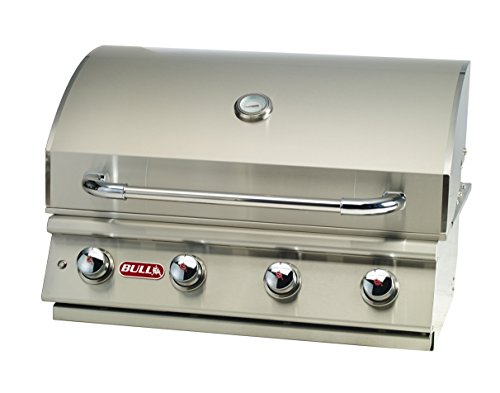
Bull Lonestar Drop-In Grill Head (Natural Gas) — Best Natural-Gas Built-In
Bull built its name on outdoor kitchen components, and the Lonestar is its workhorse head: a stainless steel drop-in grill rated at 60,000 BTU, in this listing configured for natural gas. For the outdoor kitchen with a gas line stubbed to the island, it is the set-and-forget proposition — no cylinders to swap mid-party, no propane economics, just a plumbed appliance with serious output.
Strengths
- 60,000 BTU across the head is genuine high-output built-in power
- Natural gas configuration ends cylinder logistics permanently
- Bull’s component ecosystem — doors, drawers, refrigeration — builds a matched island
Trade-offs
- Natural gas only in this configuration; the gas line work is part of the project cost
- Drop-in format requires the island build, like all built-ins
- Bull’s dealer heritage means some support flows through its dealer network
| Specification | Detail |
|---|---|
| Total output | 60,000 BTU (per verified listing) |
| Fuel | Natural gas (per verified listing) |
| Format | Drop-in grill head, stainless steel |
The Lonestar’s argument is infrastructure. A plumbed natural-gas head changes the psychology of an outdoor kitchen: the grill is always fueled, always ready, and effectively free to run compared with cylinder propane, so it gets used for the Tuesday chicken as readily as the Saturday production. The 60,000 BTU rating is substantial for a head of this class, and in practice it means fast preheats and a sear zone that does not apologize. Construction is the built-in standard — stainless body, heavy grates, components meant to be serviced in place — and Bull’s surrounding catalog lets the island grow around it with matching doors, drawers and cold storage, which matters more to the finished kitchen’s coherence than buyers expect. Budget the project honestly: the head, the island, the gas line and the permits are one purchase, and the gas work belongs to a licensed fitter. Done properly, the Lonestar is the last grill head most outdoor kitchens will ever buy.
Best for: Outdoor kitchens with natural gas available, and builders who want a matched component ecosystem / Not suited for: Propane sites, renters, or anyone not committing to a permanent island build
Check on Amazon — check the current price on Amazon, since listings and configurations change through the season.

Char-Broil Pro Series Amplifire Infrared 4-Burner Grill — Best Infrared Construction
Infrared construction solves the gas grill’s oldest flaw — uneven heat — by interposing an emitter plate between burner and food, and Char-Broil’s Pro Series Amplifire is the technology’s most considered mainstream expression: four burners, a cabinet-style body, a side burner, and an emitter system that converts flame into a uniform radiant field with virtually no flare-ups and notably juicier results.
Strengths
- Amplifire infrared delivers the most even heat map of any grill here
- Flare-ups are engineered away — fatty foods cook calmly at high heat
- Cabinet body and side burner complete a full outdoor cooking station
Trade-offs
- Emitter plates are a maintenance item — they must be kept clean to perform
- Infrared searing style differs from open-flame; some traditionalists miss the flame-kissed edges
- More system complexity than a simple tube-burner grill
| Specification | Detail |
|---|---|
| Burners | 4, plus side burner (per verified listing) |
| Heating system | Amplifire infrared (per verified listing) |
| Format | Cabinet-style freestanding, propane |
| Model | 463281024 (per verified listing) |
The Amplifire’s construction intelligence is in what the emitter does to the ownership experience. Even heat means the whole grate is usable — no sacrificial hot corner, no pale zone where chicken goes to steam — and the near-absence of flare-ups means fatty cuts, skin-on chicken and burgers cook at temperatures that would turn an open-flame grill into a fire management exercise. Food stays juicier because the radiant heat sears the surface without the convective drying of hot air rushing past. The trade is a maintenance covenant: the emitter plates accumulate carbon and grease, and their performance — the entire point of the grill — depends on periodic cleaning that the manual spells out and the wise owner schedules. Keep that covenant and the Pro Series cooks with a consistency that embarrasses grills costing more; break it and the system quietly degrades into ordinariness. For the cook who values repeatable results over ritual, it is the most technically interesting construction in this roundup.
Best for: Results-focused cooks who want maximum evenness and flare-up control, and grill lots of fatty or delicate foods / Not suited for: Open-flame traditionalists, or owners who will not keep an emitter system clean
Check on Amazon — check the current price on Amazon, since listings and configurations change through the season.

Monument Grills Mesa Series 4+1 Propane Gas Grill — Best Value Construction
Monument has built a following by doing the unglamorous things right at prices the big brands will not meet, and the Mesa 4+1 is the formula in full: four main burners plus a side burner, 62,000 BTU total, stainless steel construction, and a feature set — enclosed cabinet, clear-view lid touches, LED-lit controls in this series’ style — that reads a class above its price.
Strengths
- 62,000 BTU across five burners is the most output per dollar in this roundup
- Stainless construction and a cabinet body at a mid-market price
- Side burner completes the outdoor station without a second appliance
Trade-offs
- Long-term parts depth cannot yet match Weber’s decades-deep catalog
- Stainless grade and gauge are value-engineered — good, not Blaze-grade
- Assembly is a real project; budget the afternoon the box promises and then some
| Specification | Detail |
|---|---|
| Burners | 4 main + 1 side burner (per verified listing) |
| Total output | 62,000 BTU (per verified listing) |
| Body | Stainless steel (per verified listing) |
| Format | Freestanding cart grill, propane |
The Mesa is the pick for the buyer who has read the construction gospel, believes it, and has a budget that stops short of the premium tier. Its compromises are chosen intelligently: the stainless is a working grade rather than a showpiece grade, the cart is engineered for cost as well as strength, and the brand’s parts catalog is young. What is not compromised is the cooking hardware’s ambition — five burners of real output, a grate with genuine area, and heat that owners consistently describe as a class above the price. The ownership strategy that suits it is proactive: register the warranty, keep the manual and model number, order the inevitable wear parts (igniter, a burner) from the maker while the model is current, and maintain the stainless with the simple wash-and-dry routine that keeps any grade of stainless ahead of corrosion. Treated that way, the Mesa delivers the constructed-grill experience — even heat, real sear, a decade’s ambition — at the price of two disposable grills, which is the comparison that actually matters.
Best for: Value-driven buyers who want genuine construction and maximum burner capacity without premium pricing / Not suited for: Buyers who rank the deepest possible parts catalog above price, or who want 304-grade stainless throughout
Check on Amazon — check the current price on Amazon, since listings and configurations change through the season.
Comparison Table
| Pick | Badge | Key Spec | Best For |
|---|---|---|---|
| Weber Genesis E-415 Gas Grill | Best Overall | 4 PureBlu burners, cast-iron grates | Households buying a freestanding grill for a decade-plus of family cooking, with parts support to match |
| Weber Spirit E-310 Gas Grill | Best Mid-Range Construction | 3 burners, cast-iron grates, Snap-Jet | Households of two to five wanting Weber-grade construction at a mid-range price and footprint |
| Blaze Prelude LBM 25-Inch Built-In Grill | Best Built-In Construction | 25 in built-in, 3 burners, stainless | Homeowners and venues building a permanent outdoor kitchen who want commercial-grade stainless in a compact head |
| Bull Lonestar Drop-In Grill Head (Natural Gas) | Best Natural-Gas Built-In | 60,000 BTU, natural gas drop-in | Outdoor kitchens with natural gas available, and builders who want a matched component ecosystem |
| Char-Broil Pro Series Amplifire Infrared 4-Burner Grill | Best Infrared Construction | 4-burner infrared, side burner | Results-focused cooks who want maximum evenness and flare-up control, and grill lots of fatty or delicate foods |
| Monument Grills Mesa Series 4+1 Propane Gas Grill | Best Value Construction | 4+1 burners, 62,000 BTU, stainless | Value-driven buyers who want genuine construction and maximum burner capacity without premium pricing |
Construction quality hides in the columns the table cannot show: stainless grade, burner warranty, grate weight and parts depth. Use the table to shortlist by format and burners, then read the two reviews of your finalists for the ownership story — in this category, the ten-year story is the product. A useful tiebreaker when two finalists look equal on paper: search for each maker’s replacement burner and grate for a model from several seasons back. The grill whose wear parts are in stock, priced fairly and documented with owner-level instructions is the grill its maker intends you to keep — and intentions, in this category, are everything.
How to Choose the Best Constructed Gas Grills
Grade the stainless, literally. 304-grade stainless contains more nickel and chromium and resists rust and corrosion far better than 430-grade, which is magnetic, cheaper, and prone to surface rust in coastal and humid climates. A magnet test tells them apart in a showroom — 304 is weakly magnetic at most, 430 grabs the magnet. Makers who use 304 say so proudly; silence on grade usually means 430. Neither is a scandal at the right price, but you should know which you are buying and maintain it accordingly.
Burners and grates are the grill. Cast stainless or cast brass burners outlast thin tube burners by years; heavy cast-iron or thick stainless rod grates hold the heat that makes searing possible. When comparing two grills, lift the grates. The heavier set, over the heavier burners, under the heavier lid, is the better-constructed grill, whatever the brochures claim — weight in the right places is the most honest spec in the category.
Parts support is a construction feature. A grill is well-constructed partly in the factory and partly in the catalog: burners, grates, igniters, valves and heat tents available by model number, years after purchase, with instructions an owner can follow. Before buying, spend five minutes on the maker’s parts pages for a five-year-old model. What you find there is your grill’s second decade, previewed.
Match the format to the commitment. Freestanding grills can be sold, moved and upgraded; built-ins are architecture. Buy the freestanding benchmark unless the outdoor kitchen is truly being built — and if it is, buy the built-in head like a building component, with the gas work permitted and the cutout verified twice.
The True Cost of a Gas Grill: A Ten-Year Accounting
Run the numbers the way an accountant would and the constructed grill stops looking expensive. The disposable pattern — a budget grill every three seasons, each cooking worse than the last as its burners degrade — costs, across a decade, roughly what one Genesis-class grill costs, while delivering worse food in every one of those years and sending three grills to landfill. The constructed pattern costs the grill, a set of burners or grates mid-life, an igniter or two, and a cover: less money, better cooking, one grill.
The accounting has a second column: performance over time. A cheap grill’s cooking quality is a declining curve — hot spots grow, ignition gets temperamental, the lid warps and leaks heat — so its tenth season, if it reaches one, barely resembles its first. A well-constructed grill, maintained with the simple routines in the how-to below, cooks in year ten essentially as it did in year one, because every wear part was designed to be replaced. Buyers who grill weekly should do this math before they shop; it changes what “expensive” means.
How to Maintain a Well-Constructed Gas Grill for a Decade of Service
- Burn off and brush after cooking. Ten minutes on high, then a brush of the hot grates, keeps carbon from building into the baked layer that flakes into food and traps moisture against the metal.
- Empty the grease system on schedule. Tray and cup, regularly — old grease is a fire risk, a pest invitation and a corrosion source in one.
- Inspect burners each spring. Look for blocked ports, rust-through and uneven flame; clean ports with a brush as the manual directs, and replace a burner at the first sign of perforation rather than after the flare-up.
- Protect the finish. Wash stainless with the grain using mild detergent, dry it, and use a cover that breathes. In coastal air, a light wipe of stainless protectant a few times a year keeps 430 and 304 alike ahead of surface rust.
- Test ignition before the season, not during the party. Igniters and batteries are cheap in spring and priceless in July. Keep a long lighter as the household backup regardless.
- Order wear parts while they are current. When a grate or heat tent eventually goes, replace it from the maker’s catalog promptly — parts availability is best while the model is in production, and a small shelf stock of the inevitable items is the cheapest insurance in grilling.
Ignition Systems, Explained Without Tears
Ignition is the component owners interact with most and understand least, and its design says a lot about a grill’s construction philosophy. The classic piezo igniter — one button, one spark, shared across burners — is simple and cheap to replace. Individual electronic ignition, like the Snap-Jet system on the current Spirit, gives each burner its own igniter: more parts, but each burner lights independently and a single failure degrades gracefully instead of darkening the whole grill. Battery-powered electronic modules sit between the two in convenience and are the most common point of ‘my grill won’t light’ calls — usually cured by the battery nobody remembered existed.
The ownership habits are simple: know which system your grill has, keep its battery (if any) fresh each spring, keep the electrode tips clean and correctly gapped per the manual, and keep a long lighter in the drawer without shame — every grill in history has, at some point, been lit by hand. A well-constructed grill makes all of this easy: the module is reachable, the part is catalogued, and the manual treats ignition service as normal owner maintenance rather than a dealer secret.
Heat Management on a Multi-Burner Grill: Zones Are the Whole Game
A multi-burner grill’s real feature is not power — it is geography. Two-zone cooking, with one side hot and one side gentle, is the foundational layout: sear over the fire, finish beside it, and let the lid turn the gentle side into a small oven. Three and four burners refine the map into a gradient, so a whole mixed menu — steaks, chicken, vegetables, bread — can be in motion at once, each item riding the zone it needs and moving as it cooks. This is why burner count outranks total BTU in this guide’s judgments, and why even heat distribution matters so much: a gradient you design is control, while hot spots the grill imposes are chaos.
Building the skill takes one habit: preheat the whole grill, then set the zones, then cook the menu as a sequence of movements rather than a placement. Food starts where the heat is fiercest and migrates as it finishes; the cook’s job is traffic management, not firefighting. The constructed grills in this roundup reward that habit disproportionately, because their even burners and heavy grates hold the zones you set — on a cheap grill, the zones drift and merge until the map is fiction. Construction quality, in the end, is the difference between a grill you cook on and a grill you cook with.
When to Repair, When to Replace: An Honest Framework
Even the best-constructed grill eventually asks the question, and a clear framework beats sentiment and sales pressure alike. Repair when the structure is sound — firebox true, lid sealing, frame rigid — and the failed items are catalog wear parts: burners, grates, igniters, valves, heat tents. On the grills in this guide, those repairs are economical almost by definition, because the parts exist and the labor is an owner’s afternoon. Replace when the structure itself has gone: a rusted-through firebox, a warped lid that cannot seal, a frame fatigued at the joints — or when the maker has orphaned the model and parts have genuinely vanished.
Two traps flank the decision. The first is repairing a disposable grill: burners for a three-season budget model can cost half its replacement price, and the rest of the grill is aging on the same schedule, so the repair buys months, not years. The second is replacing a constructed grill over a twenty-dollar igniter because the failure felt like decline. The framework resolves both: price the part, inspect the structure, and let those two facts — not the season’s advertisements — make the call. Owners of well-built grills who follow it routinely get fifteen years from a purchase their neighbors replaced five times.
Covers, Placement and the Environment a Grill Lives In
A grill’s environment writes its maintenance schedule. Coastal air carries salt that pits lesser stainless and finds every scratch; desert sun destroys covers, knobs and ignition buttons with ultraviolet; humid shade grows corrosion in the grease tray and the firebox corners. None of these climates forbids a good grill — all of them reward the buyer who matches construction to conditions: 304 stainless and diligence at the coast, a serious cover and shaded placement in the desert, relentless grease discipline in the humid shade.
Placement details compound over years. A grill on a level, drained surface keeps water out of its cabinet and feet; a grill under a drip edge or a tree takes a beating no finish deserves; a grill stored with its cover slightly vented dries between rains instead of stewing in its own condensation. These are five-minute decisions made once, and they are worth more to a grill’s tenth year than any product you can spray on it. Construction quality starts at the factory, but it finishes — or fails — at the address.
Assembly Day: Building the Grill You Bought, Properly
A surprising share of a constructed grill’s lifetime performance is decided in its first two hours, on the patio, with an instruction booklet. Assembly is not a race and not a formality: it is where the firebox gets squared, the lid gets aligned, the burner tubes get seated correctly over their valves, and the ignition wires get routed away from heat. A grill assembled hastily cooks unevenly for a decade and gets blamed for it; the same grill assembled carefully, with every fastener snugged in sequence and every alignment checked before the panels close, starts life as the instrument it was designed to be.
The habits are simple. Inventory the parts before opening a single bag. Assemble on a soft, flat surface so finishes survive the process. Leave fasteners finger-tight until the structure is complete, then tighten in a cross pattern so nothing is pulled out of square. Before the first cooking, run the full leak test on every gas connection, light each burner individually, and watch the flame pattern along each tube — blue, even, and consistent is the signature of a burner seated correctly. Finally, do the seasoning burn: thirty minutes at medium-high to burn off manufacturing oils, a light oil wipe on the grates, and the grill is ready. Keep the manual, the model number and the warranty registration together in one envelope. Future you, ordering a part in year seven, will be grateful.
Common Buying Mistakes
- Judging construction by features. Bluetooth and bottle openers are not construction. Grates, burners, steel grade and parts catalogs are.
- Ignoring stainless grade. 430 in a coastal yard will freckle with rust while 304 stays clean. Know what you bought; maintain it for what it is.
- Letting grease accumulate. Most grill fires and most corrosion start in a neglected grease tray.
- Skipping the cover — or using a bad one. A fitted, breathable cover protects; a plastic sheet traps moisture against the steel and does the weather’s work for it.
- Replacing instead of repairing. On a constructed grill, a dead burner is a part, not a funeral. Check the catalog before the curb.
- Buying built-in permanence on a freestanding plan. Islands are architecture. Be sure before the stone is cut.
Final Recommendation
For the freestanding buyer, the Weber Genesis E-415 is the construction benchmark and the decade-long answer; households of two to five should take its slightly smaller sibling in spirit, the Weber Spirit E-310, and lose nothing that matters. Outdoor kitchens should be built around the Blaze Prelude LBM in propane or the Bull Lonestar in natural gas. Cooks who prize evenness above all take the Char-Broil Amplifire and keep its emitters clean; value hunters take the Monument Mesa and maintain it proactively. Every one of these is a deliberate rejection of the three-season disposable cycle — which is, in the end, the only construction decision that really counts.
Start your shortlist there: Weber Genesis E-415 Gas Grill, Weber Spirit E-310 Gas Grill, Blaze Prelude LBM 25-Inch Built-In Grill — check the current price on Amazon for each and confirm the configuration matches your site before ordering.
Keep exploring the cluster before you decide:
- Best Commercial Outdoor Grills
- Best Compact Gas Grills
- Best Compact Outdoor Grills
- Best Commercial Smoker Grills
Frequently Asked Questions
How long should a well-constructed gas grill last?
A decade or more of regular use is a reasonable expectation for the grills in this guide, with wear parts — igniters, a burner set, possibly grates — replaced along the way. The firebox, lid and frame are the permanent structure; everything else is designed to be a replaceable part on a genuinely well-built grill.
Is 304 stainless worth paying more for?
In coastal, humid or poolside environments, yes — its corrosion resistance is visibly better over years. Inland and covered, 430-grade stainless with basic care serves well. The honest answer is environmental: match the grade to your air, and maintain whichever you buy.
What are the first parts to fail on a gas grill?
Igniters and batteries first, then heat tents or flavorizer bars, then burners, with grates lasting longest of the wear items. On a well-constructed grill all of these are catalog parts; the pattern to fear is the grill whose maker sells none of them.
Cast iron or stainless steel grates — which is better?
Cast iron (especially porcelain-enameled) holds more heat and marks food better, but needs seasoning care and can chip or rust if abused. Stainless rod grates are lower-maintenance and very durable, with slightly less thermal mass. Both are legitimate; thin stamped grates are the only wrong answer.
Are built-in grills better constructed than freestanding ones?
They are built for a harder life — permanent outdoor exposure — and the good ones use heavier stainless and serviceable components accordingly. But a premium freestanding grill is better constructed than a cheap built-in. Judge the specific model’s materials and parts support, not the format.
How can I tell if a grill is well constructed in a store?
Lift the grates (heavy is good), close the lid (it should feel weighted and seal evenly), check the burner material, ask the stainless grade, and look up the parts catalog for an older model from the same maker. Five minutes of this tells you more than an hour of feature comparison.


