Disclosure: airfryerkitchensupply.com is reader-supported. When you buy through links on our site, we may earn an affiliate commission at no extra cost to you.
Where to buy
This guide to the best commercial grills for burgers starts with the burger itself. Burger cooking splits commercial grills into three honest camps: charbroilers for flame-kissed patties with grill marks, flat top griddles for smash burgers and maximum ticket density, and big mobile grills for event-scale burger service outdoors. This roundup picks the best verified unit in each camp from Amazon’s catalog data for this site. Decide your burger style first — the grill follows from it, and the picks below are labeled by camp so you can shop your own style.
- CHUMART 48-Inch Commercial Charbroiler — check price on Amazon
- Blackstone 36-Inch Griddle Cooking Station — check price on Amazon
- Kratos 36-Inch Commercial Gas Charbroiler (29Y-002) — check price on Amazon
- Atosa CookRite ATCB-36 Charbroiler — check price on Amazon
- Crown Verity BM-60 Charcoal Grill — check price on Amazon
- VEVOR 22.4-Inch Commercial Gas Griddle — check price on Amazon
The best commercial grills for burgers are the ones that match how your burgers are actually made. A smash burger concept and a half-pound char-grilled pub burger are both ‘burgers,’ but they want opposite equipment: the smash burger needs a screaming-hot flat steel surface and room for two spatulas per cook; the pub burger needs open flame, grate marks and the smoke that only drippings over fire produce. The six picks below cover both religions plus the outdoor event case, all verified commercial units with their heat systems and outputs stated from their listings.
Burger service also has a physics problem other menus do not: patties are cold, fatty and cooked in batches, so the surface’s recovery — how fast it reheats after a drop of cold meat — decides whether your burgers sear or steam. That is why the spec boxes below lead with burner output and surface type, and why the buying guide spends real time on recovery and fat management. A grill that cannot manage rendered fat at burger volume will flare, smoke out the room and slow the line, whatever its badge says.
Format note: this roundup mixes line charbroilers, a countertop griddle and mobile outdoor grills because burger businesses genuinely operate in all three settings — restaurants, trucks and events. Each verdict states its setting plainly.
A word on what this roundup leaves out: residential patio grills, however expensive, are not commercial burger equipment — their duty cycle, listings and parts support are built for weekends. Every unit below is sold for business use, which is why the comparisons focus on recovery, zones and fat management rather than styling and side burners.
In this guide
Quick Picks
Best Overall for Burgers — CHUMART 48-Inch Commercial Charbroiler. Four radiant zones and 140,000 BTU across 48 inches — a full grate of patties sears instead of steaming, and zones let you hold finished burgers without overcooking them. Check the current price on Amazon.
Best for Smash Burgers — Blackstone 36-Inch Griddle Cooking Station. The smash burger machine: 36 inches of flat steel, four burners and 60,000 BTU — crust development and ticket density no grate can match. Check the current price on Amazon.
Best Mid-Volume Charbroiler — Kratos 36-Inch Commercial Gas Charbroiler (29Y-002). Three radiant zones at 105,000 BTU — the charbroiler most independent burger restaurants actually need, at a value-brand price. Check the current price on Amazon.
Best Char Flavor per Dollar — Atosa CookRite ATCB-36 Charbroiler. Same 105,000 BTU and three zones as the Kratos, but over lava briquettes — for burger programs that want smoke in the patty, not just marks on it. Check the current price on Amazon.
Best for Event Burgers — Crown Verity BM-60 Charcoal Grill. A 72-inch-class charcoal grill for cooking burgers outdoors at event scale — unmatched flavor, festival-grade capacity. Check the current price on Amazon.
Best Budget Smash Station — VEVOR 22.4-Inch Commercial Gas Griddle. A compact countertop flat top for cafes and trucks starting a smash burger program small — modest output, tiny footprint, low entry cost. Check the current price on Amazon.
How These Picks Were Chosen
Every unit was verified: brand-and-model search, listing title matched, ASIN and specs taken from the verified title. We shortlisted for burger-specific traits — per-zone output for recovery, heat system (radiant, briquette, flat steel, charcoal) for flavor style, and surface area for batch size.
The camps are represented by their strongest verified options: CHUMART and Kratos charbroilers plus the Atosa CookRite for flame burgers, Blackstone and VEVOR griddles for smash and high-density work, and Crown Verity’s BM-60 for charcoal event burgers. No unit appears here on reputation alone; each earned its slot on specs a burger operator can use.
The 6 Best Commercial Grills for Burgers
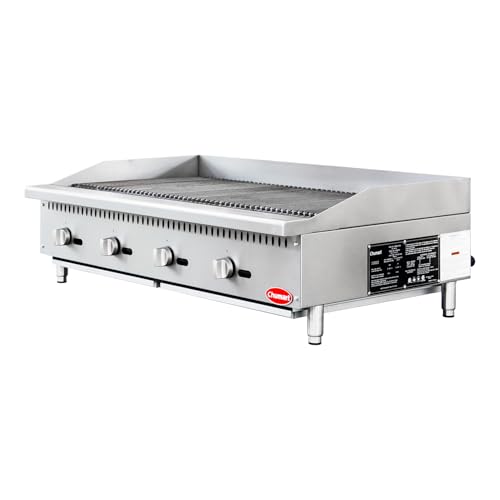
CHUMART 48-Inch Commercial Charbroiler — Best Overall for Burgers
A burger line lives or dies on recovery, and the CHUMART 48 is built for exactly that test: 35,000 BTU per zone across four zones, so a full drop of cold patties lands on a surface that fights back. Radiants keep burger fat from turning into flare-up theater — drippings vaporize for flavor while the flame stays where it belongs.
Strengths
- Strongest recovery here — holds sear through full-grate drops
- Four zones: sear, finish, cheese-melt and hold on one grate
- Radiant design manages burger fat with minimal flare-ups
Trade-offs
- 48 inches needs the hood, gas and counter to match
- Overkill for low-volume burger programs
- Radiants need daily scraping to stay even
| Width | 48 in |
| Burners | 4 U-shaped |
| Total output | 140,000 BTU |
| Heat type | Gas radiant |
| Fuel | Natural gas / propane (LP kit included) |
Run a burger service in your head on this unit: zone one and two at full heat take the drops in rotation, zone three at medium finishes and melts cheese under a dome or cloche, zone four at low holds for the pass. That choreography is what ‘commercial grill for burgers’ means at volume — not a single hot surface, but a small factory with heat levels. The CHUMART is the only pick here that runs the whole factory at full power.
Burger-specific ownership note: the grease drawer on a burger line fills faster than on any other station — put it on the mid-service check, not just the closing list, during your biggest days. A full drawer is a flare and smoke problem waiting for the worst moment of the rush. The CHUMART’s zones also deserve a burger map at the pass: drops left, finishes center, holds right — the same map every cook, every shift.
Best for: Burger-focused restaurants doing serious lunch and dinner volume / Not suited for: Smash-burger-only concepts (buy the flat top instead)
Check on Amazon — check price on Amazon before you order; commercial configurations and included accessories vary by listing.

Blackstone 36-Inch Griddle Cooking Station — Best for Smash Burgers
For smash burgers, the flat top is not one option among many; it is the correct tool. A ball of ground beef smashed onto seasoned steel develops a lacy, caramelized crust across its whole face — a texture a grate physically cannot produce — and the Blackstone 36 is the format’s proven workhorse, with four burners zoning the surface from sear-hot to holding-warm.
Strengths
- Full-surface crust on smash burgers — the style’s signature texture
- Highest ticket density here: dozens of portions on one plane
- Fat stays on the surface and drains to the grease pan — no flare-ups
Trade-offs
- No grill marks or flame flavor — a different burger religion
- Steel top requires seasoning and rust discipline
- Buns, onions and cheese all compete for the same plane — plan the layout
| Width | 36 in |
| Burners | 4 |
| Total output | 60,000 BTU |
| Surface | Steel flat top |
| Features | Foldable legs, grease pan, storage rack |
The Blackstone’s burger economics are compelling for trucks and counters: one cook with two spatulas can run patties, onions, buns and cheese simultaneously, turning tickets at a pace a charbroiler station needs two cooks to match. The discipline is surface care — seasoned steel, scraped between rushes, oiled at close. Concepts that keep that rhythm get a burger with a crust customers photograph; the grill-marks crowd was never their customer anyway.
Smash burger service lives on spatula discipline: a stiff press for the smash, a sharp scraper for the crust release, and a surface scraped clean between waves so yesterday’s carbon never seasons today’s burgers. Keep the grease cup emptied on a rhythm — smash volume renders fat faster than any other style — and the Blackstone will run a whole day of tickets without a flavor complaint.
Best for: Smash burger concepts, food trucks and breakfast-to-burger counters / Not suited for: Menus selling flame-grilled flavor and char marks
Check on Amazon — check price on Amazon before you order; commercial configurations and included accessories vary by listing.

Kratos 36-Inch Commercial Gas Charbroiler (29Y-002) — Best Mid-Volume Charbroiler
Most burger programs do not need 48 inches; they need a strong 36 with honest zones, and the Kratos 29Y-002 is that unit. Its 35,000 BTU per zone matches the big CHUMART burner for burner, so patties sear properly through a lunch rush, while the third zone gives you the finish-and-hold space a two-burner unit cannot.
Strengths
- Full-power zones — no output compromise versus 48-inch units
- Three zones enable real sear/finish/hold workflow
- Value pricing leaves budget for the rest of the station
Trade-offs
- Value-brand finish trails legacy names
- Radiant flavor is cleaner than rock-bed char flavor
- Confirm fuel configuration before ordering
| Width | 36 in |
| Burners | 3 |
| Total output | 105,000 BTU |
| Heat type | Gas radiant |
| Body | Stainless steel |
The Kratos is the rational center of this roundup: if your burger volume is a strong lunch and dinner at a 40–80 seat restaurant, this is the charbroiler that fits the tickets, the line and the budget simultaneously. It also ages gracefully — if the concept outgrows it, the 36 becomes the chicken-and-vegetable station beside a bigger burger box, rather than a mistake to sell.
The Kratos’s three zones map perfectly onto burger flow — sear, finish-and-melt, hold — and the station works best when that map never changes, even on slow days, so the choreography is muscle memory when the rush lands. Its value pricing also leaves room in the budget for the station’s real consumables: a good cloche set for cheese melts, spare tongs, and the grate brush you will actually replace on schedule.
Best for: Independent burger restaurants at small-to-mid volume / Not suited for: Event-scale or 48-inch-class burger volume
Check on Amazon — check price on Amazon before you order; commercial configurations and included accessories vary by listing.

Atosa CookRite ATCB-36 Charbroiler — Best Char Flavor per Dollar
The CookRite ATCB-36 is the flavor argument at 36 inches: burger fat drips onto hot briquettes and returns as the smoke that makes a patty taste grilled rather than merely cooked. With 105,000 BTU across three burners it gives up nothing in power to the radiant picks, and the included LP kit adds fuel flexibility.
Strengths
- Briquette smoke flavor that radiants cannot fully replicate
- 105,000 BTU across three working zones
- LP conversion kit included
Trade-offs
- Briquettes need turning, cleaning and eventual replacement
- More flare-up management with fatty blends
- Value-brand trim and finish
| Width | 36 in |
| Burners | 3 |
| Total output | 105,000 BTU |
| Heat type | Radiant with lava briquettes |
| Fuel | Gas — LP conversion kit included |
Blend choice interacts with this pick: an 80/20 chuck patty over briquettes is a flavor event, and also a flare management exercise for the cook. Kitchens that staff the grill properly sell a burger with a genuine backyard-charcoal echo from a gas line — a real differentiator against the radiant-grilled burger at the place down the street. That is worth the rock-bed chores to the concepts that build their name on it.
Briquette care is burger care on this unit: fat-heavy service fouls a bed faster than steak service does, so turn and brush the rocks on a shorter cycle than the manual’s minimum, and keep spare briquettes stocked. The payoff is the flavor your menu advertises — the moment the bed is neglected, the ‘flame-grilled’ claim on the menu stops being true, and regulars notice before you do.
Best for: Burger programs marketing flame-grilled, smoky flavor / Not suited for: Stations without a dedicated grill cook at peak
Check on Amazon — check price on Amazon before you order; commercial configurations and included accessories vary by listing.

Crown Verity BM-60 Charcoal Grill — Best for Event Burgers
Outdoor burger service — festivals, brewery patios, company picnics, game days — runs on grills like the BM-60: a huge charcoal surface (listing dimensions 72 x 24 x 31 inches) that turns out char-grilled burgers with the smoke no indoor line can legally or practically reproduce. Crown Verity builds it to be hauled and hammered season after season.
Strengths
- Charcoal flavor and theater that sells burgers by itself
- Event-scale surface for continuous burger output
- Dead-simple, durable construction
Trade-offs
- Fire management is a skilled, constant job
- Charcoal cost and ash handling at volume
- Outdoor only, subject to local open-flame rules
| Dimensions | 72 x 24 x 31 in (listing) |
| Fuel | Charcoal |
| Type | Large-format event grill |
| Brand | Crown Verity |
At an event, the grill is also the marketing: smoke in the air and burgers on open coals draw the queue. The BM-60’s capacity means the queue moves — a bed of coals this size holds multiple zones, from a ripping-hot sear strip to a gentle holding edge. Staff it with a cook who reads coals the way line cooks read dials and it is the most profitable burger station in this roundup per event day.
Event burger economics favor a two-cook system on the BM-60: one manages the fire and the drops, one finishes, dresses and serves. Trying to run it solo at volume creates the queue that kills an event stand’s reputation. Also standardize your coal — the same fuel, the same bed layout, every event — so cook times become predictable enough to quote ticket times to a line of hungry people.
Best for: Festivals, breweries and caterers selling char-grilled burgers outdoors / Not suited for: Indoor lines or unattended, set-and-forget cooking
Check on Amazon — check price on Amazon before you order; commercial configurations and included accessories vary by listing.

VEVOR 22.4-Inch Commercial Gas Griddle — Best Budget Smash Station
Not every burger program starts at volume. The VEVOR 22.4-inch countertop griddle lets a cafe, bar or truck add a genuine smash burger station in under two feet of counter: flat plate, H-shaped burner for even spread, manual control. Its 13,000 BTU is gentle, which defines its honest role — steady, moderate-pace burger work, not a slammed rush.
Strengths
- Smallest, cheapest route into flat-top burger cooking
- H-burner evens the plate better than a single tube
- Fits counters and truck lines where 36 inches cannot
Trade-offs
- 13,000 BTU — recovery lags with back-to-back cold drops
- Budget fit and finish
- Surface size caps simultaneous portions
| Width | 22.4 in |
| Burner | H-shaped |
| Total output | 13,000 BTU |
| Type | Countertop gas griddle |
Used within its limits, this little griddle prints money: a bar that sells fifteen smash burgers an hour gains a signature item without touching its line. The technique adjustment is batching — smash in waves the plate can recover from, keep a hot corner reserved for searing, and do not let the whole surface fill with cold beef at once. Exceed its pace and burgers steam; respect it and they crust beautifully.
The VEVOR’s smash burger trick is thermal budgeting: keep a third of the plate empty and hot as your recovery reserve, smash in small waves, and let buns toast on the cooler edge while patties crust. Run that discipline and a 13,000 BTU plate produces burgers that embarrass bigger, lazier stations. Ignore it, and the same plate teaches you what steamed beef tastes like.
Best for: Bars, cafes and trucks adding a modest smash burger program / Not suited for: High-volume burger service as the only station
Check on Amazon — check price on Amazon before you order; commercial configurations and included accessories vary by listing.
Comparison Table
| Pick | Badge | Key spec | Best for |
|---|---|---|---|
| CHUMART 48-Inch Commercial Charbroiler | Best Overall for Burgers | 48 in · 4 burners · 140,000 BTU radiant | Burger-focused restaurants doing serious lunch and dinner volume |
| Blackstone 36-Inch Griddle Cooking Station | Best for Smash Burgers | 36 in · 4 burners · 60,000 BTU flat top | Smash burger concepts, food trucks and breakfast-to-burger counters |
| Kratos 36-Inch Commercial Gas Charbroiler (29Y-002) | Best Mid-Volume Charbroiler | 36 in · 3 burners · 105,000 BTU radiant | Independent burger restaurants at small-to-mid volume |
| Atosa CookRite ATCB-36 Charbroiler | Best Char Flavor per Dollar | 36 in · 3 burners · 105,000 BTU · briquettes | Burger programs marketing flame-grilled, smoky flavor |
| Crown Verity BM-60 Charcoal Grill | Best for Event Burgers | 72 in class · charcoal · event scale | Festivals, breweries and caterers selling char-grilled burgers outdoors |
| VEVOR 22.4-Inch Commercial Gas Griddle | Best Budget Smash Station | 22.4 in · H burner · 13,000 BTU flat top | Bars, cafes and trucks adding a modest smash burger program |
What Grind, Thickness and Sear Make the Grill’s Job Easier?
Equipment cannot rescue a badly specified patty. For charbroilers, a loosely packed patty around a half-inch to three-quarters thick, well chilled, sears without falling apart and cooks through before the exterior burns. For flat tops, smash patties start as loose balls — the press does the forming on the steel — and they should be smashed once, hard, in the first seconds, then left alone to crust.
Fat content is the other dial: around 80/20 gives charbroilers the drippings that make flavor (and the flare to manage) and gives flat tops the lubrication a clean crust release needs. Leaner blends suit neither surface as well. Match the blend to the surface you bought, season assertively on the surface, and the grill you chose can do the rest.
How Do You Scale a Burger Program Without Replacing the Grill?
Most burger programs hit workflow limits before equipment limits. The scaling levers, in order: station choreography (zones, waves, staging — see the how-to above), a second pair of hands at peak before a second appliance, menu discipline (a tight burger list turns faster than a long one), and only then surface area. Kitchens routinely gain a third more output from choreography alone.
When surface truly is the ceiling, the cheapest capacity is usually a complementary surface rather than a bigger same surface: a charbroiler program adds a compact flat top for smash specials and toppings; a flat-top program adds a small charbroiler for a premium flame-grilled line. Two formats cover more menu — and more failure modes — than one giant one.
Smash Burgers vs Char-Grilled Burgers: The Equipment Follows the Style
Smash burgers are pressed thin on a flat top for maximum crust-to-meat ratio; they need a steel plate, serious spatula work and surface area for the press-and-scrape rhythm. Char-grilled burgers are formed patties cooked over open flame or hot grates; they need a charbroiler or charcoal grill, and their flavor comes from drippings meeting fire. Neither style is superior — they are different products that happen to share a bun.
Choose by concept, not by trend. A smash program runs faster tickets with cheaper trim and thrives in trucks and counters. A char program supports premium pricing and a ‘flame-grilled’ identity. Retrofitting the wrong equipment to a style — smashing on a grate, or chasing char on a flat top — produces the disappointing version of both.
Why Recovery Matters More Than Peak Temperature for Burgers
Every cold patty is a heat debt. A surface at searing temperature drops fast when eight cold, fatty patties land, and until it recovers, the meat steams in its own juice — gray, tough, crustless. Recovery is bought with thermal mass (heavy grates, thick plates) and per-zone burner output, which is why this roundup leads with BTU per zone rather than totals.
Practical test for any grill you are considering: can it sear a second full batch immediately after the first comes off? The picks above were chosen because their zone output says yes at their intended scale. In your own kitchen, recovery also improves with pacing — stagger drops by a minute and even a modest unit like the VEVOR keeps its crust.
How Do You Manage Fat and Flare-Ups at Burger Volume?
Burger fat is both the flavor source and the fire risk. Radiant charbroilers vaporize drippings on angled plates, converting most fat to flavor with controlled flare. Rock and briquette beds flare more — that is their flavor mechanism — and need a cook who moves patties rather than fighting flames. Griddles eliminate flare entirely; fat renders onto the plate and drains to the grease management system, which is why the Blackstone includes a grease pan as a headline feature.
Whatever the system, the grease path must be maintained: empty drawers and pans daily, scrape radiants, turn rocks. A burger program renders more fat than almost any other menu, and neglected grease management is how burger stations become fire stories. Build the fat routine into closing checklists from day one.
How Much Burger Capacity Do You Actually Need?
Work backward from your peak fifteen minutes. Count the burgers that must be on the surface simultaneously at the worst moment of your worst service, then add the finishing and holding space the workflow needs. A charbroiler zone holds roughly a dozen standard patties per foot of width in working arrangement; a flat top holds more small smash patties but shares space with buns and toppings.
Most independent restaurants land at 36 inches of dedicated burger surface; high-volume burger concepts go 48; trucks and bars run 22–36 inches of flat top. Oversizing wastes gas and hood; undersizing shows up as ticket times, not as a spec you can argue with. Size to the proven peak, and let catering or a second station handle the exceptional day.
How to Run a Burger Station Through a Rush
Equipment is half the burger equation; station choreography is the other half. This is the rush workflow that lets one cook on a charbroiler or flat top hold ticket times when the rail fills up.
- Pre-stage before the rush: patties portioned and chilled (cold meat sears better and holds shape), buns buttered or staged, cheese pulled, toppings at the pass — nothing fetched mid-rush.
- Set your zones and do not chase them: sear zone at full heat, finish zone at medium, holding edge at low; on a flat top, reserve the hottest third exclusively for smashing and searing.
- Drop in waves, not walls: stagger fresh patties by the minute so the surface always has recovery gaps; a wall of cold meat is how crust goes to die.
- Season on the surface, flip once with conviction, and move finished patties forward through the zones — cheese goes on in the finish zone, under a cloche or dome for a fast melt.
- Scrape and reset between waves: a quick scrape on grates or flat top removes carbon that would bitter the next batch, and keeps fat moving toward the grease path instead of pooling.
- Call your holds honestly: if the station saturates, hold new drops for sixty seconds rather than crowding — a one-minute delay beats a tray of steamed burgers every time.
Notice that none of these steps is about the grill’s brand. The picks above give you surfaces that can execute this workflow at their scale; the workflow itself is what your guests taste. Train it, card it at the pass, and your burger program survives staff changes intact.
The Burger Grill Decision, Distilled
Everything in this roundup compresses into a sequence any burger operator can run in one sitting. Name the burger: smashed thin with a lacy crust, or formed and flame-grilled — that answer chooses flat steel or open fire, and no amount of budget changes it. Count the peak: patties that must cook simultaneously in your worst fifteen minutes, plus finishing and holding room — that answer chooses the width, and it should be counted from tickets, not optimism. Check the setting: hood and gas for a line unit, codes and fuel for a truck, open sky for the charcoal event grill — that answer vetoes what cannot legally or practically run. Then, and only then, compare the survivors on per-zone output, fat management and parts support, which is where the picks above have already done the sorting.
Run that sequence and the purchase tends to feel obvious in hindsight — the CHUMART’s four zones for the high-volume flame program, the Blackstone’s plane for the smash concept, the BM-60’s coals for the outdoor stand, the Kratos and Atosa at the rational center, the VEVOR where the program is young. What the sequence prevents is the category’s one unforgivable error: a beautiful grill cooking the wrong burger. Get the burger right and the grill follows; get the grill first and the menu spends years apologizing for it.
How Do You Cost a Burger Program’s Grill Choice?
Run the comparison in cost per hundred burgers, not purchase price. Include fuel at your volume, consumables (rocks, igniters, brushes), the labor minutes of the station’s cleaning rhythm, and the waste rate your current setup produces — steamed batches and flare losses are costs wearing an apron. Divided across the unit’s expected services, the gap between a value pick and a premium pick often shrinks to a few cents per burger, while the gap in ticket speed and remake rate grows.
That math regularly reverses the showroom conclusion: the ‘expensive’ charbroiler with real zones is the cheap one at volume, and the bargain surface that steams every third batch is the costly one. Volume forgives purchase prices; it never forgives per-service waste. Buy for the service you will actually run.
What Does a Great Burger Station Smell, Sound and Look Like?
It is worth describing the target, because crews steer toward what they can picture. A great burger station smells like searing beef and toasted buns, not old grease. It sounds like a steady sizzle with spatula rhythm, not flare-up whooshes and shouted remakes. It looks like zones with a purpose — raw landing, active sear, finishing row, dressed plates leaving in order — and a cook whose movements are small because everything is where the system put it.
Every pick and practice in this roundup exists to produce that picture: the output for recovery, the zones for order, the fat management for the smell, the choreography for the calm. When your station looks like that at 7 p.m. on a Friday, the equipment decision has been fully repaid — everything after is margin.
How Do You Write a Burger Menu the Grill Can Actually Execute?
Menu engineering for burgers starts at the surface. Count your simultaneous cooking slots honestly — patties per zone on the charbroiler, patties plus buns plus onions on the flat top — and design the menu so the peak-hour mix fits those slots with the choreography in this article. A menu with six burger builds that share two patty styles and three topping sets turns far faster than six unrelated constructions.
Price and describe to the equipment’s strengths: char programs sell smoke and marks (‘flame-grilled,’ ‘char-crusted’), smash programs sell crust and speed (‘smashed to order,’ ‘crispy-laced’). When the menu language matches what the surface genuinely produces, guests taste what they were promised — and the grill stops being a constraint and becomes the concept’s signature.
What Are the Signs Your Burger Grill Is Undersized or Tired?
Undersized shows up as behavior: cooks batching and holding, ticket times spiking at the grill while the pass waits, and a creeping reliance on pre-cooking. Tired shows up as physics: uneven flames, a zone that no longer recovers, ignition that needs three tries, rust blooming at burner ports. The first set calls for capacity or choreography; the second calls for parts or replacement — and confusing the two wastes money in both directions.
Before replacing a tired unit, price the resurrection: burners, radiants or a rock refresh, igniters and a professional deep clean restore many charbroilers to honest service for a fraction of replacement cost. The brands in this roundup support that path with parts. Replace when the firebox, valves or body themselves are done — or when the concept has outgrown the format, which is a happier reason entirely.
How Should a Burger Truck or Stand Choose Its One Grill?
A single-grill operation must choose the surface its signature burger needs and accept the trade completely. Smash signature: the flat top, sized to the queue you expect, with the Blackstone format as the proven template. Char signature: a compact charbroiler where codes allow, or a charcoal-capable setup for outdoor stands where the fire is also the advertisement, as with the BM-60’s event role.
Then design everything else around the choice: the menu’s width, the staffing (one cook or two), the fuel logistics, and the cleaning rhythm that a single point of failure demands — a spare igniter and a backup plan are not paranoia in a one-grill business, they are the business continuity plan. Choose once, choose for the signature, and build the operation to make that one surface shine.
How Do Buns, Cheese and Toppings Fit the Grill Decision?
A burger station is a system, and the grill is only its heat source. Buns want gentle, even toasting — a low zone, a flat corner, or a separate small toaster at volume. Cheese wants trapped heat: a cloche on the charbroiler, a dome on the flat top. Toppings want cold holding within arm’s reach so the cook never leaves the station mid-rush. When you evaluate a grill, evaluate the square footage around it for these jobs, because a powerful grill in a badly arranged station still produces slow burgers.
This is also where a second, smaller surface earns its keep in many programs: the main grill cooks patties while a compact flat top or the grill’s low zone handles buns and onions. Programs that plan the whole station — heat, cold, landing, pass — out-serve programs that simply bought the biggest grill the budget allowed.
What Does a Burger Grill Cost to Run per Service?
Fuel is the visible cost and usually the smaller one: gas charbroilers and griddles are inexpensive heat per hour compared with labor. The real running costs of a burger station are consumables and time — briquettes on a rock bed’s replacement cycle, igniters, grate brushes, the minutes of the closing clean, and hood cleaning at the interval burger grease demands. None is large; together they are the difference between a station that stays profitable and one that quietly leaks.
The lever management actually controls is waste: patties lost to flare-ups, batches steamed by overloading, remakes from inconsistent zones. A grill with honest zones, run with the choreography in this article, wastes less food than a cheaper unit run chaotically — which is why the equipment and the workflow are one purchase, not two.
Common Buying Mistakes
Buying a grate grill for a smash burger concept
Smashing requires a flat surface, full stop. Concepts that try to adapt grate grills get broken patties, lost meat through the grates and no crust. Match the surface to the style before spending anything.
Judging a burger grill by total BTU
A 140,000 BTU 48-inch and a 105,000 BTU 36-inch charbroiler have the same muscle per zone. Burger recovery is per-zone math; totals only tell you the width you are feeding.
Ignoring fat management until the first flare incident
Burger volume renders fat faster than any other station. Radiants, rocks, grease drawers and pans all need a daily rhythm from the first week — not after the dining room fills with smoke.
Pressing patties on the grill (the wrong kind of smash)
On a charbroiler, pressing a formed patty squeezes juice into the fire and dries the burger. Smashing belongs on the flat top, at the moment the meat lands, once. Teach the difference or lose both styles’ benefits.
Final Recommendation
Pick your burger religion and the shortlist resolves. Flame and marks at restaurant volume: CHUMART 48 for the full factory, Kratos 36 for the rational center, Atosa CookRite 36 for briquette smoke at the same power. Smash and density: Blackstone 36 as the proven machine, VEVOR 22.4 as the budget station. Outdoor char at event scale: Crown Verity BM-60, without a serious rival.
Confirm fuel, hood and setting before ordering a line unit, and check price on Amazon on purchase day — included kits and configurations vary across listings of the same model.
- Best Overall for Burgers: CHUMART 48-Inch Commercial Charbroiler — check price on Amazon
- Best for Smash Burgers: Blackstone 36-Inch Griddle Cooking Station — check price on Amazon
- Best Mid-Volume Charbroiler: Kratos 36-Inch Commercial Gas Charbroiler (29Y-002) — check price on Amazon
- Best Char Flavor per Dollar: Atosa CookRite ATCB-36 Charbroiler — check price on Amazon
- Best for Event Burgers: Crown Verity BM-60 Charcoal Grill — check price on Amazon
- Best Budget Smash Station: VEVOR 22.4-Inch Commercial Gas Griddle — check price on Amazon
Keep exploring the cluster: Best Commercial Charbroiler Grills · Best Commercial Grills · Best Commercial Gas Grills · Best Commercial Grills 24 · Best Commercial Griddle
Frequently Asked Questions
Is a griddle or a charbroiler better for burgers?
For smash burgers, the griddle — the crust is the point and only a flat surface makes it. For thick, flame-grilled pub burgers, the charbroiler — marks, smoke and rendered-fat flavor. Many burger concepts eventually run both: flat top for the smash line, charbroiler for the premium patty.
How many BTUs do I need for a burger charbroiler?
Think per zone: around 35,000 BTU per 12-inch zone holds a sear through full batches. That is why the 105,000 BTU three-burner and 140,000 BTU four-burner picks above perform alike zone-for-zone despite different totals.
Why do my burgers steam instead of sear?
Almost always recovery: too much cold meat at once on a surface without the mass or output to fight back. Stagger drops, keep the sear zone truly hot, and make sure burners and radiants are clean — carbon and grease buildup quietly steal heat.
Can a food truck run a charbroiler for burgers?
In many jurisdictions yes, with the correct propane configuration — but some local codes restrict charbroiling in mobile units, and trucks must manage grease and ventilation carefully. Many trucks choose flat tops for exactly these reasons; check your local rules before buying either.
What patty blend works best on each surface?
An 80/20 ground chuck is the all-round burger blend: enough fat for flavor on a charbroiler (with flare management) and for crust lubrication on a flat top. Leaner blends dry out on grates; fattier blends demand respect over open flame.
How do I get cheese to melt properly on a charbroiler?
Move the patty to the finish zone, add cheese, and cover with a small dome or cloche for 20–30 seconds — the trapped heat melts evenly without overcooking the meat. On a flat top, a dome plus a tiny splash of water for steam does the same job faster.
How do I stop burgers from sticking to a charbroiler grate?
A fully preheated, seasoned, oiled grate plus patience: place the patty, let the crust form and release naturally, and flip once. Sticking is usually a cold-grate or early-flip problem, not a grill defect.
Should a burger concept buy one big grill or two smaller ones?
Two surfaces give redundancy and format range — if one is down, service continues — while one big unit gives simpler workflow. Concepts whose whole menu is burgers often prefer two stations; mixed-menu restaurants usually prefer one strong station plus their existing line.
Do I need a separate bun toaster for a burger program?
Not at modest volume — a low zone or flat corner handles buns. At high volume a dedicated toaster earns its counter space by freeing the grill’s zones for patties and keeping bun timing off the grill cook’s mental load. Let ticket volume, not ambition, make the call.
How thick should smash burgers be pressed?
Thin enough for maximum crust contact — the classic smash is pressed hard once, immediately on landing, to roughly a quarter-inch at the edges with a lacy perimeter. The crust-to-meat ratio is the style’s entire point, so a timid press produces neither a smash burger nor a good thick one.


