Disclosure: airfryerkitchensupply.com is reader-supported. When you buy through links on our site, we may earn an affiliate commission at no extra cost to you.
Where to buy
This guide to the best commercial gas grills starts with the setting. Commercial gas grills split into two working families: mobile outdoor grills on carts and frames for catering, patios and events, and countertop gas units — charbroilers and their kin — that live on the line under a hood. This roundup covers both, because real buyers cross-shop them. Every model below was confirmed in Amazon’s catalog data for this site with specs taken from the verified listing title. Match the family to where the cooking actually happens before you compare a single BTU.
- Crown Verity 60-Inch Outdoor Mobile Grill with Roll Dome — check price on Amazon
- Crown Verity 36-Inch Mobile Grill Package — check price on Amazon
- Globe 48-Inch Radiant Gas Charbroiler — check price on Amazon
- Atosa CookRite ATCB-36 Charbroiler — check price on Amazon
- KoolMore 36-Inch Commercial Charbroiler (KM-GCB3-36M) — check price on Amazon
- CHUMART 48-Inch Commercial Charbroiler — check price on Amazon
The best commercial gas grills share one trait that separates them from residential patio grills: they are built to be cooked on all day, cleaned hard, and repaired with parts that exist. Stainless fireboxes, heavy grates, burners that swap without surgery — that is the commercial difference, and it is why a restaurant patio, a catering crew or a busy line buys from this category instead of the garden-center aisle. The six picks below span the category’s real range, from Crown Verity’s mobile event grills to Globe’s 48-inch countertop charbroiler.
Gas is the default commercial fuel for practical reasons: instant ignition, zone-by-zone control, no ash, no coal logistics, and a consistent cost per service. The trade against charcoal is flavor ceiling — gas with radiants or lava rock gets close, but a charcoal purist will always find the last five percent missing. Most commercial buyers accept that trade happily, because what they are buying is throughput and repeatability across a hundred covers.
Read the picks with your setting in mind. A mobile grill lives outdoors, rolls through doorways and runs on propane tanks; a countertop unit needs a gas line, a hood and a licensed install. Both are ‘commercial gas grills,’ but they solve different problems, and the verdict lines below call out which setting each pick belongs to.
Note how this roundup is organized: by setting first and brand second. That mirrors how professionals actually buy — a caterer does not comparison-shop a countertop charbroiler, and a line cook’s kitchen never considers a wheeled event grill. Find your setting in the verdict lines, and the shortlist narrows to two or three honest candidates immediately.
In this guide
Quick Picks
Best Overall — Crown Verity 60-Inch Outdoor Mobile Grill with Roll Dome. The event-grilling benchmark: a 60-inch propane mobile grill with a single roll dome, built for caterers and institutions that cook outdoors at serious volume. Check the current price on Amazon.
Best for Catering Crews — Crown Verity 36-Inch Mobile Grill Package. The same rental-grade Crown Verity platform in a 36-inch propane package — the size one or two cooks can run for weddings, markets and club events. Check the current price on Amazon.
Best Countertop Line Grill — Globe 48-Inch Radiant Gas Charbroiler. Globe’s stainless 48-inch radiant countertop charbroiler — four feet of line grilling from one of commercial countertop cooking’s legacy names. Check the current price on Amazon.
Best Value 36-Inch — Atosa CookRite ATCB-36 Charbroiler. Atosa’s CookRite 36 runs three burners at 105,000 BTU over lava briquettes, in stainless, with the LP conversion kit included — value-brand money, working-kitchen specs. Check the current price on Amazon.
Best Budget Line Grill — KoolMore 36-Inch Commercial Charbroiler (KM-GCB3-36M). An ETL-listed, stainless 36-inch three-burner charbroiler at 90,000 BTU — the entry point into a listed commercial line grill without legacy-brand pricing. Check the current price on Amazon.
Best High-Output Countertop — CHUMART 48-Inch Commercial Charbroiler. Four U-shaped burners and 140,000 BTU across 48 radiant inches, convertible between natural gas and propane — the output leader among the countertop picks. Check the current price on Amazon.
How These Picks Were Chosen
Every grill here was verified — searched by brand and model, matched against the returned listing title, with ASIN and headline specs taken from that title. Where a title states burners, BTU or fuel, the spec box repeats it; where it does not, we left the box lean rather than invent numbers.
The mix was chosen to represent how commercial gas grilling is actually bought: Crown Verity owns the mobile/event niche in North America, so it appears twice at two sizes; the countertop side is represented by Globe, Atosa, KoolMore and CHUMART across 36 and 48 inches, covering premium and value tiers. We favored stainless construction, honest BTU-per-zone math and brands with real parts support.
The 6 Best Commercial Gas Grills

Crown Verity 60-Inch Outdoor Mobile Grill with Roll Dome — Best Overall
Crown Verity’s mobile grills are the units you see at stadium concessions, corporate picnics and rental yards across North America, and the 60-inch roll-dome model is the flagship configuration. The roll dome matters more than it looks: it opens with one hand, holds heat for roasting and finishing, and turns a flat event grill into a genuine outdoor cooking station.
Strengths
- 60 inches of grate on a mobile frame — event-scale capacity that still rolls to the site
- Roll dome adds roasting and holding capability flat-top event grills lack
- Crown Verity’s rental-grade construction is built to be transported repeatedly
Trade-offs
- Liquid propane only in this configuration — plan tank logistics for long events
- A 60-inch mobile grill is a two-person move despite the wheels
- Premium pricing; this is professional kit, not a patio upgrade
| Width | 60 in |
| Fuel | Liquid propane |
| Lid | Single roll dome |
| Type | Outdoor mobile grill |
The business case for the Crown Verity is durability under transport. Event grills die at hinges, legs and igniters because they are loaded, bounced and unloaded weekly. Crown Verity builds for the rental market, where a unit that fails on site costs a company its reputation, and that overbuilding is what your money buys. If your grill lives in one place, you may not need it; if it earns money at a different address every weekend, this is the class to buy.
Plan the propane system as carefully as the grill: a 60-inch unit at full song drinks fuel, so stage spare tanks, store them upright and secured per code, and assign tank checks to the setup list rather than memory. The roll dome’s hinge and handle are the transport wear points — a monthly look and a cover when stored outdoors keep the flagship feeling like one.
Best for: Caterers, institutions and rental operations cooking outdoors at volume / Not suited for: Fixed kitchen lines that need a countertop unit under a hood
Check on Amazon — check price on Amazon before you order; commercial configurations and included accessories vary by listing.
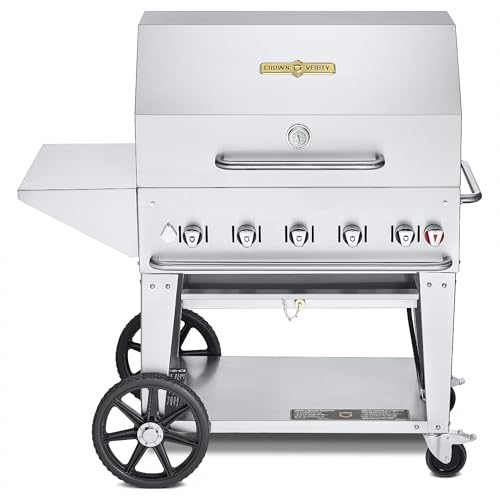
Crown Verity 36-Inch Mobile Grill Package — Best for Catering Crews
Not every event needs 60 inches. The 36-inch Crown Verity package scales the platform down to the size a small catering crew actually runs: enough grate for a wedding’s grilled proteins or a market stall’s full menu, in a package that loads and moves without drama. Buying it as a package means the configuration arrives matched rather than pieced together.
Strengths
- Rental-grade Crown Verity build in a manageable 36-inch footprint
- Package configuration — the pieces arrive designed to work together
- Propane operation suits any outdoor venue without utilities
Trade-offs
- 36 inches caps your volume — big events will outgrow it
- Still premium-priced against consumer ‘pro-style’ grills
- Outdoor-only role; it does not substitute for a line charbroiler
| Width | 36 in |
| Fuel | Propane |
| Type | Mobile grill package |
| Brand | Crown Verity |
For a growing caterer, this is the ‘buy once’ size: large enough for real events, small enough for a two-person load-in, and durable enough that it will still be working when the business can afford the 60-inch sibling. The package format also removes the classic mistake of mismatched accessories — everything in the box was specced by the manufacturer to run together through a long service.
The package format pays off in small ways all season: parts designed together store together, and the whole kit develops one packing routine your crew can run half-asleep at midnight teardown. Keep a laminated load list in the transport case — tank wrench, spare igniter batteries where fitted, grate brush — and the 36 will be the least dramatic piece of equipment you own.
Best for: Small catering crews and market vendors stepping up to pro gear / Not suited for: High-volume event operations that need 48–60 inches of grate
Check on Amazon — check price on Amazon before you order; commercial configurations and included accessories vary by listing.
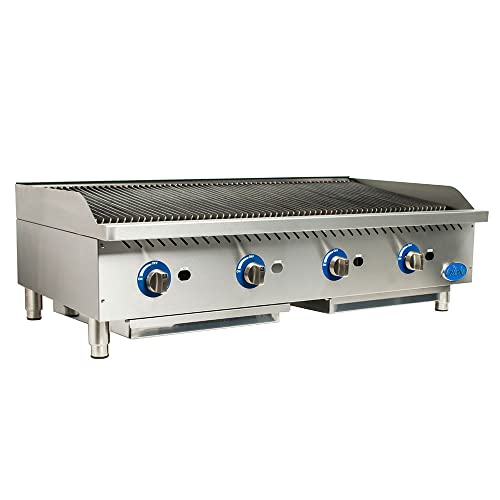
Globe 48-Inch Radiant Gas Charbroiler — Best Countertop Line Grill
When ‘commercial gas grill’ means the line station rather than the patio, this is the form it takes: a 48-inch stainless radiant charbroiler from Globe. Radiants keep the heat field even and flare-ups civilized across a long service, and Globe’s countertop cooking line is a staple of American diners and grill stations for a reason — it is built to be serviced, not replaced.
Strengths
- Full 48-inch line capacity in a countertop footprint
- Radiant heat system for even, controlled grilling across the width
- Globe’s parts and dealer support behind a stainless commercial body
Trade-offs
- Requires commercial gas connection and Type I hood — no exceptions
- Countertop format needs a proper equipment stand or chef base
- Less char flavor than a lava rock design at the same width
| Width | 48 in |
| Heat type | Radiant |
| Body | Stainless steel |
| Type | Countertop charbroiler |
The Globe 48 suits the kitchen whose grill station is a profit center: burgers at lunch, steaks at dinner, chicken and vegetables in between. Radiant evenness means the newest cook on the line produces roughly the same plate as the veteran, which is worth more across a year than a small flavor edge. Pair the width with an honest look at your hood and gas capacity — a 48-inch charbroiler is a serious appliance that wants a serious install.
A 48-inch radiant line lives on its cleaning rhythm: scrape hot nightly, lift radiants weekly, and degrease the crumb tray before it becomes a fuel source. Globe’s service documentation and dealer network mean wear parts are a phone call rather than a research project — register the unit, keep the manual with the station paperwork, and note the installing fitter’s details on the same page.
Best for: Restaurants whose grill station carries the menu / Not suited for: Outdoor catering or any setting without a commercial hood
Check on Amazon — check price on Amazon before you order; commercial configurations and included accessories vary by listing.

Atosa CookRite ATCB-36 Charbroiler — Best Value 36-Inch
The ATCB-36 is the value play on the countertop side: 105,000 BTU across three burners, lava briquettes for char flavor, stainless construction, and — unusually helpful — the LP conversion kit in the box, so the same unit can start on propane and move to natural gas later, or the reverse with the right fitter.
Strengths
- 105,000 BTU over three zones matches premium units burner-for-burner
- Lava briquettes deliver char flavor radiants cannot fully match
- LP conversion kit included — fuel flexibility most rivals charge extra for
Trade-offs
- Briquettes need turning, cleaning and periodic replacement
- Value-brand finish and long-term trim durability trail Globe or Vulcan
- Three zones is the practical ceiling for control at this width
| Width | 36 in |
| Burners | 3 |
| Total output | 105,000 BTU |
| Heat type | Radiant with lava briquettes |
| Fuel | Gas — LP conversion kit included |
Hotels and diners — the settings Atosa names for this unit — run exactly the service the ATCB-36 is built for: long hours, mixed proteins, cooks of varying experience. The briquette bed forgives timing mistakes better than bare radiants and flavors everything that crosses it. Budget the rock maintenance into your closing checklist and this is the most cooking per dollar on the countertop side of this roundup.
The included LP kit deserves respect: have the conversion done or verified by a qualified fitter, label the unit with its current fuel configuration, and keep the unused orifices bagged with the paperwork. Briquette care is the other ownership thread — a turned, brushed bed keeps the CookRite’s flavor advantage real instead of theoretical.
Best for: Diners, hotels and bistros wanting char flavor at a value price / Not suited for: Kitchens that will not keep up with briquette maintenance
Check on Amazon — check price on Amazon before you order; commercial configurations and included accessories vary by listing.

KoolMore 36-Inch Commercial Charbroiler (KM-GCB3-36M) — Best Budget Line Grill
KoolMore’s 36-inch charbroiler brings the two things budget buyers most need and least often get together: a real safety listing (ETL) and honest mid-range power. 90,000 BTU across three burners will not out-sear the premium boxes, but it cooks a genuine commercial service for cafes, bars and small restaurants.
Strengths
- ETL listed — the paperwork your inspector and insurer actually ask for
- Three-burner zoning at a budget acquisition cost
- Stainless body stands up to nightly cleaning
Trade-offs
- 90,000 BTU is the gentlest output here — recovery under heavy load is slower
- Natural gas configuration on this listing
- Budget-brand parts support is thinner than Globe or Atosa
| Width | 36 in |
| Burners | 3 |
| Total output | 90,000 BTU |
| Listing | ETL Listed |
| Fuel | Natural gas |
The honest way to frame the KoolMore is as a first commercial grill for a business still proving its menu. If the grilled items sell, the unit pays for itself quickly and a later upgrade to a premium brand is a happy problem. If volume stays modest, the KoolMore may be all the grill the business ever needs. Either way, the ETL listing means the cheap option does not create an inspection problem — which is where untested no-name imports genuinely fail buyers.
At 90,000 BTU, station discipline is the KoolMore’s performance upgrade: stagger drops, keep one zone as the recovery zone during peaks, and the output proves adequate for the menus it targets. Its ETL listing paperwork should live with your inspection file — when the inspector asks, producing it in ten seconds is worth more than any argument.
Best for: Cafes, bars and small restaurants buying a first listed line grill / Not suited for: High-volume steak and burger service at peak pace
Check on Amazon — check price on Amazon before you order; commercial configurations and included accessories vary by listing.
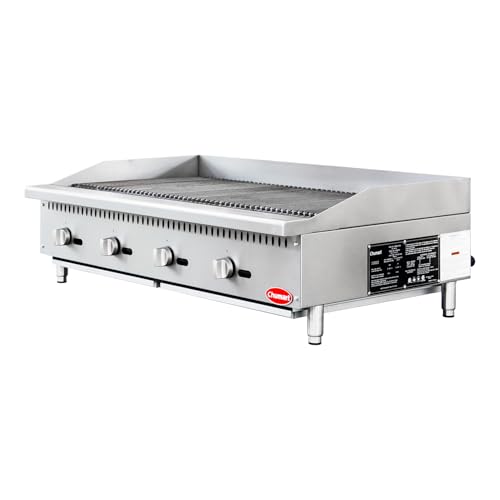
CHUMART 48-Inch Commercial Charbroiler — Best High-Output Countertop
If the Globe is the countertop establishment pick, the CHUMART 48 is the output pick: 140,000 BTU is the highest total in this roundup, spread across four U-shaped burners whose wide heating pattern suits a grate that is loaded edge to edge during a rush. The included LP conversion kit makes it the flexible choice for kitchens whose fuel setup may change.
Strengths
- 140,000 BTU — strongest recovery when the grate is fully loaded
- Four zones across 48 inches for true multi-temperature service
- Converts between natural gas and propane with the included kit
Trade-offs
- Full output demands verified gas line capacity and hood performance
- Newer brand — dealer network is thinner than Globe’s
- Radiants need a strict cleaning rhythm to stay even
| Width | 48 in |
| Burners | 4 U-shaped |
| Total output | 140,000 BTU |
| Heat type | Gas radiant |
| Fuel | Natural gas / propane (kit included) |
Judge this unit on a Friday night test: a full grate of cold burgers at 7 p.m. Weak charbroilers steam the first batch and never catch up; the CHUMART’s per-zone output is built to hold sear temperature through exactly that moment. Kitchens choosing between it and the Globe are really choosing between maximum output with a newer badge and legacy support with a radiant system — both defensible, decided by how much your operation leans on local service.
High output cuts both ways: the CHUMART will expose an undersized gas line or a tired hood faster than any gentler unit. Commission it properly — full-load flame check with every burner lit, hood capture verified with the station running — and it settles into being the line’s strong, quiet workhorse rather than its drama source.
Best for: High-volume lines that load the grate edge to edge / Not suited for: Kitchens with marginal gas supply or hood capacity
Check on Amazon — check price on Amazon before you order; commercial configurations and included accessories vary by listing.
Comparison Table
| Pick | Badge | Key spec | Best for |
|---|---|---|---|
| Crown Verity 60-Inch Outdoor Mobile Grill with Roll Dome | Best Overall | 60 in · propane · roll dome mobile | Caterers, institutions and rental operations cooking outdoors at volume |
| Crown Verity 36-Inch Mobile Grill Package | Best for Catering Crews | 36 in · propane · mobile package | Small catering crews and market vendors stepping up to pro gear |
| Globe 48-Inch Radiant Gas Charbroiler | Best Countertop Line Grill | 48 in · radiant · stainless countertop | Restaurants whose grill station carries the menu |
| Atosa CookRite ATCB-36 Charbroiler | Best Value 36-Inch | 36 in · 3 burners · 105,000 BTU · LP kit | Diners, hotels and bistros wanting char flavor at a value price |
| KoolMore 36-Inch Commercial Charbroiler (KM-GCB3-36M) | Best Budget Line Grill | 36 in · 3 burners · 90,000 BTU · ETL | Cafes, bars and small restaurants buying a first listed line grill |
| CHUMART 48-Inch Commercial Charbroiler | Best High-Output Countertop | 48 in · 4 burners · 140,000 BTU radiant | High-volume lines that load the grate edge to edge |
How Do You Choose Between Propane and Natural Gas for a Commercial Grill?
Mobility decides first: anything that travels or works outdoors away from the building runs propane, full stop. For fixed line units, natural gas is usually the cheaper fuel per BTU and never runs out mid-service, but it ties the unit to the plumbed position. Propane on a fixed line makes sense where natural gas is unavailable or where a kitchen wants the option to reconfigure — several picks above include conversion kits precisely for that flexibility.
Whichever fuel, the conversion rule is absolute: orifices and regulator settings are fuel-specific, conversions use the manufacturer’s kit, and a qualified fitter does or verifies the work. A grill converted casually is a grill that soots, underperforms or endangers — the savings are never worth it.
What Maintenance Schedule Keeps a Commercial Gas Grill Honest?
Daily: scrape grates or plates hot, empty the grease drawer or pan, wipe the front and knobs. Weekly: lift radiants or turn rocks, brush burner ports clear, check igniters on every zone. Monthly: inspect gas connections with soapy water, check flame color and pattern on all burners, degrease the areas the daily routine cannot reach. Seasonally for mobile units: a full service — wheels, hinges, dome hardware, cover condition — before the event calendar fills.
None of this is exotic, and that is the point. Commercial gas grills fail from accumulated neglect, not from single dramatic events. A written schedule with initials beats a verbal understanding every time, because the grill does not know whose shift it is — it only knows whether it was cleaned.
Mobile Grill or Countertop Unit: Which Commercial Gas Grill Do You Actually Need?
The setting decides the family. If the cooking happens outdoors — catering, patios, concessions, events — you need a mobile grill: self-contained, propane-fired, on wheels, like the Crown Verity picks. If the cooking happens on a fixed line, you need a countertop unit under a Type I hood, connected to the building’s gas by a licensed fitter, like the Globe, Atosa, KoolMore and CHUMART picks.
Trying to make one family do the other’s job is the classic commercial grill mistake. A countertop charbroiler cannot go to a wedding; a mobile grill cannot join your line (it is not built or listed for indoor hood service). Many growing operations end up owning one of each — the line unit for daily service, the mobile for the patio and events revenue.
How Should You Read BTU Figures on Commercial Gas Grills?
Always translate total BTU into BTU per zone and per inch before comparing. A 48-inch unit at 140,000 BTU and a 36-inch at 105,000 BTU deliver similar heat per burner zone — the bigger unit is wider, not hotter. For mobile grills, what matters is whether the burners hold temperature across the whole grate in wind, which is a design question (burner spacing, wind protection, dome) more than a headline number.
Also separate marketing BTU from cooking behavior. Recovery — how fast the grate reheats after cold food lands — is what your cooks will feel. Heavy grates, strong per-zone output and a dome or lid that traps heat all improve recovery more than a big total printed on the box.
What Does ‘Commercial Grade’ Actually Mean in Practice?
Three things you can verify: materials (stainless fireboxes and bodies, cast iron or heavy steel grates rather than thin porcelain wire), serviceability (burners, valves and igniters that a tech can replace with stocked parts), and listing (ETL or equivalent certification that your inspector and insurer recognize). A grill with those three is commercial in the ways that cost money when absent.
What it does not automatically mean is better food. A skilled cook on a mid-tier unit beats a careless cook on a flagship every service. Buy the durability and support your volume justifies, and spend the difference on the crew and the product.
What Are the Ownership Costs Beyond the Purchase?
Budget for the install and the ecosystem, not just the grill. Countertop units need a gas connection by a licensed fitter, possibly an equipment stand, and hood capacity. Mobile units need propane tanks, a safe storage spot, covers and transport tie-downs. Both families consume wear parts: burners, radiants or briquettes, grates eventually, igniters sooner.
Fuel economics favor gas in most markets — propane and natural gas both deliver cheap, controllable heat per service compared with charcoal logistics. The quiet cost is cleaning: grease management supplies and the labor minutes at close. A grill that is easy to scrape down and whose grease drawer empties without a wrestling match saves real money across a year of closes.
How to Set Up a Commercial Gas Grill Station for Service
Whether the grill is a mobile unit at an event or a countertop charbroiler on the line, a deliberate station setup is the difference between a smooth service and a chaotic one. This is the setup sequence experienced grill cooks run before the first ticket.
- Position and level the unit: countertop units confirmed under the hood with clearances per the manual; mobile units on level ground, sheltered from wind, with propane tanks secured upright and lines checked for leaks with soapy water.
- Stage fuel and ignition: verify gas supply or tank level for the whole service, test every igniter, and light each burner zone individually to confirm even flame before preheating.
- Preheat with intent: bring the grate up in zones — hottest where steaks and burgers will land, medium for chicken, low for holding — rather than running the whole surface at maximum.
- Set the landing zone: tongs for raw and cooked product kept separate, a resting rack or sheet pan, seasoning at hand, and a spray bottle only if your station standard allows it (many charbroiler stations ban water sprays for flare control).
- Run a test piece: one burger or chicken portion through the station to verify marks, timing and doneness at your zone settings before tickets arrive.
- Assign the cleaning rhythm at setup, not at close: who scrapes mid-service, who empties the grease drawer, and what the end-of-night deep-clean steps are.
A station set up this way makes the grill cook’s job mostly timing and judgment, which is what you are paying them for. The same sequence works at a wedding with a mobile Crown Verity and on a Friday line with a 48-inch charbroiler — only the scenery changes.
A Final Framework: Buy the Grill Your Hardest Service Needs
Every commercial gas grill decision simplifies under one test: picture your hardest service — the festival Saturday, the holiday dinner rush, the wedding with a late start and a hungry crowd — and ask which unit on the shortlist you would want under you in that hour, with your actual crew, in your actual setting. Not the brochure service, not the average Tuesday: the hardest one, because equipment is bought for the peaks and merely used on the averages. The Crown Verity owner pictures the 60-inch dome grill swallowing the event’s whole menu without a queue. The line operator pictures four radiant zones holding temperature while tickets stack. The cafe owner pictures a listed 36-inch box doing its modest job without a single inspection worry. Each picture is a different grill, and each is correct — for the service it was pictured in.
The corollary is just as important: do not buy for a hardest service you do not actually have. The aspirational purchase — capacity for crowds that have not materialized, output for a menu that exists only in a pitch deck — taxes every ordinary day with its size, fuel appetite and price. Buy for the hardest service on your real calendar, keep the upgrade path open (the brands in this roundup all sell the next size up), and let proven demand, not hope, trigger the step up. That discipline, more than any single model’s virtues, is what separates kitchens whose equipment feels inevitable from kitchens whose equipment feels like a compromise they keep paying for.
How Do You Read a Commercial Grill Listing Like a Buyer, Not a Browser?
Commercial listings reward a specific reading order: fuel and configuration first (the wrong gas type ends the conversation), then width against your hood or event format, then burners and per-zone output, then the listing and warranty terms, and only then the photographs. Marketing orders those facts in exactly the reverse sequence, which is why disciplined buyers read listings backwards and save themselves the most common returns in the category.
Apply the same discipline to included items: ‘package,’ ‘kit included’ and bare-unit listings of the same model differ by hundreds of dollars of accessories. The verified titles in this roundup state their inclusions — roll dome, LP kit, package configuration — because those words are where the value differences hide. Read them as carefully as the BTU line.
What Does the First Month With a New Commercial Gas Grill Teach You?
Month one is calibration. The crew learns the unit’s true preheat time (not the manual’s), its hot spots, its recovery personality under your actual menu, and its cleaning rhythm. Smart kitchens write down what the month teaches — a station card with zone settings per menu item — because month two’s staff will otherwise relearn it at the cost of month two’s guests.
It is also when small install truths surface: a valve that is awkward to reach in service, a grease drawer that fills faster than expected, a dome hinge that wants adjustment. Catch them in month one, while the installer relationship is warm and the fixes are small. A grill that is commissioned, learned and documented in its first month tends to disappear into the kitchen’s routine — the highest state a piece of commercial equipment can achieve.
How Do Gas Grills Fit a Restaurant’s Energy and Ventilation Budget?
A countertop gas grill’s true footprint includes the hood capacity it consumes and the make-up air the building must replace — costs that arrive monthly, long after the purchase is forgotten. High-output units like the 48-inch picks deserve an honest ventilation conversation with your mechanical contractor before ordering, because discovering the hood is undersized after install converts a grill purchase into a building project.
Mobile propane grills invert the equation: no building systems at all, but a fuel logistics chain — tanks, storage, transport rules — that someone must own. Neither is cheaper in the abstract. The right question is which cost structure your operation is built to carry: buildings absorb ventilation costs invisibly; event operations absorb logistics visibly but flexibly.
What Separates a Good Demo or Showroom Test From a Useless One?
If you can see a unit before buying, test what matters: light every burner and read the flames; load the grate or plate with cold product and watch recovery; work the valves with wet, greasy hands; and scrape the surface as you would at close. A grill that performs in those four moments will perform in service. A grill that merely gleams under showroom lights has told you nothing.
For mobile units, add the transport test: fold it, roll it over a threshold, load it as your crew actually will. For countertop units, bring your line’s measurements and a photo of the hood. The best dealers welcome these tests because their equipment passes them — and a dealer who resists a working test has given you the most useful information of the visit.
How Should You Plan a Gas Grill Purchase Around a Menu Launch?
Sequence backwards from the menu’s first service: the grill must be installed, commissioned and burned in before the staff tasting, and the crew needs at least a few calm services on it before the public menu depends on it. That means the purchase decision belongs weeks before the launch, with the fitter and hood work scheduled as the long-lead items they are.
Launch menus also lie to equipment: opening-week volume is not steady-state volume. If the concept is unproven, the value-tier picks in this roundup (KoolMore, Atosa) are a rational hedge — real commercial capability without flagship commitment — with an upgrade path once the tickets prove the demand. Proven concepts should buy their tier once and be done.
How Do Commercial Gas Grills Handle Weather and Outdoor Storage?
Mobile grills live outdoors, so their enemies are water and neglect rather than heat. Stainless bodies resist rust well, but burners, igniters and fasteners are the corrosion frontier — a fitted cover, a dry storage spot and a monthly once-over during the off-season keep an event grill ready instead of revived. Before the first event of spring, run a full commissioning: leak test, flame check on every burner, dome and hinge hardware, wheel condition.
Countertop units face the indoor version of the same truth: steam and grease in the air attack igniters and valves over years. The defense is the cleaning schedule plus one habit — never hose down or steam-blast a gas appliance’s valve and burner area. Wipe, brush and vacuum; water belongs in the drip tray, not in the gas train.
What Accessories Does a Commercial Gas Grill Station Actually Need?
For mobile grills: a cover that fits, a tank wrench and spare regulator kept with the unit, a stiff grate brush, long tongs, and a transport strap set. For countertop units: a fitted equipment stand or chef base, a scraper sized to the radiants, a grease management routine with spare drawers if your volume justifies it, and heat-resistant gloves that live at the station rather than wandering the kitchen.
Skip the gadget layer until the basics are owned twice over. Commercial grilling is a craft of a few tools used constantly; the money for novelty accessories is better spent on the spare igniter and the second set of tongs that keep service moving when the first set vanishes mid-rush — as tongs, mysteriously, always do.
Common Buying Mistakes
Buying a countertop unit for outdoor events
Countertop charbroilers need a building gas line and a commercial hood. They are not portable and not outdoor-rated. Event work belongs on mobile propane grills built for transport.
Undersizing the gas line for a big countertop grill
A 48-inch charbroiler at full output can starve on a line sized for a smaller appliance, delivering weak flames on every burner. Have a fitter verify capacity before the unit arrives.
Judging by total BTU alone
Width disguised as power fools many buyers. Compare per-zone output and recovery design, and remember a dome or lid changes real cooking performance on mobile grills.
Skipping the listing to save money
An unlisted commercial grill can fail inspection, void insurance and shut a new kitchen down before it opens. The ETL mark on budget picks like the KoolMore exists precisely so the affordable route stays legal.
Final Recommendation
Choose the family first. Outdoor and event cooking: the Crown Verity 60 is the flagship, the Crown Verity 36 package the right-sized crew pick. On the line: the Globe 48 for legacy radiant reliability, the CHUMART 48 for maximum output and fuel flexibility, the Atosa ATCB-36 for briquette flavor at a value price, and the KoolMore 36 when a listed budget unit is the brief.
Confirm fuel, install requirements and listing before ordering any commercial unit, and check price on Amazon the day you buy — configurations and included kits vary between listings of the same model family.
- Best Overall: Crown Verity 60-Inch Outdoor Mobile Grill with Roll Dome — check price on Amazon
- Best for Catering Crews: Crown Verity 36-Inch Mobile Grill Package — check price on Amazon
- Best Countertop Line Grill: Globe 48-Inch Radiant Gas Charbroiler — check price on Amazon
- Best Value 36-Inch: Atosa CookRite ATCB-36 Charbroiler — check price on Amazon
- Best Budget Line Grill: KoolMore 36-Inch Commercial Charbroiler (KM-GCB3-36M) — check price on Amazon
- Best High-Output Countertop: CHUMART 48-Inch Commercial Charbroiler — check price on Amazon
Keep exploring the cluster: Best Commercial Charbroiler Grills · Best Commercial Grills · Best Commercial Grills 24 · Best Commercial Grills For Burgers · Best Commercial Griddle
Frequently Asked Questions
Are commercial gas grills worth it for a home patio?
Usually not. They are built and listed for commercial settings, often lack residential certification, and countertop models require commercial ventilation. Serious home grillers get more from a high-end residential grill designed and warranted for home use.
How long do commercial gas grills last?
With daily cleaning and normal wear-part replacement (burners, igniters, radiants or rocks), a quality commercial unit serves for many years of daily use. Rental-grade mobile grills like Crown Verity are specifically engineered for long, transport-heavy lives.
Can a countertop charbroiler run on propane?
Many can, with the correct conversion kit and a licensed fitter doing the work — the Atosa and CHUMART picks above include LP kits. Never improvise a fuel conversion; orifice size and regulator pressure differ between gases.
What size mobile grill does a caterer need?
A 36-inch mobile grill handles small-to-mid events with one or two cooks. Operations regularly serving 100-plus guests outdoors usually step up to 48–60 inches so proteins and vegetables are not queuing for grate space.
Do commercial gas grills need a hood?
Countertop line units: yes, a Type I commercial hood with fire suppression per local code, without exception. Mobile outdoor grills: no hood, because they are used outdoors — which is exactly why they cannot substitute indoors.
How do I keep a commercial grill’s grates from rusting?
Keep cast iron grates seasoned and oiled, scrape them hot after service, and never leave them soaking. Stainless grates need only cleaning. A grill put away clean and dry, under a cover if it lives outdoors, resists rust for years.
How often should burners be replaced on a commercial gas grill?
There is no fixed calendar — burners are replaced when flames turn uneven, ports corrode through or heat output visibly falls despite clean ports and correct pressure. With weekly port brushing, quality burners serve for years of daily use.
Is a roll dome worth it on a mobile grill?
For menus beyond straight grilling — roasting, holding, finishing thick cuts — yes; it converts the grill into a genuine outdoor oven-adjacent station. For pure high-volume flat grilling, a domeless unit is simpler and cheaper to run.


