Disclosure: airfryerkitchensupply.com is reader-supported. When you buy through links on our site, we may earn an affiliate commission at no extra cost to you.
Where to buy
The fastest way to buy any of the best combination of grills for outdoor kitchen in this guide is through Amazon, where the listings carry the current configuration, fuel options and delivery terms for each model. Start with our top pick, the Blaze Premium LTE+ 32-Inch 4-Burner Built-In Propane Grill (check price on Amazon), and work down the list from there. Prices move with seasons and promotions, so we do not print static prices in this article — use the links to check the current price on Amazon for the exact version you want. The full shortlist: Napoleon Built-In 700 Series 32-Inch Propane Grill (check price on Amazon); Bull Outlaw Drop-In Grill Head, Liquid Propane (check price on Amazon); Bullet by Bull Outdoor Kitchen Grill Set (4-Burner Bundle) (check price on Amazon); Weber Summit SB38 S Built-In Gas Grill (Liquid Propane) (check price on Amazon); SPIRE 30-Inch Built-In 5-Burner Dual Fuel Grill (check price on Amazon).
Building an outdoor kitchen raises a question a single grill cannot answer: what is the best combination of grills for outdoor kitchen cooking, so that one island can sear, roast, smoke, simmer and griddle without a trip indoors? The answer is a combination in the architectural sense — a primary built-in grill chosen well, supported by the right second fire: a power burner, a griddle surface, a charcoal or pellet partner, and burners where the sauces live.
This guide approaches the combination two ways. The six picks below are the built-in grill heads and bundles we would anchor an island around, each verified against its current Amazon listing — including complete outdoor kitchen bundles that pair a grill with a side burner in one purchase. Then the buying guide lays out the proven combinations: which second fire earns its cutout, how to sequence an island’s appliances, and where owners most often overspend.
An outdoor kitchen is the largest purchase in this entire grills cluster, and the one you can least easily return. Read the picks as anchors, the combinations as floor plans, and the mistakes section twice — most outdoor kitchen regret is layout regret, and layout is decided exactly where you are standing now: before the first cutout is cut.
In this guide
Quick Picks
Short on time? These are the six best combination of grills for outdoor kitchen worth your money, each chosen for a different kind of cook and a different kind of space. Every pick below was cross-checked against the manufacturer listing data available through Amazon before it earned a place here.
- Blaze Premium LTE+ 32-Inch 4-Burner Built-In Propane Grill — Best Overall Anchor. The island anchor most designers reach for: 32 inches, four burners, a rear infrared burner for the rotisserie, LED knobs and a lift-assist hood. Check the current price on Amazon.
- Napoleon Built-In 700 Series 32-Inch Propane Grill — Best Premium Anchor. Napoleon’s flagship built-in line in 32-inch form: 66,000 listed BTUs, 786 square inches and an infrared rear burner, in stainless throughout. Check the current price on Amazon.
- Bull Outlaw Drop-In Grill Head, Liquid Propane — Best Value Anchor. The workhorse drop-in: 60,000 listed BTUs of stainless Bull grill head, the anchor that leaves budget alive for the rest of the island. Check the current price on Amazon.
- Bullet by Bull Outdoor Kitchen Grill Set (4-Burner Bundle) — Best Complete Bundle. The combination in a single purchase: a four-burner built-in grill bundled with a side burner and island doors, in matching stainless. Check the current price on Amazon.
- Weber Summit SB38 S Built-In Gas Grill (Liquid Propane) — Best Luxury Anchor. Weber’s flagship built-in: the Summit platform dropped into an island, for owners who want the most refined gas grilling Weber makes. Check the current price on Amazon.
- SPIRE 30-Inch Built-In 5-Burner Dual Fuel Grill — Best Dual-Fuel Built-In. A built-in that brings its own combination: five burners, dual-fuel flexibility, 904 listed square inches and an all-304 stainless body. Check the current price on Amazon.
How These Picks Were Chosen
We chose anchors, not ornaments. Each pick is a built-in grill head or bundle with the construction an island demands — stainless steel bodies, serious burner counts and the rear burners and rotisserie features outdoor kitchens are built around — from brands with a track record in the built-in world: Blaze, Napoleon, Bull, Weber and their peers.
Verification followed the program standard connection: brand-and-model searches, title matches against the exact built-in model and fuel type, and links only to confirmed ASINs. Fuel matters enormously in built-ins — propane and natural gas versions are different products with different ASINs — and the spec boxes state the fuel of the exact listing verified, because ordering the wrong fuel version is the classic outdoor kitchen own-goal.
We also judged each anchor by the company it keeps: does the brand offer the matching side burners, doors, drawers and refrigeration that complete an island in one finish? An outdoor kitchen is a system purchase disguised as a grill purchase, and the picks below are the ones whose systems hold together.
The 6 Best combination of grills for outdoor kitchen
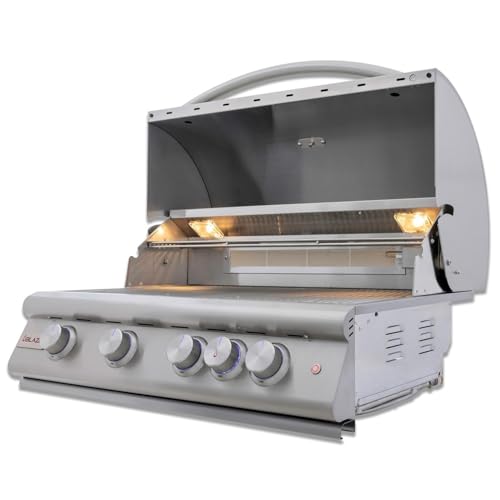
1. Blaze Premium LTE+ 32-Inch 4-Burner Built-In Propane Grill — Best Overall Anchor
The LTE+ is the grill to build the island around if you want the combination to start from strength. Four burners give true zoning at family-plus scale, the rear infrared burner makes rotisserie a weekly tool instead of a party trick, and details like the lift-assist hood and lit knobs are the ones you feel at every single cook for a decade.
Strengths
- Complete feature set: rear infrared burner, rotisserie-ready
- Lift-assist hood and LED knobs reward daily use
- Deep Blaze ecosystem of matching island components
Trade-offs
- Premium tier — and the island around it multiplies the bill
- 32 inches is the family size; big hosts should step to 40
- Propane version: confirm fuel before ordering, always
| Size | 32-inch built-in, 4 burners |
| Fuel | Propane (this listing) |
| Extras | Rear infrared burner, LED control knobs, lift-assist hood (listing) |
An anchor grill should be boring in exactly one way: it should never be the reason a cook goes indoors. The LTE+ clears that bar with margin — heat for searing, zones for mixed loads, a rear burner that turns a chicken into an event, and a hood a single finger can lift when your other hand holds the tray. In combination terms, it covers grill, roast and rotisserie so completely that your second fire can be chosen for pleasure — griddle or charcoal — rather than for rescue.
Blaze’s component bench seals the recommendation: side burners, power burners, doors, drawers and trash pull-outs in the same finish and design language, so the island looks designed rather than accumulated. Among the best combination of grills for outdoor kitchen anchors, this is the one we would sign for first.
Best for: families building a serious island around one superb gas grill / Not suited for: budget builds or hosts who regularly cook for twenty
Check on Amazon to see the current configuration and delivery options for the Blaze Premium LTE+ 32-Inch 4-Burner Built-In Propane Grill.

2. Napoleon Built-In 700 Series 32-Inch Propane Grill — Best Premium Anchor
Choose the 700 Series when the island is a showpiece and the cooking is expected to match. Napoleon’s built-in flagship brings the brand’s best burner engineering, an infrared rear burner for rotisserie work, and a 786-square-inch stage that swallows family feasts. It pairs naturally with Napoleon’s own built-in power and range burners — the combination components the 700 line was designed beside.
Strengths
- Flagship build and burner performance
- 786 sq. in. and 66,000 BTUs — serious capacity
- Matching 700 Series burner components for the island
Trade-offs
- Flagship pricing, before the island itself
- Stainless at this scale is a fingerprint commitment
- Needs a planned ventilation and clearance design
| Size | 32-inch built-in |
| Output | 66,000 BTUs (listing figure) |
| Area | 786 sq. in. (listing figure) |
| Extras | Infrared rear burner (listing) |
The 700 Series earns its premium in the unglamorous places: burner consistency across the grate, ignition that behaves in February, and stainless that still looks like a decision in year eight. As an anchor it also plays the combination game properly — its infrared rear burner owns roasting, which frees the island’s second cutout for a high-power burner for wok and stockpot work, the pairing serious outdoor cooks ask for by name.
Budget honestly around it: the grill head is the famous cost, but the island, the fuel run, the ventilation and the components are the real project. For the household that cooks outside four nights a week and entertains monthly, the 700 is not an extravagance — it is the correct tool, wearing the right finish.
Best for: premium islands and serious, frequent outdoor cooks / Not suited for: first islands on a learning budget
Check on Amazon to see the current configuration and delivery options for the Napoleon Built-In 700 Series 32-Inch Propane Grill.

3. Bull Outlaw Drop-In Grill Head, Liquid Propane — Best Value Anchor
Bull built its name on exactly this proposition — a straightforward, powerful stainless grill head that lets the money go to the island, the burners and the doors around it. The Outlaw’s 60,000 BTUs cover family grilling without theatre, and Bull’s component catalog is one of the deepest in the business, so the combination you plan is the combination you can actually buy in one finish.
Strengths
- Strong output at a value-for-built-in tier
- Stainless construction suited to island life
- Enormous Bull component ecosystem for the full combination
Trade-offs
- Fewer luxury touches than Blaze or Napoleon flagships
- A simpler feature set — no lift-assist theatre
- Confirm propane vs natural gas version before ordering
| Output | 60,000 BTUs (listing figure) |
| Fuel | Liquid propane (this listing) |
| Style | Drop-in grill head, stainless steel (listing) |
Outdoor kitchen budgets die by a thousand upgrades to the grill head while the island itself — counters, storage, a burner that can boil a lobster pot — goes begging. The Outlaw is the discipline pick: a proven, powerful head at a tier that keeps the combination affordable. Most families will never cook past its abilities; nearly all will use a side burner and dry storage every single week.
It is also the safest pair of hands in the category. Bull’s installed base is enormous, parts and service knowledge are everywhere, and the head’s simplicity is a longevity feature. If your island plan is long and your grill-head budget is honest, this is the anchor that lets the whole combination happen.
Best for: value-led island builds that prioritize the full combination / Not suited for: feature collectors wanting flagship touches
Check on Amazon to see the current configuration and delivery options for the Bull Outlaw Drop-In Grill Head, Liquid Propane.

4. Bullet by Bull Outdoor Kitchen Grill Set (4-Burner Bundle) — Best Complete Bundle
If the research itself is the obstacle, this bundle is the shortcut: Bullet by Bull packages a four-burner built-in propane grill with the side burner and access components an island needs, matched in stainless from one maker. You give up the pick-every-piece freedom of a bespoke build and gain a combination that is guaranteed to fit, match and arrive as one project.
Strengths
- Grill, side burner and doors in one matched purchase
- Removes the compatibility guesswork from a first island
- Bull-family parts and support behind the bundle
Trade-offs
- Less freedom to mix brands or upgrade single pieces
- Bundle sizing may not match every island plan
- Verify the full included-components list before ordering
| Layout | 4-burner built-in grill bundle |
| Fuel | Liquid propane (listing) |
| Includes | Side burner and island door components (listing, truncated) |
Most outdoor kitchen projects stall in the components phase — cutouts, finishes and fuel versions across five brands and forty tabs. A bundle collapses that phase into one decision, and for first-time island builders that is not laziness; it is risk management. The grill-plus-side-burner pairing inside this set is also the single most useful combination in this entire guide: a main fire and a supporting flame cover the overwhelming majority of outdoor menus.
The trade is bespoke freedom, and experienced builders with a specific plan should take the separate-anchor route above. But as the fastest honest path from ‘we want an outdoor kitchen’ to cooking in one, the Bullet bundle is the pick — a combination chosen by people who have sold a great many islands.
Best for: first-time island builders who want one matched decision / Not suited for: bespoke builders mixing brands piece by piece
Check on Amazon to see the current configuration and delivery options for the Bullet by Bull Outdoor Kitchen Grill Set (4-Burner Bundle).

5. Weber Summit SB38 S Built-In Gas Grill (Liquid Propane) — Best Luxury Anchor
The Summit SB38 is the luxury anchor — Weber’s top gas platform in built-in form, with the line’s signature extras like an infrared broiler, integrated rotisserie and smoker box per the Summit family’s design. Choose it when the island is the home’s second kitchen and the grill is expected to be its finest appliance, full stop.
Strengths
- Flagship Weber engineering and finish
- Rotisserie, broiler and smoker-box talents in one head
- Weber’s support and parts depth behind a built-in
Trade-offs
- The highest tier in this guide — before island costs
- Summit-size cutout commits the island design around it
- Luxury features demand an owner who will use them
| Style | Premium built-in gas grill (listing) |
| Fuel | Liquid propane (this listing) |
| Line | Weber Summit SB38 S |
There is a particular buyer the Summit exists for: the one who has owned great grills, knows exactly what refinement feels like at the knobs, and is building the island once, properly. For that buyer the SB38’s broiler-seared finishes, rotisserie evenings and smoker-box experiments are not features on a list — they are the weekly texture of cooking outside at the highest level a gas head offers.
In combination terms it is also the most self-sufficient anchor here: with rotisserie and smoking talents in the head itself, the island’s remaining budget can go to refrigeration, storage and a power burner rather than a second cooker. Luxury, spent this way, actually simplifies the combination — one magnificent fire, everything else support.
Best for: once-and-properly luxury island builds / Not suited for: budget-led projects or occasional grillers
Check on Amazon to see the current configuration and delivery options for the Weber Summit SB38 S Built-In Gas Grill (Liquid Propane).

6. SPIRE 30-Inch Built-In 5-Burner Dual Fuel Grill — Best Dual-Fuel Built-In
The SPIRE is the anchor for the island that wants two fuels without two cutouts. Its dual-fuel design and five burners spread 63,000 listed BTUs across 904 square inches, and the all-304 stainless body is the correct material promise for a grill that will live outdoors permanently. For a compact island, it concentrates the combination into a single opening.
Strengths
- Dual-fuel flexibility in one built-in cutout
- 904 sq. in. and five burners — big capacity at 30 inches
- All-304 stainless body for outdoor permanence
Trade-offs
- Smaller brand than the legacy names — research support
- Dual-fuel systems add components to maintain
- Confirm the exact fuel configuration of the listing
| Size | 30-inch built-in, 5 burners |
| Output | 63,000 BTUs (listing figure) |
| Area | 904 sq. in. (listing figure) |
| Body | All 304 stainless steel (listing) |
Island space is the scarcest resource in outdoor kitchen design, and the SPIRE spends it brilliantly: one cutout, two fuels, family-plus capacity. For the lot whose island run is eight feet rather than sixteen, that concentration is the difference between a combination and a compromise — the second fire lives inside the first one’s footprint.
The 304 stainless specification matters more than the headline numbers: built-ins cannot be wheeled into the garage for winter, and the body alloy is what decides whether year five looks like year one. Pair it with a simple side burner or none at all, and a small island gains a range that full-size builds envy.
Best for: compact islands wanting two fuels in one cutout / Not suited for: brand-conservative buyers wanting a legacy dealer network
Check on Amazon to see the current configuration and delivery options for the SPIRE 30-Inch Built-In 5-Burner Dual Fuel Grill.
Comparison Table
| Pick | Badge | Key spec | Best for |
|---|---|---|---|
| Blaze Premium LTE+ 32-Inch 4-Burner Built-In Propane Grill | Best Overall Anchor | 32-inch built-in, 4 burners | families building a serious island around one superb gas grill |
| Napoleon Built-In 700 Series 32-Inch Propane Grill | Best Premium Anchor | 32-inch built-in | premium islands and serious, frequent outdoor cooks |
| Bull Outlaw Drop-In Grill Head, Liquid Propane | Best Value Anchor | 60,000 BTUs (listing figure) | value-led island builds that prioritize the full combination |
| Bullet by Bull Outdoor Kitchen Grill Set (4-Burner Bundle) | Best Complete Bundle | 4-burner built-in grill bundle | first-time island builders who want one matched decision |
| Weber Summit SB38 S Built-In Gas Grill (Liquid Propane) | Best Luxury Anchor | Premium built-in gas grill (listing) | once-and-properly luxury island builds |
| SPIRE 30-Inch Built-In 5-Burner Dual Fuel Grill | Best Dual-Fuel Built-In | 30-inch built-in, 5 burners | compact islands wanting two fuels in one cutout |
Read the table as a map, not a ranking. The right row is the one whose key spec matches the way you actually cook — the most powerful grill in this list of best combination of grills for outdoor kitchen is the wrong buy if its fuel, footprint or cleaning routine fights your routine every single week.
The Proven Combinations: What to Pair With Your Anchor Grill
Three pairings cover nearly every great island. Anchor plus power burner is the cook’s combination: the grill owns searing and roasting while a high-output burner boils lobster pots, blackens in cast iron and runs a wok at temperatures no grill burner reaches. Anchor plus griddle is the family’s combination — a drop-in or cart griddle beside the grill turns the island into a breakfast and teppanyaki station without evicting the flame.
Anchor plus charcoal or pellet partner is the enthusiast’s combination: gas for the calendar, live fire for the soul. A kamado or pellet unit at the island’s end — built in or on a matching cart — adds smoking and charcoal flavor the gas head cannot fake. Notice what is absent from the proven list: a second full gas grill. Two anchors is the most common overspend in island design; one anchor, one specialist, is the combination that cooks best.
Island Layout: Sequence, Clearances and the Work Triangle Outdoors
Lay the island out in cooking order: cold storage and prep at one end, the anchor grill at the center of attention, the second fire beside it, and landing space — real, empty counter — on both sides of every heat source. The landing rule is the one owners violate in drawings and curse in practice: hot trays need somewhere to go that is not a lap or a lap’s worth of counter clutter.
Respect the unglamorous specifications. Built-in heads need their manufacturers’ clearances to combustibles, ventilation for enclosed propane storage, and a fuel run planned before the structure closes. Gas and electrical should be roughed in for the combination you might add in phase two — a capped line and an outlet cost little during construction and a fortune after the stone is set.
Fuel Strategy for an Outdoor Kitchen Combination
Decide the island’s fuels as a system. A natural gas anchor with a natural gas power burner is the cleanest professional answer where a line exists — no tanks, no refills, endless burn time. Propane islands trade a tank cabinet for installation freedom. Either way, let the second fire diversify rather than duplicate: charcoal, pellets or wood bring a flavor the gas system cannot, which is the entire point of combining.
Plan storage for the fuels you choose with the same care as the grills: a ventilated tank enclosure for propane, a dry sealed bin for charcoal or pellets, and both placed at the island’s working end rather than across the yard. The best combination of grills for outdoor kitchen use fails quietly when its fuel lives a wet walk away.
How to Choose the Best Combination of Grills for Outdoor Kitchen Cooking
Write your twenty most-cooked outdoor meals and assign each a fire. If one fire takes eighteen of them, buy the finest anchor you can and add support, not a second cooker. If the meals split honestly — grilled weeknights, smoked weekends, griddle breakfasts — your combination has named itself, and the anchors above are ranked to receive it.
Phase the build if budget demands: anchor and infrastructure now, second fire next season, with cutouts and fuel roughed in from day one. An island designed as a combination and built in stages beats a finished island that must be cut apart to grow. That, more than any single product, is the secret the best outdoor kitchens share.
How to Plan and Commission an Outdoor Kitchen Grill Combination
Built-ins punish improvisation. This sequence — from tape measure to first cook — is how a combination gets planned once and built right.
- Fix the menu and the fires first. List the meals, assign them to an anchor and one specialist, and freeze the combination before pricing anything. Every later decision — cutouts, fuel, counters — is arithmetic once the fires are chosen.
- Choose exact models and download their cutout sheets. Built-in dimensions are model-specific and fuel-specific. Work from the manufacturers’ cutout and clearance documents for the exact listings you will order, and confirm propane versus natural gas versions in writing.
- Design the island around landing space. Draw counters before appliances: a minimum of clear landing counter beside each heat source, prep run near storage, and a serving side for guests that keeps them out of the cook’s triangle.
- Rough in fuel, power and ventilation. Have licensed trades run gas and electrical to the plan — including the capped line and outlet for a phase-two fire — and design propane storage ventilation to code before the structure is closed.
- Dry-fit every component before finishing. Set the heads and components into the unfinished island and cook nothing yet: check door swings, drawer clearances, hood arcs and hose routing. Corrections are free now and expensive after stone and stucco.
- Commission with a full-menu test cook. Light every burner, run the rotisserie, boil a pot on the power burner and cook one complete meal before signing off. A combination is only proven when all its fires have worked the same evening.
Menu, models, counters, utilities, dry-fit, test cook. Followed in order, that sequence turns the largest purchase in this grills cluster into the least stressful — and leaves you with an island whose combination was chosen, not accumulated.
Phase Two and Beyond: Growing the Combination Over Time
Few outdoor kitchens are finished the day the first steak lands, and the wisest owners plan the combination as a sequence rather than a single purchase. Phase one is the anchor and the infrastructure: the built-in head, the island structure, fuel and power roughed in for everything the plan imagines, and enough counter to cook properly from the first evening. This phase should already feel complete — a great anchor with landing space is a kitchen, not a construction site — because phase two may wait a season for budget or for the household to learn what it actually misses.
Phase two is the specialist, chosen by evidence rather than by the original fantasy. A season of cooking tells you the truth no showroom can: if every Saturday ended with a pot exiled to the indoor stove, the power burner is next; if breakfast kept migrating outside in pieces, it is the griddle; if the gas head’s food is excellent and somehow always missing something, the kamado or pellet partner earns its end of the island. Owners who let the menu vote in this order almost never regret phase two — the ones who pre-bought every component sometimes discover they built a showroom, not a kitchen.
Phase three is refinement: refrigeration where the drinks actually live, storage fitted to the tools that accumulated, lighting for the cooks who discovered autumn evenings, and the small luxuries — a sink that works, a trash pull-out where the prep happens — that separate a cooking station from a kitchen. Notice that none of phase three is a grill. The combination’s fires were settled in phases one and two; what grows afterward is the room around them. Plan the sequence, rough in for all of it, and let each phase be finished before the next begins.
Outdoor Kitchen Combinations for Different Households: Four Worked Plans
The family of five that cooks outside three nights a week should build the workhorse plan: a 32-inch anchor like the Blaze LTE+ or the Bull Outlaw, a side burner for the pasta water and the pan sauces, doors and drawers under the counters, and a cart griddle that rolls out for Saturday breakfast and rolls away after. Total fires: two, plus a guest. This plan spends on storage and landing space rather than on a third cooker, and its owners report the highest satisfaction per dollar in the entire category — because every component works every week.
The entertainer’s plan stretches the island: a 40-inch class anchor or the Napoleon 700’s capacity, a power burner for the crawfish pot and the wok, a refrigeration drawer at the guests’ end, and a long serving counter that keeps the crowd out of the cook’s triangle. The second fire here is about spectacle as much as supper — a power burner’s roar and a rotisserie turning behind the anchor’s glass are theatre, and theatre is a legitimate line item when the island’s job is hosting.
The barbecue devotee’s plan inverts the budget: a solid mid-tier gas anchor for the calendar, and the island’s far end given to live fire — a built-in kamado or a pellet flagship with counter around it and a dry, sealed fuel store beneath. Gas handles Tuesday; the far end handles the religion. And the compact plan, for the small lot and the honest budget: one dual-fuel cutout like the SPIRE, a single side burner or none, and every remaining inch surrendered to counter. Four households, four combinations — each correct, because each was derived from a menu rather than from a catalog.
The Outdoor Kitchen Budget, Allocated: Where the Money Actually Goes
First-time builders consistently misjudge the budget’s shape, imagining the grill head as most of it. In a real project the head is often a third or less: the island structure, counters, fuel and electrical work, ventilation, storage components and finishes divide the rest, and labor — if you are not building it yourself — can rival the equipment entirely. This is not a warning against the project; it is the map that lets the project succeed. The combinations in this guide were chosen with that map in mind, which is why a value anchor like the Bull Outlaw is not a compromise pick — it is the pick that lets the island around the grill be as good as the grill.
Allocate by use, as the worked plans in this guide suggest. The components touched at every cook — the anchor, the landing counters, the storage that holds the daily tools — deserve the first dollars and the best materials. The components touched weekly — the second fire, the refrigeration — come next. The components touched monthly should be bought last, phased, or honestly skipped, because an island groaning with monthly equipment and starved of counter is the classic budget failure in architectural form.
Hold a reserve. Every build discovers something — a fuel route that must move, a slope that must be leveled, a component whose cutout differs from its brochure. Owners who reserve a tenth of the budget treat these as errands; owners who spent to the limit treat them as crises. The best combination of grills for outdoor kitchen cooking is, in the end, partly a financial design: the right fires, in the right island, with the money left over to finish the room around them properly.
Permits, Codes and Neighbors: the Paperwork Side of the Island
An outdoor kitchen is a construction project, and it lives under rules a portable grill never meets. Gas work belongs to licensed hands in most jurisdictions and to permits in many — not as bureaucracy for its own sake, but because a built-in fuel line inside a masonry structure is precisely the installation that should be inspected once and trusted for decades. Electrical work near water and cooking carries its own requirements, and enclosed propane storage has ventilation specifications that are written in the aftermath of other people’s accidents. None of this should discourage the project; all of it should be priced and scheduled into it from the first sketch, because discovering a permit at the framing stage is how islands stall for a season.
The unwritten codes matter too. Homeowners’ associations may govern the island’s visibility, materials or even its existence; a conversation before the pour is cheaper than a variance after it. Neighbors deserve a thought as well — a smoker component at the fence line will make your weekends part of their lives, and a five-minute conversation, perhaps with an invitation attached, has saved more outdoor kitchens than any lawyer. Finally, tell your insurer: a built-in kitchen is an improvement to the home, and documenting it protects the investment you are about to make. Paperwork is nobody’s favorite part of the best combination of grills for outdoor kitchen cooking — but it is the part that makes the rest permanent.
Working With a Designer or Contractor: Getting the Combination You Planned
Most islands are built by someone else, and the combination you end up with is the one that survives translation into drawings, orders and other people’s assumptions. Protect it with paper: a one-page brief naming the exact anchor model and fuel version, the specialist component, the cutout dimensions from the manufacturers’ own sheets, and the landing-counter minimums you will not negotiate away. Contractors respect a brief; they improvise around a vibe. Insist, politely and in writing, that no substitute model is ordered without your sign-off — the ‘equivalent’ grill head with a different cutout is the most common way a planned combination quietly becomes a different one.
Then be present at the two moments that decide everything: the rough-in, when fuel and power can still move cheaply, and the dry-fit, when the heads sit in the unfinished island and every door swing can be tested. A homeowner who attends those two afternoons gets the kitchen in the drawings. Everyone else gets a story about a kitchen. The best combination of grills for outdoor kitchen cooking is a design before it is a purchase — defend the design at exactly those two moments, and the build will do the rest.
Common Buying Mistakes
Buying two anchor grills instead of a combination. Two big gas heads duplicate one talent and starve the rest of the island. One anchor plus a specialist — burner, griddle or live fire — cooks a wider menu for less money and less counter. It is the single most expensive layout error we see.
Ordering the wrong fuel version. Built-in heads ship as propane or natural gas variants with different ASINs, valves and orifices. Confirming fuel at order time takes one minute; converting after installation takes a technician. Check the listing title’s fuel line twice.
Starving the island of landing counter. Drawings love appliances and forget trays. An island with three fires and nowhere to set a hot pan is a beautiful hazard. Protect the landing spaces in the plan as fiercely as the grill budget.
Closing the structure before roughing in phase two. The second fire you ‘might add later’ needs its gas, power and cutout planned now. Retrofitting a finished island costs multiples of roughing in — design the combination whole, even if you build it in stages.
Skipping ventilation and clearance rules. Enclosed propane storage must vent, and grill heads must keep their clearances to combustibles. These are safety specifications, not suggestions, and they belong in the design documents — not in a conversation after the island is framed.
Final Recommendation
Anchor the island with the Blaze LTE+ for the most complete all-round combination start, or the Napoleon 700 for a flagship statement, the Bull Outlaw to protect the budget for the rest of the build, the Bullet bundle for one matched decision, the Weber Summit for a luxury single-fire island, or the SPIRE to fold two fuels into one cutout. Then pair by your menu: a power burner for the serious cook, a griddle for the family, a kamado or pellet partner for the live-fire heart.
That is the real answer to the best combination of grills for outdoor kitchen cooking — not a product but a proportion: one great anchor, one honest specialist, landing space to work, and fuel planned as a system. Build that, and the island stops being a grill with furniture and becomes what you promised everyone it would be: a second kitchen, under the sky.
Ready to decide? Start at the top of the shortlist — Blaze Premium LTE+ 32-Inch 4-Burner Built-In Propane Grill, Napoleon Built-In 700 Series 32-Inch Propane Grill and Bull Outlaw Drop-In Grill Head, Liquid Propane cover the majority of buyers in this category — and check the current price on Amazon for the configuration you want.
Keep exploring the grills cluster: Best Combination Grills Best Combi Grills Best Combination Gas Charcoal Grills Best Coleman Grills Best Collapsible Grills
Frequently Asked Questions
What is the best combination of grills for an outdoor kitchen?
For most households: one premium built-in gas grill as the anchor, plus one specialist — a power burner for serious stovetop work, a griddle for family breakfasts and flat-top cooking, or a kamado or pellet unit for charcoal flavor and smoking. That pairing covers virtually every outdoor menu in two cutouts.
Do I need a side burner in an outdoor kitchen?
If your menus include sauces, boiled sides or pan work, yes — it is the most-used second component in most islands. If you truly only grill, skip it and spend the money on landing counter and storage. The bundle and anchor picks above include both philosophies.
Should an outdoor kitchen grill be propane or natural gas?
Natural gas if a line can be run: no tanks, no refills, and it suits a permanent island. Propane if it cannot — with a properly ventilated tank enclosure. Either way, order the exact fuel version of the model you chose; built-in variants are fuel-specific.
How much counter space does an outdoor kitchen need?
Plan clear landing space beside every heat source — roughly a tray’s width on at least one side of each — plus a prep run and a serving edge. In practice, islands under about eight feet should limit themselves to an anchor and one compact specialist; appliances without counters cook badly at any price.
Can I add a second grill to my island later?
Yes, if you design for it now: rough in the gas line and an outlet, and leave the cutout or cart space in the plan. Adding a specialist to a prepared island is a weekend; cutting a finished island apart to add one is a renovation.
What size built-in grill should anchor an outdoor kitchen?
Thirty-two inches is the family standard and the size most anchors in this guide cluster around; step to forty inches if you regularly cook for fifteen or more. Remember the anchor shares the island with its partner and its counters — the best size is the one that leaves the combination room to breathe.


