Disclosure: airfryerkitchensupply.com is reader-supported. When you buy through links on our site, we may earn an affiliate commission at no extra cost to you.
Where to buy
The fastest way to buy any of the best combination gas charcoal grills in this guide is through Amazon, where the listings carry the current configuration, fuel options and delivery terms for each model. Start with our top pick, the Oklahoma Joe’s Canyon Combo Dual Fuel Smoker and Grill (check price on Amazon), and work down the list from there. Prices move with seasons and promotions, so we do not print static prices in this article — use the links to check the current price on Amazon for the exact version you want. The full shortlist: Char-Griller Dual-Function Combination Grill and Smoker, Model E5030 (check price on Amazon); Grills House ZH3005Y Gas and Charcoal Combo Grill (check price on Amazon); Sophia & William Gas and Charcoal Grill Combo with Offset Smoker (check price on Amazon); Royal Gourmet ZH3006Y Gas and Charcoal Grill Combo with Offset Smoker (check price on Amazon); Nexgrill Dual Fuel 4-Burner Gas Grill with Griddle Insert (check price on Amazon).
Combination gas charcoal grills exist because the fuel debate has no winner. Gas is instant, clean and precise; charcoal is primal, smoky and fun. The best combination gas charcoal grills refuse the choice, mounting a propane grill and a charcoal grill on one frame so the same machine that rushes Tuesday’s chicken breasts can spend Saturday perfuming ribs with real fire. One footprint, both religions.
This guide is deliberately narrower than a general combi roundup. Every pick below is a true gas-plus-charcoal dual-fuel machine — no pellet hybrids, no griddle-only combos — and each was verified against its current Amazon listing before it earned a place. We judged both chambers as grills in their own right, because a combination whose charcoal side is a token tray, or whose gas side cannot sear, betrays the entire idea.
After the six reviews you will find a buying guide on chamber layouts, charcoal-pan designs and gas-side burner counts, plus a how-to on the two-fire cook that makes these machines sing. If you are cross-shopping the broader combi category, the internal links at the end will take you to the sibling guides in this grills cluster.
In this guide
Quick Picks
Short on time? These are the six best combination gas charcoal grills worth your money, each chosen for a different kind of cook and a different kind of space. Every pick below was cross-checked against the manufacturer listing data available through Amazon before it earned a place here.
- Oklahoma Joe’s Canyon Combo Dual Fuel Smoker and Grill — Best Overall. The heavyweight of the category: a three-burner gas grill married to a charcoal chamber built by a company that actually understands smoke, across 1,031 square inches. Check the current price on Amazon.
- Char-Griller Dual-Function Combination Grill and Smoker, Model E5030 — Best Value Dual Fuel. The balanced classic: two gas burners at 24,000 listed BTUs beside a proper charcoal grill, 870 square inches in all, at the category’s friendliest serious price tier. Check the current price on Amazon.
- Grills House ZH3005Y Gas and Charcoal Combo Grill — Best with Side Burner. A dual-fuel combo that adds the side burner many rivals skip — 34,000 listed BTUs and 1,020 square inches in a porcelain-enameled package. Check the current price on Amazon.
- Sophia & William Gas and Charcoal Grill Combo with Offset Smoker — Best for Offset Smoking. Three gas burners, a charcoal chamber and an offset smoker in the same frame — the combination for the cook whose weekends smell of wood smoke. Check the current price on Amazon.
- Royal Gourmet ZH3006Y Gas and Charcoal Grill Combo with Offset Smoker — Best Large Cooking Area. Royal Gourmet’s big dual-fuel: 1,020 listed square inches, an offset smoker, a side burner and a bottom shelf for the charcoal bag, at 34,000 BTUs. Check the current price on Amazon.
- Nexgrill Dual Fuel 4-Burner Gas Grill with Griddle Insert — Best Gas-Forward Combo. A gas-dominant dual fuel: four burners and 59,000 listed BTUs with a side burner and griddle insert — for households whose charcoal moments come by tray and insert rather than a second chamber. Check the current price on Amazon.
How These Picks Were Chosen
Our rule for this list was symmetry of respect: the gas side and the charcoal side each had to be a grill we would recommend on its own merits at the price. That cut several famous names whose second chamber is a garnish. What survived are machines where both fires are real — proper burners with zone control on one side, a charcoal bed with airflow and ash handling on the other.
Verification followed the standard for this program: brand-and-model searches connection, title-matching each returned result to the exact dual-fuel model, and linking only confirmed ASINs. Specs in the mini boxes — burner counts, BTU figures, cooking areas — are quoted from those verified listing titles, not from memory or marketing summaries.
We also cooked the category down to ownership questions. How does the charcoal pan adjust, and will that mechanism survive its hundredth crank? Where does the grease go on the gas side? Can one person move the machine, and does the cover exist? A combination grill is two appliances sharing a skeleton, and the skeleton’s quality decides whether you own a solution or a compromise with wheels.
The 6 Best combination gas charcoal grills
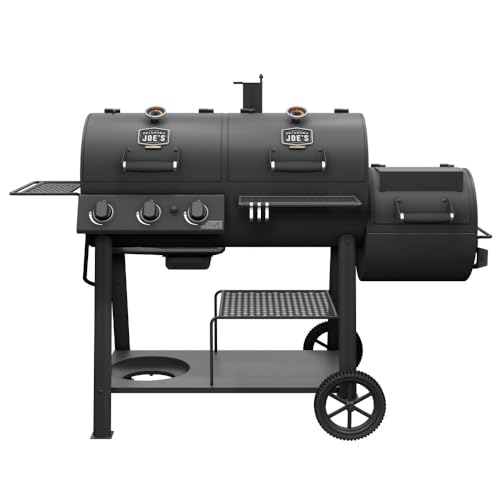
1. Oklahoma Joe’s Canyon Combo Dual Fuel Smoker and Grill — Best Overall
Put the Canyon first if charcoal is your first language and gas is your concession to the calendar. Oklahoma Joe’s builds the charcoal side like a small pit — heavy steel, real airflow, room to work — and then gives the gas side three burners instead of the category’s usual two, so neither half feels like the apology. It is the most complete gas-charcoal combination we verified.
Strengths
- Charcoal chamber with genuine smoking manners
- Three-burner gas side for proper zone cooking
- Heavy construction that shrugs off weather and years
Trade-offs
- A large, heavy machine — it chooses its spot once
- Overkill for couples who grill small twice a week
- Premium tier within the combination category
| Gas side | 3 burners |
| Total area | 1,031 sq. in. (listing figure) |
| Fuels | Propane gas and charcoal |
| Style | Dual fuel smoker and grill (listing) |
Combination grills are usually designed by gas-grill companies that bolt on a charcoal box. The Canyon reads the other way: a barbecue maker’s machine that happens to include an excellent gas grill. The difference shows in the charcoal cook — ribs and chicken thighs take smoke evenly, the fire responds to the dampers, and the whole chamber feels like equipment rather than packaging.
The gas side, meanwhile, is nobody’s afterthought: three burners give you the hot-middle, gentle-edge layout that makes weeknight cooking calm. Add the two together and you have the rare combination that satisfies a purist and a pragmatist sharing one patio — which, in most households, is exactly the marriage being negotiated.
Best for: charcoal-first families who need gas speed on weekdays / Not suited for: small patios, balconies, or minimalists
Check on Amazon to see the current configuration and delivery options for the Oklahoma Joe’s Canyon Combo Dual Fuel Smoker and Grill.

2. Char-Griller Dual-Function Combination Grill and Smoker, Model E5030 — Best Value Dual Fuel
The E5030 is the combination for households that split their cooking evenly and their budget carefully. Neither chamber is the biggest here, but both are honestly sized, the charcoal side adjusts and ashes like a Char-Griller should, and the gas side’s two burners cover the weeknight repertoire without fuss. It is the dual-fuel sweet spot.
Strengths
- Even balance between the two chambers
- 870 sq. in. total — family-sized without patio domination
- Deep parts and accessory support from a dual-fuel specialist
Trade-offs
- Two gas burners mean simpler zones than three-burner rivals
- Big gatherings will run both fires to keep up
- Steel is honest, not heavy — cover it and it lasts
| Gas side | 2 burners, 24,000 BTUs (listing figure) |
| Total area | 870 sq. in. (listing figure) |
| Fuels | Propane gas and charcoal |
| Model | E5030 |
There is a reason this layout is the one imitators copy: it is the smallest machine that still feels like two full grills. The charcoal side gets the details right — an adjustable fire, a grate with presence, ash handling that does not require disassembly — and the gas side lights, sears and simmers like the only grill many families would ever need.
Value here is not about being cheapest; it is about nothing wasted. You are not paying for a firebox you will not tend or a fifth burner you will not light, and you are not saving money on steel so thin it oil-cans by August. Among the best combination gas charcoal grills, the E5030 is the one we would hand to a sibling with a clear conscience.
Best for: families splitting cooking evenly between fuels / Not suited for: offset-smoking hobbyists or banquet-scale hosts
Check on Amazon to see the current configuration and delivery options for the Char-Griller Dual-Function Combination Grill and Smoker, Model E5030.

3. Grills House ZH3005Y Gas and Charcoal Combo Grill — Best with Side Burner
The ZH3005Y’s argument is completeness per dollar: two gas burners plus a side burner for the beans, a charcoal chamber beside them, and a listed total of 1,020 square inches that rivals machines a tier up. The porcelain-enameled finish also gives it a tidier, more weather-tolerant skin than bare painted steel at this level.
Strengths
- Side burner included — sauces and sides without the kitchen
- Large listed cooking area for the tier
- Porcelain-enameled finish resists weather better than paint
Trade-offs
- Lesser-known brand — check parts availability in your region
- Assembly and manual quality trail the big names
- Charcoal fire control is capable, not refined
| Gas side | 2 burners + side burner |
| Output | 34,000 BTUs (listing figure) |
| Total area | 1,020 sq. in. (listing figure) |
| Finish | Porcelain-enameled (listing) |
Side burners are the most skipped and most missed feature in this category. The first time you need to hold a sauce, boil corn or keep beans at a simmer while both chambers are full, the ZH3005Y’s little third flame justifies the whole design. Combined with the big listed area, it cooks like a machine planned by someone who actually hosts.
The brand caveat is real and manageable: confirm that grates, burners and igniters are orderable before you buy, and keep the manual. Do that homework and this is the combination that gives a value shopper the fewest ‘if only it had’ moments — a complete dual-fuel station, side burner and all.
Best for: hosts who cook full menus outdoors on a budget / Not suited for: buyers who need a big-brand dealer network behind them
Check on Amazon to see the current configuration and delivery options for the Grills House ZH3005Y Gas and Charcoal Combo Grill.
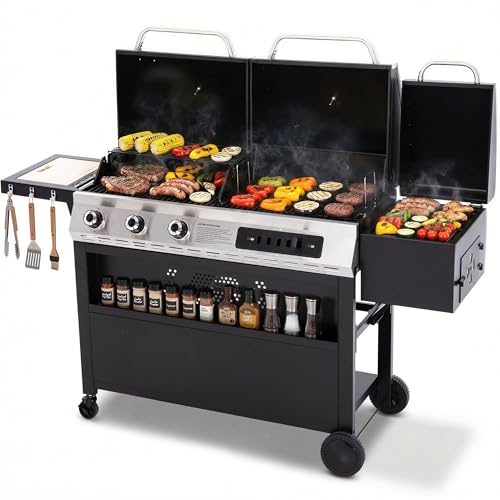
4. Sophia & William Gas and Charcoal Grill Combo with Offset Smoker — Best for Offset Smoking
This combo adds the piece most dual-fuels omit: an offset smoker, so the charcoal side can run indirect with the fire in its own box. With three gas burners for the week and 840 listed square inches overall, it is aimed squarely at the barbecue hobbyist who still has a job, a family and a Tuesday.
Strengths
- Offset smoker enables true indirect barbecue
- Three-burner gas side matches the class leaders
- Heavy-duty positioning at a mid-tier price point
Trade-offs
- Offset smoking demands tending and leaks some heat and smoke
- The widest ownership routine here: three zones to clean
- Brand support is thinner than Oklahoma Joe’s or Char-Griller
| Gas side | 3 burners |
| Total area | 840 sq. in. (listing figure) |
| Extras | Offset smoker (listing) |
| Fuels | Propane gas and charcoal |
Offset configuration is the difference between ‘charcoal grill that can smoke a little’ and ‘smoker that happens to share a frame with a gas grill’. The fire lives apart, the smoke travels across the food, and ribs and pork shoulders cook in the gentle current they want. On a combination machine that is a remarkable amount of barbecue authenticity.
Keep expectations calibrated: the seals and steel of a combo offset will never match a dedicated pit, so you will feed the fire more often and chase temperatures more actively. Many owners call that the fun. If you are one of them, this is the gas-charcoal combination that respects your hobby instead of tolerating it.
Best for: hobbyist smokers who also need weeknight gas / Not suited for: set-and-forget cooks or tiny patios
Check on Amazon to see the current configuration and delivery options for the Sophia & William Gas and Charcoal Grill Combo with Offset Smoker.

5. Royal Gourmet ZH3006Y Gas and Charcoal Grill Combo with Offset Smoker — Best Large Cooking Area
The ZH3006Y is the maximal Royal Gourmet formula — everything the ZH3002N does, plus an offset smoker, a side burner, a bottom storage shelf and a jump to 1,020 listed square inches. For a large household that wants the full dual-fuel repertoire without leaving the value tier, it is the most complete package in this guide.
Strengths
- Offset smoker and side burner both included
- 1,020 sq. in. listed area handles crowds
- Bottom shelf stores charcoal where you need it
Trade-offs
- Two gas burners only, despite the size
- Value-tier materials want a cover and gentle handling
- A big machine to assemble and to house
| Gas side | 2 burners + side burner |
| Output | 34,000 BTUs (listing figure) |
| Total area | 1,020 sq. in. (listing figure) |
| Extras | Offset smoker, bottom shelf (listing) |
Read the ZH3006Y as a checklist answered: dual fuel, yes; smoker, yes; side burner, yes; storage, yes; crowd capacity, yes. Royal Gourmet’s skill is bundling, and this is its fullest bundle in the category. The gas side’s two burners are the one modest note, but with a charcoal chamber and a smoker beside them, total firepower is rarely the problem at a real cookout.
The value-tier bargain applies as ever: thinner steel than the premium pair, a cover treated as mandatory, and a realistic expectation of strong seasons rather than decades. For a big family buying its first serious outdoor station, that trade buys a repertoire — grill, smoke, simmer, sear — that would cost far more assembled from dedicated machines.
Best for: large families wanting the full repertoire at a value tier / Not suited for: decade-horizon buyers or three-burner zone purists
Check on Amazon to see the current configuration and delivery options for the Royal Gourmet ZH3006Y Gas and Charcoal Grill Combo with Offset Smoker.

6. Nexgrill Dual Fuel 4-Burner Gas Grill with Griddle Insert — Best Gas-Forward Combo
Nexgrill’s take on dual fuel inverts the usual layout: instead of two chambers, you get a full four-burner gas grill — 626 listed square inches, side burner, built-in thermometer — whose dual-fuel character comes through its charcoal-ready configuration and griddle insert versatility. It suits the gas-first household that wants charcoal flavor on demand without surrendering half the machine to a chamber it uses monthly.
Strengths
- Four burners and the highest listed output here
- Side burner and griddle insert widen the menu
- One chamber to clean, season and cover
Trade-offs
- Not a true side-by-side — charcoal purists should look above
- 626 sq. in. is the smallest main area in this guide
- Griddle insert care adds a small routine
| Gas side | 4 burners + side burner |
| Output | 59,000 BTUs (listing figure) |
| Cooking space | 626 sq. in. (listing figure) |
| Extras | Griddle insert, built-in thermometer (listing) |
Include this Nexgrill as the honest alternative philosophy: most ‘dual-fuel’ households are really gas households with charcoal cravings. A big, capable gas grill that can host charcoal cooking when the craving strikes — and a griddle the rest of the month — matches that reality better than a second chamber gathering rust and wasps.
The numbers support the gas-first case: four burners for real zoning, the strongest listed output in the guide, and porcelain-coated cast-iron grates per the listing. If your charcoal cooking is a monthly steak ritual rather than a weekly practice, this is the combination that spends your money where your cooking actually happens.
Best for: gas-first households with occasional charcoal ambitions / Not suited for: true dual-chamber seekers or weekly charcoal cooks
Check on Amazon to see the current configuration and delivery options for the Nexgrill Dual Fuel 4-Burner Gas Grill with Griddle Insert.
Comparison Table
| Pick | Badge | Key spec | Best for |
|---|---|---|---|
| Oklahoma Joe’s Canyon Combo Dual Fuel Smoker and Grill | Best Overall | 3 burners | charcoal-first families who need gas speed on weekdays |
| Char-Griller Dual-Function Combination Grill and Smoker, Model E5030 | Best Value Dual Fuel | 2 burners, 24,000 BTUs (listing figure) | families splitting cooking evenly between fuels |
| Grills House ZH3005Y Gas and Charcoal Combo Grill | Best with Side Burner | 2 burners + side burner | hosts who cook full menus outdoors on a budget |
| Sophia & William Gas and Charcoal Grill Combo with Offset Smoker | Best for Offset Smoking | 3 burners | hobbyist smokers who also need weeknight gas |
| Royal Gourmet ZH3006Y Gas and Charcoal Grill Combo with Offset Smoker | Best Large Cooking Area | 2 burners + side burner | large families wanting the full repertoire at a value tier |
| Nexgrill Dual Fuel 4-Burner Gas Grill with Griddle Insert | Best Gas-Forward Combo | 4 burners + side burner | gas-first households with occasional charcoal ambitions |
Read the table as a map, not a ranking. The right row is the one whose key spec matches the way you actually cook — the most powerful grill in this list of best combination gas charcoal grills is the wrong buy if its fuel, footprint or cleaning routine fights your routine every single week.
Gas Side vs. Charcoal Side: How to Split Your Budget of Attention
In a combination grill, you are buying two grills that share legs. Decide which one you are really marrying. The gas side earns its keep on ignition reliability, burner quality and zone control — light it in February wind and it should still light. The charcoal side earns its keep on airflow, pan adjustment and ash handling, the unglamorous mechanics that separate a fire you conduct from a fire you endure.
A useful test when comparing models: imagine each chamber sold separately at half the machine’s price. Would you buy that gas grill? That charcoal grill? The combinations worth owning — every pick above — pass both halves of the test. The ones that fail always fail the same way, with one proud chamber and one apologetic tray.
Charcoal Pan Designs: Crank, Tray and Fixed Beds
How the charcoal bed adjusts is the charcoal side’s whole personality. Crank-adjustable pans raise the coals to searing distance or drop them for gentler cooking without moving food — the finest control, and a mechanism to keep clean and oiled. Multi-position trays offer two or three set heights: simpler, sturdier, nearly as useful. Fixed beds ask you to control heat with coal quantity and dampers alone, which works in practiced hands and frustrates beginners.
Ash handling is the other half of the design. A removable ash pan or drawer turns the worst chore into a ten-second slide; a scoop-it-yourself firebox turns it into the reason the charcoal side gets used less each year. When you compare the best combination gas charcoal grills, put ash handling beside burner counts in your notes — your future self is voting for the drawer.
How Many Gas Burners Does the Gas Side Need?
Two burners is the category’s standard and it is enough for a two-zone cook: hot side, gentle side. Three burners — as on the Canyon and the Sophia & William — add a true middle zone and make indirect cooking on gas genuinely comfortable, which matters on the nights the charcoal side is cold and the chicken is whole. Four burners, as on the Nexgrill, belong to a gas-first machine and behave like one.
Count zones, not BTUs. Total output figures bundle side burners and marketing optimism; what cooks your dinner is burner independence across the grate’s width. A well-zoned two-burner side will out-cook a sloppy three-burner side every weeknight of the year, and the reviews above call out which is which.
How to Choose the Best Combination Gas Charcoal Grills for Your Household
Begin with your true ratio. Cook charcoal weekly? Weight the chamber, the pan and the ash drawer — Canyon, E5030. Smoke monthly with intent? The offset models earn their width. Grill on gas six nights and dream in charcoal? The Nexgrill’s inversion is built for you. Then check the unglamorous trio: side burner if your menus simmer, storage if your patio is bare, and a cover that actually fits the machine’s full width.
End with the space itself. These are the widest grills a household buys; measure the patio, the gate and the storage corner, and leave room to stand at the side you will use most. A combination chosen with that honesty becomes the household’s single outdoor appliance — which is the entire promise of the category, kept.
How to Cook a Full Meal on a Combination Gas Charcoal Grill
The two-fire meal — charcoal-kissed mains, gas-managed everything else — is the combination grill’s signature performance. Here is a working sequence for a steakhouse dinner at home.
- Light the charcoal chimney 30 minutes out. Fill a chimney, light it and let the coals ash over completely. Charcoal sets the schedule; everything else in this plan is built backwards from the moment the coals are ready to pour.
- Arrange a two-level charcoal fire. Pour the coals to one side of the charcoal chamber for a searing zone over the coals and an indirect zone beside them. This single arrangement handles searing, finishing and resting without moving a single coal.
- Preheat the gas side for sides and insurance. Light the gas burners ten minutes before cooking. Vegetables, garlic bread and any pan work live here, and the lit gas side is your insurance policy if the charcoal fire misbehaves or a guest arrives ‘starving’.
- Sear on charcoal, finish on indirect. Give steaks and chops their crust directly over the coals, then slide them to the indirect zone, lid down, until a probe thermometer — not the clock — calls the temperature. Rest the meat under foil on the gas side’s warming space.
- Use the gas side to bring sides home. While the meat rests, finish vegetables on gas where a knob corrects in seconds, toast buns over the charcoal’s last heat, and hold sauces on the side burner if your model has one.
- Shut down like you mean it. Close the charcoal dampers to smother and save the coals, switch off gas at the burners and then at the tank, and leave ash removal for tomorrow when everything is stone cold. A combination grill rewards a tidy shutdown with an easy next lighting.
Charcoal on the clock’s terms, gas as the stage manager, a probe as the referee. Cook that sequence twice and it stops feeling like two grills — it feels like one kitchen that happens to live outside, which is precisely what you bought.
What Separates a Real Dual-Fuel Grill From a Gas Grill With a Tray?
The combination category has a impostor problem. Some machines sold as dual-fuel are honest gas grills with a charcoal tray that drops over the burners — a device that cooks with charcoal flavor the way a photograph cooks dinner. The tell is independence: in a real combination, each chamber has its own lid, its own fire and its own cooking session, and both can run at once. In the impostor, the charcoal experience borrows the gas grill’s body, cannot coincide with gas cooking, and usually cannot hold enough coal to sear two steaks and finish them too. Every pick in this guide is the real architecture; this section exists so you can audit any other model you meet.
Audit the charcoal side with four questions. Is there a dedicated chamber with its own lid? Does the fire have adjustable airflow — dampers that open and close with authority? Can the ash leave without disassembly? Is the grate a cooking grate, heavy enough to hold heat and mark food? Four yeses describe a charcoal grill. Two or fewer describe a garnish. Then audit the gas side the same way: independent burners with real valves, an ignition per burner or a reliable shared system, and grease management that ends in a removable tray rather than in the cabinet’s floor.
Why does the distinction matter enough for a full section? Because the disappointment pattern is identical every time: a buyer pays combination money, discovers the tray in month two, and concludes that combination grills are a gimmick — when in fact they bought a photograph of one. The best combination gas charcoal grills, the real ones, have kept households cooking both ways for a decade. The audit above is how you make sure your money lands on the architecture, not the adjective.
Two-Fuel Etiquette: Running a Combination Grill in a Real Household
A combination grill usually serves a household with divided loyalties — the charcoal romantic and the gas pragmatist sharing one patio and, often, one dinner. The machine works best when the household develops a small etiquette around it. Fuel stays stocked for both sides, because the fastest way to kill the charcoal habit is an empty bag on the night inspiration strikes. The cook who lights a side owns its shutdown — dampers closed, valves off, ash noted for tomorrow — so the next cook inherits a ready machine instead of a mystery.
Menus divide naturally once the habit forms. Weeknights default to gas, with the charcoal side reserved for the one item that justifies it — the steak, the skin-on chicken — lit in a small, hot bed rather than a full chamber. Weekends invert the ratio: charcoal leads, gas supports with sides, holding and the impatient child’s burger that cannot wait for coals. Parties use the machine’s true superpower, simultaneity, with each side running the menu it suits and the cook conducting rather than sprinting.
There is also a teaching dividend nobody advertises. A combination grill is where gas cooks learn fire and charcoal cooks learn precision, at the same address, often from each other. Teenagers start on the gas side’s forgiveness and graduate to the coals. Guests ask which side made the difference and a small friendly rivalry improves both cooks. Buy the machine for the food, by all means — but expect it to quietly reorganize the household’s cooking culture around both fires, which may be the most durable thing it produces.
The First Month With a Combination Grill: a Learning Curve Worth Taking
Week one belongs to the gas side, deliberately. It is the familiar half — light it, learn its hot spots with a round of toast or a sacrificial tray of vegetables, find where the thermometer lies and by how much. Cook two ordinary weeknight dinners and let the machine become boring on gas, because boring is what weeknights need. The charcoal side waits, and its waiting is part of the plan: anticipation makes the first charcoal cook an event rather than a chore wedged into a Tuesday.
Week two is the charcoal side’s debut, and it should be a forgiving menu — chicken thighs, sausages, vegetables — food that tolerates a learning fire. Build a two-zone bed, keep the probe thermometer in charge, and take the few notes that turn experience into knowledge: how much charcoal, how the dampers sat, how long the chamber held its temperature. Most new owners discover the charcoal side is more intuitive than feared and more responsive than the gas side is precise — a small conversion experience that explains the category’s loyal following.
By week four the combination should disappear as a concept. There is just the grill: gas for the school-night stir-fry components and the emergency burgers, charcoal for the Saturday steaks, both together for the first small gathering, where the simultaneity trick stops being a reviewer’s phrase and becomes the household’s party infrastructure. If the first month follows anything like this arc, you have bought one of the best combination gas charcoal grills for your life. If week four still finds one side cold and dusty, the honest month has told you something too — and the resale market for nearly-new combinations is kind to owners who admit it early.
Fuel Storage and Supply: the Unglamorous Half of Dual-Fuel Ownership
Every combination grill household eventually builds the same small infrastructure, and planning it at purchase time beats improvising it in the rain. Propane wants a ventilated, upright home — the grill’s own tank cabinet if it has one, never a sealed shed corner where a slow leak can pool. A second tank, swapped rather than refilled in rotation, ends the mid-cook empty-tank tragedy permanently and costs less than one ruined dinner party. Charcoal wants the opposite of ventilation drama: dry, sealed and near the grill, in a bin with a lid that actually closes, because damp charcoal is the number one cause of ‘the charcoal side doesn’t work’ complaints that are really storage complaints.
Add the small consumables to the same shelf and the system completes itself: a chimney starter and its newspaper or cubes, a spare igniter battery where the design uses one, the brush that fits the charcoal grate and the different brush that suits the gas side’s grates, and the cover, folded where it can be reached in the ten seconds before the sky opens. Owners picture the grill when they shop and the infrastructure never; then they live with both for a decade. The households that love their combination grills in year five are, disproportionately, the ones whose fuel lives dry, close and ready — because a dual-fuel machine is only as convenient as the least convenient of its two supplies.
Accessories That Complete a Combination Grill Station
The machine is the center, but a combination grill becomes a station with a short ring of supporting gear. A chimney starter sized to the charcoal chamber is non-negotiable — it is the tool that makes the charcoal side a weeknight possibility rather than a weekend ceremony. Beside it: a lidded charcoal bin and a tank gauge or spare tank on the gas side, so neither fuel ever surprises you. Two brushes, one for each grate type, kept apart and replaced on schedule. A side table or cart if your model’s shelves are spoken for, because two chambers generate twice the tray traffic of one grill and every tray needs a home that is not the ground.
The finishing touches are organizational: hooks for the tools at the grill, a mat under the charcoal side’s ash zone, and a small caddy that ferries sauces and thermometers in one trip from the kitchen. None of it is glamorous and all of it compounds — the difference between a combination grill that feels like a project and one that feels like a kitchen is almost entirely this ring of small, ready things. Buy the machine for its chambers; keep it for its station.
Common Buying Mistakes
Treating the charcoal side as a storage box. It happens constantly: the charcoal chamber becomes the home for tools and the cover, and then it is never a firebox again. Keep both chambers empty, clean and ready, or admit you bought the wrong grill and trade down to a great gas model.
Judging by combined BTU totals. Summing both chambers’ output produces a heroic number that cooks nothing — you will rarely, if ever, run every burner and a full coal bed at once. Judge each side’s figures separately, the way you will actually light them.
Forgetting the tank and the bag in the budget. A combination grill consumes propane and charcoal, plus a wide cover and usually a chimney starter. Buyers who spend to the last dollar on the machine itself end up feeding it badly. Hold back a little for fuel and the cover.
Letting one side’s neglect kill the frame. Ash corrosion on the charcoal side and grease fires on the gas side are the two assassins of combination grills, and both are prevented by minutes of routine. A combi does not need more care than any grill — it needs its care in two places.
Buying the widest model for the narrowest patio. Combination grills are wide, and their lids, shelves and your elbows need room beyond the tape measure’s number. If the fit is tight, the Captiva-class footprint in the sibling combi guide will serve you better than a flagship you cook beside sideways.
Final Recommendation
The Oklahoma Joe’s Canyon is our top combination: the charcoal side a barbecue cook respects and a three-burner gas side a weeknight cook loves. The Char-Griller E5030 remains the value benchmark, balanced and proven. Add the Grills House ZH3005Y if a side burner matters, the Sophia & William or Royal Gourmet ZH3006Y if offset smoking is the dream, and consider the Nexgrill’s gas-first inversion if your charcoal life is monthly rather than weekly.
All six keep the category’s promise in different proportions: one machine, both fires, no fuel debate at the point of purchase ever again. Choose your proportion honestly and the best combination gas charcoal grills will do what they have quietly done for thousands of households — end the argument by cooking both ways, beautifully.
Ready to decide? Start at the top of the shortlist — Oklahoma Joe’s Canyon Combo Dual Fuel Smoker and Grill, Char-Griller Dual-Function Combination Grill and Smoker, Model E5030 and Grills House ZH3005Y Gas and Charcoal Combo Grill cover the majority of buyers in this category — and check the current price on Amazon for the configuration you want.
Keep exploring the grills cluster: Best Combi Grills Best Combination Grills Best Coleman Grills Best Combination Of Grills For Outdoor Kitchen Best Color For Grills
Frequently Asked Questions
What is the difference between a combination grill and a combi grill?
In practice, very little — the terms overlap. We use ‘combination gas charcoal’ for true dual-fuel machines with a gas chamber and a charcoal chamber, while ‘combi’ in the sibling guide also embraces three-in-one models with griddles and fireboxes. If both fuels burn in dedicated chambers, it qualifies for this list.
Can a combination grill replace a smoker?
Models with an offset firebox can smoke genuinely — ribs, shoulders and chicken take real smoke flavor — but with more tending and temperature swing than a dedicated smoker. Chamber-only models can add smoke flavor with chips or a tube, yet they are grills first. Buy the combination for grilling both ways; treat smoking as a welcome talent, not the headline.
Which fuel is cheaper to run, gas or charcoal?
Propane from a refillable tank is generally the cheaper and always the more predictable fuel per cook; charcoal costs more per session and adds the chimney ritual. Most combination owners find the split lands naturally: gas for the many quick cooks, charcoal for the fewer, longer ones — which is also the cheapest way to run the machine.
How long do combination gas charcoal grills last?
With a cover and both routines kept — ash out, grease managed — the premium models here are decade machines and the value models strong multi-season machines. The charcoal side’s firebox is usually the first wear point, which is another argument for the ash habit.
Do I need a special cover for a combination grill?
You need a wide one, and it is worth buying the maker’s fitted cover or measuring carefully for a generic. These are the widest household grills made; a standard cover will ride up at the corners and funnel rain exactly where you least want it.
Can I convert the gas side to natural gas?
Most combination grills are propane-only designs, and conversion kits, where they exist, come from the manufacturer for specific models. If a natural gas line is central to your plan, confirm conversion support for the exact model before buying — do not assume it.


